Fundamentals Of Marketing
Green Marketing In India
Submitted To:
Asst. Prof. Nandish Upadhyay
S.R Luthra Institute Of Management
Submitted By:
Bhargav Gondaliya
Jigar Khokhar
What Is Green Marketing
 Green marketing refers to the process of selling products and/or services based
on their environmental benefits. Such a product or service may be
environmentally friendly in itself or produced in an environmentally friendly
way….
 Not containing toxic materials or Ozone depilating materials.
 Recyclable or produce from recyclable material.
 Not making use of excessive packaging.
 Being designed to be repairable and not throwaway.
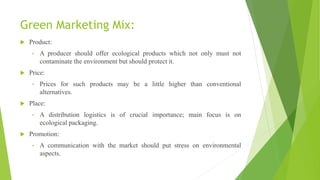
Green Marketing Mix:
 Product:
• A producer should offer ecological products which not only must not
contaminate the environment but should protect it.
 Price:
• Prices for such products may be a little higher than conventional
alternatives.
 Place:
• A distribution logistics is of crucial importance; main focus is on
ecological packaging.
 Promotion:
• A communication with the market should put stress on environmental
aspects.
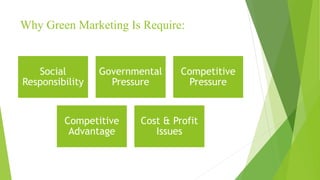
Why Green Marketing Is Require:
Social
Responsibility
Governmental
Pressure
Competitive
Pressure
Competitive
Advantage
Cost & Profit
Issues
Benefits Of Green Marketing:
 It ensures sustained long term growth along with profitability.
 It saves money in the long run, though initially the cost is more.
 It helps the companies market their products and services keeping the
environment aspects in mind
 It helps in accessing the new markets and enjoying the competitive advantage.
 Most of the employees also feel proud and responsible to be working for an
environmentally responsible company.
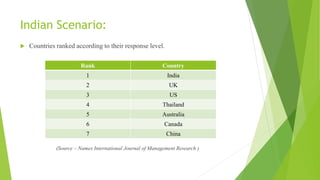
Indian Scenario:
 Countries ranked according to their response level.
(Source – Namex International Journal of Management Research )
Rank Country
1 India
2 UK
3 US
4 Thailand
5 Australia
6 Canada
7 China
 GREEN PRODUCT IN INDIA
 CNG
• New Delhi, capital of India, was being polluted at a very fast pace
until Supreme Court of India forced a change to alternative fuels. In 2002, a
directive was issued to completely adopt CNG in all public transport
systems to curb pollution.
 Wipro:
• Reducing greenhouse gas release
• Increasing use of renewable energy
 ITC
• Environmentally friendly multi-purpose paper that is less polluting was
introduced.
 IDEA Telecommunication:
• It came with “USE MOBILE, SAVE PAPER” campaign.
 Philips India:
• Energy saving lights, medical equipment and home appliances
 Samsung mobile:
• W510 and F268 made from renewable material.
 Honda:
• Civik hybrid car
 IndusInd Bank:
• It opened the country’s first solar powered ATMs.
Challenges Of Green Marketing
1. New Concept:
it is still a new concept for the masses. The consumer needs to be educated and
made aware of the environmental threats. The new green movements need to
reach the masses and that will take a lot of time and effort.
2. Cost Factor:
Green marketing involves marketing of green products/services, green
technology, green power/energy for which a lot of money has to be spent on
R&D program for their development and subsequent promotional programs
which ultimately may lead to increased costs.
3. Sustainability
Initially the profits are very low since renewable and recyclable products and
green technologies are more expensive. Green marketing will be successful
only in long run
4. High Price Product:
Majority of the consumer are not willing to pay premium price for the green
products.
5. Need for Standardization
It is found that only 5% of the marketing messages from “Green” campaigns
are entirely true and there is a lack of standardization to authenticate these
claims.
GREEN MARKETING IN INDIA

GREEN MARKETING IN INDIA

  • 1.
    Fundamentals Of Marketing GreenMarketing In India Submitted To: Asst. Prof. Nandish Upadhyay S.R Luthra Institute Of Management Submitted By: Bhargav Gondaliya Jigar Khokhar
  • 2.
    What Is GreenMarketing  Green marketing refers to the process of selling products and/or services based on their environmental benefits. Such a product or service may be environmentally friendly in itself or produced in an environmentally friendly way….  Not containing toxic materials or Ozone depilating materials.  Recyclable or produce from recyclable material.  Not making use of excessive packaging.  Being designed to be repairable and not throwaway.
  • 3.
    Green Marketing Mix: Product: • A producer should offer ecological products which not only must not contaminate the environment but should protect it.  Price: • Prices for such products may be a little higher than conventional alternatives.  Place: • A distribution logistics is of crucial importance; main focus is on ecological packaging.  Promotion: • A communication with the market should put stress on environmental aspects.
  • 4.
    Why Green MarketingIs Require: Social Responsibility Governmental Pressure Competitive Pressure Competitive Advantage Cost & Profit Issues
  • 5.
    Benefits Of GreenMarketing:  It ensures sustained long term growth along with profitability.  It saves money in the long run, though initially the cost is more.  It helps the companies market their products and services keeping the environment aspects in mind  It helps in accessing the new markets and enjoying the competitive advantage.  Most of the employees also feel proud and responsible to be working for an environmentally responsible company.
  • 6.
    Indian Scenario:  Countriesranked according to their response level. (Source – Namex International Journal of Management Research ) Rank Country 1 India 2 UK 3 US 4 Thailand 5 Australia 6 Canada 7 China
  • 7.
     GREEN PRODUCTIN INDIA  CNG • New Delhi, capital of India, was being polluted at a very fast pace until Supreme Court of India forced a change to alternative fuels. In 2002, a directive was issued to completely adopt CNG in all public transport systems to curb pollution.  Wipro: • Reducing greenhouse gas release • Increasing use of renewable energy  ITC • Environmentally friendly multi-purpose paper that is less polluting was introduced.  IDEA Telecommunication: • It came with “USE MOBILE, SAVE PAPER” campaign.
  • 8.
     Philips India: •Energy saving lights, medical equipment and home appliances  Samsung mobile: • W510 and F268 made from renewable material.  Honda: • Civik hybrid car  IndusInd Bank: • It opened the country’s first solar powered ATMs.
  • 9.
    Challenges Of GreenMarketing 1. New Concept: it is still a new concept for the masses. The consumer needs to be educated and made aware of the environmental threats. The new green movements need to reach the masses and that will take a lot of time and effort. 2. Cost Factor: Green marketing involves marketing of green products/services, green technology, green power/energy for which a lot of money has to be spent on R&D program for their development and subsequent promotional programs which ultimately may lead to increased costs. 3. Sustainability Initially the profits are very low since renewable and recyclable products and green technologies are more expensive. Green marketing will be successful only in long run
  • 10.
    4. High PriceProduct: Majority of the consumer are not willing to pay premium price for the green products. 5. Need for Standardization It is found that only 5% of the marketing messages from “Green” campaigns are entirely true and there is a lack of standardization to authenticate these claims.