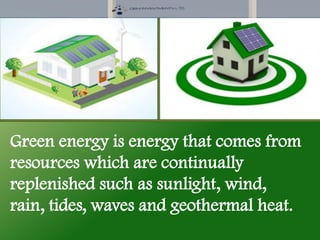
Green energy is energy that comes from
resources which are continually
replenished such as sunlight, wind,
rain, tides, waves and geothermal heat.
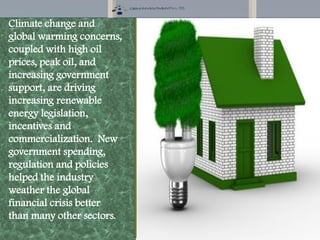
Climate change and
global warming concerns,
coupled with high oil
prices, peak oil, and
increasing government
support, are driving
increasing renewable
energy legislation,
incentives and
commercialization. New
government spending,
regulation and policies
helped the industry
weather the global
financial crisis better
than many other sectors.
They are a variety of green household appliances & services
available in the market mainly solar wind systems and solar
powered products. They are built with strong production capacity
with strict quality control. Dedicated R&D engineering teams work
on the manufacturing process & produce innovative and
competitive continually. Some of the most common green energy
alternate household appliances available are below.
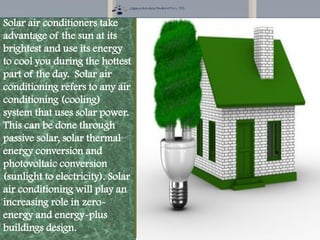
Solar air conditioners take
advantage of the sun at its
brightest and use its energy
to cool you during the hottest
part of the day. Solar air
conditioning refers to any air
conditioning (cooling)
system that uses solar power.
This can be done through
passive solar, solar thermal
energy conversion and
photovoltaic conversion
(sunlight to electricity). Solar
air conditioning will play an
increasing role in zero-
energy and energy-plus
buildings design.
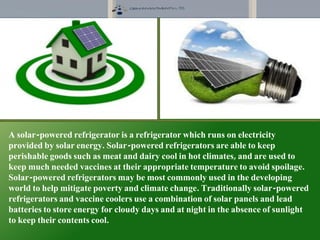
A solar-powered refrigerator is a refrigerator which runs on electricity
provided by solar energy. Solar-powered refrigerators are able to keep
perishable goods such as meat and dairy cool in hot climates, and are used to
keep much needed vaccines at their appropriate temperature to avoid spoilage.
Solar-powered refrigerators may be most commonly used in the developing
world to help mitigate poverty and climate change. Traditionally solar-powered
refrigerators and vaccine coolers use a combination of solar panels and lead
batteries to store energy for cloudy days and at night in the absence of sunlight
to keep their contents cool.
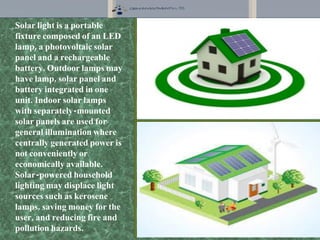
Solar light is a portable
fixture composed of an LED
lamp, a photovoltaic solar
panel and a rechargeable
battery. Outdoor lamps may
have lamp, solar panel and
battery integrated in one
unit. Indoor solar lamps
with separately-mounted
solar panels are used for
general illumination where
centrally generated power is
not conveniently or
economically available.
Solar-powered household
lighting may displace light
sources such as kerosene
lamps, saving money for the
user, and reducing fire and
pollution hazards.
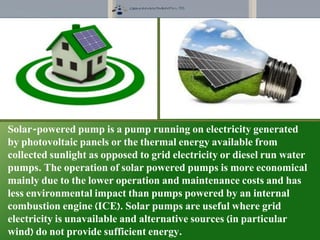
Solar-powered pump is a pump running on electricity generated
by photovoltaic panels or the thermal energy available from
collected sunlight as opposed to grid electricity or diesel run water
pumps. The operation of solar powered pumps is more economical
mainly due to the lower operation and maintenance costs and has
less environmental impact than pumps powered by an internal
combustion engine (ICE). Solar pumps are useful where grid
electricity is unavailable and alternative sources (in particular
wind) do not provide sufficient energy.
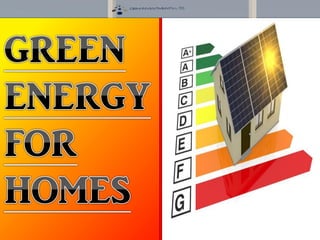
Green energy for homes

Green energy for homes

  • 2.
    Green energy isenergy that comes from resources which are continually replenished such as sunlight, wind, rain, tides, waves and geothermal heat.
  • 3.
    Climate change and globalwarming concerns, coupled with high oil prices, peak oil, and increasing government support, are driving increasing renewable energy legislation, incentives and commercialization. New government spending, regulation and policies helped the industry weather the global financial crisis better than many other sectors.
  • 4.
    They are avariety of green household appliances & services available in the market mainly solar wind systems and solar powered products. They are built with strong production capacity with strict quality control. Dedicated R&D engineering teams work on the manufacturing process & produce innovative and competitive continually. Some of the most common green energy alternate household appliances available are below.
  • 5.
    Solar air conditionerstake advantage of the sun at its brightest and use its energy to cool you during the hottest part of the day. Solar air conditioning refers to any air conditioning (cooling) system that uses solar power. This can be done through passive solar, solar thermal energy conversion and photovoltaic conversion (sunlight to electricity). Solar air conditioning will play an increasing role in zero- energy and energy-plus buildings design.
  • 6.
    A solar-powered refrigeratoris a refrigerator which runs on electricity provided by solar energy. Solar-powered refrigerators are able to keep perishable goods such as meat and dairy cool in hot climates, and are used to keep much needed vaccines at their appropriate temperature to avoid spoilage. Solar-powered refrigerators may be most commonly used in the developing world to help mitigate poverty and climate change. Traditionally solar-powered refrigerators and vaccine coolers use a combination of solar panels and lead batteries to store energy for cloudy days and at night in the absence of sunlight to keep their contents cool.
  • 7.
    Solar light isa portable fixture composed of an LED lamp, a photovoltaic solar panel and a rechargeable battery. Outdoor lamps may have lamp, solar panel and battery integrated in one unit. Indoor solar lamps with separately-mounted solar panels are used for general illumination where centrally generated power is not conveniently or economically available. Solar-powered household lighting may displace light sources such as kerosene lamps, saving money for the user, and reducing fire and pollution hazards.
  • 8.
    Solar-powered pump isa pump running on electricity generated by photovoltaic panels or the thermal energy available from collected sunlight as opposed to grid electricity or diesel run water pumps. The operation of solar powered pumps is more economical mainly due to the lower operation and maintenance costs and has less environmental impact than pumps powered by an internal combustion engine (ICE). Solar pumps are useful where grid electricity is unavailable and alternative sources (in particular wind) do not provide sufficient energy.