1
Contents
• Introduction
• What is Green Computing
• Why Go For Green Computing
• How Computing Harm Environment
• Road to Green Computing
• Approaches to Green Computing
• Simple Tasks to Go Green
• Industrial Implementation
• Conclusion
2
What is Green Computing?
 Green computing or green IT, refers to environmentally
sustainable computing or IT.
 It is “the study and practice of Designing, Manufacturing,
Using, and Disposing of computers, servers, and associated
subsystems efficiently and effectively with minimal or no
impact on the environment.”
 Green computing is the environmentally responsible and eco-
friendly use of computers and their resources.
3
Why Go For Green Computing
 Today, the main problem of the world is Global warming.
 The atmosphere is becoming hot & is causing many
problems to living organisms
 Tons of Electronic Waste
 Limited Resources
 Computers also play a major role in polluting the world.
4
How Computing Harm Environment
 Increase in power consumtion and space utilization
for data centres.
 2007-$4.5 billion of electricity
 2011-$7.4 billion of electricity( i.e. 25 power plants)
it will double the CO2 output ( 62 million metric
tons) by electronic appliances.
 Desktop requires 85 watts just in idle Mode.
 Left on 24 hrs/day-1,500 pounds of CO2 per year.
 A tree absorbs between 3 to 15 pounds of CO2 each
year. (up to 500 trees)
5
How Computing Harm Environment
 According to reports from the German Federal
Environment Office, devices consume around 17
billion (kWh) in a year in standby mode.
 The CO2 dissipated from ‘sleeping’ devices = 1/7th the
CO2 emitted by an automobile.
 Manufacturers do not provide a proper shut-off button
in devices.
 Windows Vista’s default shut down mode is a deep
sleep mode that requires power.
6
 Hazardous materials present inside computers.
 These are:
 Lead (disrupt brain neurotransmitters)
 Mercury (neurological damage)
 Cadmium (damage your kidneys)
7
How Computing Harm Environment
Chemical Elements Used: Lead
 Used in soldering of printed circuit boards and other
components
 Also used in glass for CRTs
 It is estimated that between 1997 and 2004, 1.2 billion
tons of lead was used in computer components
 The problem:
 Lead can cause damage to the central and peripheral
nervous systems, blood system, kidneys, endocrine
system and cause negative effects on child brain
development.
 Lead accumulates in the environment and has toxic
effects on plants, animals and microorganisms.
Chemical Elements Used: Mercury
 Mercury is used in
 Batteries, switches, housing, printed circuit boards
 Mercury is found in medical equipment, data
transmission equipment, telecommunications
equipment and cell phones as well
 If is estimated that 22% of the yearly use of mercury is
in electrical and electronic equipment
 The problem
 Mercury spreads out in water transforming into
Methylmercury which easily accumulates in living
organisms.
 Methylmercury can cause chronic brain damage.
Chemical Elements Used: Cadmium
 Cadmium is used in resistors for chips, infrared detectors
and in semiconductors (like: older CRTs)
 Estimated that between 1997 and 2004, 2 million
pounds of cadmium was used in computer components
 The problem:
 Cadmium is classified as toxic, these compounds
accumulate in the human body, particularly the
kidneys
 Cadmium is absorbed through respiration.
 Cadmium has a half life of 30 years so that cadmium
can poison a human body slowly through out the
human’s life.
Road to Green Computing
 Green Use
 Green Disposal
 Green Design
 Green Manufacturing
11
Green Manufacturing
 Bamboo : is becoming increasingly popular for making casings for
computers and peripherals.
 Recyclable plastics : Computers are constructed from recyclable plastics
i.e. recyclable polycarbonate resin.
 Eco-friendly flame retardant : There are flame retardant silicone
compounds available that are flame retardant and completely non-toxic.
 Inventory management : Reducing the quantity of both hazardous
materials used in the process and the amount of excess raw materials.
 Volume reduction : Removes hazardous portion of waste from non
hazardous portion.
12
Green Products
13
Approaches to Green Computing
 Virtualization
 Power Management
 Storage
14
Approaches to Green Computing
Virtualization:
It includes Server virtualization, Desktop
virtualization & Storage consolidation.
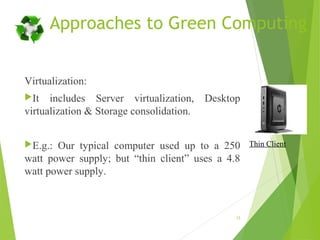
E.g.: Our typical computer used up to a 250
watt power supply; but “thin client” uses a 4.8
watt power supply.
15
Thin Client
Approaches to Green Computing
Power management:
Prolong battery life.
Reduce cooling requirements.
Reduce operating costs for energy and cooling.
Lower power consumption.
Following the ACPI (Advanced Configuration and Power
Interface), an open industry standard.
16
IT Equipment Recycling:
 If you can extend the working life of your IT
products, you reduce the environmental
consequences of mining, manufacture, packaging,
shipping and disposal.
 Many organizations, including some
manufacturers themselves, are willing to take
equipment back and recycle the components into
new products.
17
Approaches to Green Computing
Product Longevity:
Gartner, Inc. research result says that the PC
manufacturing process accounts for 70 % of the
natural resources used in the life cycle of a PC.
 Another report from Gartner, Inc. recommends
us to go for upgradability and modularity instead
of buying new PCs or subsystems.
18
Operating System Support:
Windows 7 includes refinements for more efficient use
of operating system by providing timers, processor
power management, and display panel brightness
facilities.
Linux Os utilizing less resources than other Os, and
also have a better power management facility.
Terminal servers:
Terminals can be combined with thin clients, which
use up to 1/8 the amount of energy of a normal
workstation.
19
Approaches to Green Computing
Algorithmic efficiency:
The Efficiency of algorithms can be described by
the amount of Resources it consumes.
Algorithms are the base of any computing system
or electronic device, each and every computer chip
has a certain algorithm that allows it to complete
its function.
Even though these chips are small, they use a lot
of power.
20
Approaches to Green Computing
Simple Tasks to Go Green
Some Basic Steps:
 Buy and use a low power desktop or a laptop
computer (40-90 watts) rather a higher power desktop
(e.g. 300 watts).
 Thin clients can use only 4 to 8 watts of power at the
desktop as the processing is done by a server.
 Buy hardware from manufacturers that have a
hardware recycling scheme, and recycle your old
computer equipment rather than sending it to landfill.
21
Simple Tasks to Go Green
 Turn your computer and monitor off when you
are not using it.
 Enable hibernation using the power
management settings. Standby does not save as
much power.
 Replace your CRT screen with an LCD screen.
 Save Your Paper! Use e-documents more
frequently.
22
Industrial Implementation
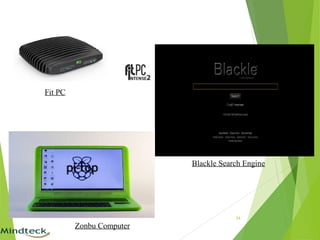
 Blackle (Uses: 59 watt): Search Engine powered by Google. Black Google
Would Save 750 Megawatt-hours a Year.
 Fit-PC (compact, quiet and green): It is a range of state-of-the-art miniature fan
less PCs that are extremely small, very low power and have more features than
any other PC in their category. Power Consumption: 6W.
 Zonbu Computer (Power: 20W): Zonbu's hybrid OS combines a robust, yet
easy-to-use, linux-based desktop environment with a complementary suite of
cloud-based services including:
 remote access from any browser
 data synchronization and automatic backups
 online storage that grows with you
 the ability to edit and share documents and files on the fly.
 Consumes one third of the power of a typical light bulb.
23
24
Blackle Search Engine
Fit PC
Zonbu Computer
Special Fact about Blackle
 Take at look at Google, who gets about 200 million queries a day.
 Let's assume each query is displayed for about 10 seconds; that
means Google is running for about 550,000 hours every day on
some desktops.
 Assuming that users run Blackle in full screen mode, the shift to a
black background [on a CRT monitor!] will save a total of 15 (74-
59) watts.
 That turns into a global savings of 8.3 Megawatt-hours per day, or
about 3000 Megawatt-hours a year.
 Now take into account that about 25 percent of the monitors in the
world are CRTs, and at 10 cents a kilowatt-hour, that's $75,000, a
goodly amount of energy and dollars for changing a few color
codes.
25
VS
Conclusion
 Green computing is not about going out and
designing biodegradable packaging for products.
 Now the time has come to think about the
efficiently use computers and the resources which
are non renewable.
 It opens a new window for the new entrepreneur
for harvesting with E-Waste materials and scrap
computers.
 The greenest computer will not miraculously fall
from the sky one day, it’ll be the product of year
of improvements.
 The beauty of pursuing a green IT/ Computing
strategy is its multifaceted benefits.
26
27
28

GreenComputing_15thFeb16_Siddharth_latest

  • 1.
  • 2.
    Contents • Introduction • Whatis Green Computing • Why Go For Green Computing • How Computing Harm Environment • Road to Green Computing • Approaches to Green Computing • Simple Tasks to Go Green • Industrial Implementation • Conclusion 2
  • 3.
    What is GreenComputing?  Green computing or green IT, refers to environmentally sustainable computing or IT.  It is “the study and practice of Designing, Manufacturing, Using, and Disposing of computers, servers, and associated subsystems efficiently and effectively with minimal or no impact on the environment.”  Green computing is the environmentally responsible and eco- friendly use of computers and their resources. 3
  • 4.
    Why Go ForGreen Computing  Today, the main problem of the world is Global warming.  The atmosphere is becoming hot & is causing many problems to living organisms  Tons of Electronic Waste  Limited Resources  Computers also play a major role in polluting the world. 4
  • 5.
    How Computing HarmEnvironment  Increase in power consumtion and space utilization for data centres.  2007-$4.5 billion of electricity  2011-$7.4 billion of electricity( i.e. 25 power plants) it will double the CO2 output ( 62 million metric tons) by electronic appliances.  Desktop requires 85 watts just in idle Mode.  Left on 24 hrs/day-1,500 pounds of CO2 per year.  A tree absorbs between 3 to 15 pounds of CO2 each year. (up to 500 trees) 5
  • 6.
    How Computing HarmEnvironment  According to reports from the German Federal Environment Office, devices consume around 17 billion (kWh) in a year in standby mode.  The CO2 dissipated from ‘sleeping’ devices = 1/7th the CO2 emitted by an automobile.  Manufacturers do not provide a proper shut-off button in devices.  Windows Vista’s default shut down mode is a deep sleep mode that requires power. 6
  • 7.
     Hazardous materialspresent inside computers.  These are:  Lead (disrupt brain neurotransmitters)  Mercury (neurological damage)  Cadmium (damage your kidneys) 7 How Computing Harm Environment
  • 8.
    Chemical Elements Used:Lead  Used in soldering of printed circuit boards and other components  Also used in glass for CRTs  It is estimated that between 1997 and 2004, 1.2 billion tons of lead was used in computer components  The problem:  Lead can cause damage to the central and peripheral nervous systems, blood system, kidneys, endocrine system and cause negative effects on child brain development.  Lead accumulates in the environment and has toxic effects on plants, animals and microorganisms.
  • 9.
    Chemical Elements Used:Mercury  Mercury is used in  Batteries, switches, housing, printed circuit boards  Mercury is found in medical equipment, data transmission equipment, telecommunications equipment and cell phones as well  If is estimated that 22% of the yearly use of mercury is in electrical and electronic equipment  The problem  Mercury spreads out in water transforming into Methylmercury which easily accumulates in living organisms.  Methylmercury can cause chronic brain damage.
  • 10.
    Chemical Elements Used:Cadmium  Cadmium is used in resistors for chips, infrared detectors and in semiconductors (like: older CRTs)  Estimated that between 1997 and 2004, 2 million pounds of cadmium was used in computer components  The problem:  Cadmium is classified as toxic, these compounds accumulate in the human body, particularly the kidneys  Cadmium is absorbed through respiration.  Cadmium has a half life of 30 years so that cadmium can poison a human body slowly through out the human’s life.
  • 11.
    Road to GreenComputing  Green Use  Green Disposal  Green Design  Green Manufacturing 11
  • 12.
    Green Manufacturing  Bamboo: is becoming increasingly popular for making casings for computers and peripherals.  Recyclable plastics : Computers are constructed from recyclable plastics i.e. recyclable polycarbonate resin.  Eco-friendly flame retardant : There are flame retardant silicone compounds available that are flame retardant and completely non-toxic.  Inventory management : Reducing the quantity of both hazardous materials used in the process and the amount of excess raw materials.  Volume reduction : Removes hazardous portion of waste from non hazardous portion. 12
  • 13.
  • 14.
    Approaches to GreenComputing  Virtualization  Power Management  Storage 14
  • 15.
    Approaches to GreenComputing Virtualization: It includes Server virtualization, Desktop virtualization & Storage consolidation. E.g.: Our typical computer used up to a 250 watt power supply; but “thin client” uses a 4.8 watt power supply. 15 Thin Client
  • 16.
    Approaches to GreenComputing Power management: Prolong battery life. Reduce cooling requirements. Reduce operating costs for energy and cooling. Lower power consumption. Following the ACPI (Advanced Configuration and Power Interface), an open industry standard. 16
  • 17.
    IT Equipment Recycling: If you can extend the working life of your IT products, you reduce the environmental consequences of mining, manufacture, packaging, shipping and disposal.  Many organizations, including some manufacturers themselves, are willing to take equipment back and recycle the components into new products. 17 Approaches to Green Computing
  • 18.
    Approaches to GreenComputing Product Longevity: Gartner, Inc. research result says that the PC manufacturing process accounts for 70 % of the natural resources used in the life cycle of a PC.  Another report from Gartner, Inc. recommends us to go for upgradability and modularity instead of buying new PCs or subsystems. 18
  • 19.
    Operating System Support: Windows7 includes refinements for more efficient use of operating system by providing timers, processor power management, and display panel brightness facilities. Linux Os utilizing less resources than other Os, and also have a better power management facility. Terminal servers: Terminals can be combined with thin clients, which use up to 1/8 the amount of energy of a normal workstation. 19 Approaches to Green Computing
  • 20.
    Algorithmic efficiency: The Efficiencyof algorithms can be described by the amount of Resources it consumes. Algorithms are the base of any computing system or electronic device, each and every computer chip has a certain algorithm that allows it to complete its function. Even though these chips are small, they use a lot of power. 20 Approaches to Green Computing
  • 21.
    Simple Tasks toGo Green Some Basic Steps:  Buy and use a low power desktop or a laptop computer (40-90 watts) rather a higher power desktop (e.g. 300 watts).  Thin clients can use only 4 to 8 watts of power at the desktop as the processing is done by a server.  Buy hardware from manufacturers that have a hardware recycling scheme, and recycle your old computer equipment rather than sending it to landfill. 21
  • 22.
    Simple Tasks toGo Green  Turn your computer and monitor off when you are not using it.  Enable hibernation using the power management settings. Standby does not save as much power.  Replace your CRT screen with an LCD screen.  Save Your Paper! Use e-documents more frequently. 22
  • 23.
    Industrial Implementation  Blackle(Uses: 59 watt): Search Engine powered by Google. Black Google Would Save 750 Megawatt-hours a Year.  Fit-PC (compact, quiet and green): It is a range of state-of-the-art miniature fan less PCs that are extremely small, very low power and have more features than any other PC in their category. Power Consumption: 6W.  Zonbu Computer (Power: 20W): Zonbu's hybrid OS combines a robust, yet easy-to-use, linux-based desktop environment with a complementary suite of cloud-based services including:  remote access from any browser  data synchronization and automatic backups  online storage that grows with you  the ability to edit and share documents and files on the fly.  Consumes one third of the power of a typical light bulb. 23
  • 24.
  • 25.
    Special Fact aboutBlackle  Take at look at Google, who gets about 200 million queries a day.  Let's assume each query is displayed for about 10 seconds; that means Google is running for about 550,000 hours every day on some desktops.  Assuming that users run Blackle in full screen mode, the shift to a black background [on a CRT monitor!] will save a total of 15 (74- 59) watts.  That turns into a global savings of 8.3 Megawatt-hours per day, or about 3000 Megawatt-hours a year.  Now take into account that about 25 percent of the monitors in the world are CRTs, and at 10 cents a kilowatt-hour, that's $75,000, a goodly amount of energy and dollars for changing a few color codes. 25 VS
  • 26.
    Conclusion  Green computingis not about going out and designing biodegradable packaging for products.  Now the time has come to think about the efficiently use computers and the resources which are non renewable.  It opens a new window for the new entrepreneur for harvesting with E-Waste materials and scrap computers.  The greenest computer will not miraculously fall from the sky one day, it’ll be the product of year of improvements.  The beauty of pursuing a green IT/ Computing strategy is its multifaceted benefits. 26
  • 27.
  • 28.