1. Green Manufacturing “Green manufacturing involves making manufactured products and the manufacturing process safer for the environment and human health” (Cha). What does this mean? Regarding ProductsThe use of less toxic or nontoxic materialsPost-consumer recycled content (containing materials that consumers have used and recycled)Locally sourced materials (ex. Stone and granite from local quarries rather than imported from around the globe)Products manufactured and used in renewable and energy efficient systems (ex. Gearboxes used in small-scale wind turbines)Regarding ProcessImproving operational energy efficiencyOnsite recycling Employee occupational health and safety
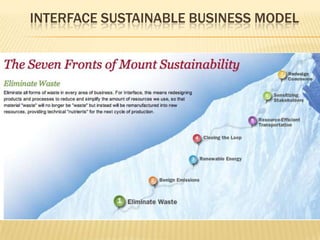
1. Green manufacturing (continued)Example:Interface (Global Carpeting Company)Vision: “To be the first company that, by its deeds, shows the entire industrial world what sustainability is in all its dimensions.” By 2020 the company hopes to have become restorative through the power of influence.Green Manufacturing in action (steps that Interface has taken)Use bio-based raw materials such as fibers made from PLA (Polylactic Acid) such as flax, hemp, and woolMore than 27% of Interface’s global energy consumption is derived from renewable sourcesSince 1995, the company has eliminated 50% of waste cost per unit, resulting in $372 million in avoided waste costs
Interface sustainable business model
2. Deconstruction“Deconstruction is the process of carefully dismantling and removing useable materials from structures for reuse, recycling, and waste management” (Cha). Advantages: Maximizes the recovery of valuable building materials for reuse and recyclingMinimizes the amount of waste destined for landfillsAlternative to demolition“A typical 13,300 square foot commercial demolition project generates over 155 pounds per square foot or over 2 million pounds of waste;2 building-related projects in the U.S. alone generate an estimated 164 million tons of construction and demolition (C&D) material every year. Approximately 40% of this material is reused, recycled, or sent to waste-to-energy facilities, while 60 percent is sent to C&D landfills” EPA Report: Beneficial Use of Secondary Materials – Construction and Demolition Materials
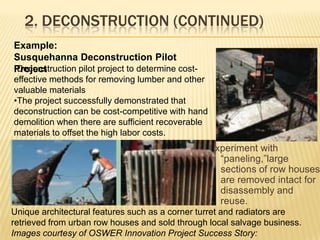
2. DECONSTRUCTION (CONTINUED)Example: Susquehanna Deconstruction Pilot ProjectDeconstruction pilot project to determine cost-effective methods for removing lumber and other valuable materials
The project successfully demonstrated that deconstruction can be cost-competitive with hand demolition when there are sufficient recoverable materials to offset the high labor costs.Experiment with “paneling,”large sections of row houses are removed intact for disassembly and reuse. Unique architectural features such as a corner turret and radiators are retrieved from urban row houses and sold through local salvage business. Images courtesy of OSWER Innovation Project Success Story: Deconstruction
3. Reuse“This subsector redistributes unwanted yet perfectly usable materials and equipment, including items from demolished structures” (Cha). AdvantagesKeeps goods and materials out of the waste streamAdvances source reductionPreserves the ‘embodied energy’ originally used to manufacture an itemCreates less air and water pollution than making a new product or recyclingSaves money in purchase and disposal costs
4. Recycling“Recycling is the collection, sorting, and reprocessing of used material into new raw materials” (Cha).

Green

  • 1.
    1. Green Manufacturing“Green manufacturing involves making manufactured products and the manufacturing process safer for the environment and human health” (Cha). What does this mean? Regarding ProductsThe use of less toxic or nontoxic materialsPost-consumer recycled content (containing materials that consumers have used and recycled)Locally sourced materials (ex. Stone and granite from local quarries rather than imported from around the globe)Products manufactured and used in renewable and energy efficient systems (ex. Gearboxes used in small-scale wind turbines)Regarding ProcessImproving operational energy efficiencyOnsite recycling Employee occupational health and safety
  • 2.
    1. Green manufacturing(continued)Example:Interface (Global Carpeting Company)Vision: “To be the first company that, by its deeds, shows the entire industrial world what sustainability is in all its dimensions.” By 2020 the company hopes to have become restorative through the power of influence.Green Manufacturing in action (steps that Interface has taken)Use bio-based raw materials such as fibers made from PLA (Polylactic Acid) such as flax, hemp, and woolMore than 27% of Interface’s global energy consumption is derived from renewable sourcesSince 1995, the company has eliminated 50% of waste cost per unit, resulting in $372 million in avoided waste costs
  • 3.
  • 4.
    2. Deconstruction“Deconstruction isthe process of carefully dismantling and removing useable materials from structures for reuse, recycling, and waste management” (Cha). Advantages: Maximizes the recovery of valuable building materials for reuse and recyclingMinimizes the amount of waste destined for landfillsAlternative to demolition“A typical 13,300 square foot commercial demolition project generates over 155 pounds per square foot or over 2 million pounds of waste;2 building-related projects in the U.S. alone generate an estimated 164 million tons of construction and demolition (C&D) material every year. Approximately 40% of this material is reused, recycled, or sent to waste-to-energy facilities, while 60 percent is sent to C&D landfills” EPA Report: Beneficial Use of Secondary Materials – Construction and Demolition Materials
  • 5.
    2. DECONSTRUCTION (CONTINUED)Example:Susquehanna Deconstruction Pilot ProjectDeconstruction pilot project to determine cost-effective methods for removing lumber and other valuable materials
  • 6.
    The project successfullydemonstrated that deconstruction can be cost-competitive with hand demolition when there are sufficient recoverable materials to offset the high labor costs.Experiment with “paneling,”large sections of row houses are removed intact for disassembly and reuse. Unique architectural features such as a corner turret and radiators are retrieved from urban row houses and sold through local salvage business. Images courtesy of OSWER Innovation Project Success Story: Deconstruction
  • 7.
    3. Reuse“This subsectorredistributes unwanted yet perfectly usable materials and equipment, including items from demolished structures” (Cha). AdvantagesKeeps goods and materials out of the waste streamAdvances source reductionPreserves the ‘embodied energy’ originally used to manufacture an itemCreates less air and water pollution than making a new product or recyclingSaves money in purchase and disposal costs
  • 8.
    4. Recycling“Recycling isthe collection, sorting, and reprocessing of used material into new raw materials” (Cha).