PLATO.
LIFE AND LEGACY
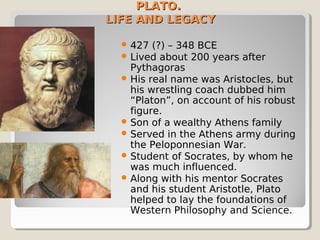
 427 (?) – 348 BCE
 Lived about 200 years

after

Pythagoras
 His real name was Aristocles, but
his wrestling coach dubbed him
“Platon”, on account of his robust
figure.
 Son of a wealthy Athens family
 Served in the Athens army during
the Peloponnesian War.
 Student of Socrates, by whom he
was much influenced.
 Along with his mentor Socrates
and his student Aristotle, Plato
helped to lay the foundations of
Western Philosophy and Science.
PLATO
THE ACADEMY
In

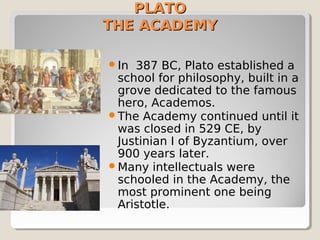
387 BC, Plato established a
school for philosophy, built in a
grove dedicated to the famous
hero, Academos.
The Academy continued until it
was closed in 529 CE, by
Justinian I of Byzantium, over
900 years later.
Many intellectuals were
schooled in the Academy, the
most prominent one being
Aristotle.
PLATO
THE DIALOGUES
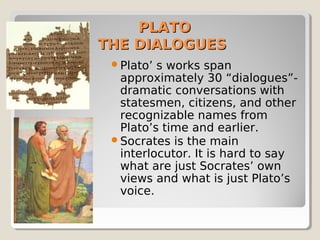
Plato’

s works span
approximately 30 “dialogues”dramatic conversations with
statesmen, citizens, and other
recognizable names from
Plato’s time and earlier.
Socrates is the main
interlocutor. It is hard to say
what are just Socrates’ own
views and what is just Plato’s
voice.
PLATO
MAIN THOUGHTS ON THE NATURE OF REALITY
Most

of Plato’s writings are
not about nature, but his
concepts of reality and
knowledge have had a
profound impact.
In his well-known dialogue,
The Republic, there is nicely
portrayed his overall view on
reality.
PLATO
MAIN THOUGHTS ON THE NATURE OF REALITY
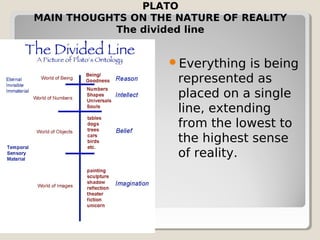
The divided line

Everything

is being
represented as
placed on a single
line, extending
from the lowest to
the highest sense
of reality.
PLATO
MAIN THOUGHTS ON THE NATURE OF REALITY
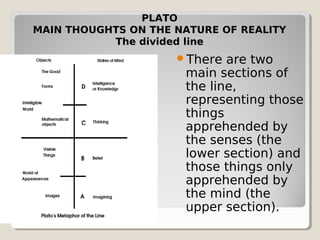
The divided line

There

are two
main sections of
the line,
representing those
things
apprehended by
the senses (the
lower section) and
those things only
apprehended by
the mind (the
upper section).
PLATO
MAIN THOUGHTS ON THE NATURE OF REALITY
The divided line

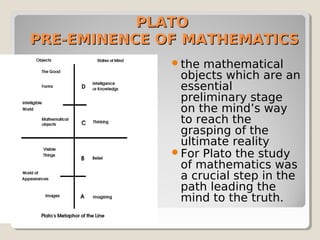
The

upper section
(the intelligible
world) is divided
again in the purest
form of reality (the
forms and the
Good – which is
the highest form)
and
PLATO
PRE-EMINENCE OF MATHEMATICS
the

mathematical
objects which are an
essential
preliminary stage
on the mind’s way
to reach the
grasping of the
ultimate reality
For Plato the study
of mathematics was
a crucial step in the
path leading the
mind to the truth.
PLATO
PRE-EMINENCE OF MATHEMATICS
Plato

had become
convinced that the road to
knowledge lay in exact
reasoning, as in
mathematics.
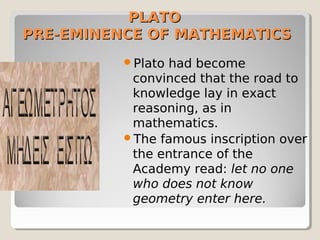
The famous inscription over
the entrance of the
Academy read: let no one
who does not know
geometry enter here.
PYTHAGORAS
582-520 BC

All is number
PYTHAGORAS
EARLY LIFE
Born

in Samos, Greece,
circa 582 BC
Was taught about early
Ionian, presocratic
philophers Thales,
Anaximander and
Anaximenes.
Was drawn away from
his land because of his
disgust for tyranny of
Polycrates.
pythagoreanism
Pythagoras,

after
leaving his homeland
settled in Crotone, a
Dorian Greek colony
in southern Italy.
There he founded his
own cult, the
pythagoreans.
It was based on
philosophical, political
and religious beliefs.
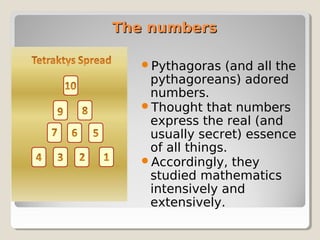
The numbers
Pythagoras

(and all the
pythagoreans) adored
numbers.
Thought that numbers
express the real (and
usually secret) essence
of all things.
Accordingly, they
studied mathematics
intensively and
extensively.
Pythagoras mathematical
discoveries
Discovered

the
existence of
irrational numbers
His famous
pythagorean
theorem
( a2+b2=c2)
The ratios of
musical intervals
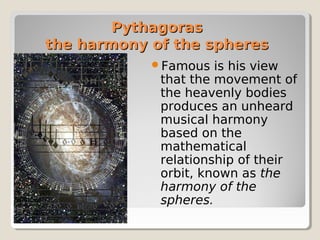
Pythagoras
the harmony of the spheres
Famous

is his view
that the movement of
the heavenly bodies
produces an unheard
musical harmony
based on the
mathematical
relationship of their
orbit, known as the
harmony of the
spheres.

Plato and mathematics

  • 1.
    PLATO. LIFE AND LEGACY 427 (?) – 348 BCE  Lived about 200 years after Pythagoras  His real name was Aristocles, but his wrestling coach dubbed him “Platon”, on account of his robust figure.  Son of a wealthy Athens family  Served in the Athens army during the Peloponnesian War.  Student of Socrates, by whom he was much influenced.  Along with his mentor Socrates and his student Aristotle, Plato helped to lay the foundations of Western Philosophy and Science.
  • 2.
    PLATO THE ACADEMY In 387 BC,Plato established a school for philosophy, built in a grove dedicated to the famous hero, Academos. The Academy continued until it was closed in 529 CE, by Justinian I of Byzantium, over 900 years later. Many intellectuals were schooled in the Academy, the most prominent one being Aristotle.
  • 3.
    PLATO THE DIALOGUES Plato’ s worksspan approximately 30 “dialogues”dramatic conversations with statesmen, citizens, and other recognizable names from Plato’s time and earlier. Socrates is the main interlocutor. It is hard to say what are just Socrates’ own views and what is just Plato’s voice.
  • 4.
    PLATO MAIN THOUGHTS ONTHE NATURE OF REALITY Most of Plato’s writings are not about nature, but his concepts of reality and knowledge have had a profound impact. In his well-known dialogue, The Republic, there is nicely portrayed his overall view on reality.
  • 5.
    PLATO MAIN THOUGHTS ONTHE NATURE OF REALITY The divided line Everything is being represented as placed on a single line, extending from the lowest to the highest sense of reality.
  • 6.
    PLATO MAIN THOUGHTS ONTHE NATURE OF REALITY The divided line There are two main sections of the line, representing those things apprehended by the senses (the lower section) and those things only apprehended by the mind (the upper section).
  • 7.
    PLATO MAIN THOUGHTS ONTHE NATURE OF REALITY The divided line The upper section (the intelligible world) is divided again in the purest form of reality (the forms and the Good – which is the highest form) and
  • 8.
    PLATO PRE-EMINENCE OF MATHEMATICS the mathematical objectswhich are an essential preliminary stage on the mind’s way to reach the grasping of the ultimate reality For Plato the study of mathematics was a crucial step in the path leading the mind to the truth.
  • 9.
    PLATO PRE-EMINENCE OF MATHEMATICS Plato hadbecome convinced that the road to knowledge lay in exact reasoning, as in mathematics. The famous inscription over the entrance of the Academy read: let no one who does not know geometry enter here.
  • 10.
  • 11.
    PYTHAGORAS EARLY LIFE Born in Samos,Greece, circa 582 BC Was taught about early Ionian, presocratic philophers Thales, Anaximander and Anaximenes. Was drawn away from his land because of his disgust for tyranny of Polycrates.
  • 12.
    pythagoreanism Pythagoras, after leaving his homeland settledin Crotone, a Dorian Greek colony in southern Italy. There he founded his own cult, the pythagoreans. It was based on philosophical, political and religious beliefs.
  • 13.
    The numbers Pythagoras (and allthe pythagoreans) adored numbers. Thought that numbers express the real (and usually secret) essence of all things. Accordingly, they studied mathematics intensively and extensively.
  • 14.
    Pythagoras mathematical discoveries Discovered the existence of irrationalnumbers His famous pythagorean theorem ( a2+b2=c2) The ratios of musical intervals
  • 15.
    Pythagoras the harmony ofthe spheres Famous is his view that the movement of the heavenly bodies produces an unheard musical harmony based on the mathematical relationship of their orbit, known as the harmony of the spheres.