Great Ape Language
GORILLAS, ORANGUTANS, CHIMPANZEES, BONOBOS, HUMANS
HTTP://ANIMALFACTS.NET/PRIMATES/164-BONOBOS
The ability to communicate via language is one of the
defining characteristics of human beings.
Researchers have shown that other great apes have the
ability to develop language skills. They have been taught
to communicate using sign language and lexigrams
(symbols that stand for words).
Non-human great apes can understand relatively complex
sentences. They can use language to talk about things
that are not present and to ask for things. They can
combine words that they already know to express different
concepts.
In the 1960s, Allen and Beatrix Gardner raised a
chimpanzee named Washoe and taught her American
Sign Language. She was able to learn over 300 words and
to combine them to create new meanings.
Between 1971 and 1976, Sue Savage-Rumbugh and
Duane Rumbaugh taught a chimpanzee named Lana
(after Language Analog Project - LANA) at the Yerkes
National Primate Research Center. Lana was taught to
communicate by using a keyboard with lexigrams. She was
able to ask questions and developed the ability to put
words in an order that made sense gramatically.
Later, Sue Savage-Rumbaugh taught two
chimpanzees named Sherman and Austin to use the
LANA keyboard. Sherman and Austin have used language
to communicate directly with one another and to make
plans together.
A one-year old gorilla named Koko began learning how to
use sign language in 1972. By the time she was 5 years
old, she knew over 200 signs. Koko was taught by Penny
Patterson, who would speak to her while signing at the
same time. This enabled Koko to understand spoken
English as well as she understood sign language.
As of 2012, Koko knows more than 1,000 signs and
understands about 2,000 spoken English words.
A gorilla named Michael, who lived with Koko for a while,
also developed significant signing ability.
An orangutan named Chantek, who was born in 1997, has
learned about 150 signs in American Sign Language.
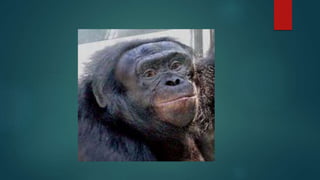
Kanzi, a bonobo, was the first non-human great ape to
acquire language skills spontaneously.
He was the adopted son of a bonobo named Matata. In
1981, when Kanzi was 9 months old, Sue Savage-
Rumbaugh tried to teach language to Matata, using
lexigrams.
Kanzi was left to play around in the lab because he was
thought to be too young for language training.
Amazingly, when Kanzi was separated from his mother
a short time, because she had been sent away for
breeding, Kanzi began using lexigrams on his own. He
went to the keyboard to try to communicate with
Rumbaugh, asking her for food and to help him find his
mother. On the first day of his separation from his
Kanzi went to the keyboard over 300 times.
Kanzi also showed an understanding of spoken English -
which Matata had never developed. Kanzi seemed to find
it easier to learn signs than his adoptive mother did.
When he was older, Kanzi was exposed to videos of Koko
using sign language and picked up some sign language
on his own.
Kanzi's younger half-sister, Panbanisha, also
spontaneously began to use lexigrams. She began using
the keyboard at an even younger age than Kanzi did. The
two bonobos use language to communicate with each
other.
Kanzi and Panbanisha also developed the ability to
manufacture stone tools.
http://www.bonobo.org/

Great Ape Language

  • 1.
    Great Ape Language GORILLAS,ORANGUTANS, CHIMPANZEES, BONOBOS, HUMANS HTTP://ANIMALFACTS.NET/PRIMATES/164-BONOBOS
  • 2.
    The ability tocommunicate via language is one of the defining characteristics of human beings. Researchers have shown that other great apes have the ability to develop language skills. They have been taught to communicate using sign language and lexigrams (symbols that stand for words). Non-human great apes can understand relatively complex sentences. They can use language to talk about things that are not present and to ask for things. They can combine words that they already know to express different concepts.
  • 3.
    In the 1960s,Allen and Beatrix Gardner raised a chimpanzee named Washoe and taught her American Sign Language. She was able to learn over 300 words and to combine them to create new meanings. Between 1971 and 1976, Sue Savage-Rumbugh and Duane Rumbaugh taught a chimpanzee named Lana (after Language Analog Project - LANA) at the Yerkes National Primate Research Center. Lana was taught to communicate by using a keyboard with lexigrams. She was able to ask questions and developed the ability to put words in an order that made sense gramatically. Later, Sue Savage-Rumbaugh taught two chimpanzees named Sherman and Austin to use the LANA keyboard. Sherman and Austin have used language to communicate directly with one another and to make plans together.
  • 4.
    A one-year oldgorilla named Koko began learning how to use sign language in 1972. By the time she was 5 years old, she knew over 200 signs. Koko was taught by Penny Patterson, who would speak to her while signing at the same time. This enabled Koko to understand spoken English as well as she understood sign language. As of 2012, Koko knows more than 1,000 signs and understands about 2,000 spoken English words. A gorilla named Michael, who lived with Koko for a while, also developed significant signing ability. An orangutan named Chantek, who was born in 1997, has learned about 150 signs in American Sign Language.
  • 5.
    Kanzi, a bonobo,was the first non-human great ape to acquire language skills spontaneously. He was the adopted son of a bonobo named Matata. In 1981, when Kanzi was 9 months old, Sue Savage- Rumbaugh tried to teach language to Matata, using lexigrams. Kanzi was left to play around in the lab because he was thought to be too young for language training. Amazingly, when Kanzi was separated from his mother a short time, because she had been sent away for breeding, Kanzi began using lexigrams on his own. He went to the keyboard to try to communicate with Rumbaugh, asking her for food and to help him find his mother. On the first day of his separation from his Kanzi went to the keyboard over 300 times.
  • 7.
    Kanzi also showedan understanding of spoken English - which Matata had never developed. Kanzi seemed to find it easier to learn signs than his adoptive mother did. When he was older, Kanzi was exposed to videos of Koko using sign language and picked up some sign language on his own. Kanzi's younger half-sister, Panbanisha, also spontaneously began to use lexigrams. She began using the keyboard at an even younger age than Kanzi did. The two bonobos use language to communicate with each other. Kanzi and Panbanisha also developed the ability to manufacture stone tools.
  • 8.