Name: Anushish
Agarwal
Class: 1A
Roll No:
• It is a fibrous material consisting of mixtures of cement,
concrete and uniformly distributed fibres (lending varying
properties) to increase structural integrity.
• The character of concrete changes with varying
concretes, fibre materials, geometries, distribution,
orientation, and densities.
USE OF FIBRES IN CONCRETE:
• Used to control shrinkage and cracking of concrete.
Provides shatter resistance and abrasion.
• Lower permeability of concrete to prevent bleeding of
water.
• Increases Tensile Strength and reduce air and water
voids.
THERMAL PROPERTIES:
• High melting point( around 165 degrees Celsius) with a
working temperature of 100 degrees Celsius.
• Constituent polypropylene fibres are hydrophobic and
can be easily mixed.
• Asbestos fibres have thermal resistance .
• Provides thermal insulation, therefore some times used
on facade barely.
BALLING OF FIBRES:
• The mix should have a uniform dispersion of the fibres in
order to prevent segregation or balling of the fibres during
mixing.
• Increase of aspect ratio, volume percentage of fibre, and
size and quantity of coarse aggregate will intensify the
balling tendencies .
The mechanical properties of FRC majorly depends on
type and percentage of fibre.
• Compressive Strength: Degree of bearable
compression. The presence of fibres doesn’t have large
effect on compressive strength values (0 to 15 percent).
• Modulus of Elasticity : It increases slightly with an
increase in the fibres content. ( 1 percent increase in fibre
content by volume increase modulus of elasticity by 3
percent).
• Flexure: The stress in a material just before it yields in a
flexure test. (Increase with fibre content i.e. increase by
2.5 times using 4 percent of fibres).
• Toughness: For FRC, toughness is about 10 to 40 times
that of plain concrete.
• Fibres with end anchorage (end strength) and high aspect
ratio were found to have improved effectiveness.
• For the same length and diameter, crimped-end fibres can
achieve the same properties as straight fibres using 40
percent less fibres.
Different Types Of Fibres In Concrete:
• It consists of many constituent fibres:
1.Steel Fibres : Straight, crimped, twisted, hooked, ringed,
and paddled ends. Diameter range from 0.25 to 0.76mm.
2. Glass Fibres: Straight. Diameter ranges from 0.005 to
0.015mm.
3. Polypropylene Fibres: Plain, twisted, fibrillated, and with
buttoned ends.
4.Other Synthetic Fibres : Kevlar, nylon, and polyester.
Diameter ranges from 0.02 to 0.38mm.
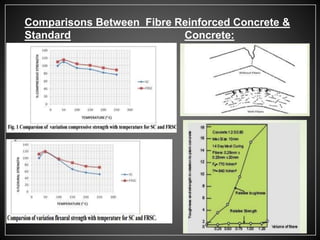
Comparisons Between Fibre Reinforced Concrete &
Standard Concrete:
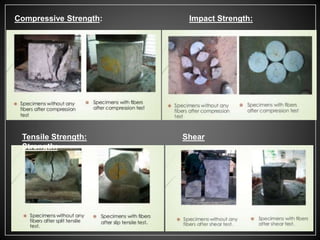
Compressive Strength: Impact Strength:
Tensile Strength: Shear
Strength:
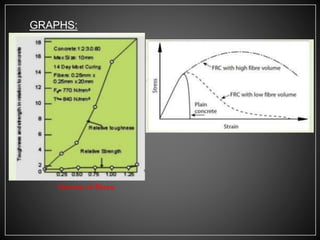
GRAPHS:
Volume of fibres
THANK YOU

Grc life cyle

  • 1.
  • 2.
    • It isa fibrous material consisting of mixtures of cement, concrete and uniformly distributed fibres (lending varying properties) to increase structural integrity. • The character of concrete changes with varying concretes, fibre materials, geometries, distribution, orientation, and densities. USE OF FIBRES IN CONCRETE: • Used to control shrinkage and cracking of concrete. Provides shatter resistance and abrasion. • Lower permeability of concrete to prevent bleeding of water. • Increases Tensile Strength and reduce air and water voids.
  • 3.
    THERMAL PROPERTIES: • Highmelting point( around 165 degrees Celsius) with a working temperature of 100 degrees Celsius. • Constituent polypropylene fibres are hydrophobic and can be easily mixed. • Asbestos fibres have thermal resistance . • Provides thermal insulation, therefore some times used on facade barely. BALLING OF FIBRES: • The mix should have a uniform dispersion of the fibres in order to prevent segregation or balling of the fibres during mixing. • Increase of aspect ratio, volume percentage of fibre, and size and quantity of coarse aggregate will intensify the balling tendencies .
  • 4.
    The mechanical propertiesof FRC majorly depends on type and percentage of fibre. • Compressive Strength: Degree of bearable compression. The presence of fibres doesn’t have large effect on compressive strength values (0 to 15 percent). • Modulus of Elasticity : It increases slightly with an increase in the fibres content. ( 1 percent increase in fibre content by volume increase modulus of elasticity by 3 percent). • Flexure: The stress in a material just before it yields in a flexure test. (Increase with fibre content i.e. increase by 2.5 times using 4 percent of fibres). • Toughness: For FRC, toughness is about 10 to 40 times that of plain concrete.
  • 5.
    • Fibres withend anchorage (end strength) and high aspect ratio were found to have improved effectiveness. • For the same length and diameter, crimped-end fibres can achieve the same properties as straight fibres using 40 percent less fibres. Different Types Of Fibres In Concrete: • It consists of many constituent fibres: 1.Steel Fibres : Straight, crimped, twisted, hooked, ringed, and paddled ends. Diameter range from 0.25 to 0.76mm. 2. Glass Fibres: Straight. Diameter ranges from 0.005 to 0.015mm. 3. Polypropylene Fibres: Plain, twisted, fibrillated, and with buttoned ends. 4.Other Synthetic Fibres : Kevlar, nylon, and polyester. Diameter ranges from 0.02 to 0.38mm.
  • 6.
    Comparisons Between FibreReinforced Concrete & Standard Concrete:
  • 7.
    Compressive Strength: ImpactStrength: Tensile Strength: Shear Strength:
  • 8.
  • 9.