Fields:
gravitational & electric
Learning outcomes
• describe uniform and radial electric and gravitational fields in
terms of force, field strength and potential, using equations,
graphs and the conventional line diagrams
• describe similarities and differences between electric and
gravitational fields
• solve quantitative problems involving gravitational and electric
fields, including orbits
Teaching challenges
Helping students to understand several ways of
describing fields (pictures, graphs, equations) and
developing their ability to ‘translate’ between each of
them.
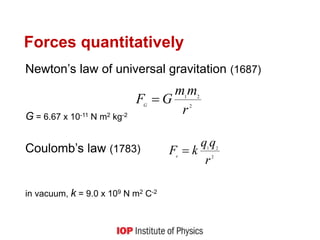
Forces quantitatively
Newton’s law of universal gravitation (1687)
G = 6.67 x 10⁻¹¹ N m2 kg-2
Coulomb’s law (1783)
in vacuum, k = 9.0 x 10⁹ N m2 C-2
2
21
r
mm
GFG

2
21
r
qq
kFe

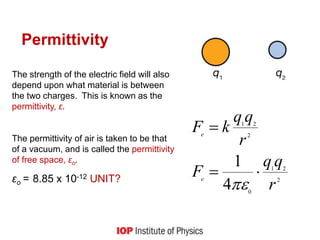
Permittivity
2
21
0
2
21
4
1
r
qq
F
r
qq
kF
e
e



The strength of the electric field will also
depend upon what material is between
the two charges. This is known as the
permittivity, ε.
The permittivity of air is taken to be that
of a vacuum, and is called the permittivity
of free space, εo.
εo = 8.85 x 10⁻¹² UNIT?
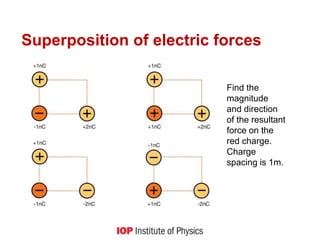
Superposition of electric forces
Find the
magnitude
and direction
of the resultant
force on the
red charge.
Charge
spacing is 1m.
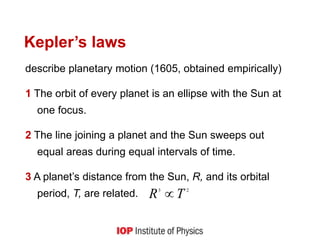
Kepler’s laws
describe planetary motion (1605, obtained empirically)
1 The orbit of every planet is an ellipse with the Sun at
one focus.
2 The line joining a planet and the Sun sweeps out
equal areas during equal intervals of time.
3 A planet’s distance from the Sun, R, and its orbital
period, T, are related. 23
TR 
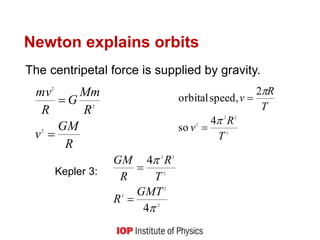
Newton explains orbits
The centripetal force is supplied by gravity.
R
GM
v
R
Mm
G
R
mv


2
2
2
2
22
2 4
so
2
speed,orbital
T
R
v
T
R
v




2
2
3
2
22
4
4


GMT
R
T
R
R
GM

Kepler 3:
Practice questions 1
• TAP Newton’s law of universal gravitation
Gravitational fields
used to explain (in some cases, control)
• everyday situations involving lifting & falling, floating & sinking,
including transport (ship, road, rail, hot air balloons, aviation)
• some machines in children’s playgrounds, adventure park
rides
• variation of g with latitude, altitude, anomalies associated with
mineral deposits, plate tectonics
• solar system mechanics – moons, planets, meteors, asteroids
• star formation, galaxies, Universe
• space launches, mission paths and orbits
Electric fields
used to explain (in some cases, control)
• natural phenomena such as thunderstorms, solar wind
• static electricity & antistatic devices & procedures
• electric circuits of many kinds
• computer processors and memory
• atomic structure, electrolysis
• industrial processes such as spray painting
• devices such as spark plugs and photocopiers
• particle accelerators
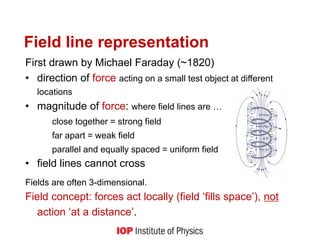
First drawn by Michael Faraday (~1820)
• direction of force acting on a small test object at different
locations
• magnitude of force: where field lines are …
close together = strong field
far apart = weak field
parallel and equally spaced = uniform field
• field lines cannot cross
Fields are often 3-dimensional.
Field concept: forces act locally (field ‘fills space’), not
action ‘at a distance’.
Field line representation
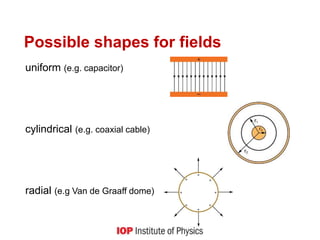
Possible shapes for fields
uniform (e.g. capacitor)
cylindrical (e.g. coaxial cable)
radial (e.g Van de Graaff dome)
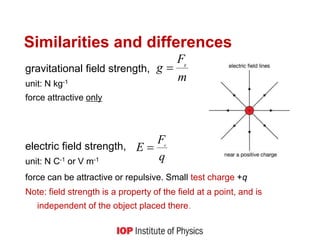
Similarities and differences
gravitational field strength,
unit: N kg-1
force attractive only
electric field strength,
unit: N C-1 or V m-1
force can be attractive or repulsive. Small test charge +q
Note: field strength is a property of the field at a point, and is
independent of the object placed there.
m
F
g g

q
F
E e

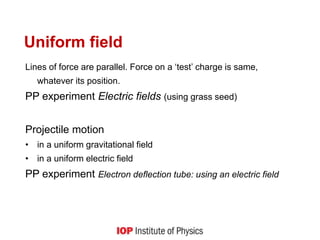
Uniform field
Lines of force are parallel. Force on a ‘test’ charge is same,
whatever its position.
PP experiment Electric fields (using grass seed)
Projectile motion
• in a uniform gravitational field
• in a uniform electric field
PP experiment Electron deflection tube: using an electric field
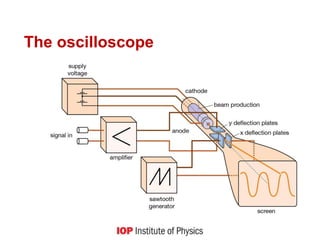
The oscilloscope
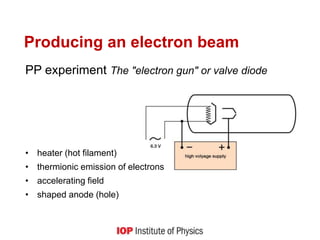
PP experiment The "electron gun" or valve diode
• heater (hot filament)
• thermionic emission of electrons
• accelerating field
• shaped anode (hole)
Producing an electron beam
Calculating electron speed
m
qV
v
m
qV
v
mv
qVW
2
2
2
2
2


 Example:
V = 5 kV.
e = 1.6 x 10⁻¹⁹ C
m = 9.1 x 10⁻³¹ kg
Show that electron v = 4.2 x 10⁷ ms-1
[ignoring relativistic effects]
The field does work W on the electron
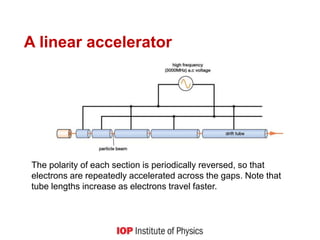
A linear accelerator
The polarity of each section is periodically reversed, so that
electrons are repeatedly accelerated across the gaps. Note that
tube lengths increase as electrons travel faster.
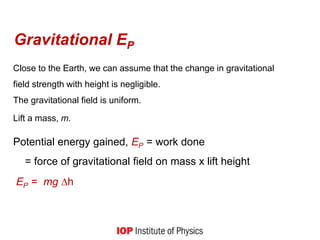
Gravitational EP
Close to the Earth, we can assume that the change in gravitational
field strength with height is negligible.
The gravitational field is uniform.
Lift a mass, m.
Potential energy gained, EP = work done
= force of gravitational field on mass x lift height
EP = mg ∆h
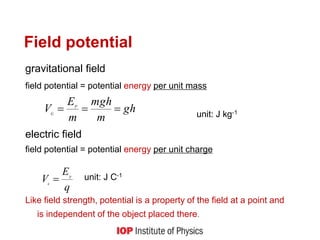
Field potential
gravitational field
field potential = potential energy per unit mass
unit: J kg-1
electric field
field potential = potential energy per unit charge
unit: J C-1
Like field strength, potential is a property of the field at a point and
is independent of the object placed there.
q
E
V p
e

gh
m
mgh
m
E
V P
G

Potential difference
change in potential between points A and B.
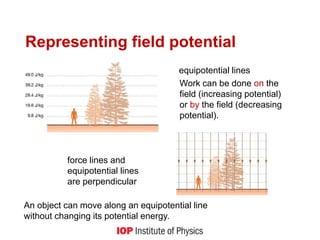
Representing field potential
equipotential lines
force lines and
equipotential lines
are perpendicular
Work can be done on the
field (increasing potential)
or by the field (decreasing
potential).
An object can move along an equipotential line
without changing its potential energy.
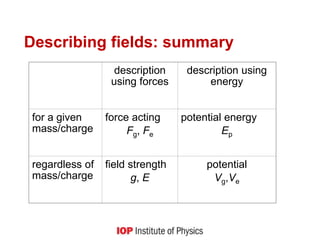
Describing fields: summary
description
using forces
description using
energy
for a given
mass/charge
force acting
Fg, Fe
potential energy
Ep
regardless of
mass/charge
field strength
g, E
potential
Vg,Ve
Practice questions 2
(Adv Phys) Gravitational potential energy and
gravitational potential
Practice in Physics Qs 20.24 – 20.30
Potential gradient
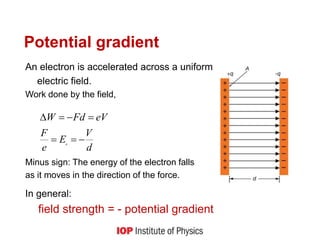
An electron is accelerated across a uniform
electric field.
Work done by the field,
Minus sign: The energy of the electron falls
as it moves in the direction of the force.
In general:
field strength = - potential gradient
d
V
E
e
F
eVFdW
e


What is the p.d. across the terminals of a spark
plug?
[Assume the field strength required to ionise the mixture
is 6 x 10⁶ V m-1 and the field is uniform.]
Sparks and ionisation
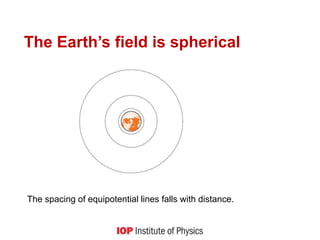
The Earth’s field is spherical
The spacing of equipotential lines falls with distance.
Radial field
of a point charge or mass
NOTE: F and Ep are 0 at infinity
• field around a mass or negative charge is attractive. This means
that F, Ep get increasingly negative with smaller r.
• field around a positive charge is repulsive. This means that F, Ep
get increasingly positive with smaller r.
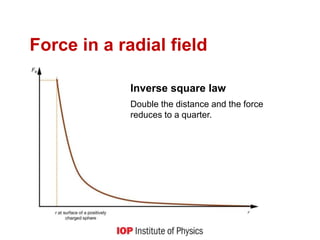
Force in a radial field
Inverse square law
Double the distance and the force
reduces to a quarter.
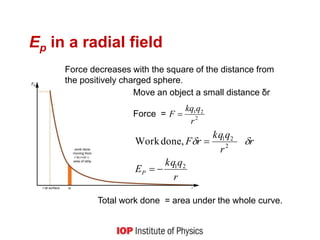
Ep in a radial field
Force decreases with the square of the distance from
the positively charged sphere.
Move an object a small distance δr
Force = 2
21
r
qkq
F 
r
qkq
E
r
r
qkq
rF
P
21
2
21
done,Work

 
Total work done = area under the whole curve.
Practice questions 3
Practice in Physics Qs 20.36, 39, 40, 43, 44
Electric field simulations
Falstad
Caltech
PhET

gravitationl field ans strength

  • 1.
  • 2.
    Learning outcomes • describeuniform and radial electric and gravitational fields in terms of force, field strength and potential, using equations, graphs and the conventional line diagrams • describe similarities and differences between electric and gravitational fields • solve quantitative problems involving gravitational and electric fields, including orbits
  • 3.
    Teaching challenges Helping studentsto understand several ways of describing fields (pictures, graphs, equations) and developing their ability to ‘translate’ between each of them.
  • 4.
    Forces quantitatively Newton’s lawof universal gravitation (1687) G = 6.67 x 10⁻¹¹ N m2 kg-2 Coulomb’s law (1783) in vacuum, k = 9.0 x 10⁹ N m2 C-2 2 21 r mm GFG  2 21 r qq kFe 
  • 5.
    Permittivity 2 21 0 2 21 4 1 r qq F r qq kF e e    The strength ofthe electric field will also depend upon what material is between the two charges. This is known as the permittivity, ε. The permittivity of air is taken to be that of a vacuum, and is called the permittivity of free space, εo. εo = 8.85 x 10⁻¹² UNIT?
  • 6.
    Superposition of electricforces Find the magnitude and direction of the resultant force on the red charge. Charge spacing is 1m.
  • 7.
    Kepler’s laws describe planetarymotion (1605, obtained empirically) 1 The orbit of every planet is an ellipse with the Sun at one focus. 2 The line joining a planet and the Sun sweeps out equal areas during equal intervals of time. 3 A planet’s distance from the Sun, R, and its orbital period, T, are related. 23 TR 
  • 8.
    Newton explains orbits Thecentripetal force is supplied by gravity. R GM v R Mm G R mv   2 2 2 2 22 2 4 so 2 speed,orbital T R v T R v     2 2 3 2 22 4 4   GMT R T R R GM  Kepler 3:
  • 9.
    Practice questions 1 •TAP Newton’s law of universal gravitation
  • 10.
    Gravitational fields used toexplain (in some cases, control) • everyday situations involving lifting & falling, floating & sinking, including transport (ship, road, rail, hot air balloons, aviation) • some machines in children’s playgrounds, adventure park rides • variation of g with latitude, altitude, anomalies associated with mineral deposits, plate tectonics • solar system mechanics – moons, planets, meteors, asteroids • star formation, galaxies, Universe • space launches, mission paths and orbits
  • 11.
    Electric fields used toexplain (in some cases, control) • natural phenomena such as thunderstorms, solar wind • static electricity & antistatic devices & procedures • electric circuits of many kinds • computer processors and memory • atomic structure, electrolysis • industrial processes such as spray painting • devices such as spark plugs and photocopiers • particle accelerators
  • 12.
    First drawn byMichael Faraday (~1820) • direction of force acting on a small test object at different locations • magnitude of force: where field lines are … close together = strong field far apart = weak field parallel and equally spaced = uniform field • field lines cannot cross Fields are often 3-dimensional. Field concept: forces act locally (field ‘fills space’), not action ‘at a distance’. Field line representation
  • 13.
    Possible shapes forfields uniform (e.g. capacitor) cylindrical (e.g. coaxial cable) radial (e.g Van de Graaff dome)
  • 14.
    Similarities and differences gravitationalfield strength, unit: N kg-1 force attractive only electric field strength, unit: N C-1 or V m-1 force can be attractive or repulsive. Small test charge +q Note: field strength is a property of the field at a point, and is independent of the object placed there. m F g g  q F E e 
  • 15.
    Uniform field Lines offorce are parallel. Force on a ‘test’ charge is same, whatever its position. PP experiment Electric fields (using grass seed) Projectile motion • in a uniform gravitational field • in a uniform electric field PP experiment Electron deflection tube: using an electric field
  • 16.
  • 17.
    PP experiment The"electron gun" or valve diode • heater (hot filament) • thermionic emission of electrons • accelerating field • shaped anode (hole) Producing an electron beam
  • 18.
    Calculating electron speed m qV v m qV v mv qVW 2 2 2 2 2   Example: V = 5 kV. e = 1.6 x 10⁻¹⁹ C m = 9.1 x 10⁻³¹ kg Show that electron v = 4.2 x 10⁷ ms-1 [ignoring relativistic effects] The field does work W on the electron
  • 19.
    A linear accelerator Thepolarity of each section is periodically reversed, so that electrons are repeatedly accelerated across the gaps. Note that tube lengths increase as electrons travel faster.
  • 20.
    Gravitational EP Close tothe Earth, we can assume that the change in gravitational field strength with height is negligible. The gravitational field is uniform. Lift a mass, m. Potential energy gained, EP = work done = force of gravitational field on mass x lift height EP = mg ∆h
  • 21.
    Field potential gravitational field fieldpotential = potential energy per unit mass unit: J kg-1 electric field field potential = potential energy per unit charge unit: J C-1 Like field strength, potential is a property of the field at a point and is independent of the object placed there. q E V p e  gh m mgh m E V P G 
  • 22.
    Potential difference change inpotential between points A and B.
  • 23.
    Representing field potential equipotentiallines force lines and equipotential lines are perpendicular Work can be done on the field (increasing potential) or by the field (decreasing potential). An object can move along an equipotential line without changing its potential energy.
  • 24.
    Describing fields: summary description usingforces description using energy for a given mass/charge force acting Fg, Fe potential energy Ep regardless of mass/charge field strength g, E potential Vg,Ve
  • 25.
    Practice questions 2 (AdvPhys) Gravitational potential energy and gravitational potential Practice in Physics Qs 20.24 – 20.30
  • 26.
    Potential gradient An electronis accelerated across a uniform electric field. Work done by the field, Minus sign: The energy of the electron falls as it moves in the direction of the force. In general: field strength = - potential gradient d V E e F eVFdW e  
  • 27.
    What is thep.d. across the terminals of a spark plug? [Assume the field strength required to ionise the mixture is 6 x 10⁶ V m-1 and the field is uniform.] Sparks and ionisation
  • 28.
    The Earth’s fieldis spherical The spacing of equipotential lines falls with distance.
  • 29.
    Radial field of apoint charge or mass NOTE: F and Ep are 0 at infinity • field around a mass or negative charge is attractive. This means that F, Ep get increasingly negative with smaller r. • field around a positive charge is repulsive. This means that F, Ep get increasingly positive with smaller r.
  • 30.
    Force in aradial field Inverse square law Double the distance and the force reduces to a quarter.
  • 31.
    Ep in aradial field Force decreases with the square of the distance from the positively charged sphere. Move an object a small distance δr Force = 2 21 r qkq F  r qkq E r r qkq rF P 21 2 21 done,Work    Total work done = area under the whole curve.
  • 32.
    Practice questions 3 Practicein Physics Qs 20.36, 39, 40, 43, 44 Electric field simulations Falstad Caltech PhET