pg. 1
The GenAIDivide
STATE OF AI IN
BUSINESS 2025
MIT NANDA
Aditya Challapally
Chris Pease
Ramesh Raskar
Pradyumna Chari
July 2025
2.
pg. 2
NOTES
Preliminary Findingsfrom AI Implementation Research from Project NANDA
Reviewers: Pradyumna Chari, Project NANDA
Research Period: January – June 2025
Methodology: This report is based on a multi-method research design that includes
a systematic review of over 300 publicly disclosed AI initiatives, structured
interviews with representatives from 52 organizations, and survey responses from
153 senior leaders collected across four major industry conferences.
Disclaimer: The views expressed in this report are solely those of the authors and
reviewers and do not reflect the positions of any affiliated employers.
Confidentiality Note: All company-specific data and quotes have been
anonymized to maintain compliance with corporate disclosure policies and
confidentiality agreements, ensure neutrality, and prevent any perception of
commercial advancement or opinion.
3.
pg. 3
1 CONTENTS
1.Executive Summary
2. The Wrong Side of the GenAI Divide: High Adoption, Low Transformation
3. Why Pilots Stall: The Learning Gap Behind the Divide
4. Crossing the GenAI Divide: How the Best Builders Succeed
5. Crossing the GenAI Divide: How the Best Buyers Succeed
6. Conclusion: Bridging the GenAI Divide
2 EXECUTIVE SUMMARY
Despite $30–40 billion in enterprise investment into GenAI, this report uncovers a surprising
result in that 95% of organizations are getting zero return. The outcomes are so starkly
divided across both buyers (enterprises, mid-market, SMBs) and builders (startups, vendors,
consultancies) that we call it the GenAI Divide. Just 5% of integrated AI pilots are extracting
millions in value, while the vast majority remain stuck with no measurable P&L impact. This
divide does not seem to be driven by model quality or regulation, but seems to be
determined by approach.
Tools like ChatGPT and Copilot are widely adopted. Over 80 percent of organizations have
explored or piloted them, and nearly 40 percent report deployment. But these tools
primarily enhance individual productivity, not P&L performance. Meanwhile, enterprise-
grade systems, custom or vendor-sold, are being quietly rejected. Sixty percent of
organizations evaluated such tools, but only 20 percent reached pilot stage and just 5
percent reached production. Most fail due to brittle workflows, lack of contextual learning,
and misalignment with day-to-day operations.
From our interviews, surveys, and analysis of 300 public implementations, four patterns
emerged that define the GenAI Divide:
• Limited disruption: Only 2 of 8 major sectors show meaningful structural change
• Enterprise paradox: Big firms lead in pilot volume but lag in scale-up
• Investment bias: Budgets favor visible, top-line functions over high-ROI back office
• Implementation advantage: External partnerships see twice the success rate of
internal builds
The core barrier to scaling is not infrastructure, regulation, or talent. It is learning. Most
GenAI systems do not retain feedback, adapt to context, or improve over time.
A small group of vendors and buyers are achieving faster progress by addressing these
limitations directly. Buyers who succeed demand process-specific customization and
evaluate tools based on business outcomes rather than software benchmarks. They expect
4.
pg. 4
systems thatintegrate with existing processes and improve over time. Vendors meeting
these expectations are securing multi-million-dollar deployments within months.
While most implementations don't drive headcount reduction, organizations that have
crossed the GenAI Divide are beginning to see selective workforce impacts in customer
support, software engineering, and administrative functions. In addition, the highest-
performing organizations report measurable savings from reduced BPO spending and
external agency use, particularly in back-office operations. Others cite improved customer
retention and sales conversion through automated outreach and intelligent follow-up
systems. These early results suggest that learning-capable systems, when targeted at
specific processes, can deliver real value, even without major organizational restructuring.
3 THE WRONG SIDE OF THE GENAI DIVIDE: HIGH ADOPTION,
LOW TRANSFORMATION
Takeaway: Most organizations fall on the wrong side of the GenAI Divide, adoption is high,
but disruption is low. Seven of nine sectors show little structural change. Enterprises are
piloting GenAI tools, but very few reach deployment. Generic tools like ChatGPT are widely
used, but custom solutions stall due to integration complexity and lack of fit with existing
workflows.
The GenAI Divide is most visible when examining industry-level transformation patterns.
Despite high-profile investment and widespread pilot activity, only a small fraction of
organizations have moved beyond experimentation to achieve meaningful business
transformation.
3.1 THE DISRUPTION REALITY BEHIND THE DIVIDE
Takeaway: The GenAI Divide manifests clearly at the industry level, despite GenAI's
visibility, only two industries (Tech and Media) show clear signs of structural disruption,
while seven others remain on the wrong side of transformation.
Despite high-profile investment, industry-level transformation remains limited. GenAI has
been embedded in support, content creation, and analytics use cases, but few industries
show the deep structural shifts associated with past general-purpose technologies such as
new market leaders, disrupted business models, or measurable changes in customer
behavior.
To better quantify the state of disruption, we developed a composite AI Market Disruption
Index. Each industry was scored from 0 to 5 based on five observable indicators. These
scores represent normalized averages across five dimensions, triangulated from public
indicators and interview-derived assessments. Alternative weighting schemes were tested
to confirm consistency of industry rankings:
1. Market share volatility among top incumbents (2022 to 2025)
5.
pg. 5
2. Revenuegrowth of AI-native firms founded after 2020
3. Emergence of new AI-driven business models
4. Changes in user behavior attributable to GenAI
5. Frequency of executive org changes attributed to AI tooling
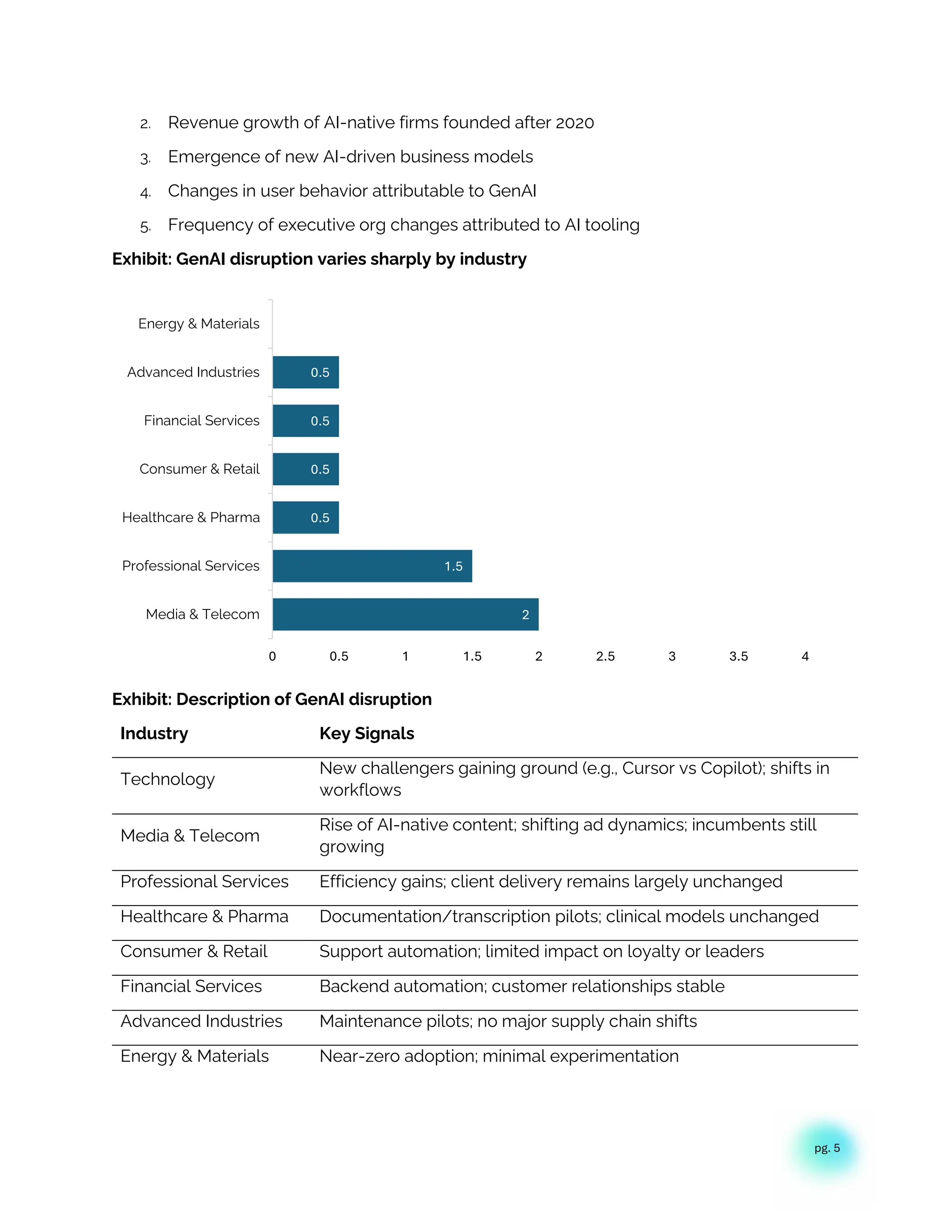
Exhibit: GenAI disruption varies sharply by industry
Exhibit: Description of GenAI disruption
Industry Key Signals
Technology
New challengers gaining ground (e.g., Cursor vs Copilot); shifts in
workflows
Media & Telecom
Rise of AI-native content; shifting ad dynamics; incumbents still
growing
Professional Services Efficiency gains; client delivery remains largely unchanged
Healthcare & Pharma Documentation/transcription pilots; clinical models unchanged
Consumer & Retail Support automation; limited impact on loyalty or leaders
Financial Services Backend automation; customer relationships stable
Advanced Industries Maintenance pilots; no major supply chain shifts
Energy & Materials Near-zero adoption; minimal experimentation
2
1.5
0.5
0.5
0.5
0.5
0
0 0.5 1 1.5 2 2.5 3 3.5 4
Media & Telecom
Professional Services
Healthcare & Pharma
Consumer & Retail
Financial Services
Advanced Industries
Energy & Materials
6.
pg. 6
Sensitivity Analysis:We tested alternative weightings for the five disruption indicators.
Technology and Media & Telecom maintained top rankings across all reasonable weighting
schemes, while Healthcare and Energy remained consistently low. Professional Services
showed the most sensitivity to weighting changes, ranging from 1.2 to 2.1 depending on
emphasis placed on efficiency gains versus structural change.
Seven out of nine major sectors showed significant pilot activity but little to no structural
change. This gap between investment and disruption directly demonstrates the GenAI
Divide at scale, widespread experimentation without transformation.
Interviewees were blunt in their assessments. One mid-market manufacturing COO
summarized the prevailing sentiment:
"The hype on LinkedIn says everything has changed, but in our operations, nothing
fundamental has shifted. We're processing some contracts faster, but that's all that has
changed."
3.2 THE PILOT-TO-PRODUCTION CHASM
Takeaway: The GenAI Divide is starkest in deployment rates, only 5% of custom enterprise
AI tools reach production. Chatbots succeed because they're easy to try and flexible, but fail
in critical workflows due to lack of memory and customization. This fundamental gap
explains why most organizations remain on the wrong side of the divide.
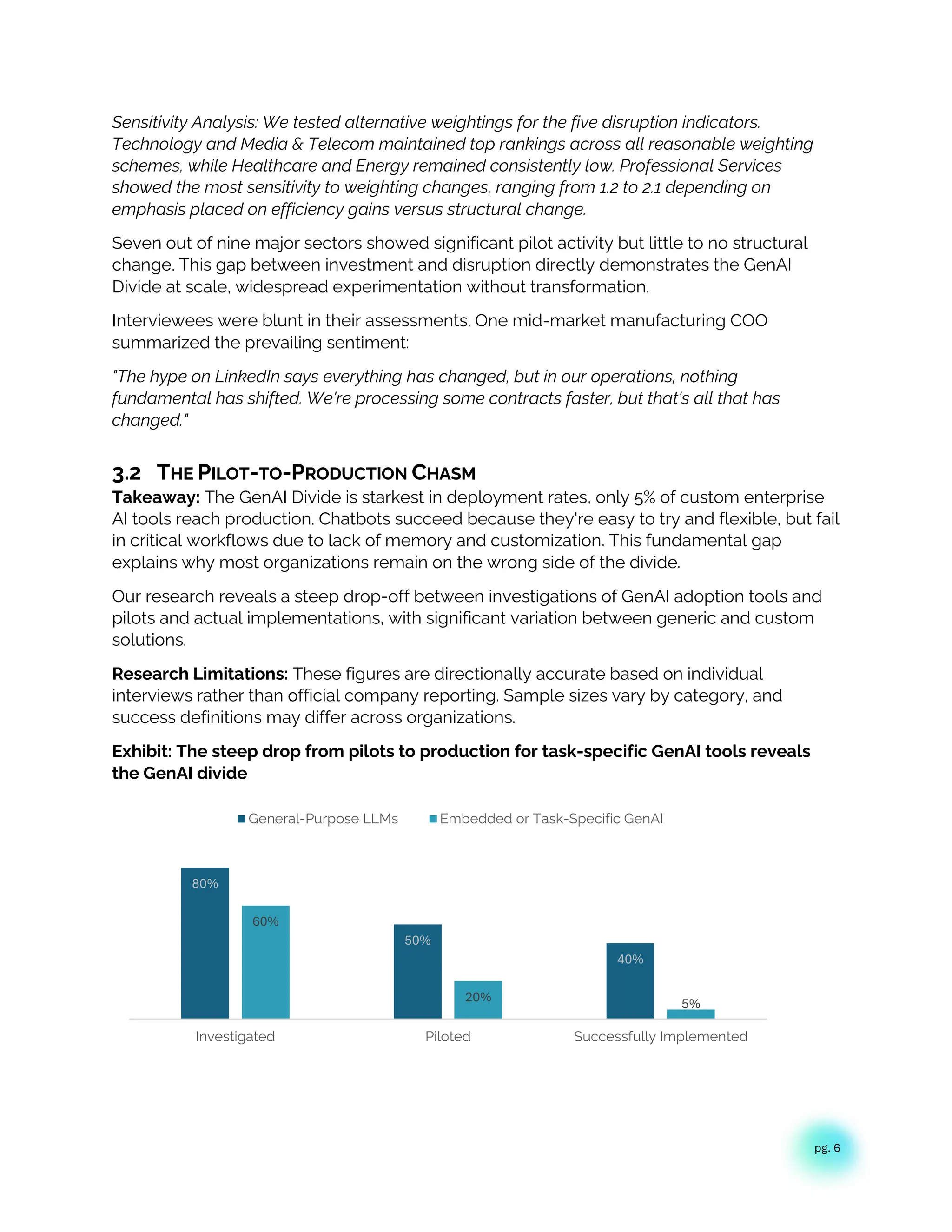
Our research reveals a steep drop-off between investigations of GenAI adoption tools and
pilots and actual implementations, with significant variation between generic and custom
solutions.
Research Limitations: These figures are directionally accurate based on individual
interviews rather than official company reporting. Sample sizes vary by category, and
success definitions may differ across organizations.
Exhibit: The steep drop from pilots to production for task-specific GenAI tools reveals
the GenAI divide
80%
50%
40%
60%
20% 5%
Investigated Piloted Successfully Implemented
General-Purpose LLMs Embedded or Task-Specific GenAI
7.
pg. 7
Research Note:We define successfully implemented for task-specific GenAI tools as ones
users or executives have remarked as causing a marked and sustained productivity and/or
P&L impact
The 95% failure rate for enterprise AI solutions represents the clearest manifestation of the
GenAI Divide. Organizations stuck on the wrong side continue investing in static tools that
can't adapt to their workflows, while those crossing the divide focus on learning-capable
systems.
Generic LLM chatbots appear to show high pilot-to-implementation rates (~83%). However,
this masks a deeper split in perceived value and reveals why most organizations remain
trapped on the wrong side of the divide.
In interviews, enterprise users reported consistently positive experiences with consumer-
grade tools like ChatGPT and Copilot. These systems were praised for flexibility, familiarity,
and immediate utility. Yet the same users were overwhelmingly skeptical of custom or
vendor-pitched AI tools, describing them as brittle, overengineered, or misaligned with
actual workflows.
As one CIO put it, "We've seen dozens of demos this year. Maybe one or two are genuinely
useful. The rest are wrappers or science projects."
While enthusiasm and budgets are often sufficient to launch pilots, converting these into
workflow-integrated systems with persistent value remains rare, a pattern that defines the
experience of organizations on the wrong side of the GenAI Divide.
Enterprises, defined here as firms with over $100 million in annual revenue, lead in pilot
count and allocate more staff to AI-related initiatives. Yet this intensity has not translated
into success. These organizations report the lowest rates of pilot-to-scale conversion.
By contrast, mid-market companies moved faster and more decisively. Top performers
reported average timelines of 90 days from pilot to full implementation. Enterprises, by
comparison, took nine months or longer.
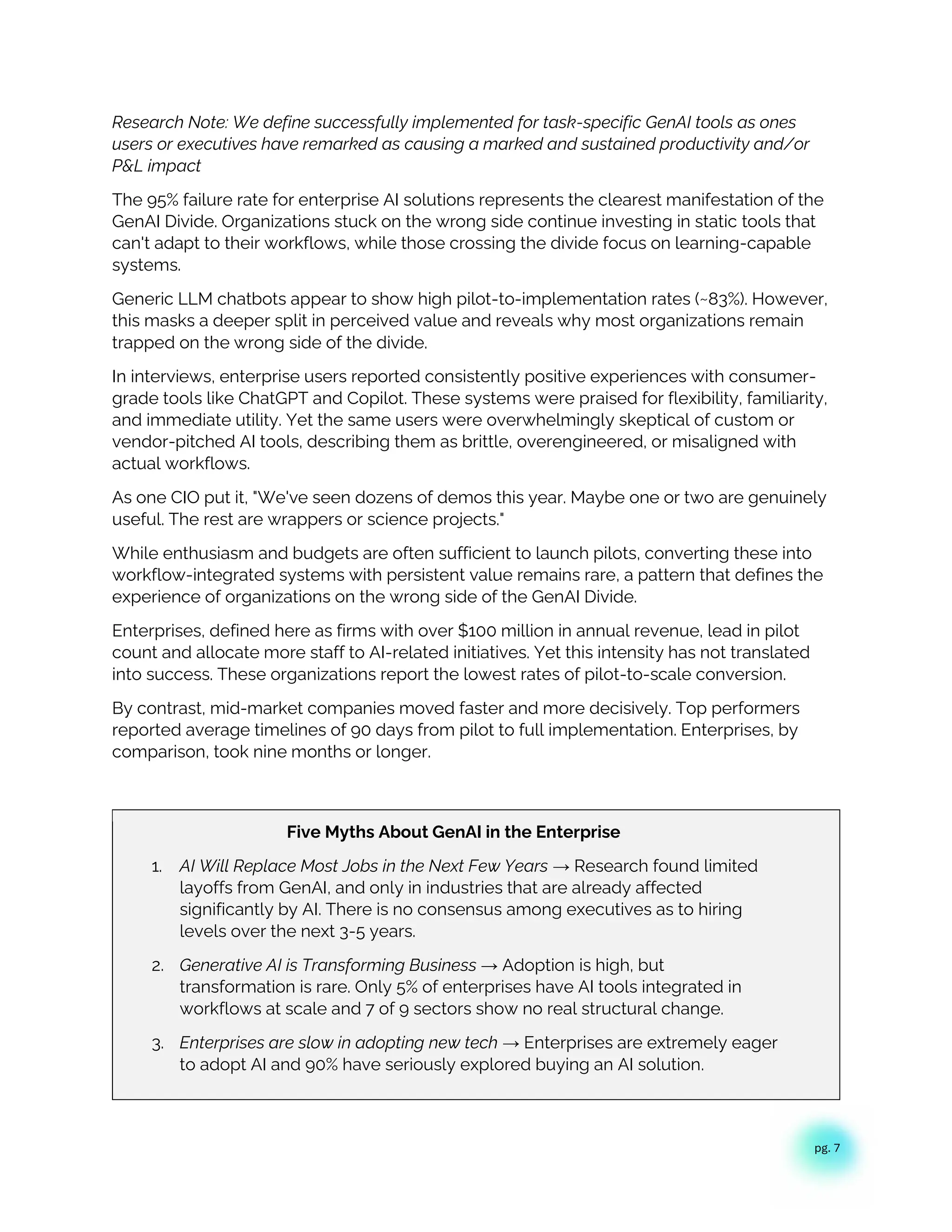
Five Myths About GenAI in the Enterprise
1. AI Will Replace Most Jobs in the Next Few Years → Research found limited
layoffs from GenAI, and only in industries that are already affected
significantly by AI. There is no consensus among executives as to hiring
levels over the next 3-5 years.
2. Generative AI is Transforming Business → Adoption is high, but
transformation is rare. Only 5% of enterprises have AI tools integrated in
workflows at scale and 7 of 9 sectors show no real structural change.
3. Enterprises are slow in adopting new tech → Enterprises are extremely eager
to adopt AI and 90% have seriously explored buying an AI solution.
8.
pg. 8
4. Thebiggest thing holding back AI is model quality, legal, data, risk → What's
really holding it back is that most AI tools don't learn and don’t integrate
well into workflows.
5. The best enterprises are building their own tools → Internal builds fail twice as
often.
3.3 THE SHADOW AI ECONOMY: A BRIDGE ACROSS THE DIVIDE
Takeaway: While official enterprise initiatives remain stuck on the wrong side of the GenAI
Divide, employees are already crossing it through personal AI tools. This "shadow AI" often
delivers better ROI than formal initiatives and reveals what actually works for bridging the
divide.
Behind the disappointing enterprise deployment numbers lies a surprising reality: AI is
already transforming work, just not through official channels. Our research uncovered a
thriving "shadow AI economy" where employees use personal ChatGPT accounts, Claude
subscriptions, and other consumer tools to automate significant portions of their jobs, often
without IT knowledge or approval.
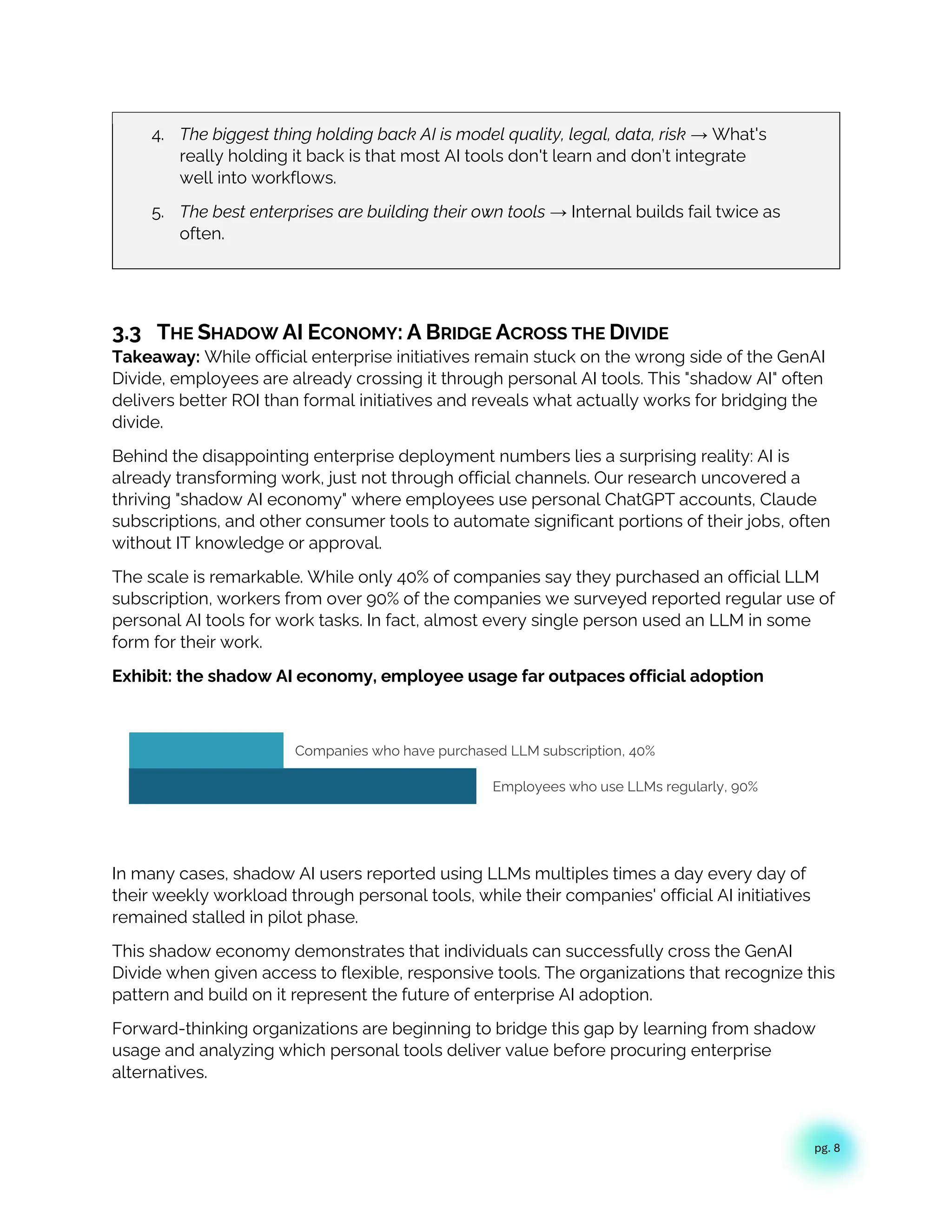
The scale is remarkable. While only 40% of companies say they purchased an official LLM
subscription, workers from over 90% of the companies we surveyed reported regular use of
personal AI tools for work tasks. In fact, almost every single person used an LLM in some
form for their work.
Exhibit: the shadow AI economy, employee usage far outpaces official adoption
In many cases, shadow AI users reported using LLMs multiples times a day every day of
their weekly workload through personal tools, while their companies' official AI initiatives
remained stalled in pilot phase.
This shadow economy demonstrates that individuals can successfully cross the GenAI
Divide when given access to flexible, responsive tools. The organizations that recognize this
pattern and build on it represent the future of enterprise AI adoption.
Forward-thinking organizations are beginning to bridge this gap by learning from shadow
usage and analyzing which personal tools deliver value before procuring enterprise
alternatives.
Employees who use LLMs regularly, 90%
Companies who have purchased LLM subscription, 40%
9.
pg. 9
3.4 INVESTMENTPATTERNS REFLECT THE DIVIDE
Takeaway: Investment allocation reveals the GenAI Divide in action, 50% of GenAI budgets
go to sales and marketing, but back-office automation often yields better ROI. This bias
reflects easier metric attribution, not actual value, and keeps organizations focused on the
wrong priorities.
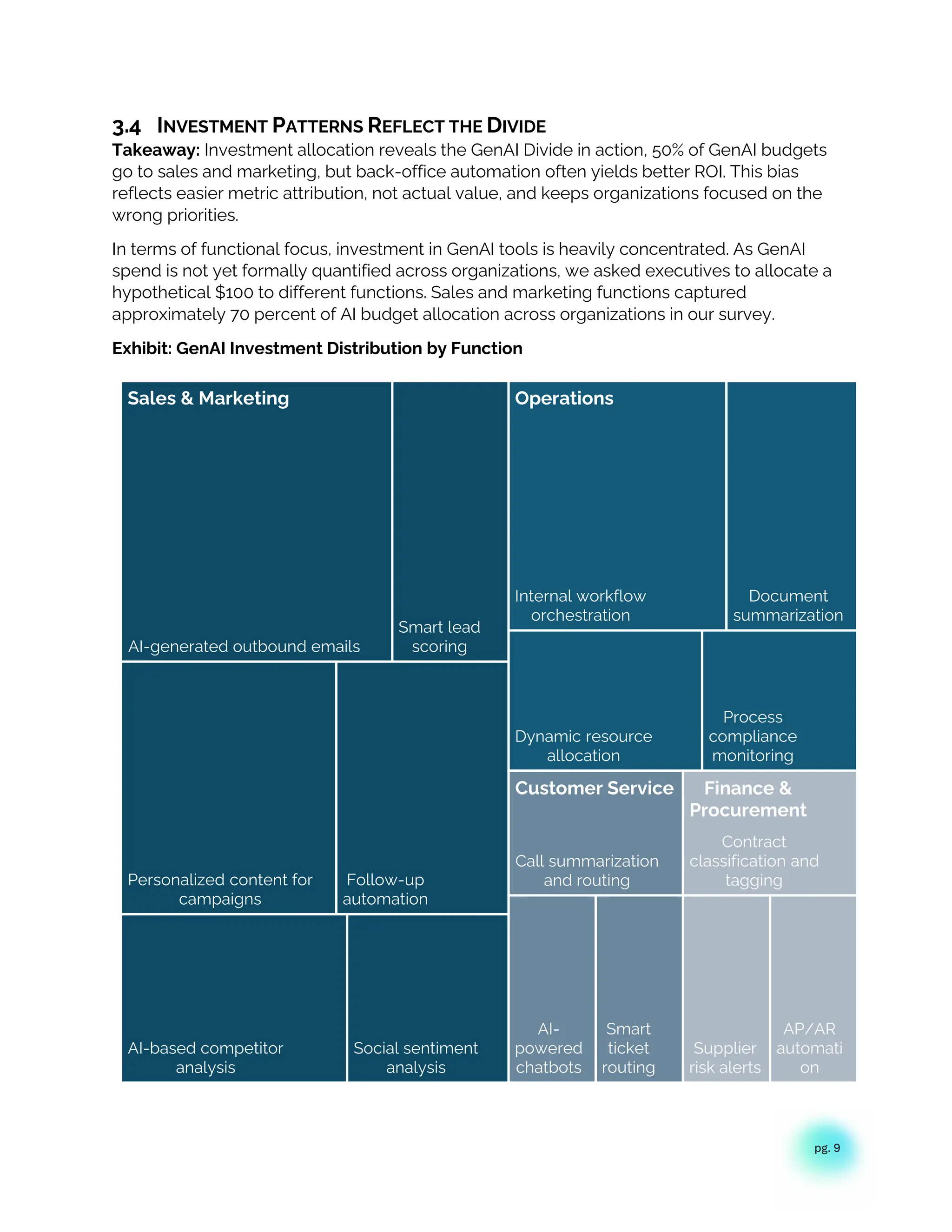
In terms of functional focus, investment in GenAI tools is heavily concentrated. As GenAI
spend is not yet formally quantified across organizations, we asked executives to allocate a
hypothetical $100 to different functions. Sales and marketing functions captured
approximately 70 percent of AI budget allocation across organizations in our survey.
Exhibit: GenAI Investment Distribution by Function
AI-generated outbound emails
Smart lead
scoring
Personalized content for
campaigns
Follow-up
automation
AI-based competitor
analysis
Social sentiment
analysis
Internal workflow
orchestration
Document
summarization
Dynamic resource
allocation
Process
compliance
monitoring
Call summarization
and routing
AI-
powered
chatbots
Smart
ticket
routing
Contract
classification and
tagging
Supplier
risk alerts
AP/AR
automati
on
Sales & Marketing Operations
Customer Service Finance &
Procurement
10.
pg. 10
Research Notes:While the general functional allocation of GenAI investment (e.g., ~50% to
Sales & Marketing) was relatively consistent across executive interviews, the sub-category and
use-case breakdowns should be treated as directional at best. Subcategories reflect
synthesized notes and anecdotal patterns, rather than precise accounting. Company type
drives significant variation. For example, manufacturers and healthcare providers typically
directed minimal investment to Sales & Marketing and over-indexed on Operations. Tech and
media firms often prioritized Marketing, Content, and Developer Productivity. Professional
services leaned toward Document Automation and Legal/Compliance tools.
Sales and marketing dominate not only because of visibility, but because outcomes can be
measured easily. Metrics such as demo volume or email response time align directly with
board-level KPIs.
Legal, procurement, and finance functions, in contrast, offer more subtle efficiencies. These
include fewer compliance violations, streamlined workflows, or accelerated month-end
processes, important but hard to surface in executive conversations or investor updates.
A VP of Procurement at a Fortune 1000 pharmaceutical company expressed this challenge
clearly:
"If I buy a tool to help my team work faster, how do I quantify that impact? How do I justify it to
my CEO when it won't directly move revenue or decrease measurable costs? I could argue it
helps our scientists get their tools faster, but that's several degrees removed from bottom-line
impact."
This investment bias perpetuates the GenAI Divide by directing resources toward visible but
often less transformative use cases, while the highest-ROI opportunities in back-office
functions remain underfunded.
Beyond measurement challenges, trust and social proof remain decisive in purchase
decisions. A Head of Procurement at a major CPG firm captured the dilemma many buyers
face:
"I receive numerous emails daily claiming to offer the best GenAI solution. Some have
impressive demos, but establishing trust is the real challenge. With so many options flooding
our inbox, we rely heavily on peer recommendations and referrals from our network."
This highlights a broader pattern: product quality alone is rarely sufficient. Referrals, prior
relationships, and VC introductions remain stronger predictors of enterprise adoption than
functionality or feature set.
4 WHY PILOTS STALL: THE LEARNING GAP BEHIND THE DIVIDE
The primary factor keeping organizations on the wrong side of the GenAI Divide is the
learning gap, tools that don't learn, integrate poorly, or match workflows. Users prefer
ChatGPT for simple tasks, but abandon it for mission-critical work due to its lack of memory.
What's missing is systems that adapt, remember, and evolve, capabilities that define the
difference between the two sides of the divide.
11.
pg. 11
4.1 THEBARRIERS KEEPING ORGANIZATIONS TRAPPED
Takeaway: The top barriers reflect the fundamental learning gap that defines the GenAI
Divide: users resist tools that don't adapt, model quality fails without context, and UX suffers
when systems can't remember. Even avid ChatGPT users distrust internal GenAI tools that
don't match their expectations.
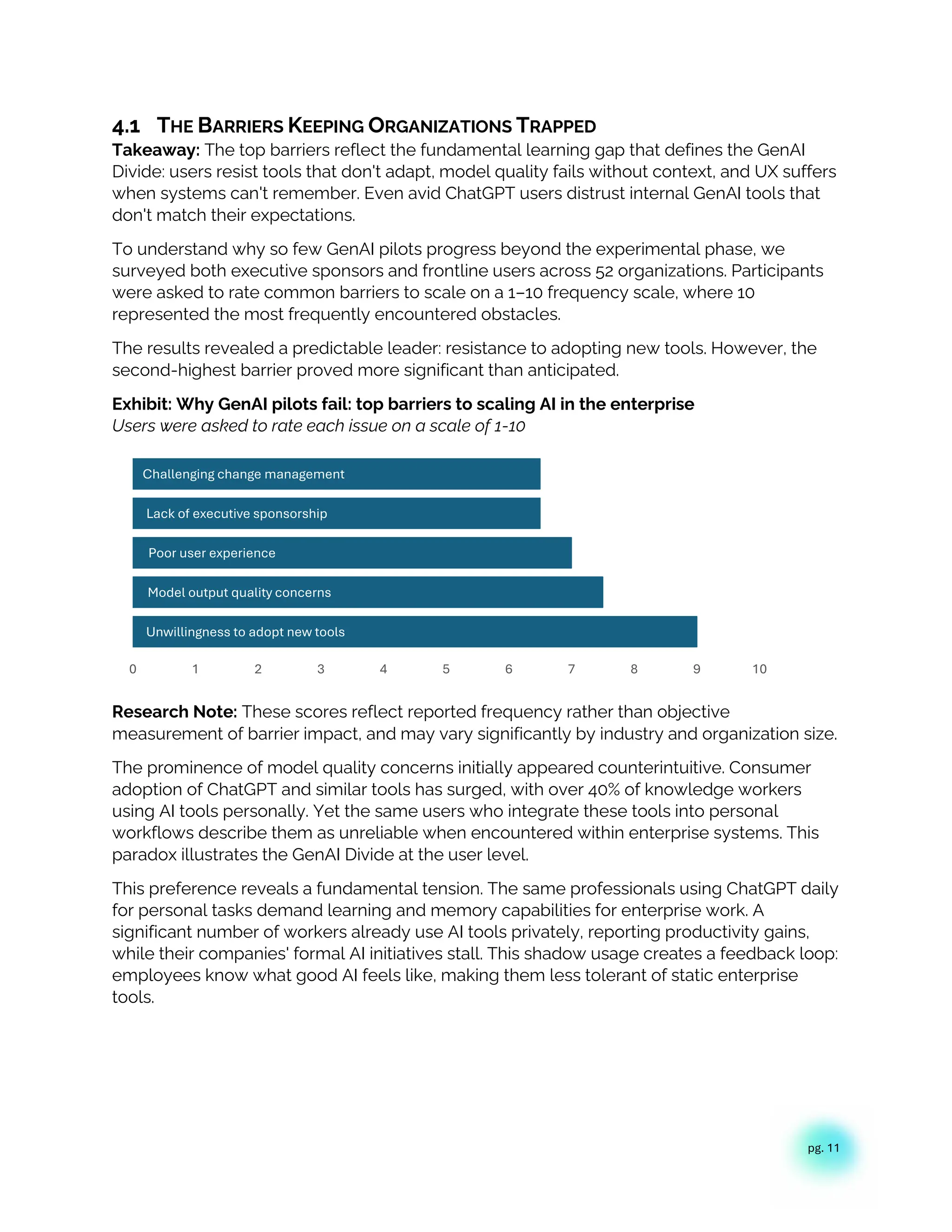
To understand why so few GenAI pilots progress beyond the experimental phase, we
surveyed both executive sponsors and frontline users across 52 organizations. Participants
were asked to rate common barriers to scale on a 1–10 frequency scale, where 10
represented the most frequently encountered obstacles.
The results revealed a predictable leader: resistance to adopting new tools. However, the
second-highest barrier proved more significant than anticipated.
Exhibit: Why GenAI pilots fail: top barriers to scaling AI in the enterprise
Users were asked to rate each issue on a scale of 1-10
Research Note: These scores reflect reported frequency rather than objective
measurement of barrier impact, and may vary significantly by industry and organization size.
The prominence of model quality concerns initially appeared counterintuitive. Consumer
adoption of ChatGPT and similar tools has surged, with over 40% of knowledge workers
using AI tools personally. Yet the same users who integrate these tools into personal
workflows describe them as unreliable when encountered within enterprise systems. This
paradox illustrates the GenAI Divide at the user level.
This preference reveals a fundamental tension. The same professionals using ChatGPT daily
for personal tasks demand learning and memory capabilities for enterprise work. A
significant number of workers already use AI tools privately, reporting productivity gains,
while their companies' formal AI initiatives stall. This shadow usage creates a feedback loop:
employees know what good AI feels like, making them less tolerant of static enterprise
tools.
Unwillingness to adopt new tools
Model output quality concerns
Poor user experience
Lack of executive sponsorship
Challenging change management
0 1 2 3 4 5 6 7 8 9 10
12.
pg. 12
4.2 WHYGENERIC TOOLS WIN, AND LOSE
Takeaway: The GenAI Divide manifests in user preferences: ChatGPT beats enterprise tools
because it's better, faster, and more familiar, even when both use similar models. But this
same preference exposes why organizations remain stuck on the wrong side of the divide.
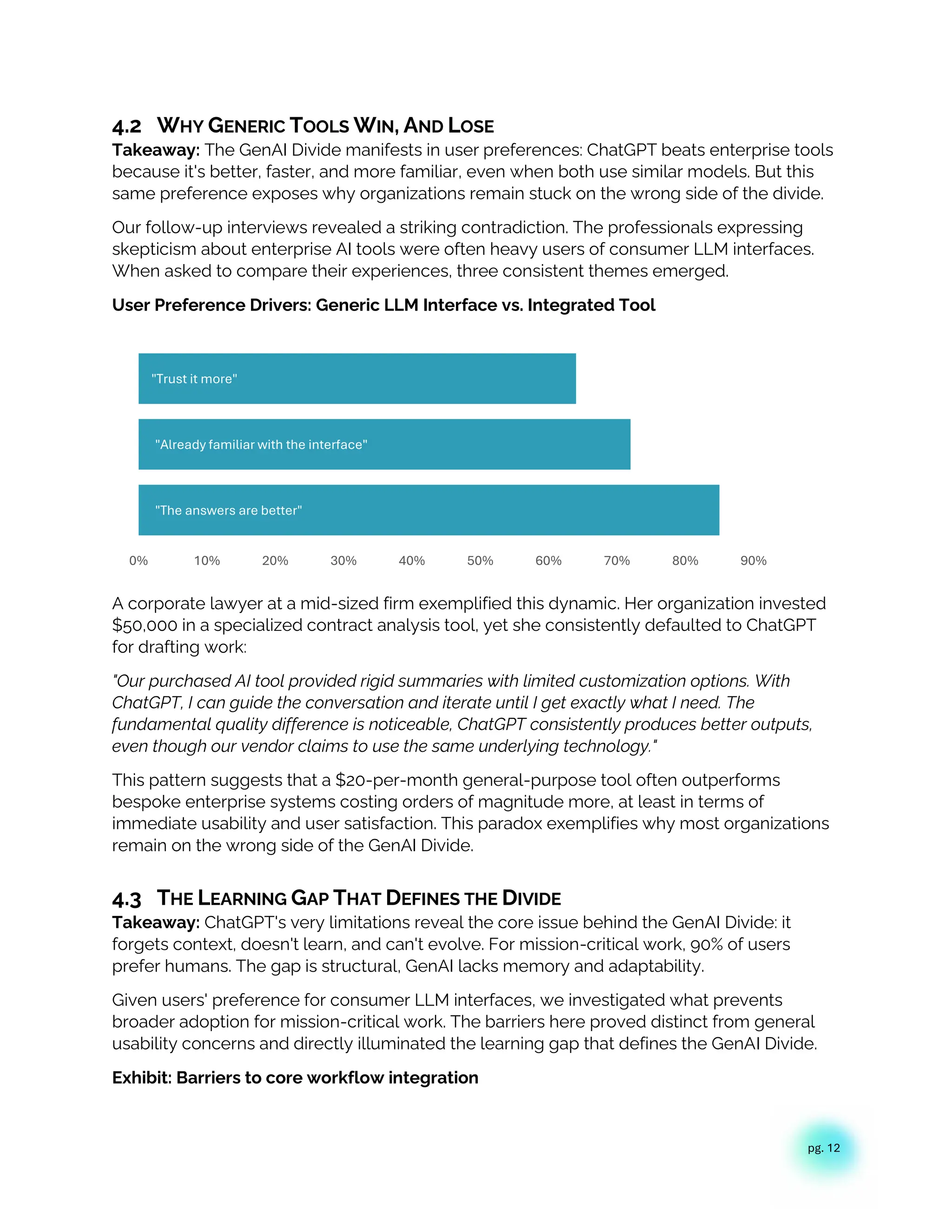
Our follow-up interviews revealed a striking contradiction. The professionals expressing
skepticism about enterprise AI tools were often heavy users of consumer LLM interfaces.
When asked to compare their experiences, three consistent themes emerged.
User Preference Drivers: Generic LLM Interface vs. Integrated Tool
A corporate lawyer at a mid-sized firm exemplified this dynamic. Her organization invested
$50,000 in a specialized contract analysis tool, yet she consistently defaulted to ChatGPT
for drafting work:
"Our purchased AI tool provided rigid summaries with limited customization options. With
ChatGPT, I can guide the conversation and iterate until I get exactly what I need. The
fundamental quality difference is noticeable, ChatGPT consistently produces better outputs,
even though our vendor claims to use the same underlying technology."
This pattern suggests that a $20-per-month general-purpose tool often outperforms
bespoke enterprise systems costing orders of magnitude more, at least in terms of
immediate usability and user satisfaction. This paradox exemplifies why most organizations
remain on the wrong side of the GenAI Divide.
4.3 THE LEARNING GAP THAT DEFINES THE DIVIDE
Takeaway: ChatGPT's very limitations reveal the core issue behind the GenAI Divide: it
forgets context, doesn't learn, and can't evolve. For mission-critical work, 90% of users
prefer humans. The gap is structural, GenAI lacks memory and adaptability.
Given users' preference for consumer LLM interfaces, we investigated what prevents
broader adoption for mission-critical work. The barriers here proved distinct from general
usability concerns and directly illuminated the learning gap that defines the GenAI Divide.
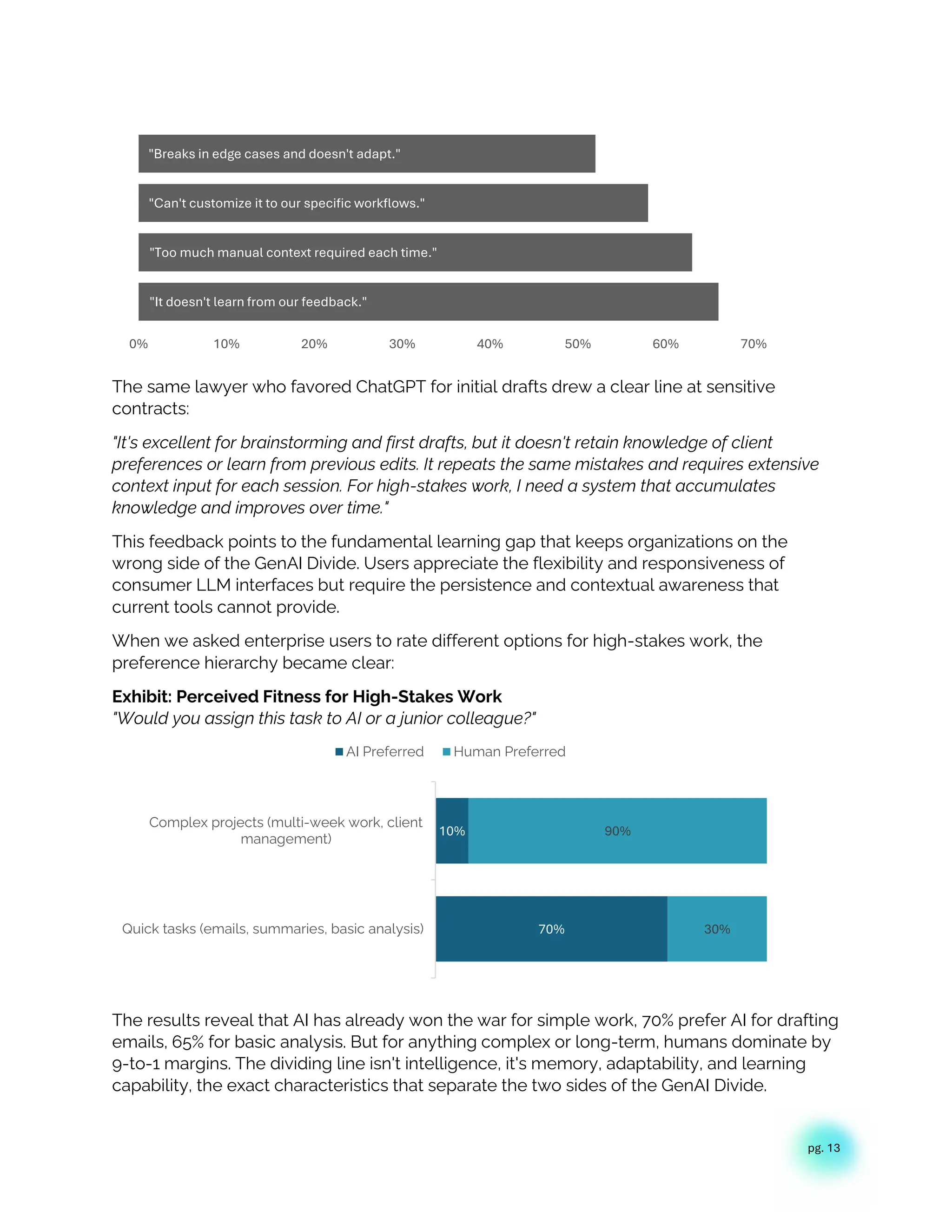
Exhibit: Barriers to core workflow integration
"The answers are better"
"Already familiar with the interface"
"Trust it more"
0% 10% 20% 30% 40% 50% 60% 70% 80% 90%
13.
pg. 13
The samelawyer who favored ChatGPT for initial drafts drew a clear line at sensitive
contracts:
"It's excellent for brainstorming and first drafts, but it doesn't retain knowledge of client
preferences or learn from previous edits. It repeats the same mistakes and requires extensive
context input for each session. For high-stakes work, I need a system that accumulates
knowledge and improves over time."
This feedback points to the fundamental learning gap that keeps organizations on the
wrong side of the GenAI Divide. Users appreciate the flexibility and responsiveness of
consumer LLM interfaces but require the persistence and contextual awareness that
current tools cannot provide.
When we asked enterprise users to rate different options for high-stakes work, the
preference hierarchy became clear:
Exhibit: Perceived Fitness for High-Stakes Work
"Would you assign this task to AI or a junior colleague?"
The results reveal that AI has already won the war for simple work, 70% prefer AI for drafting
emails, 65% for basic analysis. But for anything complex or long-term, humans dominate by
9-to-1 margins. The dividing line isn't intelligence, it's memory, adaptability, and learning
capability, the exact characteristics that separate the two sides of the GenAI Divide.
"It doesn't learn from our feedback."
"Too much manual context required each time."
"Can't customize it to our specific workflows."
"Breaks in edge cases and doesn't adapt."
0% 10% 20% 30% 40% 50% 60% 70%
70%
10%
30%
90%
Quick tasks (emails, summaries, basic analysis)
Complex projects (multi-week work, client
management)
AI Preferred Human Preferred
14.
pg. 14
Agentic AI,the class of systems that embeds persistent memory and iterative learning by
design, directly addresses the learning gap that defines the GenAI Divide. Unlike current
systems that require full context each time, agentic systems maintain persistent memory,
learn from interactions, and can autonomously orchestrate complex workflows. Early
enterprise experiments with customer service agents that handle complete inquiries end-
to-end, financial processing agents that monitor and approve routine transactions, and sales
pipeline agents that track engagement across channels demonstrate how autonomy and
memory address the core gaps enterprises identify.
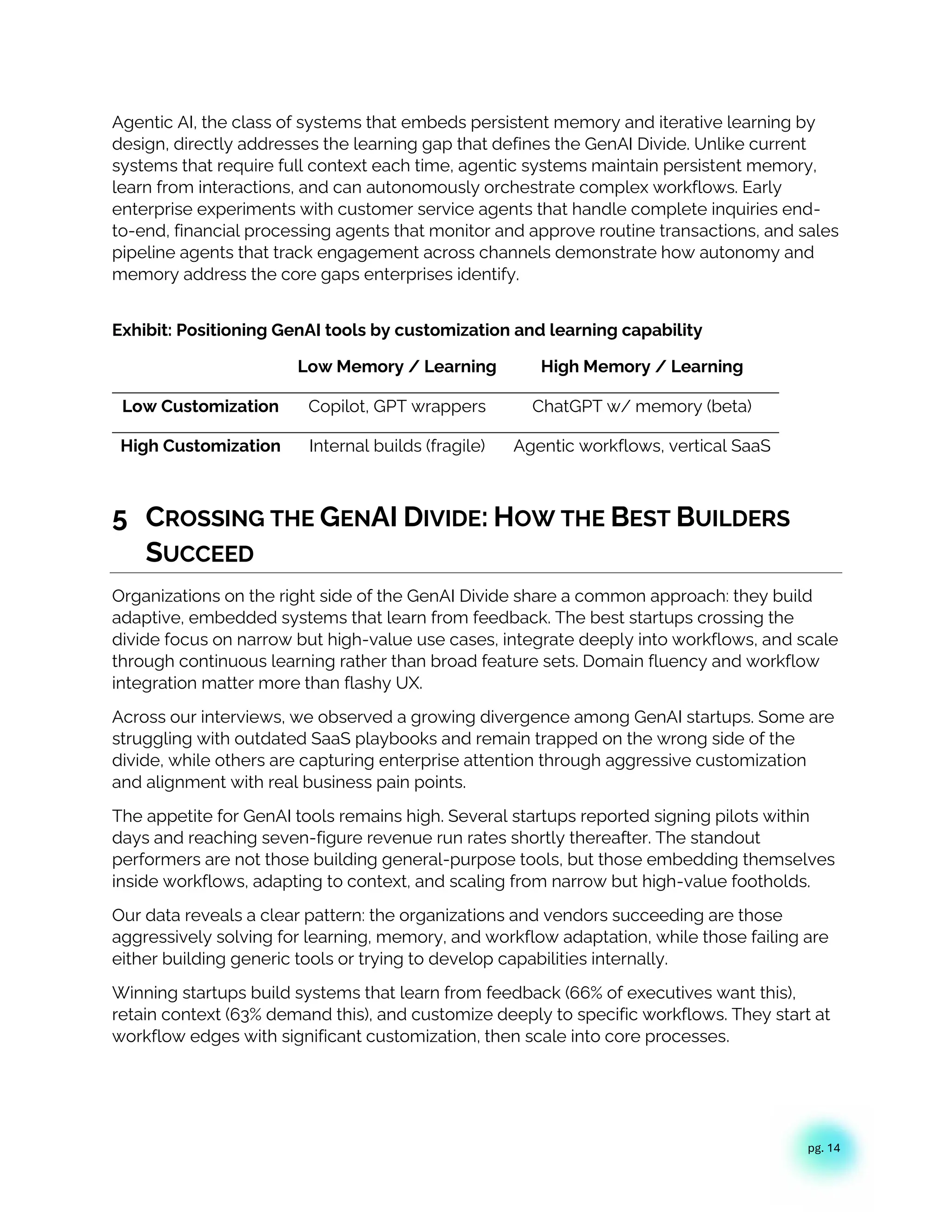
Exhibit: Positioning GenAI tools by customization and learning capability
Low Memory / Learning High Memory / Learning
Low Customization Copilot, GPT wrappers ChatGPT w/ memory (beta)
High Customization Internal builds (fragile) Agentic workflows, vertical SaaS
5 CROSSING THE GENAI DIVIDE: HOW THE BEST BUILDERS
SUCCEED
Organizations on the right side of the GenAI Divide share a common approach: they build
adaptive, embedded systems that learn from feedback. The best startups crossing the
divide focus on narrow but high-value use cases, integrate deeply into workflows, and scale
through continuous learning rather than broad feature sets. Domain fluency and workflow
integration matter more than flashy UX.
Across our interviews, we observed a growing divergence among GenAI startups. Some are
struggling with outdated SaaS playbooks and remain trapped on the wrong side of the
divide, while others are capturing enterprise attention through aggressive customization
and alignment with real business pain points.
The appetite for GenAI tools remains high. Several startups reported signing pilots within
days and reaching seven-figure revenue run rates shortly thereafter. The standout
performers are not those building general-purpose tools, but those embedding themselves
inside workflows, adapting to context, and scaling from narrow but high-value footholds.
Our data reveals a clear pattern: the organizations and vendors succeeding are those
aggressively solving for learning, memory, and workflow adaptation, while those failing are
either building generic tools or trying to develop capabilities internally.
Winning startups build systems that learn from feedback (66% of executives want this),
retain context (63% demand this), and customize deeply to specific workflows. They start at
workflow edges with significant customization, then scale into core processes.
15.
pg. 15
5.1 WHATENTERPRISES ACTUALLY WANT: THE BRIDGE ACROSS THE DIVIDE
The most successful vendors understand that crossing the GenAI Divide requires building
systems that executives repeatedly emphasized: AI systems that do not just generate
content, but learn and improve within their environment.
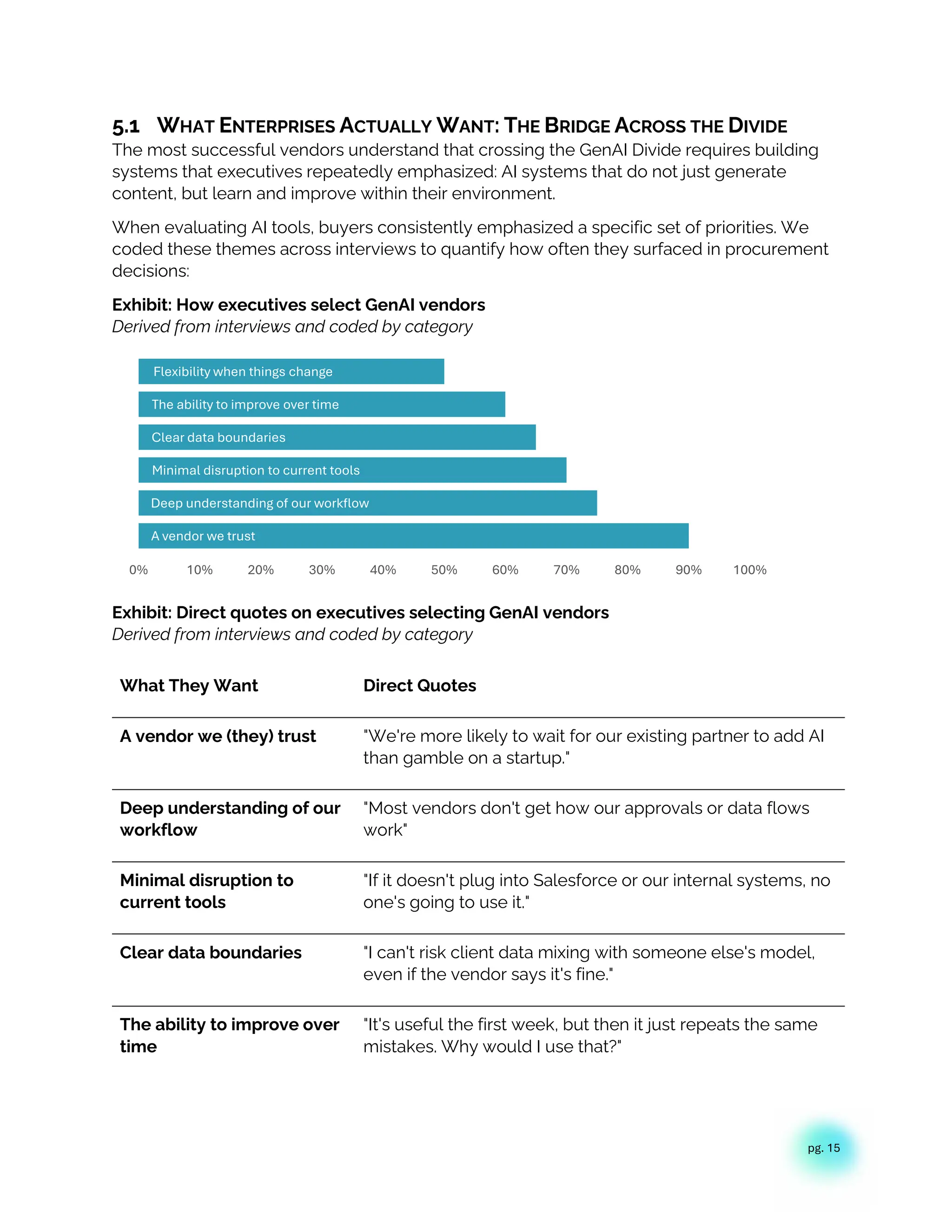
When evaluating AI tools, buyers consistently emphasized a specific set of priorities. We
coded these themes across interviews to quantify how often they surfaced in procurement
decisions:
Exhibit: How executives select GenAI vendors
Derived from interviews and coded by category
Exhibit: Direct quotes on executives selecting GenAI vendors
Derived from interviews and coded by category
What They Want Direct Quotes
A vendor we (they) trust "We're more likely to wait for our existing partner to add AI
than gamble on a startup."
Deep understanding of our
workflow
"Most vendors don't get how our approvals or data flows
work"
Minimal disruption to
current tools
"If it doesn't plug into Salesforce or our internal systems, no
one's going to use it."
Clear data boundaries "I can't risk client data mixing with someone else's model,
even if the vendor says it's fine."
The ability to improve over
time
"It's useful the first week, but then it just repeats the same
mistakes. Why would I use that?"
A vendor we trust
Deep understanding of our workflow
Minimal disruption to current tools
Clear data boundaries
The ability to improve over time
Flexibility when things change
0% 10% 20% 30% 40% 50% 60% 70% 80% 90% 100%
16.
pg. 16
Flexibility whenthings
change
"Our process evolves every quarter. If the AI can't adapt,
we're back to spreadsheets."
Concerns about workforce impact were far less common than anticipated. Most users
welcomed automation, especially for tedious, manual tasks, as long as data remained
secure and outcomes were measurable.
Despite conventional wisdom that enterprises resist training AI systems, most teams in our
interviews expressed willingness to do so, provided the benefits were clear and guardrails
were in place.
Despite interest in AI, there is notable skepticism toward emerging vendors, especially in
high-trust or regulated workflows. Many procurement leaders told us they ignore most
startup pitches, regardless of innovation.
"We receive dozens of pitches daily about AI-powered procurement tools. However, our
established BPO partner already understands our policies and processes. We're more likely to
wait for their AI-enhanced version than switch to an unknown vendor." , Head of Procurement,
Global CPG
5.2 THE WINNING PLAYBOOK FOR CROSSING THE DIVIDE
Takeaway: Startups that successfully cross the GenAI Divide land small, visible wins in
narrow workflows, then expand. Tools with low setup burden and fast time-to-value
outperform heavy enterprise builds. Channel referrals and peer trust are key growth levers
for bridging the divide.
The most successful startups addressed both the desire for learning systems and the
skepticism around new tools by executing two strategies:
5.2.1 Customizing for specific workflows
Embedding in non-critical or adjacent processes with significant customization,
demonstrating clear value, then scaling into core workflows is critical. Tools that succeeded
shared two traits: low configuration burden and immediate, visible value. In contrast, tools
requiring extensive enterprise customization often stalled at pilot stage.
Successful categories from our sample included:
• Voice AI for call summarization and routing
• Document automation for contracts and forms
• Code generation for repetitive engineering tasks
Struggling categories were often those involving complex internal logic, opaque decision
support, or optimization based on proprietary heuristics. These tools frequently hit adoption
friction due to deep enterprise specificity.
Some startups have excelled by dominating small but critical workflows, especially in sales
and marketing, and then expanding. Top-quartile GenAI startups are reaching $1.2M in
annualized revenue within 6–12 months of launch.
17.
pg. 17
Narrow ScopeBroad Scope
Simple
Execution
Fast wins (Spend Categorization,
Contract Review)
Partial pilots (Supplier Risk
Monitoring)
Complex
Execution
Early pilots (Negotiation Bots) Fails (Full Procurement
Orchestration)
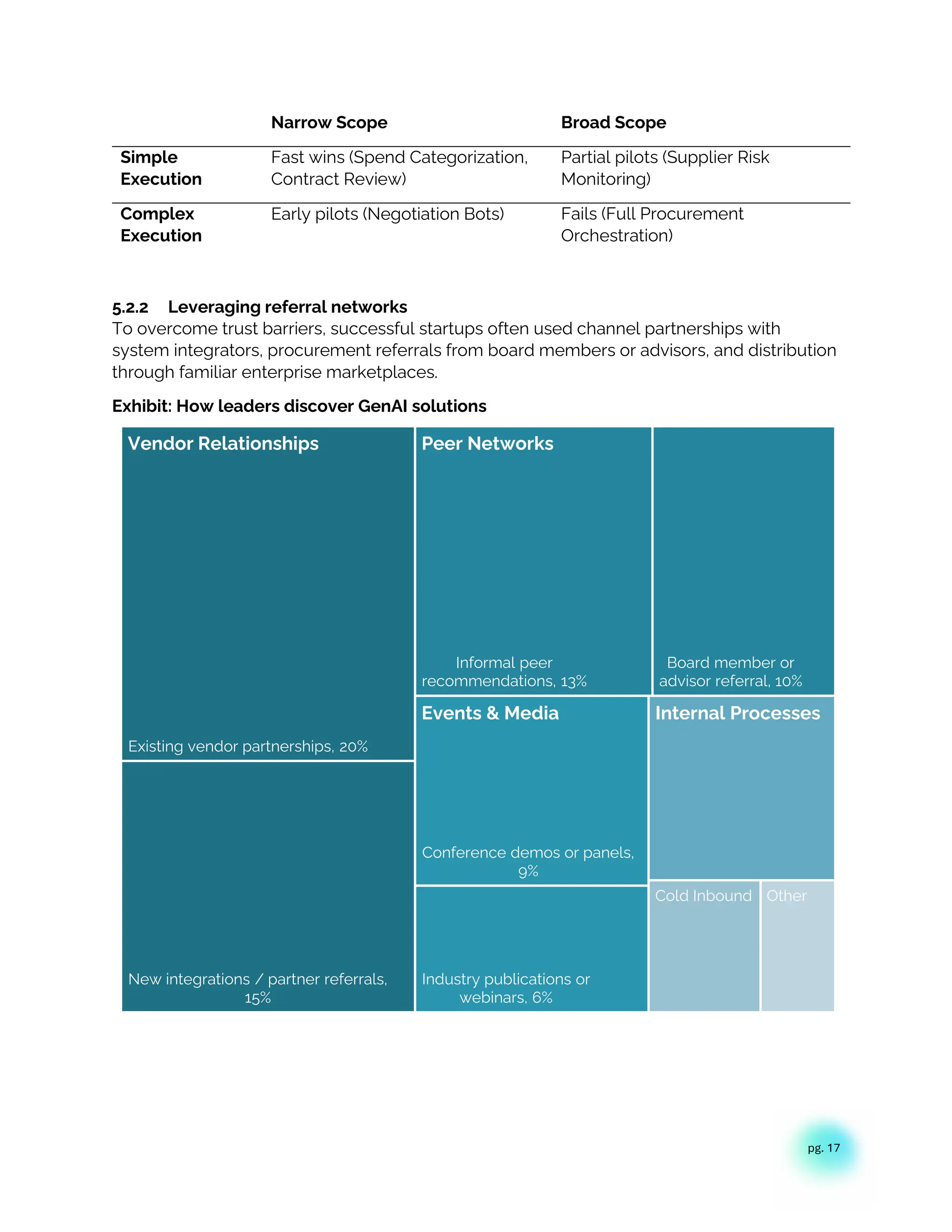
5.2.2 Leveraging referral networks
To overcome trust barriers, successful startups often used channel partnerships with
system integrators, procurement referrals from board members or advisors, and distribution
through familiar enterprise marketplaces.
Exhibit: How leaders discover GenAI solutions
Existing vendor partnerships, 20%
New integrations / partner referrals,
15%
Informal peer
recommendations, 13%
Board member or
advisor referral, 10%
Conference demos or panels,
9%
Industry publications or
webinars, 6%
Cold Inbound Other
Vendor Relationships Peer Networks
Events & Media Internal Processes
18.
pg. 18
5.3 THENARROWING WINDOW TO CROSS THE DIVIDE
Takeaway: The window for crossing the GenAI Divide is rapidly closing. Enterprises are
locking in learning-capable tools. Agentic AI and memory frameworks (like NANDA and
MCP) will define which vendors help organizations cross the divide versus remain trapped
on the wrong side.
Enterprises are increasingly demanding systems that adapt over time. Microsoft 365 Copilot
and Dynamics 365 are incorporating persistent memory and feedback loops. OpenAI's
ChatGPT memory beta signals similar expectations in general-purpose tools.
Startups that act quickly to close this gap, by building adaptive agents that learn from
feedback, usage, and outcomes, can establish durable product moats through both data
and integration depth. The window to do this is narrow. In many verticals, pilots are already
underway.
The infrastructure to support this transition is emerging through frameworks like Model
Context Protocol (MCP), Agent-to-Agent (A2A), and NANDA, which enable agent
interoperability and coordination. These protocols create market competition and cost
efficiencies by allowing specialized agents to work together rather than requiring monolithic
systems. And these frameworks form the foundation of the emerging Agentic Web, a mesh
of interoperable agents and protocols that replaces monolithic applications with dynamic
coordination layers.
In the next few quarters, several enterprises will lock in vendor relationships that will be
nearly impossible to unwind. This 18-month horizon reflects consensus from seventeen
procurement and IT sourcing leaders we interviewed, supported by analysis of public
procurement disclosures showing enterprise RFP-to-implementation cycles ranging from
two to eighteen months. Organizations investing in AI systems that learn from their data,
workflows, and feedback are creating switching costs that compound monthly.
"We're currently evaluating five different GenAI solutions, but whichever system best learns and
adapts to our specific processes will ultimately win our business. Once we've invested time in
training a system to understand our workflows, the switching costs become prohibitive." - CIO,
$5B Financial Services Firm
6 CROSSING THE GENAI DIVIDE: HOW THE BEST BUYERS
SUCCEED
Organizations that successfully cross the GenAI Divide approach AI procurement differently,
they act like BPO clients, not SaaS customers. They demand deep customization, drive
adoption from the front lines, and hold vendors accountable to business metrics. The most
successful buyers understand that crossing the divide requires partnership, not just
purchase.
Across our interviews, one insight was clear: the most effective AI-buying organizations no
longer wait for perfect use cases or central approval. Instead, they drive adoption through
19.
pg. 19
distributed experimentation,vendor partnerships, and clear accountability. These buyers
are not just more eager, they are more strategically adaptive.
In our sample, external partnerships with learning-capable, customized tools reached
deployment ~67% of the time, compared to ~33% for internally built tools. While these
figures reflect self-reported outcomes and may not account for all confounding variables,
the magnitude of difference was consistent across interviewees.
This gap explains why ChatGPT dominates for ad-hoc tasks but fails at critical workflows,
and why generic enterprise tools lose to both consumer LLMs and deeply customized
alternatives.
6.1 ORGANIZATIONAL DESIGN FOR CROSSING THE DIVIDE
Takeaway: The right organizational structure is critical for crossing the GenAI Divide.
Strategic partnerships are twice as likely to succeed as internal builds. Success depends
less on resources and more on decentralizing authority with clear ownership.
The dominant barrier to crossing the GenAI Divide is not integration or budget, it is
organizational design. Our data shows that companies succeed when they decentralize
implementation authority but retain accountability.
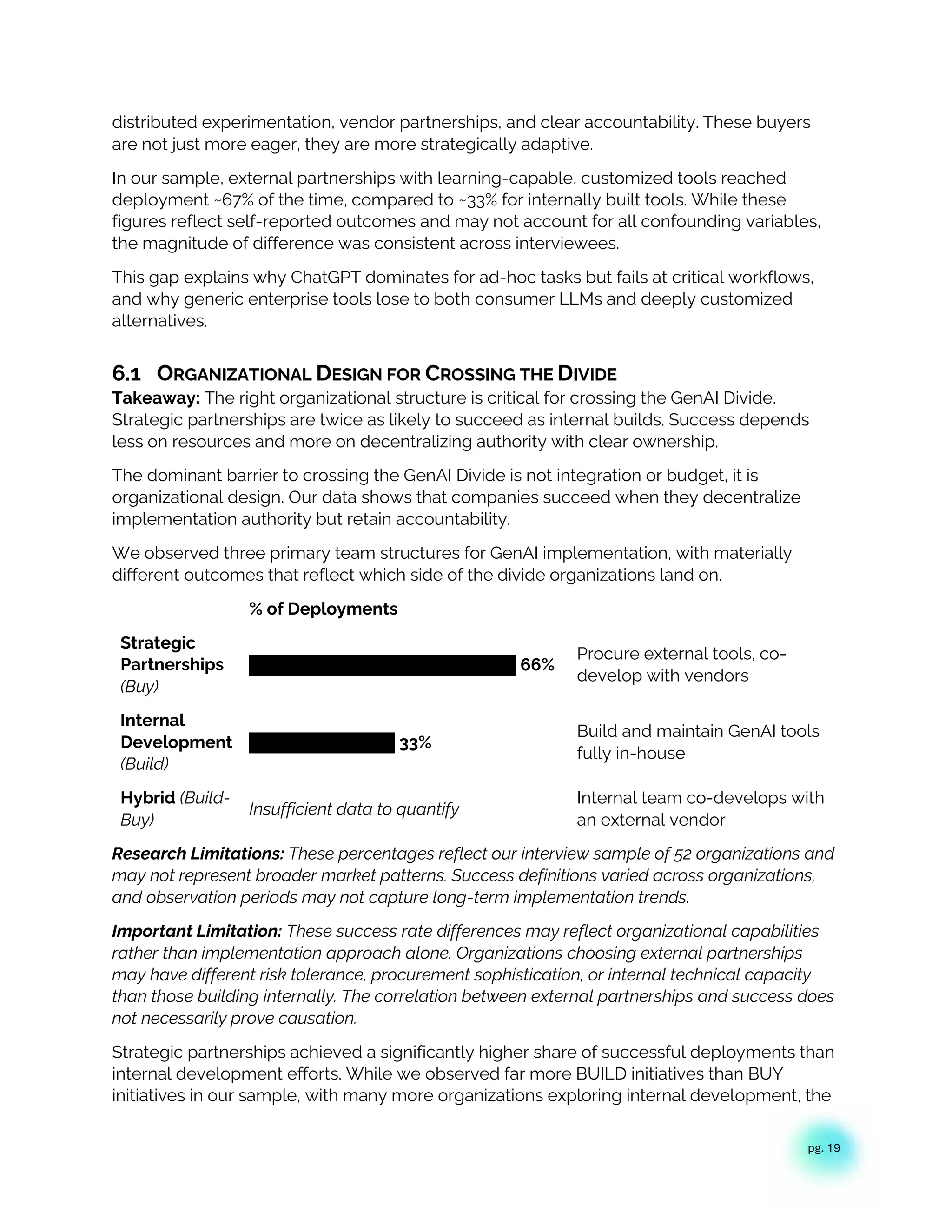
We observed three primary team structures for GenAI implementation, with materially
different outcomes that reflect which side of the divide organizations land on.
% of Deployments
Strategic
Partnerships
(Buy)
██████████████████████ 66%
Procure external tools, co-
develop with vendors
Internal
Development
(Build)
████████████ 33%
Build and maintain GenAI tools
fully in-house
Hybrid (Build-
Buy)
Insufficient data to quantify
Internal team co-develops with
an external vendor
Research Limitations: These percentages reflect our interview sample of 52 organizations and
may not represent broader market patterns. Success definitions varied across organizations,
and observation periods may not capture long-term implementation trends.
Important Limitation: These success rate differences may reflect organizational capabilities
rather than implementation approach alone. Organizations choosing external partnerships
may have different risk tolerance, procurement sophistication, or internal technical capacity
than those building internally. The correlation between external partnerships and success does
not necessarily prove causation.
Strategic partnerships achieved a significantly higher share of successful deployments than
internal development efforts. While we observed far more BUILD initiatives than BUY
initiatives in our sample, with many more organizations exploring internal development, the
20.
pg. 20
success ratesfavored external partnerships. Though we lack precise data on total initiative
volumes, the pattern suggests that internal development efforts have substantially lower
success rates despite being more commonly attempted.
While organizations often combined approaches, pilots built via strategic partnerships were
2x as likely to reach full deployment as those built internally. More strikingly, employee
usage rates were nearly double for externally built tools.
These partnerships often provided faster time-to-value, lower total cost, and better
alignment with operational workflows. Companies avoided the overhead of building from
scratch, while still achieving tailored solutions. Organizations that understand this pattern
position themselves to cross the GenAI Divide more effectively.
6.2 BUYER PRACTICES THAT CROSS THE DIVIDE
Across interviews, a consistent pattern emerged among organizations successfully crossing
the GenAI Divide: top buyers treated AI startups less like software vendors and more like
business service providers, holding them to benchmarks closer to those used for consulting
firms or BPOs. These organizations:
• Demanded deep customization aligned to internal processes and data
• Benchmarked tools on operational outcomes, not model benchmarks
• Partnered through early-stage failures, treating deployment as co-evolution
• Sourced AI initiatives from frontline managers, not central labs
In this last pattern, individual contributors and team managers often played a critical role.
Many of the strongest enterprise deployments began with power users, employees who
had already experimented with tools like ChatGPT or Claude for personal productivity.
These "prosumers" intuitively understood GenAI's capabilities and limits, and became early
champions of internally sanctioned solutions. Rather than relying on a centralized AI
function to identify use cases, successful organizations allowed budget holders and domain
managers to surface problems, vet tools, and lead rollouts. This bottom-up sourcing, paired
with executive accountability, accelerated adoption while preserving operational fit.
6.3 WHERE THE REAL ROI LIVES: BEYOND THE DIVIDE
Takeaway: Organizations that cross the GenAI Divide discover that ROI is often highest in
ignored functions like operations and finance. Real gains come from replacing BPOs and
external agencies, not cutting internal staff. Front-office tools get attention, but back-office
tools deliver savings.
Despite 50% of AI budgets flowing to sales and marketing (from the theoretical estimate
with executives), some of the most dramatic cost savings we documented came from back-
office automation. While front-office gains are visible and board-friendly, the back-office
deployments often delivered faster payback periods and clearer cost reductions.
Best-in-class organizations are generating measurable value across both areas:
Front-office wins:
21.
pg. 21
• Leadqualification speed: 40% faster
• Customer retention: 10% improvement through AI-powered follow-ups and
messaging
Back-office wins:
• BPO elimination: $2-10M annually in customer service and document processing
• Agency spend reduction: 30% decrease in external creative and content costs
• Risk checks for financial services: $1M saved annually on outsourced risk
management
Notably, these gains came without material workforce reduction. Tools accelerated work,
but did not change team structures or budgets. Instead, ROI emerged from reduced
external spend, eliminating BPO contracts, cutting agency fees, and replacing expensive
consultants with AI-powered internal capabilities.
The pattern suggests that while sales and marketing capture the majority of attention and
investment, back-office automation may offer more dramatic and sustainable returns for
organizations willing to look beyond the obvious use cases and truly cross the GenAI Divide.
6.4 THE JOB IMPACT REALITY:WHAT CROSSING THE DIVIDE ACTUALLY MEANS
Takeaway: GenAI is already starting to have workforce impact and it is manifesting through
selective displacement of previously outsourced functions and constrained hiring patterns,
but not through broad-based layoffs. Organizations that have crossed the GenAI Divide
demonstrate measurable external cost reduction while slightly decreasing internal
headcount.
6.4.1 Displacement Patterns and Organizational Strategy
Our analysis reveals that GenAI-driven workforce reductions concentrate in functions
historically treated as non-core business activities: customer support operations,
administrative processing, and standardized development tasks. These roles exhibited
vulnerability prior to AI implementation due to their outsourced status and process
standardization. Executives were hesitant to reveal the scope of layoffs due to AI but it was
between 5-20% of customer support operations and administrative processing work in
these companies.
Industry-specific hiring expectations reveal a clear correlation with GenAI impact patterns.
In sectors showing minimal structural disruption from AI, Healthcare, Energy, Advanced
Industries, most executives report no current or anticipated hiring reductions over the next
five years. A few executives mentioned that they could anticipate decreased hiring but
admitted that they currently do not have the systems in place to accurately predict when or
where it could happen. Healthcare executives, for example, express no expectation of
reducing physician or clinical staff hiring.
Conversely, in Technology and Media sectors where GenAI has demonstrated measurable
impact, >80% of executives anticipate reduced hiring volumes within 24 months.
22.
pg. 22
Critical finding:This dynamic remains concentrated among advanced AI adopters, and only
in industries that are currently experiencing significant disruption with GenAI (tech, media).
6.4.2 Evolving Hiring Criteria and Skills Requirements
GenAI adoption creates divergent hiring strategies across organizations. While executives
demonstrate no consensus regarding entry-level or general hiring volumes, they
consistently emphasize AI literacy as a fundamental capability requirement. This reflects
organizational recognition that AI proficiency represents a competitive advantage in
workflow optimization.
"Our hiring strategy prioritizes candidates who demonstrate AI tool proficiency. Recent
graduates often exceed experienced professionals in this capability." - VP of Operations, Mid-
Market Manufacturing
6.4.3 Future Workforce Impact Projections
MIT's Project Iceberg analysis provides quantitative context for potential automation
exposure:
Current automation potential: 2.27% of U.S. labor value
Latent automation exposure: $2.3 trillion in labor value affecting 39 million positions
This latent exposure becomes actionable as AI systems develop persistent memory,
continuous learning, and autonomous tool integration, capabilities that define crossing the
GenAI Divide.
Workforce transformation will occur gradually rather than through discrete displacement
events. Until AI systems achieve contextual adaptation and autonomous operation,
organizational impact will manifest through external cost optimization rather than internal
restructuring.
6.5 BEYOND AGENTS: THE AGENTIC WEB
Takeaway: The next evolution beyond individual AI agents is an agentic web where
autonomous systems can discover, negotiate, and coordinate across the entire
internet infrastructure, fundamentally changing how business processes operate.
The infrastructure foundations for this transformation are already emerging through
protocols like Model Context Protocol (MCP), Agent-to-Agent (A2A), and NANDA,
which enable not just agent interoperability but autonomous web navigation. In an
agentic web, systems will autonomously discover optimal vendors and evaluate
solutions without human research, establish dynamic API integrations in real-time
without pre-built connectors, execute trustless transactions through blockchain-
enabled smart contracts, and develop emergent workflows that self-optimize
across multiple platforms and organizational boundaries. Early experiments show
procurement agents identifying new suppliers and negotiating terms independently,
customer service systems coordinating seamlessly across platforms, and content
creation workflows spanning multiple providers with automated quality assurance
23.
pg. 23
and payment.This represents a fundamental shift from today's human-mediated
business processes to autonomous systems that operate across the entire internet
ecosystem, moving well beyond the current GenAI Divide to reshape how
organizations discover, integrate, and transact in a networked economy.
7 CONCLUSION: BRIDGING THE GENAI DIVIDE
Organizations that successfully cross the GenAI Divide do three things differently: they buy
rather than build, empower line managers rather than central labs, and select tools that
integrate deeply while adapting over time. The most forward-thinking organizations are
already experimenting with agentic systems that can learn, remember, and act
autonomously within defined parameters.
This transition marks not just a shift in tooling, but the emergence of an Agentic Web: a
persistent, interconnected layer of learning systems that collaborate across vendors,
domains, and interfaces. Where today’s enterprise stack is defined by siloed SaaS tools and
static workflows, the Agentic Web replaces these with dynamic agents capable of
negotiating tasks, sharing context, and coordinating action across the enterprise.
Just as the original Web decentralized publishing and commerce, the Agentic Web
decentralizes action, moving from prompts to autonomous protocol-driven coordination.
Systems like NANDA, MCP, and A2A represent early infrastructure for this web, enabling
organizations to compose workflows not from code, but from agent capabilities and
interactions. As enterprises begin locking in vendor relationships and feedback loops
through 2026, the window to cross the GenAI Divide is rapidly narrowing. The next wave of
adoption will be won not by the flashiest models, but by the systems that learn and
remember and/or by systems that are custom built for a specific process.
The shift from building to buying, combined with the rise of prosumer adoption and the
emergence of agentic capabilities, creates unprecedented opportunities for vendors who
can deliver learning-capable, deeply integrated AI systems. The organizations and vendors
that recognize and act on these patterns will establish the dominant positions in the post-
pilot AI economy, on the right side of the GenAI Divide.
For organizations currently trapped on the wrong side, the path forward is clear: stop
investing in static tools that require constant prompting, start partnering with vendors who
offer custom systems, and focus on workflow integration over flashy demos. The GenAI
Divide is not permanent, but crossing it requires fundamentally different choices about
technology, partnerships, and organizational design.
8 APPENDIX
8.1 ACKNOWLEDGMENTS
Produced in collaboration with Project NANDA out of MIT: NANDA (Networked Agents
And Decentralized Architecture) builds on Anthropic's Model Context Protocol (MCP) and
the Google/Linux Foundation A2A to create infrastructure for distributed agent intelligence
24.
pg. 24
at scale.Our research focuses on translating AI capabilities into measurable business
outcomes across enterprise and mid-market organizations. We acknowledge the generous
participation of executives who shared their implementation experiences and insights.
8.2 RESEARCH METHODOLOGY AND LIMITATIONS
Methodology: 52 structured interviews across enterprise stakeholders, systematic analysis
of 300+ public AI initiatives and announcements, and surveys with 153 leaders. Success
defined as deployment beyond pilot phase with measurable KPIs. ROI impact measured 6
months post-pilot, adjusted for department size. Confidence intervals calculated using
bootstrap resampling methods where applicable.
Sample Limitations:
• Our sample may not fully represent all enterprise segments or geographic regions
• Organizations willing to discuss AI implementation challenges may systematically
differ from those declining participation, potentially creating bias toward either more
experimental or more cautious adopters
• Selection bias possible in organizations willing to participate in AI research
• Success metrics vary significantly across organizations and industries, limiting direct
comparisons
Methodological Constraints:
• Industry disruption scores reflect publicly observable patterns and may not capture
private or emerging developments
• Build vs. buy percentages based on interview responses rather than comprehensive
market data
• ROI measurements complicated by concurrent operational improvements and
external economic factors
• Six-month observation period may be insufficient to fully assess "successful
deployment" for complex enterprise systems, potentially understating success rates
for longer-term implementations
External Factors Not Fully Addressed:
• Regulatory constraints affecting adoption
8.3 RESEARCH INSTRUMENTS
This study used two semi-structured protocols:
• Executive interviews focused on investment decisions, organizational design, and
vendor selection
25.
pg. 25
• Functionalleader interviews explored user preferences, workflow fit, and friction in
daily usage
A lightweight survey supplemented these interviews with quantifiable input on tool
adoption, satisfaction, and barriers.
8.3.1 Executive Interview Questionnaire
Focus: Strategy, investment, procurement, outcomes
Section 1: Strategy and Budget
1. Has your organization allocated a dedicated budget for GenAI initiatives?
2. Which business functions are currently prioritized?
3. Are there specific use cases identified for GenAI in your org?
Section 2: Buy vs Build
4. Do you primarily build internally, partner externally, or take a hybrid approach?
5. What drives that decision, cost, risk, timeline, control, etc.?
Section 3: Pilot to Scale
6. How many GenAI pilots have been launched since Jan 2024?
7. Of those, how many are now deployed at scale?
8. What were the major barriers that stalled scale-up?
Section 4: Procurement and Evaluation
9. How do you evaluate potential GenAI vendors or partners?
10. What are the most important selection criteria (e.g., trust, integration, data control)?
11. How do referrals or ecosystem partners factor into decisions?
Section 5: ROI and Outcomes
12. Have you observed measurable ROI from any GenAI deployment?
13. Which metrics (cost savings, productivity, customer retention) were used?
14. Were there specific back-office or front-office gains?
Section 6: Workforce and Governance
15. Have you reduced headcount due to GenAI?
16. Who leads implementation efforts (e.g., IT, line managers, AI CoE)?
17. How are responsibilities distributed across teams?
8.3.2 Functional Leader / User Interview Questionnaire
Focus: Tool usability, friction, and performance in day-to-day workflows
26.
pg. 26
Section 1:Personal Use and Preferences
1. Do you personally use GenAI tools like ChatGPT or Claude? For what tasks?
2. Do you use internal GenAI tools at work? How do they compare?
Section 2: Enterprise Tool Experience
3. What GenAI tools have been introduced by your organization?
4. How frequently do you use them?
5. What's working well? What's frustrating?
Section 3: Workflow Fit
6. Do these tools integrate with your core systems (e.g., CRM, internal portals)?
7. Do they adapt to your workflow over time or feel static?
8. Have you seen them improve from user feedback?
Section 4: Task Type Preferences
9. For [X use case: email, doc drafting, research, etc.], would you prefer AI or a human
colleague?
10. What kinds of tasks do you trust AI with? What kinds do you avoid?
Section 5: Adoption Barriers
11. What stops you or your colleagues from using these tools more often?
12. Are training, UX, or trust in outputs major issues?
[1] Project Iceberg - Are you living under the Agentic API?
![pg. 26
Section 1: Personal Use and Preferences
1. Do you personally use GenAI tools like ChatGPT or Claude? For what tasks?
2. Do you use internal GenAI tools at work? How do they compare?
Section 2: Enterprise Tool Experience
3. What GenAI tools have been introduced by your organization?
4. How frequently do you use them?
5. What's working well? What's frustrating?
Section 3: Workflow Fit
6. Do these tools integrate with your core systems (e.g., CRM, internal portals)?
7. Do they adapt to your workflow over time or feel static?
8. Have you seen them improve from user feedback?
Section 4: Task Type Preferences
9. For [X use case: email, doc drafting, research, etc.], would you prefer AI or a human
colleague?
10. What kinds of tasks do you trust AI with? What kinds do you avoid?
Section 5: Adoption Barriers
11. What stops you or your colleagues from using these tools more often?
12. Are training, UX, or trust in outputs major issues?
[1] Project Iceberg - Are you living under the Agentic API?](https://image.slidesharecdn.com/v0-250831033518-dd7bb1a4/75/State-of-AI-in-Business-2025-MIT-NANDA-26-2048.jpg)


![State of the VC Market - Untapped Capital [Redacted]](https://cdn.slidesharecdn.com/ss_thumbnails/stateofthevcmarket-untappedcapitalredacted-251121032845-0feab568-thumbnail.jpg?width=640&height=640&fit=bounds)


![Coded Agents – with UiPath SDK + LangGraph [Virtual Hands-on Workshop]](https://cdn.slidesharecdn.com/ss_thumbnails/codedagentsdeck-251215155422-5497c599-thumbnail.jpg?width=640&height=640&fit=bounds)


