Go Graphic!
• Fall VEMA Conference 2010
• Nancy Hally
Longdale Elementary School
Glen Allen, VA
Henrico County Public Schools
My Background
• B.S. in Elementary Ed. Indiana
University of PA
• M.S. in Reading/Language Arts
Duquesne University
• School Library Media certification
Longwood University
• 3 years Reading Specialist, Title
One
• 22 years classroom teacher,
ranging 1-8
• 3rd year School Librarian Pre-K-5
My goal:
• alleviate some anxiety
about purchasing graphic
novels for your library
• introduce you to some that
have been hits in my
library and I think are
pretty “safe”
Beach Reading...
...think of your favorite type of
book to relax at the beach
with...
Was it...
• Wuthering Heights?
• War and Peace?
• Canterbury Tales?
• See Spot Run?
In most cases...
• It most likely isn’t something
heavy, deep, or extra long.
NCLB
• stronger push for skills,
accountability, testing,
testing, testing
• what about the PLEASURE of
reading?
Reading:
Insights from the
Research
Insights from the
Research
• Stephen D. Krashen, Libraries
Unlimited, 2004
• Free Voluntary Reading (FVR)
Reading for
Pleasure=
• major attitude adjustment
toward reading
• if we like something, aren’t
we more likely to do it?
• more reading yields better
reading and writing
CHOICE IS IMPORTANT!
(Ben Carson)
(Ben Carson)
• currently a neurosurgeon
• very poor childhood, single mom
• 2 books per week from
library/his choice, had to
report to mom weekly
• went from being poor student to
top of his class
What Kids Like to
Read
• scary stories
• comic books
• graphic novels
• whatever their peers are
reading
GRAPHIC NOVELS
• comic format
• longer than comic book
• beginning, middle, end
• can be part of series
• trade paperback or hardcover
It’s just a FORMAT
• in all genres
• multiple panels/pictures per
page
• appeals to kids across the
board: genders, reading
abilities, socioeconomic
backgrounds, ethnic groups
Common Concerns
• graphic novels/comics not good
literature
• will keep kids from reading
classics
• will not help improve literacy
Facts
• current comics contain average
of 2,000 words/issue
• one comic book/day=500,000
words/year
p. 95-97 The Power of Reading: Insights from the Research
Benefits
• reading of graphic novels can
be more cognitively
challenging (visual literacy)
• graphic novels, comics can
lure reluctant readers
• confidence built from graphic
novels/comics can lead to
reading of more difficult text
My Experience
• Suburban school
• Title One/low socioeconomicgroup
• read articles, attendedpresentation
• explored Follett, read MANYreviews
• read graphic novels, orderedsome
• presented to teachers/staff
• ARRA money
Some Suggested
Titles:
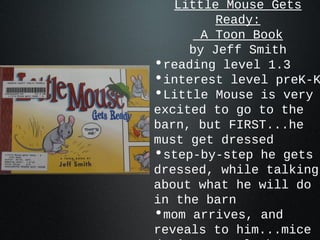
Little Mouse Gets
Ready:
A Toon Book
by Jeff Smith
•reading level 1.3
•interest level preK-K
•Little Mouse is very
excited to go to the
barn, but FIRST...he
must get dressed
•step-by-step he gets
dressed, while talking
about what he will do
in the barn
•mom arrives, and
reveals to him...mice
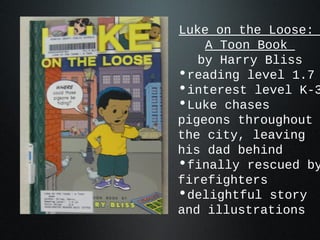
Luke on the Loose:
A Toon Book
by Harry Bliss
•reading level 1.7
•interest level K-3
•Luke chases
pigeons throughout
the city, leaving
his dad behind
•finally rescued by
firefighters
•delightful story
and illustrations
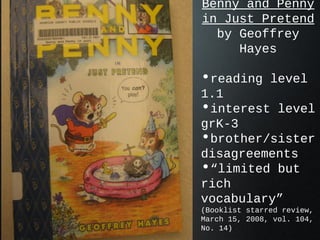
Benny and Penny
in Just Pretend
by Geoffrey
Hayes
•reading level
1.1
•interest level
grK-3
•brother/sister
disagreements
•“limited but
rich
vocabulary”
(Booklist starred review,
March 15, 2008, vol. 104,
No. 14)
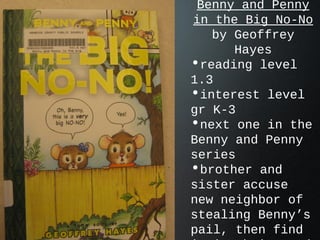
Benny and Penny
in the Big No-No
by Geoffrey
Hayes
•reading level
1.3
•interest level
gr K-3
•next one in the
Benny and Penny
series
•brother and
sister accuse
new neighbor of
stealing Benny’s
pail, then find
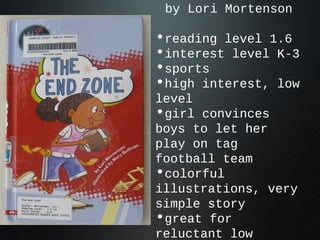
by Lori Mortenson
•reading level 1.6
•interest level K-3
•sports
•high interest, low
level
•girl convinces
boys to let her
play on tag
football team
•colorful
illustrations, very
simple story
•great for
reluctant low
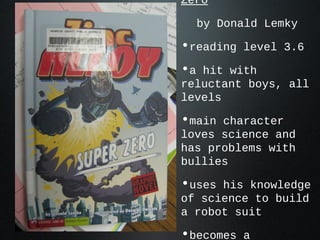
Zero
by Donald Lemky
•reading level 3.6
•a hit with
reluctant boys, all
levels
•main character
loves science and
has problems with
bullies
•uses his knowledge
of science to build
a robot suit
•becomes a
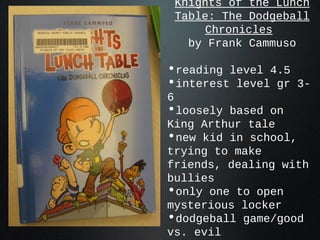
Knights of the Lunch
Table: The Dodgeball
Chronicles
by Frank Cammuso
•reading level 4.5
•interest level gr 3-
6
•loosely based on
King Arthur tale
•new kid in school,
trying to make
friends, dealing with
bullies
•only one to open
mysterious locker
•dodgeball game/good
vs. evil
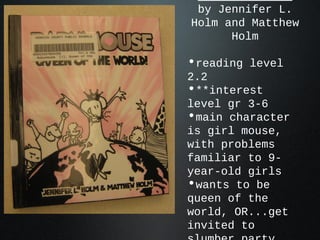
by Jennifer L.
Holm and Matthew
Holm
•reading level
2.2
•**interest
level gr 3-6
•main character
is girl mouse,
with problems
familiar to 9-
year-old girls
•wants to be
queen of the
world, OR...get
invited to
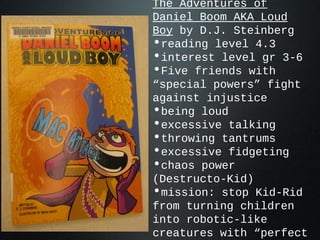
The Adventures of
Daniel Boom AKA Loud
Boy by D.J. Steinberg
•reading level 4.3
•interest level gr 3-6
•Five friends with
“special powers” fight
against injustice
•being loud
•excessive talking
•throwing tantrums
•excessive fidgeting
•chaos power
(Destructo-Kid)
•mission: stop Kid-Rid
from turning children
into robotic-like
creatures with “perfect
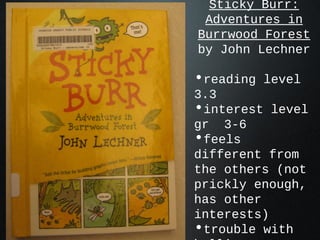
Sticky Burr:
Adventures in
Burrwood Forest
by John Lechner
•reading level
3.3
•interest level
gr 3-6
•feels
different from
the others (not
prickly enough,
has other
interests)
•trouble with
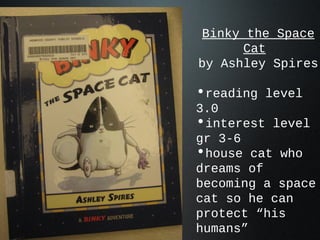
Binky the Space
Cat
by Ashley Spires
•reading level
3.0
•interest level
gr 3-6
•house cat who
dreams of
becoming a space
cat so he can
protect “his
humans”
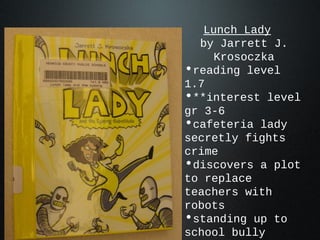
Lunch Lady
by Jarrett J.
Krosoczka
•reading level
1.7
•**interest level
gr 3-6
•cafeteria lady
secretly fights
crime
•discovers a plot
to replace
teachers with
robots
•standing up to
school bully
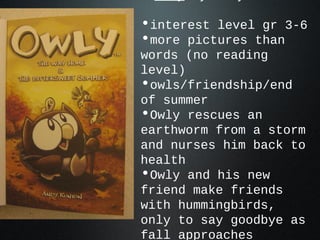
•interest level gr 3-6
•more pictures than
words (no reading
level)
•owls/friendship/end
of summer
•Owly rescues an
earthworm from a storm
and nurses him back to
health
•Owly and his new
friend make friends
with hummingbirds,
only to say goodbye as
fall approaches
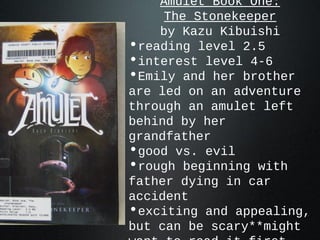
Amulet Book One:
The Stonekeeper
by Kazu Kibuishi
•reading level 2.5
•interest level 4-6
•Emily and her brother
are led on an adventure
through an amulet left
behind by her
grandfather
•good vs. evil
•rough beginning with
father dying in car
accident
•exciting and appealing,
but can be scary**might
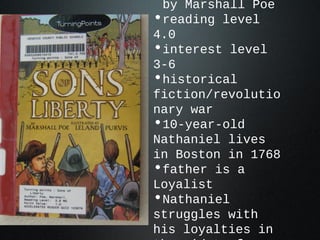
by Marshall Poe
•reading level
4.0
•interest level
3-6
•historical
fiction/revolutio
nary war
•10-year-old
Nathaniel lives
in Boston in 1768
•father is a
Loyalist
•Nathaniel
struggles with
his loyalties in
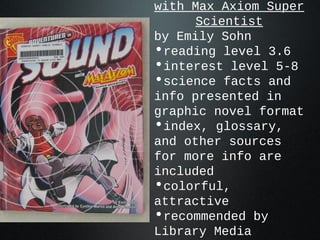
with Max Axiom Super
Scientist
by Emily Sohn
•reading level 3.6
•interest level 5-8
•science facts and
info presented in
graphic novel format
•index, glossary,
and other sources
for more info are
included
•colorful,
attractive
•recommended by
Library Media
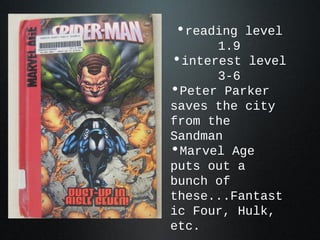
•reading level
1.9
•interest level
3-6
•Peter Parker
saves the city
from the
Sandman
•Marvel Age
puts out a
bunch of
these...Fantast
ic Four, Hulk,
etc.
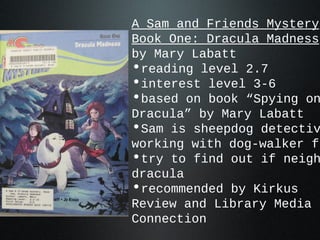
A Sam and Friends Mystery
Book One: Dracula Madness
by Mary Labatt
•reading level 2.7
•interest level 3-6
•based on book “Spying on
Dracula” by Mary Labatt
•Sam is sheepdog detectiv
working with dog-walker fr
•try to find out if neigh
dracula
•recommended by Kirkus
Review and Library Media
Connection
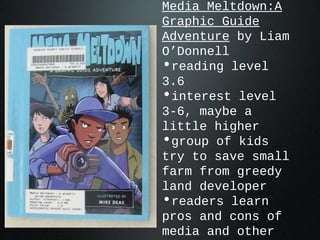
Media Meltdown:A
Graphic Guide
Adventure by Liam
O’Donnell
•reading level
3.6
•interest level
3-6, maybe a
little higher
•group of kids
try to save small
farm from greedy
land developer
•readers learn
pros and cons of
media and other
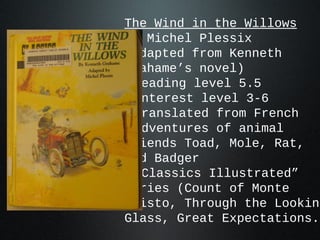
The Wind in the Willows
by Michel Plessix
(adapted from Kenneth
Grahame’s novel)
•reading level 5.5
•interest level 3-6
•translated from French
•adventures of animal
friends Toad, Mole, Rat,
and Badger
•“Classics Illustrated”
series (Count of Monte
Cristo, Through the Looking
Glass, Great Expectations..
Manga
• Japanese origin
• adapted from Animae
• begin in back of book
• read right to left
• Action/adventure
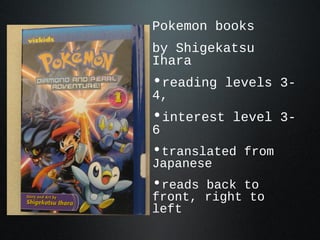
Pokemon books
by Shigekatsu
Ihara
•reading levels 3-
4,
•interest level 3-
6
•translated from
Japanese
•reads back to
front, right to
left
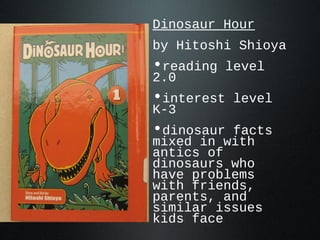
Dinosaur Hour
by Hitoshi Shioya
•reading level
2.0
•interest level
K-3
•dinosaur facts
mixed in with
antics of
dinosaurs who
have problems
with friends,
parents, and
similar issues
kids face
How/Where to Shelve?
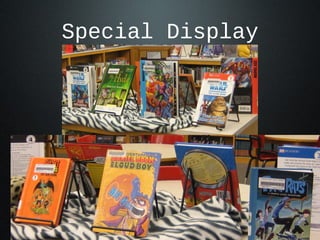
• Special area or display
• many in 741.5, others
depending on main topic
(scientific, historical, etc.)
• my decision
Special Display
Web Sites• Cooperative Children’s Book Center,
School of Education, University of
Wisconsin, Madison
• links to awards and recommended
lists
• reviews
• resources for “Understanding,
Using, and Defending” graphic
novels
• suggested articles for further
• Reading Online, “An Electronic
Journal of the International
Reading Association”
• provides a background article on
graphic novels and some resources
for further study
• Create Your Own Comic
• Can create a 1-3 panel comic strip
or a whole comic book
• major superheroes, dialogue
balloons, sound effect words (BAM,
WHUMP, etc.)
• Professor Garfield
• Great site! Lots of fun reading-
related stuff
• Comics Lab(Create simple comic
strip)
• Comics Lab Extreme (Create own
graphic novel)
READ AROUND!
QUESTIONS/COMMENTS?
DOOR PRIZE!!!
Bibliography
• Cleaver, Samantha. "Ms. Grundy's Right! You Can Teach
Reading with Comics & Graphic Novels." Instructor.
May/June (2008): 29-34 Print.
• Haynes, Elizabeth. "Getting Started with Graphic Novels in
School Libraries." Library Media Connection.
January/February (2009): 10-11. Print.
• Krashen, Stephen D. The Power of Reading: Insights from
the Research. 2nd. Westport, CT: Libraries Unlimited, 2004.
5-110. Print.
• Lyga, Allyson A.W. "Graphic Novels for (Really) Young
Readers." School Library Journal. March (2006): 56-61.
Print.
• Nylund, Carol. "Selecting Mangas and Graphic Novels."
Library Media Connection. 25.February (2007): 30. Print.
Bibliography (cont.)• O'English, Lorena, J. Gregory Matthews, and Elizabeth
Blakesly Lindsay. "Graphic Novels in Academic
Libraries: From Maus to Manga and Beyond." Journal
of Adademic Librarianship. 32.2 (2006): 173-182.
Print.
• Rudiger, Hollis Margaret, and Megan Schliesman.
"Graphic Novels and School Libraries." Knowledge
Quest. 36.2 (2007): 57-59. Print.
• Samet, Raya. "Get Graphic Novels into your
Elementary Collection." School Library Monthly. 26.5
(2010): 12-13. Print.
• Seyfried, Jonathan. "Reinventing the Book Club."
Knowledge Quest. 36.3 (2008): 44-48. Print.

Graphnov vema 1

  • 1.
    Go Graphic! • FallVEMA Conference 2010 • Nancy Hally Longdale Elementary School Glen Allen, VA Henrico County Public Schools
  • 2.
    My Background • B.S.in Elementary Ed. Indiana University of PA • M.S. in Reading/Language Arts Duquesne University • School Library Media certification Longwood University • 3 years Reading Specialist, Title One • 22 years classroom teacher, ranging 1-8 • 3rd year School Librarian Pre-K-5
  • 3.
    My goal: • alleviatesome anxiety about purchasing graphic novels for your library • introduce you to some that have been hits in my library and I think are pretty “safe”
  • 4.
    Beach Reading... ...think ofyour favorite type of book to relax at the beach with...
  • 5.
    Was it... • WutheringHeights? • War and Peace? • Canterbury Tales? • See Spot Run?
  • 6.
    In most cases... •It most likely isn’t something heavy, deep, or extra long.
  • 7.
    NCLB • stronger pushfor skills, accountability, testing, testing, testing • what about the PLEASURE of reading?
  • 8.
    Reading: Insights from the Research Insightsfrom the Research • Stephen D. Krashen, Libraries Unlimited, 2004 • Free Voluntary Reading (FVR)
  • 9.
    Reading for Pleasure= • majorattitude adjustment toward reading • if we like something, aren’t we more likely to do it? • more reading yields better reading and writing
  • 10.
    CHOICE IS IMPORTANT! (BenCarson) (Ben Carson) • currently a neurosurgeon • very poor childhood, single mom • 2 books per week from library/his choice, had to report to mom weekly • went from being poor student to top of his class
  • 11.
    What Kids Liketo Read • scary stories • comic books • graphic novels • whatever their peers are reading
  • 12.
    GRAPHIC NOVELS • comicformat • longer than comic book • beginning, middle, end • can be part of series • trade paperback or hardcover
  • 13.
    It’s just aFORMAT • in all genres • multiple panels/pictures per page • appeals to kids across the board: genders, reading abilities, socioeconomic backgrounds, ethnic groups
  • 14.
    Common Concerns • graphicnovels/comics not good literature • will keep kids from reading classics • will not help improve literacy
  • 15.
    Facts • current comicscontain average of 2,000 words/issue • one comic book/day=500,000 words/year p. 95-97 The Power of Reading: Insights from the Research
  • 16.
    Benefits • reading ofgraphic novels can be more cognitively challenging (visual literacy) • graphic novels, comics can lure reluctant readers • confidence built from graphic novels/comics can lead to reading of more difficult text
  • 17.
    My Experience • Suburbanschool • Title One/low socioeconomicgroup • read articles, attendedpresentation • explored Follett, read MANYreviews • read graphic novels, orderedsome • presented to teachers/staff • ARRA money
  • 18.
  • 19.
    Little Mouse Gets Ready: AToon Book by Jeff Smith •reading level 1.3 •interest level preK-K •Little Mouse is very excited to go to the barn, but FIRST...he must get dressed •step-by-step he gets dressed, while talking about what he will do in the barn •mom arrives, and reveals to him...mice
  • 20.
    Luke on theLoose: A Toon Book by Harry Bliss •reading level 1.7 •interest level K-3 •Luke chases pigeons throughout the city, leaving his dad behind •finally rescued by firefighters •delightful story and illustrations
  • 21.
    Benny and Penny inJust Pretend by Geoffrey Hayes •reading level 1.1 •interest level grK-3 •brother/sister disagreements •“limited but rich vocabulary” (Booklist starred review, March 15, 2008, vol. 104, No. 14)
  • 22.
    Benny and Penny inthe Big No-No by Geoffrey Hayes •reading level 1.3 •interest level gr K-3 •next one in the Benny and Penny series •brother and sister accuse new neighbor of stealing Benny’s pail, then find
  • 23.
    by Lori Mortenson •readinglevel 1.6 •interest level K-3 •sports •high interest, low level •girl convinces boys to let her play on tag football team •colorful illustrations, very simple story •great for reluctant low
  • 24.
    Zero by Donald Lemky •readinglevel 3.6 •a hit with reluctant boys, all levels •main character loves science and has problems with bullies •uses his knowledge of science to build a robot suit •becomes a
  • 25.
    Knights of theLunch Table: The Dodgeball Chronicles by Frank Cammuso •reading level 4.5 •interest level gr 3- 6 •loosely based on King Arthur tale •new kid in school, trying to make friends, dealing with bullies •only one to open mysterious locker •dodgeball game/good vs. evil
  • 26.
    by Jennifer L. Holmand Matthew Holm •reading level 2.2 •**interest level gr 3-6 •main character is girl mouse, with problems familiar to 9- year-old girls •wants to be queen of the world, OR...get invited to
  • 27.
    The Adventures of DanielBoom AKA Loud Boy by D.J. Steinberg •reading level 4.3 •interest level gr 3-6 •Five friends with “special powers” fight against injustice •being loud •excessive talking •throwing tantrums •excessive fidgeting •chaos power (Destructo-Kid) •mission: stop Kid-Rid from turning children into robotic-like creatures with “perfect
  • 28.
    Sticky Burr: Adventures in BurrwoodForest by John Lechner •reading level 3.3 •interest level gr 3-6 •feels different from the others (not prickly enough, has other interests) •trouble with
  • 29.
    Binky the Space Cat byAshley Spires •reading level 3.0 •interest level gr 3-6 •house cat who dreams of becoming a space cat so he can protect “his humans”
  • 30.
    Lunch Lady by JarrettJ. Krosoczka •reading level 1.7 •**interest level gr 3-6 •cafeteria lady secretly fights crime •discovers a plot to replace teachers with robots •standing up to school bully
  • 31.
    •interest level gr3-6 •more pictures than words (no reading level) •owls/friendship/end of summer •Owly rescues an earthworm from a storm and nurses him back to health •Owly and his new friend make friends with hummingbirds, only to say goodbye as fall approaches
  • 32.
    Amulet Book One: TheStonekeeper by Kazu Kibuishi •reading level 2.5 •interest level 4-6 •Emily and her brother are led on an adventure through an amulet left behind by her grandfather •good vs. evil •rough beginning with father dying in car accident •exciting and appealing, but can be scary**might
  • 33.
    by Marshall Poe •readinglevel 4.0 •interest level 3-6 •historical fiction/revolutio nary war •10-year-old Nathaniel lives in Boston in 1768 •father is a Loyalist •Nathaniel struggles with his loyalties in
  • 34.
    with Max AxiomSuper Scientist by Emily Sohn •reading level 3.6 •interest level 5-8 •science facts and info presented in graphic novel format •index, glossary, and other sources for more info are included •colorful, attractive •recommended by Library Media
  • 35.
    •reading level 1.9 •interest level 3-6 •PeterParker saves the city from the Sandman •Marvel Age puts out a bunch of these...Fantast ic Four, Hulk, etc.
  • 36.
    A Sam andFriends Mystery Book One: Dracula Madness by Mary Labatt •reading level 2.7 •interest level 3-6 •based on book “Spying on Dracula” by Mary Labatt •Sam is sheepdog detectiv working with dog-walker fr •try to find out if neigh dracula •recommended by Kirkus Review and Library Media Connection
  • 37.
    Media Meltdown:A Graphic Guide Adventureby Liam O’Donnell •reading level 3.6 •interest level 3-6, maybe a little higher •group of kids try to save small farm from greedy land developer •readers learn pros and cons of media and other
  • 38.
    The Wind inthe Willows by Michel Plessix (adapted from Kenneth Grahame’s novel) •reading level 5.5 •interest level 3-6 •translated from French •adventures of animal friends Toad, Mole, Rat, and Badger •“Classics Illustrated” series (Count of Monte Cristo, Through the Looking Glass, Great Expectations..
  • 39.
    Manga • Japanese origin •adapted from Animae • begin in back of book • read right to left • Action/adventure
  • 40.
    Pokemon books by Shigekatsu Ihara •readinglevels 3- 4, •interest level 3- 6 •translated from Japanese •reads back to front, right to left
  • 41.
    Dinosaur Hour by HitoshiShioya •reading level 2.0 •interest level K-3 •dinosaur facts mixed in with antics of dinosaurs who have problems with friends, parents, and similar issues kids face
  • 42.
    How/Where to Shelve? •Special area or display • many in 741.5, others depending on main topic (scientific, historical, etc.) • my decision
  • 43.
  • 44.
    Web Sites• CooperativeChildren’s Book Center, School of Education, University of Wisconsin, Madison • links to awards and recommended lists • reviews • resources for “Understanding, Using, and Defending” graphic novels • suggested articles for further
  • 45.
    • Reading Online,“An Electronic Journal of the International Reading Association” • provides a background article on graphic novels and some resources for further study
  • 46.
    • Create YourOwn Comic • Can create a 1-3 panel comic strip or a whole comic book • major superheroes, dialogue balloons, sound effect words (BAM, WHUMP, etc.)
  • 47.
    • Professor Garfield •Great site! Lots of fun reading- related stuff • Comics Lab(Create simple comic strip) • Comics Lab Extreme (Create own graphic novel)
  • 48.
  • 49.
  • 50.
  • 51.
    Bibliography • Cleaver, Samantha."Ms. Grundy's Right! You Can Teach Reading with Comics & Graphic Novels." Instructor. May/June (2008): 29-34 Print. • Haynes, Elizabeth. "Getting Started with Graphic Novels in School Libraries." Library Media Connection. January/February (2009): 10-11. Print. • Krashen, Stephen D. The Power of Reading: Insights from the Research. 2nd. Westport, CT: Libraries Unlimited, 2004. 5-110. Print. • Lyga, Allyson A.W. "Graphic Novels for (Really) Young Readers." School Library Journal. March (2006): 56-61. Print. • Nylund, Carol. "Selecting Mangas and Graphic Novels." Library Media Connection. 25.February (2007): 30. Print.
  • 52.
    Bibliography (cont.)• O'English,Lorena, J. Gregory Matthews, and Elizabeth Blakesly Lindsay. "Graphic Novels in Academic Libraries: From Maus to Manga and Beyond." Journal of Adademic Librarianship. 32.2 (2006): 173-182. Print. • Rudiger, Hollis Margaret, and Megan Schliesman. "Graphic Novels and School Libraries." Knowledge Quest. 36.2 (2007): 57-59. Print. • Samet, Raya. "Get Graphic Novels into your Elementary Collection." School Library Monthly. 26.5 (2010): 12-13. Print. • Seyfried, Jonathan. "Reinventing the Book Club." Knowledge Quest. 36.3 (2008): 44-48. Print.