



















Teri (and Karin) Talk Books:
Where to Find Them,
How to Use Them
Region X
May 2015
Slideshare.net/Prof
essorNana
OUR DAY AT A GLANCE
• Picture books
Mentor texts
Introduce
concepts and
lessons and
objectives
Create found
poems, highlight,
blackout poetry
• Promoting
reading
Booktalking new
and older books
Displays that grab
attention and add
to circulation
Read alouds that
take little time
AND LOTS OF
NEW BOOKS
Teri Lesesne
(rhymes with insane)
• @professornana
• LS5385blog.blogspot.com
• Professornana.livejournal.com
• doctorL@shsu.edu
Karin Perry
• @kperry
• http://www.karinsbooknook.com
• http://karinlibrarian.tumblr.com
• kperry@shsu.edu
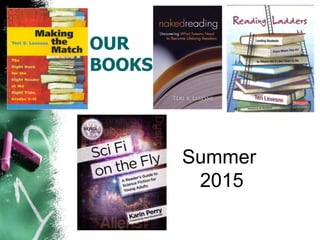
OUR
BOOKS
Summer
2015
Our Reading
Lives
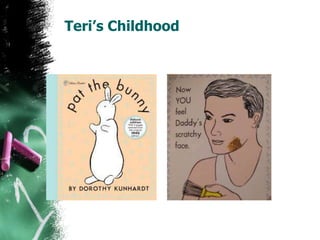
Teri’s Childhood
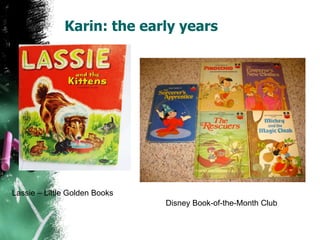
Karin: the early years
Lassie – Little Golden Books
Disney Book-of-the-Month Club
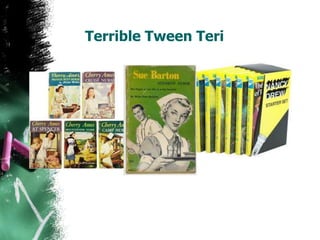
Terrible Tween Teri
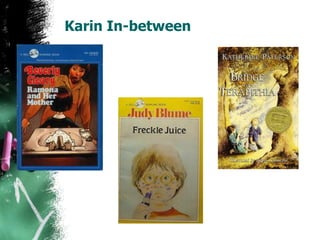
Karin In-between
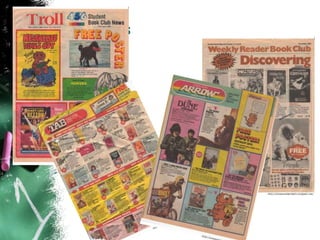
Book Orders
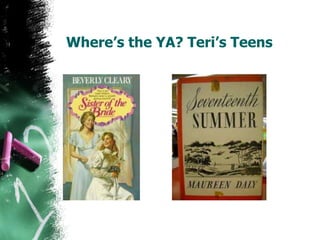
Where’s the YA? Teri’s Teens
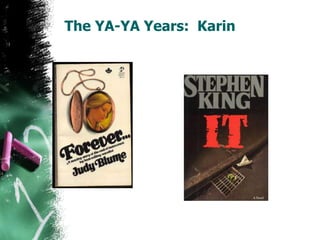
The YA-YA Years: Karin
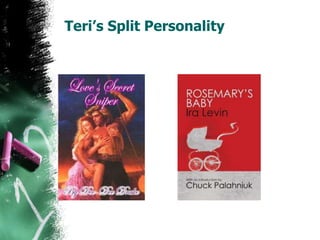
Teri’s Split Personality
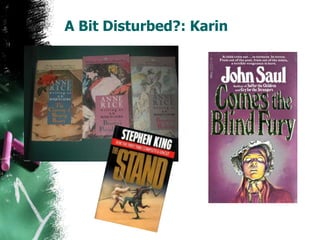
A Bit Disturbed?: Karin
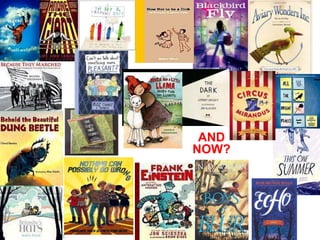
AND
NOW?
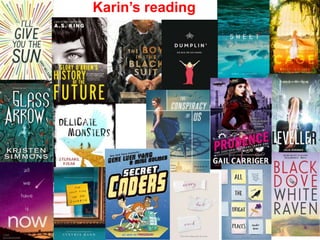
Karin’s reading
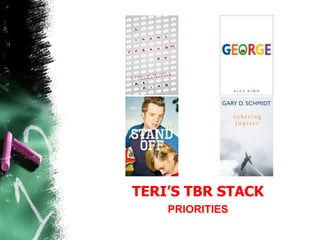
TERI’S TBR STACK
PRIORITIES
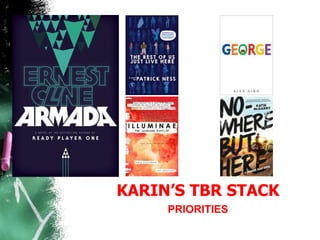
KARIN’S TBR STACK
PRIORITIES
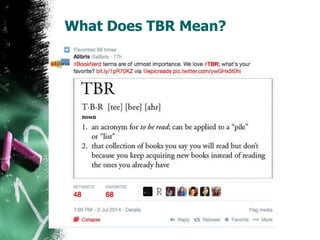
What Does TBR Mean?
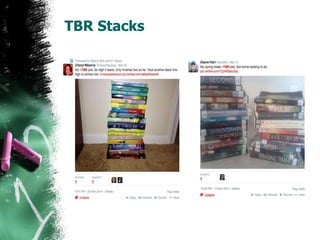
TBR Stacks
• Recommendation from our Voxer group
• Cover
• Title
• Author
• Blurb
• Review
• Genre
Setting up our TBR Stack/Shelf
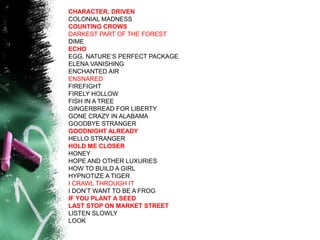
RECOMMENDED BEST BOOKS
2015
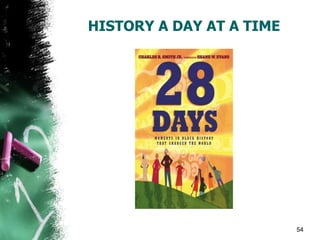
28 DAYS
A COURT OF THORNS AND ROSES
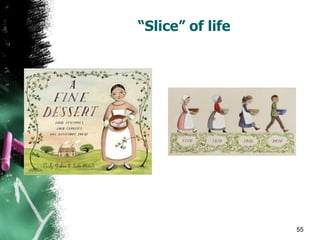
A FINE DESSERT
A SENSE OF THE INFINITE
ALL THE BRIGHT PLACES
ALL THE ANSWERS
ALL THE RAGE
AN EMBER IN THE ASHES
ARES, BRINGER OF WAR
AUDACITY
BACKLASH
BIRD & DIZ
BONE GAP
BREAKOUT
CAT AND BUNNY
CHALLENGER DEEP
CHASING FREEDOM
CIRCUS MIRANDUS
CHARACTER, DRIVEN
COLONIAL MADNESS
COUNTING CROWS
DARKEST PART OF THE FOREST
DIME
ECHO
EGG, NATURE’S PERFECT PACKAGE
ELENA VANISHING
ENCHANTED AIR
ENSNARED
FIREFIGHT
FIRELY HOLLOW
FISH IN A TREE
GINGERBREAD FOR LIBERTY
GONE CRAZY IN ALABAMA
GOODBYE STRANGER
GOODNIGHT ALREADY
HELLO STRANGER
HOLD ME CLOSER
HONEY
HOPE AND OTHER LUXURIES
HOW TO BUILD A GIRL
HYPNOTIZE A TIGER
I CRAWL THROUGH IT
I DON’T WANT TO BE A FROG
IF YOU PLANT A SEED
LAST STOP ON MARKET STREET
LISTEN SLOWLY
LOOK
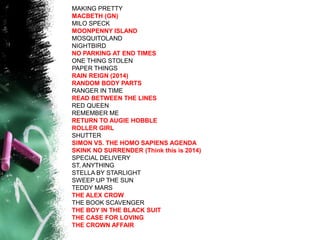
MAKING PRETTY
MACBETH (GN)
MILO SPECK
MOONPENNY ISLAND
MOSQUITOLAND
NIGHTBIRD
NO PARKING AT END TIMES
ONE THING STOLEN
PAPER THINGS
RAIN REIGN (2014)
RANDOM BODY PARTS
RANGER IN TIME
READ BETWEEN THE LINES
RED QUEEN
REMEMBER ME
RETURN TO AUGIE HOBBLE
ROLLER GIRL
SHUTTER
SIMON VS. THE HOMO SAPIENS AGENDA
SKINK NO SURRENDER (Think this is 2014)
SPECIAL DELIVERY
ST. ANYTHING
STELLA BY STARLIGHT
SWEEP UP THE SUN
TEDDY MARS
THE ALEX CROW
THE BOOK SCAVENGER
THE BOY IN THE BLACK SUIT
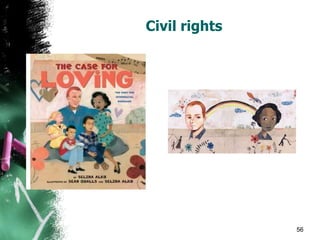
THE CASE FOR LOVING
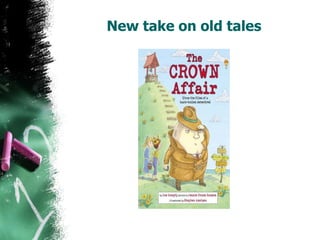
THE CROWN AFFAIR
THE DEATH OF THE HAT
THE GAME OF LOVE AND DEATH
THE GRIMM’S TALE
THE HANDLESS MAIDEN
THE HERO OF ROOM 138
THE LAST TIME WE SAY GOODBYE
THE NEW SMALL PERSON
THE HONEST TRUTH
THE RAT WITH THE HUMAN FACE
THE SACRED LIES OF MINNOW BLY
THE TERRIBLE TWO
THE TRUTH ABOUT TWINKIE PIE
THE WAY TO STAY IN DESTINY
THE WAR THAT SAVED MY LIFE
THE WHISPER
TO ALL THE BOYS I’VE LOVED BEFORE
TOAD WEATHER
UNDERTOW
UP IN THE GARDEN, DOWN IN THE DIRT
VIRGIL AND OWEN
WHEN OTIS COURTED MAMA
WHY’D THEY WEAR THAT?
WISH GIRL
WOLFIE THE BUNNY
WRITTEN IN THE STARS
X: A NOVEL
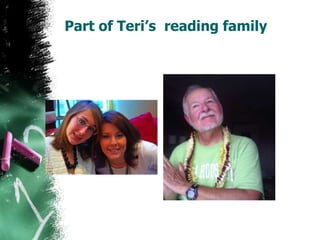
Part of Teri’s reading family
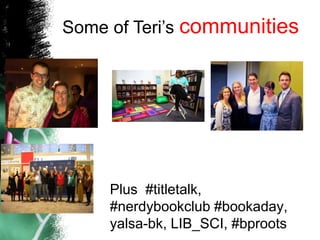
Plus #titletalk,
#nerdybookclub #bookaday,
yalsa-bk, LIB_SCI, #bproots
Some of Teri’s communities
Teri’s Reading Partners
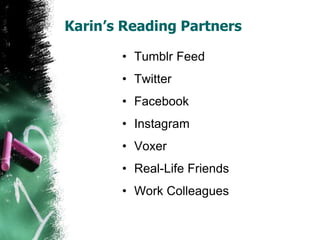
Karin’s Reading Partners
• Tumblr Feed
• Twitter
• Facebook
• Instagram
• Voxer
• Real-Life Friends
• Work Colleagues
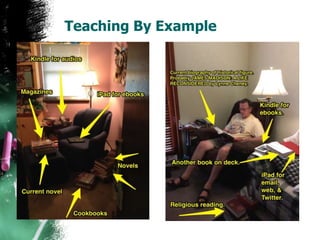
Teaching By Example
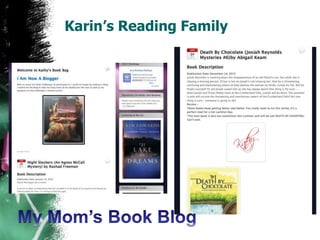
Karin’s Reading Family
Turn and talk at your tables about your
memories of reading.
And get out your smart phones or devices for a
short survey
Go to
www.kahoot.it
A short survey about reader
identity
Get ready…
Getting to Know Readers
• Ask them to create a reading autobiography
 Can be written
 Can use app such as www.whenintime.com
 Here is Teri's
 Here is Karin’s
• Collect them, analyze them for commonalities
• Identify kids who are already readers and those
who are not
Top Reasons We Share Literature
The WHY
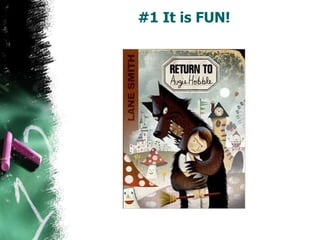
#1 It is FUN!
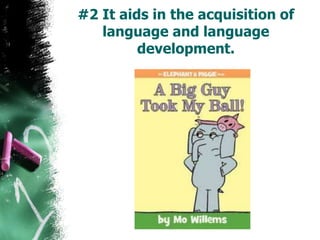
#2 It aids in the acquisition of
language and language
development.
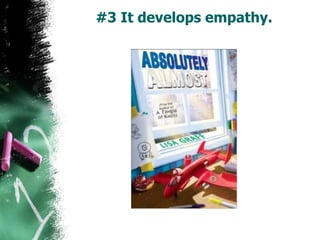
#3 It develops empathy.
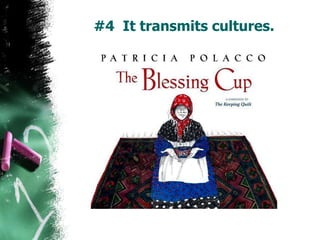
#4 It transmits cultures.
#5 It aids in the development of
lifelong readers:
Unconscious Delight
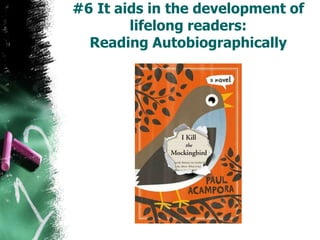
#6 It aids in the development of
lifelong readers:
Reading Autobiographically
#7 It aids in the development of
lifelong readers:
Reading Vicariously
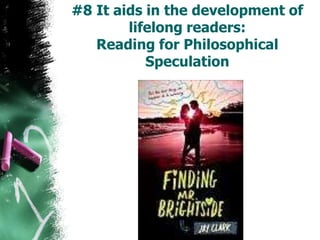
#8 It aids in the development of
lifelong readers:
Reading for Philosophical
Speculation
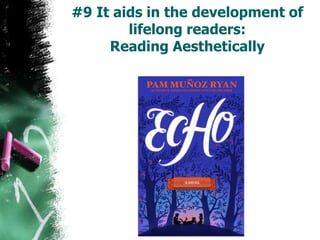
#9 It aids in the development of
lifelong readers:
Reading Aesthetically
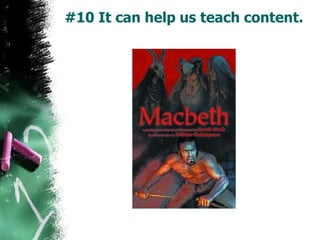
#10 It can help us teach content.
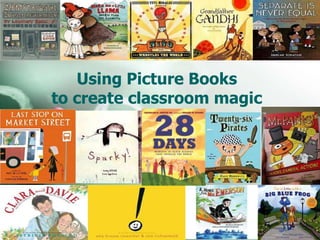
Using Picture Books
to create classroom magic
Picture Books
as Mentor texts
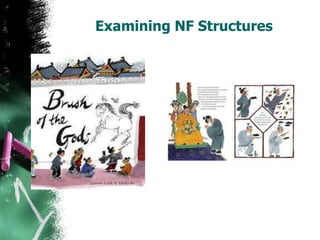
Examining NF Structures
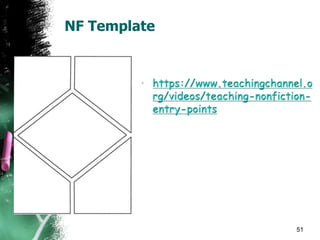
NF Template
51
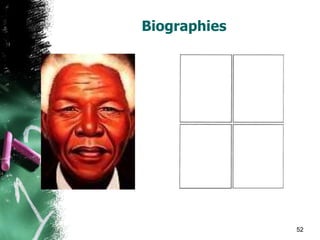
Biographies
52
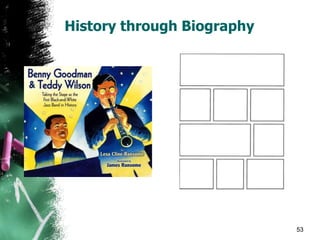
History through Biography
53
HISTORY A DAY AT A TIME
54
“Slice” of life
55
Civil rights
56
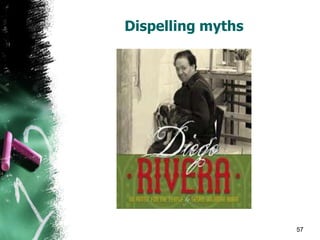
Dispelling myths
57
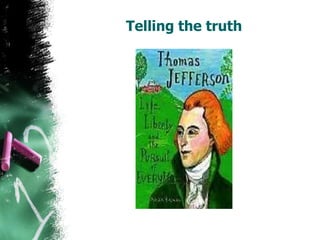
Telling the truth
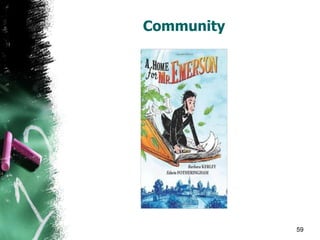
Community
59
So how can we use PB
biographies?
• As model for report writing
• As model for narrative versus expository text
differences
• As model for handling “difficult” events in lives of the
famous
• As model for teaching about AUDIENCE
• What else?
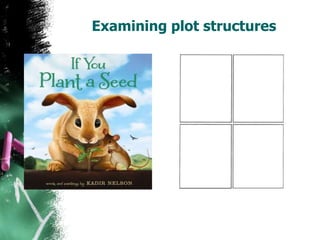
Examining plot structures
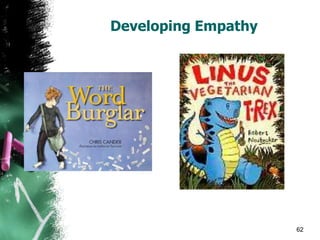
Developing Empathy
62
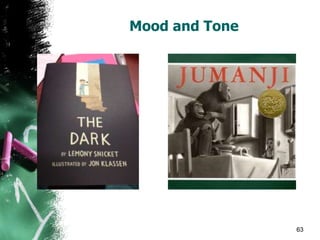
Mood and Tone
63
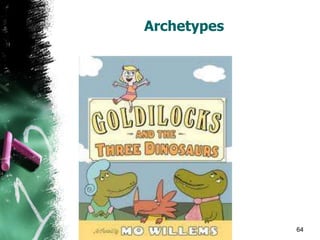
Archetypes
64
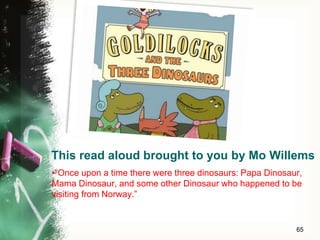
This read aloud brought to you by Mo Willems
•“Once upon a time there were three dinosaurs: Papa Dinosaur,
Mama Dinosaur, and some other Dinosaur who happened to be
visiting from Norway.”
65
–
What does the opening
sentence tell readers?
 Setting
 Main characters
 Motif
 Archetype
 And…it’s going to be funny!
66
Plus it addresses this
CCSS (anchor standard):
Write narratives to develop
real or imagined
experiences or events
using effective technique,
well-chosen details,
and well-structured event
sequences
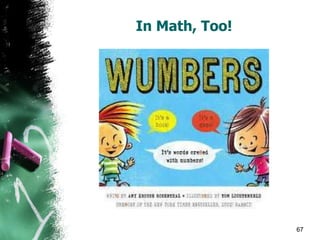
In Math, Too!
67
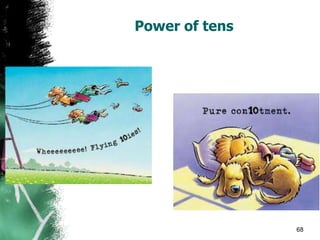
Power of tens
68
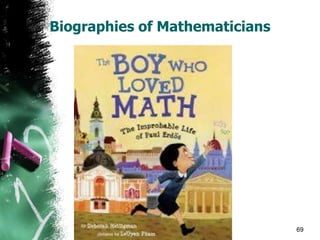
Biographies of Mathematicians
69
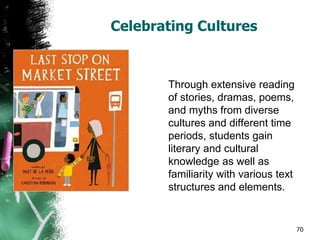
Celebrating Cultures
Through extensive reading
of stories, dramas, poems,
and myths from diverse
cultures and different time
periods, students gain
literary and cultural
knowledge as well as
familiarity with various text
structures and elements.
70
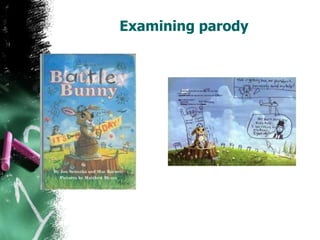
Examining parody
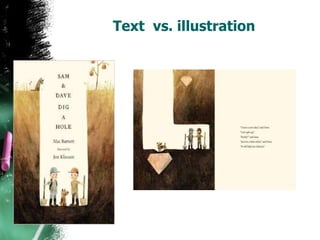
Text vs. illustration
Focus on the art
• Color
• Media
• Technique
• Perspective
• Composition
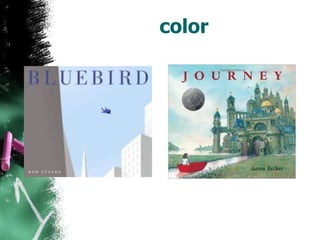
color
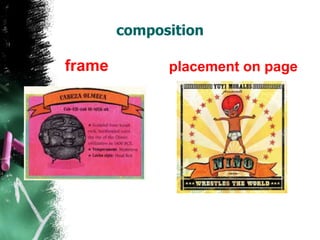
composition
frame placement on page
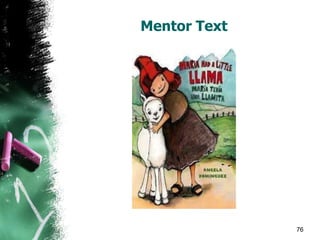
Mentor Text
76
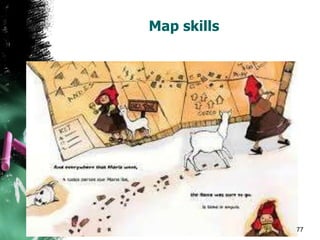
Map skills
77
The oral tradition
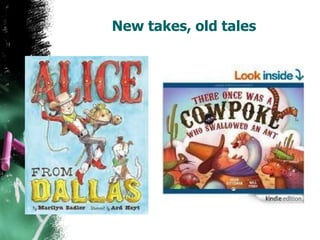
New takes, old tales
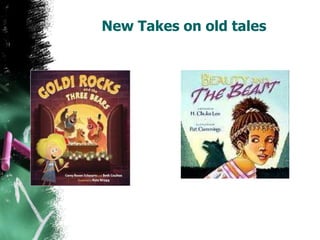
New Takes on old tales
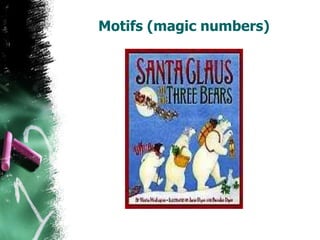
Motifs (magic numbers)
New take on old tales
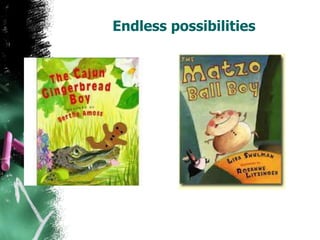
Endless possibilities
Creating talking points
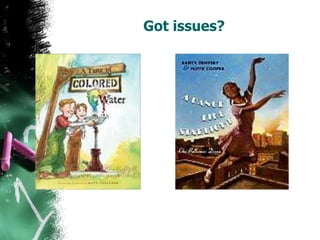
Got issues?
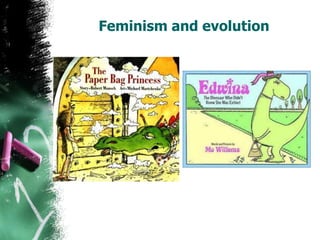
Feminism and evolution
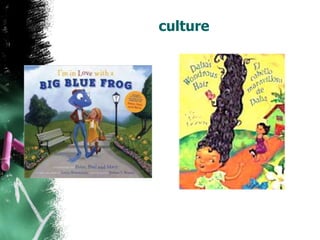
culture
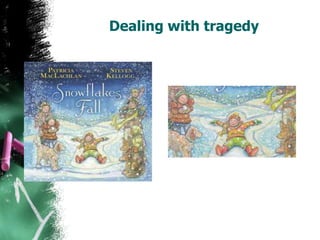
Dealing with tragedy
EDGE OR FRINGE READING
Finding time to read a problem? Consider this…
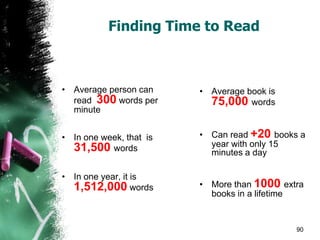
Finding Time to Read
• Average person can
read 300 words per
minute
• In one week, that is
31,500 words
• In one year, it is
1,512,000 words
• Average book is
75,000 words
• Can read +20 books a
year with only 15
minutes a day
• More than 1000 extra
books in a lifetime
90
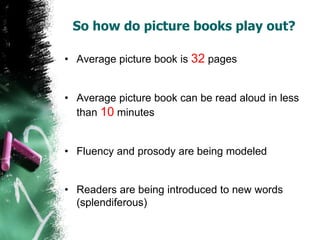
So how do picture books play out?
• Average picture book is 32 pages
• Average picture book can be read aloud in less
than 10 minutes
• Fluency and prosody are being modeled
• Readers are being introduced to new words
(splendiferous)
History and biography
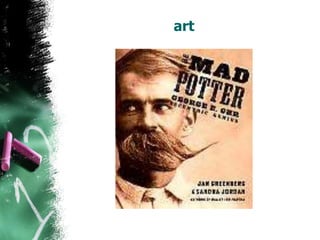
art
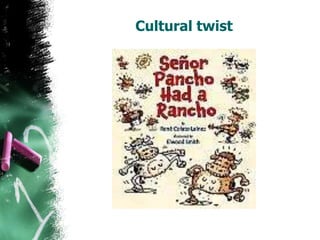
Cultural twist
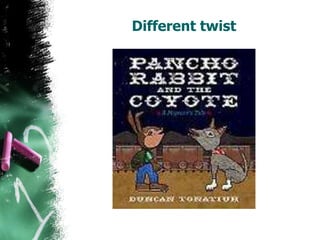
Different twist
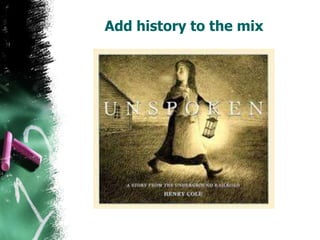
Add history to the mix
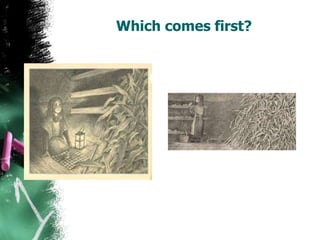
Which comes first?
Style and diction
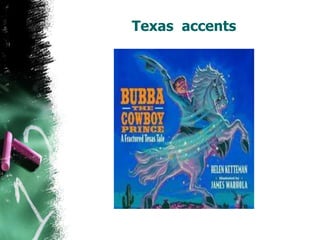
Texas accents
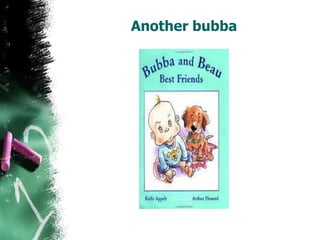
Another bubba
REMIXING
Steps
• Use F&Gs of picture books or purchase
old copies from library sales, etc.
• Design a “poster” for the book using
illustrations and key words (one word,
phrase, key sentence, theme, etc.)
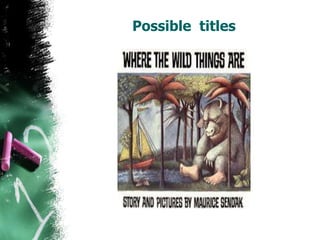
Possible titles
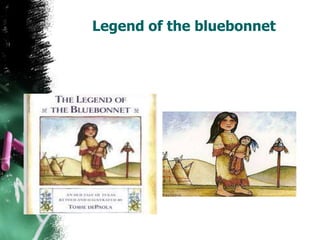
Legend of the bluebonnet
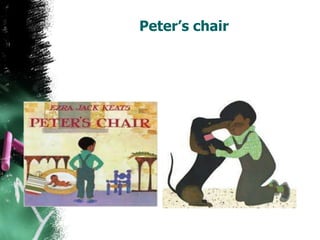
Peter’s chair
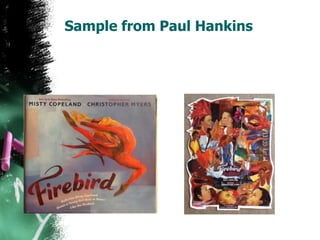
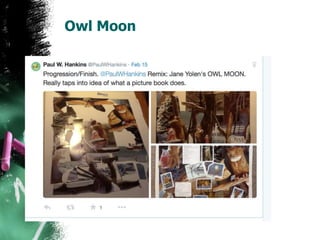
Sample from Paul Hankins
Owl Moon
YOUR TURN
• Select an F&G
• Tear it apart
• Rebuild it
• Keep in mind
 Theme?
 Characters?
 Setting?
 Another literary element?
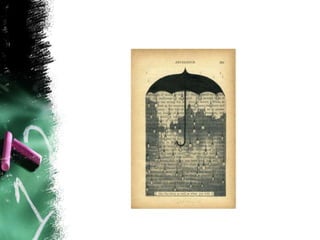
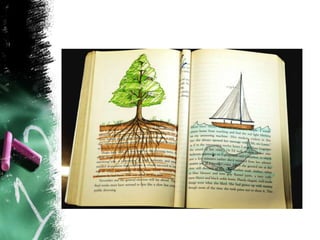
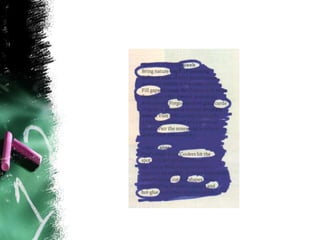
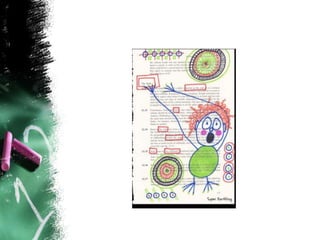
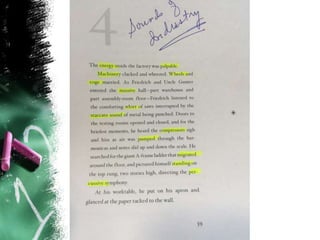
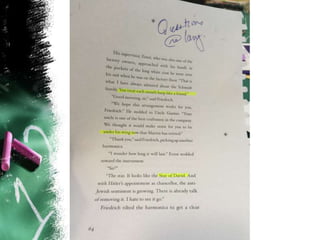
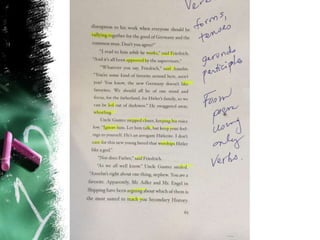
BLACK OUT POETRY
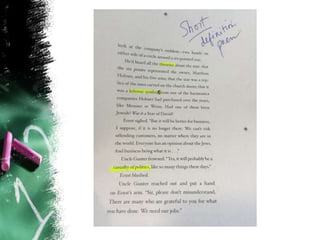
Black out and Highlight Poetry
Using ARCs
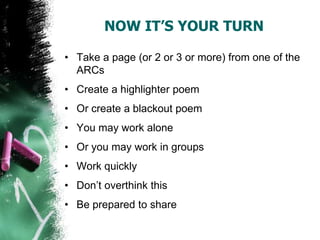
NOW IT’S YOUR TURN
• Take a page (or 2 or 3 or more) from one of the
ARCs
• Create a highlighter poem
• Or create a blackout poem
• You may work alone
• Or you may work in groups
• Work quickly
• Don’t overthink this
• Be prepared to share
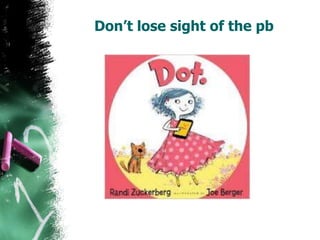
Don’t lose sight of the pb
Identity
Educators as Models
Turn to your shoulder partner and
brainstorm ways we can
demonstrate our love of reading.
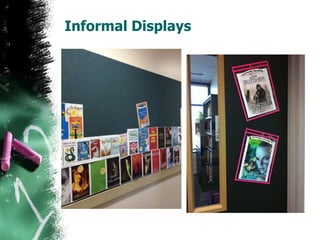
Informal Displays
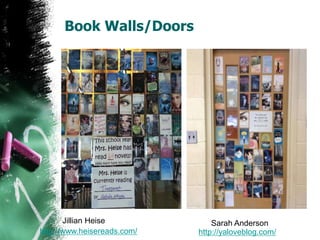
Book Walls/Doors
Jillian Heise Sarah Anderson
http://www.heisereads.com/ http://yaloveblog.com/
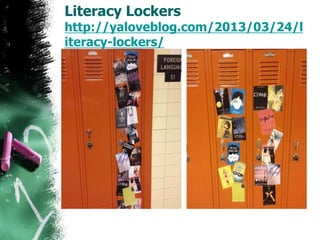
Literacy Lockers
http://yaloveblog.com/2013/03/24/l
iteracy-lockers/
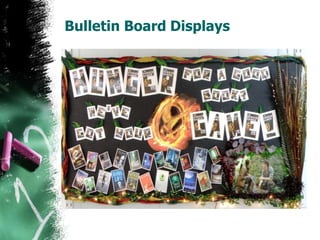
Bulletin Board Displays
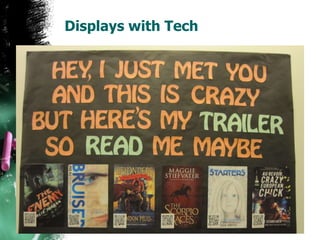
Displays with Tech
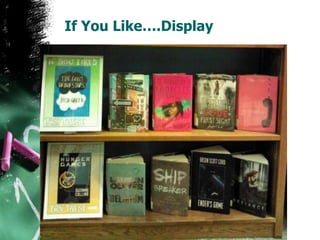
If You Like….Display
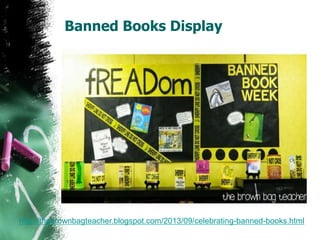
Banned Books Display
http://thebrownbagteacher.blogspot.com/2013/09/celebrating-banned-books.html
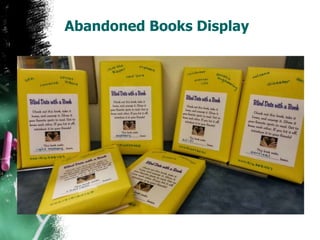
Abandoned Books Display
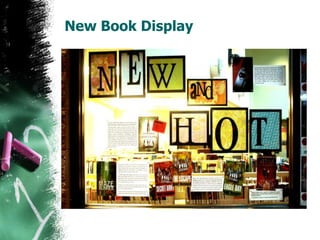
New Book Display
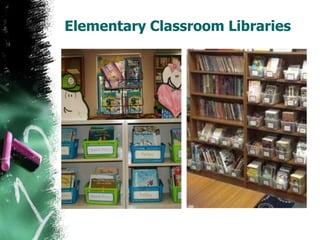
Elementary Classroom Libraries
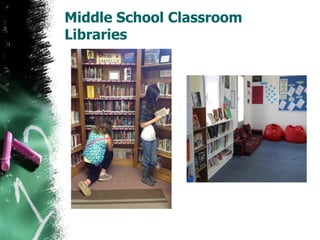
Middle School Classroom
Libraries
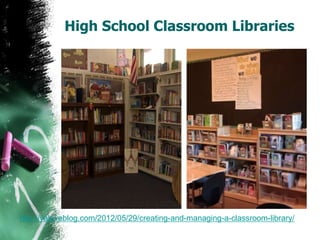
High School Classroom Libraries
http://yaloveblog.com/2012/05/29/creating-and-managing-a-classroom-library/
READ ALOUDS AND AUDIOBOOKS
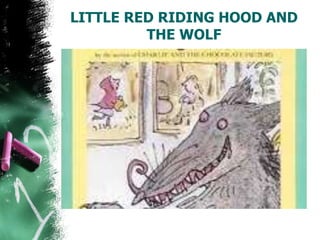
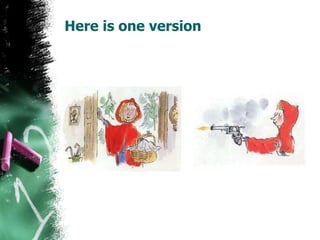
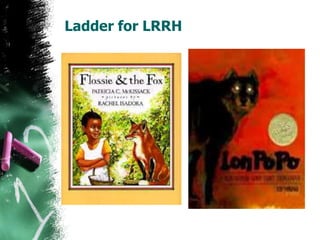
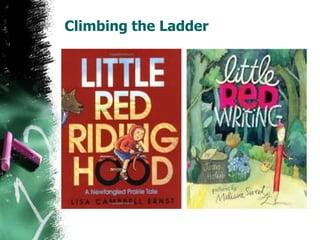
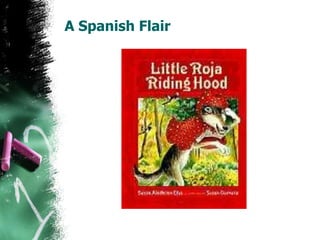
LITTLE RED RIDING HOOD AND
THE WOLF
Here is one version
Ladder for LRRH
Climbing the Ladder
A Spanish Flair
Memories of read alouds?
Share with others
Report out
The Why
• What research says
 Alicia Martinez
 Stephen Krashen
 Jim Trelease & More
 Becoming a Nation of Readers
• What we know from our own research
 Pleasure
 Prosody
 Performance
Alicia Martinez
• Meta-analysis of all read aloud studies up to
1985
 No matter age/grade, reading aloud improved:
• Vocabulary
• Reading comprehension
• Grammatical understanding (sentence structures,
etc.)
Stephen Krashen
• When teachers read aloud and discuss stories
with students, students read more
• Students who are read aloud to check out more
library books
• Hearing stories and discussing them encourages
independent reading
• Hearing stories has a direct impact on vocabulary
development
• Children who are read to at least three times a
week read better
• Students enjoy being read to
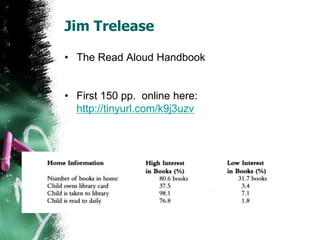
Jim Trelease
• The Read Aloud Handbook
• First 150 pp. online here:
http://tinyurl.com/k9j3uzv
More research
• http://tinyurl.com/kb8sw5qBill Teale
• Article: Reading Aloud in Classrooms: From
the Modal Toward a "Model” by James
Hoffman, Nancy L. Roser & Jennifer Battle.
Reading Teacher (1993) Vol. 46 (6): pp. 496-
507
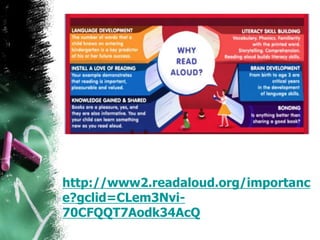
http://www2.readaloud.org/importanc
e?gclid=CLem3Nvi-
70CFQQT7Aodk34AcQ
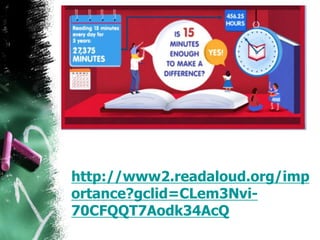
http://www2.readaloud.org/imp
ortance?gclid=CLem3Nvi-
70CFQQT7Aodk34AcQ
Becoming a
Nation of Readers (1985)
• Skilled reading requires motivation
• Skilled reading is a lifelong pursuit
• Skilled reading requires activating background
knowledge
• “The single most important activity for building
knowledge required for success in reading is
reading aloud to children. “ p. 23
Serafini and Giorgis
• Reading aloud increases test scores
• Introduces readers to new titles, authors,
genres, etc.
• Provides opportunities for extended
discussions
• Demonstrates response strategies
• Increases interest in independent reading
• Gives access to text that might be
inaccessible
• Provides models of quality writing
• Supports readers’ development
PLEASURE
• SCIENTIFIC READING FACT: Human beings are
pleasure-centered.
Every time you read to a child, you’re
sending a “pleasure” message to the
child’s brain, conditioning it to associate
books and print with pleasure.
Jim Trelease http://www.trelease-on-
reading.com/read-aloud-brochure.pdf
PROSODY
• Prosody is the rhythm, stess, and intonation of
speech. It can reflect the emotional state of the
author, the presence of irony, sarcasm or other
elements of the language that is not encoded in
grammar and vocabulary.
• HUH?
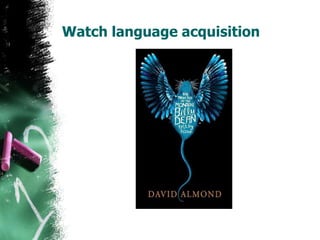
Watch language acquisition
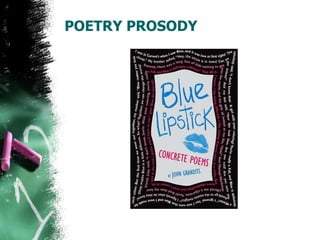
POETRY PROSODY
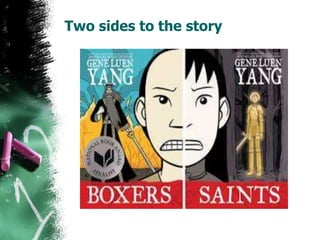
Two sides to the story
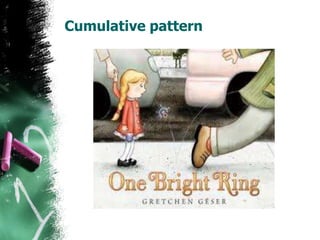
Cumulative pattern
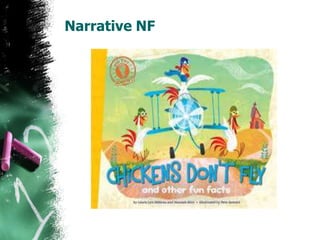
Narrative NF
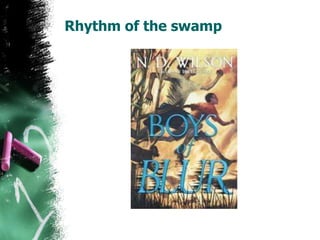
Rhythm of the swamp
Truthful narrator
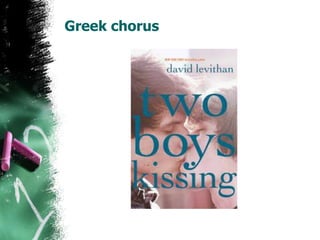
Greek chorus
A LITTLE VARIATION:
AUDIOBOOKS
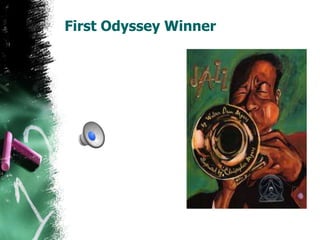
First Odyssey Winner
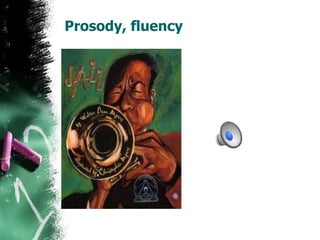
Prosody, fluency
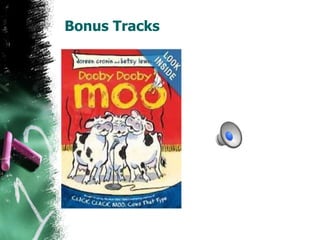
Bonus Tracks
ENJOYMENT
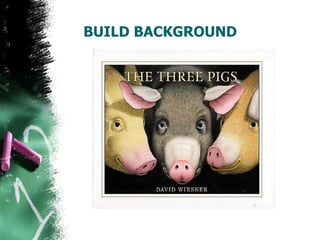
BUILD BACKGROUND
SUCCINCT CLASSICS
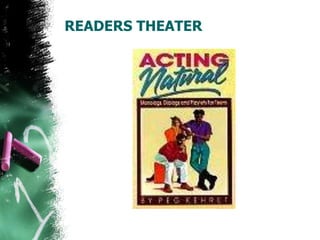
READERS THEATER
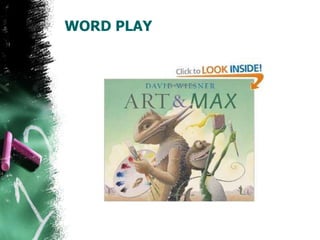
WORD PLAY
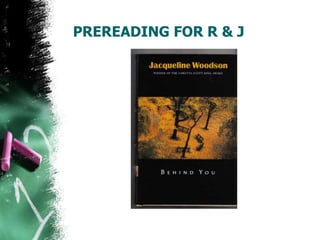
PREREADING FOR R & J
INTRODUCE A GENRE
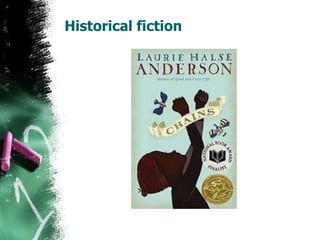
Historical fiction
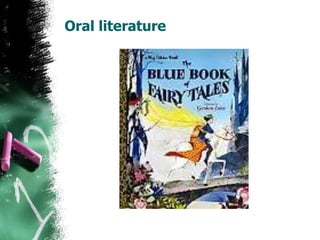
Oral literature
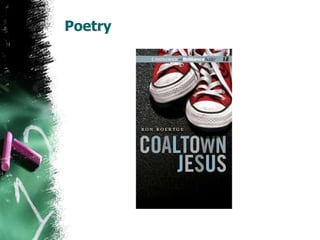
Poetry
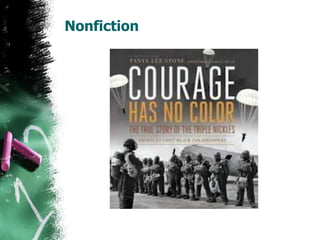
Nonfiction
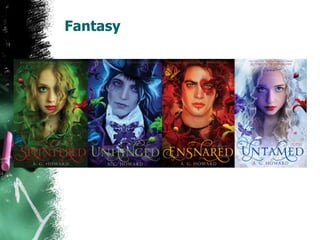
Fantasy
Realistic fiction
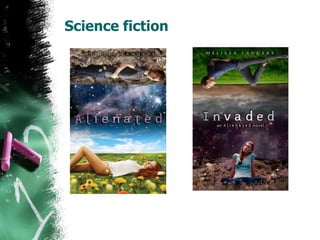
Science fiction
TEACH A LESSON
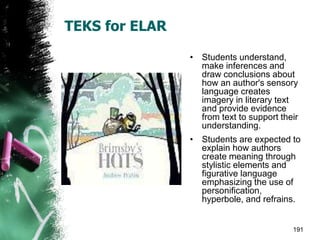
TEKS for ELAR
• Students understand,
make inferences and
draw conclusions about
how an author's sensory
language creates
imagery in literary text
and provide evidence
from text to support their
understanding.
• Students are expected to
explain how authors
create meaning through
stylistic elements and
figurative language
emphasizing the use of
personification,
hyperbole, and refrains.
191
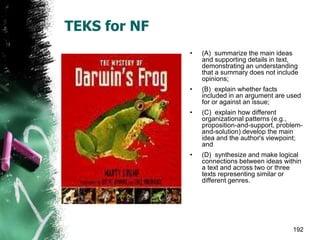
TEKS for NF
• (A) summarize the main ideas
and supporting details in text,
demonstrating an understanding
that a summary does not include
opinions;
• (B) explain whether facts
included in an argument are used
for or against an issue;
• (C) explain how different
organizational patterns (e.g.,
proposition-and-support, problem-
and-solution) develop the main
idea and the author's viewpoint;
and
• (D) synthesize and make logical
connections between ideas within
a text and across two or three
texts representing similar or
different genres.
192
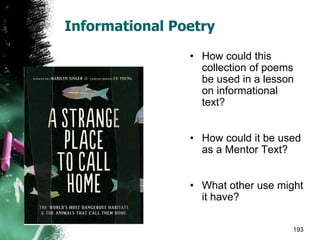
Informational Poetry
• How could this
collection of poems
be used in a lesson
on informational
text?
• How could it be used
as a Mentor Text?
• What other use might
it have?
193
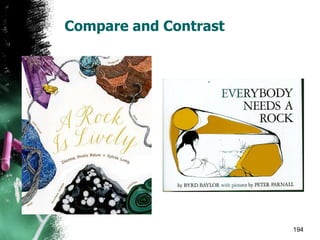
Compare and Contrast
194
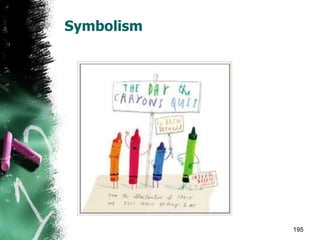
Symbolism
195
GETTING READING
SUGGESTIONS
Crowdsourced Read
Aloud Titles
http://professornana.livejournal.com
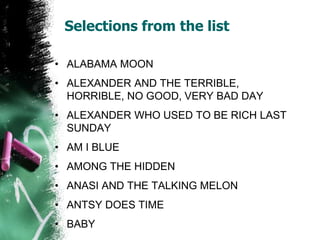
Selections from the list
• ALABAMA MOON
• ALEXANDER AND THE TERRIBLE,
HORRIBLE, NO GOOD, VERY BAD DAY
• ALEXANDER WHO USED TO BE RICH LAST
SUNDAY
• AM I BLUE
• AMONG THE HIDDEN
• ANASI AND THE TALKING MELON
• ANTSY DOES TIME
• BABY
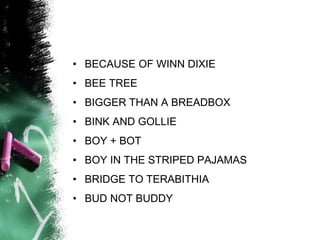
• BECAUSE OF WINN DIXIE
• BEE TREE
• BIGGER THAN A BREADBOX
• BINK AND GOLLIE
• BOY + BOT
• BOY IN THE STRIPED PAJAMAS
• BRIDGE TO TERABITHIA
• BUD NOT BUDDY
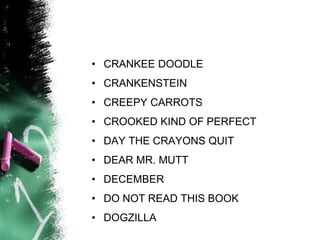
• CRANKEE DOODLE
• CRANKENSTEIN
• CREEPY CARROTS
• CROOKED KIND OF PERFECT
• DAY THE CRAYONS QUIT
• DEAR MR. MUTT
• DECEMBER
• DO NOT READ THIS BOOK
• DOGZILLA
• HARRIS AND ME
• HARRY POTTER
• HERSHEL AND THE HANNUKAH GOBLINS
• HOBBIT
• HOUSE HELD UP BY TREES
• HOW ANGEL PETERSON GOT HIS NAME
• HUSH
• I STINK
• I WANT MY HAT BACK
• LAWN BOY
• LEONARD THE TERRIBLE MONSTER
• LIBERATION OF GABRIEL KING
• LIBRARIAN WHO MEASURED THE EARTH
• LIBRARY MOUSE
• LIGHTNING THIEF
• LILY’S PURPLE PLASTIC PURSE
• MIRACLE’S BOYS
• MIRACULOUS JOURNEY OF EDWARD TULANE
• MISFITS
• MISS RUMPHIUS
• MONSTER
• MR. LEMONCELLO’S LIBRARY
• MR. WUFFLES
• NEVER TRUST A MOTHER OR THE BABYSITTER
• NIGHTJOHN
• NINO WRESTLES THE WORLD
• OF MICE AND MEN
• OFFICER BUCKLE AND GLORIa
• OWL MOON
• PETER’S CHAIR
• PIGGIE PIE
• PINK AND SAY
• PIGGIE AND GERALD
• PRESS HERE
• RIFLE
• ROLL OF THUNDER HEAR MY CRY
• RUBY HOLLER
• SPEAK
• STAND TALL
• STARGIRL
• STARRY RIVER OF THE SKY
• STORY OF FISH AND SNAIL
• STRANGER
• SWAMP ANGEL
• SYLVESTER AND THE MAGIC PEBBLE
• TALE DARK AND GRIMM
• TALE OF DESPERAUX
• TALKING EGGS
• TANGLE OF KNOTS
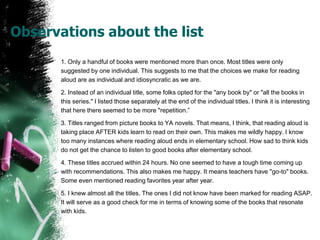
Observations about the list
1. Only a handful of books were mentioned more than once. Most titles were only
suggested by one individual. This suggests to me that the choices we make for reading
aloud are as individual and idiosyncratic as we are.
2. Instead of an individual title, some folks opted for the "any book by" or "all the books in
this series." I listed those separately at the end of the individual titles. I think it is interesting
that here there seemed to be more "repetition.”
3. Titles ranged from picture books to YA novels. That means, I think, that reading aloud is
taking place AFTER kids learn to read on their own. This makes me wildly happy. I know
too many instances where reading aloud ends in elementary school. How sad to think kids
do not get the chance to listen to good books after elementary school.
4. These titles accrued within 24 hours. No one seemed to have a tough time coming up
with recommendations. This also makes me happy. It means teachers have "go-to" books.
Some even mentioned reading favorites year after year.
5. I knew almost all the titles. The ones I did not know have been marked for reading ASAP.
It will serve as a good check for me in terms of knowing some of the books that resonate
with kids.
• http://ifllibraries.com/post/116330953920/bruno-
mars-uptown-funk-parody-unread-book

Region x 2015 (1)