Grant Getting 101Presented byMichele R. Berard, MBA, CFREDirector of Funds Development, Butler HospitalCEO, Ascent Advisors, LLCSeptember 30, 2011
Session Outline – September 30, 2011Introduction - Why Nonprofits ExistConstructing the “Boilerplate” - an introduction to The Case and Case StatementsGiving GuidelinesWhere’s the Money: Researching Potential FundersCommunicating with Foundation RepresentativesOdds & Ends, Demonstrations, Q & A
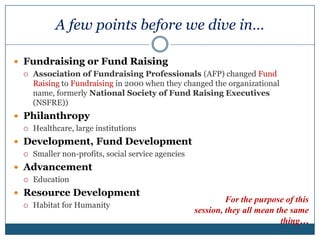
A few points before we dive in…Fundraising or Fund RaisingAssociation of Fundraising Professionals (AFP) changed Fund Raising to Fundraising in 2000 when they changed the organizational name, formerly National Society of Fund Raising Executives (NSFRE))Philanthropy Healthcare, large institutionsDevelopment, Fund Development Smaller non-profits, social service agenciesAdvancement EducationResource DevelopmentHabitat for HumanityFor the purpose of this session, they all mean the same thing…
EXERCISEWho is in the room?
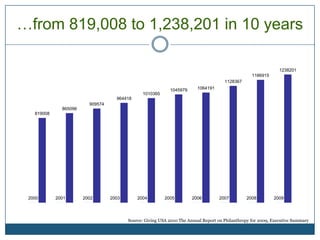
…from 819,008 to 1,238,201 in 10 yearsSource: Giving USA 2010 The Annual Report on Philanthropy for 2009, Executive Summary
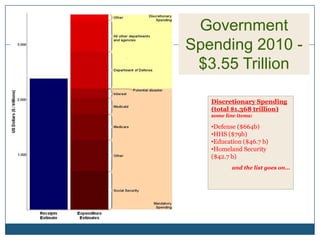
Government Spending 2010 - $3.55 TrillionDiscretionary Spending (total $1.368 trillion) some line items:Defense ($664b)
HHS ($79b)
Education ($46.7 b)
Homeland Security                 ($42.7 b)and the list goes on…
Nonprofits are bridges…Nonprofits exist to bridge the gaps in                                               services that public and private sectors                                do not provideThe trend of increasing non-profits provides                                                evidence that unmet needs are increasingRecent attention to reducing the Federal deficit                                                will result in:Less government funding for non-profitsMore gaps in services; smaller governmentOpportunities for Private and Nonprofit SectorsOrganization’s Purpose = Mission = Operations; thus nonprofits can acquire contributions/grants to fund their activities
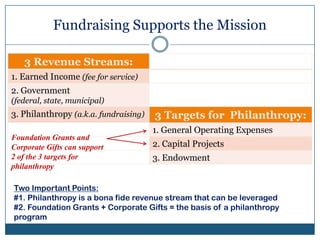
Fundraising Supports the MissionFoundation Grants and Corporate Gifts can support 2 of the 3 targets for philanthropyTwo Important Points: #1. Philanthropy is a bona fide revenue stream that can be leveraged#2. Foundation Grants + Corporate Gifts = the basis of a philanthropy program
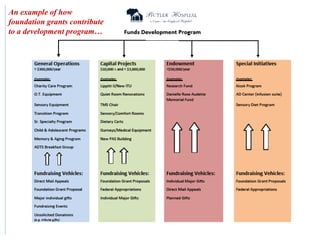
An example of how  foundation grants contribute to a development program…#1 - What Fundraising Funds
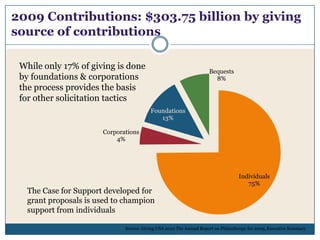
2009 Contributions: $303.75 billion by givingsource of contributionsWhile only 17% of giving is done by foundations & corporations the process provides the basis for other solicitation tacticsThe Case for Support developed for grant proposals is used to champion support from individualsSource: Giving USA 2010 The Annual Report on Philanthropy for 2009, Executive Summary
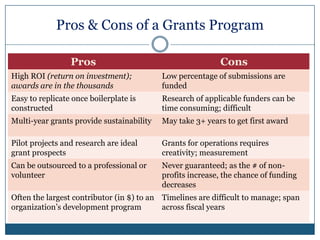
Pros & Cons of a Grants Program
EXERCISEWhy do you donate to an organization?
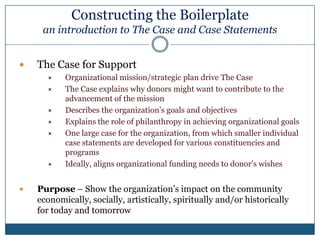
Constructing the Boilerplate an introduction to The Case and Case StatementsThe Case for SupportOrganizational mission/strategic plan drive The CaseThe Case explains why donors might want to contribute to the advancement of the missionDescribes the organization’s goals and objectivesExplains the role of philanthropy in achieving organizational goalsOne large case for the organization, from which smaller individual case statements are developed for various constituencies and programsIdeally, aligns organizational funding needs to donor’s wishesPurpose – Show the organization’s impact on the community economically, socially, artistically, spiritually and/or historically for today and tomorrow
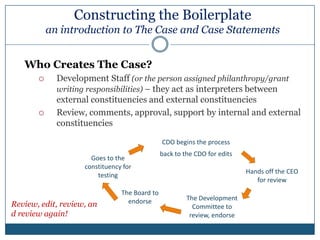
Constructing the Boilerplate an introduction to The Case and Case StatementsWho Creates The Case? Development Staff (or the person assigned philanthropy/grant writing responsibilities) – they act as interpreters between external constituencies and external constituenciesReview, comments, approval, support by internal and external constituenciesCDO begins the process back to the CDO for editsGoes to the constituency for testingHands off the CEO for reviewThe Board to endorse The Development Committee to review, endorseReview, edit, review, and review again!
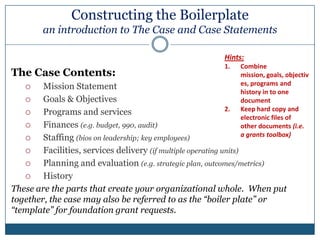
Constructing the Boilerplate an introduction to The Case and Case StatementsHints: Combine mission, goals, objectives, programs and history in to one documentKeep hard copy and electronic files of other documents (i.e. a grants toolbox) The Case Contents:Mission StatementGoals & ObjectivesPrograms and servicesFinances (e.g. budget, 990, audit)Staffing (bios on leadership; key employees)Facilities, services delivery (if multiple operating units)Planning and evaluation (e.g. strategic plan, outcomes/metrics)HistoryThese are the parts that create your organizational whole.  When put together, the case may also be referred to as the “boiler plate” or “template” for foundation grant requests.
Constructing the Boilerplate an introduction to The Case and Case StatementsConstruction Basics (which no one will tell you)Read, proof and edit your boilerplate to ensure it is grammatically correct and free of errorsRequests s/b signed by CEOUse short sentences/paragraphs; no jargon or acronymsGet an outside perspective; does it make sense? Rewrite/edit if notStock your Grants Toolbox to make grant submissions quick/easy (items: staff bios, budget, 990, audit, annual report…)Align funding needs of the organization to grantorsDon’t create programs in order to “get the grant”Address an unmet need, enhance/expand capacity, current programs/services
Constructing the Boilerplate an introduction to The Case and Case StatementsCase Statements - what are they:?Written version of The Case for a specific constituency or campaign and should state:The institution’s services, programs, and objectivesHow the goals of the fundraising program support the institutionWays in which the institution will remain significantly productive in the next decadeThe difference it would make if a donor supported the causeWhat the institution must do to improve or change its activities and aims, and why the institution is valuable to societyOBJECTIVE: The Case Statement aligns donor wishes and funding need(s) of the organization
Constructing the Boilerplate an introduction to The Case and Case StatementsTo maintain alignment with organizational needs and donors’ desires, the following questions should be answered:What is the problem or social need that is central to our concern?What special services or programs do we offer to respond this need?Why are the problems and services important?What constitutes the market for our services?Are others doing what we are doing to serve our market – and perhaps doing it better?Do we have a written plan with a statement of philosophy, objectives, and a program?What are the are the specific financial needs against which private gift support will be sought?Is the organization competent enough to carry out the defined program?Who are the people associated with the organization: staff, key volunteers, trustees, directors?Who should support the organization?
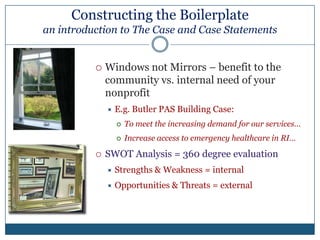
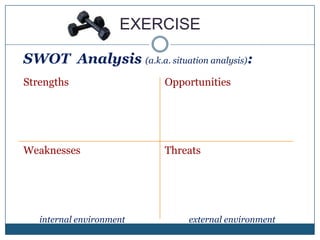
Constructing the Boilerplate an introduction to The Case and Case StatementsWindows not Mirrors – benefit to the community vs. internal need of your nonprofitE.g. Butler PAS Building Case:To meet the increasing demand for our services…Increase access to emergency healthcare in RI…SWOT Analysis = 360 degree evaluationStrengths & Weakness = internalOpportunities & Threats = external
EXERCISESWOT  Analysis (a.k.a. situation analysis):Strengths			         OpportunitiesWeaknesses		         Threats	internal environment		       external environment
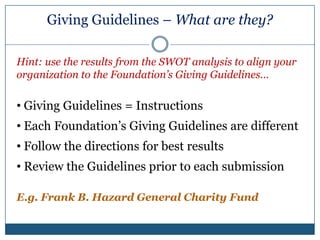
Giving Guidelines – What are they?Hint: use the results from the SWOT analysis to align your organization to the Foundation’s Giving Guidelines…  Giving Guidelines = Instructions
 Each Foundation’s Giving Guidelines are different
 Follow the directions for best results
 Review the Guidelines prior to each submissionE.g. Frank B. Hazard General Charity Fund
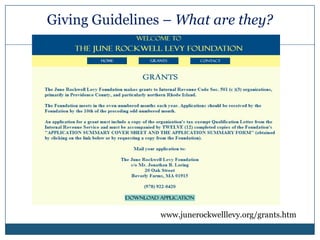
Giving Guidelines – What are they?www.junerockwelllevy.org/grants.htm
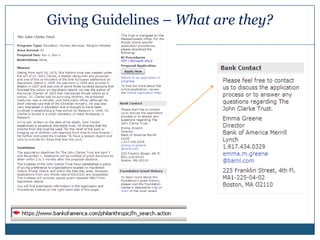
Giving Guidelines – What are they?
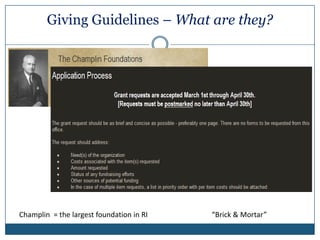
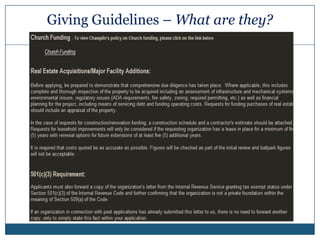
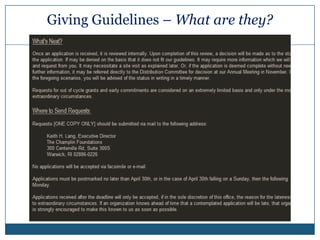
Giving Guidelines – What are they?Champlin  = the largest foundation in RI                                   “Brick & Mortar”
Giving Guidelines – What are they?
How are we doing?Break?Questions?
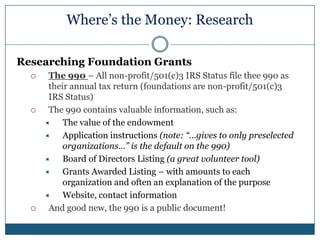
Where’s the Money: ResearchResearching Foundation GrantsThe 990 – All non-profit/501(c)3 IRS Status file thee 990 as their annual tax return (foundations are non-profit/501(c)3 IRS Status)
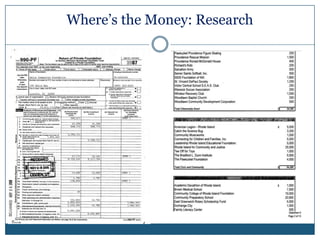
The 990 contains valuable information, such as:
The value of the endowment
Application instructions (note: “…gives to only preselected organizations…” is the default on the 990)
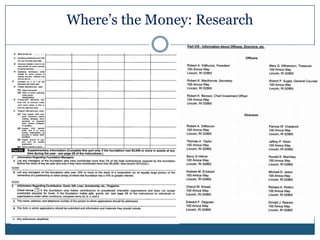
Board of Directors Listing (a great volunteer tool)
Grants Awarded Listing – with amounts to each organization and often an explanation of the purpose
Website, contact information
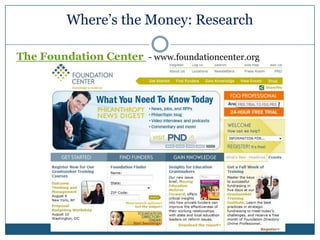
And good new, the 990 is a public document!Where’s the Money: ResearchThe Foundation Center  - www.foundationcenter.org
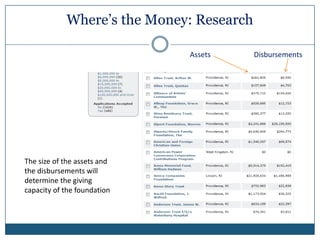
Where’s the Money: ResearchAssets		DisbursementsThe size of the assets and the disbursements will determine the giving capacity of the foundation
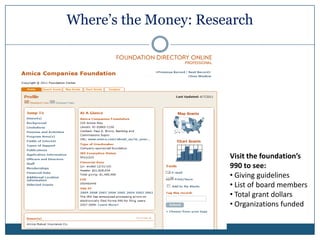
Where’s the Money: ResearchVisit the foundation’s 990 to see: Giving guidelines
 List of board members
 Total grant dollars
 Organizations funded Where’s the Money: Research
Where’s the Money: Research
Where’s the Money: ResearchNote: the free version works if you know the              funder’s name…but, how do you get that information?  Annual Reports of similar organizationsDonor walls of similar organizations (or like industries)Event programs (sponsorship listings)Networking with other fundraising professionalsAssociation of Fundraising Professionals (AFP)Council for Advancement and Support of Education (CASE)Association of Healthcare Philanthropy (AHP)Partnership for Philanthropy Planning (PPP)
Where’s the Money: ResearchOption 2 – The Foundation Directory OnlineGo to http://www.foundationcenter.org/
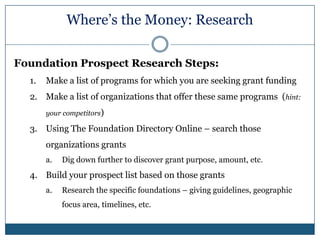
Where’s the Money: ResearchFoundation Prospect Research Steps:Make a list of programs for which you are seeking grant fundingMake a list of organizations that offer these same programs  (hint: your competitors)Using The Foundation Directory Online – search those organizations grantsDig down further to discover grant purpose, amount, etc.Build your prospect list based on those grantsResearch the specific foundations – giving guidelines, geographic focus area, timelines, etc.

Grant Getting 101

  • 1.
    Grant Getting 101PresentedbyMichele R. Berard, MBA, CFREDirector of Funds Development, Butler HospitalCEO, Ascent Advisors, LLCSeptember 30, 2011
  • 2.
    Session Outline –September 30, 2011Introduction - Why Nonprofits ExistConstructing the “Boilerplate” - an introduction to The Case and Case StatementsGiving GuidelinesWhere’s the Money: Researching Potential FundersCommunicating with Foundation RepresentativesOdds & Ends, Demonstrations, Q & A
  • 3.
    A few pointsbefore we dive in…Fundraising or Fund RaisingAssociation of Fundraising Professionals (AFP) changed Fund Raising to Fundraising in 2000 when they changed the organizational name, formerly National Society of Fund Raising Executives (NSFRE))Philanthropy Healthcare, large institutionsDevelopment, Fund Development Smaller non-profits, social service agenciesAdvancement EducationResource DevelopmentHabitat for HumanityFor the purpose of this session, they all mean the same thing…
  • 4.
  • 5.
    …from 819,008 to1,238,201 in 10 yearsSource: Giving USA 2010 The Annual Report on Philanthropy for 2009, Executive Summary
  • 6.
    Government Spending 2010- $3.55 TrillionDiscretionary Spending (total $1.368 trillion) some line items:Defense ($664b)
  • 7.
  • 8.
  • 9.
    Homeland Security ($42.7 b)and the list goes on…
  • 10.
    Nonprofits are bridges…Nonprofitsexist to bridge the gaps in services that public and private sectors do not provideThe trend of increasing non-profits provides evidence that unmet needs are increasingRecent attention to reducing the Federal deficit will result in:Less government funding for non-profitsMore gaps in services; smaller governmentOpportunities for Private and Nonprofit SectorsOrganization’s Purpose = Mission = Operations; thus nonprofits can acquire contributions/grants to fund their activities
  • 11.
    Fundraising Supports theMissionFoundation Grants and Corporate Gifts can support 2 of the 3 targets for philanthropyTwo Important Points: #1. Philanthropy is a bona fide revenue stream that can be leveraged#2. Foundation Grants + Corporate Gifts = the basis of a philanthropy program
  • 12.
    An example ofhow foundation grants contribute to a development program…#1 - What Fundraising Funds
  • 13.
    2009 Contributions: $303.75billion by givingsource of contributionsWhile only 17% of giving is done by foundations & corporations the process provides the basis for other solicitation tacticsThe Case for Support developed for grant proposals is used to champion support from individualsSource: Giving USA 2010 The Annual Report on Philanthropy for 2009, Executive Summary
  • 14.
    Pros & Consof a Grants Program
  • 15.
    EXERCISEWhy do youdonate to an organization?
  • 16.
    Constructing the Boilerplatean introduction to The Case and Case StatementsThe Case for SupportOrganizational mission/strategic plan drive The CaseThe Case explains why donors might want to contribute to the advancement of the missionDescribes the organization’s goals and objectivesExplains the role of philanthropy in achieving organizational goalsOne large case for the organization, from which smaller individual case statements are developed for various constituencies and programsIdeally, aligns organizational funding needs to donor’s wishesPurpose – Show the organization’s impact on the community economically, socially, artistically, spiritually and/or historically for today and tomorrow
  • 17.
    Constructing the Boilerplatean introduction to The Case and Case StatementsWho Creates The Case? Development Staff (or the person assigned philanthropy/grant writing responsibilities) – they act as interpreters between external constituencies and external constituenciesReview, comments, approval, support by internal and external constituenciesCDO begins the process back to the CDO for editsGoes to the constituency for testingHands off the CEO for reviewThe Board to endorse The Development Committee to review, endorseReview, edit, review, and review again!
  • 18.
    Constructing the Boilerplatean introduction to The Case and Case StatementsHints: Combine mission, goals, objectives, programs and history in to one documentKeep hard copy and electronic files of other documents (i.e. a grants toolbox) The Case Contents:Mission StatementGoals & ObjectivesPrograms and servicesFinances (e.g. budget, 990, audit)Staffing (bios on leadership; key employees)Facilities, services delivery (if multiple operating units)Planning and evaluation (e.g. strategic plan, outcomes/metrics)HistoryThese are the parts that create your organizational whole. When put together, the case may also be referred to as the “boiler plate” or “template” for foundation grant requests.
  • 19.
    Constructing the Boilerplatean introduction to The Case and Case StatementsConstruction Basics (which no one will tell you)Read, proof and edit your boilerplate to ensure it is grammatically correct and free of errorsRequests s/b signed by CEOUse short sentences/paragraphs; no jargon or acronymsGet an outside perspective; does it make sense? Rewrite/edit if notStock your Grants Toolbox to make grant submissions quick/easy (items: staff bios, budget, 990, audit, annual report…)Align funding needs of the organization to grantorsDon’t create programs in order to “get the grant”Address an unmet need, enhance/expand capacity, current programs/services
  • 20.
    Constructing the Boilerplatean introduction to The Case and Case StatementsCase Statements - what are they:?Written version of The Case for a specific constituency or campaign and should state:The institution’s services, programs, and objectivesHow the goals of the fundraising program support the institutionWays in which the institution will remain significantly productive in the next decadeThe difference it would make if a donor supported the causeWhat the institution must do to improve or change its activities and aims, and why the institution is valuable to societyOBJECTIVE: The Case Statement aligns donor wishes and funding need(s) of the organization
  • 21.
    Constructing the Boilerplatean introduction to The Case and Case StatementsTo maintain alignment with organizational needs and donors’ desires, the following questions should be answered:What is the problem or social need that is central to our concern?What special services or programs do we offer to respond this need?Why are the problems and services important?What constitutes the market for our services?Are others doing what we are doing to serve our market – and perhaps doing it better?Do we have a written plan with a statement of philosophy, objectives, and a program?What are the are the specific financial needs against which private gift support will be sought?Is the organization competent enough to carry out the defined program?Who are the people associated with the organization: staff, key volunteers, trustees, directors?Who should support the organization?
  • 22.
    Constructing the Boilerplatean introduction to The Case and Case StatementsWindows not Mirrors – benefit to the community vs. internal need of your nonprofitE.g. Butler PAS Building Case:To meet the increasing demand for our services…Increase access to emergency healthcare in RI…SWOT Analysis = 360 degree evaluationStrengths & Weakness = internalOpportunities & Threats = external
  • 23.
    EXERCISESWOT Analysis(a.k.a. situation analysis):Strengths OpportunitiesWeaknesses Threats internal environment external environment
  • 24.
    Giving Guidelines –What are they?Hint: use the results from the SWOT analysis to align your organization to the Foundation’s Giving Guidelines… Giving Guidelines = Instructions
  • 25.
    Each Foundation’sGiving Guidelines are different
  • 26.
    Follow thedirections for best results
  • 27.
    Review theGuidelines prior to each submissionE.g. Frank B. Hazard General Charity Fund
  • 28.
    Giving Guidelines –What are they?www.junerockwelllevy.org/grants.htm
  • 29.
  • 30.
    Giving Guidelines –What are they?Champlin = the largest foundation in RI “Brick & Mortar”
  • 31.
  • 32.
  • 33.
    How are wedoing?Break?Questions?
  • 34.
    Where’s the Money:ResearchResearching Foundation GrantsThe 990 – All non-profit/501(c)3 IRS Status file thee 990 as their annual tax return (foundations are non-profit/501(c)3 IRS Status)
  • 35.
    The 990 containsvaluable information, such as:
  • 36.
    The value ofthe endowment
  • 37.
    Application instructions (note:“…gives to only preselected organizations…” is the default on the 990)
  • 38.
    Board of DirectorsListing (a great volunteer tool)
  • 39.
    Grants Awarded Listing– with amounts to each organization and often an explanation of the purpose
  • 40.
  • 41.
    And good new,the 990 is a public document!Where’s the Money: ResearchThe Foundation Center - www.foundationcenter.org
  • 42.
    Where’s the Money:ResearchAssets DisbursementsThe size of the assets and the disbursements will determine the giving capacity of the foundation
  • 43.
    Where’s the Money:ResearchVisit the foundation’s 990 to see: Giving guidelines
  • 44.
    List ofboard members
  • 45.
  • 46.
    Organizations fundedWhere’s the Money: Research
  • 47.
  • 48.
    Where’s the Money:ResearchNote: the free version works if you know the funder’s name…but, how do you get that information? Annual Reports of similar organizationsDonor walls of similar organizations (or like industries)Event programs (sponsorship listings)Networking with other fundraising professionalsAssociation of Fundraising Professionals (AFP)Council for Advancement and Support of Education (CASE)Association of Healthcare Philanthropy (AHP)Partnership for Philanthropy Planning (PPP)
  • 49.
    Where’s the Money:ResearchOption 2 – The Foundation Directory OnlineGo to http://www.foundationcenter.org/
  • 50.
    Where’s the Money:ResearchFoundation Prospect Research Steps:Make a list of programs for which you are seeking grant fundingMake a list of organizations that offer these same programs (hint: your competitors)Using The Foundation Directory Online – search those organizations grantsDig down further to discover grant purpose, amount, etc.Build your prospect list based on those grantsResearch the specific foundations – giving guidelines, geographic focus area, timelines, etc.

Editor's Notes