Presented by
Michele R. Berard, MBA, CFRE
of
www.AscentAdvisors.net
Engaging Your Board in Fundraising
Why it Matters and How to do it
20 1 3 AnnualCo nfe re nce
and Trade Sho w
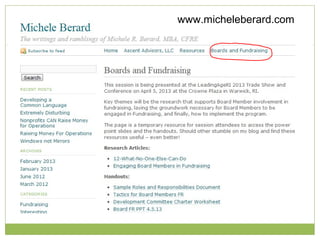
www.micheleberard.com
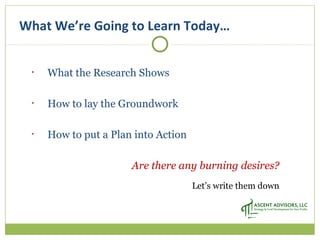
What We’re Going to Learn Today…
• What the Research Shows
• How to lay the Groundwork
• How to put a Plan into Action
Are there any burning desires?
Let’s write them down
The Research
Research Brief
What No O ne Else Can Do :
Truste e ’s VitalRo le in
He althcare Philanthro py
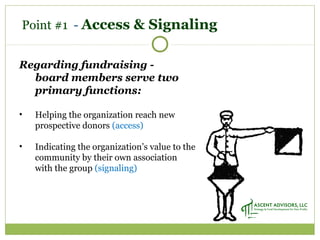
Point #1 - Access & Signaling
Regarding fundraising -
board members serve two
primary functions:
• Helping the organization reach new
prospective donors (access)
• Indicating the organization’s value to the
community by their own association
with the group (signaling)
Point #2 - Board Member Giving is Important
Organizations reported that total board
giving was between 1% and 10% of
total giving
• Board member giving is a public commitment to the
organization’s work
• Board members might pay increased attention to the
nonprofit’s mission and financial health when their
own money is engaged
• Many other donors and institutional funders will not
give to organizations that don’t have 100 percent
board participation as current donors.
Therefore require
100% board giving
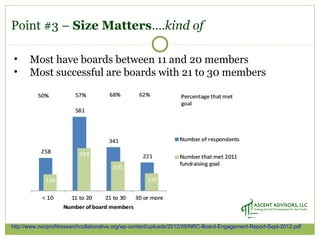
Point #3 – Size Matters….kind of
• Most have boards between 11 and 20 members
• Most successful are boards with 21 to 30 members
http://www.nonprofitresearchcollaborative.org/wp-content/uploads/2012/09/NRC-Board-Engagement-Report-Sept-2012.pdf
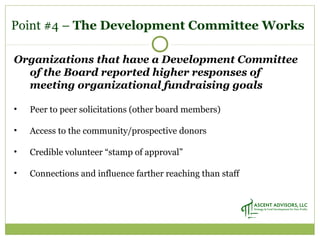
Point #4 – The Development Committee Works
Organizations that have a Development Committee
of the Board reported higher responses of
meeting organizational fundraising goals
• Peer to peer solicitations (other board members)
• Access to the community/prospective donors
• Credible volunteer “stamp of approval”
• Connections and influence farther reaching than staff
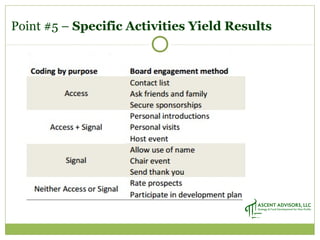
Point #5 – Specific Activities Yield Results
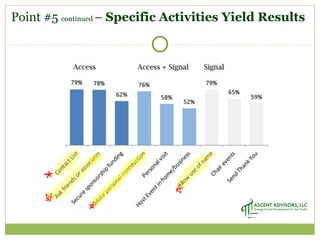
Point #5 continued – Specific Activities Yield Results
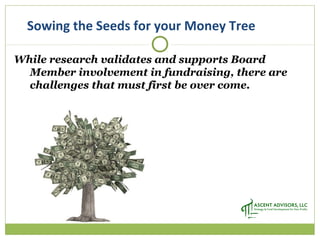
Sowing the Seeds for your Money Tree
While research validates and supports Board
Member involvement in fundraising, there are
challenges that must first be over come.
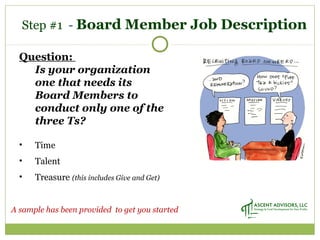
Step #1 - Board Member Job Description
Question:
Is your organization
one that needs its
Board Members to
conduct only one of the
three Ts?
• Time
• Talent
• Treasure (this includes Give and Get)
A sample has been provided to get you started
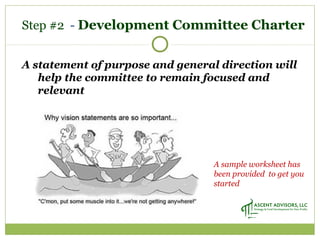
Step #2 - Development Committee Charter
A statement of purpose and general direction will
help the committee to remain focused and
relevant
A sample worksheet has
been provided to get you
started
Step #2 continued - SAMPLE
Development Committee Charter Worksheet
WHAT - To ensure XYZ Organization benefits from a strong, stable and growing
revenue stream obtained from philanthropy
HOW – by:
1. developing and fostering a culture of giving of our
internal constituencies
Examples:
2. cultivating and stewarding resources (people, products,
time, finances)
Examples:
3. Soliciting financial and in-kind support Examples:
Step #3 - Allocate Staff Support
Staff raising money without volunteers’
connections is finite;
Incorporate volunteer connections - the potential
is limitless
• Staff possess the “body of knowledge”
• Staff = logistics manager
• Staff empower volunteers
• Staff support = volunteer success
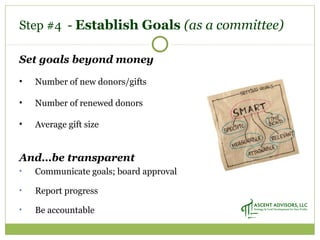
Step #4 - Establish Goals (as a committee)
Set goals beyond money
• Number of new donors/gifts
• Number of renewed donors
• Average gift size
And…be transparent
• Communicate goals; board approval
• Report progress
• Be accountable
Step #5 - Build a Plan…to meet those goals
Set goals beyond money
• Number of new donors/gifts
• Number of renewed donors
• Average gift size
And…be transparent
• Communicate goals; board approval
• Report progress
• Be accountable
Action Time!
You have collected the research and laid the
groundwork. Now, it is time to put your plan
into action.
A List of Tactics can alleviate discomfort in
Fundraising
• Acts as a “menu”
• Have Board Member select 3 from the list
Note: Include the 11 from the research section
Step #1 - Provide a List
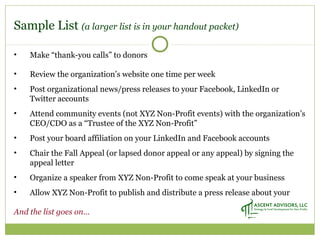
• Make “thank-you calls” to donors
• Review the organization’s website one time per week
• Post organizational news/press releases to your Facebook, LinkedIn or
Twitter accounts
• Attend community events (not XYZ Non-Profit events) with the organization’s
CEO/CDO as a “Trustee of the XYZ Non-Profit”
• Post your board affiliation on your LinkedIn and Facebook accounts
• Chair the Fall Appeal (or lapsed donor appeal or any appeal) by signing the
appeal letter
• Organize a speaker from XYZ Non-Profit to come speak at your business
• Allow XYZ Non-Profit to publish and distribute a press release about your
And the list goes on…
Sample List (a larger list is in your handout packet)
Setting individual goals gives board
members long-term vision and short-
term motivation.
• It focuses them on what they can contribute to
the greater whole
• It provides a sense of self-worth (to the group)
• When achieved, creates a huge feeling of
satisfaction
Step #2 - Individual Goals
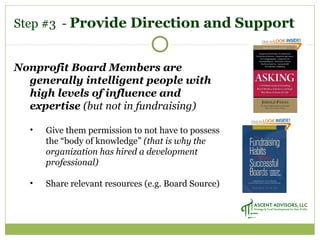
Nonprofit Board Members are
generally intelligent people with
high levels of influence and
expertise (but not in fundraising)
• Give them permission to not have to possess
the “body of knowledge” (that is why the
organization has hired a development
professional)
• Share relevant resources (e.g. Board Source)
Step #3 - Provide Direction and Support
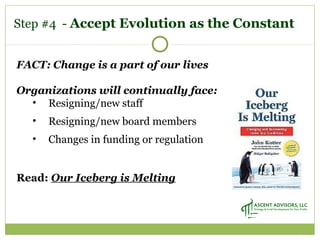
FACT: Change is a part of our lives
Organizations will continually face:
• Resigning/new staff
• Resigning/new board members
• Changes in funding or regulation
Read: Our Iceberg is Melting
Step #4 - Accept Evolution as the Constant
While organizations cannot rest on their laurels
they must celebrate successes and recognize
those that made those successes possible.
• Board Meetings
• Donor Newsletters
• Recognition events (e.g. National Philanthropy Day www.afpri.org)
• Photo shoots/check presentations
• Handwriting cards
• Calls
Step #5 - Celebrate the Successes
Questions?
CONTACT INFORMATION:
Michele R. Berard, MBA, CFRE
Phone: (401) 263-4902
www.AscentAdvisors.net
mberard@AscentAdvisors.net
This presentation and the handouts can be found on my Blog:
micheleberard.com
Twitter: @micheleberard

Proof that Engaging Your Board in Fundraising MATTERS

  • 1.
    Presented by Michele R.Berard, MBA, CFRE of www.AscentAdvisors.net Engaging Your Board in Fundraising Why it Matters and How to do it 20 1 3 AnnualCo nfe re nce and Trade Sho w
  • 2.
  • 3.
    What We’re Goingto Learn Today… • What the Research Shows • How to lay the Groundwork • How to put a Plan into Action Are there any burning desires? Let’s write them down
  • 4.
    The Research Research Brief WhatNo O ne Else Can Do : Truste e ’s VitalRo le in He althcare Philanthro py
  • 5.
    Point #1 -Access & Signaling Regarding fundraising - board members serve two primary functions: • Helping the organization reach new prospective donors (access) • Indicating the organization’s value to the community by their own association with the group (signaling)
  • 6.
    Point #2 -Board Member Giving is Important Organizations reported that total board giving was between 1% and 10% of total giving • Board member giving is a public commitment to the organization’s work • Board members might pay increased attention to the nonprofit’s mission and financial health when their own money is engaged • Many other donors and institutional funders will not give to organizations that don’t have 100 percent board participation as current donors. Therefore require 100% board giving
  • 7.
    Point #3 –Size Matters….kind of • Most have boards between 11 and 20 members • Most successful are boards with 21 to 30 members http://www.nonprofitresearchcollaborative.org/wp-content/uploads/2012/09/NRC-Board-Engagement-Report-Sept-2012.pdf
  • 8.
    Point #4 –The Development Committee Works Organizations that have a Development Committee of the Board reported higher responses of meeting organizational fundraising goals • Peer to peer solicitations (other board members) • Access to the community/prospective donors • Credible volunteer “stamp of approval” • Connections and influence farther reaching than staff
  • 9.
    Point #5 –Specific Activities Yield Results
  • 10.
    Point #5 continued– Specific Activities Yield Results
  • 11.
    Sowing the Seedsfor your Money Tree While research validates and supports Board Member involvement in fundraising, there are challenges that must first be over come.
  • 12.
    Step #1 -Board Member Job Description Question: Is your organization one that needs its Board Members to conduct only one of the three Ts? • Time • Talent • Treasure (this includes Give and Get) A sample has been provided to get you started
  • 13.
    Step #2 -Development Committee Charter A statement of purpose and general direction will help the committee to remain focused and relevant A sample worksheet has been provided to get you started
  • 14.
    Step #2 continued- SAMPLE Development Committee Charter Worksheet WHAT - To ensure XYZ Organization benefits from a strong, stable and growing revenue stream obtained from philanthropy HOW – by: 1. developing and fostering a culture of giving of our internal constituencies Examples: 2. cultivating and stewarding resources (people, products, time, finances) Examples: 3. Soliciting financial and in-kind support Examples:
  • 15.
    Step #3 -Allocate Staff Support Staff raising money without volunteers’ connections is finite; Incorporate volunteer connections - the potential is limitless • Staff possess the “body of knowledge” • Staff = logistics manager • Staff empower volunteers • Staff support = volunteer success
  • 16.
    Step #4 -Establish Goals (as a committee) Set goals beyond money • Number of new donors/gifts • Number of renewed donors • Average gift size And…be transparent • Communicate goals; board approval • Report progress • Be accountable
  • 17.
    Step #5 -Build a Plan…to meet those goals Set goals beyond money • Number of new donors/gifts • Number of renewed donors • Average gift size And…be transparent • Communicate goals; board approval • Report progress • Be accountable
  • 18.
    Action Time! You havecollected the research and laid the groundwork. Now, it is time to put your plan into action.
  • 19.
    A List ofTactics can alleviate discomfort in Fundraising • Acts as a “menu” • Have Board Member select 3 from the list Note: Include the 11 from the research section Step #1 - Provide a List
  • 20.
    • Make “thank-youcalls” to donors • Review the organization’s website one time per week • Post organizational news/press releases to your Facebook, LinkedIn or Twitter accounts • Attend community events (not XYZ Non-Profit events) with the organization’s CEO/CDO as a “Trustee of the XYZ Non-Profit” • Post your board affiliation on your LinkedIn and Facebook accounts • Chair the Fall Appeal (or lapsed donor appeal or any appeal) by signing the appeal letter • Organize a speaker from XYZ Non-Profit to come speak at your business • Allow XYZ Non-Profit to publish and distribute a press release about your And the list goes on… Sample List (a larger list is in your handout packet)
  • 21.
    Setting individual goalsgives board members long-term vision and short- term motivation. • It focuses them on what they can contribute to the greater whole • It provides a sense of self-worth (to the group) • When achieved, creates a huge feeling of satisfaction Step #2 - Individual Goals
  • 22.
    Nonprofit Board Membersare generally intelligent people with high levels of influence and expertise (but not in fundraising) • Give them permission to not have to possess the “body of knowledge” (that is why the organization has hired a development professional) • Share relevant resources (e.g. Board Source) Step #3 - Provide Direction and Support
  • 23.
    FACT: Change isa part of our lives Organizations will continually face: • Resigning/new staff • Resigning/new board members • Changes in funding or regulation Read: Our Iceberg is Melting Step #4 - Accept Evolution as the Constant
  • 24.
    While organizations cannotrest on their laurels they must celebrate successes and recognize those that made those successes possible. • Board Meetings • Donor Newsletters • Recognition events (e.g. National Philanthropy Day www.afpri.org) • Photo shoots/check presentations • Handwriting cards • Calls Step #5 - Celebrate the Successes
  • 26.
    Questions? CONTACT INFORMATION: Michele R.Berard, MBA, CFRE Phone: (401) 263-4902 www.AscentAdvisors.net mberard@AscentAdvisors.net This presentation and the handouts can be found on my Blog: micheleberard.com Twitter: @micheleberard