Appendix C: How to research funding sources
In addition to asking your board, staff, local experts, funders, and peers for recent information specific to
your domain, some general approaches for researching funding sources exist.


Foundation funding
It's unlikely that anyone foundation will be a perfect fit for your organization. Instead of looking for that
"silver bullet," identify those foundations that seem most aligned with your strengths and start building
relationships from there. The most useful information may come from the peer research discussed in Step
2. Look at the websites of organizations like your own or organizations that you aspire to be like. Though
you may find lists of funders on the websites of peer organizations, you are unlikely to find actual
amounts there. These can be found (sometimes) on the funder's website, and (always) on their Form
990, available through the Foundation Center (www.foundationcenter.org) or Guidestar
(http://www.guidestar.org).


Foundation Center's Foundation Directory Online database is a great resource for researching potential
foundation funders. This database requires a subscription, but several options are available with
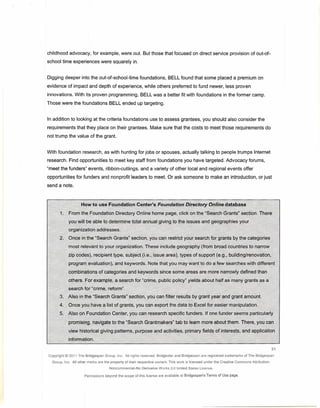
reasonable rates. (See the sidebar on page 51, "How to use Foundation Center's Foundation Directory
Online database.") The database can provide you with two very important pieces of information. First, it
can give you a sense of the overall foundation funding available in your area, which can help you to
develop realistic goals for how much your organization could raise. Secondly, it can help you pinpoint the
foundations that may be the most likely funders for your organization.


Once you've identified likely foundation funders, you'll need to assess your organization's fit with their
missions. Here, diving into foundation websites directly to determine any common characteristics of their
grantees may make sense. For example, some foundations may say that grantees from a fairly wide
geographical range are eligible, but by examining the list of agencies actually funded, you will get a
clearer sense of the geographical areas in which they are most interested. Getting specific about the
criteria they use to evaluate grantees is crucial, since foundations that on the surface look similar may in
fact have very different priorities.


Take the experience of BELL, the youth development organization cited in throughout this guide. While
working to identify potential new foundation supporters, the organization developed a list of foundations
that had historically supported youth development efforts. Further research revealed, however, that less
than a quarter of those foundations focused on efforts like BELL's. The foundations that focused on early


                                                                                                                                           50
Copyright © 2011 The Bridqespan Group. Inc. All rights reserved. Bridgestar and Bridgespan are registered trademarks of The Bridgespan
  Group. Inc. All other marks are the property of their respective owners. This work is licensed under the Creative Commons Attribution-
                                     Noncommercial-No    Derivative Works 3.0 United States License.

                      Permissions beyond the scope of this license are available at Bridgespan's Terms 01 Use page.
childhood advocacy, for example, were out. But those that focused on direct service provision of out-of-
school time experiences were squarely in.


Digging deeper into the out-of-school-time foundations, BELL found that some placed a premium on
evidence of impact and depth of experience, while others preferred to fund newer, less proven
innovations. With its proven programming, BELL was a better fit with foundations in the former camp.
Those were the foundations BELL ended up targeting.


In addition to looking at the criteria foundations use to assess grantees, you should also consider the
requirements that they place on their grantees. Make sure that the costs to meet those requirements do
not trump the value of the grant.


With foundation research, as with hunting for jobs or spouses, actually talking to people trumps Internet
research. Find opportunities to meet key staff from foundations you have targeted. Advocacy forums,
"meet the funders" events, ribbon-cuttings, and a variety of other local and regional events offer
opportunities for funders and nonprofit leaders to meet. Or ask someone to make an introduction, or just
send a note.


                                                                                                                                                         51
Copyright@   20'11 The Bridgespan   Group. Inc. All rights reserved.    Bridgestar   and Bridgespan    are registered   trademarks   of The Bridgespan

  Group, Inc. AU other marks are the property of their respective      owners. This work is licensed      under the Creative Commons      Attribution-

                                      Noncommercial-No      Derivative Works 3.0 United States License.

                      Permissions   beyond the scope of this license are available      at Bridqespan's    Terms 01 Use page.
Government funding
Federal, state, and local government funding sources will all require a different research approach. In all
cases, though, interviews with government officials will be essential to truly understand the relevant
eligibility rules and process requirements. The political climate is also an ever-present consideration. Are
government priorities shifting in a way that would affect the funding stream you're researching? Has that
stream lost its key "champion?" Will economic considerations lead to an increase or decrease in dollars?
These are all questions organizations should bear in mind when considering a government funding
source.


The good news about researching government sources is that, for the most part, all information must be
public. The bad news? Much of this information can be difficult to access or understand. Setting up phone
calls with the appropriate officials early and often will be key to your ability to answer your most important
questions. To identify those officials, do a Google search of the specific funding source. If this approach
fails, reach out to the government agency overseeing the funds (e.g., the Department of Education for
Title I money) for help in identifying the right person. Also consider how you can tap board members,
colleagues at peer organizations, and other contacts to facilitate introductions to and conversations with
government decision makers. Though it may require some persistence to schedule a meeting, the
benefits of those direct conversations can be huge.


BELL found that one-on-one conversations with government officials were essential. BELL needed to
understand if a particular government funding source would require the organization to provide
transportation to its students (something BELL did not currently do). An in-depth online search yielded no
clear answer, so BELL reached out to the appropriate federal administrator. When that person did not
respond right away, BELL leveraged its relationships with donors, intermediaries, and board members.
Through that process, BELL was able to get the clear answer it needed: transportation would be required
in most cases, so the source might not be a good fit for the organization.


As with foundations, getting a sense of past funding patterns is critical for understanding which
government agencies are providing funding, and who and what they are funding. For federal grants, some
agencies make it easy to find this information. For example, the Substance Abuse and Mental Health
Services Administration, which oversees much of the government's substance abuse and mental health
funding and some of its homelessness and HIV funding, lists grantees by year and program category;
within its state-by-state reports, it provides brief summaries of each funded project. The Centers for
Disease Control and Prevention, on the other hand, which is by far the largest source of disease
prevention funding, often makes it hard (or impossible) to figure out who and what it has funded. One

                                                                                                                                                         52
Copyright   © 20'11 The Bridgespan   Group. Inc. All rights reserved.    Bridgestar   and Bridgespan   are registered   trademarks   of The Bridgespan

  Group. Inc. All other marks are the property of their respective      owners. This work is licensed under the Creative Commons          Attribution-
                                       Noncommercial-No Derivative vvoncs 3.0 United States License.

                       Permissions   beyond the scope of this license are available at Bridgespan's Terms of Use page.
place to look for grantee listings is in an agency's news releases, which often include announcements of
funding awards and can usually be easily located on agency websites.


Grants.gov (www.grants.gov) is a great source for real-time information on currently available funding,
and for funding that has previously been available. It provides links to current and past funding
announcements, which contain extensive detail on program requirements, including eligibility. As with
foundations, a gap may exist between the kinds of organizations that are theoretically eligible for funding
and those that actually get funded. The National Institutes of Health, for example, almost always lists a
broad range of eligible entities in its funding announcement, but in practice directs the great bulk of
awards to academic institutions.


Subsidy Scope (www.subsidyscope.org).aninitiative                            of the Pew Charitable Trusts, is another helpful
website. It allows you to identify specific organizations that are receiving different types of government
grants.


For state-level sources, consider starting with the home page of the state department with responsibility
for your particular issue area (e.g., the Department of Education for an education nonprofit, the
Department of Justice for a juvenile crime organization). Many of these state department home pages will
provide links to specific state funding sources. It may take a bit of digging!


Finally, for local grants, the best approach is generally to go straight to the source, whether it be the
mayor's office, the school district, the county services office, or some other local body. Online information
may be scarce for local streams, so conversations with key government staff will be particularly important.


Other private giving
Though finding information on other forms of giving (such as corporate and individual) is often harder,
there are some sources that may enable you to come up with rough estimates of annual donations in your
issue area. The Center on Philanthropy at Indiana University produces Giving USA, an annual report on
philanthropy (including individual giving) that breaks out donations by domain (e.g., human services,
education). The Center on Philanthropy also has a searchable database of individual donors who have
made gifts over $1 million (called their Million Dollar List), which can be a useful tool for determining
whether peer organizations have been successful in securing major individual and/or corporate
investments. Other academic bodies and think tanks-such                                as the Center for High Impact Philanthropy at
the University of Pennsylvania and the Urban Institute's Center on Nonprofits and Philanthropy-allow
users to search their rich compendiums of research. If you are looking for state-specific information, it

                                                                                                                                                          53
Copyright   © 2011 The Bridgespan    Group. Inc. All rights reserved.    Bridqestar   and Bridgespan    are registered   trademarks   of The Bridqespan

  Group. Inc. All other marks are the property of their respective      owners. This work is licensed     under the Creative   Commons     Attribution-
                                       Noncommercial-No      Derivative Works :3.0 United States License.

                       Permissions   beyond the scope   or this   license are available at Bridqesoan's    Terms of Use page.
·   '


        may be worth a quick Google search to see if there are sources that compile high-level data for your
        state. For example, Associated Grant Makers in Boston produced a 2005 report on average levels of
        individual giving in Massachusetts.


        Note that researching individual and corporate giving may require more time and result in a less complete
        answer than you'd find with foundation or government sources. As with much of this process, success will
        hinge on a willingness to move on when the research is "complete enough."


        While outside data can provide essential evidence that significant individual and/or corporate giving exists
        in your issue area, it says little about your own organization's ability to actually secure those funds.
        Whether you are competitive depends on a variety of factors, including the strength of your narrative, the
        skill of your development team, and your ability to speak to individual passions and interests. Your
        historical success in securing individual and corporate gifts is also an important factor to consider. Our
        research has shown that growing your individual giving, in particular, is often a slow process. At some
        point, it may make sense to bring in external specialists-such                            as fund raising consultant-to                advise you
        on how to increase your likelihood of success.


                                                                                                                                                                 54
        Copyright@   20'11 The Bridqespan   Group. Inc. All rights reserved.    Bridgestar   and Bridqespan    are registered   trademarks   of The Bridgespan

          Group, Inc. All other marks are the property of their respective     owners. This work is licensed      under the Creative   Commons    Attribution-
                                              Noncommercial-No      Derivative Works     3.0 United States License.

                              Permissions   beyond the scope of this license are available      at Bridgespan's    Terms of Use page.

How to research funding sources

  • 1.
    Appendix C: Howto research funding sources In addition to asking your board, staff, local experts, funders, and peers for recent information specific to your domain, some general approaches for researching funding sources exist. Foundation funding It's unlikely that anyone foundation will be a perfect fit for your organization. Instead of looking for that "silver bullet," identify those foundations that seem most aligned with your strengths and start building relationships from there. The most useful information may come from the peer research discussed in Step 2. Look at the websites of organizations like your own or organizations that you aspire to be like. Though you may find lists of funders on the websites of peer organizations, you are unlikely to find actual amounts there. These can be found (sometimes) on the funder's website, and (always) on their Form 990, available through the Foundation Center (www.foundationcenter.org) or Guidestar (http://www.guidestar.org). Foundation Center's Foundation Directory Online database is a great resource for researching potential foundation funders. This database requires a subscription, but several options are available with reasonable rates. (See the sidebar on page 51, "How to use Foundation Center's Foundation Directory Online database.") The database can provide you with two very important pieces of information. First, it can give you a sense of the overall foundation funding available in your area, which can help you to develop realistic goals for how much your organization could raise. Secondly, it can help you pinpoint the foundations that may be the most likely funders for your organization. Once you've identified likely foundation funders, you'll need to assess your organization's fit with their missions. Here, diving into foundation websites directly to determine any common characteristics of their grantees may make sense. For example, some foundations may say that grantees from a fairly wide geographical range are eligible, but by examining the list of agencies actually funded, you will get a clearer sense of the geographical areas in which they are most interested. Getting specific about the criteria they use to evaluate grantees is crucial, since foundations that on the surface look similar may in fact have very different priorities. Take the experience of BELL, the youth development organization cited in throughout this guide. While working to identify potential new foundation supporters, the organization developed a list of foundations that had historically supported youth development efforts. Further research revealed, however, that less than a quarter of those foundations focused on efforts like BELL's. The foundations that focused on early 50 Copyright © 2011 The Bridqespan Group. Inc. All rights reserved. Bridgestar and Bridgespan are registered trademarks of The Bridgespan Group. Inc. All other marks are the property of their respective owners. This work is licensed under the Creative Commons Attribution- Noncommercial-No Derivative Works 3.0 United States License. Permissions beyond the scope of this license are available at Bridgespan's Terms 01 Use page.
  • 2.
    childhood advocacy, forexample, were out. But those that focused on direct service provision of out-of- school time experiences were squarely in. Digging deeper into the out-of-school-time foundations, BELL found that some placed a premium on evidence of impact and depth of experience, while others preferred to fund newer, less proven innovations. With its proven programming, BELL was a better fit with foundations in the former camp. Those were the foundations BELL ended up targeting. In addition to looking at the criteria foundations use to assess grantees, you should also consider the requirements that they place on their grantees. Make sure that the costs to meet those requirements do not trump the value of the grant. With foundation research, as with hunting for jobs or spouses, actually talking to people trumps Internet research. Find opportunities to meet key staff from foundations you have targeted. Advocacy forums, "meet the funders" events, ribbon-cuttings, and a variety of other local and regional events offer opportunities for funders and nonprofit leaders to meet. Or ask someone to make an introduction, or just send a note. 51 Copyright@ 20'11 The Bridgespan Group. Inc. All rights reserved. Bridgestar and Bridgespan are registered trademarks of The Bridgespan Group, Inc. AU other marks are the property of their respective owners. This work is licensed under the Creative Commons Attribution- Noncommercial-No Derivative Works 3.0 United States License. Permissions beyond the scope of this license are available at Bridqespan's Terms 01 Use page.
  • 3.
    Government funding Federal, state,and local government funding sources will all require a different research approach. In all cases, though, interviews with government officials will be essential to truly understand the relevant eligibility rules and process requirements. The political climate is also an ever-present consideration. Are government priorities shifting in a way that would affect the funding stream you're researching? Has that stream lost its key "champion?" Will economic considerations lead to an increase or decrease in dollars? These are all questions organizations should bear in mind when considering a government funding source. The good news about researching government sources is that, for the most part, all information must be public. The bad news? Much of this information can be difficult to access or understand. Setting up phone calls with the appropriate officials early and often will be key to your ability to answer your most important questions. To identify those officials, do a Google search of the specific funding source. If this approach fails, reach out to the government agency overseeing the funds (e.g., the Department of Education for Title I money) for help in identifying the right person. Also consider how you can tap board members, colleagues at peer organizations, and other contacts to facilitate introductions to and conversations with government decision makers. Though it may require some persistence to schedule a meeting, the benefits of those direct conversations can be huge. BELL found that one-on-one conversations with government officials were essential. BELL needed to understand if a particular government funding source would require the organization to provide transportation to its students (something BELL did not currently do). An in-depth online search yielded no clear answer, so BELL reached out to the appropriate federal administrator. When that person did not respond right away, BELL leveraged its relationships with donors, intermediaries, and board members. Through that process, BELL was able to get the clear answer it needed: transportation would be required in most cases, so the source might not be a good fit for the organization. As with foundations, getting a sense of past funding patterns is critical for understanding which government agencies are providing funding, and who and what they are funding. For federal grants, some agencies make it easy to find this information. For example, the Substance Abuse and Mental Health Services Administration, which oversees much of the government's substance abuse and mental health funding and some of its homelessness and HIV funding, lists grantees by year and program category; within its state-by-state reports, it provides brief summaries of each funded project. The Centers for Disease Control and Prevention, on the other hand, which is by far the largest source of disease prevention funding, often makes it hard (or impossible) to figure out who and what it has funded. One 52 Copyright © 20'11 The Bridgespan Group. Inc. All rights reserved. Bridgestar and Bridgespan are registered trademarks of The Bridgespan Group. Inc. All other marks are the property of their respective owners. This work is licensed under the Creative Commons Attribution- Noncommercial-No Derivative vvoncs 3.0 United States License. Permissions beyond the scope of this license are available at Bridgespan's Terms of Use page.
  • 4.
    place to lookfor grantee listings is in an agency's news releases, which often include announcements of funding awards and can usually be easily located on agency websites. Grants.gov (www.grants.gov) is a great source for real-time information on currently available funding, and for funding that has previously been available. It provides links to current and past funding announcements, which contain extensive detail on program requirements, including eligibility. As with foundations, a gap may exist between the kinds of organizations that are theoretically eligible for funding and those that actually get funded. The National Institutes of Health, for example, almost always lists a broad range of eligible entities in its funding announcement, but in practice directs the great bulk of awards to academic institutions. Subsidy Scope (www.subsidyscope.org).aninitiative of the Pew Charitable Trusts, is another helpful website. It allows you to identify specific organizations that are receiving different types of government grants. For state-level sources, consider starting with the home page of the state department with responsibility for your particular issue area (e.g., the Department of Education for an education nonprofit, the Department of Justice for a juvenile crime organization). Many of these state department home pages will provide links to specific state funding sources. It may take a bit of digging! Finally, for local grants, the best approach is generally to go straight to the source, whether it be the mayor's office, the school district, the county services office, or some other local body. Online information may be scarce for local streams, so conversations with key government staff will be particularly important. Other private giving Though finding information on other forms of giving (such as corporate and individual) is often harder, there are some sources that may enable you to come up with rough estimates of annual donations in your issue area. The Center on Philanthropy at Indiana University produces Giving USA, an annual report on philanthropy (including individual giving) that breaks out donations by domain (e.g., human services, education). The Center on Philanthropy also has a searchable database of individual donors who have made gifts over $1 million (called their Million Dollar List), which can be a useful tool for determining whether peer organizations have been successful in securing major individual and/or corporate investments. Other academic bodies and think tanks-such as the Center for High Impact Philanthropy at the University of Pennsylvania and the Urban Institute's Center on Nonprofits and Philanthropy-allow users to search their rich compendiums of research. If you are looking for state-specific information, it 53 Copyright © 2011 The Bridgespan Group. Inc. All rights reserved. Bridqestar and Bridgespan are registered trademarks of The Bridqespan Group. Inc. All other marks are the property of their respective owners. This work is licensed under the Creative Commons Attribution- Noncommercial-No Derivative Works :3.0 United States License. Permissions beyond the scope or this license are available at Bridqesoan's Terms of Use page.
  • 5.
    · ' may be worth a quick Google search to see if there are sources that compile high-level data for your state. For example, Associated Grant Makers in Boston produced a 2005 report on average levels of individual giving in Massachusetts. Note that researching individual and corporate giving may require more time and result in a less complete answer than you'd find with foundation or government sources. As with much of this process, success will hinge on a willingness to move on when the research is "complete enough." While outside data can provide essential evidence that significant individual and/or corporate giving exists in your issue area, it says little about your own organization's ability to actually secure those funds. Whether you are competitive depends on a variety of factors, including the strength of your narrative, the skill of your development team, and your ability to speak to individual passions and interests. Your historical success in securing individual and corporate gifts is also an important factor to consider. Our research has shown that growing your individual giving, in particular, is often a slow process. At some point, it may make sense to bring in external specialists-such as fund raising consultant-to advise you on how to increase your likelihood of success. 54 Copyright@ 20'11 The Bridqespan Group. Inc. All rights reserved. Bridgestar and Bridqespan are registered trademarks of The Bridgespan Group, Inc. All other marks are the property of their respective owners. This work is licensed under the Creative Commons Attribution- Noncommercial-No Derivative Works 3.0 United States License. Permissions beyond the scope of this license are available at Bridgespan's Terms of Use page.