Y669 IPE:Y669 IPE:
Oil PoliticsOil Politics
October 5, 2010October 5, 2010
World Energy Consumption,World Energy Consumption,
1965-2005, in Terawatts (TW)1965-2005, in Terawatts (TW)
Top Consuming Countries, 1960-Top Consuming Countries, 1960-
2005, in Million Barrels per Day2005, in Million Barrels per Day
Figure 9-5. World Consumption of Petroleum, 1960-2005,Figure 9-5. World Consumption of Petroleum, 1960-2005,
in Millions of Barrels per Dayin Millions of Barrels per Day
Source: U.S. Department of Energy, Energy Information Agency,
International Energy Annual (various years).
OPEC Headquarters, ViennaOPEC Headquarters, Vienna
Sheik Ahmed
Zaki Yamani
Table 9-1. Members of OPECTable 9-1. Members of OPEC
Country Membership
Algeria 1969
Angola 2007
Ecuador Rejoined 2008
Indonesia 1962
Iran 1960
Iraq 1960
Kuwait 1960
Libya 1962
Nigeria 1971
Qatar 1961
Saudi Arabia 1960
United Arab Emirates 1967
Venezuela 1960
OPECOPEC
 Organization of Oil Exporting CountriesOrganization of Oil Exporting Countries
Major Crude Oil Reserves, 2006Major Crude Oil Reserves, 2006
Source: Jean-Paul Rodrigue, Dept. of Economics & Geography, Hofstra University
Figure 9-4. Production of Crude Petroleum by OPECFigure 9-4. Production of Crude Petroleum by OPEC
Countries, 1970-2007, in Millions of Barrels per DayCountries, 1970-2007, in Millions of Barrels per Day
Source: U.S. Department of Energy, Energy Information Agency,
International Energy Annual (various years).
Figure 9-7. OPEC and Non-OPEC Oil Production, 1970-2007,Figure 9-7. OPEC and Non-OPEC Oil Production, 1970-2007,
in Millions of Barrels per Dayin Millions of Barrels per Day
Source: Department of Energy, Energy Information Agency,
International Energy Annual (various years).
Non-OPEC Oil Production, 1900-Non-OPEC Oil Production, 1900-
20032003
Middle East
North America
Latin America
Africa
Western Europe
Former Soviet Union
Pacific Asia
Major Oil Routes & Chokepoints, 2000Major Oil Routes & Chokepoints, 2000
15
10
3
1
Million barrels
per day
Hormuz
Malacca
Bab el-Mandab
Suez
Bosphorus
Panama
Source: Jean-Paul Rodrigue, Dept. of Economics & Geography, Hofstra University
Price of Oil, Nominal and RealPrice of Oil, Nominal and Real
1861-2006, $ per Barrel1861-2006, $ per Barrel
Source: Wikipedia.
Figure 9-14.Figure 9-14.
U.S. Gasoline Prices in Current and Constant 2007 Prices,U.S. Gasoline Prices in Current and Constant 2007 Prices,
1919-2007, in Cents per Gallon1919-2007, in Cents per Gallon
Source: Department of Energy, Energy Information Agency,
Short Term Energy Outlook, August 2008.
Spot Prices, 1980-2010Spot Prices, 1980-2010
Gasoline Prices in Pennies perGasoline Prices in Pennies per
Gallon, 1973-2010Gallon, 1973-2010
Real Price of Oil and MajorReal Price of Oil and Major
Disruptions in World Oil SupplyDisruptions in World Oil Supply
0
10
20
30
40
50
60
70
80
90
1950
1953
1956
1959
1962
1965
1968
1971
1974
1977
1980
1983
1986
1989
1992
1995
1998
2001
2004
$perbarrel(2005US$)
0
0.5
1
1.5
2
2.5
3
3.5
4
4.5
5
AnnualDemandIncreaseinMillbrls/day
Suez War
OPEC Embargo
6 Days
War
Iranian Revolution
Iran / Iraq War
Gulf War
Figure 9-8. U.S. Production, Consumption, and Imports ofFigure 9-8. U.S. Production, Consumption, and Imports of
Crude Petroleum, 1949-2007, in Millions of Barrels per DayCrude Petroleum, 1949-2007, in Millions of Barrels per Day
Source: Department of Energy, Energy Information Agency,
International Energy Annual (various years).
Challenges to the Seven Sisters andChallenges to the Seven Sisters and
the rise of the cartel (OPEC)the rise of the cartel (OPEC)
 ““Oligopsony = AnOligopsony = An oligopsonyoligopsony is ais a market formmarket form inin
which the number of buyers are small while the numberwhich the number of buyers are small while the number
of sellers in theory could be large.”of sellers in theory could be large.”
 The Seven Sisters were also an oligopsony!The Seven Sisters were also an oligopsony!
 ““AA cartelcartel is a group of formally independentis a group of formally independent
producers whose goal it is toproducers whose goal it is to fix pricesfix prices, to limit, to limit supplysupply
and to limitand to limit competitioncompetition.”.”
 OPECOPEC was formed in 1960, but its effects were mostwas formed in 1960, but its effects were most
dramatic in 1974.dramatic in 1974.
 OPEC sought to counterbalance the Seven Sisters.OPEC sought to counterbalance the Seven Sisters.
Definitions from WikipediaDefinitions from Wikipedia
Conservation Measures Taken after the OilConservation Measures Taken after the Oil
Price Shocks of the 1970sPrice Shocks of the 1970s
 Higher taxes on gasoline and fuel oil in WesternHigher taxes on gasoline and fuel oil in Western
EuropeEurope
 Fuel efficiency standards for motor vehicles inFuel efficiency standards for motor vehicles in
the USthe US
 Accelerated adoption of energy-efficient heatingAccelerated adoption of energy-efficient heating
for homes, offices, and factoriesfor homes, offices, and factories
 General substitution of energy-conservingGeneral substitution of energy-conserving
technologies for energy-intensive technologiestechnologies for energy-intensive technologies
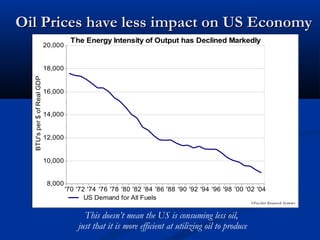
Oil Prices have less impact on US EconomyOil Prices have less impact on US Economy
'70 '72 '74 '76 '78 '80 '82 '84 '86 '88 '90 '92 '94 '96 '98 '00 '02 '04
8,000
10,000
12,000
14,000
16,000
18,000
20,000
BTU'sper$ofRealGDP
©FactSet Research Systems
The Energy Intensity of Output has Declined Markedly
US Demand for All Fuels
This doesn’t mean the US is consuming less oil,
just that it is more efficient at utilizing oil to produce
What Role Did Energy Politics PlayWhat Role Did Energy Politics Play
in September 11? In…in September 11? In…
 AfghanistanAfghanistan
 Central AsiaCentral Asia
 The Middle EastThe Middle East
 The Rest of the WorldThe Rest of the World
AfghanistanAfghanistan • Afghanistan itself
has few exportable
energy resources.
• Its main value
from an energy
standpoint stems
from the fact that it
offers a route for
Caspian energy to
the sea via Pakistan.
• There are large
deposits of oil and
natural gas in the
Caspian Sea region.
• The main problem is
getting these resources
to markets.
• Pipelines are required
to service the large
markets in North
America, Europe, and
E. Asia.
Two Pipelines in Greater DetailTwo Pipelines in Greater Detail
Main participants in these two
pipelines:
Tengiz to Novorossiysk
Russian Federation 24%
Repub. Of Kazakhstan 19%
Sultanate of Oman 7%
Chevron 15%
LUKARCO 12.5%
Rosneft/Shell 7.5%
Mobil 7.5%
Agip 2%
Turkmenistan to Pakistan:
Unocal, Gazprom, Hyundai,
Itochu, Delta Oil (Saudi
Arabia)
What is the Role of Saudi ArabiaWhat is the Role of Saudi Arabia
within OPEC?within OPEC?
 It is the largest single supplier of oil.It is the largest single supplier of oil.
 The small Saudi population permits themThe small Saudi population permits them
the luxury of varying the amount of oil thatthe luxury of varying the amount of oil that
they sell (thereby controlling prices):they sell (thereby controlling prices):
 When they want the price to increase they sellWhen they want the price to increase they sell
lessless
 When they want the price to decrease they sellWhen they want the price to decrease they sell
moremore
Figure 9-10. Saudi Export Revenues and Foreign CurrencyFigure 9-10. Saudi Export Revenues and Foreign Currency
Reserves, 1960-2005, in Billions of Current DollarsReserves, 1960-2005, in Billions of Current Dollars
Source: World Development Indicators 2007; and Saudi Arabian Monetary
Agency, Annual Report, Monetary and Banking Statistics.

Gradipe06

  • 1.
    Y669 IPE:Y669 IPE: OilPoliticsOil Politics October 5, 2010October 5, 2010
  • 2.
    World Energy Consumption,WorldEnergy Consumption, 1965-2005, in Terawatts (TW)1965-2005, in Terawatts (TW)
  • 3.
    Top Consuming Countries,1960-Top Consuming Countries, 1960- 2005, in Million Barrels per Day2005, in Million Barrels per Day
  • 4.
    Figure 9-5. WorldConsumption of Petroleum, 1960-2005,Figure 9-5. World Consumption of Petroleum, 1960-2005, in Millions of Barrels per Dayin Millions of Barrels per Day Source: U.S. Department of Energy, Energy Information Agency, International Energy Annual (various years).
  • 5.
    OPEC Headquarters, ViennaOPECHeadquarters, Vienna Sheik Ahmed Zaki Yamani
  • 6.
    Table 9-1. Membersof OPECTable 9-1. Members of OPEC Country Membership Algeria 1969 Angola 2007 Ecuador Rejoined 2008 Indonesia 1962 Iran 1960 Iraq 1960 Kuwait 1960 Libya 1962 Nigeria 1971 Qatar 1961 Saudi Arabia 1960 United Arab Emirates 1967 Venezuela 1960
  • 7.
    OPECOPEC  Organization ofOil Exporting CountriesOrganization of Oil Exporting Countries
  • 8.
    Major Crude OilReserves, 2006Major Crude Oil Reserves, 2006 Source: Jean-Paul Rodrigue, Dept. of Economics & Geography, Hofstra University
  • 9.
    Figure 9-4. Productionof Crude Petroleum by OPECFigure 9-4. Production of Crude Petroleum by OPEC Countries, 1970-2007, in Millions of Barrels per DayCountries, 1970-2007, in Millions of Barrels per Day Source: U.S. Department of Energy, Energy Information Agency, International Energy Annual (various years).
  • 10.
    Figure 9-7. OPECand Non-OPEC Oil Production, 1970-2007,Figure 9-7. OPEC and Non-OPEC Oil Production, 1970-2007, in Millions of Barrels per Dayin Millions of Barrels per Day Source: Department of Energy, Energy Information Agency, International Energy Annual (various years).
  • 11.
    Non-OPEC Oil Production,1900-Non-OPEC Oil Production, 1900- 20032003
  • 12.
    Middle East North America LatinAmerica Africa Western Europe Former Soviet Union Pacific Asia Major Oil Routes & Chokepoints, 2000Major Oil Routes & Chokepoints, 2000 15 10 3 1 Million barrels per day Hormuz Malacca Bab el-Mandab Suez Bosphorus Panama Source: Jean-Paul Rodrigue, Dept. of Economics & Geography, Hofstra University
  • 13.
    Price of Oil,Nominal and RealPrice of Oil, Nominal and Real 1861-2006, $ per Barrel1861-2006, $ per Barrel Source: Wikipedia.
  • 14.
    Figure 9-14.Figure 9-14. U.S.Gasoline Prices in Current and Constant 2007 Prices,U.S. Gasoline Prices in Current and Constant 2007 Prices, 1919-2007, in Cents per Gallon1919-2007, in Cents per Gallon Source: Department of Energy, Energy Information Agency, Short Term Energy Outlook, August 2008.
  • 15.
    Spot Prices, 1980-2010SpotPrices, 1980-2010
  • 16.
    Gasoline Prices inPennies perGasoline Prices in Pennies per Gallon, 1973-2010Gallon, 1973-2010
  • 17.
    Real Price ofOil and MajorReal Price of Oil and Major Disruptions in World Oil SupplyDisruptions in World Oil Supply 0 10 20 30 40 50 60 70 80 90 1950 1953 1956 1959 1962 1965 1968 1971 1974 1977 1980 1983 1986 1989 1992 1995 1998 2001 2004 $perbarrel(2005US$) 0 0.5 1 1.5 2 2.5 3 3.5 4 4.5 5 AnnualDemandIncreaseinMillbrls/day Suez War OPEC Embargo 6 Days War Iranian Revolution Iran / Iraq War Gulf War
  • 18.
    Figure 9-8. U.S.Production, Consumption, and Imports ofFigure 9-8. U.S. Production, Consumption, and Imports of Crude Petroleum, 1949-2007, in Millions of Barrels per DayCrude Petroleum, 1949-2007, in Millions of Barrels per Day Source: Department of Energy, Energy Information Agency, International Energy Annual (various years).
  • 19.
    Challenges to theSeven Sisters andChallenges to the Seven Sisters and the rise of the cartel (OPEC)the rise of the cartel (OPEC)  ““Oligopsony = AnOligopsony = An oligopsonyoligopsony is ais a market formmarket form inin which the number of buyers are small while the numberwhich the number of buyers are small while the number of sellers in theory could be large.”of sellers in theory could be large.”  The Seven Sisters were also an oligopsony!The Seven Sisters were also an oligopsony!  ““AA cartelcartel is a group of formally independentis a group of formally independent producers whose goal it is toproducers whose goal it is to fix pricesfix prices, to limit, to limit supplysupply and to limitand to limit competitioncompetition.”.”  OPECOPEC was formed in 1960, but its effects were mostwas formed in 1960, but its effects were most dramatic in 1974.dramatic in 1974.  OPEC sought to counterbalance the Seven Sisters.OPEC sought to counterbalance the Seven Sisters. Definitions from WikipediaDefinitions from Wikipedia
  • 20.
    Conservation Measures Takenafter the OilConservation Measures Taken after the Oil Price Shocks of the 1970sPrice Shocks of the 1970s  Higher taxes on gasoline and fuel oil in WesternHigher taxes on gasoline and fuel oil in Western EuropeEurope  Fuel efficiency standards for motor vehicles inFuel efficiency standards for motor vehicles in the USthe US  Accelerated adoption of energy-efficient heatingAccelerated adoption of energy-efficient heating for homes, offices, and factoriesfor homes, offices, and factories  General substitution of energy-conservingGeneral substitution of energy-conserving technologies for energy-intensive technologiestechnologies for energy-intensive technologies
  • 21.
    Oil Prices haveless impact on US EconomyOil Prices have less impact on US Economy '70 '72 '74 '76 '78 '80 '82 '84 '86 '88 '90 '92 '94 '96 '98 '00 '02 '04 8,000 10,000 12,000 14,000 16,000 18,000 20,000 BTU'sper$ofRealGDP ©FactSet Research Systems The Energy Intensity of Output has Declined Markedly US Demand for All Fuels This doesn’t mean the US is consuming less oil, just that it is more efficient at utilizing oil to produce
  • 22.
    What Role DidEnergy Politics PlayWhat Role Did Energy Politics Play in September 11? In…in September 11? In…  AfghanistanAfghanistan  Central AsiaCentral Asia  The Middle EastThe Middle East  The Rest of the WorldThe Rest of the World
  • 23.
    AfghanistanAfghanistan • Afghanistanitself has few exportable energy resources. • Its main value from an energy standpoint stems from the fact that it offers a route for Caspian energy to the sea via Pakistan.
  • 24.
    • There arelarge deposits of oil and natural gas in the Caspian Sea region. • The main problem is getting these resources to markets. • Pipelines are required to service the large markets in North America, Europe, and E. Asia.
  • 25.
    Two Pipelines inGreater DetailTwo Pipelines in Greater Detail Main participants in these two pipelines: Tengiz to Novorossiysk Russian Federation 24% Repub. Of Kazakhstan 19% Sultanate of Oman 7% Chevron 15% LUKARCO 12.5% Rosneft/Shell 7.5% Mobil 7.5% Agip 2% Turkmenistan to Pakistan: Unocal, Gazprom, Hyundai, Itochu, Delta Oil (Saudi Arabia)
  • 26.
    What is theRole of Saudi ArabiaWhat is the Role of Saudi Arabia within OPEC?within OPEC?  It is the largest single supplier of oil.It is the largest single supplier of oil.  The small Saudi population permits themThe small Saudi population permits them the luxury of varying the amount of oil thatthe luxury of varying the amount of oil that they sell (thereby controlling prices):they sell (thereby controlling prices):  When they want the price to increase they sellWhen they want the price to increase they sell lessless  When they want the price to decrease they sellWhen they want the price to decrease they sell moremore
  • 27.
    Figure 9-10. SaudiExport Revenues and Foreign CurrencyFigure 9-10. Saudi Export Revenues and Foreign Currency Reserves, 1960-2005, in Billions of Current DollarsReserves, 1960-2005, in Billions of Current Dollars Source: World Development Indicators 2007; and Saudi Arabian Monetary Agency, Annual Report, Monetary and Banking Statistics.

Editor's Notes

  • #14 Source: US Department of Energy, Energy Information Administration, International Energy Annual Report http://www.eia.doe.gov
  • #18 Source: Energy Information Administration, Interagency Database and Projections Working Group. http://www.eia.doe.gov/emeu/security/distable.html Source: Worldwatch Institute.