Petroleum Economics.
Topic: Petroleum Politics
Group members:
Shah Faisal (28544)
Masiullah (30870)
Junaid Ahmed (28312)
Amanullah Talpur (31416)
Department of petroleum and gas Engineering (BUITEMS)
Introduction:
 Petroleum politics have been an increasingly important
aspect of diplomacy.
 The ability to fix the price and the production of oil was
first established in 1928 by the Achnacarry Agreements.
Q. Why Achnacarry Agreements where established?
Because the discovery of the East Texas Oil Field in the
1930s led to a boom in production that caused prices to fall,
the commission retained to control the oil price.
Introduction:
 These agreements were formed between the seven multinationals
known as “ Seven Sisters”.
They Include,
 Exxon,
 Texaco,
 British Petroleum,
 Shell,
 Gulf,
 Standard Oil company
 Mobil Oil
Introduction:
 Invested massively in extraction infrastructures, especially
in the Middle East.
 Several producing countries, most of them in the Third
World, wanted to have a more important share of the
incomes of this lucrative ( profitable) market.
 OPEC.
Organization of petroleum exporting Countries.
 Formed in 1960 at the Baghdad (Iraq).
OPEC.
 Venezuela was the first country to move towards the
establishment of OPEC. when the United States forced
import quotas on Venezuelan and Persian Gulf oil in order
to support the Canadian and Mexican oil industries.
First member countries of OPEC were,
 Venezuela
 Iran
 Iraq
 Saudi Arabia
 Kuwait
OPEC.
 Qatar (1961), Indonesia (1962), Libya (1969), Algeria
(1970), Nigeria (1971), Ecuador (1973-1992, left the
organization in order to avoid production quotas), The
United Arab Emirates (1973) and Gabon (1973-1994).
 From its foundation until the beginning of the 1970s,
OPEC was unable to increase oil prices.
 Reason was, Difficulty of OPEC members to agree on a
common policy.
 First commercial exploitations in Pennsylvania in 1859.
 Importance of oil increased significantly in the global economy.
 Oil and gas prices directly affecting the health of the economy as a
whole.
 Oil and gas is incredibly important not only to individuals and
businesses within a country, but also to the position of the Country
among other countries across the globe.
 Economic systems, which include industry, housing, energy
generation and transportation, became dependent on cheap oil
prices.
 The United States being the most eloquent example.
Costs of oil dependency.
 Wealth is transferred from oil consumers to producers.
 The economy’s overall ability to produce is reduced by
oil’s greater economic scarcity.
 When price movements are sudden and drastic, inflation
and unemployment cause additional losses of output.
 Creates instability.
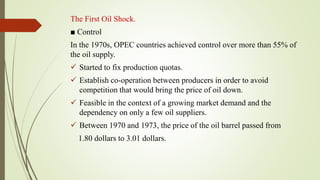
The First Oil Shock.
■ Control
In the 1970s, OPEC countries achieved control over more than 55% of
the oil supply.
 Started to fix production quotas.
 Establish co-operation between producers in order to avoid
competition that would bring the price of oil down.
 Feasible in the context of a growing market demand and the
dependency on only a few oil suppliers.
 Between 1970 and 1973, the price of the oil barrel passed from
1.80 dollars to 3.01 dollars.
The Kippur War of 1973
 Between Israel and Egypt (and several other Arabian countries).
 OPEC intervened by nationalizing production facilities, reducing
production by 25% and imposing export quotas.
 OPEC imposed quotas on countries supporting Israel.
 The price of oil consequently reached 11.65 dollars per barrel at the
end of the same year.
 High oil demand, the limited capacity of developed countries to
supply oil and no readily energetic substitutes.
 OPEC gained the ability to control the price of oil with a market
controlled by oil producers.
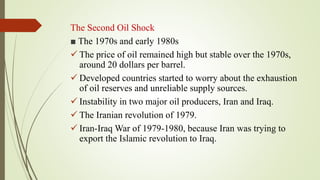
The Second Oil Shock
■ The 1970s and early 1980s
 The price of oil remained high but stable over the 1970s,
around 20 dollars per barrel.
 Developed countries started to worry about the exhaustion
of oil reserves and unreliable supply sources.
 Instability in two major oil producers, Iran and Iraq.
 The Iranian revolution of 1979.
 Iran-Iraq War of 1979-1980, because Iran was trying to
export the Islamic revolution to Iraq.
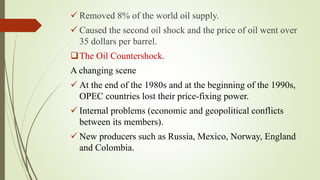
 Removed 8% of the world oil supply.
 Caused the second oil shock and the price of oil went over
35 dollars per barrel.
The Oil Countershock.
A changing scene
 At the end of the 1980s and at the beginning of the 1990s,
OPEC countries lost their price-fixing power.
 Internal problems (economic and geopolitical conflicts
between its members).
 New producers such as Russia, Mexico, Norway, England
and Colombia.
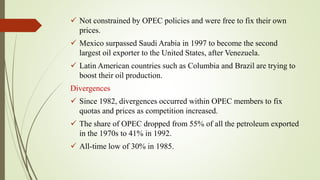
 Not constrained by OPEC policies and were free to fix their own
prices.
 Mexico surpassed Saudi Arabia in 1997 to become the second
largest oil exporter to the United States, after Venezuela.
 Latin American countries such as Columbia and Brazil are trying to
boost their oil production.
Divergences
 Since 1982, divergences occurred within OPEC members to fix
quotas and prices as competition increased.
 The share of OPEC dropped from 55% of all the petroleum exported
in the 1970s to 41% in 1992.
 All-time low of 30% in 1985.
 That year Saudi Arabia lowered the price of its oil to increase its
market share.
 Oil counter-shock that lowered the price of the barrel under 20
dollars, even reaching a record of 15 dollars in 1988.
The Gulf War
 Respecting production quotas became a major issue among OPEC
members.
 Countries such as Kuwait producing well above quota.
 This event was a motivation for the invasion of Kuwait by Iraq in
1990, which saw the price of petroleum jump to 41$.
 7.8% of the world’s oil production was removed (Iraq and Kuwait).
 Other petroleum-producing countries were quick to expand their
production to replace Iraq's and Kuwait's shortfalls.
 The increase in oil price was short-lived.
Reemergence.
 At the end of the 1990s, the price of petroleum increased.
 Oil reserves are in the Middle East.
 Share of OPEC expected to climb to 48% in 2005 and
52% in 2010.
Petroleum politics

Petroleum politics

  • 1.
    Petroleum Economics. Topic: PetroleumPolitics Group members: Shah Faisal (28544) Masiullah (30870) Junaid Ahmed (28312) Amanullah Talpur (31416) Department of petroleum and gas Engineering (BUITEMS)
  • 2.
    Introduction:  Petroleum politicshave been an increasingly important aspect of diplomacy.  The ability to fix the price and the production of oil was first established in 1928 by the Achnacarry Agreements. Q. Why Achnacarry Agreements where established? Because the discovery of the East Texas Oil Field in the 1930s led to a boom in production that caused prices to fall, the commission retained to control the oil price.
  • 3.
    Introduction:  These agreementswere formed between the seven multinationals known as “ Seven Sisters”. They Include,  Exxon,  Texaco,  British Petroleum,  Shell,  Gulf,  Standard Oil company  Mobil Oil
  • 4.
    Introduction:  Invested massivelyin extraction infrastructures, especially in the Middle East.  Several producing countries, most of them in the Third World, wanted to have a more important share of the incomes of this lucrative ( profitable) market.  OPEC. Organization of petroleum exporting Countries.  Formed in 1960 at the Baghdad (Iraq).
  • 5.
    OPEC.  Venezuela wasthe first country to move towards the establishment of OPEC. when the United States forced import quotas on Venezuelan and Persian Gulf oil in order to support the Canadian and Mexican oil industries. First member countries of OPEC were,  Venezuela  Iran  Iraq  Saudi Arabia  Kuwait
  • 6.
    OPEC.  Qatar (1961),Indonesia (1962), Libya (1969), Algeria (1970), Nigeria (1971), Ecuador (1973-1992, left the organization in order to avoid production quotas), The United Arab Emirates (1973) and Gabon (1973-1994).  From its foundation until the beginning of the 1970s, OPEC was unable to increase oil prices.  Reason was, Difficulty of OPEC members to agree on a common policy.
  • 7.
     First commercialexploitations in Pennsylvania in 1859.  Importance of oil increased significantly in the global economy.  Oil and gas prices directly affecting the health of the economy as a whole.  Oil and gas is incredibly important not only to individuals and businesses within a country, but also to the position of the Country among other countries across the globe.  Economic systems, which include industry, housing, energy generation and transportation, became dependent on cheap oil prices.  The United States being the most eloquent example.
  • 8.
    Costs of oildependency.  Wealth is transferred from oil consumers to producers.  The economy’s overall ability to produce is reduced by oil’s greater economic scarcity.  When price movements are sudden and drastic, inflation and unemployment cause additional losses of output.  Creates instability.
  • 9.
    The First OilShock. ■ Control In the 1970s, OPEC countries achieved control over more than 55% of the oil supply.  Started to fix production quotas.  Establish co-operation between producers in order to avoid competition that would bring the price of oil down.  Feasible in the context of a growing market demand and the dependency on only a few oil suppliers.  Between 1970 and 1973, the price of the oil barrel passed from 1.80 dollars to 3.01 dollars.
  • 10.
    The Kippur Warof 1973  Between Israel and Egypt (and several other Arabian countries).  OPEC intervened by nationalizing production facilities, reducing production by 25% and imposing export quotas.  OPEC imposed quotas on countries supporting Israel.  The price of oil consequently reached 11.65 dollars per barrel at the end of the same year.  High oil demand, the limited capacity of developed countries to supply oil and no readily energetic substitutes.  OPEC gained the ability to control the price of oil with a market controlled by oil producers.
  • 11.
    The Second OilShock ■ The 1970s and early 1980s  The price of oil remained high but stable over the 1970s, around 20 dollars per barrel.  Developed countries started to worry about the exhaustion of oil reserves and unreliable supply sources.  Instability in two major oil producers, Iran and Iraq.  The Iranian revolution of 1979.  Iran-Iraq War of 1979-1980, because Iran was trying to export the Islamic revolution to Iraq.
  • 12.
     Removed 8%of the world oil supply.  Caused the second oil shock and the price of oil went over 35 dollars per barrel. The Oil Countershock. A changing scene  At the end of the 1980s and at the beginning of the 1990s, OPEC countries lost their price-fixing power.  Internal problems (economic and geopolitical conflicts between its members).  New producers such as Russia, Mexico, Norway, England and Colombia.
  • 13.
     Not constrainedby OPEC policies and were free to fix their own prices.  Mexico surpassed Saudi Arabia in 1997 to become the second largest oil exporter to the United States, after Venezuela.  Latin American countries such as Columbia and Brazil are trying to boost their oil production. Divergences  Since 1982, divergences occurred within OPEC members to fix quotas and prices as competition increased.  The share of OPEC dropped from 55% of all the petroleum exported in the 1970s to 41% in 1992.  All-time low of 30% in 1985.
  • 14.
     That yearSaudi Arabia lowered the price of its oil to increase its market share.  Oil counter-shock that lowered the price of the barrel under 20 dollars, even reaching a record of 15 dollars in 1988. The Gulf War  Respecting production quotas became a major issue among OPEC members.  Countries such as Kuwait producing well above quota.  This event was a motivation for the invasion of Kuwait by Iraq in 1990, which saw the price of petroleum jump to 41$.  7.8% of the world’s oil production was removed (Iraq and Kuwait).
  • 15.
     Other petroleum-producingcountries were quick to expand their production to replace Iraq's and Kuwait's shortfalls.  The increase in oil price was short-lived. Reemergence.  At the end of the 1990s, the price of petroleum increased.  Oil reserves are in the Middle East.  Share of OPEC expected to climb to 48% in 2005 and 52% in 2010.