Department of Education
Negros Island Region
DIVISION OF NEGROS OCCIDENTAL
Junior HS Science Weekly Lesson Log & Lesson Plan Exemplar First Version: November 2016
Grade 8
Quarter 4
Page 1
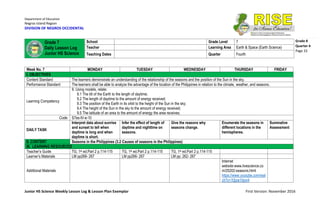
Week No. 1 MONDAY TUESDAY WEDNESDAY THURSDAY FRIDAY
I. OBJECTIVES
Content Standard
The learners demonstrate an understanding of:
1. the relation of geographical location of the Philippines to its environment;
2. the different phenomena that occur in the atmosphere;
3. the relationship of the seasons and the position and of the Sun in the sky; and
4. the occurrence of eclipses.
Performance Standard
The learners shall be able to:
analyze the advantage of the location of the Philippines in relation to the climate, weather, and seasons.
Learning Competency
1. Demonstrate how places on Earth may be located using a coordinate system.
2. Describe the location of the Philippines with respect to the continents and oceans of the world.
Code: S7ES-IVa-1 S7ES-IV-a-2
S7ES-IVb-3
S7ES-IVb-4
DAILY TASK
To assess the
prior knowledge
of the students on
the topic.
Describe the location of the
Philippines using latitude
and longitude.
Describe the location
of the Philippines with
respect to the surrounding
landmasses and bodies of
water.
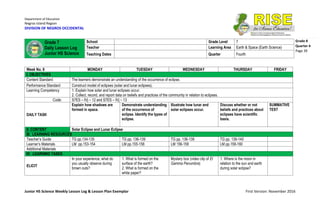
Recognize that soil, water,
coal, and other fossil fuels
are earth materials that
people use as resources;
and
Describe ways of using
earth’s resources
sustainably.
Design a procedure to
show how a certain
factor affects the
amount of water that
can be stored
underground or
released by water shed
to rivers, lakes and
other bodies of water.
Grade 7
Daily Lesson Log
Junior HS Science
School Grade Level 7
Teacher Learning Area Earth & Space (Earth Science)
Teaching Dates Quarter Fourth
Department of Education
Negros Island Region
DIVISION OF NEGROS OCCIDENTAL
Junior HS Science Weekly Lesson Log & Lesson Plan Exemplar First Version: November 2016
Grade 8
Quarter 4
Page 2
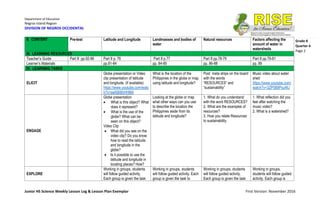
II. CONTENT Pre-test Latitude and Longitude Landmasses and bodies of
water
Natural resources Factors affecting the
amount of water in
watersheds
III. LEARNING RESOURCES
Teacher’s Guide Part II pp.92-96 Part II p. 76 Part II p.77 Part II pp.78-79 Part II pp.79-81
Learner’s Materials pp.81-84 pp. 84-85 pp. 86-88 pp. 89
IV. LEARNING TASKS
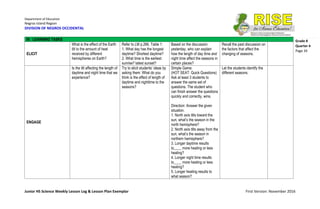
ELICIT
Globe presentation or Video
clip presentation of latitude
and longitude. (if available)
https://www.youtube.com/watc
h?v=swKBi6hHHMA
What is the location of the
Philippines in the globe or map
using latitude and longitude?
Post meta strips on the board
with the words
“RESOURCES” and
“sustainability”
Music video about water
shed
https://www.youtube.com/
watch?v=3ZP0B8PsuNU
ENGAGE
Globe presentation
 What is this object? What
does it represent?
 What is the use of the
globe? What can be
seen on this object?
Video Clip
 What did you see on the
video clip? Do you know
how to read the latitude
and longitude in the
globe?
 Is it possible to use the
latitude and longitude in
locating places? How?
Looking at the globe or map
what other ways can you use
to describe the location the
Philippines aside from its
latitude and longitude?
1. What do you understand
with the word RESOURCES?
2. What are the examples of
resources?
3. How you relate Resources
to sustainability
1. What reflection did you
feel after watching the
music video?
2. What is a watershed?
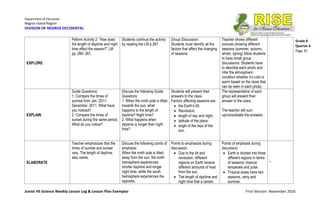
EXPLORE
Working in groups, students
will follow guided activity.
Each group is given the task
Working in groups, students
will follow guided activity. Each
group is given the task to
Working in groups, students
will follow guided activity.
Each group is given the task
Working in groups,
students will follow guided
activity. Each group is
Department of Education
Negros Island Region
DIVISION OF NEGROS OCCIDENTAL
Junior HS Science Weekly Lesson Log & Lesson Plan Exemplar First Version: November 2016
Grade 8
Quarter 4
Page 3
to describe the location of the
Philippines using latitude and
longitude (refer to LM pp. 81-
84)
describe the location of the
Philippines with respect to the
surrounding landmasses and
bodies of water. (Refer to LM
pp. 84-85)
to study the pictures on page (
Refer to LM pp.86-88)
given the tasks to design
a procedure to determine
the factors that affect the
amount of water that can
be stored underground or
released by a watershed
to rivers, lakes, and other
bodies of water. (Refer to
LM p.89)
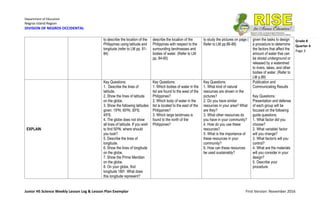
EXPLAIN
Key Questions:
1. Describe the lines of
latitude.
2. Show the lines of latitude
on the globe.
3. Show the following latitudes
given: 150N; 600N; 300S;
450S.
4. The globe does not show
all lines of latitude. If you wish
to find 500N; where should
you look?
5. Describe the lines of
longitude.
6. Show the lines of longitude
on the globe.
7. Show the Prime Meridian
on the globe.
8. On your globe, find
longitude 1800. What does
this longitude represent?
Key Questions:
1. Which bodies of water in the
list are found to the west of the
Philippines?
2. Which body of water in the
list is located to the east of the
Philippines?
3. Which large landmass is
found to the north of the
Philippines?
Key Questions:
1. What kind of natural
resources are shown in the
pictures?
2. Do you have similar
resources in your area? What
are they?
3. What other resources do
you have in your community?
4. How do you use these
resources?
5. What is the importance of
these resources in your
community?
6. How can these resources
be used sustainably?
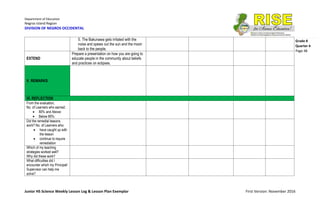
Publication and
Communicating Results
Key Questions:
Presentation and defense
of each group will be
focused on the following
guide questions:
1. What factor did you
choose?
2. What variable/ factor
will you change?
3. What factor/s will you
control?
4. What are the materials
will you consider in your
design?
5. Describe your
procedure.
Department of Education
Negros Island Region
DIVISION OF NEGROS OCCIDENTAL
Junior HS Science Weekly Lesson Log & Lesson Plan Exemplar First Version: November 2016
Grade 8
Quarter 4
Page 4
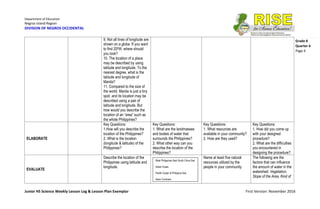
9. Not all lines of longitude are
shown on a globe. If you want
to find 200W, where should
you look?
10. The location of a place
may be described by using
latitude and longitude. To the
nearest degree, what is the
latitude and longitude of
Manila?
11. Compared to the size of
the world, Manila is just a tiny
spot, and its location may be
described using a pair of
latitude and longitude. But
how would you describe the
location of an “area” such as
the whole Philippines?
ELABORATE
Key Questions:
1.How will you describe the
location of the Philippines?
2. What is the location
(longitude & latitude) of the
Philippines?
Key Questions:
1. What are the landmasses
and bodies of water that
surrounds the Philippines?
2. What other way can you
describe the location of the
Philippines?
Key Questions:
1. What resources are
available in your community?
2. How are they used?
Key Questions:
1. How did you come up
with your designed
procedure?
2. What are the difficulties
you encountered in
designing the procedure?
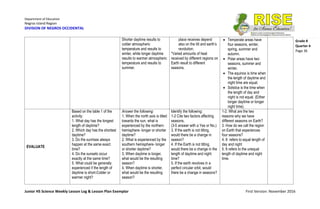
EVALUATE
Describe the location of the
Philippines using latitude and
longitude.
Name at least five natural
resources utilized by the
people in your community
The following are the
factors that can influence
the amount of water in the
watershed: Vegetation,
Slope of the Area, Kind of
West Philippines Sea/ South China Sea
Indian Ocean
Pacific Ocean & Philippine Sea
Asian Continent
Department of Education
Negros Island Region
DIVISION OF NEGROS OCCIDENTAL
Junior HS Science Weekly Lesson Log & Lesson Plan Exemplar First Version: November 2016
Grade 8
Quarter 4
Page 5
Choose your answers from the
box.
1.What bodies of water are
found to the west of the
Philippines?
2.What large landmass is
found to the north of the
Philippines?
3.What bodies of water are
found to the east of the
Philippines?
Soil and Amount of
Rainfall.
If you want to determine
the effect of the amount of
rainfall on the amount of
water in the watershed,
1. What factor will you
change?
2. What factor will you
control?
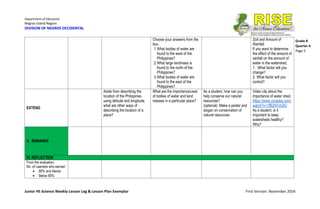
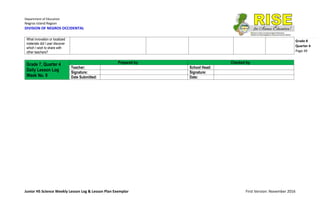
EXTEND
Aside from describing the
location of the Philippines
using latitude and longitude,
what are other ways of
describing the location of a
place?
What are the importance/uses
of bodies of water and land
masses in a particular place?
As a student, how can you
help conserve our natural
resources?
(optional) Make a poster and
slogan on conservation of
natural resources.
Video clip about the
importance of water shed.
https://www.youtube.com/
watch?v=1fB2N7chZlU
As a student, is it
important to keep
watersheds healthy?
Why?
V. REMARKS
VI. REFLECTION
From the evaluation,
No. of Learners who earned:
 80% and Above:
 Below 80%:
Department of Education
Negros Island Region
DIVISION OF NEGROS OCCIDENTAL
Junior HS Science Weekly Lesson Log & Lesson Plan Exemplar First Version: November 2016
Grade 8
Quarter 4
Page 6
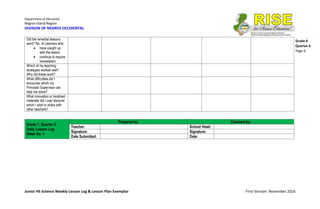
Did the remedial lessons
work? No. of Learners who:
 have caught up
with the lesson
 continue to require
remediation
Which of my teaching
strategies worked well?
Why did these work?
What difficulties did I
encounter which my
Principal/ Supervisor can
help me solve?
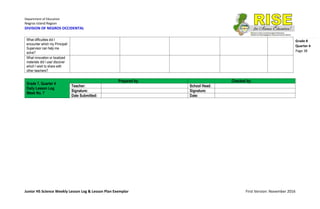
What innovation or localized
materials did I use/ discover
which I wish to share with
other teachers?
Grade 7, Quarter 4
Daily Lesson Log
Week No. 1
Prepared by: Checked by:
Teacher: School Head:
Signature: Signature:
Date Submitted: Date:
Department of Education
Negros Island Region
DIVISION OF NEGROS OCCIDENTAL
Junior HS Science Weekly Lesson Log & Lesson Plan Exemplar First Version: November 2016
Grade 8
Quarter 4
Page 7
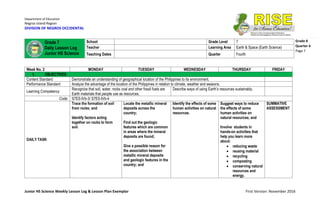
Week No. 2 MONDAY TUESDAY WEDNESDAY THURSDAY FRIDAY
I. OBJECTIVES
Content Standard Demonstrate an understanding of geographical location of the Philippines to its environment.
Performance Standard Analyze the advantage of the location of the Philippines in relation to climate, weather and seasons.
Learning Competency
Recognize that soil, water, rocks coal and other fossil fuels are
Earth materials that people use as resources.
Describe ways of using Earth’s resources sustainably.
Code: S7ES-IVb-3/ S7ES-IVb-4
DAILY TASK
Trace the formation of soil
from rocks; and
Identify factors acting
together on rocks to form
soil.
Locate the metallic mineral
deposits across the
country;
Find out the geologic
features which are common
in areas where the mineral
deposits are found;
Give a possible reason for
the association between
metallic mineral deposits
and geologic features in the
country; and
Identify the effects of some
human activities on natural
resources.
Suggest ways to reduce
the effects of some
human activities on
natural resources; and
Involve students in
hands-on activities that
help you learn more
about:
 reducing waste
 reusing material
 recycling
 composting
 conserving natural
resources and
energy.
SUMMATIVE
ASSESSMENT
Grade 7
Daily Lesson Log
Junior HS Science
School Grade Level 7
Teacher Learning Area Earth & Space (Earth Science)
Teaching Dates Quarter Fourth
Department of Education
Negros Island Region
DIVISION OF NEGROS OCCIDENTAL
Junior HS Science Weekly Lesson Log & Lesson Plan Exemplar First Version: November 2016
Grade 8
Quarter 4
Page 8
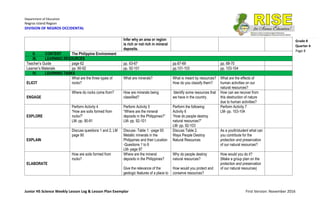
Infer why an area or region
is rich or not rich in mineral
deposits.
II. CONTENT The Philippine Environment
III. LEARNING RESOURCES
Teacher’s Guide page 62 pp. 63-67 pp.67-69 pp. 68-70
Learner’s Materials pp. 90-92 pp. 92-101 pp.101-103 pp. 103-104
IV. LEARNING TASKS
ELICIT
What are the three types of
rocks?
What are minerals? What is meant by resources?
How do you classify them?
What are the effects of
human activities on our
natural resources?
ENGAGE
Where do rocks come from? How are minerals being
classified?
Identify some resources that
we have in the country.
How can we recover from
this destruction of nature
due to human activities?
EXPLORE
Perform Activity 4
“How are soils formed from
rocks?”
LM- pp. 90-91
Perform Activity 5
“Where are the mineral
deposits in the Philippines?”
LM- pp. 92-101
Perform the following:
Activity 6
“How do people destroy
natural resources?”
LM- pp. 92-103
Perform Activity 7
LM- pp. 103-104
EXPLAIN
Discuss questions 1 and 2, LM
page 90
Discuss- Table 1: -page 93
Metallic minerals in the
Philippines and their Location
-Questions 1 to 8
LM- page 97
Discuss Table 2.
Ways People Destroy
Natural Resources
As a youth/student what can
you contribute for the
protection and preservation
of our natural resources?
ELABORATE
How are soils formed from
rocks?
Where are the mineral
deposits in the Philippines?
Give the relevance of the
geologic features of a place to
Why do people destroy
natural resources?
How would you protect and
conserve resources?
How would you do it?
(Make a group plan on the
protection and preservation
of our natural resources)
Department of Education
Negros Island Region
DIVISION OF NEGROS OCCIDENTAL
Junior HS Science Weekly Lesson Log & Lesson Plan Exemplar First Version: November 2016
Grade 8
Quarter 4
Page 9
the abundance of its mineral
deposits.
EVALUATE
Give the different factors of soil
formation. (5 points)
List down the 5 most
abundant METALS in the
country.
Enumerate at least 3 factors
that determine the abundance
of minerals in a certain
place/locality.
Write a short essay about:
“Too much is taken from
Earth and too much is put
into Earth!” (10 points) Use
one whole sheet pad paper.
Write an essay: “Plan your
work. Work your plan.”
EXTEND
Differentiate “ROCKS” from
“SOIL”.
Write at least 5 ways or
means to protect and
conserve our Philippine
natural- resources.
Explain the following on your
science notebook, to be
checked next meeting:
The 5 R’s of
ENVIRONMENTAL
PRESERVATION.
Prepare a short skit on
protection and preservation
of our natural resources.
(Group Presentation to be
presented next meeting)
V. REMARKS
VI. REFLECTION
From the evaluation,
No. of Learners who earned:
 80% and Above:
 Below 80%:
Department of Education
Negros Island Region
DIVISION OF NEGROS OCCIDENTAL
Junior HS Science Weekly Lesson Log & Lesson Plan Exemplar First Version: November 2016
Grade 8
Quarter 4
Page 10
Did the remedial lessons
work? No. of Learners who:
 have caught up with
the lesson
 continue to require
remediation
Which of my teaching
strategies worked well?
Why did these work?
What difficulties did I
encounter which my Principal/
Supervisor can help me
solve?
What innovation or localized
materials did I use/ discover
which I wish to share with
other teachers?
Grade 7, Quarter 4
Daily Lesson Log
Week No. 2
Prepared by: Checked by:
Teacher: School Head:
Signature: Signature:
Date Submitted: Date:
Department of Education
Negros Island Region
DIVISION OF NEGROS OCCIDENTAL
Junior HS Science Weekly Lesson Log & Lesson Plan Exemplar First Version: November 2016
Grade 8
Quarter 4
Page 11
Week No. 3 MONDAY TUESDAY WEDNESDAY THURSDAY FRIDAY
I. OBJECTIVES
Content Standard Demonstrate an understanding of the different phenomena that occur in the atmosphere.
Performance Standard Analyze the advantage of the location of the Philippines in relation to the weather, climate and seasons.
Learning Competency
Discuss how energy from the Sun interacts with the layers of the atmosphere.
Explain how some human activities affect the atmosphere.
Code: S7ES-IVd-5/ S7ES-IVd-6
DAILY TASK
Describe and compare the
features of the five layers of
the atmosphere.
Explain the basis for the
division of the layers of the
atmosphere.
Construct a model
greenhouse; and
Find out if your model
greenhouse retains heat.
Relate the concept of
greenhouse to the
increasing temperature of
Earth’s atmosphere.
Summative
Assessment
II. CONTENT Interactions in the Atmosphere: Greenhouse Effect and Global Warming
II. LEARNING RESOURCES
Teacher’s Guide pp. 76-78 pp. 76-78 pp. 78-79 pp. 78-80
Learner’s Materials pp. 105-107 pp. 105-107 pp. 108-113 pp. 108-113
Additional Materials
III. LEARNING TASKS
ELICIT
What are the three layers or
spheres of the Earth?
What is the coldest layer of
the Earth’s atmosphere?
Why?
What are the different gases or
elements that made up the
Earth’s atmosphere?
Does greenhouse retains
heat or release heat?
Grade 7
Daily Lesson Log
Junior HS Science
School Grade Level 7
Teacher Learning Area Earth & Space (Earth Science)
Teaching Dates Quarter Fourth
Department of Education
Negros Island Region
DIVISION OF NEGROS OCCIDENTAL
Junior HS Science Weekly Lesson Log & Lesson Plan Exemplar First Version: November 2016
Grade 8
Quarter 4
Page 12
ENGAGE
What layer maintains the
existence of life?
What is the layer of the
Earth’s atmosphere that
merges into outer space?
Why?
Is this mixture of gases pure?
Why? Why not?
What is the difference
between GREENHOUSE
EFFECT and GLOBAL
WARMING? Explain.
EXPLORE
Perform Activity 1
What is the basis for dividing
Earth’s atmosphere into layers?
LM pp. 105-107
Do activity on TG p. 78 on A
Sample Table of Data about
the Earth’s Atmosphere
Perform Activity 2:
Does a greenhouse retain or
release heat?
LM pp. 108-113
Discuss:
What is the
GREENHOUSE EFFECT?
LM page 107- Figure 2.
TM- page 79
EXPLAIN
Discuss questions 1 – 8
LM page 106
Discuss: What is the basis for
dividing Earth’s atmosphere
into layers?
Discuss questions 1 to 9
LM page 109
Discuss: “Analogy of a Car”
TG page 80
ELABORATE
What are the different elements
or gases that the Earth’s
atmosphere contains?
Why does temperature
decreases with altitude?
Questions
1. Why are greenhouse
gases like the glass in
the greenhouse?
2. What gas is present in
Venus that explains its
high surface
temperature?
3. Is Earth getting
warmer? Cite the
evidences.
Questions:
1. Does greenhouse
retains or release
heat?
2. How is greenhouse
related to the
increasing
temperature of
Earth’s
atmosphere?
EVALUATE
Answer in ½ crosswise the
following question: (5 pts.)
List down the five layers of the
Earth’s atmosphere according
to its increasing temperature.
Answer the following
questions in ½ crosswise:
1. What is the most
abundant element in
the Earth’s
atmosphere?
2. How about the least?
Answer the following questions
in ½ crosswise:
1. What layer of Earth’s
atmosphere contains
ozone layer? ____
2. What are the two major
greenhouse gases?
Answer the following
questions in ½ crosswise:
1. Which layer of the
Earth’s
atmosphere
contains the ozone
layer? ____
Department of Education
Negros Island Region
DIVISION OF NEGROS OCCIDENTAL
Junior HS Science Weekly Lesson Log & Lesson Plan Exemplar First Version: November 2016
Grade 8
Quarter 4
Page 13
3. . What are the bases
for dividing Earth’s
atmosphere into
layers? (3 points)
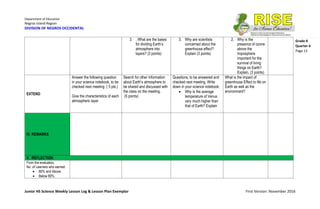
3. Why are scientists
concerned about the
greenhouse effect?
Explain (3 points)
2. Why is the
presence of ozone
above the
troposphere
important for the
survival of living
things on Earth?
Explain. (3 points)
EXTEND
Answer the following question
in your science notebook, to be
checked next meeting :( 5 pts.)
Give the characteristics of each
atmospheric layer
Search for other information
about Earth’s atmosphere to
be shared and discussed with
the class on the meeting.
(5 points)
Questions, to be answered and
checked next meeting. Write
down in your science notebook:
 Why is the average
temperature of Venus
very much higher than
that of Earth? Explain
What is the impact of
greenhouse Effect to life on
Earth as well as the
environment?
IV. REMARKS
V. REFLECTION
From the evaluation,
No. of Learners who earned:
 80% and Above:
 Below 80%:
Department of Education
Negros Island Region
DIVISION OF NEGROS OCCIDENTAL
Junior HS Science Weekly Lesson Log & Lesson Plan Exemplar First Version: November 2016
Grade 8
Quarter 4
Page 14
Did the remedial lessons
work? No. of Learners who:
 have caught up with
the lesson
 continue to require
remediation
Which of my teaching
strategies worked well?
Why did these work?
What difficulties did I
encounter which my Principal/
Supervisor can help me
solve?
What innovation or localized
materials did I use/ discover
which I wish to share with
other teachers?
Grade 7, Quarter 4
Daily Lesson Log
Week No. 3
Prepared by: Checked by:
Teacher: School Head:
Signature: Signature:
Date Submitted: Date:
Department of Education
Negros Island Region
DIVISION OF NEGROS OCCIDENTAL
Junior HS Science Weekly Lesson Log & Lesson Plan Exemplar First Version: November 2016
Grade 8
Quarter 4
Page 15
Week No. 4 MONDAY TUESDAY WEDNESDAY THURSDAY FRIDAY
I. OBJECTIVES
Content Standard The learners demonstrate an understanding of the different phenomena that occur in the atmosphere
Performance Standard The learners shall be able to analyze the advantage of the location of the Philippines in relation to the climate, weather, and seasons
Learning Competency The learners should be able to account for the occurrence of land and sea breezes, monsoons, and intertropical convergence zone (ITCZ)
Code: S7ES-IVe-7
DAILY TASK
Explain what happens when
air is heated.
Explain what happens to the
air in the surroundings as
warm air rises.
Compare which warms up
faster: sand or water;
Compare which cools faster:
sand or water
Use the results of the
activity to explain sea
breeze and land breeze.
Summative
Test
II. CONTENT
What Happens When Air is
Heated
What Happens to the Air in
the Surrounding as Warm
Air Rises
Which Warms Up Faster Sea Breeze and Land
Breeze
III. LEARNING RESOURCES
Teacher’s Guide TG p. 105-106 TG p. 107-108 TG p. 108 TG p.109
Learner’s Materials
LM p. 128-129
(1st Edition, 2013)
LM p. 130-131
(1st Edition, 2013)
LM p. 132-133
(1st Edition, 2013)
LM p. 134-135
(1st Edition, 2013)
Additional Materials
Balloon, glass bottle, hot water Internet source on Sea
Breeze and Land breeze
https://www.youtube.com/watch?v=
L1QJlrneJUw
IV. LEARNING TASKS
ELICIT
Predict – Observe – Explain
Materials:
Balloon, glass bottle, hot water
Review on what happens when
air is heated.
Right after the review on the
previous lesson, Begin by a short
discourse or informal debate.
Brainstorming
Grade 7
Daily Lesson Log
Junior HS Science
School Grade Level 7
Teacher Learning Area Earth & Space (Earth Science)
Teaching Dates Quarter Fourth
Department of Education
Negros Island Region
DIVISION OF NEGROS OCCIDENTAL
Junior HS Science Weekly Lesson Log & Lesson Plan Exemplar First Version: November 2016
Grade 8
Quarter 4
Page 16
ENGAGE
Key Questions:
1. If I insert this deflated balloon
in the glass bottle what do
you think will happen?
2. Gather students’ prediction.
3. Perform the activity (Insert
the deflated balloon on the
glass bottle and let them
observe).
4. Record students’ responses.
5. What happens to the balloon
as it was placed in the glass
bottle with hot water?
6. Why does the balloon inflate?
Key Question:
As warm air rises, what
happens to the air in the
surrounding?
Key Question:
Issue to discuss: Which warms
faster: sand or water?
In five minutes let the group
prepare their stand and be able
to present their basis.
Key Questions:
1.How often you go to the
beach? What do you do
there?
2.When is the time you go to
the beach, day time or night
time? Why?
3.What do you feel if you
swim at day time? Night
time? Why do you say so?
4.During day time at the
beach, how does your hair
go about with the wind? To
what direction does your
hair being blown? Towards
the sea or away from the
sea?
5.What about the night time?
6.How would you explain
these observations?
EXPLORE
Essential Question:
What happens when air is heated?
Essential Question:
What happens to the air in the
surroundings as warm air rises?
Essential Question:
Which warms and cools faster,
land or water?
Essential Question:
What is sea breeze and land
breeze?
Perform Activity No. 3, pp. 128-
129 – What Happens When Air
is Heated?
Answer questions in the activity.
Key Questions:
1. What does the candle flame
do to the air in the bag?
Activity No. 4, LM pp. 130-131
– What Happens to the Air in
the Surroundings as Warm Air
Rises?
Key Questions:
1. What do you think will
happen if you place a
Activity No. 5 – Which Warms
Up Faster?
Key Questions:
1. Which has a higher
temperature after 25 minutes
in the Sun, water or sand?
2. After 25 minutes, how
many Celsius degrees was
No Activity but instead activity
no. 4 result will serve as basis
for discussion on sea breeze
and land breeze.
Key Questions:
1.From the previous activity,
you learned that sand heats
up faster than water. In the
Department of Education
Negros Island Region
DIVISION OF NEGROS OCCIDENTAL
Junior HS Science Weekly Lesson Log & Lesson Plan Exemplar First Version: November 2016
Grade 8
Quarter 4
Page 17
2. What happens when air is
heated?
3. If the air expands, where will
the expanding air go?
4. When the air goes out of the
bag, does it become lighter or
heavier?
5. Will the bag sink or rise?
Explain.
smoke source near the
hole?
2. Was your prediction
accurate?
3. What happened?
4. Can you explain why?
the increase in the
temperature of the water? Of
the sand?
3. Based on the graph, which is
heated faster, water or sand?
4. What happened to the
temperature of the water and
sand when brought to the
shade?
5. How many Celsius degrees
was the decrease in
temperature of the water after
25 minutes? Of the sand?
6. Based on the graph, which
cooled down faster, water or
sand?
same way, when land
surfaces are exposed to
the Sun during the day,
they heat up faster than
bodies of water. At night,
when the Sun has set,
the land loses heat faster
than bodies of water.
How does this affect the air
in the surroundings?
2.When does sea breeze
occur?
3.What will happen at night,
when the Sun is gone?
4.When does land breeze
occur?
EXPLAIN
Students will present their
observation.
Key Questions:
1. What happens when air is
heated?
2. As warm air rises, what is its
effect in the surroundings?
Presentation of Group’s
output follows.
Key Questions:
1. What makes the air move?
2. What happens to the air in
the surroundings?
3. How can you tell that the
air is moving?
Presentation of group’s output.
Key Questions:
1. Which from the two heats up
faster?
2. Which cools down faster?
3. What makes the sand heats
up and cools down faster
than water?
Processing of students’
response and do a Lecturette
on sea breeze and land
breeze.
Key Questions:
1. Based on what you learned
so far, in what direction
does air move, from a low-
pressure area to a high
pressure area or the other
way around? Expand.
2. What causes the sea
breeze and the land
breeze?
Department of Education
Negros Island Region
DIVISION OF NEGROS OCCIDENTAL
Junior HS Science Weekly Lesson Log & Lesson Plan Exemplar First Version: November 2016
Grade 8
Quarter 4
Page 18
ELABORATE
Key Questions:
1. What is the result if air is
heated?
2. Why does hot air rise?
Key Questions:
1. What happens to the warm
air?
2. How is the air in the
surroundings affected?
Key Questions:
1. If we relate the activity with
the sun’s rays, what can you
infer with the heating of the
water and the sand?
2. Do they heat up as fast as
each other?
3. Do land and water absorb
heat from the Sun in the
same way?
Process students’ responses.
Right after students will have
a grasp on the process
involve in sea breeze and land
breeze let them watch a video
presentation for them to
understand better the
process.
Sea Breeze and Land Breeze:
https://www.youtube.com/watc
h?v=L1QJlrneJUw
Key Question:
1. What is sea breeze? Land
breeze?
Deepening of the lesson
follows.
EVALUATE
True or False
1. Warm air is heavier than cool
air so it sinks while cooler air
rises. (F)
2. Cool air is heavier than warm
air so it sinks while warm air
rises. (T)
Answer this question briefly:
Explain what happens when air
is heated. (3 pts.)
True or False
1. The constant changes of
warm air in the atmosphere
causes changing weather
condition. (T)
2. As warm air rises, it
becomes warmer. (F)
3. As air becomes heated
near the surface of the
Earth, air molecules
expand, thus making the air
denser than the cooler air
layers on top of it. (F)
4. Warm air rises and air
moves toward the place
where warm air is rising. (T)
True or False
1. The sand cools faster
than water. (T)
2. The water cools faster
than sand. (F)
3. The sand heats faster
than water. (T)
4. The water heats faster
than sand. (F)
5. The temperature of the
sand increases faster
than water. (T)
Multiple Choice
1. Which is the best answer
for which breezes blow?
a.High pressure to low
pressure*
b.West to east
c.Low pressure to high
pressure
d.North to south
2. What type of breeze forms
when the land cools faster
than the ocean?
a.Sea breeze*
b.Valley breeze
c.Mountain breeze
d.Land breeze
Department of Education
Negros Island Region
DIVISION OF NEGROS OCCIDENTAL
Junior HS Science Weekly Lesson Log & Lesson Plan Exemplar First Version: November 2016
Grade 8
Quarter 4
Page 19
5. Wind refers to the air in the
surroundings moving
toward the place where
warm air is rising. (T)
3. It is also called as offshore.
a.Sea breeze
b.Land breeze*
c.Mountain breeze
d.Valley breeze
Essay:
Explain sea breeze and land
breeze When these occur?
EXTEND
You already know that warm air
rises, what is then the effect of
this to the surrounding?
What is/are the importance of
understanding the effect of
warm air and its effect to the
surroundings?
What is the effect of fast
warming and cooling of land to
us? List ways that people do to
minimize the effect of heat
absorbed by land during day
time especially summer time.
Make a creative drawing
showing the direction of wind
during the sea breeze and
land breeze.
V. REMARKS
VI. REFLECTION
From the evaluation,
No. of Learners who earned:
 80% and Above:
 Below 80%:
Did the remedial lessons
work? No. of Learners who:
 have caught up with
the lesson
 continue to require
remediation
Department of Education
Negros Island Region
DIVISION OF NEGROS OCCIDENTAL
Junior HS Science Weekly Lesson Log & Lesson Plan Exemplar First Version: November 2016
Grade 8
Quarter 4
Page 20
Which of my teaching
strategies worked well?
Why did these work?
What difficulties did I
encounter which my
Principal/ Supervisor can help
me solve?
What innovation or localized
materials did I use/ discover
which I wish to share with
other teachers?
Grade 7, Quarter 4
Daily Lesson Log
Week No. 4
Prepared by: Checked by:
Teacher: School Head:
Signature: Signature:
Date Submitted: Date:
Department of Education
Negros Island Region
DIVISION OF NEGROS OCCIDENTAL
Junior HS Science Weekly Lesson Log & Lesson Plan Exemplar First Version: November 2016
Grade 8
Quarter 4
Page 21
Week No. 5 MONDAY TUESDAY WEDNESDAY THURSDAY FRIDAY
I. OBJECTIVES
Content Standard The different phenomena that occur in the atmosphere.
Performance Standard Analyze the advantage of the location of the Philippines in relation to the climate, weather, and seasons.
Learning Competency Describe the effects of certain weather systems in the Philippines.
Code: S7ES-IVd-7
DAILY TASK
Interpret a map to determine
direction of wind
movement; and
Explain why it is cold
around in December to
February and warm around
July.
Describe the occurrence
monsoons.
Illustrate why habagat brings
lots of rain; and
Give examples how
monsoons (amihan and
habagat) affect people.
Describe the occurrence
of ITCZ.
Summative
Assessment
II. CONTENT Monsoons
Intertropical
Convergence Zone (ITCZ)
III. LEARNING RESOURCES
Teacher’s Guide Part II pp. 109-111 Part II pp.112-113
Learner’s Materials Part II pp.120-124 Part II pp.125-126
Additional Materials
Grade 7
Daily Lesson Log
Junior HS Science
School Grade Level 7
Teacher Learning Area Earth & Space (Earth Science)
Teaching Dates Quarter Fourth
Department of Education
Negros Island Region
DIVISION OF NEGROS OCCIDENTAL
Junior HS Science Weekly Lesson Log & Lesson Plan Exemplar First Version: November 2016
Grade 8
Quarter 4
Page 22
IV.LEARNING TASKS
ELICIT
Video Clip presentation of low
pressure and high pressure
area
https://www.youtube.com/watc
h?v=rjODDPznqNM
Show the picture of Amihan
from Encantadia.
Recall the lesson on Habagat Show a video clip:
Napapanahong Kaalaman:
ITCZ
https://www.youtube.com/wat
ch?v=xd4aafr1eVY
ENGAGE
1.What does the video clip
show?
2.What is low pressure area?
High pressure area?
1. Do you know her?
2. What is her power?
Let the students sing the song “
Rain, rain go away”
What does the song tell ?
What is ITCZ?
EXPLORE
Group Activity:
Perform Activity 6:
Refer to LM pp.121-124.
Activity: Watch and study the
Video Clips
Nakapanahong Kaalaman:
northeast Monsoon/ Amihan
https://www.youtube.com/watc
h?v=I7kBKWTBtmg
Southwest Monsoon/ Habagat
https://www.youtube.com/watc
h?v=gCO8bCu_b2U
Watch and study the video
clip:
The monsoon effects
https://www.youtube.com/watc
h?v=uePm96AFV4Y
Study Figures 19 & 20.
Part II LM p.125.
Guide Questions:
Figure19.
1. When do you observe
the direct rays of the sun?
at the equator? Or at a
higher altitude?
2. Where do you think will it
be warmer?
Figure 20
3. Where will this warm air
move?
4. How about the air away
from the equator, will it be
warm or cold?
5.Where will this air move?
Department of Education
Negros Island Region
DIVISION OF NEGROS OCCIDENTAL
Junior HS Science Weekly Lesson Log & Lesson Plan Exemplar First Version: November 2016
Grade 8
Quarter 4
Page 23
EXPLAIN
Group Presentation
Key Questions:
1. Do the winds move toward
the low-pressure area or away
from it?
2. Do the winds move toward
the high-pressure area or
away from it?
3. In what direction do winds
blow? Do winds blow from
high-pressure areas to low-
pressure areas? Or, from low-
pressure areas to high-
pressure areas?
4. Where is North in the map?
South? West? East? Write the
directions on the map.
5. Where is the Philippines on
the map? Encircle it.
6. From what direction does
the wind blow near the
Philippines in January?
7. From what direction does
the wind blow in the vicinity of
the Philippines in July?
Key Questions:
Based from the video clips:
Video 1
1. What is northeast
monsoons?
2. What is its local name?
3. Where is it compared to?
4. How does it occur?
5. When does it occur?
Video 2
1. When is southwest
monsoon?
2. What is its local name?
3. Where is it compared to?
4. How does it occur?
5. When does it occur?
Lecturette:
Discuss further monsoons:
Habagat and Amihan (with the
aid of Figures 17 & 18)
Key Questions:
1. What does amihan bring?
2. What does Habagat bring?
3. Why does Habagat bring a
lot of rain?
Group Presentation
Key Questions:
Figure19.
1. When do you observe
the direct rays of the sun?
at the equator? Or at a
higher altitude?
2. Where do you think will it
be warmer?
Figure 20
3. Where will this warm air
move?
4. How about the air away
from the equator, will it be
warm or cold?
5. Where will this air move?
6. Where do the two rising
air from the northern and
southern hemispheres
meet?
(This is what we call ITCZ)
Department of Education
Negros Island Region
DIVISION OF NEGROS OCCIDENTAL
Junior HS Science Weekly Lesson Log & Lesson Plan Exemplar First Version: November 2016
Grade 8
Quarter 4
Page 24
ELABORATE
1. How do winds move? Is it
from HPA to LPA or LPA to
HPA?
2. Why is it cold during
December to February and
warm July?
How does monsoon occur? How do monsoons affect
people?
How does ITCZ occur?
EVALUATE
Answer the following
questions:
1.How do winds move?(3pts)
2.Explain why is it cold in
December to February and
warm in July? (3pts)
Rubrics:
3 - Explain completely the
concepts of LPA & HPA.
2 - Lacking either 1 of the
concepts.
1 - Unrelated answer.
Multiple Choice:
1.Notheast monsoon is locally
known as
a. Amihan
b. Habagat
c. Bagyo
d. Tag-ulan
2. Habagat is a local name of
the monsoon wind
a.Northeast
b.Southwest
c.Typhoon
d. Trade wind
3. Amihan occurs in the
following months EXCEPT
a.December
b.July
c.February
d.January
4.Habagat occurs in
a.December
b.January
c.February
d.July
1.Illustrate why habagat brings
lots of rains. (3pts)
2.Give at least 2 examples of
the effects of habagat to
people.
Rubrics:
3- All concepts were
explained..
2 - Lacking 1-2 concepts in the
explanation.
1- unrelated answer.
Explain how ITCZ occurs?
(5pts)
Rubrics:
5 - Explain the concept
completely .
4 - One concept was not
included.
3 - Two concepts were not
included.
2 - Three or more concepts
were not included.
1 - Unrelated answer.
Department of Education
Negros Island Region
DIVISION OF NEGROS OCCIDENTAL
Junior HS Science Weekly Lesson Log & Lesson Plan Exemplar First Version: November 2016
Grade 8
Quarter 4
Page 25
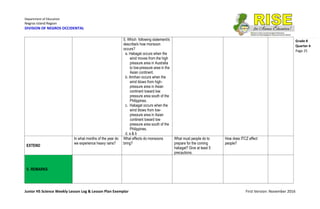
5. Which following statement/s
describe/s how monsoon
occurs?
a. Habagat occurs when the
wind moves from the high
pressure area in Australia
to low-pressure area in the
Asian continent.
b. Amihan occurs when the
wind blows from high-
pressure area in Asian
continent toward low
pressure area south of the
Philippines.
c. Habagat occurs when the
wind blows from low-
pressure area in Asian
continent toward low
pressure area south of the
Philippines.
d. a & b
EXTEND
In what months of the year do
we experience heavy rains?
What effects do monsoons
bring?
What must people do to
prepare for the coming
habagat? Give at least 5
precautions.
How does ITCZ affect
people?
V. REMARKS
Department of Education
Negros Island Region
DIVISION OF NEGROS OCCIDENTAL
Junior HS Science Weekly Lesson Log & Lesson Plan Exemplar First Version: November 2016
Grade 8
Quarter 4
Page 26
VI. REFLECTION
From the evaluation,
No. of Learners who earned:
 80% and Above:
 Below 80%:
Did the remedial lessons work?
No. of Learners who:
 have caught up with
the lesson
 continue to require
remediation
Which of my teaching strategies
worked well?
Why did these work?
What difficulties did I encounter
which my Principal/ Supervisor
can help me solve?
What innovation or localized
materials did I use/ discover
which I wish to share with other
teachers?
Grade 7, Quarter 4
Daily Lesson Log
Week No. 5
Prepared by: Checked by:
Teacher: School Head:
Signature: Signature:
Date Submitted: Date:
Department of Education
Negros Island Region
DIVISION OF NEGROS OCCIDENTAL
Junior HS Science Weekly Lesson Log & Lesson Plan Exemplar First Version: November 2016
Grade 8
Quarter 4
Page 27
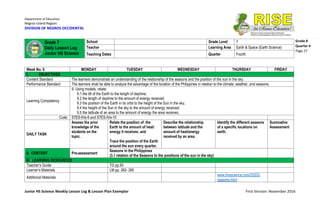
Week No. 6 MONDAY TUESDAY WEDNESDAY THURSDAY FRIDAY
I. OBJECTIVES
Content Standard The learners demonstrate an understanding of the relationship of the seasons and the position of the sun in the sky.
Performance Standard The learners shall be able to analyze the advantage of the location of the Philippines in relation to the climate, weather, and seasons.
Learning Competency
9. Using models, relate:
9.1 the tilt of the Earth to the length of daytime;
9.2 the length of daytime to the amount of energy received;
9.3 the position of the Earth in its orbit to the height of the Sun in the sky;
9.4 the height of the Sun in the sky to the amount of energy received;
9.5 the latitude of an area to the amount of energy the area receives;
Code: S7ES-IVe-9 and S7ES-IVe-10
DAILY TASK
Assess the prior
knowledge of the
students on the
topic.
Relate the position of the
Earth to the amount of heat/
energy it receives; and
Trace the position of the Earth
around the sun every quarter.
Describe the relationship
between latitude and the
amount of heat/energy
received by an area.
Identify the different seasons
of a specific locations on
earth.
Summative
Assessment
II. CONTENT Pre-assessment
Seasons in the Philippines
(3.1 relation of the Seasons to the positions of the sun in the sky)
III. LEARNING RESOURCES
Teacher’s Guide TG pp.93
Learner’s Materials LM pp. 262- 265
Additional Materials
www.livescience.com/25202-
seasons.html
Grade 7
Daily Lesson Log
Junior HS Science
School Grade Level 7
Teacher Learning Area Earth & Space (Earth Science)
Teaching Dates Quarter Fourth
Department of Education
Negros Island Region
DIVISION OF NEGROS OCCIDENTAL
Junior HS Science Weekly Lesson Log & Lesson Plan Exemplar First Version: November 2016
Grade 8
Quarter 4
Page 28
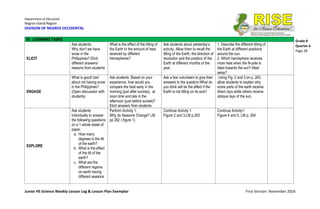
IV. LEARNING TASKS
ELICIT
Ask students:
Why don’t we have
snow in the
Philippines? Elicit
different answers/
reasons from students
What is the effect of the tilting of
the Earth to the amount of heat
received by different
hemispheres?
Ask students about yesterday’s
activity. Allow them to recall the
tilting of the Earth, the direction of
revolution and the position of the
Earth at different months of the
year.
1. Describe the different tilting of
the Earth at different positions
around the sun.
2. Which hemisphere receives
more heat when the N-pole is
tilted towards the sun? tilted
away?
ENGAGE
What is good/ bad
about not having snow
in the Philippines?
(Open discussion with
students)
Ask students: Based on your
experience, how would you
compare the heat early in the
morning (just after sunrise), at
noon time and late in the
afternoon (just before sunset)?
Elicit answers from students.
Ask a few volunteers to give their
answers to the question:What do
you think will be the effect if the
Earth is not tilting on its axis?
Using Fig. 2 and 3 on p. 263,
allow students to explain why
some parts of the earth receive
direct rays while others receive
oblique rays of the sun.
EXPLORE
Ask students
individually to answer
the following questions
on a 1 whole sheet of
paper.
a. How many
degrees is the tilt
of the earth?
b. What is the effect
of the tilt of the
earth?
c. What are the
different regions
on earth having
different seasons
Perform Activity 1:
Why do Seasons Change? LM
pp 262 ( figure 1)
Continue Activity 1:
Figure 2 and 3,LM p.263
Continue Activity1:
Figure 4 and 5, LM p. 264
Department of Education
Negros Island Region
DIVISION OF NEGROS OCCIDENTAL
Junior HS Science Weekly Lesson Log & Lesson Plan Exemplar First Version: November 2016
Grade 8
Quarter 4
Page 29
EXPLAIN
Group sharing
(refer to questions
posted on the explore
stage)
Discuss guide questions:
1. In which month is the north
pole tilted toward the sun- in
June or December?
2. In which month is the north
pole tilted away from the sun- in
June or December?
Allow each group to present the
answers to guide questions 3-4.
Guide Questions:
#3. In June, which hemisphere
receives direct rays from the
Sun- the Northern hemisphere or
Southern hemisphere?
#4. In December, which
hemisphere receives direct rays
from the sun- the northern
hemisphere or southern
hemisphere?
Discuss with students the effect
of the heat of direct rays and
oblique rays of the sun to
certain areas.
Guide Questions:
1. What do you think will happen
to the temperature of the place
receiving direct rays from the
sun? What will be its effect to
the season?
2. Compare the atmospheric
condition of a certain place
receiving direct rays of the sun
to a certain place receiving
oblique rays from the sun?
ELABORATE
Teacher presents a
general information
on the topics to be
undertaken.
Teacher focuses on the figure 1,
page 128, showing the tilting of
the Earth at different positions
around the Sun.
Teacher focuses discussion to
figure 2, showing the tilting of the
Earth and the hemisphere
receiving the direct rays of the
sun.
Discuss with students the effect
of the heat of direct rays and
oblique rays of the sun to certain
areas
Points of emphasis during
discussion:
 Countries receiving direct
rays from the sun are
having warmer season
during those months.
 Countries receiving oblique
rays are having colder
season.
 The more oblique rays
received by a place, the
colder is the atmospheric
temperature which affects
the season.
Department of Education
Negros Island Region
DIVISION OF NEGROS OCCIDENTAL
Junior HS Science Weekly Lesson Log & Lesson Plan Exemplar First Version: November 2016
Grade 8
Quarter 4
Page 30
 Countries near the equator
receive almost direct rays
of the sun for the entire
year. These countries have
dry and wet seasons.
 Countries in the temperate
areas sometimes receive
the direct rays or
sometimes receive the
oblique rays of the sun. As
a result, they experience
four different seasons.
EVALUATE
Multiple Choice:
1. In which month is the north
pole tilted towards the Sun?
a. June
b. December
c. March
2. In which month is the north
pole tilted away from the sun?
a. June
b. December
c. September
True or False
3. The Earth is always tilting
towards the sun.
4. The Earth revolves on its orbit
in a counter clockwise direction.
5. In March, the North and South
poles are equally distant from the
sun.
Identification:
1. In June, which
hemisphere receives
direct rays from the Sun?
2. In December, which
hemisphere receives
direct rays from the sun?
3. In which month is the
north pole tilted towards
the sun?
4. In which month is the
south pole tilted towards
the sun?
5. How many degrees is
the tilt of the Earth?
With the world map on hand,
identify whether the following
countries have 2 or 4 seasons:
1. Indonesia
2. Thailand
3. Peru
4. Philippines
5. North Korea
Department of Education
Negros Island Region
DIVISION OF NEGROS OCCIDENTAL
Junior HS Science Weekly Lesson Log & Lesson Plan Exemplar First Version: November 2016
Grade 8
Quarter 4
Page 31
EXTEND
Prepare to discuss your answer
to the question:
What do you think will be the
effect if the Earth is not tilting on
its axis?
Identify at least 5 countries
having snow. Locate their
position on the map. Bring a
world map for the next lesson.
Do we experience 4 seasons in
the Philippines? Why? Why not?
(Prepare for summative test)
V. REMARKS
VI. REFLECTION
From the evaluation,
No. of Learners who earned:
 80% and Above:
 Below 80%:
Did the remedial lessons
work? No. of Learners who:
 have caught up with
the lesson
 continue to require
remediation
Which of my teaching
strategies worked well?
Why did these work?
What difficulties did I
encounter which my Principal/
Supervisor can help me
solve?
Department of Education
Negros Island Region
DIVISION OF NEGROS OCCIDENTAL
Junior HS Science Weekly Lesson Log & Lesson Plan Exemplar First Version: November 2016
Grade 8
Quarter 4
Page 32
What innovation or localized
materials did I use/ discover
which I wish to share with
other teachers?
Grade 7, Quarter 4
Daily Lesson Log
Week No. 6
Prepared by: Checked by:
Teacher: School Head:
Signature: Signature:
Date Submitted: Date:
Department of Education
Negros Island Region
DIVISION OF NEGROS OCCIDENTAL
Junior HS Science Weekly Lesson Log & Lesson Plan Exemplar First Version: November 2016
Grade 8
Quarter 4
Page 33
Week No. 7 MONDAY TUESDAY WEDNESDAY THURSDAY FRIDAY
I. OBJECTIVES
Content Standard The learners demonstrate an understanding of the relationship of the seasons and the position of the Sun in the sky.
Performance Standard The learners shall be able to analyze the advantage of the location of the Philippines in relation to the climate, weather, and seasons.
Learning Competency
9. Using models, relate:
9.1 The tilt of the Earth to the length of daytime;
9.2 The length of daytime to the amount of energy received;
9.3 The position of the Earth in its orbit to the height of the Sun in the sky;
9.4 The height of the Sun in the sky to the amount of energy received;
9.5 The latitude of an area to the amount of energy the area receives;
Code: S7es-IV-e-10
DAILY TASK
Interpret data about sunrise
and sunset to tell when
daytime is long and when
daytime is short.
Infer the effect of length of
daytime and nighttime on
seasons.
Give the reasons why
seasons change.
Enumerate the seasons in
different locations in the
hemispheres.
Summative
Assessment
II. CONTENT Seasons in the Philippines (3.2 Causes of seasons in the Philippines)
III. LEARNING RESOURCES
Teacher’s Guide TG, 1st ed.Part 2 p.114-115 TG, 1st ed.Part 2 p.114-115 TG, 1st ed.Part 2 p.114-115
Learner’s Materials LM pp266- 267 LM pp266- 267 LM pp. 262- 267
Additional Materials
Internet
website:www.livescience.co
m/25202-seasons.html
https://www.youtube.com/wat
ch?v=10jzw1hjov4
Grade 7
Daily Lesson Log
Junior HS Science
School Grade Level 7
Teacher Learning Area Earth & Space (Earth Science)
Teaching Dates Quarter Fourth
Department of Education
Negros Island Region
DIVISION OF NEGROS OCCIDENTAL
Junior HS Science Weekly Lesson Log & Lesson Plan Exemplar First Version: November 2016
Grade 8
Quarter 4
Page 34
IV. LEARNING TASKS
ELICIT
What is the effect of the Earth
tilt to the amount of heat
received by different
hemispheres on Earth?
Refer to LM p.266, Table 1:
1. What day has the longest
daytime? Shortest daytime?
2. What time is the earliest
sunrise? latest sunset?
Based on the discussion
yesterday, who can explain
how the length of day time and
night time affect the seasons in
certain places?
Recall the past discussion on
the factors that affect the
changing of seasons.
ENGAGE
Is the tilt affecting the length of
daytime and night time that we
experience?
Try to elicit students’ ideas by
asking them: What do you
think is the effect of length of
daytime and nighttime to the
seasons?
Simple Game:
(HOT SEAT: Quick Questions)
Ask at least 3 students to
answer the same set of
questions. The student who
can finish answer the questions
quickly and correctly, wins.
Direction: Answer the given
situation.
1. North axis tilts toward the
sun, what’s the season in the
north hemisphere?
2. North axis tilts away from the
sun, what’s the season in
northern hemisphere?
3. Longer daytime results
to____ more heating or less
heating?
4. Longer night time results
to____ more heating or less
heating?
5. Longer heating results to
what season?
Let the students identify the
different seasons.
Department of Education
Negros Island Region
DIVISION OF NEGROS OCCIDENTAL
Junior HS Science Weekly Lesson Log & Lesson Plan Exemplar First Version: November 2016
Grade 8
Quarter 4
Page 35
EXPLORE
Peform Activity 2: “How does
the length of daytime and night
time affect the season?” LM
pp. 266- 267.
Students continue the activity
by reading the LM p.267
Group Discussion:
Students must identify all the
factors that affect the changing
of seasons.
Teacher shows different
pictures showing different
seasons (summer, autumn,
winter, spring) Allow students
to have small group
discussions. Students have
to describe each photo and
infer the atmospheric
condition whether it’s cold or
warm based on the clues that
can be seen in each photo.
EXPLAIN
Guide Questions:
1. Compare the times of
sunrise from Jan. 2011-
December, 2011. What have
you noticed?
2. Compare the times of
sunset during the same period.
What do you notice?
Discuss the following Guide
Questions:
1. When the north pole is tilted
towards the sun, what
happens to the length of
daytime? Night time?
2. What happens when
daytime is longer than night
time?
Students will present their
answers to the class.
Factors affecting seasons are:
 the Earth’s tilt;
 Revolution;
 length of day and night;
 latitude of the place;
 angle of the rays of the
sun.
The representative of each
group will present their
answer to the class.
The teacher will sum
up/consolidate the answers
ELABORATE
Teacher emphasizes that the
times of sunrise and sunset
vary. The length of daytime
also varies.
Discuss the following points of
emphasis:
When the north pole is tilted
away from the sun, the north
hemisphere experiences
shorter daytime and longer
night time, while the south
hemisphere experiences the
opposite.
Points to emphasize during
discussion:
 Due to the tilt and
revolution, different
regions on Earth receive
different amounts of heat
from the sun.
 The length of daytime and
night time that a certain
Points of emphasis during
discussion:
 Earth is divided into three
different regions in terms
of seasons: tropical,
temperate and polar.
 Tropical areas have two
seasons, rainy and
summer.
*
Department of Education
Negros Island Region
DIVISION OF NEGROS OCCIDENTAL
Junior HS Science Weekly Lesson Log & Lesson Plan Exemplar First Version: November 2016
Grade 8
Quarter 4
Page 36
Shorter daytime results to
colder atmospheric
temperature and results to
winter, while longer daytime
results to warmer atmospheric
temperature and results to
summer.
place receives depend
also on the tilt and earth’s
revolution.
*Varied amounts of heat
received by different regions on
Earth result to different
seasons.
 Temperate areas have
four seasons, winter,
spring, summer and
autumn.
 Polar areas have two
seasons, summer and
winter.
 The equinox is time when
the length of daytime and
night time are equal.
 Solstice is the time when
the length of day and
night is not equal. (Either
longer daytime or longer
night time).
EVALUATE
Based on the table 1 of the
activity:
1. What day has the longest
length of daytime?
2. Which day has the shortest
daytime?
3. Do the sunrises always
happen at the same exact
time?
4. Do the sunsets occur
exactly at the same time?
5. What could be generally
experienced if the length of
daytime is short-Colder or
warmer night?
Answer the following:
1. When the north axis is tilted
towards the sun, what is
experienced by the northern
hemisphere- longer or shorter
daytime?
2. What is experienced by the
southern hemisphere- longer
or shorter daytime?
3. When daytime is longer,
what would be the resulting
season?
4. When daytime is shorter,
what would be the resulting
season?
Identify the following:
1-2 Cite two factors affecting
seasons.
(3-5 answer with a Yes or No.)
3. If the earth is not tilting,
would there be a change in
season?
4. If the Earth is not tilting,
would there be a change in the
length of daytime and night
time?
5. If the earth revolves in a
perfect circular orbit, would
there be a change in seasons?
1-2. What are the two
reasons why we have
different seasons on Earth?
3. How do we call the region
on Earth that experiences
four seasons?
4. It refers to equal length of
day and night
5. It refers to the unequal
length of daytime and night
time.
Department of Education
Negros Island Region
DIVISION OF NEGROS OCCIDENTAL
Junior HS Science Weekly Lesson Log & Lesson Plan Exemplar First Version: November 2016
Grade 8
Quarter 4
Page 37
5. If the Philippines is having
cold season, what is being
experienced by the southern
hemisphere- winter or
summer?
EXTEND
If the North pole is tilted
towards the sun, what is its
effect to the length of daytime
in the Northern hemisphere?
Southern Hemisphere?
Bring a world map Differentiate: tropical,
temperate and polar regions on
Earth?
Prepare for summative test.
V. REMARKS
VI. REFLECTIONS
From the evaluation,
No. of Learners who earned:
 80% and Above:
 Below 80%:
Did the remedial lessons
work? No. of Learners who:
 have caught up with
the lesson
 continue to require
remediation
Which of my teaching
strategies worked well?
Why did these work?
Department of Education
Negros Island Region
DIVISION OF NEGROS OCCIDENTAL
Junior HS Science Weekly Lesson Log & Lesson Plan Exemplar First Version: November 2016
Grade 8
Quarter 4
Page 38
What difficulties did I
encounter which my Principal/
Supervisor can help me
solve?
What innovation or localized
materials did I use/ discover
which I wish to share with
other teachers?
Grade 7, Quarter 4
Daily Lesson Log
Week No. 7
Prepared by: Checked by:
Teacher: School Head:
Signature: Signature:
Date Submitted: Date:
Department of Education
Negros Island Region
DIVISION OF NEGROS OCCIDENTAL
Junior HS Science Weekly Lesson Log & Lesson Plan Exemplar First Version: November 2016
Grade 8
Quarter 4
Page 39
Week No. 8 MONDAY TUESDAY WEDNESDAY THURSDAY FRIDAY
I. OBJECTIVES
Content Standard The learners demonstrate an understanding of the occurrence of eclipse.
Performance Standard Construct model of eclipses (solar and lunar eclipses).
Learning Competency 1. Explain how solar and lunar eclipses occur.
2. Collect, record, and report data on beliefs and practices of the community in relation to eclipses.
Code: S7ES – IVj – 12 and S7ES – IVj – 13
DAILY TASK
Explain how shadows are
formed in space.
Demonstrate understanding
of the occurrence of
eclipse. Identify the types of
eclipse.
Illustrate how lunar and
solar eclipses occur.
Discuss whether or not
beliefs and practices about
eclipses have scientific
basis.
SUMMATIVE
TEST
II. CONTENT Solar Eclipse and Lunar Eclipse
III. LEARNING RESOURCES
Teacher’s Guide TG pp.134-135 TG pp. 136-139 TG pp. 136-138 TG pp. 139-140
Learner’s Materials LM pp.153-154 LM pp.155-158 LM 156-158 LM pp.158-160
Additional Materials
IV. LEARNING TASKS
ELICIT
In your experience, what do
you usually observe during
brown outs?
1. What is formed on the
surface of the earth?
2. What is formed on the
white paper?
Mystery box (video clip of El
Gamma Penumbra)
1. Where is the moon in
relation to the sun and earth
during solar eclipse?
Grade 7
Daily Lesson Log
Junior HS Science
School Grade Level 7
Teacher Learning Area Earth & Space (Earth Science)
Teaching Dates Quarter Fourth
Department of Education
Negros Island Region
DIVISION OF NEGROS OCCIDENTAL
Junior HS Science Weekly Lesson Log & Lesson Plan Exemplar First Version: November 2016
Grade 8
Quarter 4
Page 40
3. What happens to the
moon’s shadow as you move
the moon around the earth?
2. Where is the earth in
relation to the sun and moon
during a lunar eclipse?
ENGAGE
Video Presentation (How
shadows are formed in space.)
Video Presentation (Solar and
Lunar Eclipse)
1. What can you say about the
video clip?
2. What images did you see in
the video clip?
3. How did the performers
form the images?
Video presentation (Eclipses:
Facts, Myths, and
superstitions.
EXPLORE
Activity 3: Are there Shadows
in Space? (Refer to L.M pp.
268 – 270)
How do eclipses happen?
(Refer to L.M pp. 270 – 273)
Working in groups, students
will design an activity/follow
guided activity simulating the
occurrence of lunar and solar
eclipses using the following
materials.
Refer to Activity 3: Are there
Shadows in Space?
(LM pp.134-135)
Use the following materials:
a. flashlight
b. large ball
c. small ball (1/4 the size of
the large ball)
d. 2 barbecue sticks
e. clay
Activity 4: Does a Bakunawa
cause eclipse? (Refer to L.M
pp. 270 – 273
EXPLAIN
1. Base from your activity,
what is formed on the other
side of the moon?
2. What is formed on the
surface of the earth?
1. Based on the figures that
are presented to you (refer to
the figures in module), Where
does the shadow of the moon
Student will present their
diagram.
1. Which beliefs and practices
have scientific bases? Why do
you say so?
Department of Education
Negros Island Region
DIVISION OF NEGROS OCCIDENTAL
Junior HS Science Weekly Lesson Log & Lesson Plan Exemplar First Version: November 2016
Grade 8
Quarter 4
Page 41
3. What is formed on the white
paper?
4. What happens to the
Moon’s shadow as you move
the moon around the earth?
fall? Where does the shadow
of the earth fall?
2. When does the shadow of
the moon fall on earth?
3. When does earth cast a
shadow on the moon?
4. Where is the moon in
relation to the sun and the
earth during a solar eclipse?
5. Where is the earth in
relation to the sun and the
moon during a lunar eclipse?
Key Questions.
1. Based on the diagram, how
do solar and lunar eclipses
occur?
2. At what phase of the moon
will solar and lunar eclipse
occur?
2. Which beliefs and practices
have no specific bases?
Support your answer.
ELABORATE
The planets and their satellites
are opaque bodies in space.
As they travel around the sun,
they sometimes block the path
of light coming from the sun
and their shadows are formed.
The shadow formation
happens when the earth or the
moon intercepts the path of
light coming from the sun as
they revolve in their respective
orbits.
The formation and darkening
is exactly the same as the
formation of shadows
commonly seen around you.
The shadow of the moon
cannot be noticed until it falls
on the earth. When it does,
people in the place where the
shadow falls experience an
eclipse of the sun or a solar
eclipse.
A solar eclipse occurs when
the moon comes directly
between the sun and the
earth.
In areas where the umbra of
the moons falls. The eclipse is
called a total solar eclipse.
Key Questions:
1. Is it possible for solar
eclipse to happen every new
moon phase?
2. Is it possible for lunar
eclipse to happen every full
moon phase?
3. Will all places on earth
experience total solar and
lunar eclipses at the same
time? Why? Why not?
Superstitious beliefs about the
occurrence of an eclipse:
 In many regions, it was
believed that eclipse
occurs when evil
mythological creature
attack the sun: a giant
turtle (Vietnam), a jaguar
(Latin America), a
dragon (Asia), or a
werewolf (Romania).
 In Tahiti, eclipses have
been interpreted as the
lovemaking of the sun
and the moon. So,
people in Tahiti find the
event to be something to
look forward to, since
eclipse seems to be the
Department of Education
Negros Island Region
DIVISION OF NEGROS OCCIDENTAL
Junior HS Science Weekly Lesson Log & Lesson Plan Exemplar First Version: November 2016
Grade 8
Quarter 4
Page 42
When shadows are formed on
astronomical objects, a
darkening effect is observed.
In places where the penumbra
falls. The eclipse is called
partial solar eclipse.
When the moon is at apogee;
consequently, a ring of light
(called antumbra) surrounds
the umbra, the eclipse is
called annular eclipse.
A lunar eclipse occurs when
the moon is directly on the
opposite of the earth as the
sun.
In a lunar eclipse the shadow
of the earth also darkens the
moon.
Lunar eclipse happens during
full moon. But just like in solar
eclipse, it does not happen
every full moon because of
the tilting of the moon’s orbit.
Total eclipse of the moon
happens when the moon
crosses the umbra of the
earth’s shadow.
harbinger of a divine
blessing.
Practices and Rituals that are
followed during an eclipse:
 During an eclipse,
impure gases circulate in
the environment. These
gases are also absorbed
by our food and water,
so people should avoid
eating and drinking
during the eclipse phase.
Water can be made pure
by adding basil leaves.
The cooked food should
be eaten before the
eclipse begins. Pregnant
woman should strictly
observe these tips.
Practices and rituals that
counteract the negative
effects of eclipses:
 Chinese people shoot
fireworks in the sky and
make a brighter
hullabaloo by shaking
bells or beating in gongs,
pots, and drums to chase
away the dragon that
Department of Education
Negros Island Region
DIVISION OF NEGROS OCCIDENTAL
Junior HS Science Weekly Lesson Log & Lesson Plan Exemplar First Version: November 2016
Grade 8
Quarter 4
Page 43
The moon frequently passes
the earth’s penumbra, but the
shadow cast by the earth on
the moon’s surface is hardly
visible.
guzzled the piece of the
sun.
In science, explanations are
supported with evidence.
Beliefs related to eclipse, such
as the increase off harmful
microorganisms during an
eclipse, are passed on by
adults to young children. Until
now, no proof has been
offered to show that they are
true.
EVALUATE
Read the following questions
carefully. Pick out the letter of
the correct answer.
1. Which of the following
statement is true on how
shadows are formed in space.
a. When shadows are formed
on astronomical objects, a
darkening is observed.
b. The shadows formation
happens when the earth or the
stars intercepts the path of
light coming from the sun as
they revolved in their
respective orbits.
c. The planets and their
satellites, as they travel
around the sun, sometimes
Supply the missing word or
group of words to complete
the sentences.
1. The darkest part of a
shadow cast by an opaque
object is called _______?
2. Lunar eclipse can happen
during _____ phase?
3. Solar eclipse can happen
during _____ phase?
4. During annular eclipse, the
ring of light that surrounds the
umbra is called ______?
5. In areas where the umbra
of the moon falls, eclipse is
called _______?
Draw and explain the position
of the moon, sun, and earth
during:
1. Solar eclipse
2. Lunar eclipse
With the practices and rituals
that we have discussed,
select at least one and
evaluate. Make a simple
explanation if it is possible to
happen.(5 pts.)
Department of Education
Negros Island Region
DIVISION OF NEGROS OCCIDENTAL
Junior HS Science Weekly Lesson Log & Lesson Plan Exemplar First Version: November 2016
Grade 8
Quarter 4
Page 44
block the path of light coming
from the sun and their
shadows are formed.
d. The shadows formation
happens when the earth or the
moon intercepts the path of
light coming from the sun as
they revolved in their
respective orbits.
e. When shadows are formed
on astronomical objects, a
brighter effect is observed.
EXTEND
How do eclipses happen? Why do we not experience
solar and lunar eclipse every
month?
Gather 5 beliefs in your
community about eclipses.
Which beliefs have scientific
bases? Why do you think so?
Using the latest eclipse as
basis, discuss how you were
able to observe the
phenomenon. Were you able
to observe some changes in
the environment?
V. REMARKS
VI. REFLECTIONS
From the evaluation,
No. of Learners who:
 80% and Above:
 Below 80%
Department of Education
Negros Island Region
DIVISION OF NEGROS OCCIDENTAL
Junior HS Science Weekly Lesson Log & Lesson Plan Exemplar First Version: November 2016
Grade 8
Quarter 4
Page 45
Did the remedial lessons
work? No. of learners who:
 Have caught up with
the lesson
 Continue to require
remediation
Which of my teaching
strategies worked well?
Why did these work?
What difficulties did I
encounter which my
Principal/Supervisor can help
me solve?
What innovation or localized
materials did I use/ discover
which I wish to share with
other teachers?
Grade 7, Quarter 4
Daily Lesson Log
Week No. 8
Prepared by: Checked by:
Teacher: School Head:
Signature: Signature:
Date Submitted: Date:
Department of Education
Negros Island Region
DIVISION OF NEGROS OCCIDENTAL
Junior HS Science Weekly Lesson Log & Lesson Plan Exemplar First Version: November 2016
Grade 8
Quarter 4
Page 46
Week No. 9 MONDAY TUESDAY WEDNESDAY THURSDAY FRIDAY
I. OBJECTIVES
Content Standard Demonstrate understanding of the occurrence of eclipses.
Performance Standard Construct model of eclipses (solar and lunar eclipses).
Learning Competency Collect, record, and report data on the beliefs and practices of the community in relation to eclipses.
Code: S7ES-IVj-13
DAILY TASK
Collect beliefs and practices about eclipses;
and
Evaluate beliefs and practices about eclipses
with scientific basis.
Preparation for the
presentation
Actual Presentation of
the Role play on the
beliefs and practices
about eclipses.
Review for the
summative and
final exam
Summative
Assessment
II. CONTENT Beliefs and Practices about Eclipses
III. LEARNING RESOURCES
Teacher’s Guide Part II p. 127
Learner’s Materials Part II pp. 139-140
Additional Materials
IV. LEARNING TASKS
ELICIT What are the different atmospheric phenomena?
ENGAGE
Watch a video clip:Filipino myths about eclipse
https://www.youtube.com/watch?v=ryqTVrtGKIA
What are the beliefs and practices you have
seen in the video clip?
Grade 7
Daily Lesson Log
Junior HS Science
School Grade Level 7
Teacher Learning Area Earth & Space (Earth Science)
Teaching Dates Quarter Fourth
Department of Education
Negros Island Region
DIVISION OF NEGROS OCCIDENTAL
Junior HS Science Weekly Lesson Log & Lesson Plan Exemplar First Version: November 2016
Grade 8
Quarter 4
Page 47
EXPLORE
Do Activity 4:
Does a Bakunawa cause eclipses?
Refer to Part II LM pp139-140.
Students will be given
time to prepare for their
presentation.
EXPLAIN
1. Which among the beliefs you have collected
do you consider true? Why do you say so?
2. Do all the beliefs you have collected have
scientific basis?
3. 3. Are the explanations of the occurrences of
eclipses related to these beliefs?
4. Are there any proofs that tell you they are
true?
ELABORATE
1. Are all beliefs and practices about eclipses
have scientific basis? Why do you say so?
2. What have you realized about beliefs and
practices on eclipses
EVALUATE
Tell whether beliefs and practices about eclipses
have scientific basis or no scientific basis.
Write ( √ ) if it has scientific basis while ( x ) if it
has no scientific basis.
1. Eclipse occur because the sun and the
moon were beaten by Bakunawa.
2. During lunar eclipse many “aswang”
appear at night to have their victims.
3. The pregnant woman should not go out
during eclipse to avoid having delivered an
abnormal baby.
4. It is not advisable to look at the sun
without any eye protector during solar
eclipse because the spirit of the sun will
punish you.
Criteria for scoring:
Content - 60%
Teamwork - 30%
Props - 10%
Total - 100%
Department of Education
Negros Island Region
DIVISION OF NEGROS OCCIDENTAL
Junior HS Science Weekly Lesson Log & Lesson Plan Exemplar First Version: November 2016
Grade 8
Quarter 4
Page 48
5. The Bakunawa gets irritated with the
noise and spews out the sun and the moon
back to the people.
EXTEND
Prepare a presentation on how you are going to
educate people in the community about beliefs
and practices on eclipses.
V. REMARKS
VI. REFLECTION
From the evaluation,
No. of Learners who earned:
 80% and Above:
 Below 80%:
Did the remedial lessons
work? No. of Learners who:
 have caught up with
the lesson
 continue to require
remediation
Which of my teaching
strategies worked well?
Why did these work?
What difficulties did I
encounter which my Principal/
Supervisor can help me
solve?
Department of Education
Negros Island Region
DIVISION OF NEGROS OCCIDENTAL
Junior HS Science Weekly Lesson Log & Lesson Plan Exemplar First Version: November 2016
Grade 8
Quarter 4
Page 49
What innovation or localized
materials did I use/ discover
which I wish to share with
other teachers?
Grade 7, Quarter 4
Daily Lesson Log
Week No. 9
Prepared by: Checked by:
Teacher: School Head:
Signature: Signature:
Date Submitted: Date:

Grade 7, Quarter 4.pdf

  • 1.
    Department of Education NegrosIsland Region DIVISION OF NEGROS OCCIDENTAL Junior HS Science Weekly Lesson Log & Lesson Plan Exemplar First Version: November 2016 Grade 8 Quarter 4 Page 1 Week No. 1 MONDAY TUESDAY WEDNESDAY THURSDAY FRIDAY I. OBJECTIVES Content Standard The learners demonstrate an understanding of: 1. the relation of geographical location of the Philippines to its environment; 2. the different phenomena that occur in the atmosphere; 3. the relationship of the seasons and the position and of the Sun in the sky; and 4. the occurrence of eclipses. Performance Standard The learners shall be able to: analyze the advantage of the location of the Philippines in relation to the climate, weather, and seasons. Learning Competency 1. Demonstrate how places on Earth may be located using a coordinate system. 2. Describe the location of the Philippines with respect to the continents and oceans of the world. Code: S7ES-IVa-1 S7ES-IV-a-2 S7ES-IVb-3 S7ES-IVb-4 DAILY TASK To assess the prior knowledge of the students on the topic. Describe the location of the Philippines using latitude and longitude. Describe the location of the Philippines with respect to the surrounding landmasses and bodies of water. Recognize that soil, water, coal, and other fossil fuels are earth materials that people use as resources; and Describe ways of using earth’s resources sustainably. Design a procedure to show how a certain factor affects the amount of water that can be stored underground or released by water shed to rivers, lakes and other bodies of water. Grade 7 Daily Lesson Log Junior HS Science School Grade Level 7 Teacher Learning Area Earth & Space (Earth Science) Teaching Dates Quarter Fourth
  • 2.
    Department of Education NegrosIsland Region DIVISION OF NEGROS OCCIDENTAL Junior HS Science Weekly Lesson Log & Lesson Plan Exemplar First Version: November 2016 Grade 8 Quarter 4 Page 2 II. CONTENT Pre-test Latitude and Longitude Landmasses and bodies of water Natural resources Factors affecting the amount of water in watersheds III. LEARNING RESOURCES Teacher’s Guide Part II pp.92-96 Part II p. 76 Part II p.77 Part II pp.78-79 Part II pp.79-81 Learner’s Materials pp.81-84 pp. 84-85 pp. 86-88 pp. 89 IV. LEARNING TASKS ELICIT Globe presentation or Video clip presentation of latitude and longitude. (if available) https://www.youtube.com/watc h?v=swKBi6hHHMA What is the location of the Philippines in the globe or map using latitude and longitude? Post meta strips on the board with the words “RESOURCES” and “sustainability” Music video about water shed https://www.youtube.com/ watch?v=3ZP0B8PsuNU ENGAGE Globe presentation  What is this object? What does it represent?  What is the use of the globe? What can be seen on this object? Video Clip  What did you see on the video clip? Do you know how to read the latitude and longitude in the globe?  Is it possible to use the latitude and longitude in locating places? How? Looking at the globe or map what other ways can you use to describe the location the Philippines aside from its latitude and longitude? 1. What do you understand with the word RESOURCES? 2. What are the examples of resources? 3. How you relate Resources to sustainability 1. What reflection did you feel after watching the music video? 2. What is a watershed? EXPLORE Working in groups, students will follow guided activity. Each group is given the task Working in groups, students will follow guided activity. Each group is given the task to Working in groups, students will follow guided activity. Each group is given the task Working in groups, students will follow guided activity. Each group is
  • 3.
    Department of Education NegrosIsland Region DIVISION OF NEGROS OCCIDENTAL Junior HS Science Weekly Lesson Log & Lesson Plan Exemplar First Version: November 2016 Grade 8 Quarter 4 Page 3 to describe the location of the Philippines using latitude and longitude (refer to LM pp. 81- 84) describe the location of the Philippines with respect to the surrounding landmasses and bodies of water. (Refer to LM pp. 84-85) to study the pictures on page ( Refer to LM pp.86-88) given the tasks to design a procedure to determine the factors that affect the amount of water that can be stored underground or released by a watershed to rivers, lakes, and other bodies of water. (Refer to LM p.89) EXPLAIN Key Questions: 1. Describe the lines of latitude. 2. Show the lines of latitude on the globe. 3. Show the following latitudes given: 150N; 600N; 300S; 450S. 4. The globe does not show all lines of latitude. If you wish to find 500N; where should you look? 5. Describe the lines of longitude. 6. Show the lines of longitude on the globe. 7. Show the Prime Meridian on the globe. 8. On your globe, find longitude 1800. What does this longitude represent? Key Questions: 1. Which bodies of water in the list are found to the west of the Philippines? 2. Which body of water in the list is located to the east of the Philippines? 3. Which large landmass is found to the north of the Philippines? Key Questions: 1. What kind of natural resources are shown in the pictures? 2. Do you have similar resources in your area? What are they? 3. What other resources do you have in your community? 4. How do you use these resources? 5. What is the importance of these resources in your community? 6. How can these resources be used sustainably? Publication and Communicating Results Key Questions: Presentation and defense of each group will be focused on the following guide questions: 1. What factor did you choose? 2. What variable/ factor will you change? 3. What factor/s will you control? 4. What are the materials will you consider in your design? 5. Describe your procedure.
  • 4.
    Department of Education NegrosIsland Region DIVISION OF NEGROS OCCIDENTAL Junior HS Science Weekly Lesson Log & Lesson Plan Exemplar First Version: November 2016 Grade 8 Quarter 4 Page 4 9. Not all lines of longitude are shown on a globe. If you want to find 200W, where should you look? 10. The location of a place may be described by using latitude and longitude. To the nearest degree, what is the latitude and longitude of Manila? 11. Compared to the size of the world, Manila is just a tiny spot, and its location may be described using a pair of latitude and longitude. But how would you describe the location of an “area” such as the whole Philippines? ELABORATE Key Questions: 1.How will you describe the location of the Philippines? 2. What is the location (longitude & latitude) of the Philippines? Key Questions: 1. What are the landmasses and bodies of water that surrounds the Philippines? 2. What other way can you describe the location of the Philippines? Key Questions: 1. What resources are available in your community? 2. How are they used? Key Questions: 1. How did you come up with your designed procedure? 2. What are the difficulties you encountered in designing the procedure? EVALUATE Describe the location of the Philippines using latitude and longitude. Name at least five natural resources utilized by the people in your community The following are the factors that can influence the amount of water in the watershed: Vegetation, Slope of the Area, Kind of West Philippines Sea/ South China Sea Indian Ocean Pacific Ocean & Philippine Sea Asian Continent
  • 5.
    Department of Education NegrosIsland Region DIVISION OF NEGROS OCCIDENTAL Junior HS Science Weekly Lesson Log & Lesson Plan Exemplar First Version: November 2016 Grade 8 Quarter 4 Page 5 Choose your answers from the box. 1.What bodies of water are found to the west of the Philippines? 2.What large landmass is found to the north of the Philippines? 3.What bodies of water are found to the east of the Philippines? Soil and Amount of Rainfall. If you want to determine the effect of the amount of rainfall on the amount of water in the watershed, 1. What factor will you change? 2. What factor will you control? EXTEND Aside from describing the location of the Philippines using latitude and longitude, what are other ways of describing the location of a place? What are the importance/uses of bodies of water and land masses in a particular place? As a student, how can you help conserve our natural resources? (optional) Make a poster and slogan on conservation of natural resources. Video clip about the importance of water shed. https://www.youtube.com/ watch?v=1fB2N7chZlU As a student, is it important to keep watersheds healthy? Why? V. REMARKS VI. REFLECTION From the evaluation, No. of Learners who earned:  80% and Above:  Below 80%:
  • 6.
    Department of Education NegrosIsland Region DIVISION OF NEGROS OCCIDENTAL Junior HS Science Weekly Lesson Log & Lesson Plan Exemplar First Version: November 2016 Grade 8 Quarter 4 Page 6 Did the remedial lessons work? No. of Learners who:  have caught up with the lesson  continue to require remediation Which of my teaching strategies worked well? Why did these work? What difficulties did I encounter which my Principal/ Supervisor can help me solve? What innovation or localized materials did I use/ discover which I wish to share with other teachers? Grade 7, Quarter 4 Daily Lesson Log Week No. 1 Prepared by: Checked by: Teacher: School Head: Signature: Signature: Date Submitted: Date:
  • 7.
    Department of Education NegrosIsland Region DIVISION OF NEGROS OCCIDENTAL Junior HS Science Weekly Lesson Log & Lesson Plan Exemplar First Version: November 2016 Grade 8 Quarter 4 Page 7 Week No. 2 MONDAY TUESDAY WEDNESDAY THURSDAY FRIDAY I. OBJECTIVES Content Standard Demonstrate an understanding of geographical location of the Philippines to its environment. Performance Standard Analyze the advantage of the location of the Philippines in relation to climate, weather and seasons. Learning Competency Recognize that soil, water, rocks coal and other fossil fuels are Earth materials that people use as resources. Describe ways of using Earth’s resources sustainably. Code: S7ES-IVb-3/ S7ES-IVb-4 DAILY TASK Trace the formation of soil from rocks; and Identify factors acting together on rocks to form soil. Locate the metallic mineral deposits across the country; Find out the geologic features which are common in areas where the mineral deposits are found; Give a possible reason for the association between metallic mineral deposits and geologic features in the country; and Identify the effects of some human activities on natural resources. Suggest ways to reduce the effects of some human activities on natural resources; and Involve students in hands-on activities that help you learn more about:  reducing waste  reusing material  recycling  composting  conserving natural resources and energy. SUMMATIVE ASSESSMENT Grade 7 Daily Lesson Log Junior HS Science School Grade Level 7 Teacher Learning Area Earth & Space (Earth Science) Teaching Dates Quarter Fourth
  • 8.
    Department of Education NegrosIsland Region DIVISION OF NEGROS OCCIDENTAL Junior HS Science Weekly Lesson Log & Lesson Plan Exemplar First Version: November 2016 Grade 8 Quarter 4 Page 8 Infer why an area or region is rich or not rich in mineral deposits. II. CONTENT The Philippine Environment III. LEARNING RESOURCES Teacher’s Guide page 62 pp. 63-67 pp.67-69 pp. 68-70 Learner’s Materials pp. 90-92 pp. 92-101 pp.101-103 pp. 103-104 IV. LEARNING TASKS ELICIT What are the three types of rocks? What are minerals? What is meant by resources? How do you classify them? What are the effects of human activities on our natural resources? ENGAGE Where do rocks come from? How are minerals being classified? Identify some resources that we have in the country. How can we recover from this destruction of nature due to human activities? EXPLORE Perform Activity 4 “How are soils formed from rocks?” LM- pp. 90-91 Perform Activity 5 “Where are the mineral deposits in the Philippines?” LM- pp. 92-101 Perform the following: Activity 6 “How do people destroy natural resources?” LM- pp. 92-103 Perform Activity 7 LM- pp. 103-104 EXPLAIN Discuss questions 1 and 2, LM page 90 Discuss- Table 1: -page 93 Metallic minerals in the Philippines and their Location -Questions 1 to 8 LM- page 97 Discuss Table 2. Ways People Destroy Natural Resources As a youth/student what can you contribute for the protection and preservation of our natural resources? ELABORATE How are soils formed from rocks? Where are the mineral deposits in the Philippines? Give the relevance of the geologic features of a place to Why do people destroy natural resources? How would you protect and conserve resources? How would you do it? (Make a group plan on the protection and preservation of our natural resources)
  • 9.
    Department of Education NegrosIsland Region DIVISION OF NEGROS OCCIDENTAL Junior HS Science Weekly Lesson Log & Lesson Plan Exemplar First Version: November 2016 Grade 8 Quarter 4 Page 9 the abundance of its mineral deposits. EVALUATE Give the different factors of soil formation. (5 points) List down the 5 most abundant METALS in the country. Enumerate at least 3 factors that determine the abundance of minerals in a certain place/locality. Write a short essay about: “Too much is taken from Earth and too much is put into Earth!” (10 points) Use one whole sheet pad paper. Write an essay: “Plan your work. Work your plan.” EXTEND Differentiate “ROCKS” from “SOIL”. Write at least 5 ways or means to protect and conserve our Philippine natural- resources. Explain the following on your science notebook, to be checked next meeting: The 5 R’s of ENVIRONMENTAL PRESERVATION. Prepare a short skit on protection and preservation of our natural resources. (Group Presentation to be presented next meeting) V. REMARKS VI. REFLECTION From the evaluation, No. of Learners who earned:  80% and Above:  Below 80%:
  • 10.
    Department of Education NegrosIsland Region DIVISION OF NEGROS OCCIDENTAL Junior HS Science Weekly Lesson Log & Lesson Plan Exemplar First Version: November 2016 Grade 8 Quarter 4 Page 10 Did the remedial lessons work? No. of Learners who:  have caught up with the lesson  continue to require remediation Which of my teaching strategies worked well? Why did these work? What difficulties did I encounter which my Principal/ Supervisor can help me solve? What innovation or localized materials did I use/ discover which I wish to share with other teachers? Grade 7, Quarter 4 Daily Lesson Log Week No. 2 Prepared by: Checked by: Teacher: School Head: Signature: Signature: Date Submitted: Date:
  • 11.
    Department of Education NegrosIsland Region DIVISION OF NEGROS OCCIDENTAL Junior HS Science Weekly Lesson Log & Lesson Plan Exemplar First Version: November 2016 Grade 8 Quarter 4 Page 11 Week No. 3 MONDAY TUESDAY WEDNESDAY THURSDAY FRIDAY I. OBJECTIVES Content Standard Demonstrate an understanding of the different phenomena that occur in the atmosphere. Performance Standard Analyze the advantage of the location of the Philippines in relation to the weather, climate and seasons. Learning Competency Discuss how energy from the Sun interacts with the layers of the atmosphere. Explain how some human activities affect the atmosphere. Code: S7ES-IVd-5/ S7ES-IVd-6 DAILY TASK Describe and compare the features of the five layers of the atmosphere. Explain the basis for the division of the layers of the atmosphere. Construct a model greenhouse; and Find out if your model greenhouse retains heat. Relate the concept of greenhouse to the increasing temperature of Earth’s atmosphere. Summative Assessment II. CONTENT Interactions in the Atmosphere: Greenhouse Effect and Global Warming II. LEARNING RESOURCES Teacher’s Guide pp. 76-78 pp. 76-78 pp. 78-79 pp. 78-80 Learner’s Materials pp. 105-107 pp. 105-107 pp. 108-113 pp. 108-113 Additional Materials III. LEARNING TASKS ELICIT What are the three layers or spheres of the Earth? What is the coldest layer of the Earth’s atmosphere? Why? What are the different gases or elements that made up the Earth’s atmosphere? Does greenhouse retains heat or release heat? Grade 7 Daily Lesson Log Junior HS Science School Grade Level 7 Teacher Learning Area Earth & Space (Earth Science) Teaching Dates Quarter Fourth
  • 12.
    Department of Education NegrosIsland Region DIVISION OF NEGROS OCCIDENTAL Junior HS Science Weekly Lesson Log & Lesson Plan Exemplar First Version: November 2016 Grade 8 Quarter 4 Page 12 ENGAGE What layer maintains the existence of life? What is the layer of the Earth’s atmosphere that merges into outer space? Why? Is this mixture of gases pure? Why? Why not? What is the difference between GREENHOUSE EFFECT and GLOBAL WARMING? Explain. EXPLORE Perform Activity 1 What is the basis for dividing Earth’s atmosphere into layers? LM pp. 105-107 Do activity on TG p. 78 on A Sample Table of Data about the Earth’s Atmosphere Perform Activity 2: Does a greenhouse retain or release heat? LM pp. 108-113 Discuss: What is the GREENHOUSE EFFECT? LM page 107- Figure 2. TM- page 79 EXPLAIN Discuss questions 1 – 8 LM page 106 Discuss: What is the basis for dividing Earth’s atmosphere into layers? Discuss questions 1 to 9 LM page 109 Discuss: “Analogy of a Car” TG page 80 ELABORATE What are the different elements or gases that the Earth’s atmosphere contains? Why does temperature decreases with altitude? Questions 1. Why are greenhouse gases like the glass in the greenhouse? 2. What gas is present in Venus that explains its high surface temperature? 3. Is Earth getting warmer? Cite the evidences. Questions: 1. Does greenhouse retains or release heat? 2. How is greenhouse related to the increasing temperature of Earth’s atmosphere? EVALUATE Answer in ½ crosswise the following question: (5 pts.) List down the five layers of the Earth’s atmosphere according to its increasing temperature. Answer the following questions in ½ crosswise: 1. What is the most abundant element in the Earth’s atmosphere? 2. How about the least? Answer the following questions in ½ crosswise: 1. What layer of Earth’s atmosphere contains ozone layer? ____ 2. What are the two major greenhouse gases? Answer the following questions in ½ crosswise: 1. Which layer of the Earth’s atmosphere contains the ozone layer? ____
  • 13.
    Department of Education NegrosIsland Region DIVISION OF NEGROS OCCIDENTAL Junior HS Science Weekly Lesson Log & Lesson Plan Exemplar First Version: November 2016 Grade 8 Quarter 4 Page 13 3. . What are the bases for dividing Earth’s atmosphere into layers? (3 points) 3. Why are scientists concerned about the greenhouse effect? Explain (3 points) 2. Why is the presence of ozone above the troposphere important for the survival of living things on Earth? Explain. (3 points) EXTEND Answer the following question in your science notebook, to be checked next meeting :( 5 pts.) Give the characteristics of each atmospheric layer Search for other information about Earth’s atmosphere to be shared and discussed with the class on the meeting. (5 points) Questions, to be answered and checked next meeting. Write down in your science notebook:  Why is the average temperature of Venus very much higher than that of Earth? Explain What is the impact of greenhouse Effect to life on Earth as well as the environment? IV. REMARKS V. REFLECTION From the evaluation, No. of Learners who earned:  80% and Above:  Below 80%:
  • 14.
    Department of Education NegrosIsland Region DIVISION OF NEGROS OCCIDENTAL Junior HS Science Weekly Lesson Log & Lesson Plan Exemplar First Version: November 2016 Grade 8 Quarter 4 Page 14 Did the remedial lessons work? No. of Learners who:  have caught up with the lesson  continue to require remediation Which of my teaching strategies worked well? Why did these work? What difficulties did I encounter which my Principal/ Supervisor can help me solve? What innovation or localized materials did I use/ discover which I wish to share with other teachers? Grade 7, Quarter 4 Daily Lesson Log Week No. 3 Prepared by: Checked by: Teacher: School Head: Signature: Signature: Date Submitted: Date:
  • 15.
    Department of Education NegrosIsland Region DIVISION OF NEGROS OCCIDENTAL Junior HS Science Weekly Lesson Log & Lesson Plan Exemplar First Version: November 2016 Grade 8 Quarter 4 Page 15 Week No. 4 MONDAY TUESDAY WEDNESDAY THURSDAY FRIDAY I. OBJECTIVES Content Standard The learners demonstrate an understanding of the different phenomena that occur in the atmosphere Performance Standard The learners shall be able to analyze the advantage of the location of the Philippines in relation to the climate, weather, and seasons Learning Competency The learners should be able to account for the occurrence of land and sea breezes, monsoons, and intertropical convergence zone (ITCZ) Code: S7ES-IVe-7 DAILY TASK Explain what happens when air is heated. Explain what happens to the air in the surroundings as warm air rises. Compare which warms up faster: sand or water; Compare which cools faster: sand or water Use the results of the activity to explain sea breeze and land breeze. Summative Test II. CONTENT What Happens When Air is Heated What Happens to the Air in the Surrounding as Warm Air Rises Which Warms Up Faster Sea Breeze and Land Breeze III. LEARNING RESOURCES Teacher’s Guide TG p. 105-106 TG p. 107-108 TG p. 108 TG p.109 Learner’s Materials LM p. 128-129 (1st Edition, 2013) LM p. 130-131 (1st Edition, 2013) LM p. 132-133 (1st Edition, 2013) LM p. 134-135 (1st Edition, 2013) Additional Materials Balloon, glass bottle, hot water Internet source on Sea Breeze and Land breeze https://www.youtube.com/watch?v= L1QJlrneJUw IV. LEARNING TASKS ELICIT Predict – Observe – Explain Materials: Balloon, glass bottle, hot water Review on what happens when air is heated. Right after the review on the previous lesson, Begin by a short discourse or informal debate. Brainstorming Grade 7 Daily Lesson Log Junior HS Science School Grade Level 7 Teacher Learning Area Earth & Space (Earth Science) Teaching Dates Quarter Fourth
  • 16.
    Department of Education NegrosIsland Region DIVISION OF NEGROS OCCIDENTAL Junior HS Science Weekly Lesson Log & Lesson Plan Exemplar First Version: November 2016 Grade 8 Quarter 4 Page 16 ENGAGE Key Questions: 1. If I insert this deflated balloon in the glass bottle what do you think will happen? 2. Gather students’ prediction. 3. Perform the activity (Insert the deflated balloon on the glass bottle and let them observe). 4. Record students’ responses. 5. What happens to the balloon as it was placed in the glass bottle with hot water? 6. Why does the balloon inflate? Key Question: As warm air rises, what happens to the air in the surrounding? Key Question: Issue to discuss: Which warms faster: sand or water? In five minutes let the group prepare their stand and be able to present their basis. Key Questions: 1.How often you go to the beach? What do you do there? 2.When is the time you go to the beach, day time or night time? Why? 3.What do you feel if you swim at day time? Night time? Why do you say so? 4.During day time at the beach, how does your hair go about with the wind? To what direction does your hair being blown? Towards the sea or away from the sea? 5.What about the night time? 6.How would you explain these observations? EXPLORE Essential Question: What happens when air is heated? Essential Question: What happens to the air in the surroundings as warm air rises? Essential Question: Which warms and cools faster, land or water? Essential Question: What is sea breeze and land breeze? Perform Activity No. 3, pp. 128- 129 – What Happens When Air is Heated? Answer questions in the activity. Key Questions: 1. What does the candle flame do to the air in the bag? Activity No. 4, LM pp. 130-131 – What Happens to the Air in the Surroundings as Warm Air Rises? Key Questions: 1. What do you think will happen if you place a Activity No. 5 – Which Warms Up Faster? Key Questions: 1. Which has a higher temperature after 25 minutes in the Sun, water or sand? 2. After 25 minutes, how many Celsius degrees was No Activity but instead activity no. 4 result will serve as basis for discussion on sea breeze and land breeze. Key Questions: 1.From the previous activity, you learned that sand heats up faster than water. In the
  • 17.
    Department of Education NegrosIsland Region DIVISION OF NEGROS OCCIDENTAL Junior HS Science Weekly Lesson Log & Lesson Plan Exemplar First Version: November 2016 Grade 8 Quarter 4 Page 17 2. What happens when air is heated? 3. If the air expands, where will the expanding air go? 4. When the air goes out of the bag, does it become lighter or heavier? 5. Will the bag sink or rise? Explain. smoke source near the hole? 2. Was your prediction accurate? 3. What happened? 4. Can you explain why? the increase in the temperature of the water? Of the sand? 3. Based on the graph, which is heated faster, water or sand? 4. What happened to the temperature of the water and sand when brought to the shade? 5. How many Celsius degrees was the decrease in temperature of the water after 25 minutes? Of the sand? 6. Based on the graph, which cooled down faster, water or sand? same way, when land surfaces are exposed to the Sun during the day, they heat up faster than bodies of water. At night, when the Sun has set, the land loses heat faster than bodies of water. How does this affect the air in the surroundings? 2.When does sea breeze occur? 3.What will happen at night, when the Sun is gone? 4.When does land breeze occur? EXPLAIN Students will present their observation. Key Questions: 1. What happens when air is heated? 2. As warm air rises, what is its effect in the surroundings? Presentation of Group’s output follows. Key Questions: 1. What makes the air move? 2. What happens to the air in the surroundings? 3. How can you tell that the air is moving? Presentation of group’s output. Key Questions: 1. Which from the two heats up faster? 2. Which cools down faster? 3. What makes the sand heats up and cools down faster than water? Processing of students’ response and do a Lecturette on sea breeze and land breeze. Key Questions: 1. Based on what you learned so far, in what direction does air move, from a low- pressure area to a high pressure area or the other way around? Expand. 2. What causes the sea breeze and the land breeze?
  • 18.
    Department of Education NegrosIsland Region DIVISION OF NEGROS OCCIDENTAL Junior HS Science Weekly Lesson Log & Lesson Plan Exemplar First Version: November 2016 Grade 8 Quarter 4 Page 18 ELABORATE Key Questions: 1. What is the result if air is heated? 2. Why does hot air rise? Key Questions: 1. What happens to the warm air? 2. How is the air in the surroundings affected? Key Questions: 1. If we relate the activity with the sun’s rays, what can you infer with the heating of the water and the sand? 2. Do they heat up as fast as each other? 3. Do land and water absorb heat from the Sun in the same way? Process students’ responses. Right after students will have a grasp on the process involve in sea breeze and land breeze let them watch a video presentation for them to understand better the process. Sea Breeze and Land Breeze: https://www.youtube.com/watc h?v=L1QJlrneJUw Key Question: 1. What is sea breeze? Land breeze? Deepening of the lesson follows. EVALUATE True or False 1. Warm air is heavier than cool air so it sinks while cooler air rises. (F) 2. Cool air is heavier than warm air so it sinks while warm air rises. (T) Answer this question briefly: Explain what happens when air is heated. (3 pts.) True or False 1. The constant changes of warm air in the atmosphere causes changing weather condition. (T) 2. As warm air rises, it becomes warmer. (F) 3. As air becomes heated near the surface of the Earth, air molecules expand, thus making the air denser than the cooler air layers on top of it. (F) 4. Warm air rises and air moves toward the place where warm air is rising. (T) True or False 1. The sand cools faster than water. (T) 2. The water cools faster than sand. (F) 3. The sand heats faster than water. (T) 4. The water heats faster than sand. (F) 5. The temperature of the sand increases faster than water. (T) Multiple Choice 1. Which is the best answer for which breezes blow? a.High pressure to low pressure* b.West to east c.Low pressure to high pressure d.North to south 2. What type of breeze forms when the land cools faster than the ocean? a.Sea breeze* b.Valley breeze c.Mountain breeze d.Land breeze
  • 19.
    Department of Education NegrosIsland Region DIVISION OF NEGROS OCCIDENTAL Junior HS Science Weekly Lesson Log & Lesson Plan Exemplar First Version: November 2016 Grade 8 Quarter 4 Page 19 5. Wind refers to the air in the surroundings moving toward the place where warm air is rising. (T) 3. It is also called as offshore. a.Sea breeze b.Land breeze* c.Mountain breeze d.Valley breeze Essay: Explain sea breeze and land breeze When these occur? EXTEND You already know that warm air rises, what is then the effect of this to the surrounding? What is/are the importance of understanding the effect of warm air and its effect to the surroundings? What is the effect of fast warming and cooling of land to us? List ways that people do to minimize the effect of heat absorbed by land during day time especially summer time. Make a creative drawing showing the direction of wind during the sea breeze and land breeze. V. REMARKS VI. REFLECTION From the evaluation, No. of Learners who earned:  80% and Above:  Below 80%: Did the remedial lessons work? No. of Learners who:  have caught up with the lesson  continue to require remediation
  • 20.
    Department of Education NegrosIsland Region DIVISION OF NEGROS OCCIDENTAL Junior HS Science Weekly Lesson Log & Lesson Plan Exemplar First Version: November 2016 Grade 8 Quarter 4 Page 20 Which of my teaching strategies worked well? Why did these work? What difficulties did I encounter which my Principal/ Supervisor can help me solve? What innovation or localized materials did I use/ discover which I wish to share with other teachers? Grade 7, Quarter 4 Daily Lesson Log Week No. 4 Prepared by: Checked by: Teacher: School Head: Signature: Signature: Date Submitted: Date:
  • 21.
    Department of Education NegrosIsland Region DIVISION OF NEGROS OCCIDENTAL Junior HS Science Weekly Lesson Log & Lesson Plan Exemplar First Version: November 2016 Grade 8 Quarter 4 Page 21 Week No. 5 MONDAY TUESDAY WEDNESDAY THURSDAY FRIDAY I. OBJECTIVES Content Standard The different phenomena that occur in the atmosphere. Performance Standard Analyze the advantage of the location of the Philippines in relation to the climate, weather, and seasons. Learning Competency Describe the effects of certain weather systems in the Philippines. Code: S7ES-IVd-7 DAILY TASK Interpret a map to determine direction of wind movement; and Explain why it is cold around in December to February and warm around July. Describe the occurrence monsoons. Illustrate why habagat brings lots of rain; and Give examples how monsoons (amihan and habagat) affect people. Describe the occurrence of ITCZ. Summative Assessment II. CONTENT Monsoons Intertropical Convergence Zone (ITCZ) III. LEARNING RESOURCES Teacher’s Guide Part II pp. 109-111 Part II pp.112-113 Learner’s Materials Part II pp.120-124 Part II pp.125-126 Additional Materials Grade 7 Daily Lesson Log Junior HS Science School Grade Level 7 Teacher Learning Area Earth & Space (Earth Science) Teaching Dates Quarter Fourth
  • 22.
    Department of Education NegrosIsland Region DIVISION OF NEGROS OCCIDENTAL Junior HS Science Weekly Lesson Log & Lesson Plan Exemplar First Version: November 2016 Grade 8 Quarter 4 Page 22 IV.LEARNING TASKS ELICIT Video Clip presentation of low pressure and high pressure area https://www.youtube.com/watc h?v=rjODDPznqNM Show the picture of Amihan from Encantadia. Recall the lesson on Habagat Show a video clip: Napapanahong Kaalaman: ITCZ https://www.youtube.com/wat ch?v=xd4aafr1eVY ENGAGE 1.What does the video clip show? 2.What is low pressure area? High pressure area? 1. Do you know her? 2. What is her power? Let the students sing the song “ Rain, rain go away” What does the song tell ? What is ITCZ? EXPLORE Group Activity: Perform Activity 6: Refer to LM pp.121-124. Activity: Watch and study the Video Clips Nakapanahong Kaalaman: northeast Monsoon/ Amihan https://www.youtube.com/watc h?v=I7kBKWTBtmg Southwest Monsoon/ Habagat https://www.youtube.com/watc h?v=gCO8bCu_b2U Watch and study the video clip: The monsoon effects https://www.youtube.com/watc h?v=uePm96AFV4Y Study Figures 19 & 20. Part II LM p.125. Guide Questions: Figure19. 1. When do you observe the direct rays of the sun? at the equator? Or at a higher altitude? 2. Where do you think will it be warmer? Figure 20 3. Where will this warm air move? 4. How about the air away from the equator, will it be warm or cold? 5.Where will this air move?
  • 23.
    Department of Education NegrosIsland Region DIVISION OF NEGROS OCCIDENTAL Junior HS Science Weekly Lesson Log & Lesson Plan Exemplar First Version: November 2016 Grade 8 Quarter 4 Page 23 EXPLAIN Group Presentation Key Questions: 1. Do the winds move toward the low-pressure area or away from it? 2. Do the winds move toward the high-pressure area or away from it? 3. In what direction do winds blow? Do winds blow from high-pressure areas to low- pressure areas? Or, from low- pressure areas to high- pressure areas? 4. Where is North in the map? South? West? East? Write the directions on the map. 5. Where is the Philippines on the map? Encircle it. 6. From what direction does the wind blow near the Philippines in January? 7. From what direction does the wind blow in the vicinity of the Philippines in July? Key Questions: Based from the video clips: Video 1 1. What is northeast monsoons? 2. What is its local name? 3. Where is it compared to? 4. How does it occur? 5. When does it occur? Video 2 1. When is southwest monsoon? 2. What is its local name? 3. Where is it compared to? 4. How does it occur? 5. When does it occur? Lecturette: Discuss further monsoons: Habagat and Amihan (with the aid of Figures 17 & 18) Key Questions: 1. What does amihan bring? 2. What does Habagat bring? 3. Why does Habagat bring a lot of rain? Group Presentation Key Questions: Figure19. 1. When do you observe the direct rays of the sun? at the equator? Or at a higher altitude? 2. Where do you think will it be warmer? Figure 20 3. Where will this warm air move? 4. How about the air away from the equator, will it be warm or cold? 5. Where will this air move? 6. Where do the two rising air from the northern and southern hemispheres meet? (This is what we call ITCZ)
  • 24.
    Department of Education NegrosIsland Region DIVISION OF NEGROS OCCIDENTAL Junior HS Science Weekly Lesson Log & Lesson Plan Exemplar First Version: November 2016 Grade 8 Quarter 4 Page 24 ELABORATE 1. How do winds move? Is it from HPA to LPA or LPA to HPA? 2. Why is it cold during December to February and warm July? How does monsoon occur? How do monsoons affect people? How does ITCZ occur? EVALUATE Answer the following questions: 1.How do winds move?(3pts) 2.Explain why is it cold in December to February and warm in July? (3pts) Rubrics: 3 - Explain completely the concepts of LPA & HPA. 2 - Lacking either 1 of the concepts. 1 - Unrelated answer. Multiple Choice: 1.Notheast monsoon is locally known as a. Amihan b. Habagat c. Bagyo d. Tag-ulan 2. Habagat is a local name of the monsoon wind a.Northeast b.Southwest c.Typhoon d. Trade wind 3. Amihan occurs in the following months EXCEPT a.December b.July c.February d.January 4.Habagat occurs in a.December b.January c.February d.July 1.Illustrate why habagat brings lots of rains. (3pts) 2.Give at least 2 examples of the effects of habagat to people. Rubrics: 3- All concepts were explained.. 2 - Lacking 1-2 concepts in the explanation. 1- unrelated answer. Explain how ITCZ occurs? (5pts) Rubrics: 5 - Explain the concept completely . 4 - One concept was not included. 3 - Two concepts were not included. 2 - Three or more concepts were not included. 1 - Unrelated answer.
  • 25.
    Department of Education NegrosIsland Region DIVISION OF NEGROS OCCIDENTAL Junior HS Science Weekly Lesson Log & Lesson Plan Exemplar First Version: November 2016 Grade 8 Quarter 4 Page 25 5. Which following statement/s describe/s how monsoon occurs? a. Habagat occurs when the wind moves from the high pressure area in Australia to low-pressure area in the Asian continent. b. Amihan occurs when the wind blows from high- pressure area in Asian continent toward low pressure area south of the Philippines. c. Habagat occurs when the wind blows from low- pressure area in Asian continent toward low pressure area south of the Philippines. d. a & b EXTEND In what months of the year do we experience heavy rains? What effects do monsoons bring? What must people do to prepare for the coming habagat? Give at least 5 precautions. How does ITCZ affect people? V. REMARKS
  • 26.
    Department of Education NegrosIsland Region DIVISION OF NEGROS OCCIDENTAL Junior HS Science Weekly Lesson Log & Lesson Plan Exemplar First Version: November 2016 Grade 8 Quarter 4 Page 26 VI. REFLECTION From the evaluation, No. of Learners who earned:  80% and Above:  Below 80%: Did the remedial lessons work? No. of Learners who:  have caught up with the lesson  continue to require remediation Which of my teaching strategies worked well? Why did these work? What difficulties did I encounter which my Principal/ Supervisor can help me solve? What innovation or localized materials did I use/ discover which I wish to share with other teachers? Grade 7, Quarter 4 Daily Lesson Log Week No. 5 Prepared by: Checked by: Teacher: School Head: Signature: Signature: Date Submitted: Date:
  • 27.
    Department of Education NegrosIsland Region DIVISION OF NEGROS OCCIDENTAL Junior HS Science Weekly Lesson Log & Lesson Plan Exemplar First Version: November 2016 Grade 8 Quarter 4 Page 27 Week No. 6 MONDAY TUESDAY WEDNESDAY THURSDAY FRIDAY I. OBJECTIVES Content Standard The learners demonstrate an understanding of the relationship of the seasons and the position of the sun in the sky. Performance Standard The learners shall be able to analyze the advantage of the location of the Philippines in relation to the climate, weather, and seasons. Learning Competency 9. Using models, relate: 9.1 the tilt of the Earth to the length of daytime; 9.2 the length of daytime to the amount of energy received; 9.3 the position of the Earth in its orbit to the height of the Sun in the sky; 9.4 the height of the Sun in the sky to the amount of energy received; 9.5 the latitude of an area to the amount of energy the area receives; Code: S7ES-IVe-9 and S7ES-IVe-10 DAILY TASK Assess the prior knowledge of the students on the topic. Relate the position of the Earth to the amount of heat/ energy it receives; and Trace the position of the Earth around the sun every quarter. Describe the relationship between latitude and the amount of heat/energy received by an area. Identify the different seasons of a specific locations on earth. Summative Assessment II. CONTENT Pre-assessment Seasons in the Philippines (3.1 relation of the Seasons to the positions of the sun in the sky) III. LEARNING RESOURCES Teacher’s Guide TG pp.93 Learner’s Materials LM pp. 262- 265 Additional Materials www.livescience.com/25202- seasons.html Grade 7 Daily Lesson Log Junior HS Science School Grade Level 7 Teacher Learning Area Earth & Space (Earth Science) Teaching Dates Quarter Fourth
  • 28.
    Department of Education NegrosIsland Region DIVISION OF NEGROS OCCIDENTAL Junior HS Science Weekly Lesson Log & Lesson Plan Exemplar First Version: November 2016 Grade 8 Quarter 4 Page 28 IV. LEARNING TASKS ELICIT Ask students: Why don’t we have snow in the Philippines? Elicit different answers/ reasons from students What is the effect of the tilting of the Earth to the amount of heat received by different hemispheres? Ask students about yesterday’s activity. Allow them to recall the tilting of the Earth, the direction of revolution and the position of the Earth at different months of the year. 1. Describe the different tilting of the Earth at different positions around the sun. 2. Which hemisphere receives more heat when the N-pole is tilted towards the sun? tilted away? ENGAGE What is good/ bad about not having snow in the Philippines? (Open discussion with students) Ask students: Based on your experience, how would you compare the heat early in the morning (just after sunrise), at noon time and late in the afternoon (just before sunset)? Elicit answers from students. Ask a few volunteers to give their answers to the question:What do you think will be the effect if the Earth is not tilting on its axis? Using Fig. 2 and 3 on p. 263, allow students to explain why some parts of the earth receive direct rays while others receive oblique rays of the sun. EXPLORE Ask students individually to answer the following questions on a 1 whole sheet of paper. a. How many degrees is the tilt of the earth? b. What is the effect of the tilt of the earth? c. What are the different regions on earth having different seasons Perform Activity 1: Why do Seasons Change? LM pp 262 ( figure 1) Continue Activity 1: Figure 2 and 3,LM p.263 Continue Activity1: Figure 4 and 5, LM p. 264
  • 29.
    Department of Education NegrosIsland Region DIVISION OF NEGROS OCCIDENTAL Junior HS Science Weekly Lesson Log & Lesson Plan Exemplar First Version: November 2016 Grade 8 Quarter 4 Page 29 EXPLAIN Group sharing (refer to questions posted on the explore stage) Discuss guide questions: 1. In which month is the north pole tilted toward the sun- in June or December? 2. In which month is the north pole tilted away from the sun- in June or December? Allow each group to present the answers to guide questions 3-4. Guide Questions: #3. In June, which hemisphere receives direct rays from the Sun- the Northern hemisphere or Southern hemisphere? #4. In December, which hemisphere receives direct rays from the sun- the northern hemisphere or southern hemisphere? Discuss with students the effect of the heat of direct rays and oblique rays of the sun to certain areas. Guide Questions: 1. What do you think will happen to the temperature of the place receiving direct rays from the sun? What will be its effect to the season? 2. Compare the atmospheric condition of a certain place receiving direct rays of the sun to a certain place receiving oblique rays from the sun? ELABORATE Teacher presents a general information on the topics to be undertaken. Teacher focuses on the figure 1, page 128, showing the tilting of the Earth at different positions around the Sun. Teacher focuses discussion to figure 2, showing the tilting of the Earth and the hemisphere receiving the direct rays of the sun. Discuss with students the effect of the heat of direct rays and oblique rays of the sun to certain areas Points of emphasis during discussion:  Countries receiving direct rays from the sun are having warmer season during those months.  Countries receiving oblique rays are having colder season.  The more oblique rays received by a place, the colder is the atmospheric temperature which affects the season.
  • 30.
    Department of Education NegrosIsland Region DIVISION OF NEGROS OCCIDENTAL Junior HS Science Weekly Lesson Log & Lesson Plan Exemplar First Version: November 2016 Grade 8 Quarter 4 Page 30  Countries near the equator receive almost direct rays of the sun for the entire year. These countries have dry and wet seasons.  Countries in the temperate areas sometimes receive the direct rays or sometimes receive the oblique rays of the sun. As a result, they experience four different seasons. EVALUATE Multiple Choice: 1. In which month is the north pole tilted towards the Sun? a. June b. December c. March 2. In which month is the north pole tilted away from the sun? a. June b. December c. September True or False 3. The Earth is always tilting towards the sun. 4. The Earth revolves on its orbit in a counter clockwise direction. 5. In March, the North and South poles are equally distant from the sun. Identification: 1. In June, which hemisphere receives direct rays from the Sun? 2. In December, which hemisphere receives direct rays from the sun? 3. In which month is the north pole tilted towards the sun? 4. In which month is the south pole tilted towards the sun? 5. How many degrees is the tilt of the Earth? With the world map on hand, identify whether the following countries have 2 or 4 seasons: 1. Indonesia 2. Thailand 3. Peru 4. Philippines 5. North Korea
  • 31.
    Department of Education NegrosIsland Region DIVISION OF NEGROS OCCIDENTAL Junior HS Science Weekly Lesson Log & Lesson Plan Exemplar First Version: November 2016 Grade 8 Quarter 4 Page 31 EXTEND Prepare to discuss your answer to the question: What do you think will be the effect if the Earth is not tilting on its axis? Identify at least 5 countries having snow. Locate their position on the map. Bring a world map for the next lesson. Do we experience 4 seasons in the Philippines? Why? Why not? (Prepare for summative test) V. REMARKS VI. REFLECTION From the evaluation, No. of Learners who earned:  80% and Above:  Below 80%: Did the remedial lessons work? No. of Learners who:  have caught up with the lesson  continue to require remediation Which of my teaching strategies worked well? Why did these work? What difficulties did I encounter which my Principal/ Supervisor can help me solve?
  • 32.
    Department of Education NegrosIsland Region DIVISION OF NEGROS OCCIDENTAL Junior HS Science Weekly Lesson Log & Lesson Plan Exemplar First Version: November 2016 Grade 8 Quarter 4 Page 32 What innovation or localized materials did I use/ discover which I wish to share with other teachers? Grade 7, Quarter 4 Daily Lesson Log Week No. 6 Prepared by: Checked by: Teacher: School Head: Signature: Signature: Date Submitted: Date:
  • 33.
    Department of Education NegrosIsland Region DIVISION OF NEGROS OCCIDENTAL Junior HS Science Weekly Lesson Log & Lesson Plan Exemplar First Version: November 2016 Grade 8 Quarter 4 Page 33 Week No. 7 MONDAY TUESDAY WEDNESDAY THURSDAY FRIDAY I. OBJECTIVES Content Standard The learners demonstrate an understanding of the relationship of the seasons and the position of the Sun in the sky. Performance Standard The learners shall be able to analyze the advantage of the location of the Philippines in relation to the climate, weather, and seasons. Learning Competency 9. Using models, relate: 9.1 The tilt of the Earth to the length of daytime; 9.2 The length of daytime to the amount of energy received; 9.3 The position of the Earth in its orbit to the height of the Sun in the sky; 9.4 The height of the Sun in the sky to the amount of energy received; 9.5 The latitude of an area to the amount of energy the area receives; Code: S7es-IV-e-10 DAILY TASK Interpret data about sunrise and sunset to tell when daytime is long and when daytime is short. Infer the effect of length of daytime and nighttime on seasons. Give the reasons why seasons change. Enumerate the seasons in different locations in the hemispheres. Summative Assessment II. CONTENT Seasons in the Philippines (3.2 Causes of seasons in the Philippines) III. LEARNING RESOURCES Teacher’s Guide TG, 1st ed.Part 2 p.114-115 TG, 1st ed.Part 2 p.114-115 TG, 1st ed.Part 2 p.114-115 Learner’s Materials LM pp266- 267 LM pp266- 267 LM pp. 262- 267 Additional Materials Internet website:www.livescience.co m/25202-seasons.html https://www.youtube.com/wat ch?v=10jzw1hjov4 Grade 7 Daily Lesson Log Junior HS Science School Grade Level 7 Teacher Learning Area Earth & Space (Earth Science) Teaching Dates Quarter Fourth
  • 34.
    Department of Education NegrosIsland Region DIVISION OF NEGROS OCCIDENTAL Junior HS Science Weekly Lesson Log & Lesson Plan Exemplar First Version: November 2016 Grade 8 Quarter 4 Page 34 IV. LEARNING TASKS ELICIT What is the effect of the Earth tilt to the amount of heat received by different hemispheres on Earth? Refer to LM p.266, Table 1: 1. What day has the longest daytime? Shortest daytime? 2. What time is the earliest sunrise? latest sunset? Based on the discussion yesterday, who can explain how the length of day time and night time affect the seasons in certain places? Recall the past discussion on the factors that affect the changing of seasons. ENGAGE Is the tilt affecting the length of daytime and night time that we experience? Try to elicit students’ ideas by asking them: What do you think is the effect of length of daytime and nighttime to the seasons? Simple Game: (HOT SEAT: Quick Questions) Ask at least 3 students to answer the same set of questions. The student who can finish answer the questions quickly and correctly, wins. Direction: Answer the given situation. 1. North axis tilts toward the sun, what’s the season in the north hemisphere? 2. North axis tilts away from the sun, what’s the season in northern hemisphere? 3. Longer daytime results to____ more heating or less heating? 4. Longer night time results to____ more heating or less heating? 5. Longer heating results to what season? Let the students identify the different seasons.
  • 35.
    Department of Education NegrosIsland Region DIVISION OF NEGROS OCCIDENTAL Junior HS Science Weekly Lesson Log & Lesson Plan Exemplar First Version: November 2016 Grade 8 Quarter 4 Page 35 EXPLORE Peform Activity 2: “How does the length of daytime and night time affect the season?” LM pp. 266- 267. Students continue the activity by reading the LM p.267 Group Discussion: Students must identify all the factors that affect the changing of seasons. Teacher shows different pictures showing different seasons (summer, autumn, winter, spring) Allow students to have small group discussions. Students have to describe each photo and infer the atmospheric condition whether it’s cold or warm based on the clues that can be seen in each photo. EXPLAIN Guide Questions: 1. Compare the times of sunrise from Jan. 2011- December, 2011. What have you noticed? 2. Compare the times of sunset during the same period. What do you notice? Discuss the following Guide Questions: 1. When the north pole is tilted towards the sun, what happens to the length of daytime? Night time? 2. What happens when daytime is longer than night time? Students will present their answers to the class. Factors affecting seasons are:  the Earth’s tilt;  Revolution;  length of day and night;  latitude of the place;  angle of the rays of the sun. The representative of each group will present their answer to the class. The teacher will sum up/consolidate the answers ELABORATE Teacher emphasizes that the times of sunrise and sunset vary. The length of daytime also varies. Discuss the following points of emphasis: When the north pole is tilted away from the sun, the north hemisphere experiences shorter daytime and longer night time, while the south hemisphere experiences the opposite. Points to emphasize during discussion:  Due to the tilt and revolution, different regions on Earth receive different amounts of heat from the sun.  The length of daytime and night time that a certain Points of emphasis during discussion:  Earth is divided into three different regions in terms of seasons: tropical, temperate and polar.  Tropical areas have two seasons, rainy and summer. *
  • 36.
    Department of Education NegrosIsland Region DIVISION OF NEGROS OCCIDENTAL Junior HS Science Weekly Lesson Log & Lesson Plan Exemplar First Version: November 2016 Grade 8 Quarter 4 Page 36 Shorter daytime results to colder atmospheric temperature and results to winter, while longer daytime results to warmer atmospheric temperature and results to summer. place receives depend also on the tilt and earth’s revolution. *Varied amounts of heat received by different regions on Earth result to different seasons.  Temperate areas have four seasons, winter, spring, summer and autumn.  Polar areas have two seasons, summer and winter.  The equinox is time when the length of daytime and night time are equal.  Solstice is the time when the length of day and night is not equal. (Either longer daytime or longer night time). EVALUATE Based on the table 1 of the activity: 1. What day has the longest length of daytime? 2. Which day has the shortest daytime? 3. Do the sunrises always happen at the same exact time? 4. Do the sunsets occur exactly at the same time? 5. What could be generally experienced if the length of daytime is short-Colder or warmer night? Answer the following: 1. When the north axis is tilted towards the sun, what is experienced by the northern hemisphere- longer or shorter daytime? 2. What is experienced by the southern hemisphere- longer or shorter daytime? 3. When daytime is longer, what would be the resulting season? 4. When daytime is shorter, what would be the resulting season? Identify the following: 1-2 Cite two factors affecting seasons. (3-5 answer with a Yes or No.) 3. If the earth is not tilting, would there be a change in season? 4. If the Earth is not tilting, would there be a change in the length of daytime and night time? 5. If the earth revolves in a perfect circular orbit, would there be a change in seasons? 1-2. What are the two reasons why we have different seasons on Earth? 3. How do we call the region on Earth that experiences four seasons? 4. It refers to equal length of day and night 5. It refers to the unequal length of daytime and night time.
  • 37.
    Department of Education NegrosIsland Region DIVISION OF NEGROS OCCIDENTAL Junior HS Science Weekly Lesson Log & Lesson Plan Exemplar First Version: November 2016 Grade 8 Quarter 4 Page 37 5. If the Philippines is having cold season, what is being experienced by the southern hemisphere- winter or summer? EXTEND If the North pole is tilted towards the sun, what is its effect to the length of daytime in the Northern hemisphere? Southern Hemisphere? Bring a world map Differentiate: tropical, temperate and polar regions on Earth? Prepare for summative test. V. REMARKS VI. REFLECTIONS From the evaluation, No. of Learners who earned:  80% and Above:  Below 80%: Did the remedial lessons work? No. of Learners who:  have caught up with the lesson  continue to require remediation Which of my teaching strategies worked well? Why did these work?
  • 38.
    Department of Education NegrosIsland Region DIVISION OF NEGROS OCCIDENTAL Junior HS Science Weekly Lesson Log & Lesson Plan Exemplar First Version: November 2016 Grade 8 Quarter 4 Page 38 What difficulties did I encounter which my Principal/ Supervisor can help me solve? What innovation or localized materials did I use/ discover which I wish to share with other teachers? Grade 7, Quarter 4 Daily Lesson Log Week No. 7 Prepared by: Checked by: Teacher: School Head: Signature: Signature: Date Submitted: Date:
  • 39.
    Department of Education NegrosIsland Region DIVISION OF NEGROS OCCIDENTAL Junior HS Science Weekly Lesson Log & Lesson Plan Exemplar First Version: November 2016 Grade 8 Quarter 4 Page 39 Week No. 8 MONDAY TUESDAY WEDNESDAY THURSDAY FRIDAY I. OBJECTIVES Content Standard The learners demonstrate an understanding of the occurrence of eclipse. Performance Standard Construct model of eclipses (solar and lunar eclipses). Learning Competency 1. Explain how solar and lunar eclipses occur. 2. Collect, record, and report data on beliefs and practices of the community in relation to eclipses. Code: S7ES – IVj – 12 and S7ES – IVj – 13 DAILY TASK Explain how shadows are formed in space. Demonstrate understanding of the occurrence of eclipse. Identify the types of eclipse. Illustrate how lunar and solar eclipses occur. Discuss whether or not beliefs and practices about eclipses have scientific basis. SUMMATIVE TEST II. CONTENT Solar Eclipse and Lunar Eclipse III. LEARNING RESOURCES Teacher’s Guide TG pp.134-135 TG pp. 136-139 TG pp. 136-138 TG pp. 139-140 Learner’s Materials LM pp.153-154 LM pp.155-158 LM 156-158 LM pp.158-160 Additional Materials IV. LEARNING TASKS ELICIT In your experience, what do you usually observe during brown outs? 1. What is formed on the surface of the earth? 2. What is formed on the white paper? Mystery box (video clip of El Gamma Penumbra) 1. Where is the moon in relation to the sun and earth during solar eclipse? Grade 7 Daily Lesson Log Junior HS Science School Grade Level 7 Teacher Learning Area Earth & Space (Earth Science) Teaching Dates Quarter Fourth
  • 40.
    Department of Education NegrosIsland Region DIVISION OF NEGROS OCCIDENTAL Junior HS Science Weekly Lesson Log & Lesson Plan Exemplar First Version: November 2016 Grade 8 Quarter 4 Page 40 3. What happens to the moon’s shadow as you move the moon around the earth? 2. Where is the earth in relation to the sun and moon during a lunar eclipse? ENGAGE Video Presentation (How shadows are formed in space.) Video Presentation (Solar and Lunar Eclipse) 1. What can you say about the video clip? 2. What images did you see in the video clip? 3. How did the performers form the images? Video presentation (Eclipses: Facts, Myths, and superstitions. EXPLORE Activity 3: Are there Shadows in Space? (Refer to L.M pp. 268 – 270) How do eclipses happen? (Refer to L.M pp. 270 – 273) Working in groups, students will design an activity/follow guided activity simulating the occurrence of lunar and solar eclipses using the following materials. Refer to Activity 3: Are there Shadows in Space? (LM pp.134-135) Use the following materials: a. flashlight b. large ball c. small ball (1/4 the size of the large ball) d. 2 barbecue sticks e. clay Activity 4: Does a Bakunawa cause eclipse? (Refer to L.M pp. 270 – 273 EXPLAIN 1. Base from your activity, what is formed on the other side of the moon? 2. What is formed on the surface of the earth? 1. Based on the figures that are presented to you (refer to the figures in module), Where does the shadow of the moon Student will present their diagram. 1. Which beliefs and practices have scientific bases? Why do you say so?
  • 41.
    Department of Education NegrosIsland Region DIVISION OF NEGROS OCCIDENTAL Junior HS Science Weekly Lesson Log & Lesson Plan Exemplar First Version: November 2016 Grade 8 Quarter 4 Page 41 3. What is formed on the white paper? 4. What happens to the Moon’s shadow as you move the moon around the earth? fall? Where does the shadow of the earth fall? 2. When does the shadow of the moon fall on earth? 3. When does earth cast a shadow on the moon? 4. Where is the moon in relation to the sun and the earth during a solar eclipse? 5. Where is the earth in relation to the sun and the moon during a lunar eclipse? Key Questions. 1. Based on the diagram, how do solar and lunar eclipses occur? 2. At what phase of the moon will solar and lunar eclipse occur? 2. Which beliefs and practices have no specific bases? Support your answer. ELABORATE The planets and their satellites are opaque bodies in space. As they travel around the sun, they sometimes block the path of light coming from the sun and their shadows are formed. The shadow formation happens when the earth or the moon intercepts the path of light coming from the sun as they revolve in their respective orbits. The formation and darkening is exactly the same as the formation of shadows commonly seen around you. The shadow of the moon cannot be noticed until it falls on the earth. When it does, people in the place where the shadow falls experience an eclipse of the sun or a solar eclipse. A solar eclipse occurs when the moon comes directly between the sun and the earth. In areas where the umbra of the moons falls. The eclipse is called a total solar eclipse. Key Questions: 1. Is it possible for solar eclipse to happen every new moon phase? 2. Is it possible for lunar eclipse to happen every full moon phase? 3. Will all places on earth experience total solar and lunar eclipses at the same time? Why? Why not? Superstitious beliefs about the occurrence of an eclipse:  In many regions, it was believed that eclipse occurs when evil mythological creature attack the sun: a giant turtle (Vietnam), a jaguar (Latin America), a dragon (Asia), or a werewolf (Romania).  In Tahiti, eclipses have been interpreted as the lovemaking of the sun and the moon. So, people in Tahiti find the event to be something to look forward to, since eclipse seems to be the
  • 42.
    Department of Education NegrosIsland Region DIVISION OF NEGROS OCCIDENTAL Junior HS Science Weekly Lesson Log & Lesson Plan Exemplar First Version: November 2016 Grade 8 Quarter 4 Page 42 When shadows are formed on astronomical objects, a darkening effect is observed. In places where the penumbra falls. The eclipse is called partial solar eclipse. When the moon is at apogee; consequently, a ring of light (called antumbra) surrounds the umbra, the eclipse is called annular eclipse. A lunar eclipse occurs when the moon is directly on the opposite of the earth as the sun. In a lunar eclipse the shadow of the earth also darkens the moon. Lunar eclipse happens during full moon. But just like in solar eclipse, it does not happen every full moon because of the tilting of the moon’s orbit. Total eclipse of the moon happens when the moon crosses the umbra of the earth’s shadow. harbinger of a divine blessing. Practices and Rituals that are followed during an eclipse:  During an eclipse, impure gases circulate in the environment. These gases are also absorbed by our food and water, so people should avoid eating and drinking during the eclipse phase. Water can be made pure by adding basil leaves. The cooked food should be eaten before the eclipse begins. Pregnant woman should strictly observe these tips. Practices and rituals that counteract the negative effects of eclipses:  Chinese people shoot fireworks in the sky and make a brighter hullabaloo by shaking bells or beating in gongs, pots, and drums to chase away the dragon that
  • 43.
    Department of Education NegrosIsland Region DIVISION OF NEGROS OCCIDENTAL Junior HS Science Weekly Lesson Log & Lesson Plan Exemplar First Version: November 2016 Grade 8 Quarter 4 Page 43 The moon frequently passes the earth’s penumbra, but the shadow cast by the earth on the moon’s surface is hardly visible. guzzled the piece of the sun. In science, explanations are supported with evidence. Beliefs related to eclipse, such as the increase off harmful microorganisms during an eclipse, are passed on by adults to young children. Until now, no proof has been offered to show that they are true. EVALUATE Read the following questions carefully. Pick out the letter of the correct answer. 1. Which of the following statement is true on how shadows are formed in space. a. When shadows are formed on astronomical objects, a darkening is observed. b. The shadows formation happens when the earth or the stars intercepts the path of light coming from the sun as they revolved in their respective orbits. c. The planets and their satellites, as they travel around the sun, sometimes Supply the missing word or group of words to complete the sentences. 1. The darkest part of a shadow cast by an opaque object is called _______? 2. Lunar eclipse can happen during _____ phase? 3. Solar eclipse can happen during _____ phase? 4. During annular eclipse, the ring of light that surrounds the umbra is called ______? 5. In areas where the umbra of the moon falls, eclipse is called _______? Draw and explain the position of the moon, sun, and earth during: 1. Solar eclipse 2. Lunar eclipse With the practices and rituals that we have discussed, select at least one and evaluate. Make a simple explanation if it is possible to happen.(5 pts.)
  • 44.
    Department of Education NegrosIsland Region DIVISION OF NEGROS OCCIDENTAL Junior HS Science Weekly Lesson Log & Lesson Plan Exemplar First Version: November 2016 Grade 8 Quarter 4 Page 44 block the path of light coming from the sun and their shadows are formed. d. The shadows formation happens when the earth or the moon intercepts the path of light coming from the sun as they revolved in their respective orbits. e. When shadows are formed on astronomical objects, a brighter effect is observed. EXTEND How do eclipses happen? Why do we not experience solar and lunar eclipse every month? Gather 5 beliefs in your community about eclipses. Which beliefs have scientific bases? Why do you think so? Using the latest eclipse as basis, discuss how you were able to observe the phenomenon. Were you able to observe some changes in the environment? V. REMARKS VI. REFLECTIONS From the evaluation, No. of Learners who:  80% and Above:  Below 80%
  • 45.
    Department of Education NegrosIsland Region DIVISION OF NEGROS OCCIDENTAL Junior HS Science Weekly Lesson Log & Lesson Plan Exemplar First Version: November 2016 Grade 8 Quarter 4 Page 45 Did the remedial lessons work? No. of learners who:  Have caught up with the lesson  Continue to require remediation Which of my teaching strategies worked well? Why did these work? What difficulties did I encounter which my Principal/Supervisor can help me solve? What innovation or localized materials did I use/ discover which I wish to share with other teachers? Grade 7, Quarter 4 Daily Lesson Log Week No. 8 Prepared by: Checked by: Teacher: School Head: Signature: Signature: Date Submitted: Date:
  • 46.
    Department of Education NegrosIsland Region DIVISION OF NEGROS OCCIDENTAL Junior HS Science Weekly Lesson Log & Lesson Plan Exemplar First Version: November 2016 Grade 8 Quarter 4 Page 46 Week No. 9 MONDAY TUESDAY WEDNESDAY THURSDAY FRIDAY I. OBJECTIVES Content Standard Demonstrate understanding of the occurrence of eclipses. Performance Standard Construct model of eclipses (solar and lunar eclipses). Learning Competency Collect, record, and report data on the beliefs and practices of the community in relation to eclipses. Code: S7ES-IVj-13 DAILY TASK Collect beliefs and practices about eclipses; and Evaluate beliefs and practices about eclipses with scientific basis. Preparation for the presentation Actual Presentation of the Role play on the beliefs and practices about eclipses. Review for the summative and final exam Summative Assessment II. CONTENT Beliefs and Practices about Eclipses III. LEARNING RESOURCES Teacher’s Guide Part II p. 127 Learner’s Materials Part II pp. 139-140 Additional Materials IV. LEARNING TASKS ELICIT What are the different atmospheric phenomena? ENGAGE Watch a video clip:Filipino myths about eclipse https://www.youtube.com/watch?v=ryqTVrtGKIA What are the beliefs and practices you have seen in the video clip? Grade 7 Daily Lesson Log Junior HS Science School Grade Level 7 Teacher Learning Area Earth & Space (Earth Science) Teaching Dates Quarter Fourth
  • 47.
    Department of Education NegrosIsland Region DIVISION OF NEGROS OCCIDENTAL Junior HS Science Weekly Lesson Log & Lesson Plan Exemplar First Version: November 2016 Grade 8 Quarter 4 Page 47 EXPLORE Do Activity 4: Does a Bakunawa cause eclipses? Refer to Part II LM pp139-140. Students will be given time to prepare for their presentation. EXPLAIN 1. Which among the beliefs you have collected do you consider true? Why do you say so? 2. Do all the beliefs you have collected have scientific basis? 3. 3. Are the explanations of the occurrences of eclipses related to these beliefs? 4. Are there any proofs that tell you they are true? ELABORATE 1. Are all beliefs and practices about eclipses have scientific basis? Why do you say so? 2. What have you realized about beliefs and practices on eclipses EVALUATE Tell whether beliefs and practices about eclipses have scientific basis or no scientific basis. Write ( √ ) if it has scientific basis while ( x ) if it has no scientific basis. 1. Eclipse occur because the sun and the moon were beaten by Bakunawa. 2. During lunar eclipse many “aswang” appear at night to have their victims. 3. The pregnant woman should not go out during eclipse to avoid having delivered an abnormal baby. 4. It is not advisable to look at the sun without any eye protector during solar eclipse because the spirit of the sun will punish you. Criteria for scoring: Content - 60% Teamwork - 30% Props - 10% Total - 100%
  • 48.
    Department of Education NegrosIsland Region DIVISION OF NEGROS OCCIDENTAL Junior HS Science Weekly Lesson Log & Lesson Plan Exemplar First Version: November 2016 Grade 8 Quarter 4 Page 48 5. The Bakunawa gets irritated with the noise and spews out the sun and the moon back to the people. EXTEND Prepare a presentation on how you are going to educate people in the community about beliefs and practices on eclipses. V. REMARKS VI. REFLECTION From the evaluation, No. of Learners who earned:  80% and Above:  Below 80%: Did the remedial lessons work? No. of Learners who:  have caught up with the lesson  continue to require remediation Which of my teaching strategies worked well? Why did these work? What difficulties did I encounter which my Principal/ Supervisor can help me solve?
  • 49.
    Department of Education NegrosIsland Region DIVISION OF NEGROS OCCIDENTAL Junior HS Science Weekly Lesson Log & Lesson Plan Exemplar First Version: November 2016 Grade 8 Quarter 4 Page 49 What innovation or localized materials did I use/ discover which I wish to share with other teachers? Grade 7, Quarter 4 Daily Lesson Log Week No. 9 Prepared by: Checked by: Teacher: School Head: Signature: Signature: Date Submitted: Date: