Structural studies of GPCRs
Tony Harmar
University of Edinburgh
Structure of the first membrane
protein

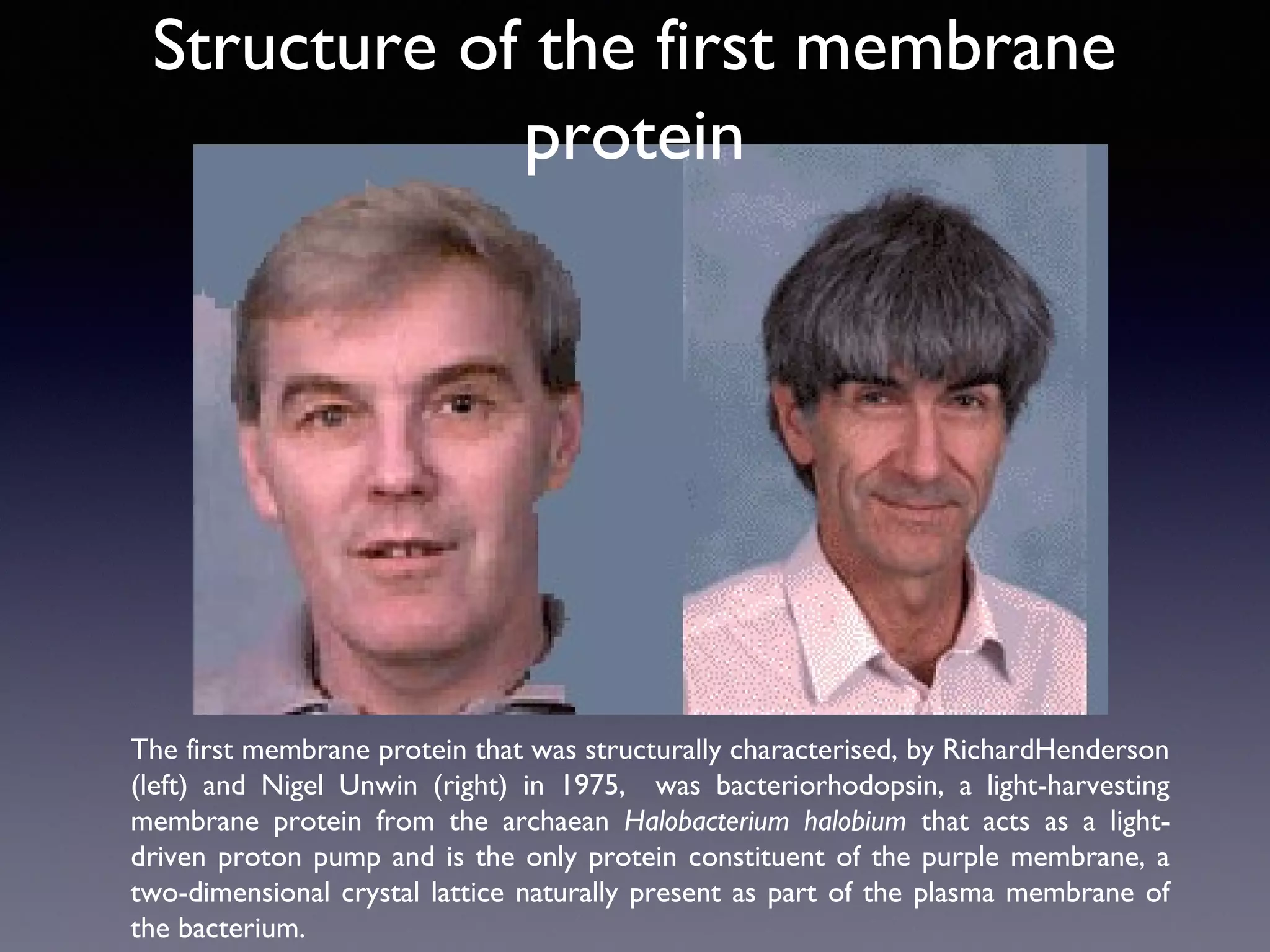
The first membrane protein that was structurally characterised, by RichardHenderson
(left) and Nigel Unwin (right) in 1975, was bacteriorhodopsin, a light-harvesting
membrane protein from the archaean Halobacterium halobium that acts as a lightdriven proton pump and is the only protein constituent of the purple membrane, a
two-dimensional crystal lattice naturally present as part of the plasma membrane of
the bacterium.
Bacteriorhodopsin -the first 7TM protein
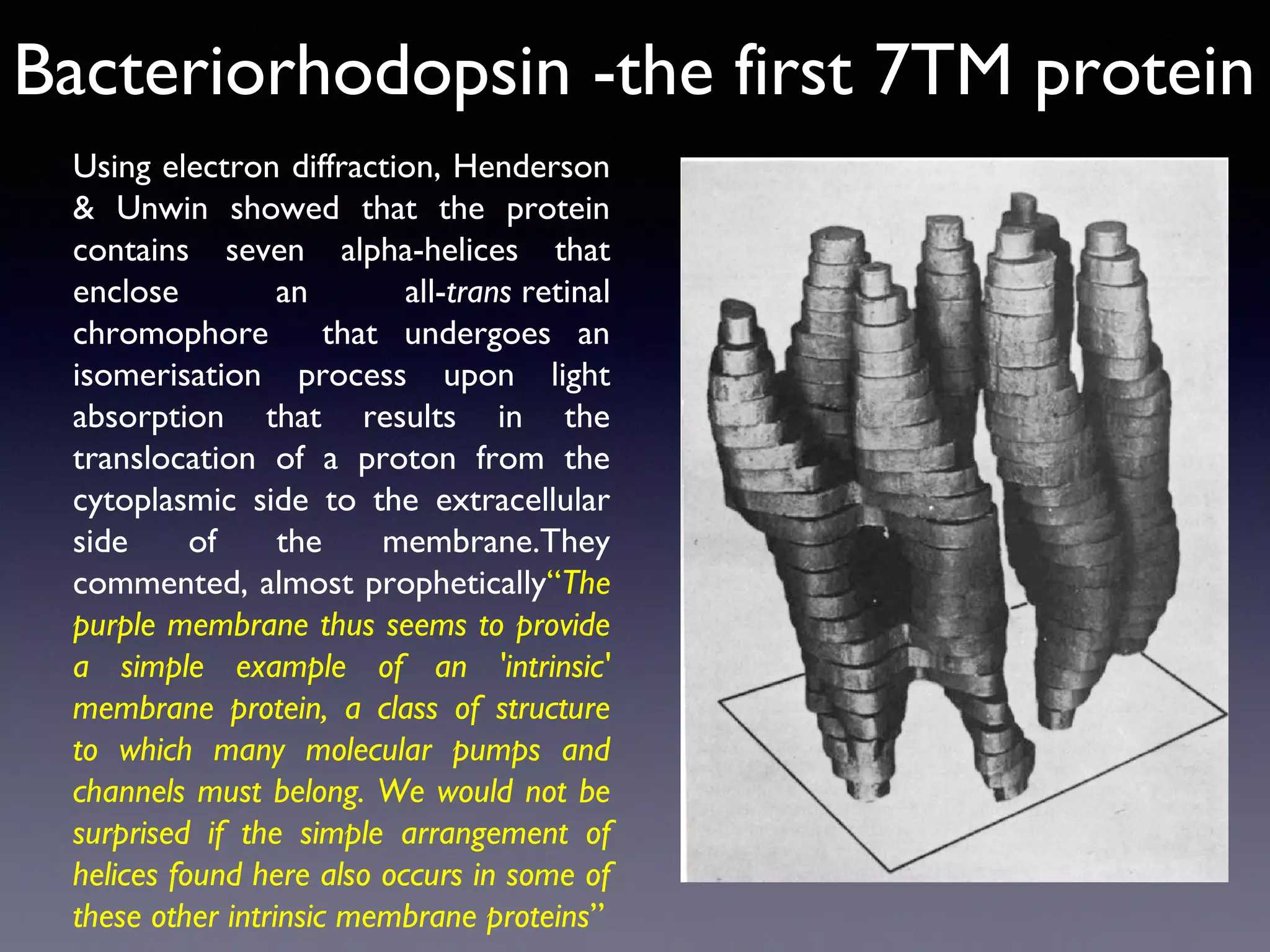
Using electron diffraction, Henderson
& Unwin showed that the protein
contains seven alpha-helices that
enclose
an
all-trans retinal
chromophore
that undergoes an
isomerisation process upon light
absorption that results in the
translocation of a proton from the
cytoplasmic side to the extracellular
side
of
the
membrane.They
commented, almost prophetically“The
purple membrane thus seems to provide
a simple example of an 'intrinsic'
membrane protein, a class of structure
to which many molecular pumps and
channels must belong. We would not be
surprised if the simple arrangement of
helices found here also occurs in some of
these other intrinsic membrane proteins”
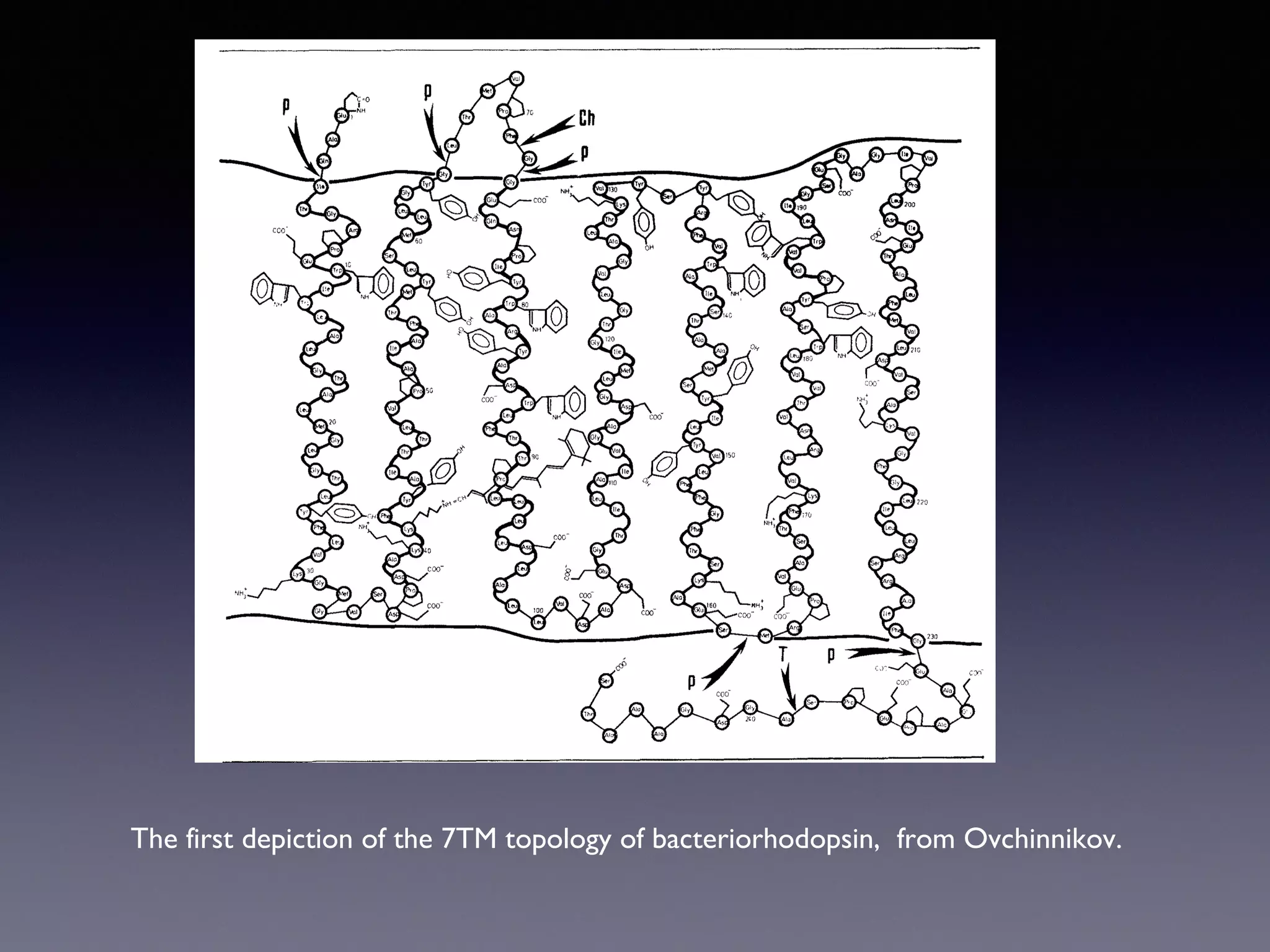
Amino acid sequence of bacteriorhodopsin

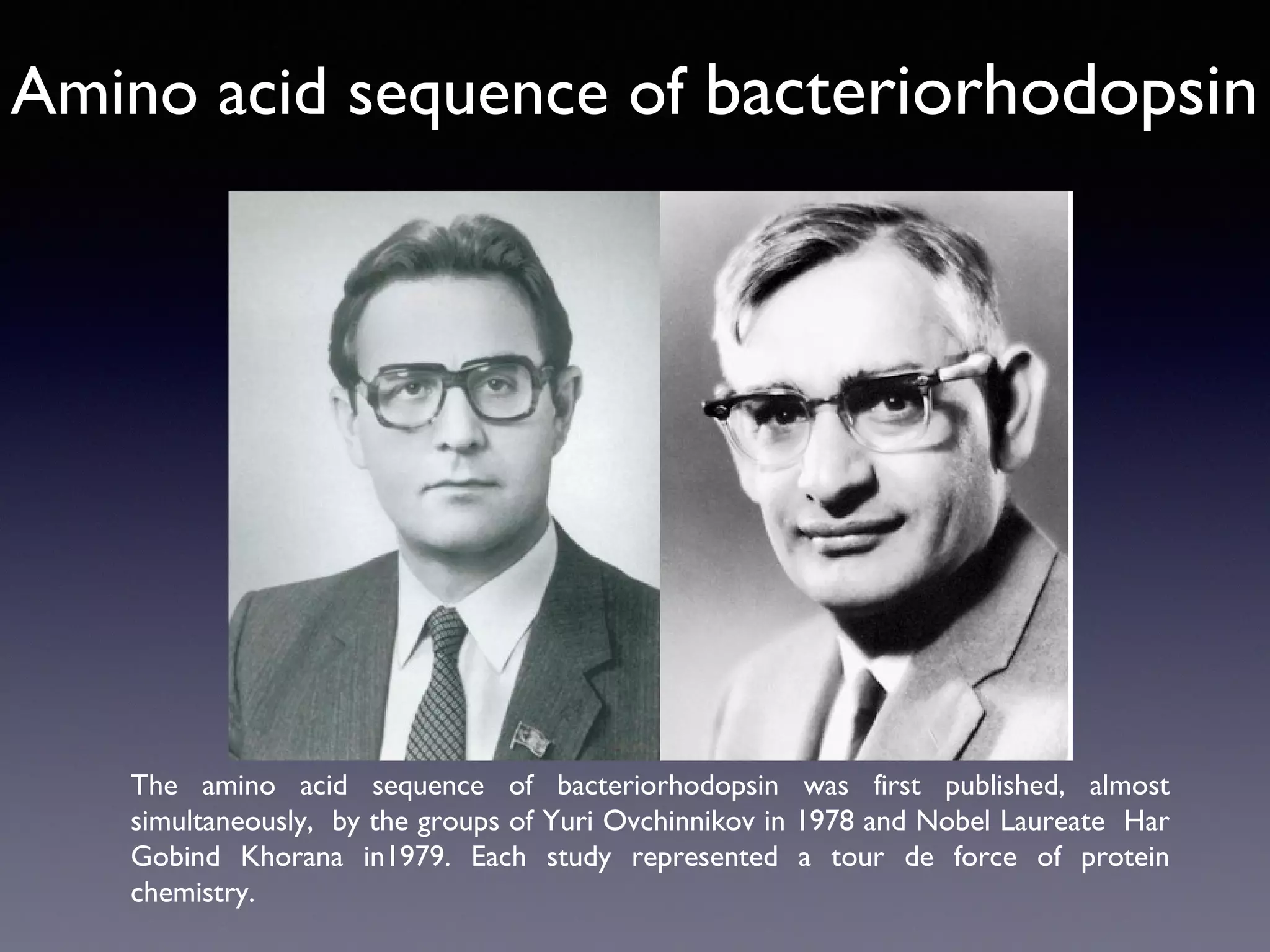
The amino acid sequence of bacteriorhodopsin was first published, almost
simultaneously, by the groups of Yuri Ovchinnikov in 1978 and Nobel Laureate Har
Gobind Khorana in1979. Each study represented a tour de force of protein
chemistry.
The first depiction of the 7TM topology of bacteriorhodopsin, from Ovchinnikov.
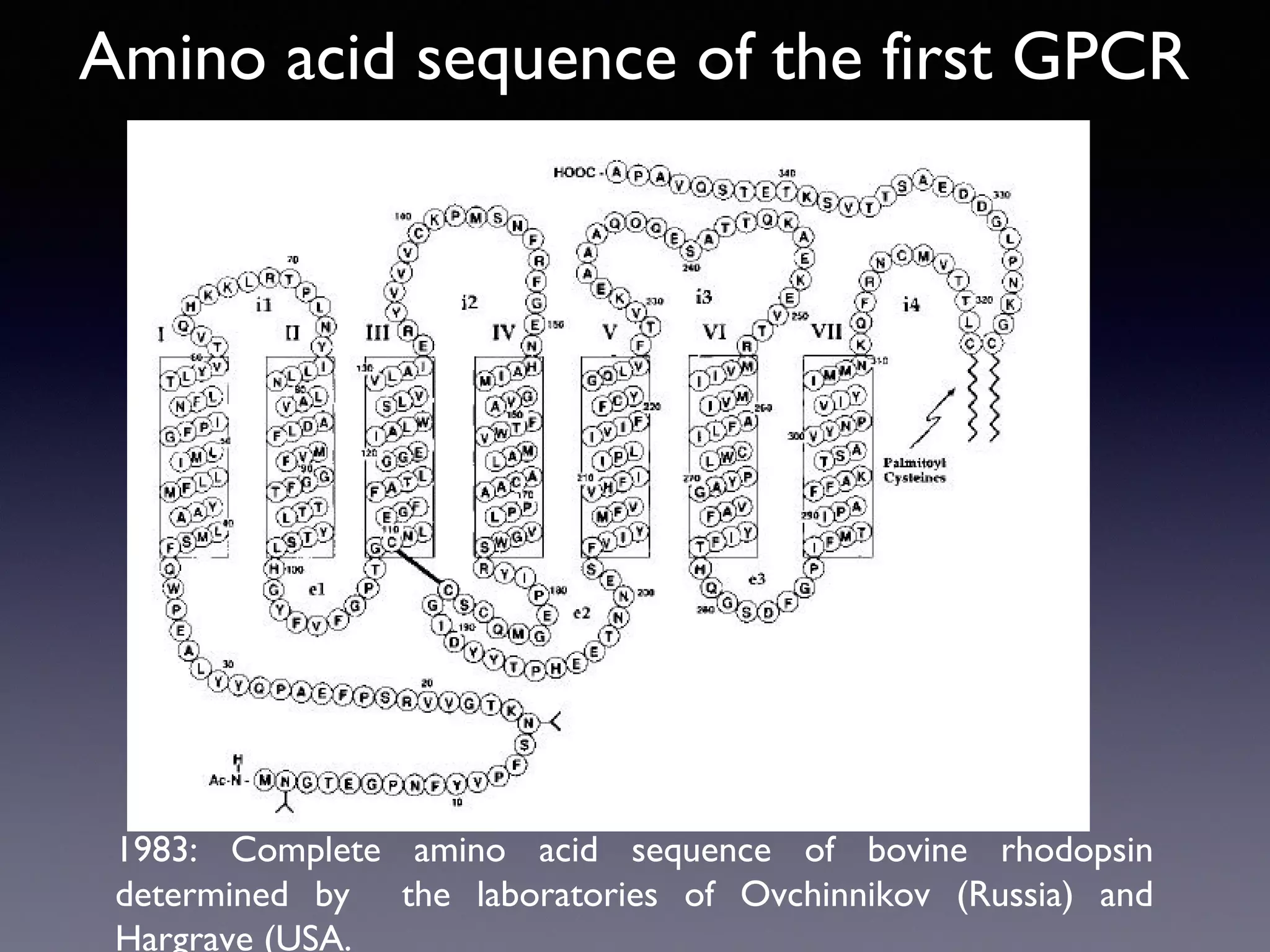
Amino acid sequence of the first GPCR

1983: Complete amino acid sequence of bovine rhodopsin
determined by the laboratories of Ovchinnikov (Russia) and
Hargrave (USA.
First cDNA and gene sequences

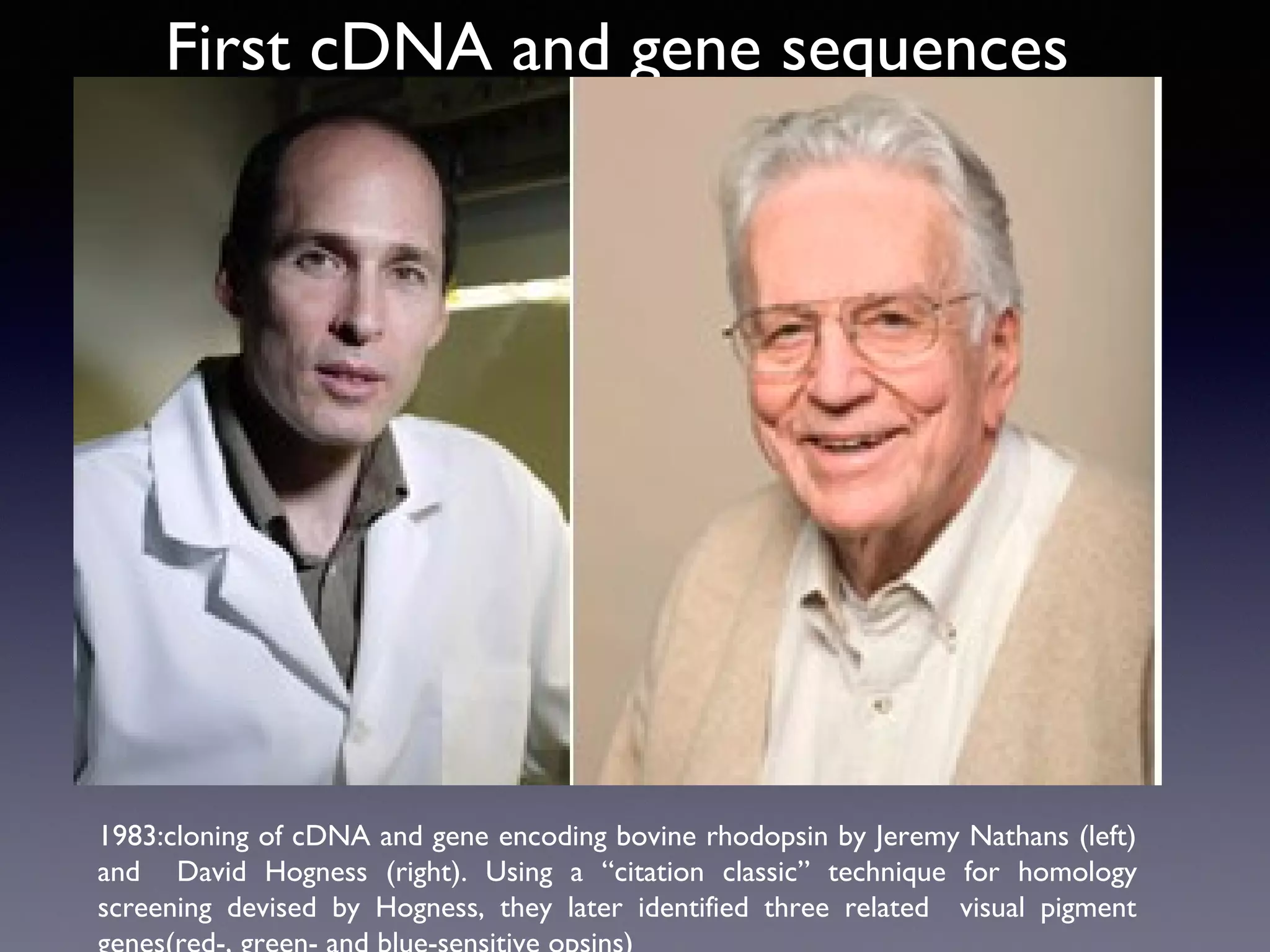
1983:cloning of cDNA and gene encoding bovine rhodopsin by Jeremy Nathans (left)
and David Hogness (right). Using a “citation classic” technique for homology
screening devised by Hogness, they later identified three related visual pigment
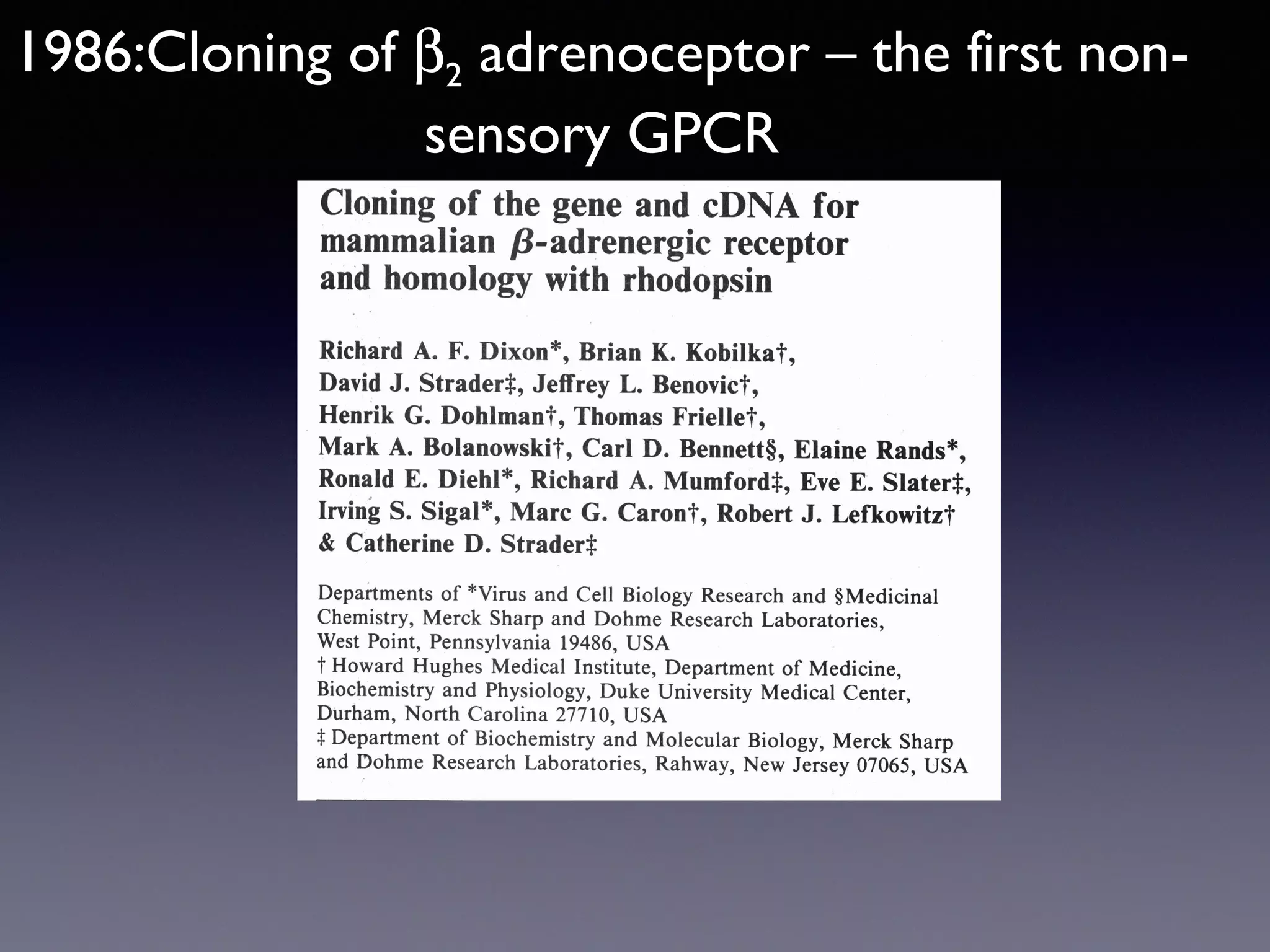
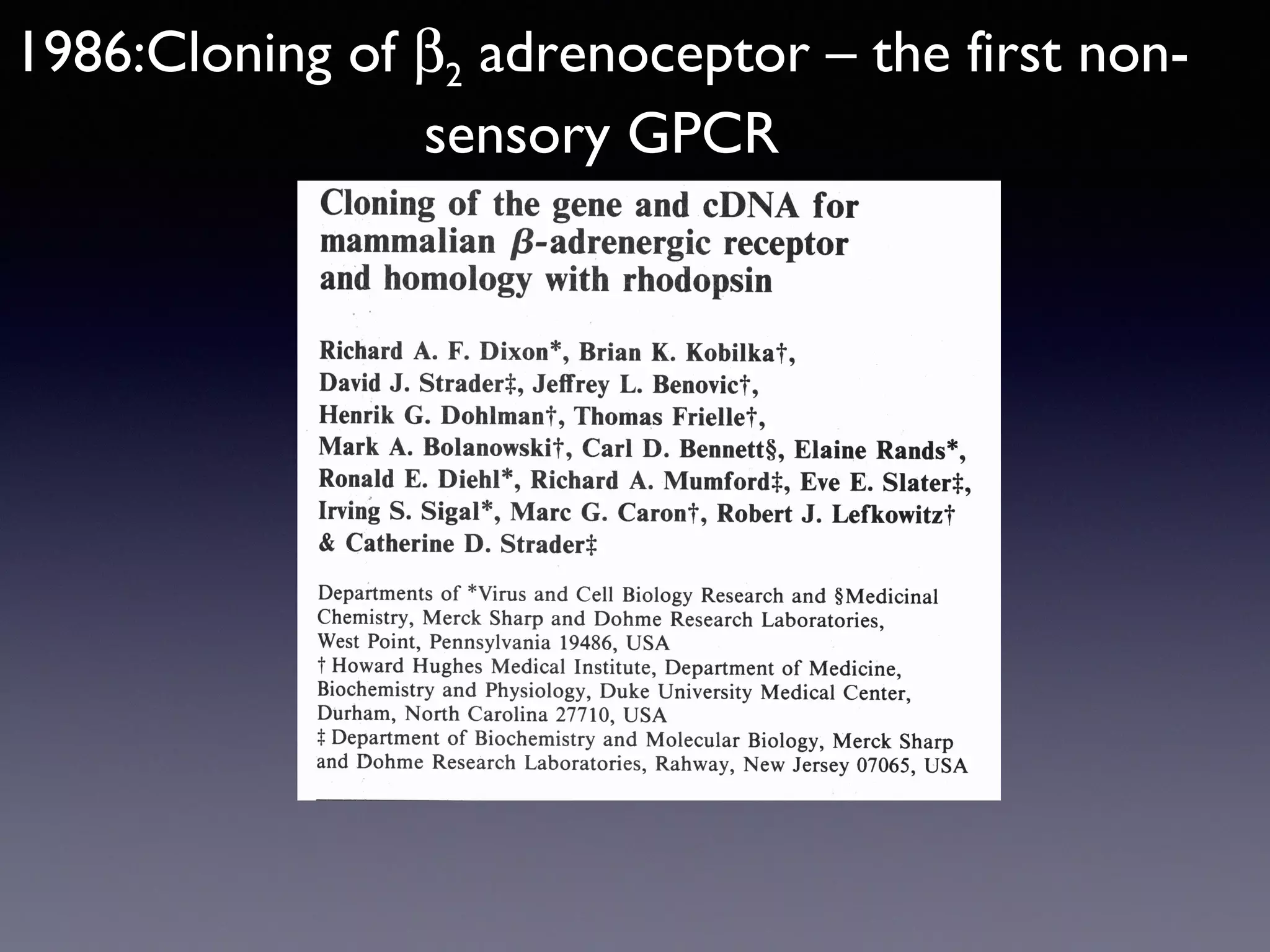
1986:Cloning of β2 adrenoceptor – the first nonsensory GPCR
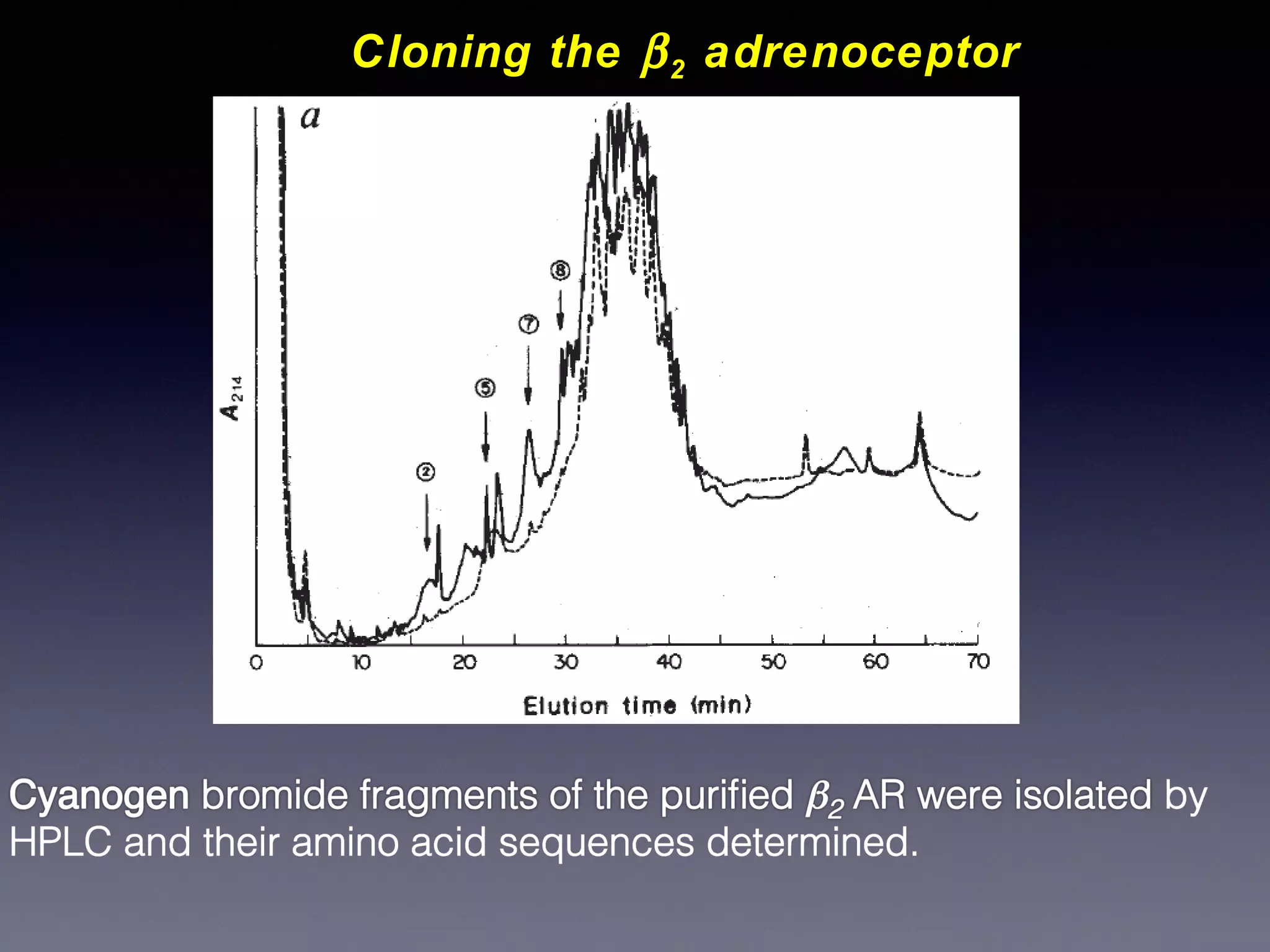
Cloning the β 2 adrenoceptor
•

Receptor from hamster lung solubilised in detergent and purified by
affinity chromatography on alprenolol-sepharose

•

Progress of purification monitored by binding of [ 125 I]-cyanopindolol

•

Attempts to obtain amino acid sequence of the intact protein failed

•

Purified protein was subjected to chemical cleavage with cyanogen
bromide (CNBr), which cleaves proteins after every methionine
residue

•

Cyanogen bromide fragments were purified by HPLC and
sequenced
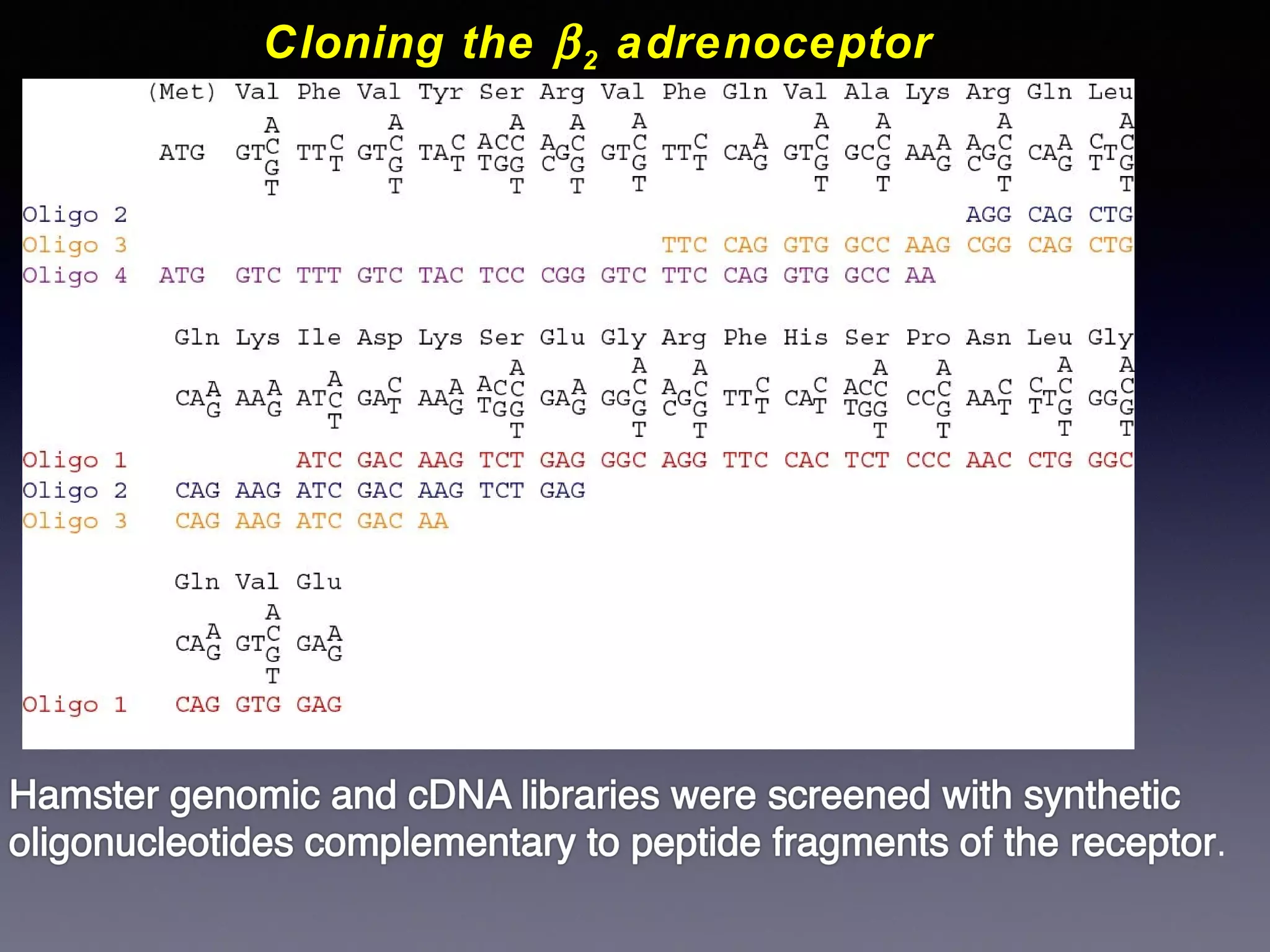
Cloning the β 2 adrenoceptor
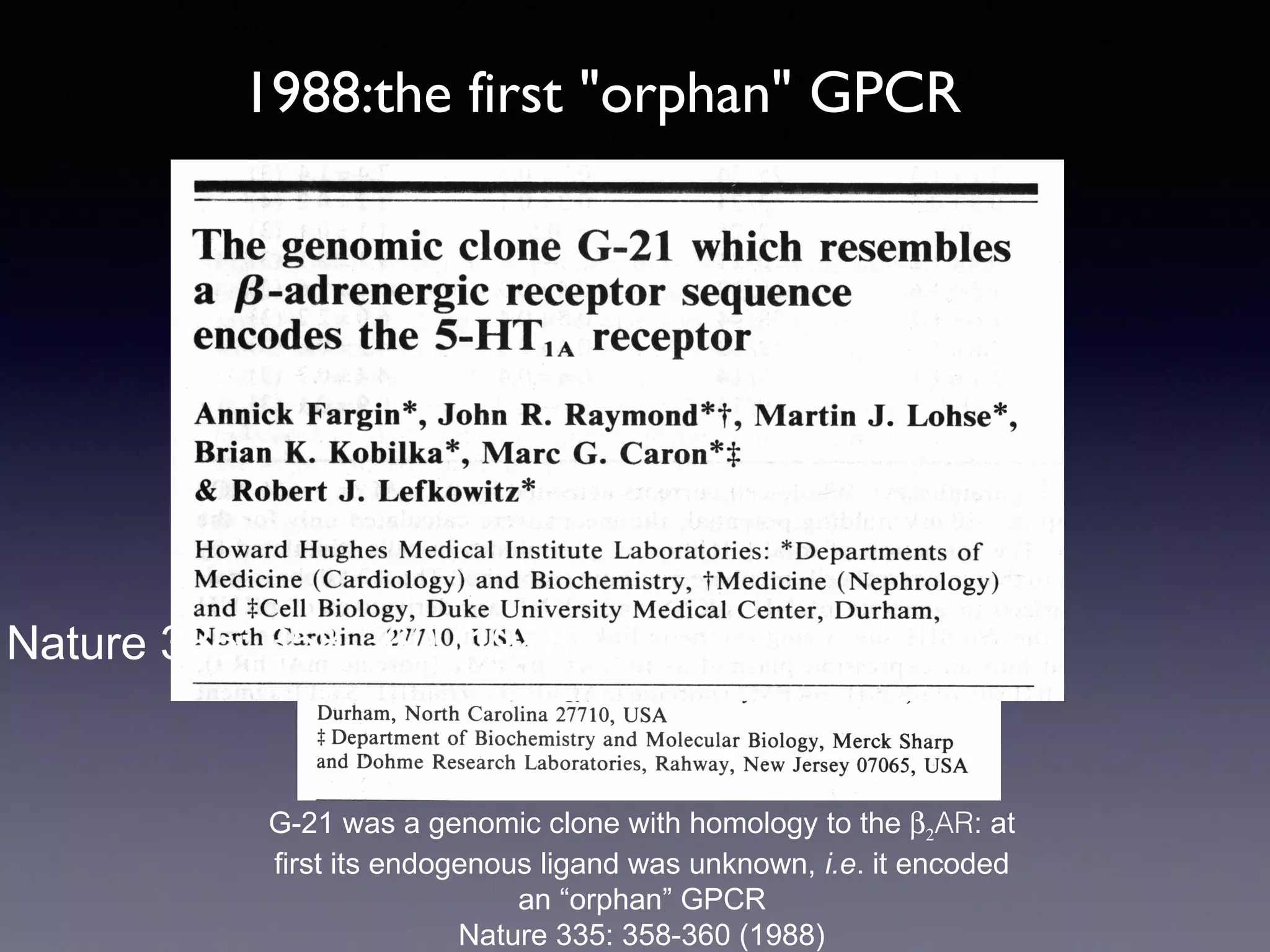
1988:the first "orphan" GPCR

Nature 335: 358-360 (1988)

G-21 was a genomic clone with homology to the β2AR: at
first its endogenous ligand was unknown, i.e. it encoded
an “orphan” GPCR
Nature 335: 358-360 (1988)
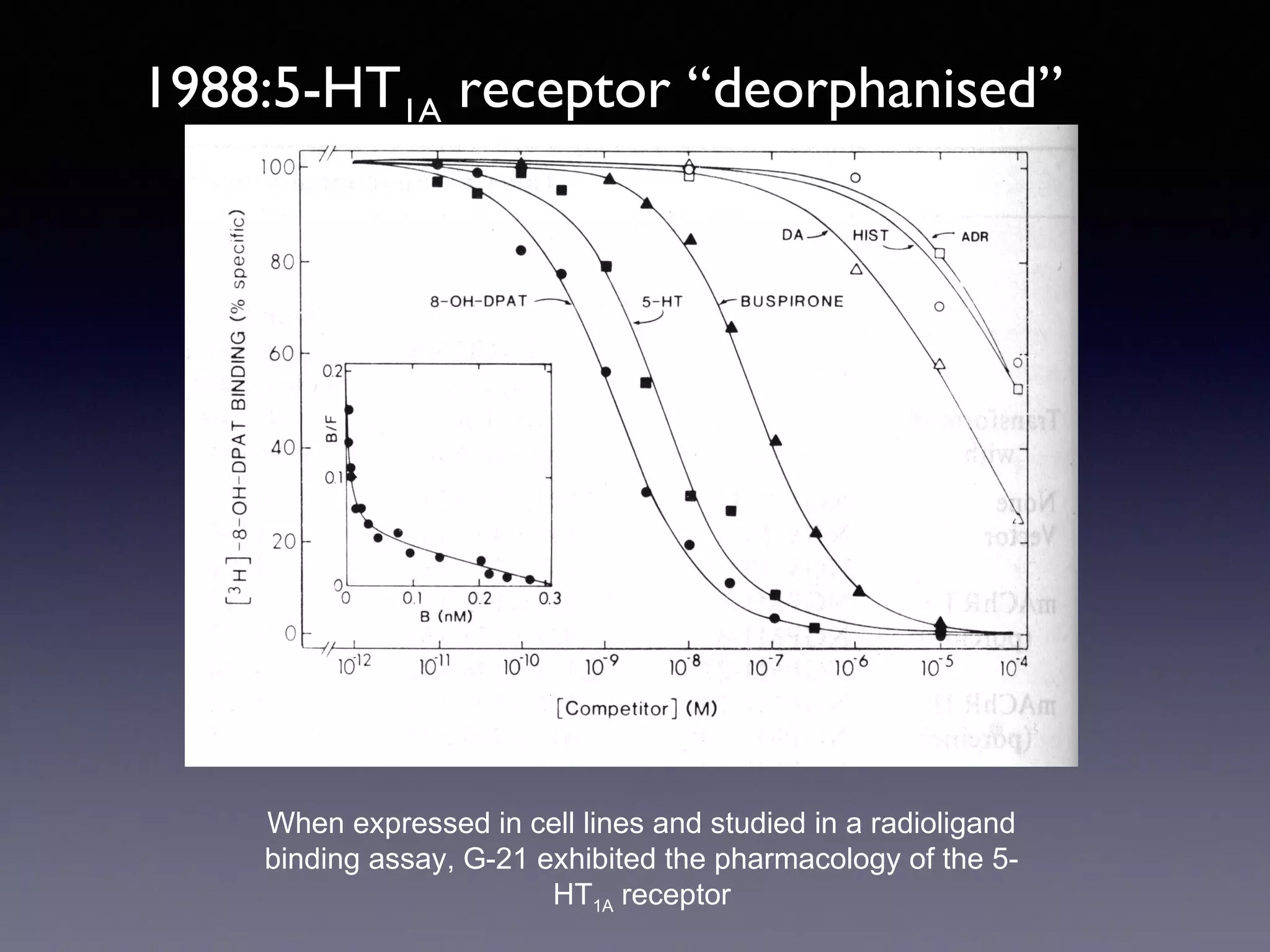
1988:5-HT1A receptor “deorphanised”

When expressed in cell lines and studied in a radioligand
binding assay, G-21 exhibited the pharmacology of the 5HT1A receptor
1987:Expression cloning of the NK2 receptor,
the first peptide GPCR

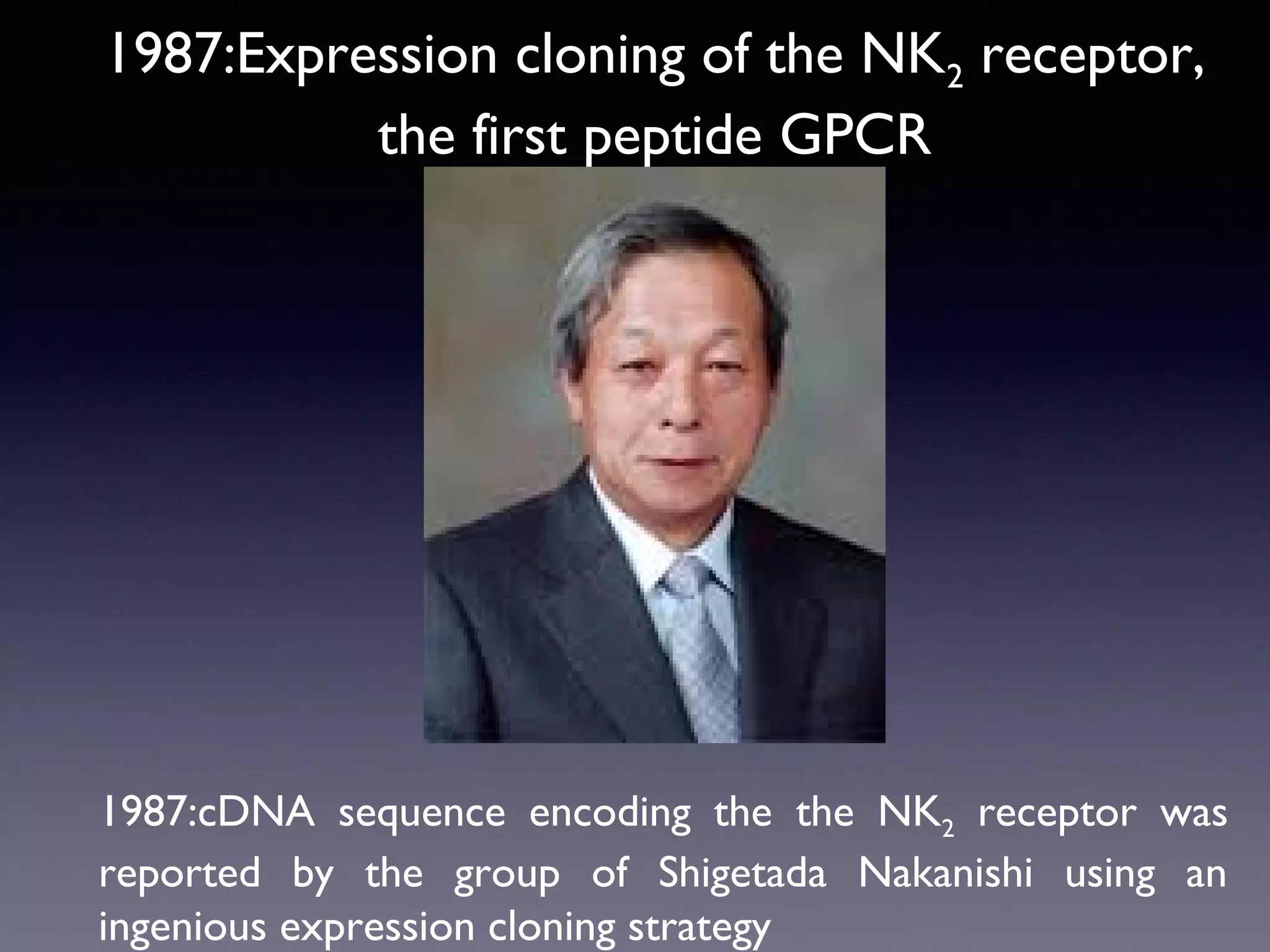
1987:cDNA sequence encoding the the NK2 receptor was
reported by the group of Shigetada Nakanishi using an
ingenious expression cloning strategy
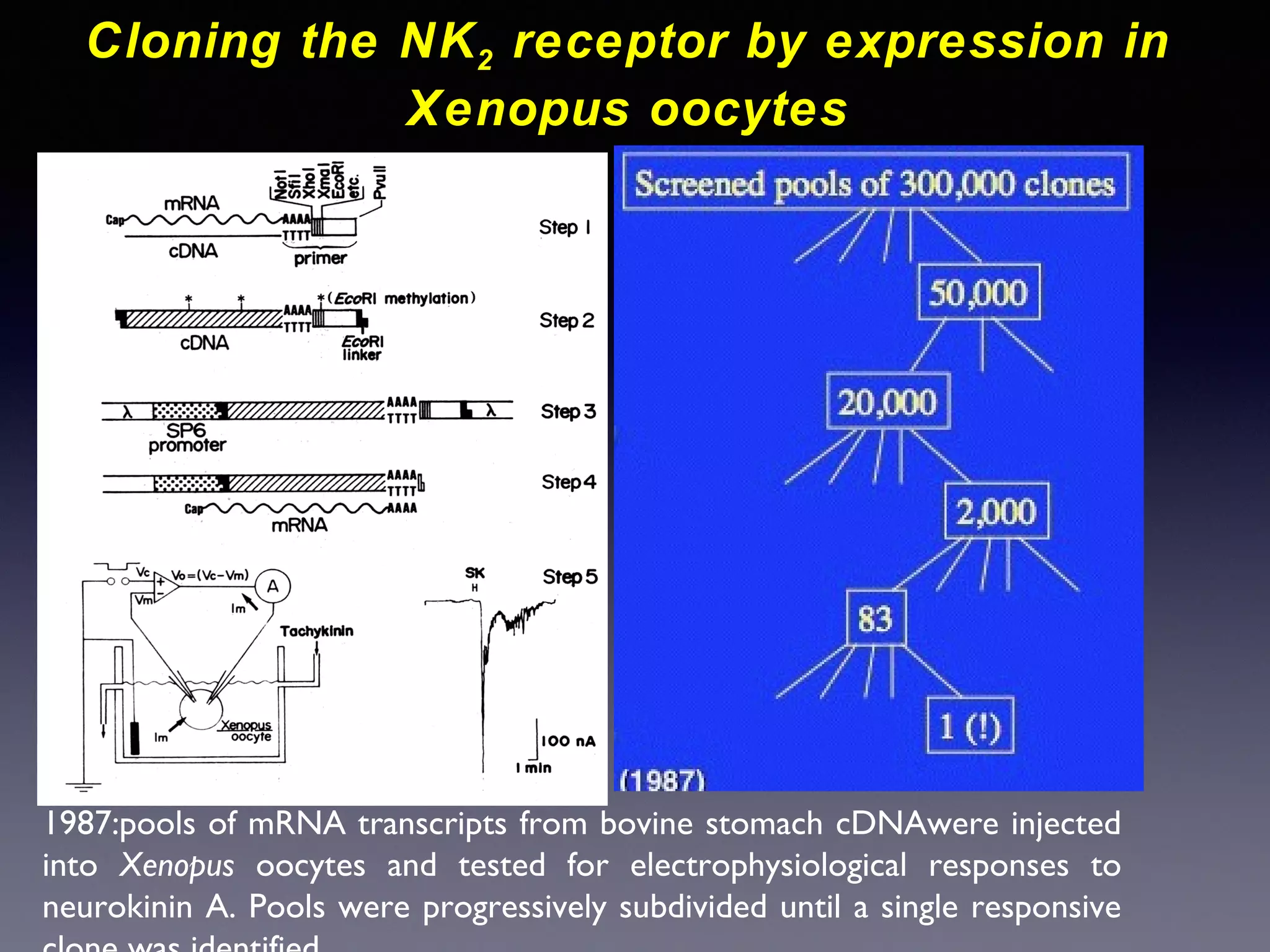
Cloning the NK 2 receptor by expression in
Xenopus oocytes

1987:pools of mRNA transcripts from bovine stomach cDNAwere injected
into Xenopus oocytes and tested for electrophysiological responses to
neurokinin A. Pools were progressively subdivided until a single responsive
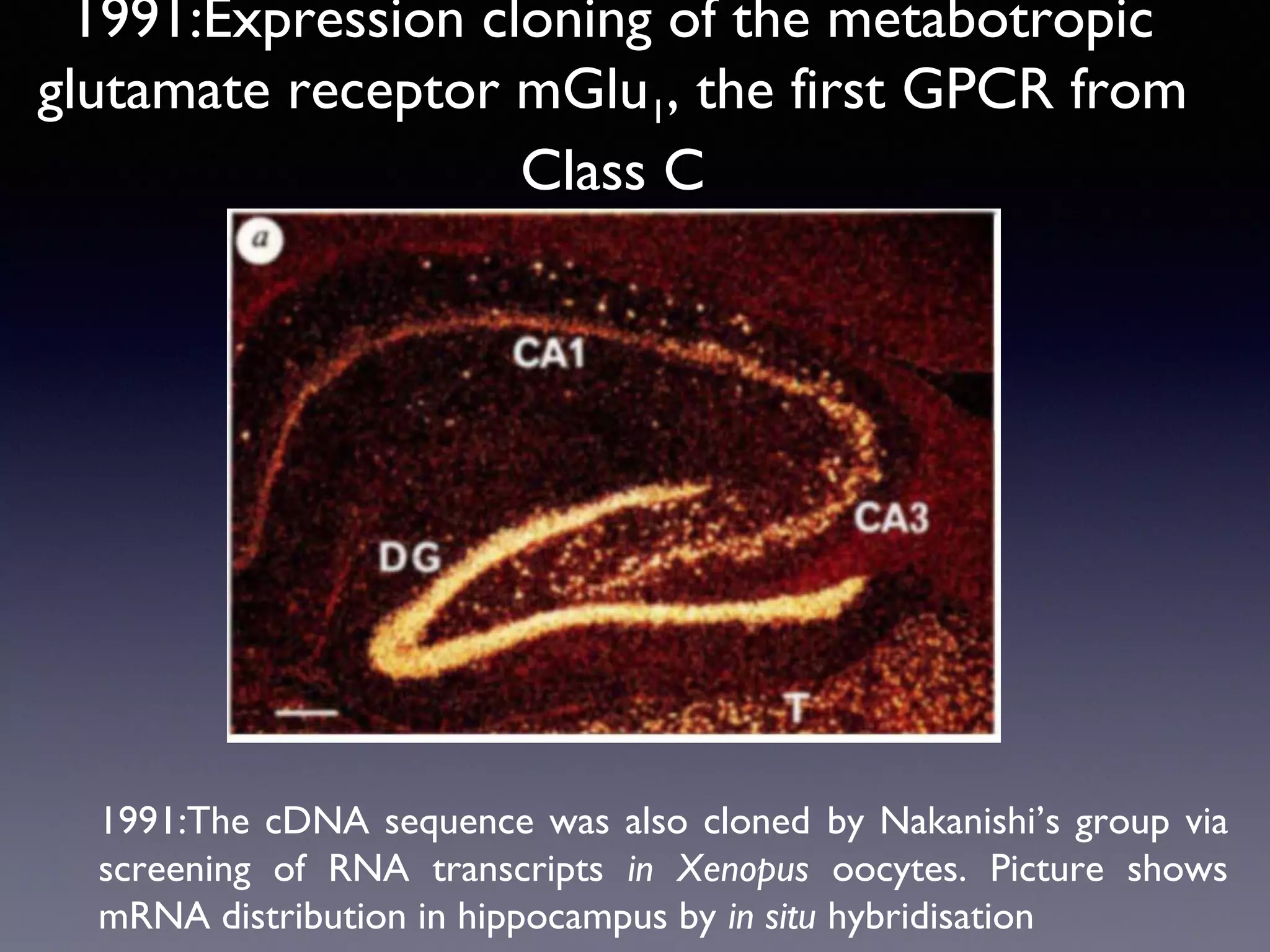
1991:Expression cloning of the metabotropic
glutamate receptor mGlu1, the first GPCR from
Class C

1991:The cDNA sequence was also cloned by Nakanishi’s group via
screening of RNA transcripts in Xenopus oocytes. Picture shows
mRNA distribution in hippocampus by in situ hybridisation
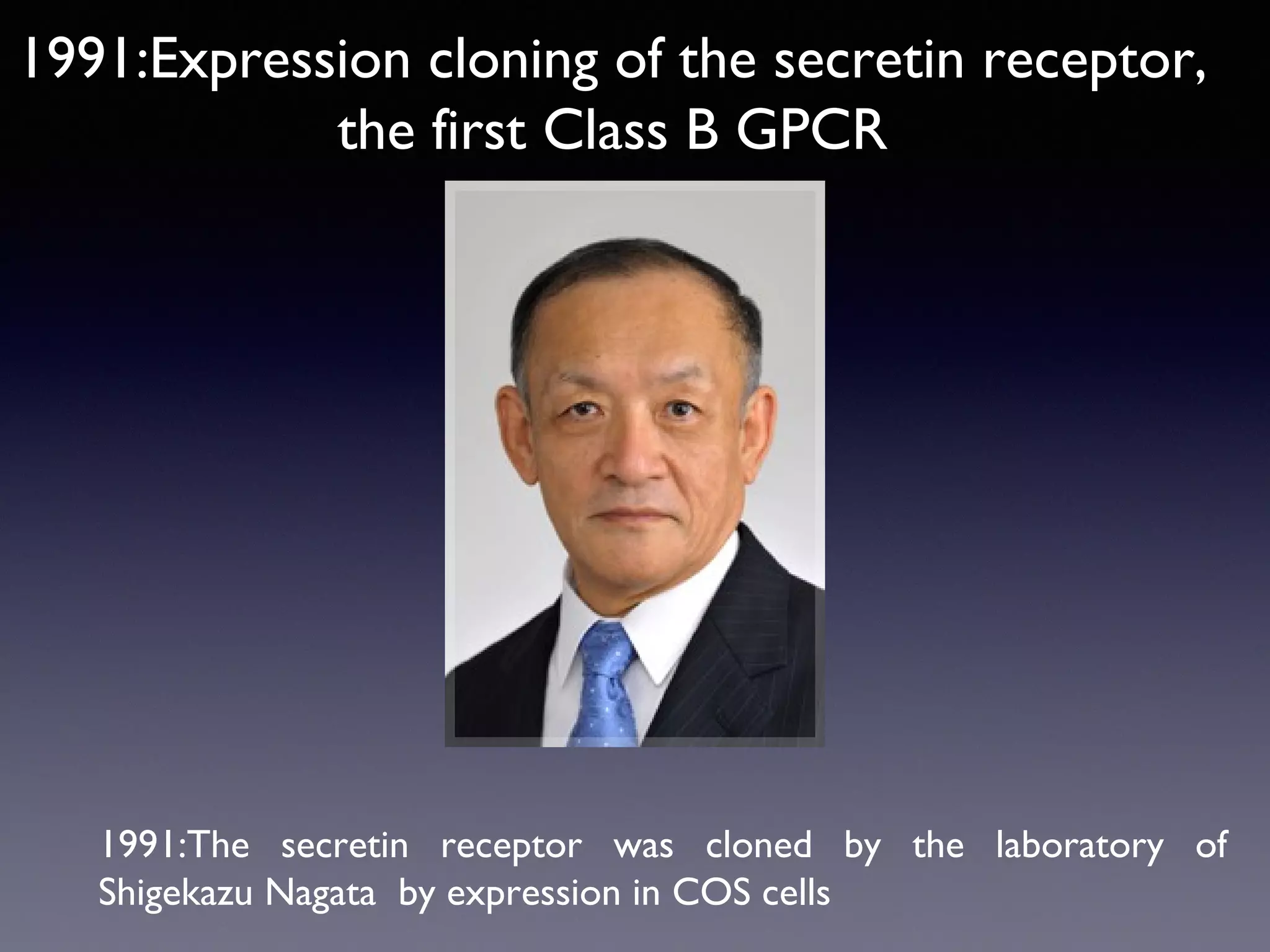
1991:Expression cloning of the secretin receptor,
the first Class B GPCR

1991:The secretin receptor was cloned by the laboratory of
Shigekazu Nagata by expression in COS cells
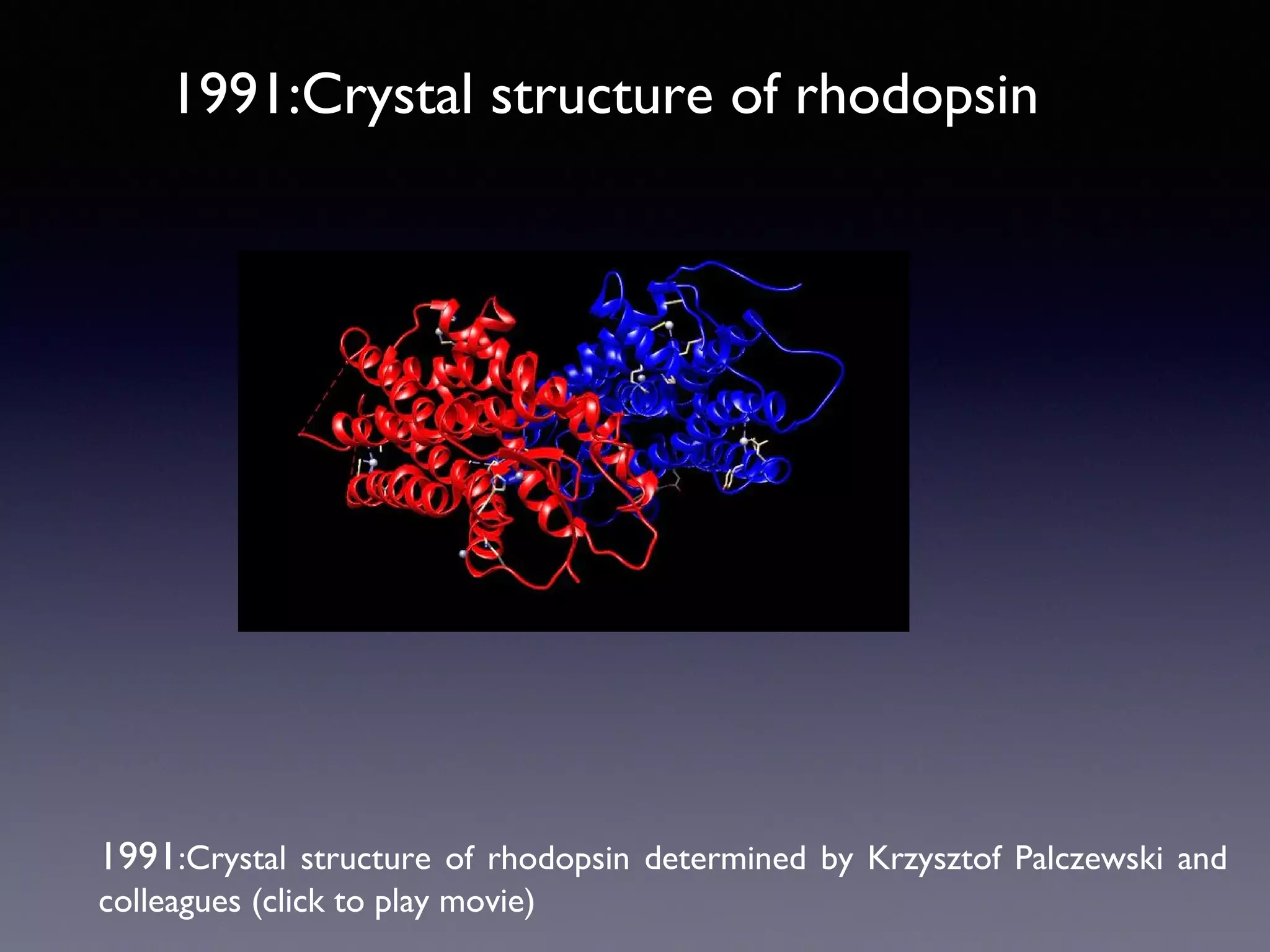
1991:Crystal structure of rhodopsin

1991:Crystal structure of rhodopsin determined by Krzysztof Palczewski and
colleagues (click to play movie)
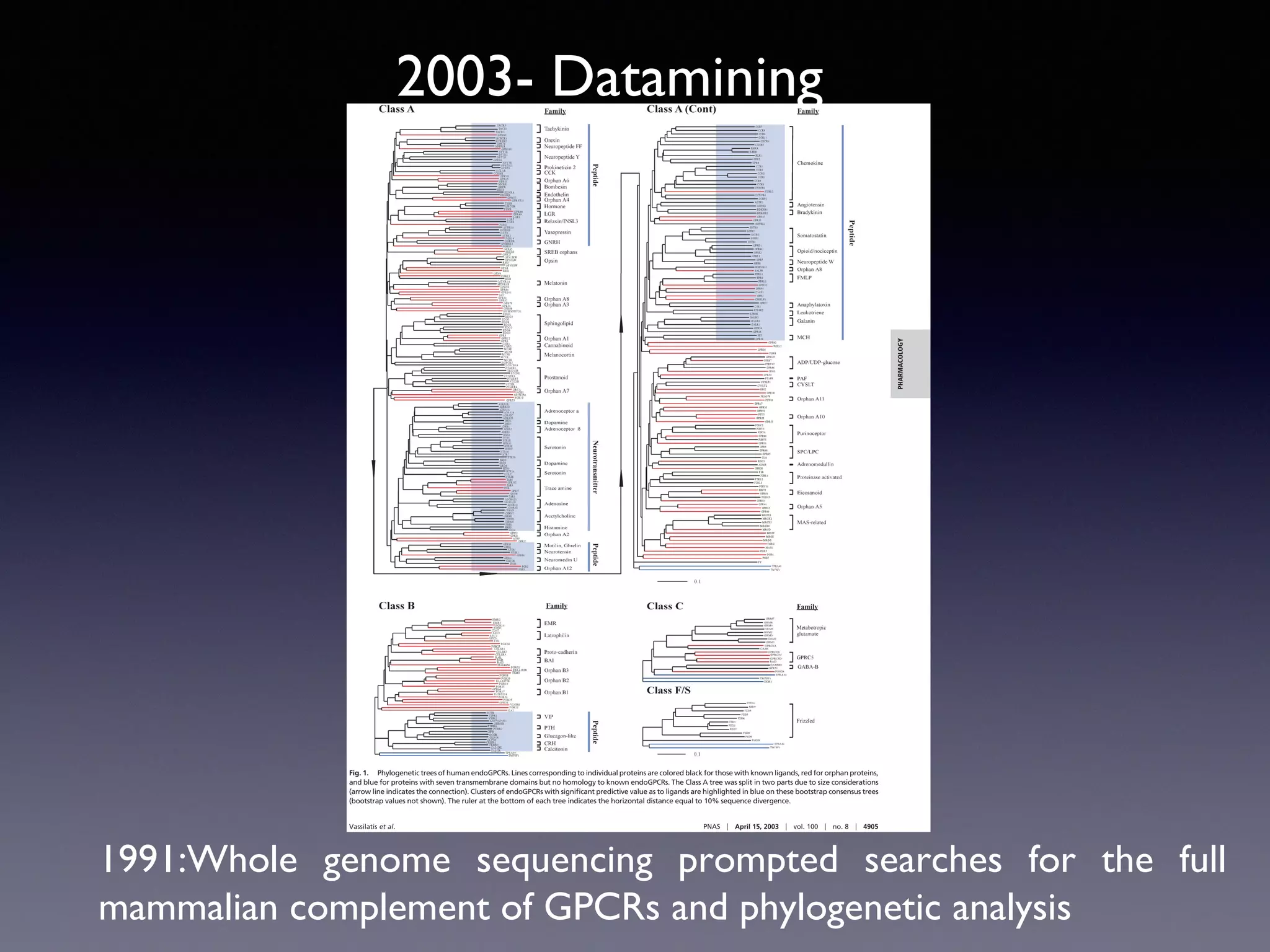
2003- Datamining

1991:Whole genome sequencing prompted searches for the full
mammalian complement of GPCRs and phylogenetic analysis
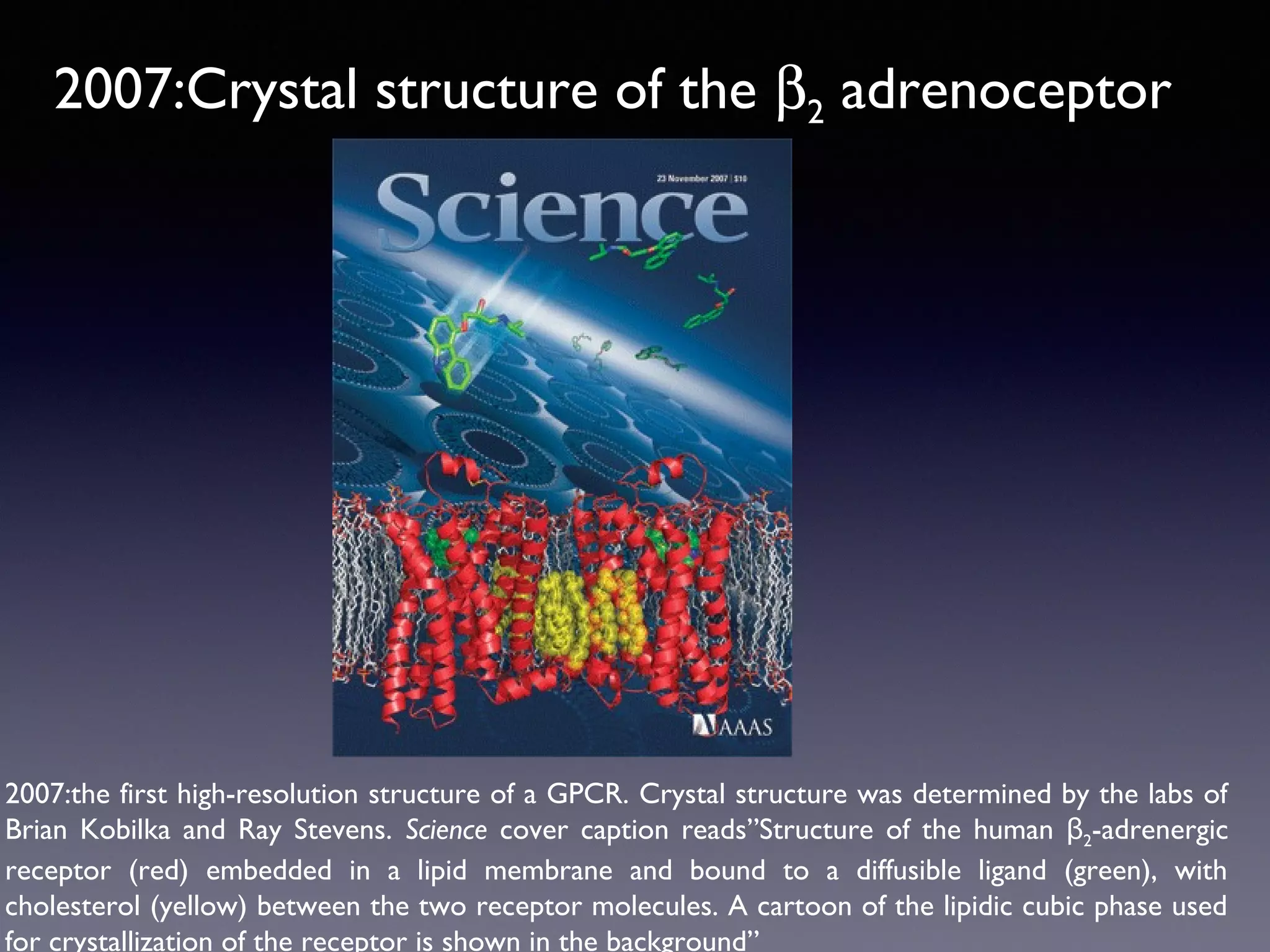
2007:Crystal structure of the β2 adrenoceptor

2007:the first high-resolution structure of a GPCR. Crystal structure was determined by the labs of
Brian Kobilka and Ray Stevens. Science cover caption reads”Structure of the human β2-adrenergic
receptor (red) embedded in a lipid membrane and bound to a diffusible ligand (green), with
cholesterol (yellow) between the two receptor molecules. A cartoon of the lipidic cubic phase used
for crystallization of the receptor is shown in the background”
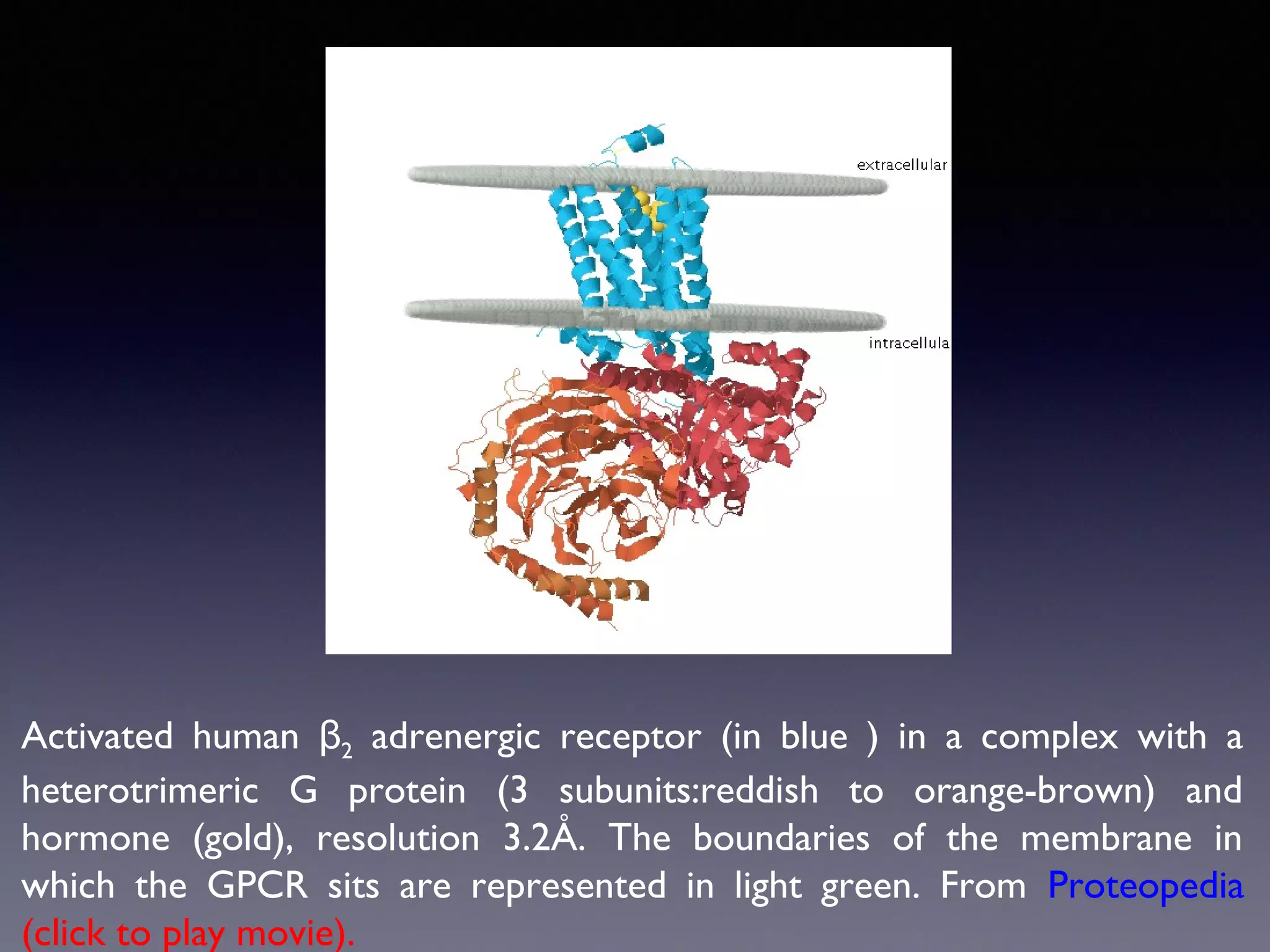
Activated human β2 adrenergic receptor (in blue ) in a complex with a
heterotrimeric G protein (3 subunits:reddish to orange-brown) and
hormone (gold), resolution 3.2Å. The boundaries of the membrane in
which the GPCR sits are represented in light green. From Proteopedia
(click to play movie).
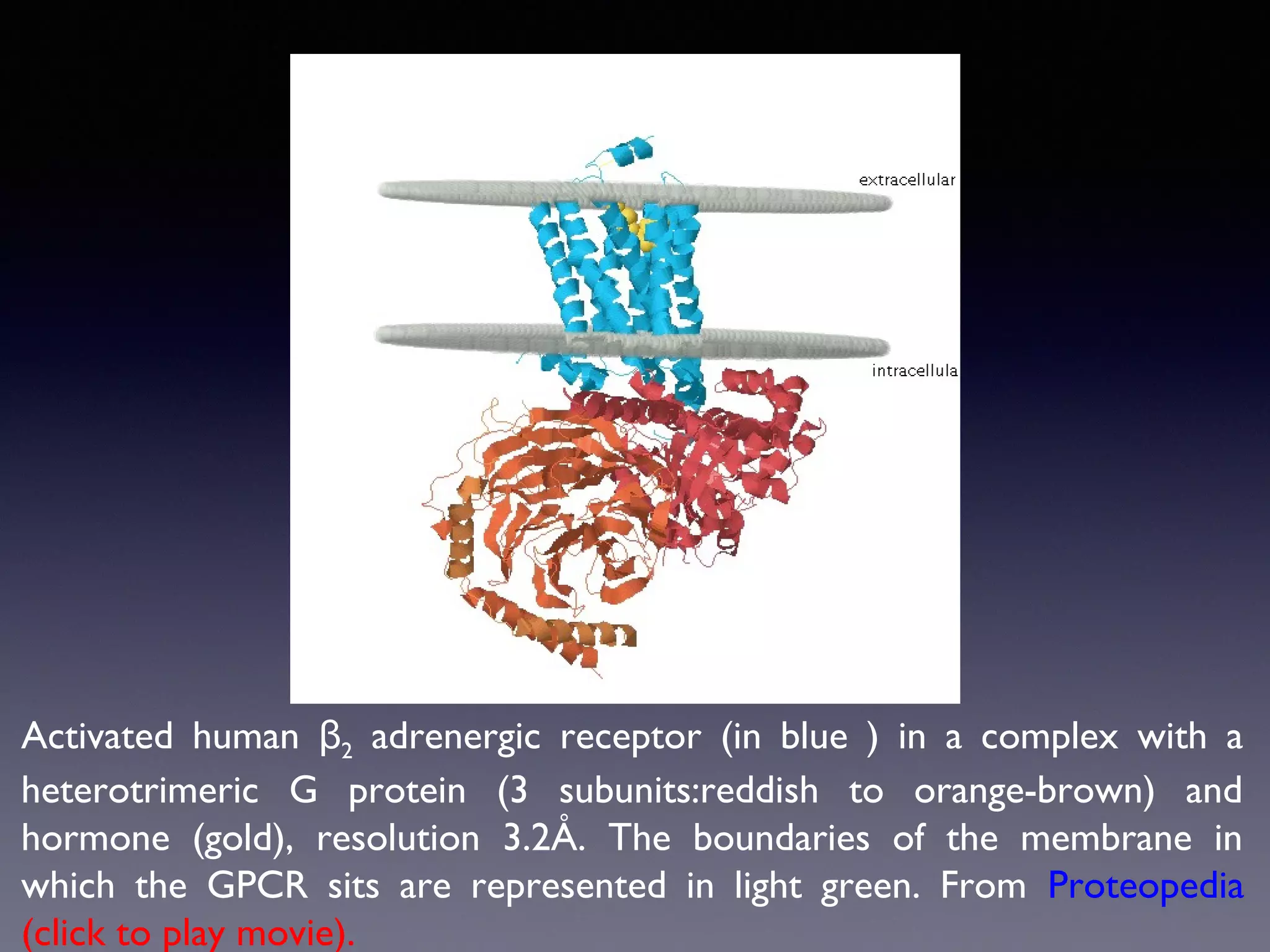
Activated human β2 adrenergic receptor (in blue ) in a complex with a
heterotrimeric G protein (3 subunits:reddish to orange-brown) and
hormone (gold), resolution 3.2Å. The boundaries of the membrane in
which the GPCR sits are represented in light green. From Proteopedia
(click to play movie).
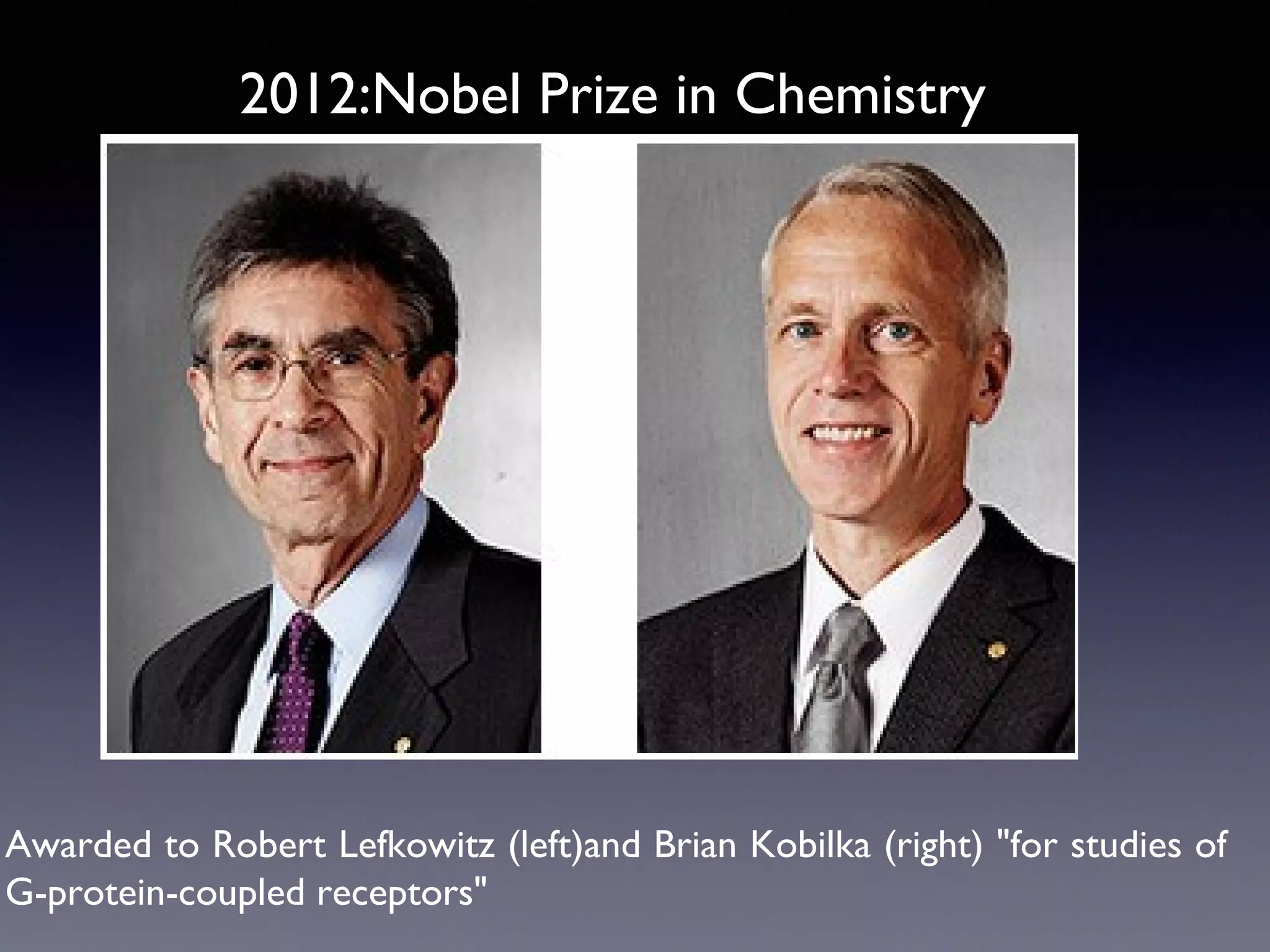
2012:Nobel Prize in Chemistry

Awarded to Robert Lefkowitz (left)and Brian Kobilka (right) "for studies of
G-protein-coupled receptors"

Gpcr structures 061213b

  • 1.
    Structural studies ofGPCRs Tony Harmar University of Edinburgh
  • 2.
    Structure of thefirst membrane protein The first membrane protein that was structurally characterised, by RichardHenderson (left) and Nigel Unwin (right) in 1975, was bacteriorhodopsin, a light-harvesting membrane protein from the archaean Halobacterium halobium that acts as a lightdriven proton pump and is the only protein constituent of the purple membrane, a two-dimensional crystal lattice naturally present as part of the plasma membrane of the bacterium.
  • 3.
    Bacteriorhodopsin -the first7TM protein Using electron diffraction, Henderson & Unwin showed that the protein contains seven alpha-helices that enclose an all-trans retinal chromophore that undergoes an isomerisation process upon light absorption that results in the translocation of a proton from the cytoplasmic side to the extracellular side of the membrane.They commented, almost prophetically“The purple membrane thus seems to provide a simple example of an 'intrinsic' membrane protein, a class of structure to which many molecular pumps and channels must belong. We would not be surprised if the simple arrangement of helices found here also occurs in some of these other intrinsic membrane proteins”
  • 4.
    Amino acid sequenceof bacteriorhodopsin The amino acid sequence of bacteriorhodopsin was first published, almost simultaneously, by the groups of Yuri Ovchinnikov in 1978 and Nobel Laureate Har Gobind Khorana in1979. Each study represented a tour de force of protein chemistry.
  • 5.
    The first depictionof the 7TM topology of bacteriorhodopsin, from Ovchinnikov.
  • 6.
    Amino acid sequenceof the first GPCR 1983: Complete amino acid sequence of bovine rhodopsin determined by the laboratories of Ovchinnikov (Russia) and Hargrave (USA.
  • 7.
    First cDNA andgene sequences 1983:cloning of cDNA and gene encoding bovine rhodopsin by Jeremy Nathans (left) and David Hogness (right). Using a “citation classic” technique for homology screening devised by Hogness, they later identified three related visual pigment
  • 8.
    1986:Cloning of β2adrenoceptor – the first nonsensory GPCR
  • 9.
    1986:Cloning of β2adrenoceptor – the first nonsensory GPCR
  • 10.
    Cloning the β2 adrenoceptor • Receptor from hamster lung solubilised in detergent and purified by affinity chromatography on alprenolol-sepharose • Progress of purification monitored by binding of [ 125 I]-cyanopindolol • Attempts to obtain amino acid sequence of the intact protein failed • Purified protein was subjected to chemical cleavage with cyanogen bromide (CNBr), which cleaves proteins after every methionine residue • Cyanogen bromide fragments were purified by HPLC and sequenced
  • 11.
    Cloning the β2 adrenoceptor
  • 12.
    Cloning the β2 adrenoceptor
  • 13.
    1988:the first "orphan"GPCR Nature 335: 358-360 (1988) G-21 was a genomic clone with homology to the β2AR: at first its endogenous ligand was unknown, i.e. it encoded an “orphan” GPCR Nature 335: 358-360 (1988)
  • 14.
    1988:5-HT1A receptor “deorphanised” Whenexpressed in cell lines and studied in a radioligand binding assay, G-21 exhibited the pharmacology of the 5HT1A receptor
  • 15.
    1987:Expression cloning ofthe NK2 receptor, the first peptide GPCR 1987:cDNA sequence encoding the the NK2 receptor was reported by the group of Shigetada Nakanishi using an ingenious expression cloning strategy
  • 16.
    Cloning the NK2 receptor by expression in Xenopus oocytes 1987:pools of mRNA transcripts from bovine stomach cDNAwere injected into Xenopus oocytes and tested for electrophysiological responses to neurokinin A. Pools were progressively subdivided until a single responsive
  • 17.
    1991:Expression cloning ofthe metabotropic glutamate receptor mGlu1, the first GPCR from Class C 1991:The cDNA sequence was also cloned by Nakanishi’s group via screening of RNA transcripts in Xenopus oocytes. Picture shows mRNA distribution in hippocampus by in situ hybridisation
  • 18.
    1991:Expression cloning ofthe secretin receptor, the first Class B GPCR 1991:The secretin receptor was cloned by the laboratory of Shigekazu Nagata by expression in COS cells
  • 19.
    1991:Crystal structure ofrhodopsin 1991:Crystal structure of rhodopsin determined by Krzysztof Palczewski and colleagues (click to play movie)
  • 20.
    2003- Datamining 1991:Whole genomesequencing prompted searches for the full mammalian complement of GPCRs and phylogenetic analysis
  • 21.
    2007:Crystal structure ofthe β2 adrenoceptor 2007:the first high-resolution structure of a GPCR. Crystal structure was determined by the labs of Brian Kobilka and Ray Stevens. Science cover caption reads”Structure of the human β2-adrenergic receptor (red) embedded in a lipid membrane and bound to a diffusible ligand (green), with cholesterol (yellow) between the two receptor molecules. A cartoon of the lipidic cubic phase used for crystallization of the receptor is shown in the background”
  • 22.
    Activated human β2adrenergic receptor (in blue ) in a complex with a heterotrimeric G protein (3 subunits:reddish to orange-brown) and hormone (gold), resolution 3.2Å. The boundaries of the membrane in which the GPCR sits are represented in light green. From Proteopedia (click to play movie).
  • 23.
    Activated human β2adrenergic receptor (in blue ) in a complex with a heterotrimeric G protein (3 subunits:reddish to orange-brown) and hormone (gold), resolution 3.2Å. The boundaries of the membrane in which the GPCR sits are represented in light green. From Proteopedia (click to play movie).
  • 24.
    2012:Nobel Prize inChemistry Awarded to Robert Lefkowitz (left)and Brian Kobilka (right) "for studies of G-protein-coupled receptors"