
Polymer Project
The rise of Polymer and Web Components
Kostas Karolemeas, CEO @allcancode
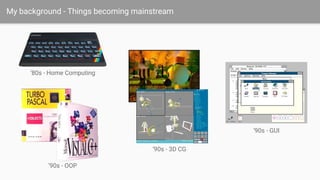
My background - Things becoming mainstream
‘80s - Home Computing
‘90s - OOP
‘90s - 3D CG
‘90s - GUI
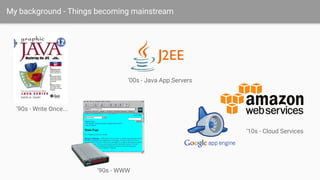
My background - Things becoming mainstream
‘90s - Write Once...
‘90s - WWW
‘00s - Java App Servers
‘10s - Cloud Services
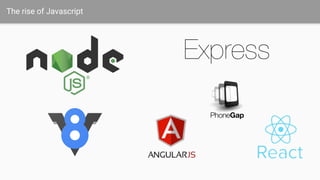
The rise of Javascript
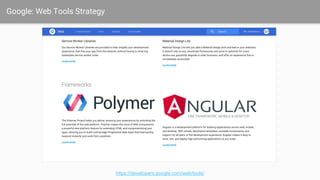
Google: Web Tools Strategy
https://developers.google.com/web/tools/
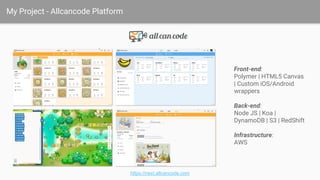
My Project - Allcancode Platform
https://next.allcancode.com
Front-end:
Polymer | HTML5 Canvas
| Custom iOS/Android
wrappers
Back-end:
Node JS | Koa |
DynamoDB | S3 | RedShift
Infrastructure:
AWS
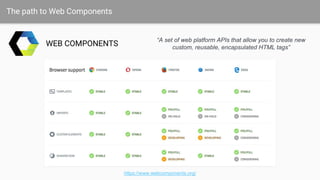
The path to Web Components
WEB COMPONENTS
https://www.webcomponents.org/
“A set of web platform APIs that allow you to create new
custom, reusable, encapsulated HTML tags”
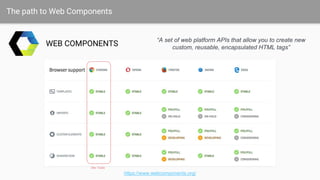
The path to Web Components
WEB COMPONENTS
https://www.webcomponents.org/
“A set of web platform APIs that allow you to create new
custom, reusable, encapsulated HTML tags”
Dev Tools
Polymer Library
A set of features for creating custom elements that work like
standard DOM elements
https://www.polymer-project.org/1.0/docs/devguide/feature-overview
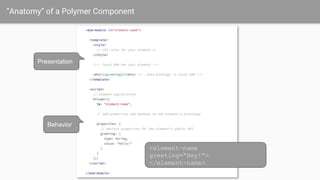
“Anatomy” of a Polymer Component
<element-name
greeting=”Hey!”>
</element-name>
Presentation
Behavior
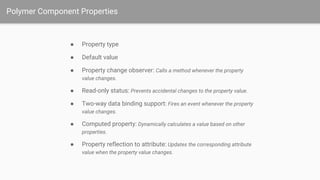
Polymer Component Properties
● Property type
● Default value
● Property change observer: Calls a method whenever the property
value changes.
● Read-only status: Prevents accidental changes to the property value.
● Two-way data binding support: Fires an event whenever the property
value changes.
● Computed property: Dynamically calculates a value based on other
properties.
● Property reflection to attribute: Updates the corresponding attribute
value when the property value changes.
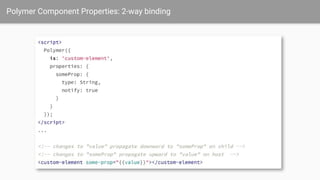
Polymer Component Properties: 2-way binding
Polymer Component Properties: One-way binding (downward)
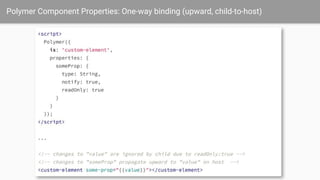
Polymer Component Properties: One-way binding (upward, child-to-host)
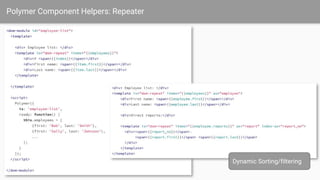
Polymer Component Helpers: Repeater
Dynamic Sorting/filtering
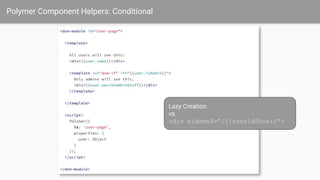
Polymer Component Helpers: Conditional
Lazy Creation
vs.
<div hidden$=”{{!shouldShow}}”>
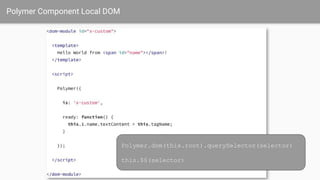
Polymer Component Local DOM
Polymer.dom(this.root).querySelector(selector)
this.$$(selector)
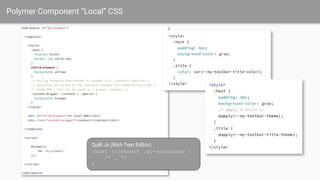
Polymer Component “Local” CSS
Quill Js (Rich Text Editor)
:host ::content .ql-container {
/* … */
}
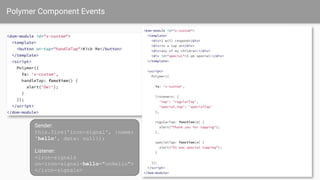
Polymer Component Events
Sender:
this.fire('iron-signal', {name:
'hello', data: null});
Listener:
<iron-signals
on-iron-signal-hello="onHello">
</iron-signals>
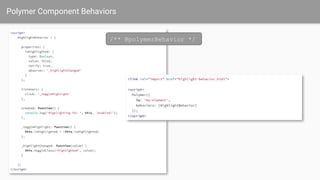
Polymer Component Behaviors
/** @polymerBehavior */
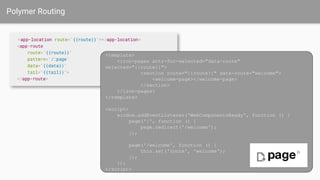
Polymer Routing
<template>
<iron-pages attr-for-selected="data-route"
selected="{{route}}">
<section route="{{route}}" data-route="welcome">
<welcome-page></welcome-page>
</section>
</iron-pages>
</template>
<script>
window.addEventListener('WebComponentsReady', function () {
page('/', function () {
page.redirect('/welcome');
});
page('/welcome', function () {
this.set('route', 'welcome');
});
});
</script>
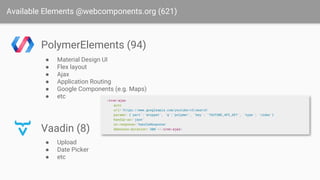
Available Elements @webcomponents.org (621)
PolymerElements (94)
● Material Design UI
● Flex layout
● Ajax
● Application Routing
● Google Components (e.g. Maps)
● etc
Vaadin (8)
● Upload
● Date Picker
● etc
Polymer 2.0 (Preview)
● Improved interoperability. Easier to use with
other libraries and frameworks. Shady DOM separated
out.
● Data system improvements. Easier to reason
about data propagation. Compatibility with Flux-like
approaches.
● More standard. Standard ES6 classes and the
standard custom elements v1 methods for defining
elements.
Polymer App Toolbox
A collection of components, tools and templates for building
Progressive Web Apps with Polymer
https://www.polymer-project.org/1.0/toolbox/
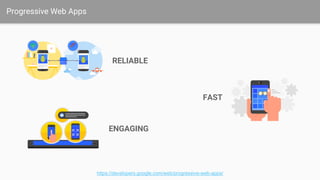
Progressive Web Apps
https://developers.google.com/web/progressive-web-apps/
RELIABLE
FAST
ENGAGING
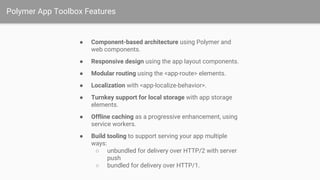
Polymer App Toolbox Features
● Component-based architecture using Polymer and
web components.
● Responsive design using the app layout components.
● Modular routing using the <app-route> elements.
● Localization with <app-localize-behavior>.
● Turnkey support for local storage with app storage
elements.
● Offline caching as a progressive enhancement, using
service workers.
● Build tooling to support serving your app multiple
ways:
○ unbundled for delivery over HTTP/2 with server
push
○ bundled for delivery over HTTP/1.
Polymer Toolchain
● Polymer CLI
○ Create an App Project
○ Run Tests
○ Local Web Server
○ Lint
○ Build (bundle)
○ Manage Dependencies (Bower)
● Gulp
○ All tools as separate modules
Components on the server?
scramjs
micro services
?
Thank you!
Q&A
Polymer Project
https://www.polymer-project.org
Kostas Karolemeas, CEO @allcancode
@VoxelPerfect | linkedin.com/in/kostaskarolemeas

Google Polymer Framework

  • 1.
    Polymer Project The riseof Polymer and Web Components Kostas Karolemeas, CEO @allcancode
  • 2.
    My background -Things becoming mainstream ‘80s - Home Computing ‘90s - OOP ‘90s - 3D CG ‘90s - GUI
  • 3.
    My background -Things becoming mainstream ‘90s - Write Once... ‘90s - WWW ‘00s - Java App Servers ‘10s - Cloud Services
  • 4.
    The rise ofJavascript
  • 5.
    Google: Web ToolsStrategy https://developers.google.com/web/tools/
  • 6.
    My Project -Allcancode Platform https://next.allcancode.com Front-end: Polymer | HTML5 Canvas | Custom iOS/Android wrappers Back-end: Node JS | Koa | DynamoDB | S3 | RedShift Infrastructure: AWS
  • 7.
    The path toWeb Components WEB COMPONENTS https://www.webcomponents.org/ “A set of web platform APIs that allow you to create new custom, reusable, encapsulated HTML tags”
  • 8.
    The path toWeb Components WEB COMPONENTS https://www.webcomponents.org/ “A set of web platform APIs that allow you to create new custom, reusable, encapsulated HTML tags” Dev Tools
  • 9.
    Polymer Library A setof features for creating custom elements that work like standard DOM elements https://www.polymer-project.org/1.0/docs/devguide/feature-overview
  • 10.
    “Anatomy” of aPolymer Component <element-name greeting=”Hey!”> </element-name> Presentation Behavior
  • 11.
    Polymer Component Properties ●Property type ● Default value ● Property change observer: Calls a method whenever the property value changes. ● Read-only status: Prevents accidental changes to the property value. ● Two-way data binding support: Fires an event whenever the property value changes. ● Computed property: Dynamically calculates a value based on other properties. ● Property reflection to attribute: Updates the corresponding attribute value when the property value changes.
  • 12.
  • 13.
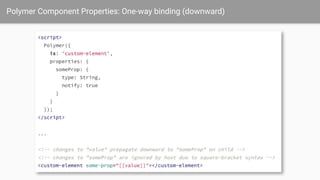
    Polymer Component Properties:One-way binding (downward)
  • 14.
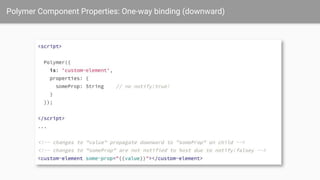
    Polymer Component Properties:One-way binding (downward)
  • 15.
    Polymer Component Properties:One-way binding (upward, child-to-host)
  • 16.
    Polymer Component Helpers:Repeater Dynamic Sorting/filtering
  • 17.
    Polymer Component Helpers:Conditional Lazy Creation vs. <div hidden$=”{{!shouldShow}}”>
  • 18.
    Polymer Component LocalDOM Polymer.dom(this.root).querySelector(selector) this.$$(selector)
  • 19.
    Polymer Component “Local”CSS Quill Js (Rich Text Editor) :host ::content .ql-container { /* … */ }
  • 20.
    Polymer Component Events Sender: this.fire('iron-signal',{name: 'hello', data: null}); Listener: <iron-signals on-iron-signal-hello="onHello"> </iron-signals>
  • 21.
  • 22.
    Polymer Routing <template> <iron-pages attr-for-selected="data-route" selected="{{route}}"> <sectionroute="{{route}}" data-route="welcome"> <welcome-page></welcome-page> </section> </iron-pages> </template> <script> window.addEventListener('WebComponentsReady', function () { page('/', function () { page.redirect('/welcome'); }); page('/welcome', function () { this.set('route', 'welcome'); }); }); </script>
  • 23.
    Available Elements @webcomponents.org(621) PolymerElements (94) ● Material Design UI ● Flex layout ● Ajax ● Application Routing ● Google Components (e.g. Maps) ● etc Vaadin (8) ● Upload ● Date Picker ● etc
  • 24.
    Polymer 2.0 (Preview) ●Improved interoperability. Easier to use with other libraries and frameworks. Shady DOM separated out. ● Data system improvements. Easier to reason about data propagation. Compatibility with Flux-like approaches. ● More standard. Standard ES6 classes and the standard custom elements v1 methods for defining elements.
  • 25.
    Polymer App Toolbox Acollection of components, tools and templates for building Progressive Web Apps with Polymer https://www.polymer-project.org/1.0/toolbox/
  • 26.
  • 27.
    Polymer App ToolboxFeatures ● Component-based architecture using Polymer and web components. ● Responsive design using the app layout components. ● Modular routing using the <app-route> elements. ● Localization with <app-localize-behavior>. ● Turnkey support for local storage with app storage elements. ● Offline caching as a progressive enhancement, using service workers. ● Build tooling to support serving your app multiple ways: ○ unbundled for delivery over HTTP/2 with server push ○ bundled for delivery over HTTP/1.
  • 28.
    Polymer Toolchain ● PolymerCLI ○ Create an App Project ○ Run Tests ○ Local Web Server ○ Lint ○ Build (bundle) ○ Manage Dependencies (Bower) ● Gulp ○ All tools as separate modules
  • 29.
    Components on theserver? scramjs micro services ?
  • 30.
    Thank you! Q&A Polymer Project https://www.polymer-project.org KostasKarolemeas, CEO @allcancode @VoxelPerfect | linkedin.com/in/kostaskarolemeas