Polymer 2.0 Codelab
What’s Polymer ?
Web Components
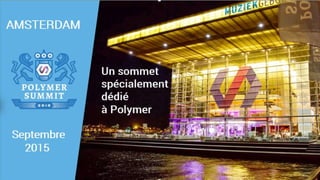
Polymer Summit
Who use Polymer ?
Create a Polymer Project
Custom style & Polymer UI Elements
Create an element
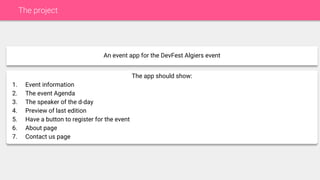
The project
Summary
Starting with Polymer
Data binding
What’s Polymer
Polymer is a JavaScript library based on web components.
It helps you create custom reusable HTML elements, and use them to build
performant, maintainable apps.
What’s Polymer ?
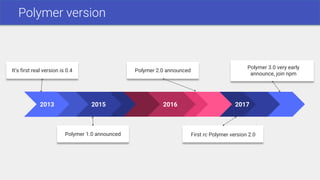
20172013 2015
It’s first real version is 0.4
Polymer 1.0 announced
2016
Polymer 2.0 announced
First rc Polymer version 2.0
Polymer 3.0 very early
announce, join npm
Polymer version
Web Component
It allows the creation of reusable widgets or components in web documents and web applications.
Web Components are a set of standards currently being produced by Google engineers as
a W3C specification.
There are 4 standards :
Custom elements, Shadow DOM, HTML Imports and Templates HTML
Whats’ Web Components
7
Custom elements
”
HTML gives us an excellent tool for structuring a document but its
vocabulary is limited to elements the HTML standard defines.
So there is custom elements that gives you the possibility to create new
HTML tags
7
Custom elements
<div>
<div class="tab-pane" id="home" >Home</div>
<div class="tab-pane" id="profile" >Profile</div>
<div class="tab-pane" id="messages" >Messages</div>
<div class="tab-pane" id="settings" >Settings</div>
</div>
Home Profile Messages Settings
From a div soup to ….
7
Custom elements
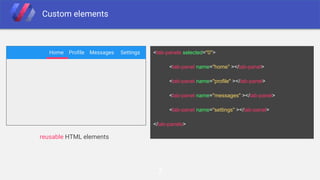
Home Profile Messages Settings <tab-panels selected="0">
<tab-panel name="home" ></tab-panel>
<tab-panel name="profile" ></tab-panel>
<tab-panel name="messages" ></tab-panel>
<tab-panel name="settings" ></tab-panel>
</tab-panels>
Home Profile Messages Settings
... reusable HTML elements
The shadow Dom addresses the DOM tree encapsulation problem. Thus
using shadow will solve problems such as same name for classes and ids
that CSS brings in maintaining your app
Shadow DOM
”
Template helps you reuse code, by adding html code embedded in template
tag, thus reusing it
Template
”
HTML imports is a way to include html documents in other html documents,
the imports is not limited to markups, you can include CSS, and JS
HTML Import
”
Polymer Summit
Who uses Polymer ?
Starting with Polymer
Node.JS
Git
Bower
Polymer-cli
What you need to Install
Create a Polymer Project
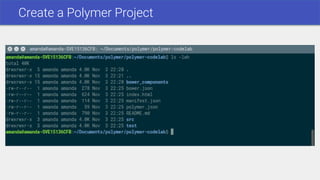
1.Create a new folder 2.Polymer init 3.Choose polymer-2-application
Create a Polymer Project
-------bower_components
-------src
-------test
-------bower.json
-------polymer.json
-------manifest.json
-------index.html
-------README.md
Polymer-codelab folder structure
Create a Polymer Project
bower_components Your app has a set of dependencies - chunks of code that it depends on to
work. These dependencies are managed with Bower, a package manager, and
stored in the bower_components folder.
src/ Folder that stores the code we'll write for your app - html, javascript and
css.
test/ A placeholder folder for automated tests. You won't need this since you will
test your app manually.
bower.json Describes your app's dependencies to the package manager, Bower.
polymer.json stores information about your project structure and desired build
configuration(s). It is used by the Polymer CLI as a way to understand the
structure of your application.
manifest.json Stores metadata for your app that helps browsers to load it efficiently.
index.html Your app's landing page.
README.md README files usually describe how to install and use the app. Currently,
yours contains some default content generated by the Polymer CLI.
Create a Polymer Project
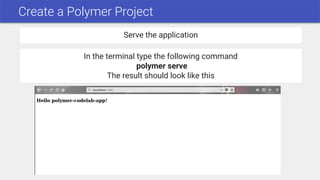
Serve the application
In the terminal type the following command
polymer serve
The result should look like this
Create an element
Create an element
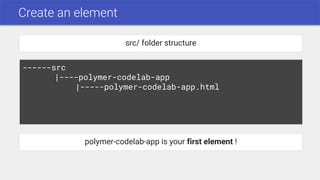
------src
|----polymer-codelab-app
|-----polymer-codelab-app.html
src/ folder structure
polymer-codelab-app is your first element !
Create an element
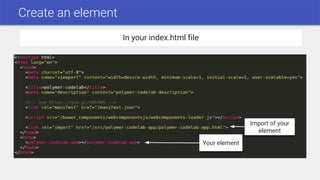
In your index.html file
Your element
Import of your
element
Create an element
Import polymer
Element template
Your element definition
Your element !
Create an element
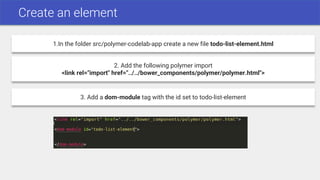
1.In the folder src/polymer-codelab-app create a new file todo-list-element.html
2. Add the following polymer import
<link rel="import" href="../../bower_components/polymer/polymer.html">
3. Add a dom-module tag with the id set to todo-list-element
Create an element
4.within the dom-module tag add the template tag and the script tag
5. In the script tag define a class with the name TodoListElement that extends the Polymer.Element
Create an element
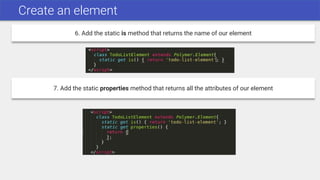
6. Add the static is method that returns the name of our element
7. Add the static properties method that returns all the attributes of our element
Create an element
8. Let’s add a header to our element with the title My First todo list
9. And now let’s add the line that define our element at the bottom of the script tag
window.customElements.define(TodoListElement.is, TodoListElement);
Create an element
10. Your new element should look like this by now
11. Let’s use our new element in the polymer-codelab-app.html
Create an element
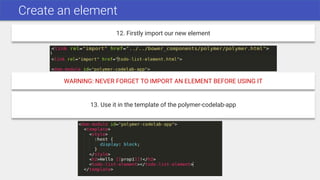
12. Firstly import our new element
13. Use it in the template of the polymer-codelab-app
WARNING: NEVER FORGET TO IMPORT AN ELEMENT BEFORE USING IT
Create an element
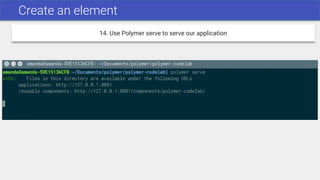
14. Use Polymer serve to serve our application
Create an element
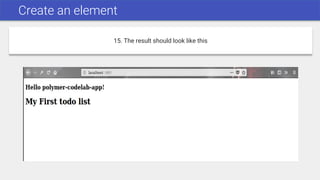
15. The result should look like this
Data binding
Data Binding
A data binding connects data from a custom element to a property or attribute of an element
This is a data binding to attribute prop1
Data Binding
1.In the todo-list-element.html add the the name property
name:{
type:String,
value:”homeworks”
}
2. Change the <h1>My First todo list</h1> to <h1>[[name]]</h1> and reload the page
Data Binding
Bind to a host property
Bind to an attribute
● Double-curly brackets ( {{ }} ) support both upward and downward data flow.
● Double square brackets ( [[ ]] ) are one-way, and support only downward data flow.
Data Binding
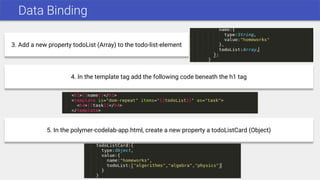
3. Add a new property todoList (Array) to the todo-list-element
4. In the template tag add the following code beneath the h1 tag
5. In the polymer-codelab-app.html, create a new property a todoListCard (Object)
Data Binding
6. In the polymer-codelab-app.html change the following line <todo-list-element></todo-list-element> to
<todo-list-element name="[[todoListCard.name]]" todo-list="[[todoListCard.todoList]]"></todo-list-element>
And reload the page
7. The result should look like this
Data Binding
8. Add the style tag on the top of the template tag
9. Add a checkbox to see if a task is complete <input type="checkbox" checked>
Data Binding
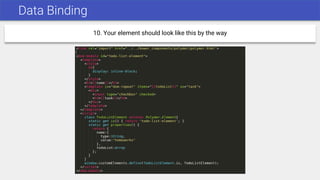
10. Your element should look like this by the way
Data Binding
11. Reload the page
12. Change in polymer-codelab-app.html the todoList property of the todoListCard object to see if a task is
complete
Data Binding
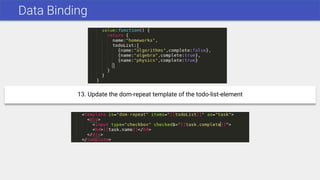
13. Update the dom-repeat template of the todo-list-element
Data Binding
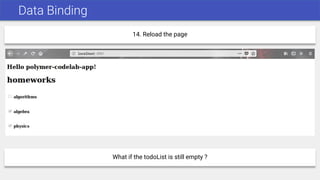
14. Reload the page
What if the todoList is still empty ?
Data Binding
We use the dom-if to ensure that in the case of empty array we show the user the message
“The list is empty”
15. Add the following code at the end of the template tag in todo-list-element.html
16. Add the following line to polymer-codelab-app.html
<todo-list-element name="Chores" todo-list="[]"></todo-list-element>
Data Binding
17.Reload the page, the result should look like this
Custom Style
Custom Style
Polymer provide custom CSS properties that you can use to style the appearance of the element in your
application.
you can use custom properties to build an interface for the users of your element so they can style it.
Custom Style
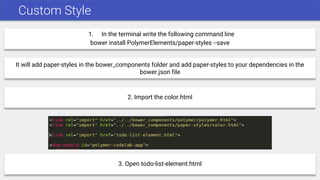
1. In the terminal write the following command line
bower install PolymerElements/paper-styles --save
It will add paper-styles in the bower_components folder and add paper-styles to your dependencies in the
bower.json file
2. Import the color.html
3. Open todo-list-element.html
Custom Style
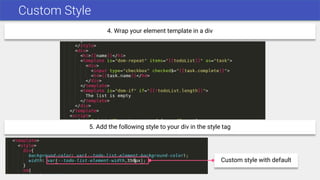
4. Wrap your element template in a div
5. Add the following style to your div in the style tag
Custom style with default
Custom Style
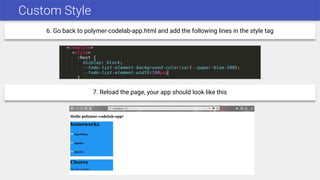
6. Go back to polymer-codelab-app.html and add the following lines in the style tag
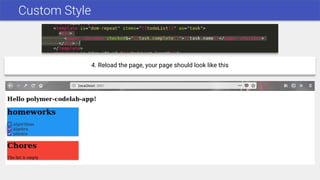
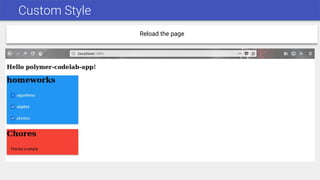
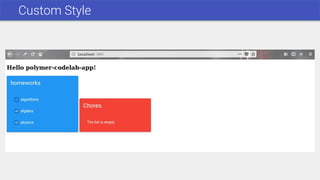
7. Reload the page, your app should look like this
Custom Style
8. In the todo-list-element.html add a new property important (boolean) this property explain whether the
todoList is important
An important todo-list-elememt must have the background-color set to a red color
To achieve it we use custom css properties and observers
Custom Style
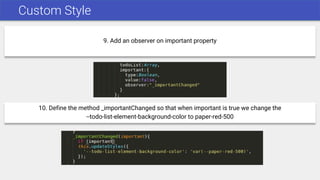
9. Add an observer on important property
10. Define the method _importantChanged so that when important is true we change the
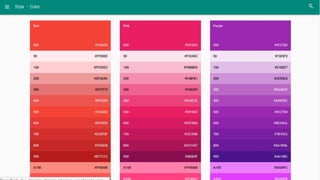
--todo-list-element-background-color to paper-red-500
Custom Style
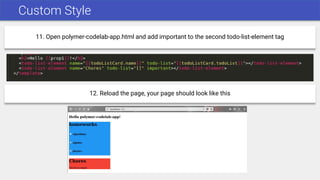
11. Open polymer-codelab-app.html and add important to the second todo-list-element tag
12. Reload the page, your page should look like this
Custom Style
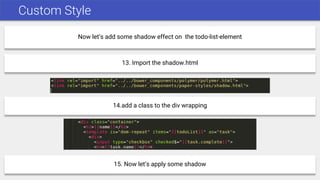
Now let’s add some shadow effect on the todo-list-element
13. Import the shadow.html
14.add a class to the div wrapping
15. Now let’s apply some shadow
Custom Style
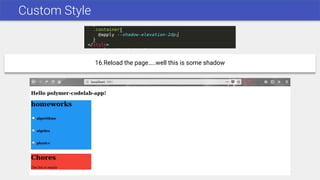
16.Reload the page…..well this is some shadow
webcomponents.org
And this is awesome !
Custom Style
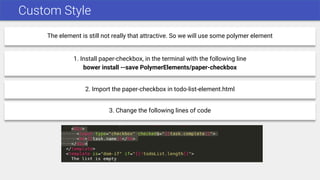
The element is still not really that attractive. So we will use some polymer element
1. Install paper-checkbox, in the terminal with the following line
bower install --save PolymerElements/paper-checkbox
2. Import the paper-checkbox in todo-list-element.html
3. Change the following lines of code
Custom Style
4. Reload the page, your page should look like this
Custom Style
5. Add the following style to the paper-checkbox
6. Relaod the page
Custom Style
7. Install the paper-item with the following command line
8. Import the paper-item with the following line
<link rel="import" href="../../bower_components/paper-item/paper-item.html">
9. Change the div tag to the paper-item tag and add the style paper-item{color:#FFF;}
Custom Style
Reload the page
Custom Style
10. Install paper-card with the following command line bower install –save PolymerElements/paper-card
11. Import the paper-card in the todo-list-element.html
<link rel="import" href="../../bower_components/paper-card/paper-card.html">
12. Change the following lines of code and delete .container style
Custom Style
13. Change the div in the style tag to paper-card and add
--paper-card-header-color:#FFF;
Custom Style
The project :D
The project
An event app for the DevFest Algiers event
The app should show:
1. Event information
2. The event Agenda
3. The speaker of the d-day
4. Preview of last edition
5. Have a button to register for the event
6. About page
7. Contact us page
You can find code related to :
Create a polymer project in
https://github.com/amandaSalander/bookworm-training-polymer2.0/tree/master/step_1
Create an element
https://github.com/amandaSalander/bookworm-training-polymer2.0/tree/master/step_2
Data binding and data binding helpers
https://github.com/amandaSalander/bookworm-training-polymer2.0/tree/master/step_3
Custom styles
https://github.com/amandaSalander/bookworm-training-polymer2.0/tree/master/step_4
Using Polymer UI Elements
https://github.com/amandaSalander/bookworm-training-polymer2.0/tree/master/step_5
Find it interesting ?
Polymer Project
http://polymer-project.org/
Webcomponents.org
https://www.webcomponents.org/
The full codelab step by step
https://github.com/amandaSalander/bookworm-training-polymer2.0
The small little mini project
https://github.com/amandaSalander/bookworm-training-polymer2.0-devfest
Polymer Summit Copenhagen 2017
https://goo.gl/ZPRpEj

Polymer 2.0 codelab for extreme beginners

  • 1.
  • 2.
    What’s Polymer ? WebComponents Polymer Summit Who use Polymer ? Create a Polymer Project Custom style & Polymer UI Elements Create an element The project Summary Starting with Polymer Data binding
  • 3.
  • 4.
    Polymer is aJavaScript library based on web components. It helps you create custom reusable HTML elements, and use them to build performant, maintainable apps. What’s Polymer ?
  • 6.
    20172013 2015 It’s firstreal version is 0.4 Polymer 1.0 announced 2016 Polymer 2.0 announced First rc Polymer version 2.0 Polymer 3.0 very early announce, join npm Polymer version
  • 7.
  • 8.
    It allows thecreation of reusable widgets or components in web documents and web applications. Web Components are a set of standards currently being produced by Google engineers as a W3C specification. There are 4 standards : Custom elements, Shadow DOM, HTML Imports and Templates HTML Whats’ Web Components
  • 9.
    7 Custom elements ” HTML givesus an excellent tool for structuring a document but its vocabulary is limited to elements the HTML standard defines. So there is custom elements that gives you the possibility to create new HTML tags
  • 10.
    7 Custom elements <div> <div class="tab-pane"id="home" >Home</div> <div class="tab-pane" id="profile" >Profile</div> <div class="tab-pane" id="messages" >Messages</div> <div class="tab-pane" id="settings" >Settings</div> </div> Home Profile Messages Settings From a div soup to ….
  • 11.
    7 Custom elements Home ProfileMessages Settings <tab-panels selected="0"> <tab-panel name="home" ></tab-panel> <tab-panel name="profile" ></tab-panel> <tab-panel name="messages" ></tab-panel> <tab-panel name="settings" ></tab-panel> </tab-panels> Home Profile Messages Settings ... reusable HTML elements
  • 12.
    The shadow Domaddresses the DOM tree encapsulation problem. Thus using shadow will solve problems such as same name for classes and ids that CSS brings in maintaining your app Shadow DOM ”
  • 13.
    Template helps youreuse code, by adding html code embedded in template tag, thus reusing it Template ”
  • 14.
    HTML imports isa way to include html documents in other html documents, the imports is not limited to markups, you can include CSS, and JS HTML Import ”
  • 15.
  • 19.
  • 21.
  • 22.
  • 23.
  • 24.
    1.Create a newfolder 2.Polymer init 3.Choose polymer-2-application Create a Polymer Project
  • 25.
    Create a PolymerProject -------bower_components -------src -------test -------bower.json -------polymer.json -------manifest.json -------index.html -------README.md Polymer-codelab folder structure
  • 26.
  • 27.
    bower_components Your apphas a set of dependencies - chunks of code that it depends on to work. These dependencies are managed with Bower, a package manager, and stored in the bower_components folder. src/ Folder that stores the code we'll write for your app - html, javascript and css. test/ A placeholder folder for automated tests. You won't need this since you will test your app manually. bower.json Describes your app's dependencies to the package manager, Bower. polymer.json stores information about your project structure and desired build configuration(s). It is used by the Polymer CLI as a way to understand the structure of your application. manifest.json Stores metadata for your app that helps browsers to load it efficiently. index.html Your app's landing page. README.md README files usually describe how to install and use the app. Currently, yours contains some default content generated by the Polymer CLI.
  • 28.
    Create a PolymerProject Serve the application In the terminal type the following command polymer serve The result should look like this
  • 29.
  • 30.
    Create an element ------src |----polymer-codelab-app |-----polymer-codelab-app.html src/folder structure polymer-codelab-app is your first element !
  • 31.
    Create an element Inyour index.html file Your element Import of your element
  • 32.
    Create an element Importpolymer Element template Your element definition Your element !
  • 33.
    Create an element 1.Inthe folder src/polymer-codelab-app create a new file todo-list-element.html 2. Add the following polymer import <link rel="import" href="../../bower_components/polymer/polymer.html"> 3. Add a dom-module tag with the id set to todo-list-element
  • 34.
    Create an element 4.withinthe dom-module tag add the template tag and the script tag 5. In the script tag define a class with the name TodoListElement that extends the Polymer.Element
  • 35.
    Create an element 6.Add the static is method that returns the name of our element 7. Add the static properties method that returns all the attributes of our element
  • 36.
    Create an element 8.Let’s add a header to our element with the title My First todo list 9. And now let’s add the line that define our element at the bottom of the script tag window.customElements.define(TodoListElement.is, TodoListElement);
  • 37.
    Create an element 10.Your new element should look like this by now 11. Let’s use our new element in the polymer-codelab-app.html
  • 38.
    Create an element 12.Firstly import our new element 13. Use it in the template of the polymer-codelab-app WARNING: NEVER FORGET TO IMPORT AN ELEMENT BEFORE USING IT
  • 39.
    Create an element 14.Use Polymer serve to serve our application
  • 40.
    Create an element 15.The result should look like this
  • 41.
  • 42.
    Data Binding A databinding connects data from a custom element to a property or attribute of an element This is a data binding to attribute prop1
  • 43.
    Data Binding 1.In thetodo-list-element.html add the the name property name:{ type:String, value:”homeworks” } 2. Change the <h1>My First todo list</h1> to <h1>[[name]]</h1> and reload the page
  • 44.
    Data Binding Bind toa host property Bind to an attribute ● Double-curly brackets ( {{ }} ) support both upward and downward data flow. ● Double square brackets ( [[ ]] ) are one-way, and support only downward data flow.
  • 45.
    Data Binding 3. Adda new property todoList (Array) to the todo-list-element 4. In the template tag add the following code beneath the h1 tag 5. In the polymer-codelab-app.html, create a new property a todoListCard (Object)
  • 46.
    Data Binding 6. Inthe polymer-codelab-app.html change the following line <todo-list-element></todo-list-element> to <todo-list-element name="[[todoListCard.name]]" todo-list="[[todoListCard.todoList]]"></todo-list-element> And reload the page 7. The result should look like this
  • 47.
    Data Binding 8. Addthe style tag on the top of the template tag 9. Add a checkbox to see if a task is complete <input type="checkbox" checked>
  • 48.
    Data Binding 10. Yourelement should look like this by the way
  • 49.
    Data Binding 11. Reloadthe page 12. Change in polymer-codelab-app.html the todoList property of the todoListCard object to see if a task is complete
  • 50.
    Data Binding 13. Updatethe dom-repeat template of the todo-list-element
  • 51.
    Data Binding 14. Reloadthe page What if the todoList is still empty ?
  • 52.
    Data Binding We usethe dom-if to ensure that in the case of empty array we show the user the message “The list is empty” 15. Add the following code at the end of the template tag in todo-list-element.html 16. Add the following line to polymer-codelab-app.html <todo-list-element name="Chores" todo-list="[]"></todo-list-element>
  • 53.
    Data Binding 17.Reload thepage, the result should look like this
  • 54.
  • 55.
    Custom Style Polymer providecustom CSS properties that you can use to style the appearance of the element in your application. you can use custom properties to build an interface for the users of your element so they can style it.
  • 56.
    Custom Style 1. Inthe terminal write the following command line bower install PolymerElements/paper-styles --save It will add paper-styles in the bower_components folder and add paper-styles to your dependencies in the bower.json file 2. Import the color.html 3. Open todo-list-element.html
  • 59.
    Custom Style 4. Wrapyour element template in a div 5. Add the following style to your div in the style tag Custom style with default
  • 60.
    Custom Style 6. Goback to polymer-codelab-app.html and add the following lines in the style tag 7. Reload the page, your app should look like this
  • 61.
    Custom Style 8. Inthe todo-list-element.html add a new property important (boolean) this property explain whether the todoList is important An important todo-list-elememt must have the background-color set to a red color To achieve it we use custom css properties and observers
  • 62.
    Custom Style 9. Addan observer on important property 10. Define the method _importantChanged so that when important is true we change the --todo-list-element-background-color to paper-red-500
  • 63.
    Custom Style 11. Openpolymer-codelab-app.html and add important to the second todo-list-element tag 12. Reload the page, your page should look like this
  • 64.
    Custom Style Now let’sadd some shadow effect on the todo-list-element 13. Import the shadow.html 14.add a class to the div wrapping 15. Now let’s apply some shadow
  • 65.
    Custom Style 16.Reload thepage…..well this is some shadow
  • 66.
  • 68.
    And this isawesome !
  • 69.
    Custom Style The elementis still not really that attractive. So we will use some polymer element 1. Install paper-checkbox, in the terminal with the following line bower install --save PolymerElements/paper-checkbox 2. Import the paper-checkbox in todo-list-element.html 3. Change the following lines of code
  • 70.
    Custom Style 4. Reloadthe page, your page should look like this
  • 71.
    Custom Style 5. Addthe following style to the paper-checkbox 6. Relaod the page
  • 72.
    Custom Style 7. Installthe paper-item with the following command line 8. Import the paper-item with the following line <link rel="import" href="../../bower_components/paper-item/paper-item.html"> 9. Change the div tag to the paper-item tag and add the style paper-item{color:#FFF;}
  • 73.
  • 74.
    Custom Style 10. Installpaper-card with the following command line bower install –save PolymerElements/paper-card 11. Import the paper-card in the todo-list-element.html <link rel="import" href="../../bower_components/paper-card/paper-card.html"> 12. Change the following lines of code and delete .container style
  • 75.
    Custom Style 13. Changethe div in the style tag to paper-card and add --paper-card-header-color:#FFF;
  • 76.
  • 77.
  • 78.
    The project An eventapp for the DevFest Algiers event The app should show: 1. Event information 2. The event Agenda 3. The speaker of the d-day 4. Preview of last edition 5. Have a button to register for the event 6. About page 7. Contact us page
  • 80.
    You can findcode related to : Create a polymer project in https://github.com/amandaSalander/bookworm-training-polymer2.0/tree/master/step_1 Create an element https://github.com/amandaSalander/bookworm-training-polymer2.0/tree/master/step_2 Data binding and data binding helpers https://github.com/amandaSalander/bookworm-training-polymer2.0/tree/master/step_3 Custom styles https://github.com/amandaSalander/bookworm-training-polymer2.0/tree/master/step_4 Using Polymer UI Elements https://github.com/amandaSalander/bookworm-training-polymer2.0/tree/master/step_5
  • 81.
    Find it interesting? Polymer Project http://polymer-project.org/ Webcomponents.org https://www.webcomponents.org/ The full codelab step by step https://github.com/amandaSalander/bookworm-training-polymer2.0 The small little mini project https://github.com/amandaSalander/bookworm-training-polymer2.0-devfest Polymer Summit Copenhagen 2017 https://goo.gl/ZPRpEj