The Web search giant, rocked by slowing ad growth and a 				
	 plunge in its shares this year, is crafting a cell phone operating system
to thwart Microsoft and put its name on millions of mobile screens.
		 	 By EDWARD ROBINSON and ARI LEVY
Wireless Gamble
’s
Photograph by Ian White
Google
82
On a chilly february morning,
AndyRubinhustlespastequation-filled
whiteboardsinatwo-storybuildingon
GoogleInc.’sSiliconValleycampus.Rubin,a
computerscientistwhobuildsrobotsforfun,
hasspentthreeyearsinthistop-secretsanc-
tumoftheGoogleplex.He’sputtingthefinal
touchesononeofthemostambitious—and
potentiallyhumbling—projectstheInternet
juggernauthaseverundertaken:anoperating
systemforcellularphonesthat’sdesignedto
giveGooglethesamegriponthemobileWeb
thatitcommandsinonlinesearchesonper-
sonalcomputers.
“We’vegottentothepointwhereanyone
canbuildacellphone,”saysRubin,44,dressed
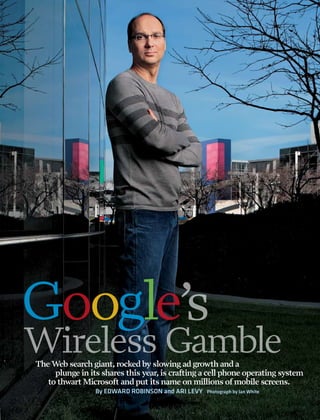
Andy Rubin is creating Google-powered mobile phones.
83
mAY 2008 Bloomberg Markets
U could likely become just one of the many
offerings in AT&T stores.
Ultimately,BrinandPagehaven’t
provedtheycandoanythingelseaswellas
theydosearch,saysLauraMartin,anequi-
tyanalystatNewYork–basedSoleilSecuri-
tiesCorp.whoratesGooglestocka“hold”
becauseshe’swaryaboutwhetherthe
companycankeepgrowingasithas.InJan-
uary,Brinsaidonanearningscallwithana-
lyststhatGooglehadyettomakeheadway
insellingadsonMySpaceandothersocial
networkingsites.Ininstantmessaging,
Microsoft’sWindowsLiveMessenger
enjoyed235millionuniquevisitorsinJan-
uary,accordingtoComScore.TheGoogle
Talkmessagingserviceisapproaching
5millionusers.“Despite relentless prod-
uct introductions, the only one that’s
been a proven economic success is
search,” Martin says. “Until Google can
show that it’s not a single-product compa-
ny, there’s no guarantee that it can sustain
its growth rate.”
winning on the mobile Web, one
of the biggest and potentially most lucra-
tive Internet markets, would take Google
far in erasing such doubts. There are
more than 3.3 billion cell phones world-
wide, about one for every two people on
the planet. By 2010, that’s expected to
jump to 4 billion, or triple the number of
personal computers, according to
research firm Gartner Inc. Brin and Page
want the first page callers see on these
phones to be Google’s. From there, users
would tap Google software to surf for
information, e-mail friends, watch vid-
eos and find the nearest deli, just like
they do on PCs.
“Itshouldbepossiblethattheprimary
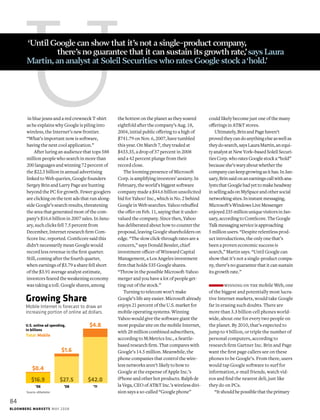
Mobile Internet is forecast to draw an
increasing portion of online ad dollars.
Growing Share
Source: eMarketer
U.S. online ad spending,
in billions
Total Mobile
$4.8
’11
$42.0
$1.6
’08
$27.5
$0.4
’06
$16.9
in blue jeans and a red crewneck T-shirt
as he explains why Google is piling into
wireless, the Internet’s new frontier.
“What’s important now is software,
having the next cool application.”
After luring an audience that tops 588
million people who search in more than
200 languages and winning 72 percent of
the $22.5 billion in annual advertising
linked to Web queries, Google founders
Sergey Brin and Larry Page are hunting
beyond the PC for growth. Fewer googlers
are clicking on the text ads that run along-
side Google’s search results, threatening
the area that generated most of the com-
pany’s $16.6 billion in 2007 sales. In Janu-
ary, such clicks fell 7.5 percent from
December, Internet research firm Com-
Score Inc. reported. ComScore said this
didn’t necessarily mean Google would
record less revenue in the first quarter.
Still, coming after the fourth quarter,
when earnings of $3.79 a share fell short
of the $3.91 average analyst estimate,
investors feared the weakening economy
was taking a toll. Google shares, among
the hottest on the planet as they soared
eightfold after the company’s Aug. 18,
2004, initial public offering to a high of
$741.79 on Nov. 6, 2007, have tumbled
this year. On March 7, they traded at
$433.35, a drop of 37 percent in 2008
and a 42 percent plunge from their
record close.
The looming presence of Microsoft
Corp. is amplifying investors’ anxiety. In
February, the world’s biggest software
company made a $44.6 billion unsolicited
bid for Yahoo! Inc., which is No. 2 behind
Google in Web searches. Yahoo rebuffed
the offer on Feb. 11, saying that it under-
valued the company. Since then, Yahoo
has deliberated about how to counter the
proposal, leaving Google shareholders on
edge. “The slow click-through rates are a
concern,’’ says Donald Bessler, chief
investment officer of Winward Capital
Management, a Los Angeles investment
firm that holds 535 Google shares.
“Throw in the possible Microsoft-Yahoo
merger and you have a lot of people get-
ting out of the stock.’’
Turning to telecom won’t make
Google’s life any easier. Microsoft already
enjoys 21 percent of the U.S. market for
mobile operating systems. Winning
Yahoo would give the software giant the
most popular site on the mobile Internet,
with 28 million combined subscribers,
according to M:Metrics Inc., a Seattle-
based research firm. That compares with
Google’s 14.5 million. Meanwhile, the
phone companies that control the wire-
less networks aren’t likely to bow to
Google at the expense of Apple Inc.’s
iPhone and other hot products. Ralph de
la Vega, CEO of AT&T Inc.’s wireless divi-
sion says a so-called “Google phone”
‘Until Google can show that it’s not a single-product company,
	 there’s no guarantee that it can sustain its growth rate,’says Laura
Martin,an analyst at Soleil Securities who rates Google stock a‘hold.’
84
Bloomberg Markets mAY 2008
placeyousearchwouldbeamobile
device,”GoogleChiefExecutiveOfficer
EricSchmidtsays.Hepredictscruisingthe
Webonhandheldgadgetsmayeventually
rivalthewiredsearchmarket,meaning
mobilemightsomedayaccountforroughly
halfofGoogle’srevenue.
Schmidt’spredictionputsthespotlight
onRubinandhisteamofengineers—and
theiroperatingsystemcalledAndroid,
whichissettohitthemarketthissummer.
UnlikeMicrosoft,whichlicensesWindows
Mobiletohandsetmanufacturers,Google
planstogiveAndroidtoscoresofcell
phonemakersandserviceproviders.Ithas
formedtheOpenHandsetAlliancewith
morethan30phonemanufacturers,carri-
ersandchipmakerstosupportAndroid.
AmongthemareMotorolaInc.and
JapanesecarrierNTTDoCoMoInc.To
pavetheway,Googlehasalreadyreleased
mobileversionsofitssearchandother
softwarethatcanrunontheiPhone,for
one.GoogleisbettingthatAndroidandits
made-for-mobile-phoneprogramswill
attractmillionsofcustomerswhocanbe
pliedwithads—justlikeGoogledoeson
PCs.MobileonlineadvertisingintheU.S.
isforecasttojumpto$4.8billionby2011
from$1.6billionthisyear,accordingto
researchfirmEMarketerInc.
“The cell phone is where it’s all mov-
ing, and Google has to get into that,” says
Rich Redelfs, a venture capitalist at Foun-
dation Capital in Menlo Park, California,
who invests in wireless technology com-
panies. “The operating system has incred-
ible power, as we’ve seen with Microsoft.
So Google wants to create an operating
systemthatcangoacrosshandsetsand
givethemastronghold.”
If any other newcomer set out to shake
up the mobile world as Google is doing,
telecom veterans would dismiss it out of
hand, says Richard Wong, a venture capi-
talist at Accel Partners in Palo Alto.
google isn’t any company. It’s a
force so synonymous with the Internet
that the Oxford English Dictionary recog-
nizes google as a verb. A decade after its
founding, Google, with its market value of
$136 billion, is the Valley’s byword for
wealth and buzz. Brin, 34, and Page, 35,
who were Stanford University Ph.D. com-
puter science students when they devised
a formula to rank and display Web search-
es by their relevance, are each worth more
than $13 billion and wing around the
globe in a Boeing 767. Former U.S. Vice
President Al Gore, who won the Nobel
Peace Prize last year for his crusade
against global warming, advises Google’s
board. Internet pioneer Vinton Cerf,
attracted by Google’s reputation for inno-
vation, holds the title chief Internet evan-
gelist. Democratic presidential candidate
Barack Obama spoke to a packed house at
Google headquarters in November.
On March 11, Google bolstered its abil-
ity to deliver online ads with video and
images by winning approval from Europe-
an Union antitrust officials for its $3.1 bil-
lion purchase of DoubleClick Inc. The
U.S. Federal Trade Commission cleared
the deal in December.
“Google sneezes, and everyone goes
bananas,” says David Weiden, a venture
capitalist at Khosla Ventures in Menlo
Park, California, just up the road from
CEO Eric Schmidt
says Web searching
is going mobile.
85
ananance/redux
mAY 2008 Bloomberg Markets
Google’s Mountain View headquarters.
“But just because it’s Google, doesn’t
mean it wins.”
Cracking the $135 billion U.S. wireless
industry will be tough, even for Google.
The market is more entrenched and bet-
ter defended by incumbents Verizon
Communications Inc. and AT&T than the
wired Internet, Accel’s Wong says. Black-
Berry maker Research In Motion Ltd.,
Palm Inc. and now Apple are dueling for
customers. Finnish phone giant Nokia Oyj
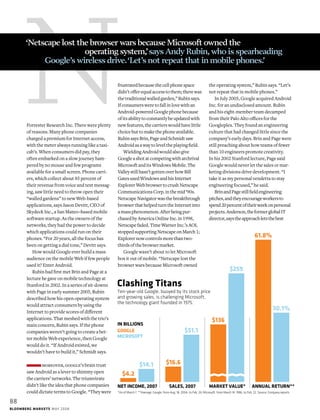
owns 48 percent of Symbian Ltd., a Lon-
don-based software firm that commands
almost two-thirds of the global market for
mobile operating systems. Then there’s
Microsoft, whose Windows Mobile runs
gadgets offered by 160 phone companies
in 55 countries.
“Googleispickingsomereallybig
fights,”saysDavidHelfrich,apartnerat
Garnett&HelfrichCapital,aSanMateo,
California–basedtechnologybuyoutfirm.
“I’mnotconvincedthatGoogle,forallthe
billionsofdollarsithas,canbetheNo.1
WebcompanyandtheNo.1mobileoper-
atingsystem.They’renotomnipotent.”
microsoft may release the sev-
enth generation of Windows Mobile this
year, just as Android makes its debut.
“Microsoft versus Google—that’s the
battle that’s coming in mobile,” Terry
Garnett, Helfrich’s partner, says.
The looming fight between two of the
most powerful tech companies promises
to open a new front in their all-out war for
Internet domination. Microsoft’s bid for
Yahoo intensified the rivalry. Invoking
Microsoft’s antitrust woes from the late
’90s, Google Chief Legal Officer David
Drummond questioned whether the
Yahoo offer was another power grab.
“Could the acquisition of Yahoo allow
Microsoft—despite its legacy of serious
legal and regulatory offenses—to extend
unfair practices from browsers and oper-
ating systems to the Internet?” he wrote
on Google’s Web site on Feb. 3. On Feb.
27, the European Union fined Microsoft a
record 899 million euros ($1.35 billion)
for failing to comply with a 2004 antitrust
order related to Windows for PCs.
InalettertotheYahooboarddatedJan.
31,MicrosoftCEOSteveBallmerhigh-
lightedGoogle’spowerinonlineadvertis-
ing.“Themarketisincreasinglydominated
byoneplayerwhoisconsolidatingitsdom-
inance,”hewrote.“Together,Microsoft
andYahoocanofferacrediblealternative.”
A potential Microsoft-Yahoo combina-
tion is turning up the pressure for Rubin
to make Android deliver in mobile. An
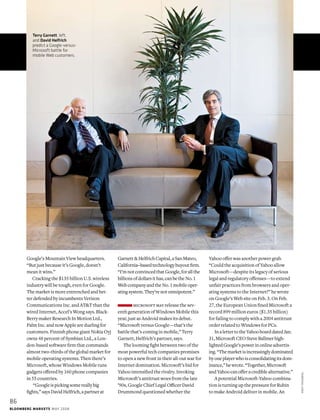
Terry Garnett, left,
and David Helfrich
predict a Google-versus-
Microsoft battle for
mobile Web customers.
86
Bloomberg Markets mAY 2008
andyfreeberg
Genergetic man who talks with the speed of
an auctioneer, Rubin falls back on geek-
speak when he describes his mission.
Leaning forward at a conference table in
Google’s mobile technology lab, he says
Android will use “end-to-end connectivi-
ty” to make phones “intelligent.” Trans­
lation: Android will let mobile users
constantly update their phones by down-
loading thousands of different programs,
from games to social networks to videos.
“It’s changing the consumers’ expecta-
tions,” Rubin says. “They go into a store
and buy a piece of physical hardware, and
it gets better over time.”
Rubin has been fixated on mobile tech-
nology for more than 15 years. He grew up
in Chappaqua, an upper-middle-class sub-
urb north of New York. After earning an
undergraduate degree in computer sci-
ence from Utica College in upstate New
York, he went to work in robotic engineer-
ing. Over the years, he’s tinkered with
dozens of robots, such as the XR4000, a
4-foot-high (1.2-meter-high) cylinder
on wheels that looks like an industrial-
strength vacuum cleaner. His current
project is a desk-sized helicopter rigged
with a global positioning system, which
he directs by clicking on a Google Maps
screen on his laptop. A digital camera
attached to the aircraft snaps panoramic
aerial photographs, occasionally buzzing
the Googleplex. “Robots are interesting
because they’re like infants,” he says.
“There’s a lot of trial and error.”
Rubindidhisfirstworkonoperatingsys-
temsformobiledevicesin1992atGeneral
MagicInc.Thecompany,apioneerintech-
nologyforpersonaldigitalassistants,had
beenspunoutofAppletwoyearsearlier.
AfterdetouringintoanInternettelevision
startupthatwasacquiredbyMicrosoftin
1997, Rubin was ready to start his own
firm. In 2000, he co-founded Danger Inc.,
which made the Hiptop, later dubbed the
Sidekick, one of the first portable phones
primed for the Web. Its pop-out screen
and full alphanumeric keypad became all
the rage among Hollywood celebrities. In
2005, the phone made headlines after a
report that socialite Paris Hilton’s Side-
kick was hacked and her contact list post-
ed on the Web.
by then, rubin had moved on. In
late 2004, he says he realized that at long
last the wireless industry had reached a
turning point. Handsets were becoming
full-blown computers. Unlike the PC mar-
ket, which was powered mainly by Micro-
soft’s Windows, mobile was a chaotic
bazaar of different operating systems.
Motorola, Nokia, Palm, Research In
Motion and later Apple all built their giz-
mos with proprietary operating systems.
Microsoft’s Windows Mobile, while mak-
ing inroads, didn’t match the clout of its
PC counterpart, which today controls 95
percent of the market. With no dominant
software maker in mobile, Rubin saw an
opportunity. He and three colleagues
co-founded Android Inc.
Asithappened,Brin,Page
andSchmidtwerealsocon-
vincedthetimewasrightto
jumpintomobile.Schmidt,
53,whoholdsaPh.D.in
computersciencefromthe
UniversityofCalifornia,
Berkeley,foundhetalked
thesametechnicallingoas
hisyoungercounterparts.
Aschieftechnologyofficer
atSunMicrosystemsInc.
from1994to’97,Schmidt
ledthedevelopmentof
Java,theprogramming
language that fueled the
growth of the Web by letting different
applications talk to one another.
In 2001, Page, then CEO, and Brin,
who was president, interviewed Schmidt
for the Google chief executive job. The
pair mused that Sun’s best days might be
past and the company wasn’t worth buy-
ing anymore, Page said in a lecture to
Stanford students in 2002. Schmidt coun-
tered with Sun’s merits. Page, who said he
and Brin like a spirited debate, were
impressed. “We had a good argument,
and he really enjoyed it,” Page said in his
lecture. “As a result, he came to work for
us.” Brin and Page declined to comment
for this story.
Officially, Page, who grew up in East
Lansing, Michigan, is now Google’s presi-
dent of products. Brin, a native of Mos-
cow, is president of technology. In prac-
tice, Google is led by three co-CEOs, with
Schmidt bridging the engineering and
sales realms, says Ken Anderson, director
of global information technology from
2003 to ’04.
As Google’s ruling trio sized up the
mobile world in ’05, they faced a sobering
reality: Americans didn’t surf the Web on
handheld devices. Only one in five had
even bothered to try, according to
Tough Terrain
Google faces a well-defended market for operating
systems that run Internet-ready smart phones.
*Nokia owns 48 percent of Symbian. Source: Strategy Analytics
Global smart phone operating
system market share
Symbian*:
Microsoft:
Research in Motion:
Apple:
Palm:
Others:
59%
9
9
3
2
18
‘Google is picking some really big fights,’says David Helfrich,
					 a partner at Silicon Valley technology
		 buyout firm Garnett & Helfrich Capital.
87
mAY 2008 Bloomberg Markets
NForrester Research Inc. There were plenty
of reasons. Many phone companies
charged a premium for Internet access,
with the meter always running like a taxi-
cab’s. When consumers did pay, they
often embarked on a slow journey ham-
pered by no mouse and few programs
available for a small screen. Phone carri-
ers, which collect about 85 percent of
their revenue from voice and text messag-
ing, saw little need to throw open their
“walled gardens” to new Web-based
applications, says Jason Devitt, CEO of
Skydeck Inc., a San Mateo–based mobile
software startup. As the owners of the
networks, they had the power to decide
which applications could run on their
phones. “For 20 years, all the focus has
been on getting a dial tone,” Devitt says.
How would Google ever build a mass
audience on the mobile Web if few people
used it? Enter Android.
Rubin had first met Brin and Page at a
lecture he gave on mobile technology at
Stanford in 2002. In a series of sit-downs
with Page in early summer 2005, Rubin
described how his open operating system
would attract consumers by using the
Internet to provide scores of different
applications. That meshed with the trio’s
main concern, Rubin says. If the phone
companies weren’t going to create a bet-
ter mobile Web experience, then Google
would do it. “If Android existed, we
wouldn’t have to build it,” Schmidt says.
moreover, google’s brain trust
saw Android as a lever to shimmy open
the carriers’ networks. The triumvirate
didn’t like the idea that phone companies
could dictate terms to Google. “They were
frustratedbecausethecellphonespace
didn’tofferequalaccesstothem;therewas
thetraditionalwalledgarden,”Rubinsays.
Ifconsumersweretofallinlovewithan
Android-poweredGooglephonebecause
ofitsabilitytoconstantlybeupdatedwith
newfeatures,thecarrierswouldhavelittle
choicebuttomakethephoneavailable.
RubinsaysBrin,PageandSchmidtsaw
Androidasawaytoleveltheplayingfield.
WieldingAndroidwouldalsogive
Googleashotatcompetingwitharchrival
MicrosoftanditsWindowsMobile.The
Valleystillhasn’tgottenoverhowBill
GatesusedWindowsandhisInternet
ExplorerWebbrowsertocrushNetscape
CommunicationsCorp.inthemid’90s.
NetscapeNavigatorwasthebreakthrough
browserthathelpedturntheInternetinto
amassphenomenon.Afterbeingpur-
chasedbyAmericaOnlineInc.in1998,
Netscapefaded.TimeWarnerInc.’sAOL
stoppedsupportingNetscapeonMarch1;
Explorernowcontrolsmorethantwo-
thirdsofthebrowsermarket.
Google wasn’t about to let Microsoft
box it out of mobile. “Netscape lost the
browser wars because Microsoft owned
the operating system,” Rubin says. “Let’s
not repeat that in mobile phones.”
In July 2005, Google acquired Android
Inc. for an undisclosed amount. Rubin
and his eight-member team decamped
from their Palo Alto offices for the
Googleplex. They found an engineering
culture that had changed little since the
company’s early days. Brin and Page were
still preaching about how teams of fewer
than 10 engineers promote creativity.
In his 2002 Stanford lecture, Page said
Google would never let the sales or mar-
keting divisions drive development. “I
take it as my personal vendetta to stay
engineering focused,” he said.
BrinandPagestillfieldengineering
pitches,andtheyencourageworkersto
spend20percentoftheirweekonpersonal
projects.Anderson,theformerglobalIT
director,saystheapproachletsthebest
*As of March 7. **Average. Google, from Aug. 18, 2004, to Feb. 26; Microsoft, from March 14, 1986, to Feb. 22. Source: Company reports
Ten-year-old Google, buoyed by its stock price
and growing sales, is challenging Microsoft,
the technology giant founded in 1975.
Clashing Titans
61.8%
30.1%
$136
$259
ANNUAL RETURN**MARKET VALUE*SALES, 2007NET INCOME, 2007
IN BILLIONS
GOOGLE
MICROSOFT
$16.6
$51.1
$4.2
$14.1
‘Netscape lost the browser wars because Microsoft owned the
			 operating system,’says Andy Rubin,who is spearheading 		
	 Google’s wireless drive.‘Let’s not repeat that in mobile phones.’
88
Bloomberg Markets mAY 2008
ideasbubbletothesurface.“Whatworks
willstay;whatdoesn’twillfadeaway,”he
says.Google’se-mailapplication,Gmail,
anditsonlinepaymentsystem,Checkout,
weredevelopedinthisbottom-upfashion.
Google pampers its employees, even by
the perquisite-rich standards of the Val-
ley. Its lobby features a grand piano, neon-
coloredlavalampsandaprojectionofa
Googlepageshowinglivequeriesfrom
aroundtheworld.Themaincafeteria
offersfreedelicaciesfromsushiandIndian
curriestooystersandsteamingstacksof
kingcrablegs.Employeescangetfreemas-
sages,havetheoilintheircarschangedand
ziptomeetingsonstand-upmotorized
scooters.Sometoiletseatsareevenheated.
rubin’s plan for Android
meshed with Google’s culture of open-
ness. From the outset, he based Android
on Linux, freely available software code
that programmers embrace as an alterna-
tive to proprietary operating systems. By
using Linux, Rubin hopes independent
programmers, from seasoned software
pros to pizza-chomping college students,
will create hundreds of applications to
run on Android. That should make
Android-powered phones a hit with con-
sumers and advertisers. Still, Linux, orig-
inally created to run servers and PCs, was
neverintendedfordevicesassmallas
mobilephones.There’snostandardver-
sionthattelephonecompaniesandmanu-
facturerscanrelyonforconsistentperfor-
mance.Instead,dozensofflavorsclutter
SiliconValley’ssoftwaredevelopment
community.Formanycodewriters,it’s
easiertocreateforastandardizedoperat-
ingsystemsuchasWindowsMobile.
“The Linux community has never
been able to consolidate behind one or
two commercial versions,” says Chris
Ambrosio, a wireless industry analyst at
Strategy Analytics Inc., a Newton Centre,
Massachusetts–based research firm.
“That’s a problem that Google is going
to have to solve.”
AsRubinwasworkingonAndroid,
Googlewaspushingaheadonanothercell
phone–relatedfront—creatingmobilever-
sionsofitsapplications.Asithadwith
Android,itturnedtooutsiders.In2004,
GoogleacquiredaValleystartupcalled
ZipdashInc.foranundisclosedsum,gain-
ingsoftwarethatshowedreal-timetraffic
congestiononmobiledevices.Twocom-
panyco-founders,MichaelChuandMark
Crady,werechildhoodfriendswho’dstud-
iedelectricalengineeringandcomputer
scienceatBerkeley.AtGoogle,they,like
Rubin,embracedaculturethatwasmore
akintoanacademicresearchlabthana
for-profitcompany.Noseniormanagers
breatheddowntheirneckswithdeadlines.
Theywereleftalonetopursuewhatever
projecttheyliked.“Googlehiresreally
smartpeople,andwedon’tworrysomuch
aboutexactlywhattheydo,”Schmidtsays.
“Wefigurethey’llself-assemble.”
Chu and Crady, both 34, talked about
using signals bouncing off cell phone tow-
ers to locate mobile users and proposed
linking their technology to Google Maps.
Before long, colleagues from advertising
and internal computer systems joined the
group. “There’s peer pressure to do cool
stuff,” Chu says. “If engineers didn’t like
the project or the people running it, they
would go elsewhere.”
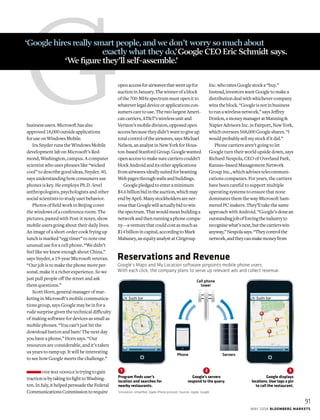
ThepairunveiledMyLocationin
November.Withit,acellphoneusercan
type:“Whereistheclosestsushirestau-
rant?”TheMapsscreenshowsnearbyeat-
eries,andausercanclickononetocallit.
MyLocationisavailablenowoniPhone
andotherhandsetsandwillbeshowcased
onAndroid.
AsGoogle’steamsprepareforAndroid’s
rollout,rivalsaregoingintoattackmode.
Microsoftisworkingonimprovementsto
WindowsMobile.Inclassicfashion,the
companyisusingthemobileoperatingsys-
temtodeployversionsofitsfamiliarExcel,
OutlookandWordprograms,targeting
Mark Crady, left,
and Michael Chu
created My
Location.
90
Bloomberg Markets mAY 2008
markhamjohnson
Gbusinessusers.Microsofthasalso
approved18,000outsideapplications
foruseonWindowsMobile.
Ira Snyder runs the Windows Mobile
development lab on Microsoft’s Red-
mond, Washington, campus. A computer
scientist who uses phrases like “wicked
cool” to describe good ideas, Snyder, 40,
says understanding how consumers use
phones is key. He employs Ph.D.-level
anthropologists, psychologists and other
social scientists to study user behavior.
Photos of field work in Beijing cover
the windows of a conference room. The
pictures, pasted with Post-it notes, show
mobile users going about their daily lives.
An image of a short-order cook frying up
lunch is marked “egg timer” to note one
unusual use for a cell phone. “We didn’t
feel like we knew enough about China,”
says Snyder, a 19-year Microsoft veteran.
“Our job is to make the phone more per-
sonal, make it a richer experience. So we
just pull people off the street and ask
them questions.”
Scott Horn, general manager of mar-
keting in Microsoft’s mobile communica-
tions group, says Google may be in for a
rude surprise given the technical difficulty
of making software for devices as small as
mobile phones. “You can’t just hit the
download button and bam! The next day
you have a phone,” Horn says. “Our
resources are considerable, and it’s taken
us years to ramp up. It will be interesting
to see how Google meets the challenge.”
onewaygoogleistryingtogain
tractionisbytakingitsfighttoWashing-
ton.InJuly,ithelpedpersuadetheFederal
CommunicationsCommissiontorequire
openaccessforairwavesthatwentupfor
auctioninJanuary.Thewinnerofablock
ofthe700-MHzspectrummustopenitto
whateverlegaldeviceorapplicationscon-
sumerscaretouse.ThetwolargestAmeri-
cancarriers,AT&T’swirelessunitand
Verizon’smobiledivision,opposedopen
accessbecausetheydidn’twanttogiveup
totalcontroloftheairwaves,saysMichael
Nelson,ananalystinNewYorkforHous-
ton-basedStanfordGroup.Googlewanted
openaccesstomakesurecarrierscouldn’t
blockAndroidanditsotherapplications
fromairwavesideallysuitedforbeaming
Webpagesthroughwallsandbuildings.
Googlepledgedtoenteraminimum
$4.6billionbidintheauction,whichmay
endbyApril.Manystockholdersarener-
vousthatGooglewillactuallybidtowin
thespectrum.Thatwouldmeanbuildinga
networkandthenrunningaphonecompa-
ny—aventurethatcouldcostasmuchas
$14billionincapital,accordingtoMark
Mahaney,anequityanalystatCitigroup
Inc.whoratesGooglestocka“buy.”
Instead,investorswantGoogletomakea
distributiondealwithwhichevercompany
winstheblock.“Googleisnotinbusiness
torunawirelessnetwork,”saysJeffrey
Donlon,amoneymanageratManning&
NapierAdvisorsInc.inFairport,NewYork,
whichoversees568,000Googleshares.“I
wouldprobablysellmystockifitdid.”
Phone carriers aren’t going to let
Google turn their world upside down, says
Richard Nespola, CEO of Overland Park,
Kansas–based Management Network
Group Inc., which advises telecommuni-
cations companies. For years, the carriers
have been careful to support multiple
operating systems to ensure that none
dominates them the way Microsoft ham-
mered PC makers. They’ll take the same
approach with Android. “Google’s donean
outstandingjobofforcingtheindustryto
recognizewhat’snext,butthecarrierswin
anyway,”Nespolasays.“Theycontrolthe
network,andtheycanmakemoneyfrom
‘Google hires really smart people,and we don’t worry so much about 		
			 exactly what they do,’Google CEO Eric Schmidt says.
		 ‘We figure they’ll self-assemble.’
Google displays
locations. User taps a pin
to call the restaurant.
Google’s Maps and My Location software pinpoints mobile phone users.
With each click, the company plans to serve up relevant ads and collect revenue.
Reservations and Revenue
Google’s servers
respond to the query.
1 2 3
Program finds user’s
location and searches for
nearby restaurants.
Simulation; simplified. Apple iPhone pictured. Sources: Apple, Google
Cell phone
tower
Phone Servers
91
mAY 2008 Bloomberg Markets
Googleopeningthenetwork—they’recry-
ingallthewaytothebank.”
de la vega at AT&T’s wireless
division says if consumers start demand-
ing the Google phone once it’s available,
that would just swell the number of
AT&T customers and the products avail-
able to them. “Android could be one of
those choices,” he says.
Googledoesn’twanttosimplyelbowits
wayinasoneoptioninacrowdedmarket-
place.Confidentintheirabilitytoout-engi-
neeranyone,Brin,Page,RubinandSchmidt
havesetouttochangethewirelessindustry
soitrevolvesaroundGoogle.“Wewantedto
createsomethingfromacleanslate,amod-
ernpieceofcomputerscience,”Rubinsays.
“WindowsandSymbianandsomeofthe
otherincumbentsare20yearsold.Comput-
ersciencehaschangedalot.”
Upending a market as competitive as
mobile telecom is shaping up unlike any
challenge in Google’s 10-year history.
First, Rubin and his team will have to push
beyond search into an area where
entrenched phone companies are stand-
ing guard. Then they must persuade cus-
tomers that Google-powered cell phones
are cool alternatives to models already
out there. Finally, they’ll need to shake off
a Microsoft potentially strengthened by
Yahoo and a six-year mobile head start.
For all the ambition and ingenuity that
Rubin and the rest of the company pos-
sess, this hard-charging giant may find
that the mobile Internet is one arena
where google may become synonymous
with overreaching. ≤
Edward Robinson is a senior writer at Bloom-
berg News in San Francisco. edrobinson@
bloomberg.net Ari Levy covers technology in
San Francisco. alevy5@bloomberg.net
With Google shares down 42 percent from their 2007 high,
the Internet search company’s valuation measures have come
closer to those of its peers. You can use the Peer Valuation
History (PVH) function to compare metrics, such as price-
earnings ratio, for the company with those of its peers. Type
GOOG US <Equity> PVH <Go> and click on the
Comparative View Tab at the bottom of the screen.
To compare Google’s P/E with that of Yahoo, first
click on the Peer Defaults button on the red tool bar.
Click on the circle to the left ofBloomberg Peers Based
on Analyst Coverage to display a list of companies
that are covered by the same analysts and click on the
Update button. Click on the arrow to the right of Ana-
lyze and select Price/Earnings. Next, click on YHOO US
under the Ticker heading to graph that company’s
P/E, as shown at right. After Microsoft unveiled its
$44.6 billion offer for Yahoo, the search company
traded at a higher P/E than Google.
Todisplayanalysts’pricetargetsforGoogle,type
ANRfortheAnalystRecommendationsfunction.Asof
Feb.8,theconsensustargetwas$691,60percentmore
thanthecompany’ssharepriceof$433.35onMarch7.
To display a list of headlines of news stories on Google’s
Android mobile phone operating system, typeSTNI GPHONE
<Go>. For headlines of news stories on Google’s share of the
Internet search market, type STNI GOOGLEMARKET <Go>.
JON ASMUNDSSON
SearchingforMoreAboutGoogle
Microsoft’s
Ira Snyder runs the
Windows Mobile lab.
92
Bloomberg Markets mAY 2008
rickdahms

google goes mobile

  • 1.
    The Web searchgiant, rocked by slowing ad growth and a plunge in its shares this year, is crafting a cell phone operating system to thwart Microsoft and put its name on millions of mobile screens. By EDWARD ROBINSON and ARI LEVY Wireless Gamble ’s Photograph by Ian White Google 82
  • 2.
    On a chillyfebruary morning, AndyRubinhustlespastequation-filled whiteboardsinatwo-storybuildingon GoogleInc.’sSiliconValleycampus.Rubin,a computerscientistwhobuildsrobotsforfun, hasspentthreeyearsinthistop-secretsanc- tumoftheGoogleplex.He’sputtingthefinal touchesononeofthemostambitious—and potentiallyhumbling—projectstheInternet juggernauthaseverundertaken:anoperating systemforcellularphonesthat’sdesignedto giveGooglethesamegriponthemobileWeb thatitcommandsinonlinesearchesonper- sonalcomputers. “We’vegottentothepointwhereanyone canbuildacellphone,”saysRubin,44,dressed Andy Rubin is creating Google-powered mobile phones. 83 mAY 2008 Bloomberg Markets
  • 3.
    U could likelybecome just one of the many offerings in AT&T stores. Ultimately,BrinandPagehaven’t provedtheycandoanythingelseaswellas theydosearch,saysLauraMartin,anequi- tyanalystatNewYork–basedSoleilSecuri- tiesCorp.whoratesGooglestocka“hold” becauseshe’swaryaboutwhetherthe companycankeepgrowingasithas.InJan- uary,Brinsaidonanearningscallwithana- lyststhatGooglehadyettomakeheadway insellingadsonMySpaceandothersocial networkingsites.Ininstantmessaging, Microsoft’sWindowsLiveMessenger enjoyed235millionuniquevisitorsinJan- uary,accordingtoComScore.TheGoogle Talkmessagingserviceisapproaching 5millionusers.“Despite relentless prod- uct introductions, the only one that’s been a proven economic success is search,” Martin says. “Until Google can show that it’s not a single-product compa- ny, there’s no guarantee that it can sustain its growth rate.” winning on the mobile Web, one of the biggest and potentially most lucra- tive Internet markets, would take Google far in erasing such doubts. There are more than 3.3 billion cell phones world- wide, about one for every two people on the planet. By 2010, that’s expected to jump to 4 billion, or triple the number of personal computers, according to research firm Gartner Inc. Brin and Page want the first page callers see on these phones to be Google’s. From there, users would tap Google software to surf for information, e-mail friends, watch vid- eos and find the nearest deli, just like they do on PCs. “Itshouldbepossiblethattheprimary Mobile Internet is forecast to draw an increasing portion of online ad dollars. Growing Share Source: eMarketer U.S. online ad spending, in billions Total Mobile $4.8 ’11 $42.0 $1.6 ’08 $27.5 $0.4 ’06 $16.9 in blue jeans and a red crewneck T-shirt as he explains why Google is piling into wireless, the Internet’s new frontier. “What’s important now is software, having the next cool application.” After luring an audience that tops 588 million people who search in more than 200 languages and winning 72 percent of the $22.5 billion in annual advertising linked to Web queries, Google founders Sergey Brin and Larry Page are hunting beyond the PC for growth. Fewer googlers are clicking on the text ads that run along- side Google’s search results, threatening the area that generated most of the com- pany’s $16.6 billion in 2007 sales. In Janu- ary, such clicks fell 7.5 percent from December, Internet research firm Com- Score Inc. reported. ComScore said this didn’t necessarily mean Google would record less revenue in the first quarter. Still, coming after the fourth quarter, when earnings of $3.79 a share fell short of the $3.91 average analyst estimate, investors feared the weakening economy was taking a toll. Google shares, among the hottest on the planet as they soared eightfold after the company’s Aug. 18, 2004, initial public offering to a high of $741.79 on Nov. 6, 2007, have tumbled this year. On March 7, they traded at $433.35, a drop of 37 percent in 2008 and a 42 percent plunge from their record close. The looming presence of Microsoft Corp. is amplifying investors’ anxiety. In February, the world’s biggest software company made a $44.6 billion unsolicited bid for Yahoo! Inc., which is No. 2 behind Google in Web searches. Yahoo rebuffed the offer on Feb. 11, saying that it under- valued the company. Since then, Yahoo has deliberated about how to counter the proposal, leaving Google shareholders on edge. “The slow click-through rates are a concern,’’ says Donald Bessler, chief investment officer of Winward Capital Management, a Los Angeles investment firm that holds 535 Google shares. “Throw in the possible Microsoft-Yahoo merger and you have a lot of people get- ting out of the stock.’’ Turning to telecom won’t make Google’s life any easier. Microsoft already enjoys 21 percent of the U.S. market for mobile operating systems. Winning Yahoo would give the software giant the most popular site on the mobile Internet, with 28 million combined subscribers, according to M:Metrics Inc., a Seattle- based research firm. That compares with Google’s 14.5 million. Meanwhile, the phone companies that control the wire- less networks aren’t likely to bow to Google at the expense of Apple Inc.’s iPhone and other hot products. Ralph de la Vega, CEO of AT&T Inc.’s wireless divi- sion says a so-called “Google phone” ‘Until Google can show that it’s not a single-product company, there’s no guarantee that it can sustain its growth rate,’says Laura Martin,an analyst at Soleil Securities who rates Google stock a‘hold.’ 84 Bloomberg Markets mAY 2008
  • 4.
    placeyousearchwouldbeamobile device,”GoogleChiefExecutiveOfficer EricSchmidtsays.Hepredictscruisingthe Webonhandheldgadgetsmayeventually rivalthewiredsearchmarket,meaning mobilemightsomedayaccountforroughly halfofGoogle’srevenue. Schmidt’spredictionputsthespotlight onRubinandhisteamofengineers—and theiroperatingsystemcalledAndroid, whichissettohitthemarketthissummer. UnlikeMicrosoft,whichlicensesWindows Mobiletohandsetmanufacturers,Google planstogiveAndroidtoscoresofcell phonemakersandserviceproviders.Ithas formedtheOpenHandsetAlliancewith morethan30phonemanufacturers,carri- ersandchipmakerstosupportAndroid. AmongthemareMotorolaInc.and JapanesecarrierNTTDoCoMoInc.To pavetheway,Googlehasalreadyreleased mobileversionsofitssearchandother softwarethatcanrunontheiPhone,for one.GoogleisbettingthatAndroidandits made-for-mobile-phoneprogramswill attractmillionsofcustomerswhocanbe pliedwithads—justlikeGoogledoeson PCs.MobileonlineadvertisingintheU.S. isforecasttojumpto$4.8billionby2011 from$1.6billionthisyear,accordingto researchfirmEMarketerInc. “The cell phoneis where it’s all mov- ing, and Google has to get into that,” says Rich Redelfs, a venture capitalist at Foun- dation Capital in Menlo Park, California, who invests in wireless technology com- panies. “The operating system has incred- ible power, as we’ve seen with Microsoft. So Google wants to create an operating systemthatcangoacrosshandsetsand givethemastronghold.” If any other newcomer set out to shake up the mobile world as Google is doing, telecom veterans would dismiss it out of hand, says Richard Wong, a venture capi- talist at Accel Partners in Palo Alto. google isn’t any company. It’s a force so synonymous with the Internet that the Oxford English Dictionary recog- nizes google as a verb. A decade after its founding, Google, with its market value of $136 billion, is the Valley’s byword for wealth and buzz. Brin, 34, and Page, 35, who were Stanford University Ph.D. com- puter science students when they devised a formula to rank and display Web search- es by their relevance, are each worth more than $13 billion and wing around the globe in a Boeing 767. Former U.S. Vice President Al Gore, who won the Nobel Peace Prize last year for his crusade against global warming, advises Google’s board. Internet pioneer Vinton Cerf, attracted by Google’s reputation for inno- vation, holds the title chief Internet evan- gelist. Democratic presidential candidate Barack Obama spoke to a packed house at Google headquarters in November. On March 11, Google bolstered its abil- ity to deliver online ads with video and images by winning approval from Europe- an Union antitrust officials for its $3.1 bil- lion purchase of DoubleClick Inc. The U.S. Federal Trade Commission cleared the deal in December. “Google sneezes, and everyone goes bananas,” says David Weiden, a venture capitalist at Khosla Ventures in Menlo Park, California, just up the road from CEO Eric Schmidt says Web searching is going mobile. 85 ananance/redux mAY 2008 Bloomberg Markets
  • 5.
    Google’s Mountain Viewheadquarters. “But just because it’s Google, doesn’t mean it wins.” Cracking the $135 billion U.S. wireless industry will be tough, even for Google. The market is more entrenched and bet- ter defended by incumbents Verizon Communications Inc. and AT&T than the wired Internet, Accel’s Wong says. Black- Berry maker Research In Motion Ltd., Palm Inc. and now Apple are dueling for customers. Finnish phone giant Nokia Oyj owns 48 percent of Symbian Ltd., a Lon- don-based software firm that commands almost two-thirds of the global market for mobile operating systems. Then there’s Microsoft, whose Windows Mobile runs gadgets offered by 160 phone companies in 55 countries. “Googleispickingsomereallybig fights,”saysDavidHelfrich,apartnerat Garnett&HelfrichCapital,aSanMateo, California–basedtechnologybuyoutfirm. “I’mnotconvincedthatGoogle,forallthe billionsofdollarsithas,canbetheNo.1 WebcompanyandtheNo.1mobileoper- atingsystem.They’renotomnipotent.” microsoft may release the sev- enth generation of Windows Mobile this year, just as Android makes its debut. “Microsoft versus Google—that’s the battle that’s coming in mobile,” Terry Garnett, Helfrich’s partner, says. The looming fight between two of the most powerful tech companies promises to open a new front in their all-out war for Internet domination. Microsoft’s bid for Yahoo intensified the rivalry. Invoking Microsoft’s antitrust woes from the late ’90s, Google Chief Legal Officer David Drummond questioned whether the Yahoo offer was another power grab. “Could the acquisition of Yahoo allow Microsoft—despite its legacy of serious legal and regulatory offenses—to extend unfair practices from browsers and oper- ating systems to the Internet?” he wrote on Google’s Web site on Feb. 3. On Feb. 27, the European Union fined Microsoft a record 899 million euros ($1.35 billion) for failing to comply with a 2004 antitrust order related to Windows for PCs. InalettertotheYahooboarddatedJan. 31,MicrosoftCEOSteveBallmerhigh- lightedGoogle’spowerinonlineadvertis- ing.“Themarketisincreasinglydominated byoneplayerwhoisconsolidatingitsdom- inance,”hewrote.“Together,Microsoft andYahoocanofferacrediblealternative.” A potential Microsoft-Yahoo combina- tion is turning up the pressure for Rubin to make Android deliver in mobile. An Terry Garnett, left, and David Helfrich predict a Google-versus- Microsoft battle for mobile Web customers. 86 Bloomberg Markets mAY 2008 andyfreeberg
  • 6.
    Genergetic man whotalks with the speed of an auctioneer, Rubin falls back on geek- speak when he describes his mission. Leaning forward at a conference table in Google’s mobile technology lab, he says Android will use “end-to-end connectivi- ty” to make phones “intelligent.” Trans­ lation: Android will let mobile users constantly update their phones by down- loading thousands of different programs, from games to social networks to videos. “It’s changing the consumers’ expecta- tions,” Rubin says. “They go into a store and buy a piece of physical hardware, and it gets better over time.” Rubin has been fixated on mobile tech- nology for more than 15 years. He grew up in Chappaqua, an upper-middle-class sub- urb north of New York. After earning an undergraduate degree in computer sci- ence from Utica College in upstate New York, he went to work in robotic engineer- ing. Over the years, he’s tinkered with dozens of robots, such as the XR4000, a 4-foot-high (1.2-meter-high) cylinder on wheels that looks like an industrial- strength vacuum cleaner. His current project is a desk-sized helicopter rigged with a global positioning system, which he directs by clicking on a Google Maps screen on his laptop. A digital camera attached to the aircraft snaps panoramic aerial photographs, occasionally buzzing the Googleplex. “Robots are interesting because they’re like infants,” he says. “There’s a lot of trial and error.” Rubindidhisfirstworkonoperatingsys- temsformobiledevicesin1992atGeneral MagicInc.Thecompany,apioneerintech- nologyforpersonaldigitalassistants,had beenspunoutofAppletwoyearsearlier. AfterdetouringintoanInternettelevision startupthatwasacquiredbyMicrosoftin 1997, Rubin was ready to start his own firm. In 2000, he co-founded Danger Inc., which made the Hiptop, later dubbed the Sidekick, one of the first portable phones primed for the Web. Its pop-out screen and full alphanumeric keypad became all the rage among Hollywood celebrities. In 2005, the phone made headlines after a report that socialite Paris Hilton’s Side- kick was hacked and her contact list post- ed on the Web. by then, rubin had moved on. In late 2004, he says he realized that at long last the wireless industry had reached a turning point. Handsets were becoming full-blown computers. Unlike the PC mar- ket, which was powered mainly by Micro- soft’s Windows, mobile was a chaotic bazaar of different operating systems. Motorola, Nokia, Palm, Research In Motion and later Apple all built their giz- mos with proprietary operating systems. Microsoft’s Windows Mobile, while mak- ing inroads, didn’t match the clout of its PC counterpart, which today controls 95 percent of the market. With no dominant software maker in mobile, Rubin saw an opportunity. He and three colleagues co-founded Android Inc. Asithappened,Brin,Page andSchmidtwerealsocon- vincedthetimewasrightto jumpintomobile.Schmidt, 53,whoholdsaPh.D.in computersciencefromthe UniversityofCalifornia, Berkeley,foundhetalked thesametechnicallingoas hisyoungercounterparts. Aschieftechnologyofficer atSunMicrosystemsInc. from1994to’97,Schmidt ledthedevelopmentof Java,theprogramming language that fueled the growth of the Web by letting different applications talk to one another. In 2001, Page, then CEO, and Brin, who was president, interviewed Schmidt for the Google chief executive job. The pair mused that Sun’s best days might be past and the company wasn’t worth buy- ing anymore, Page said in a lecture to Stanford students in 2002. Schmidt coun- tered with Sun’s merits. Page, who said he and Brin like a spirited debate, were impressed. “We had a good argument, and he really enjoyed it,” Page said in his lecture. “As a result, he came to work for us.” Brin and Page declined to comment for this story. Officially, Page, who grew up in East Lansing, Michigan, is now Google’s presi- dent of products. Brin, a native of Mos- cow, is president of technology. In prac- tice, Google is led by three co-CEOs, with Schmidt bridging the engineering and sales realms, says Ken Anderson, director of global information technology from 2003 to ’04. As Google’s ruling trio sized up the mobile world in ’05, they faced a sobering reality: Americans didn’t surf the Web on handheld devices. Only one in five had even bothered to try, according to Tough Terrain Google faces a well-defended market for operating systems that run Internet-ready smart phones. *Nokia owns 48 percent of Symbian. Source: Strategy Analytics Global smart phone operating system market share Symbian*: Microsoft: Research in Motion: Apple: Palm: Others: 59% 9 9 3 2 18 ‘Google is picking some really big fights,’says David Helfrich, a partner at Silicon Valley technology buyout firm Garnett & Helfrich Capital. 87 mAY 2008 Bloomberg Markets
  • 7.
    NForrester Research Inc.There were plenty of reasons. Many phone companies charged a premium for Internet access, with the meter always running like a taxi- cab’s. When consumers did pay, they often embarked on a slow journey ham- pered by no mouse and few programs available for a small screen. Phone carri- ers, which collect about 85 percent of their revenue from voice and text messag- ing, saw little need to throw open their “walled gardens” to new Web-based applications, says Jason Devitt, CEO of Skydeck Inc., a San Mateo–based mobile software startup. As the owners of the networks, they had the power to decide which applications could run on their phones. “For 20 years, all the focus has been on getting a dial tone,” Devitt says. How would Google ever build a mass audience on the mobile Web if few people used it? Enter Android. Rubin had first met Brin and Page at a lecture he gave on mobile technology at Stanford in 2002. In a series of sit-downs with Page in early summer 2005, Rubin described how his open operating system would attract consumers by using the Internet to provide scores of different applications. That meshed with the trio’s main concern, Rubin says. If the phone companies weren’t going to create a bet- ter mobile Web experience, then Google would do it. “If Android existed, we wouldn’t have to build it,” Schmidt says. moreover, google’s brain trust saw Android as a lever to shimmy open the carriers’ networks. The triumvirate didn’t like the idea that phone companies could dictate terms to Google. “They were frustratedbecausethecellphonespace didn’tofferequalaccesstothem;therewas thetraditionalwalledgarden,”Rubinsays. Ifconsumersweretofallinlovewithan Android-poweredGooglephonebecause ofitsabilitytoconstantlybeupdatedwith newfeatures,thecarrierswouldhavelittle choicebuttomakethephoneavailable. RubinsaysBrin,PageandSchmidtsaw Androidasawaytoleveltheplayingfield. WieldingAndroidwouldalsogive Googleashotatcompetingwitharchrival MicrosoftanditsWindowsMobile.The Valleystillhasn’tgottenoverhowBill GatesusedWindowsandhisInternet ExplorerWebbrowsertocrushNetscape CommunicationsCorp.inthemid’90s. NetscapeNavigatorwasthebreakthrough browserthathelpedturntheInternetinto amassphenomenon.Afterbeingpur- chasedbyAmericaOnlineInc.in1998, Netscapefaded.TimeWarnerInc.’sAOL stoppedsupportingNetscapeonMarch1; Explorernowcontrolsmorethantwo- thirdsofthebrowsermarket. Google wasn’t about to let Microsoft box it out of mobile. “Netscape lost the browser wars because Microsoft owned the operating system,” Rubin says. “Let’s not repeat that in mobile phones.” In July 2005, Google acquired Android Inc. for an undisclosed amount. Rubin and his eight-member team decamped from their Palo Alto offices for the Googleplex. They found an engineering culture that had changed little since the company’s early days. Brin and Page were still preaching about how teams of fewer than 10 engineers promote creativity. In his 2002 Stanford lecture, Page said Google would never let the sales or mar- keting divisions drive development. “I take it as my personal vendetta to stay engineering focused,” he said. BrinandPagestillfieldengineering pitches,andtheyencourageworkersto spend20percentoftheirweekonpersonal projects.Anderson,theformerglobalIT director,saystheapproachletsthebest *As of March 7. **Average. Google, from Aug. 18, 2004, to Feb. 26; Microsoft, from March 14, 1986, to Feb. 22. Source: Company reports Ten-year-old Google, buoyed by its stock price and growing sales, is challenging Microsoft, the technology giant founded in 1975. Clashing Titans 61.8% 30.1% $136 $259 ANNUAL RETURN**MARKET VALUE*SALES, 2007NET INCOME, 2007 IN BILLIONS GOOGLE MICROSOFT $16.6 $51.1 $4.2 $14.1 ‘Netscape lost the browser wars because Microsoft owned the operating system,’says Andy Rubin,who is spearheading Google’s wireless drive.‘Let’s not repeat that in mobile phones.’ 88 Bloomberg Markets mAY 2008
  • 8.
    ideasbubbletothesurface.“Whatworks willstay;whatdoesn’twillfadeaway,”he says.Google’se-mailapplication,Gmail, anditsonlinepaymentsystem,Checkout, weredevelopedinthisbottom-upfashion. Google pampers itsemployees, even by the perquisite-rich standards of the Val- ley. Its lobby features a grand piano, neon- coloredlavalampsandaprojectionofa Googlepageshowinglivequeriesfrom aroundtheworld.Themaincafeteria offersfreedelicaciesfromsushiandIndian curriestooystersandsteamingstacksof kingcrablegs.Employeescangetfreemas- sages,havetheoilintheircarschangedand ziptomeetingsonstand-upmotorized scooters.Sometoiletseatsareevenheated. rubin’s plan for Android meshed with Google’s culture of open- ness. From the outset, he based Android on Linux, freely available software code that programmers embrace as an alterna- tive to proprietary operating systems. By using Linux, Rubin hopes independent programmers, from seasoned software pros to pizza-chomping college students, will create hundreds of applications to run on Android. That should make Android-powered phones a hit with con- sumers and advertisers. Still, Linux, orig- inally created to run servers and PCs, was neverintendedfordevicesassmallas mobilephones.There’snostandardver- sionthattelephonecompaniesandmanu- facturerscanrelyonforconsistentperfor- mance.Instead,dozensofflavorsclutter SiliconValley’ssoftwaredevelopment community.Formanycodewriters,it’s easiertocreateforastandardizedoperat- ingsystemsuchasWindowsMobile. “The Linux community has never been able to consolidate behind one or two commercial versions,” says Chris Ambrosio, a wireless industry analyst at Strategy Analytics Inc., a Newton Centre, Massachusetts–based research firm. “That’s a problem that Google is going to have to solve.” AsRubinwasworkingonAndroid, Googlewaspushingaheadonanothercell phone–relatedfront—creatingmobilever- sionsofitsapplications.Asithadwith Android,itturnedtooutsiders.In2004, GoogleacquiredaValleystartupcalled ZipdashInc.foranundisclosedsum,gain- ingsoftwarethatshowedreal-timetraffic congestiononmobiledevices.Twocom- panyco-founders,MichaelChuandMark Crady,werechildhoodfriendswho’dstud- iedelectricalengineeringandcomputer scienceatBerkeley.AtGoogle,they,like Rubin,embracedaculturethatwasmore akintoanacademicresearchlabthana for-profitcompany.Noseniormanagers breatheddowntheirneckswithdeadlines. Theywereleftalonetopursuewhatever projecttheyliked.“Googlehiresreally smartpeople,andwedon’tworrysomuch aboutexactlywhattheydo,”Schmidtsays. “Wefigurethey’llself-assemble.” Chu and Crady, both 34, talked about using signals bouncing off cell phone tow- ers to locate mobile users and proposed linking their technology to Google Maps. Before long, colleagues from advertising and internal computer systems joined the group. “There’s peer pressure to do cool stuff,” Chu says. “If engineers didn’t like the project or the people running it, they would go elsewhere.” ThepairunveiledMyLocationin November.Withit,acellphoneusercan type:“Whereistheclosestsushirestau- rant?”TheMapsscreenshowsnearbyeat- eries,andausercanclickononetocallit. MyLocationisavailablenowoniPhone andotherhandsetsandwillbeshowcased onAndroid. AsGoogle’steamsprepareforAndroid’s rollout,rivalsaregoingintoattackmode. Microsoftisworkingonimprovementsto WindowsMobile.Inclassicfashion,the companyisusingthemobileoperatingsys- temtodeployversionsofitsfamiliarExcel, OutlookandWordprograms,targeting Mark Crady, left, and Michael Chu created My Location. 90 Bloomberg Markets mAY 2008 markhamjohnson
  • 9.
    Gbusinessusers.Microsofthasalso approved18,000outsideapplications foruseonWindowsMobile. Ira Snyder runsthe Windows Mobile development lab on Microsoft’s Red- mond, Washington, campus. A computer scientist who uses phrases like “wicked cool” to describe good ideas, Snyder, 40, says understanding how consumers use phones is key. He employs Ph.D.-level anthropologists, psychologists and other social scientists to study user behavior. Photos of field work in Beijing cover the windows of a conference room. The pictures, pasted with Post-it notes, show mobile users going about their daily lives. An image of a short-order cook frying up lunch is marked “egg timer” to note one unusual use for a cell phone. “We didn’t feel like we knew enough about China,” says Snyder, a 19-year Microsoft veteran. “Our job is to make the phone more per- sonal, make it a richer experience. So we just pull people off the street and ask them questions.” Scott Horn, general manager of mar- keting in Microsoft’s mobile communica- tions group, says Google may be in for a rude surprise given the technical difficulty of making software for devices as small as mobile phones. “You can’t just hit the download button and bam! The next day you have a phone,” Horn says. “Our resources are considerable, and it’s taken us years to ramp up. It will be interesting to see how Google meets the challenge.” onewaygoogleistryingtogain tractionisbytakingitsfighttoWashing- ton.InJuly,ithelpedpersuadetheFederal CommunicationsCommissiontorequire openaccessforairwavesthatwentupfor auctioninJanuary.Thewinnerofablock ofthe700-MHzspectrummustopenitto whateverlegaldeviceorapplicationscon- sumerscaretouse.ThetwolargestAmeri- cancarriers,AT&T’swirelessunitand Verizon’smobiledivision,opposedopen accessbecausetheydidn’twanttogiveup totalcontroloftheairwaves,saysMichael Nelson,ananalystinNewYorkforHous- ton-basedStanfordGroup.Googlewanted openaccesstomakesurecarrierscouldn’t blockAndroidanditsotherapplications fromairwavesideallysuitedforbeaming Webpagesthroughwallsandbuildings. Googlepledgedtoenteraminimum $4.6billionbidintheauction,whichmay endbyApril.Manystockholdersarener- vousthatGooglewillactuallybidtowin thespectrum.Thatwouldmeanbuildinga networkandthenrunningaphonecompa- ny—aventurethatcouldcostasmuchas $14billionincapital,accordingtoMark Mahaney,anequityanalystatCitigroup Inc.whoratesGooglestocka“buy.” Instead,investorswantGoogletomakea distributiondealwithwhichevercompany winstheblock.“Googleisnotinbusiness torunawirelessnetwork,”saysJeffrey Donlon,amoneymanageratManning& NapierAdvisorsInc.inFairport,NewYork, whichoversees568,000Googleshares.“I wouldprobablysellmystockifitdid.” Phone carriers aren’t going to let Google turn their world upside down, says Richard Nespola, CEO of Overland Park, Kansas–based Management Network Group Inc., which advises telecommuni- cations companies. For years, the carriers have been careful to support multiple operating systems to ensure that none dominates them the way Microsoft ham- mered PC makers. They’ll take the same approach with Android. “Google’s donean outstandingjobofforcingtheindustryto recognizewhat’snext,butthecarrierswin anyway,”Nespolasays.“Theycontrolthe network,andtheycanmakemoneyfrom ‘Google hires really smart people,and we don’t worry so much about exactly what they do,’Google CEO Eric Schmidt says. ‘We figure they’ll self-assemble.’ Google displays locations. User taps a pin to call the restaurant. Google’s Maps and My Location software pinpoints mobile phone users. With each click, the company plans to serve up relevant ads and collect revenue. Reservations and Revenue Google’s servers respond to the query. 1 2 3 Program finds user’s location and searches for nearby restaurants. Simulation; simplified. Apple iPhone pictured. Sources: Apple, Google Cell phone tower Phone Servers 91 mAY 2008 Bloomberg Markets
  • 10.
    Googleopeningthenetwork—they’recry- ingallthewaytothebank.” de la vegaat AT&T’s wireless division says if consumers start demand- ing the Google phone once it’s available, that would just swell the number of AT&T customers and the products avail- able to them. “Android could be one of those choices,” he says. Googledoesn’twanttosimplyelbowits wayinasoneoptioninacrowdedmarket- place.Confidentintheirabilitytoout-engi- neeranyone,Brin,Page,RubinandSchmidt havesetouttochangethewirelessindustry soitrevolvesaroundGoogle.“Wewantedto createsomethingfromacleanslate,amod- ernpieceofcomputerscience,”Rubinsays. “WindowsandSymbianandsomeofthe otherincumbentsare20yearsold.Comput- ersciencehaschangedalot.” Upending a market as competitive as mobile telecom is shaping up unlike any challenge in Google’s 10-year history. First, Rubin and his team will have to push beyond search into an area where entrenched phone companies are stand- ing guard. Then they must persuade cus- tomers that Google-powered cell phones are cool alternatives to models already out there. Finally, they’ll need to shake off a Microsoft potentially strengthened by Yahoo and a six-year mobile head start. For all the ambition and ingenuity that Rubin and the rest of the company pos- sess, this hard-charging giant may find that the mobile Internet is one arena where google may become synonymous with overreaching. ≤ Edward Robinson is a senior writer at Bloom- berg News in San Francisco. edrobinson@ bloomberg.net Ari Levy covers technology in San Francisco. alevy5@bloomberg.net With Google shares down 42 percent from their 2007 high, the Internet search company’s valuation measures have come closer to those of its peers. You can use the Peer Valuation History (PVH) function to compare metrics, such as price- earnings ratio, for the company with those of its peers. Type GOOG US <Equity> PVH <Go> and click on the Comparative View Tab at the bottom of the screen. To compare Google’s P/E with that of Yahoo, first click on the Peer Defaults button on the red tool bar. Click on the circle to the left ofBloomberg Peers Based on Analyst Coverage to display a list of companies that are covered by the same analysts and click on the Update button. Click on the arrow to the right of Ana- lyze and select Price/Earnings. Next, click on YHOO US under the Ticker heading to graph that company’s P/E, as shown at right. After Microsoft unveiled its $44.6 billion offer for Yahoo, the search company traded at a higher P/E than Google. Todisplayanalysts’pricetargetsforGoogle,type ANRfortheAnalystRecommendationsfunction.Asof Feb.8,theconsensustargetwas$691,60percentmore thanthecompany’ssharepriceof$433.35onMarch7. To display a list of headlines of news stories on Google’s Android mobile phone operating system, typeSTNI GPHONE <Go>. For headlines of news stories on Google’s share of the Internet search market, type STNI GOOGLEMARKET <Go>. JON ASMUNDSSON SearchingforMoreAboutGoogle Microsoft’s Ira Snyder runs the Windows Mobile lab. 92 Bloomberg Markets mAY 2008 rickdahms