go-man API
Learning go-lang & writing a game
Why?
 By day: I am architect/developer hacking
at Java based api’s
 By night: Still harboring a passion for
video games and regularly write small
games to try out new tech on my daily
commute (rarely finish them…)
Fusion
Why not combine both pursuits to retain a
level of interest?
Goals:-
 Better understanding of go-lang
 Maybe and actual finished skunkworks
project?
Dissecting the game
 Broke the idea of “pac-man” down to a
series of API calls.
 Create game
 Add player(s)
 Move players
 Repeat to fade
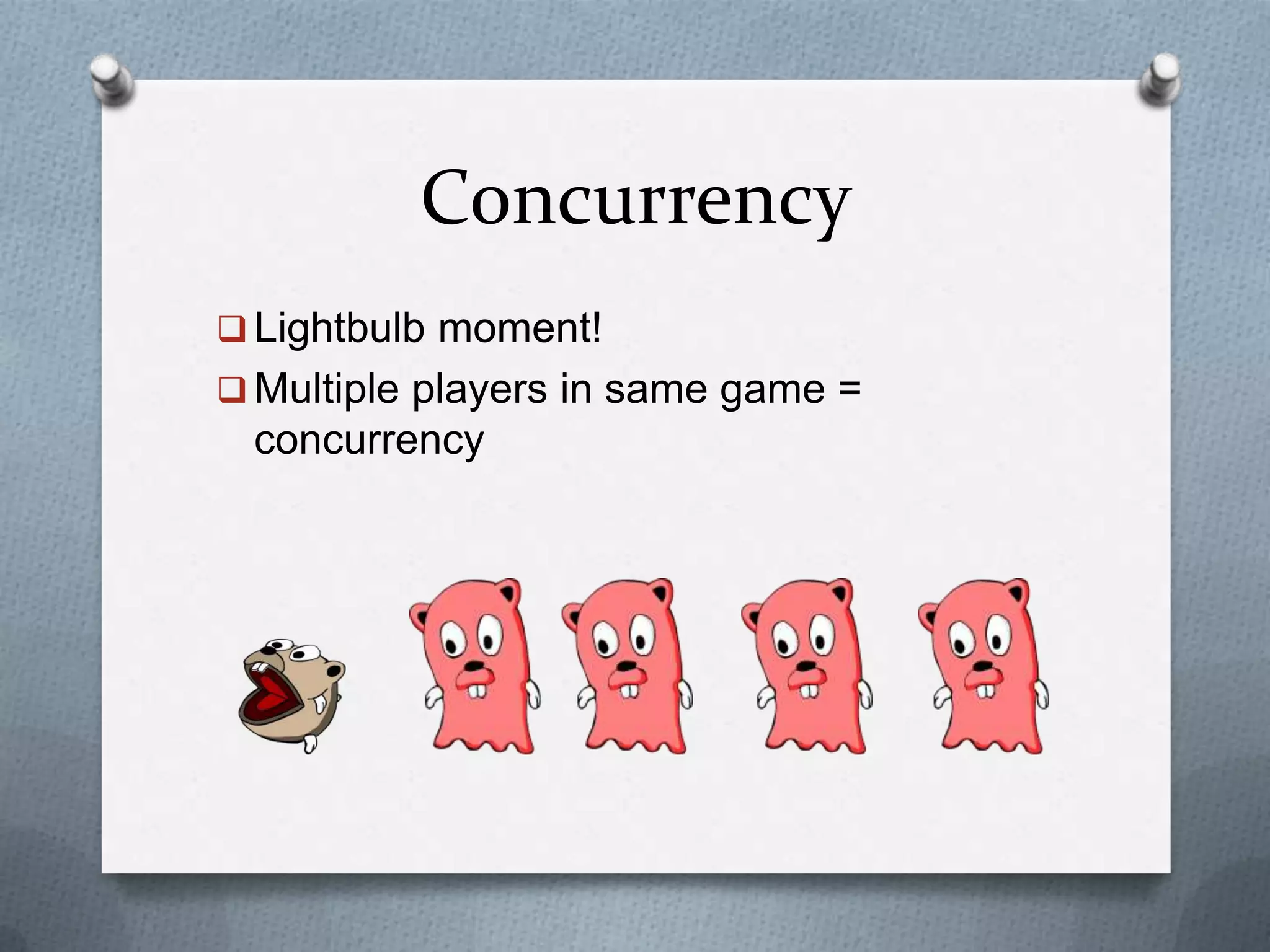
Concurrency
 Lightbulb moment!
 Multiple players in same game =
concurrency
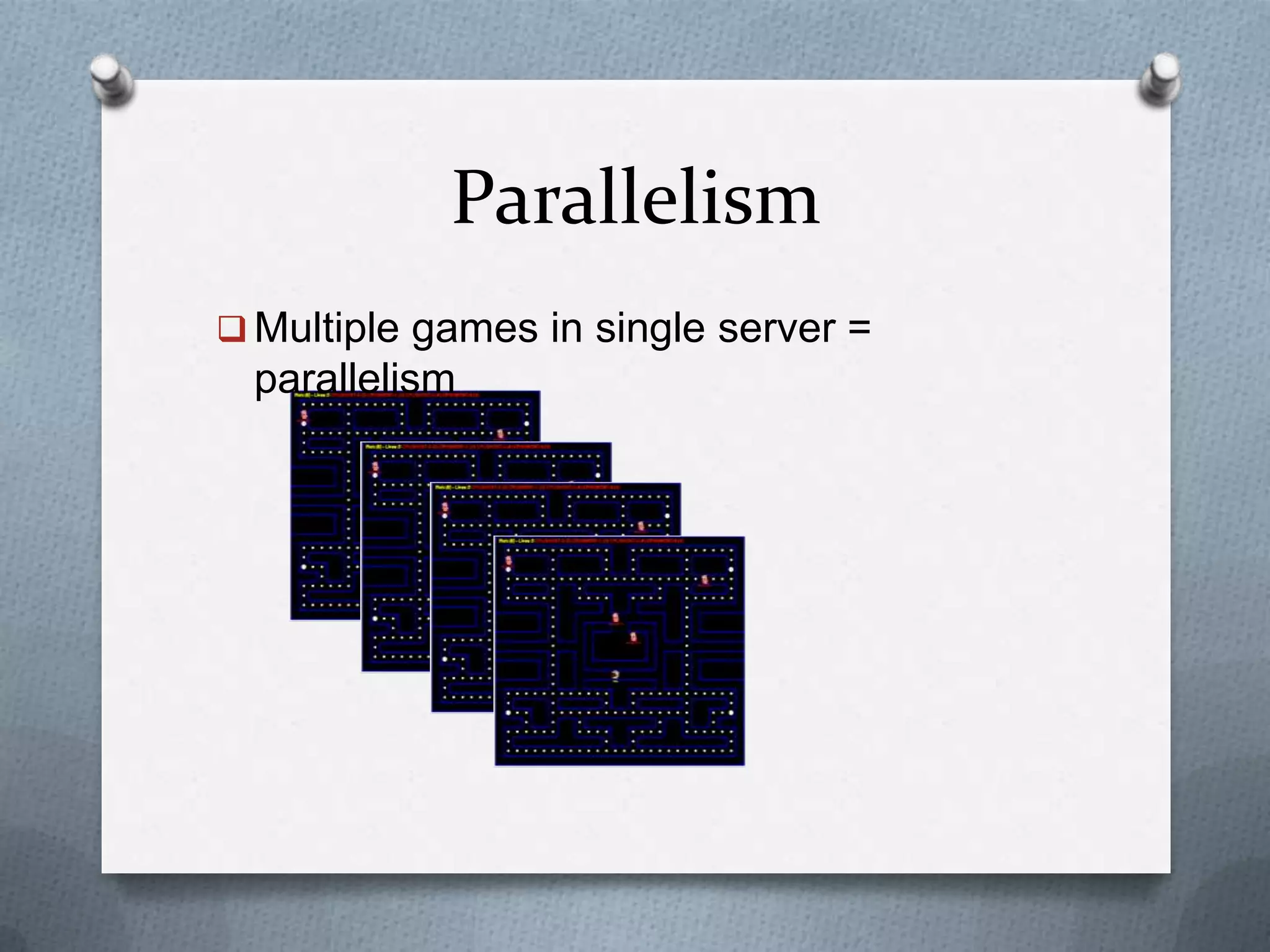
Parallelism
 Multiple games in single server =
parallelism
Caveats
 Probably not the best way to do this
 First golang code I’ve developed
 Highly inefficient
 Websockets would’ve been MUCH better
 BUT, it’s fun to try it
Starting the game
HTTP POST request to create a new game with
following parms:-
 Game name
 Max number of GoMen
 Max number of GoGhosts
 Time to wait for players
What happens?
 Creates new game on server
 Creates golang process waiting for timeout to start
game.
 Creates a single channel to listen for player
updates
Add players to game
HTTP PUT request to add a player to a
game with parms:-
 Game id
 Player name
 Player type (GoMan/GoGhost)
If total players reached game will begin
otherwise game waits for players
Time up
If wait time expires, game server adds
remaining players as CPU controlled players.
Creates new golang process for each missing
player
Dumb AI:
Wait for ¼ second.
Pick random number between 0-3
Send move request to game channel
repeat…
Game States
“new” – just created
“waiting” – waiting for players to join
“playing” – game active
“over” – all GoMan players have died
“won” – all pills eaten
Power Pills
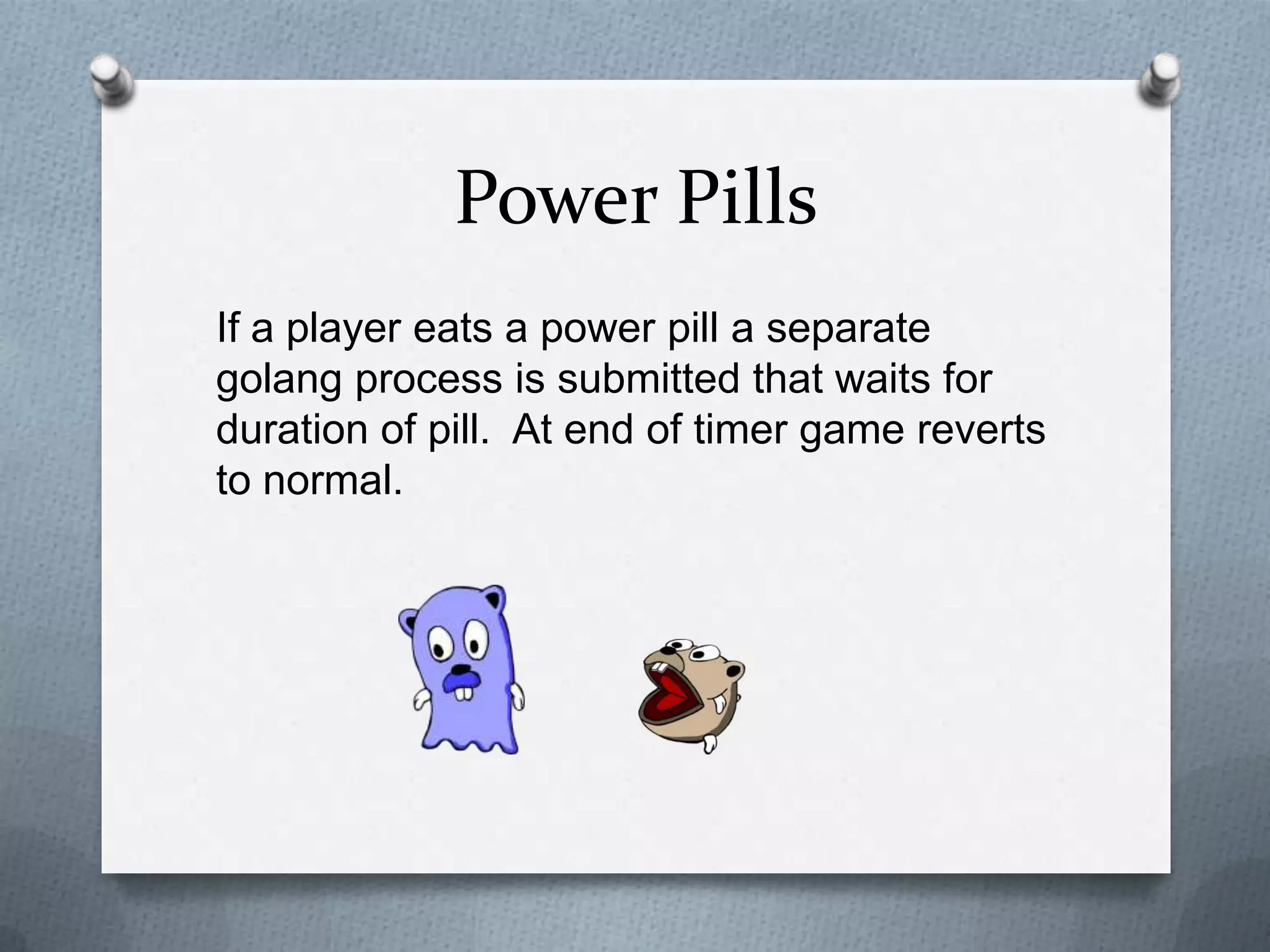
If a player eats a power pill a separate
golang process is submitted that waits for
duration of pill. At end of timer game reverts
to normal.
Game Client
Originally I started developing a separate
client in go-lang.
Stopped development of this because I
wanted people to try the game easily on the
web.
Switched to JavaScript based client as this
was the most likely client to consume the
API.
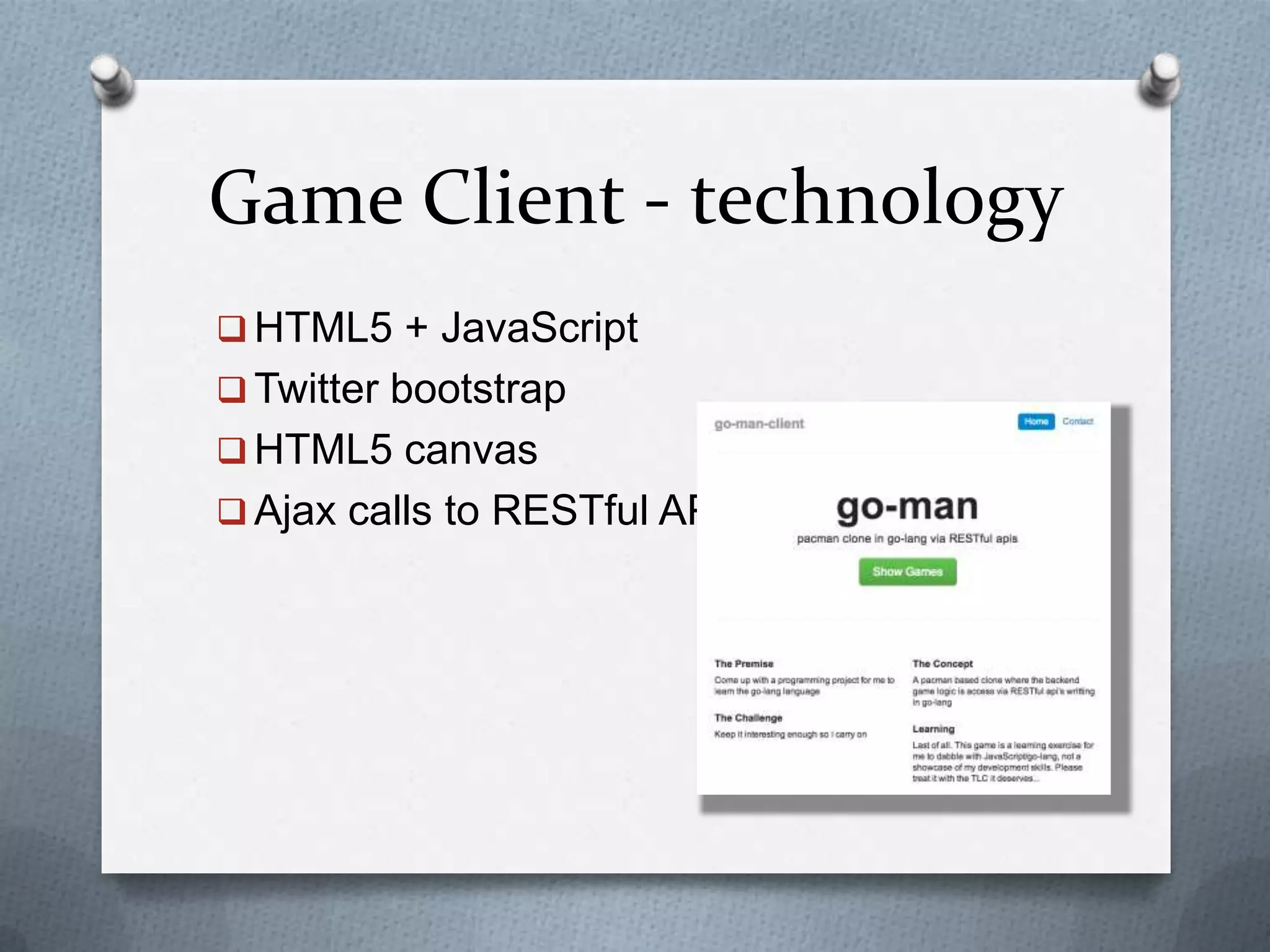
Game Client - technology
 HTML5 + JavaScript
 Twitter bootstrap
 HTML5 canvas
 Ajax calls to RESTful API
Game Client - features
 List games
 Create new game
 Join existing game
 Play game
Game Server
Server implements MVC pattern:
Models = game board + players
View = JSON representation of game state
Controller = RESTful API calls to perform
CRUD on a game instance.
Game Server - technology
 Standalone golang executable or
 Google app engine app
Uses:
 Gorillamux (for http routing)
 Game state stored in memory
Game Server – lessons learned
Things I learned during development:-
Started using filesystem as simple datastore for
games. Got tired of serialisation / deserialisation and
realised it was unnecessary for my simple demo.
Originally modeled board cells as a 2d byte array.
But these force client to have to deal with Base64
encoded binary data (nasty). Changed definition to a
2d array of “runes” for an easier life.
BoardCells [][]rune
Game Server – logic
 All game logic resides on server. Game
state / player state etc.
 Game clients are completely dumb.
 Weakness in API is that players are not
authenticated so they could easily fake
each others moves by using the other
player’s GUID.
Game Server – concurrency
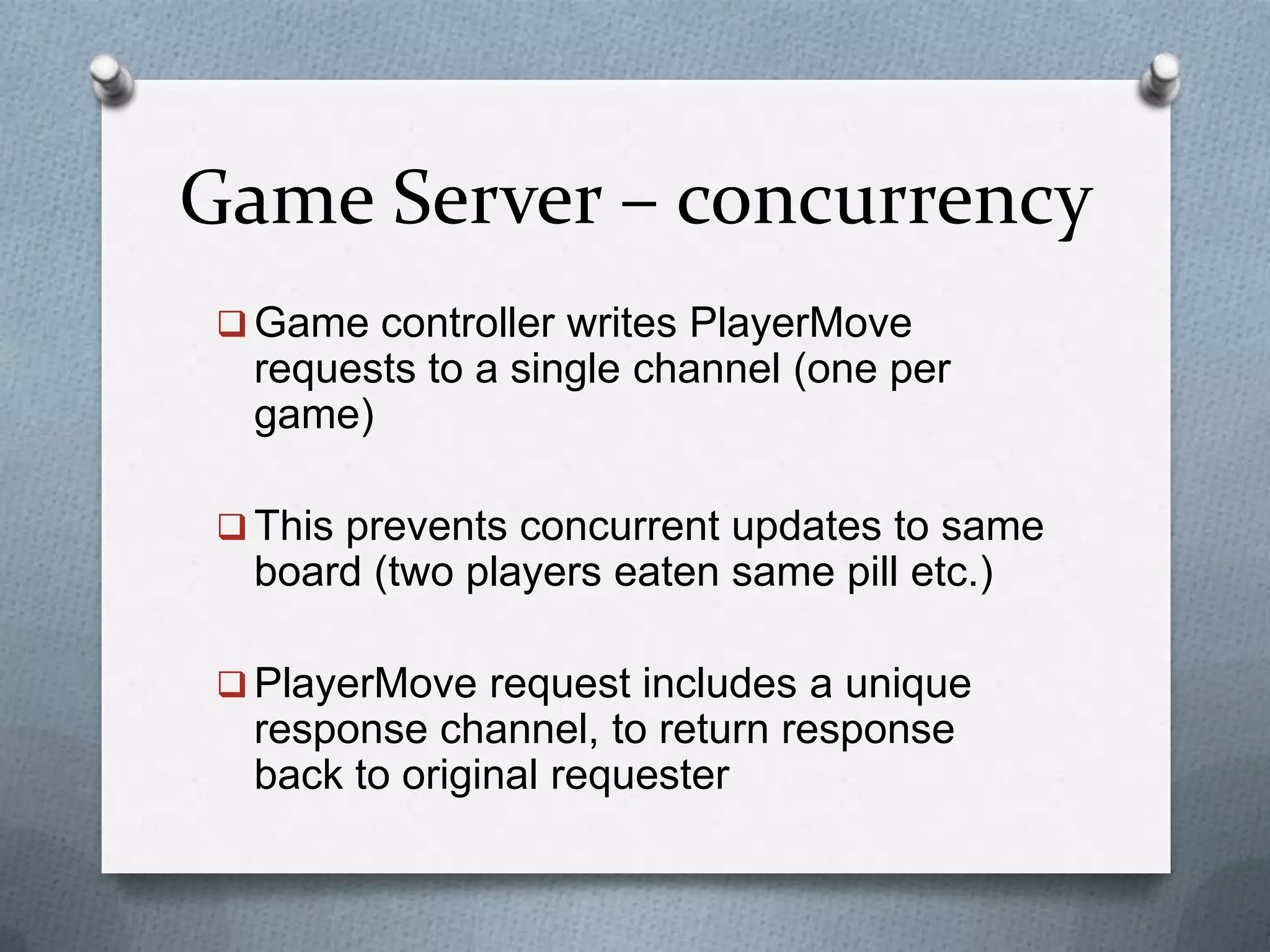
 Game controller writes PlayerMove
requests to a single channel (one per
game)
 This prevents concurrent updates to same
board (two players eaten same pill etc.)
 PlayerMove request includes a unique
response channel, to return response
back to original requester
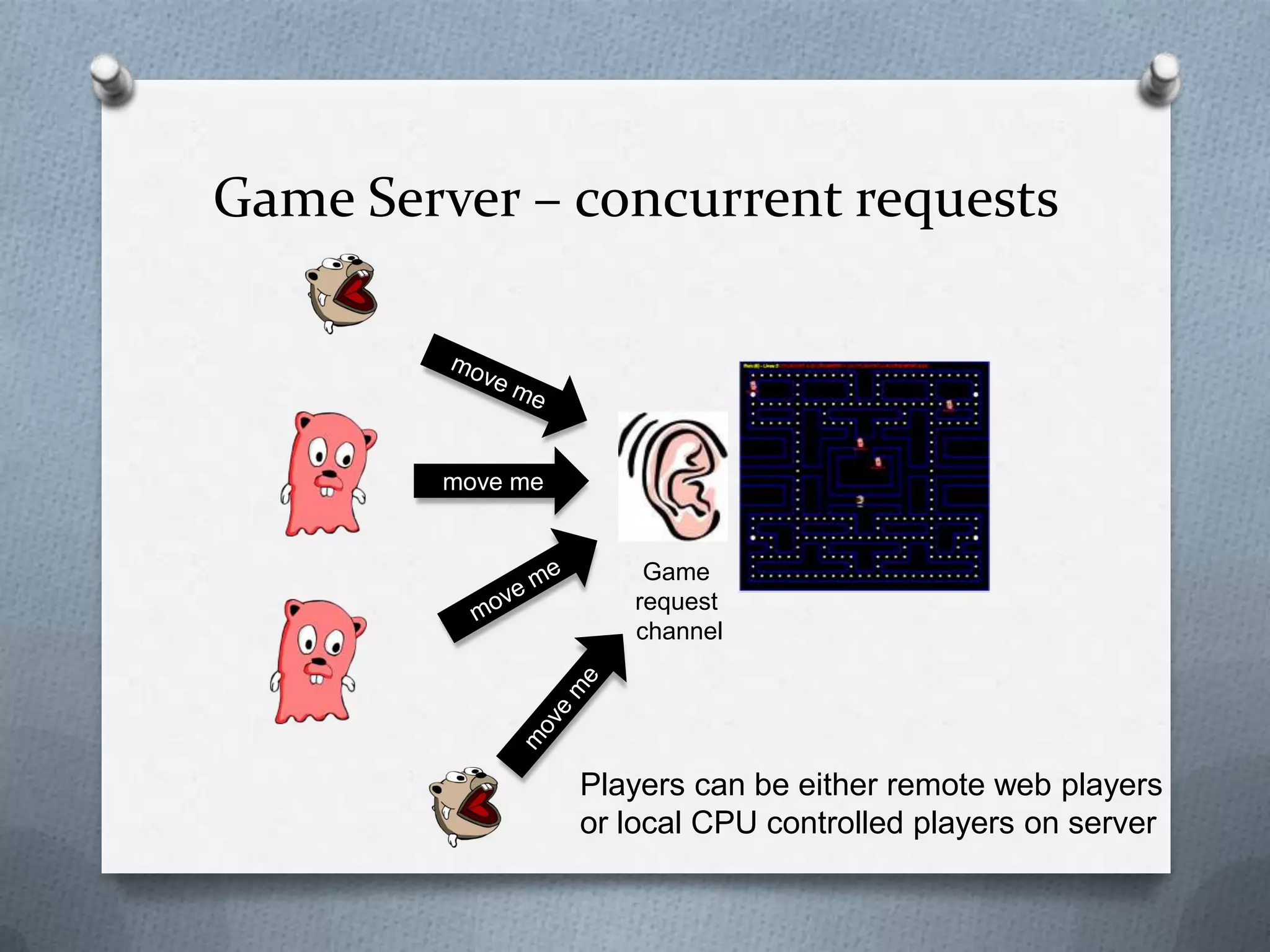
Game Server – concurrent requests
move me
Game
request
channel
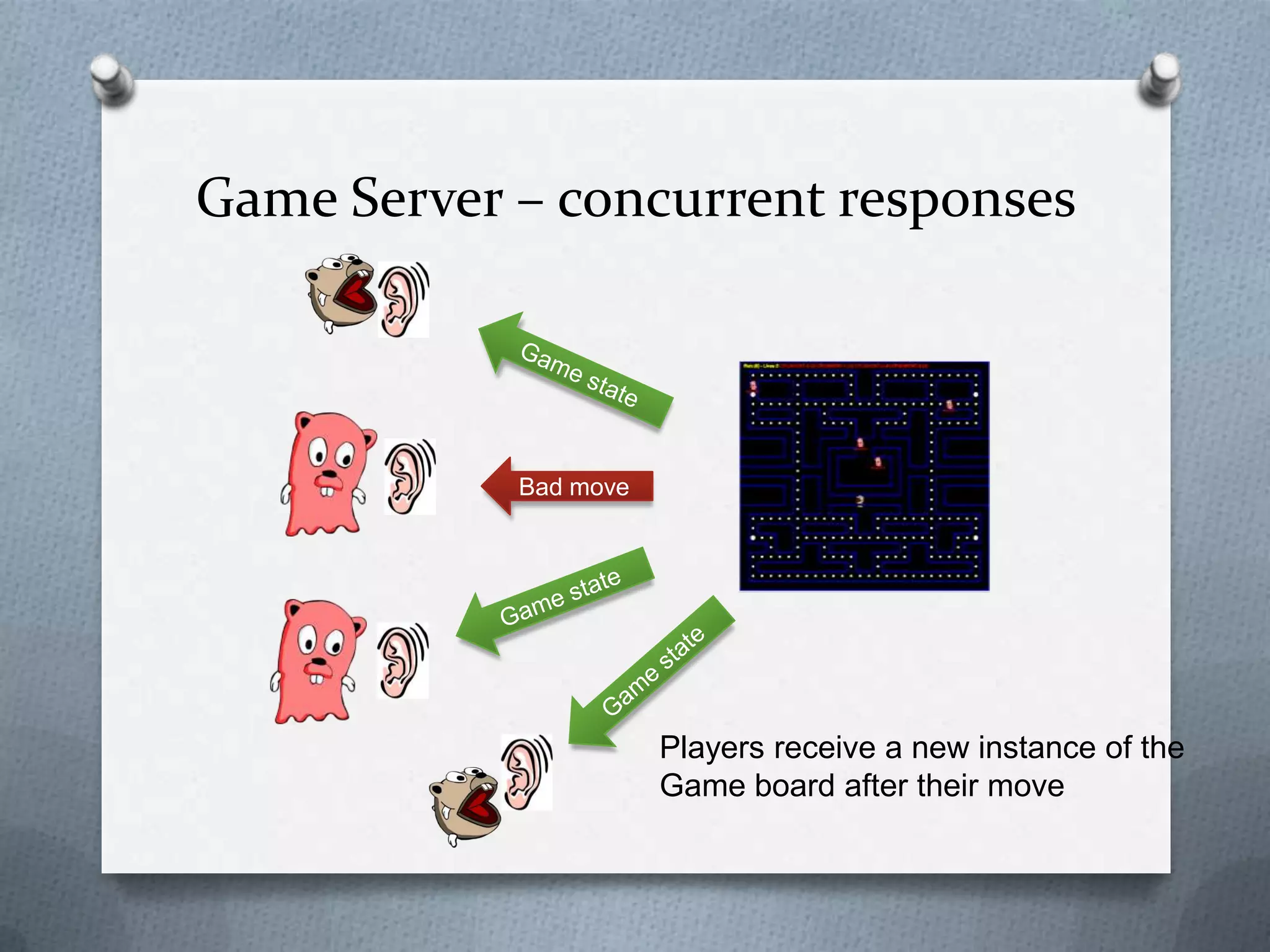
Players can be either remote web players
or local CPU controlled players on server
Game Server – concurrent responses
Players receive a new instance of the
Game board after their move
Bad move
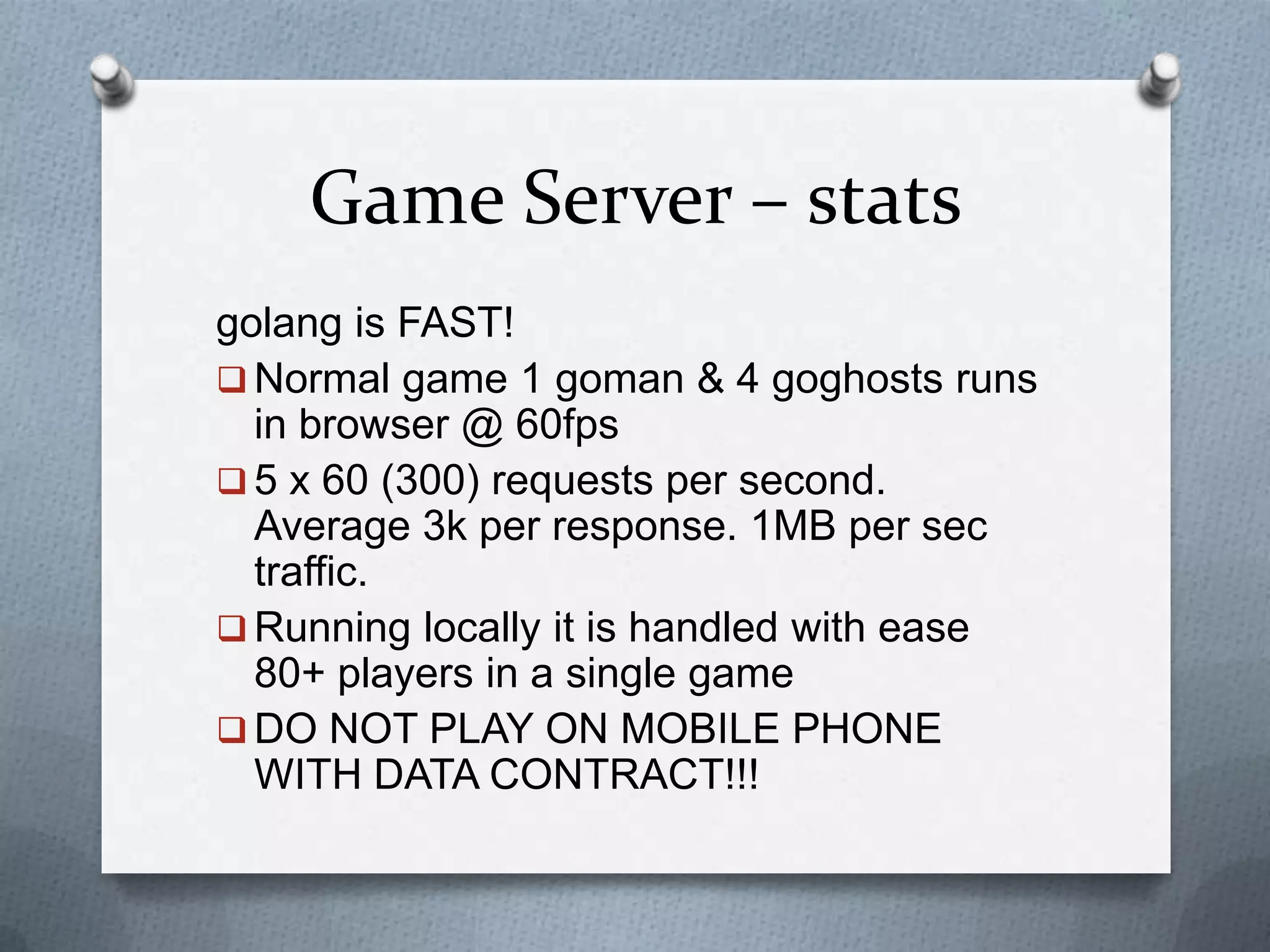
Game Server – stats
golang is FAST!
 Normal game 1 goman & 4 goghosts runs
in browser @ 60fps
 5 x 60 (300) requests per second.
Average 3k per response. 1MB per sec
traffic.
 Running locally it is handled with ease
80+ players in a single game
 DO NOT PLAY ON MOBILE PHONE
WITH DATA CONTRACT!!!
Game Models - GameBoard
type GameBoard struct {
Id string
Name string
PillsRemaining int
Players map[string]*Player
MaxGoMenAllowed int
MaxGoGhostsAllowed int
WaitForPlayersSeconds int
State GameState
PowerPillsActive int
CreatedTime time.Time
LastUpdatedTime time.Time
GameStartTime time.Time
BoardCells [][]rune
}
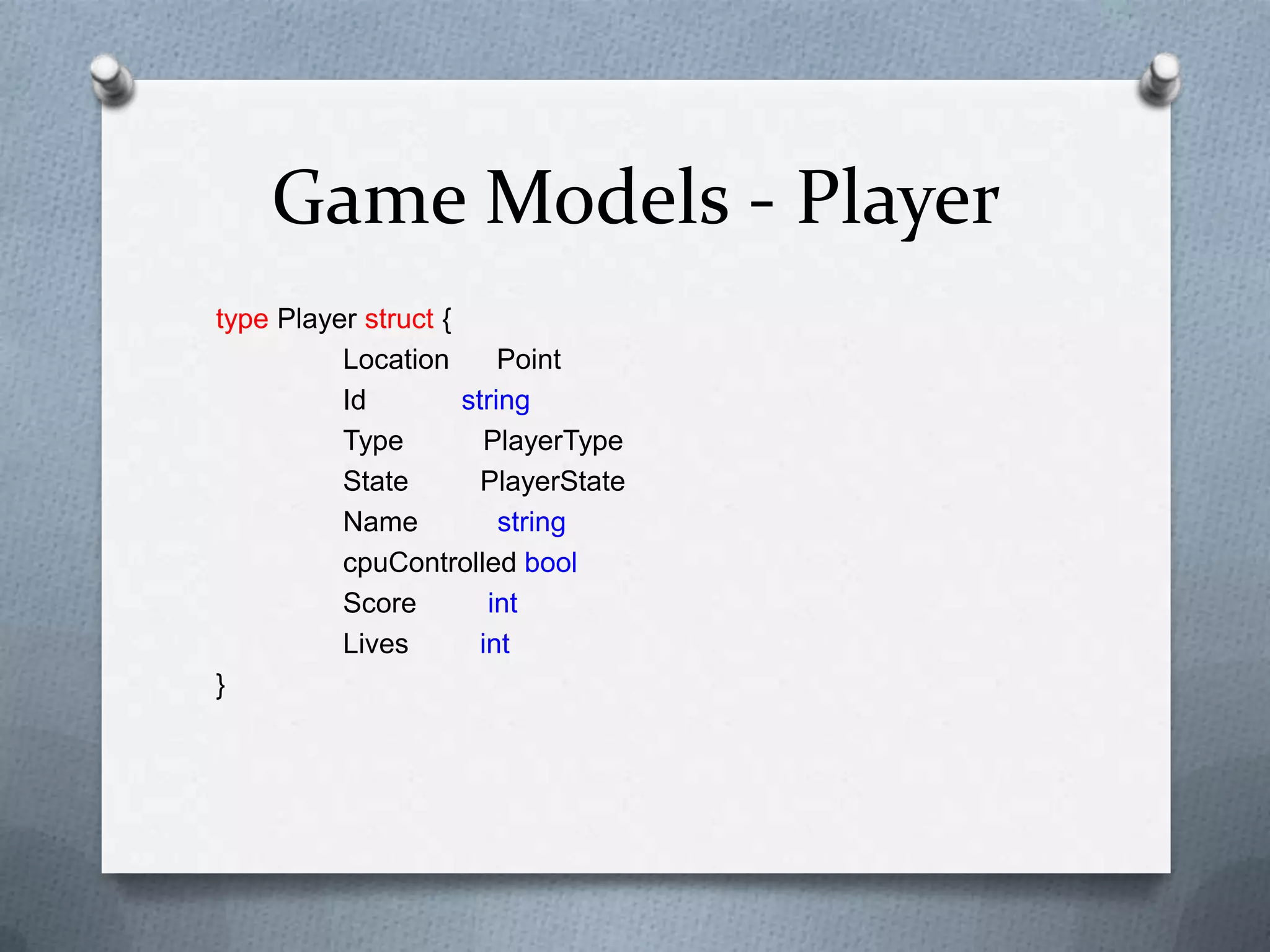
Game Models - Player
type Player struct {
Location Point
Id string
Type PlayerType
State PlayerState
Name string
cpuControlled bool
Score int
Lives int
}
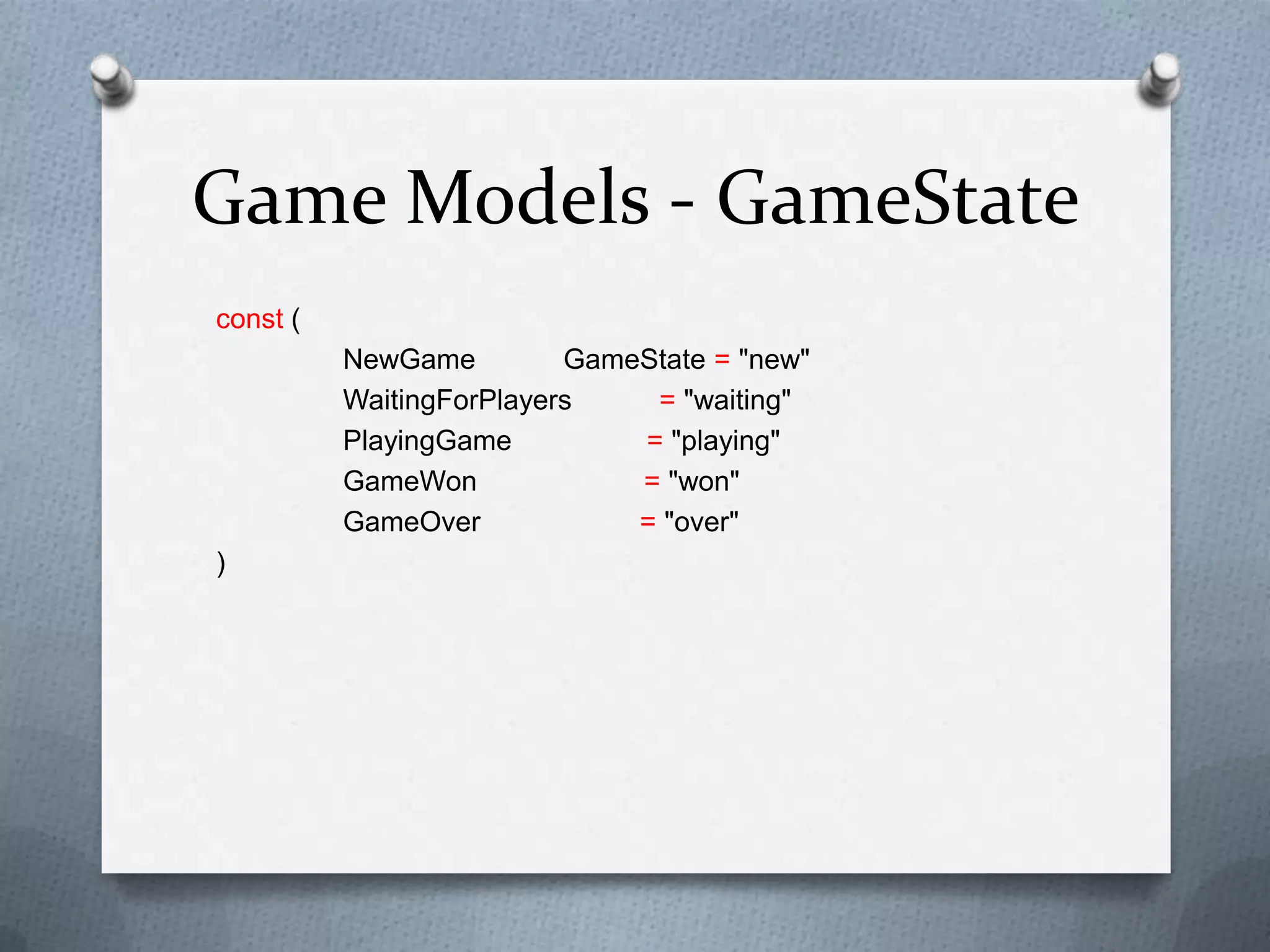
Game Models - GameState
const (
NewGame GameState = "new"
WaitingForPlayers = "waiting"
PlayingGame = "playing"
GameWon = "won"
GameOver = "over"
)
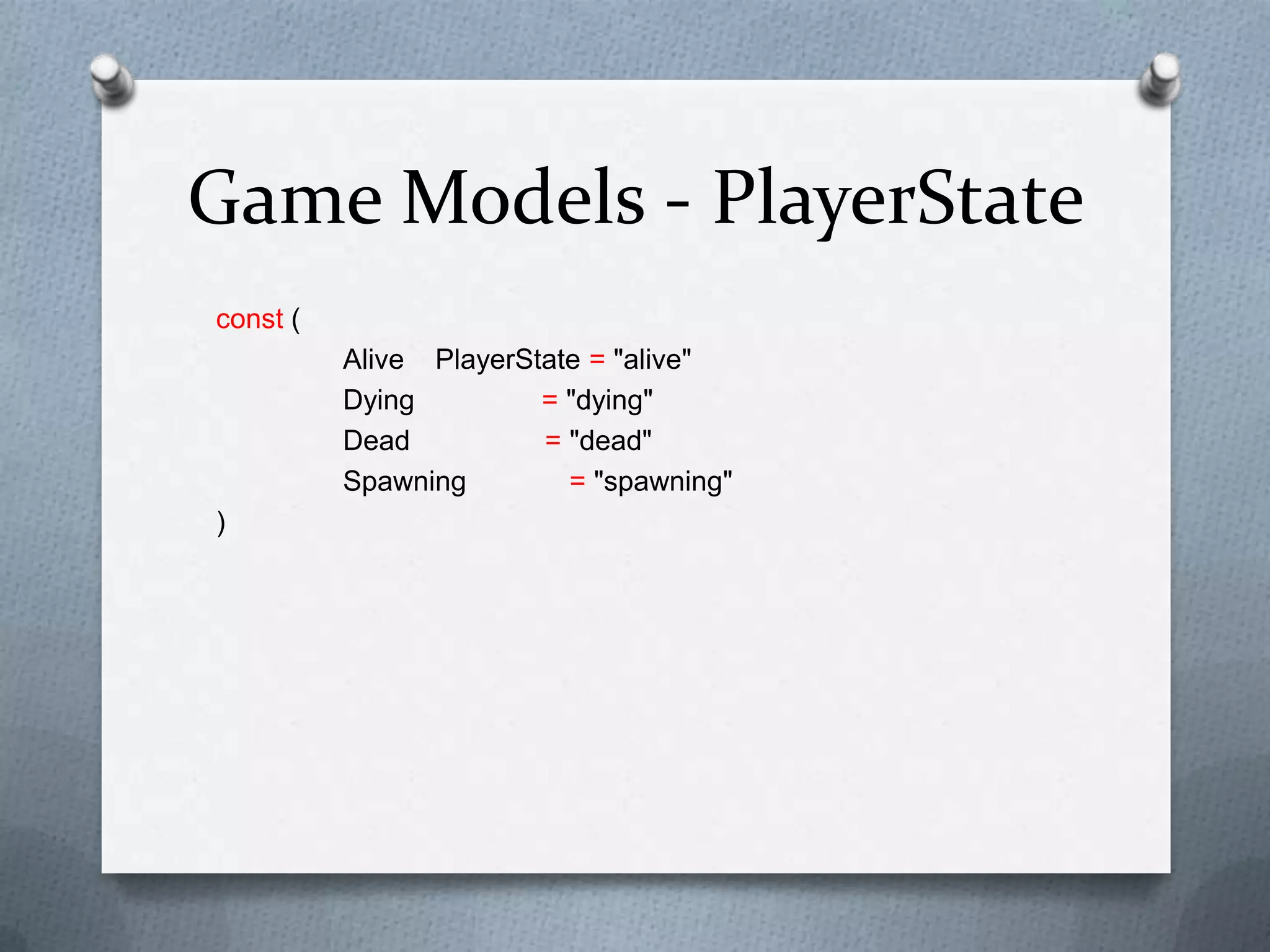
Game Models - PlayerState
const (
Alive PlayerState = "alive"
Dying = "dying"
Dead = "dead"
Spawning = "spawning"
)
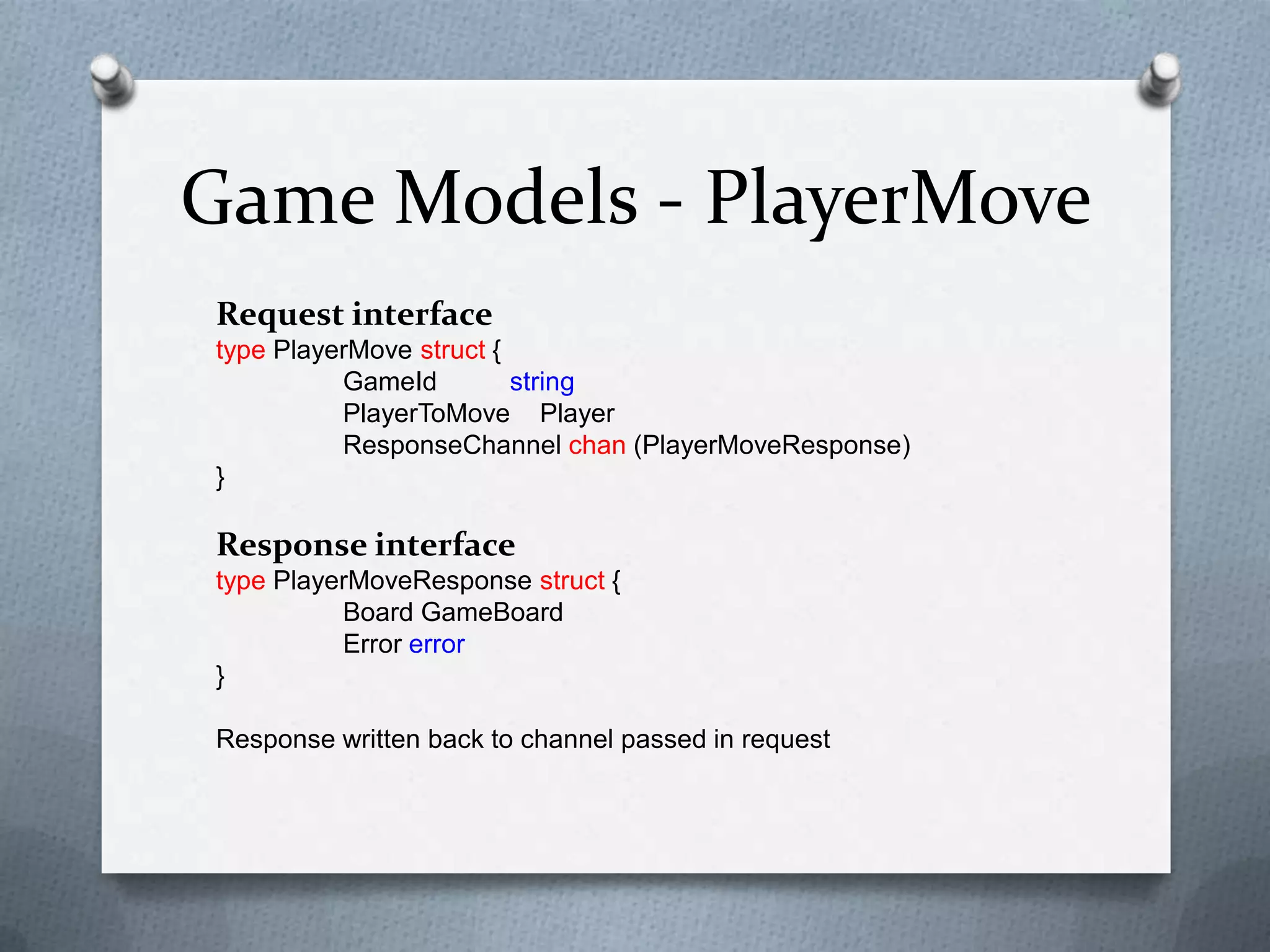
Game Models - PlayerMove
Request interface
type PlayerMove struct {
GameId string
PlayerToMove Player
ResponseChannel chan (PlayerMoveResponse)
}
Response interface
type PlayerMoveResponse struct {
Board GameBoard
Error error
}
Response written back to channel passed in request
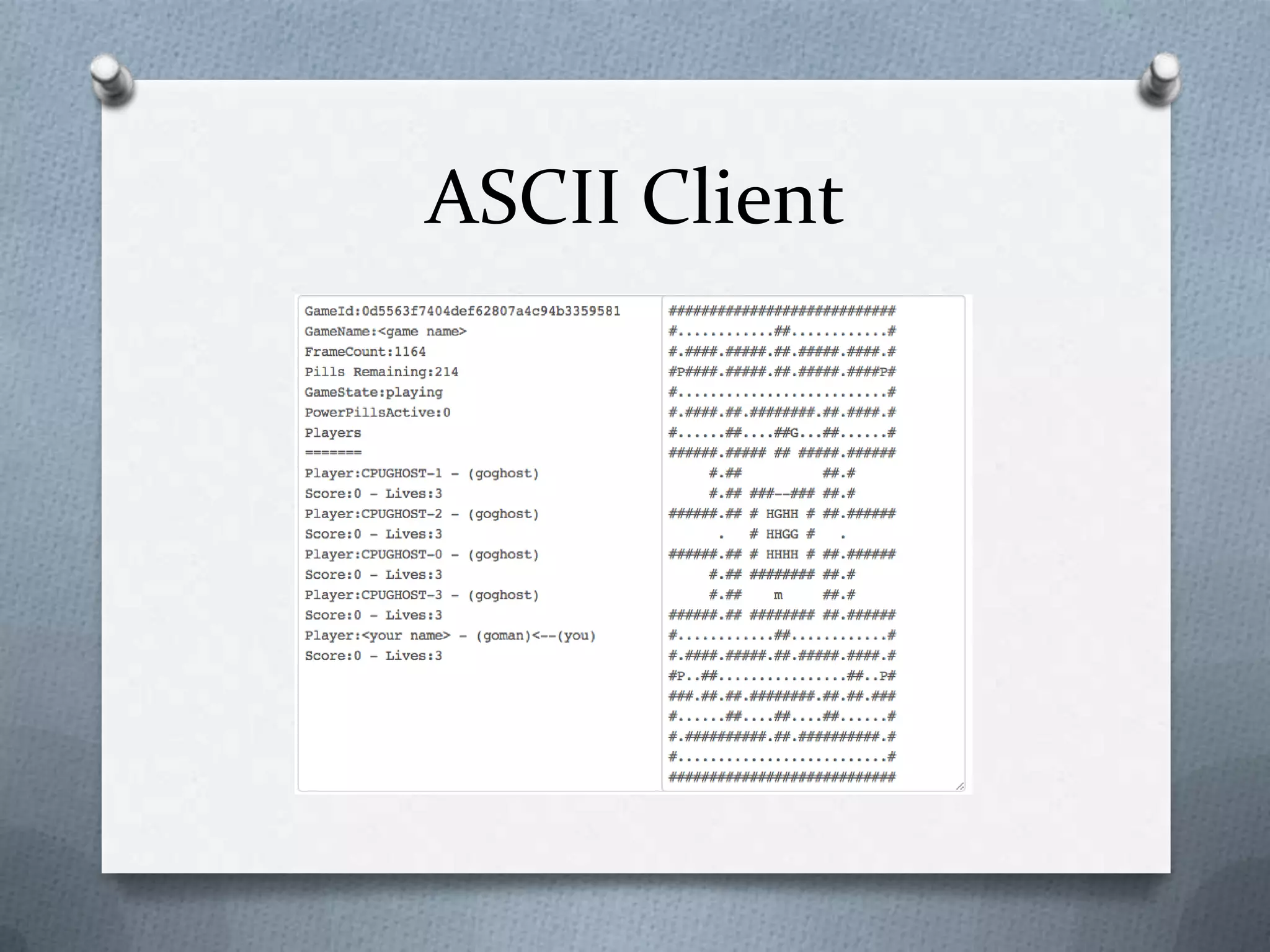
ASCII Client
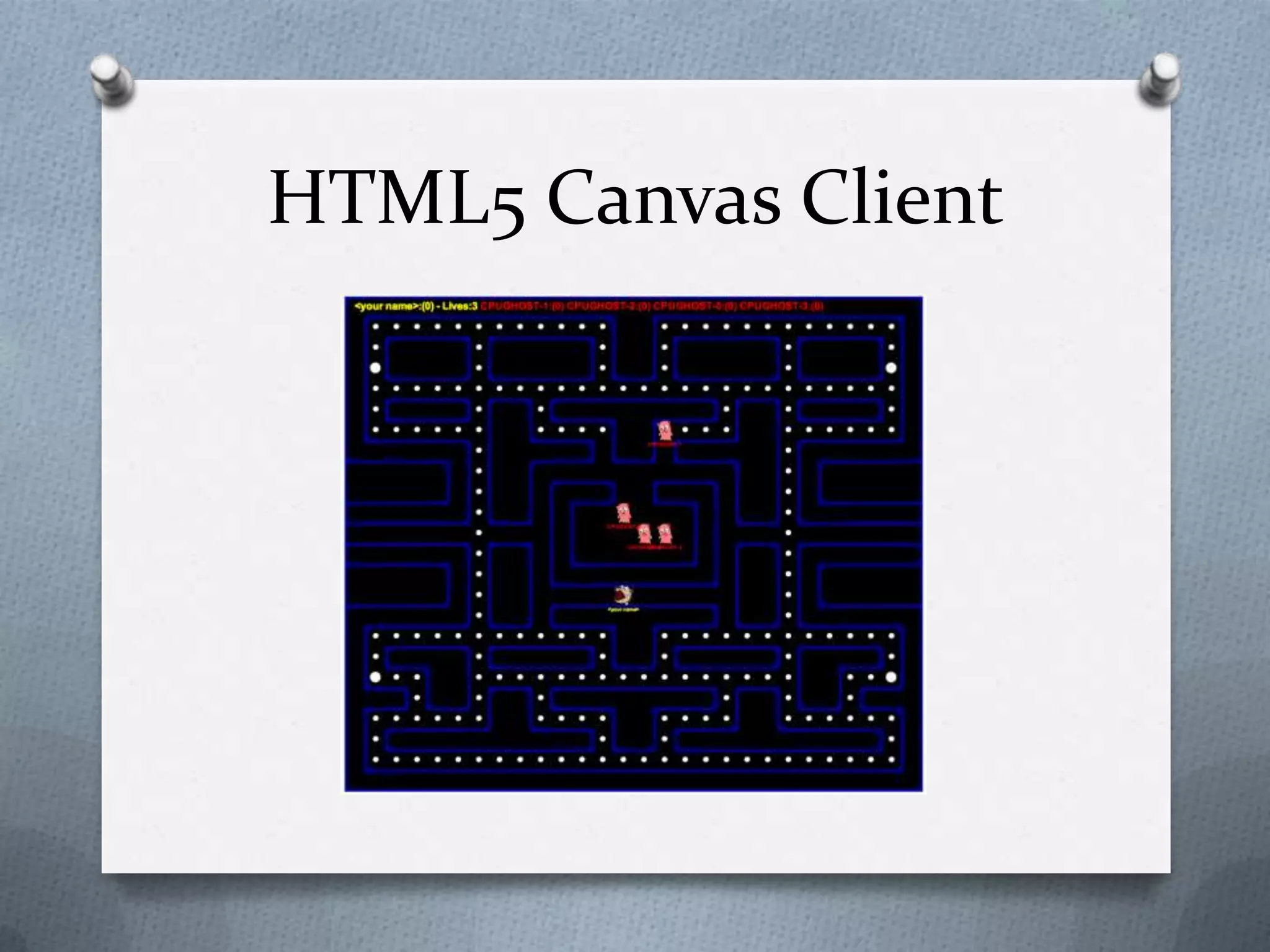
HTML5 Canvas Client
Demo
Client: http://go-man-client.herokuapp.com/
(Hosted as simple static site)
Source: https://github.com/telecoda/go-man-javascript-client
API: http://go-man-app.appspot.com
(Hosted on single GAE instance)
Source: https://github.com/telecoda/go-man-app
Wiki: https://github.com/telecoda/go-man-app/wiki
About me
robbaines@gmail.com
@telecoda

go-man API

  • 1.
  • 2.
    Why?  By day:I am architect/developer hacking at Java based api’s  By night: Still harboring a passion for video games and regularly write small games to try out new tech on my daily commute (rarely finish them…)
  • 3.
    Fusion Why not combineboth pursuits to retain a level of interest? Goals:-  Better understanding of go-lang  Maybe and actual finished skunkworks project?
  • 4.
    Dissecting the game Broke the idea of “pac-man” down to a series of API calls.  Create game  Add player(s)  Move players  Repeat to fade
  • 5.
    Concurrency  Lightbulb moment! Multiple players in same game = concurrency
  • 6.
    Parallelism  Multiple gamesin single server = parallelism
  • 7.
    Caveats  Probably notthe best way to do this  First golang code I’ve developed  Highly inefficient  Websockets would’ve been MUCH better  BUT, it’s fun to try it
  • 8.
    Starting the game HTTPPOST request to create a new game with following parms:-  Game name  Max number of GoMen  Max number of GoGhosts  Time to wait for players What happens?  Creates new game on server  Creates golang process waiting for timeout to start game.  Creates a single channel to listen for player updates
  • 9.
    Add players togame HTTP PUT request to add a player to a game with parms:-  Game id  Player name  Player type (GoMan/GoGhost) If total players reached game will begin otherwise game waits for players
  • 10.
    Time up If waittime expires, game server adds remaining players as CPU controlled players. Creates new golang process for each missing player Dumb AI: Wait for ¼ second. Pick random number between 0-3 Send move request to game channel repeat…
  • 11.
    Game States “new” –just created “waiting” – waiting for players to join “playing” – game active “over” – all GoMan players have died “won” – all pills eaten
  • 12.
    Power Pills If aplayer eats a power pill a separate golang process is submitted that waits for duration of pill. At end of timer game reverts to normal.
  • 13.
    Game Client Originally Istarted developing a separate client in go-lang. Stopped development of this because I wanted people to try the game easily on the web. Switched to JavaScript based client as this was the most likely client to consume the API.
  • 14.
    Game Client -technology  HTML5 + JavaScript  Twitter bootstrap  HTML5 canvas  Ajax calls to RESTful API
  • 15.
    Game Client -features  List games  Create new game  Join existing game  Play game
  • 16.
    Game Server Server implementsMVC pattern: Models = game board + players View = JSON representation of game state Controller = RESTful API calls to perform CRUD on a game instance.
  • 17.
    Game Server -technology  Standalone golang executable or  Google app engine app Uses:  Gorillamux (for http routing)  Game state stored in memory
  • 18.
    Game Server –lessons learned Things I learned during development:- Started using filesystem as simple datastore for games. Got tired of serialisation / deserialisation and realised it was unnecessary for my simple demo. Originally modeled board cells as a 2d byte array. But these force client to have to deal with Base64 encoded binary data (nasty). Changed definition to a 2d array of “runes” for an easier life. BoardCells [][]rune
  • 19.
    Game Server –logic  All game logic resides on server. Game state / player state etc.  Game clients are completely dumb.  Weakness in API is that players are not authenticated so they could easily fake each others moves by using the other player’s GUID.
  • 20.
    Game Server –concurrency  Game controller writes PlayerMove requests to a single channel (one per game)  This prevents concurrent updates to same board (two players eaten same pill etc.)  PlayerMove request includes a unique response channel, to return response back to original requester
  • 21.
    Game Server –concurrent requests move me Game request channel Players can be either remote web players or local CPU controlled players on server
  • 22.
    Game Server –concurrent responses Players receive a new instance of the Game board after their move Bad move
  • 23.
    Game Server –stats golang is FAST!  Normal game 1 goman & 4 goghosts runs in browser @ 60fps  5 x 60 (300) requests per second. Average 3k per response. 1MB per sec traffic.  Running locally it is handled with ease 80+ players in a single game  DO NOT PLAY ON MOBILE PHONE WITH DATA CONTRACT!!!
  • 24.
    Game Models -GameBoard type GameBoard struct { Id string Name string PillsRemaining int Players map[string]*Player MaxGoMenAllowed int MaxGoGhostsAllowed int WaitForPlayersSeconds int State GameState PowerPillsActive int CreatedTime time.Time LastUpdatedTime time.Time GameStartTime time.Time BoardCells [][]rune }
  • 25.
    Game Models -Player type Player struct { Location Point Id string Type PlayerType State PlayerState Name string cpuControlled bool Score int Lives int }
  • 26.
    Game Models -GameState const ( NewGame GameState = "new" WaitingForPlayers = "waiting" PlayingGame = "playing" GameWon = "won" GameOver = "over" )
  • 27.
    Game Models -PlayerState const ( Alive PlayerState = "alive" Dying = "dying" Dead = "dead" Spawning = "spawning" )
  • 28.
    Game Models -PlayerMove Request interface type PlayerMove struct { GameId string PlayerToMove Player ResponseChannel chan (PlayerMoveResponse) } Response interface type PlayerMoveResponse struct { Board GameBoard Error error } Response written back to channel passed in request
  • 29.
  • 30.
  • 31.
    Demo Client: http://go-man-client.herokuapp.com/ (Hosted assimple static site) Source: https://github.com/telecoda/go-man-javascript-client API: http://go-man-app.appspot.com (Hosted on single GAE instance) Source: https://github.com/telecoda/go-man-app Wiki: https://github.com/telecoda/go-man-app/wiki
  • 32.