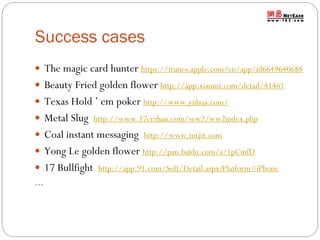
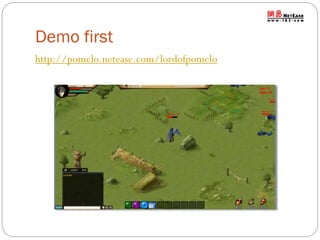
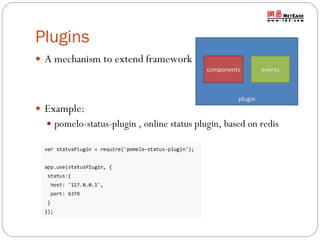
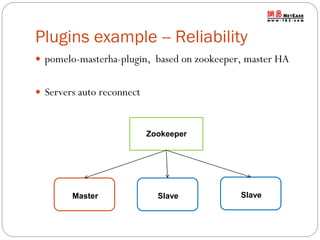
Charlie Crane presented on building fast, scalable game servers using Node.js and the open source framework Pomelo. Pomelo is a distributed, scalable framework for real-time applications that abstracts servers and provides request/response and broadcast capabilities. It addresses challenges of scalability for games through techniques like area of interest and splitting processes. Performance testing showed Pomelo can support over 500 concurrent users on a single server. Pomelo has been used successfully for games and real-time messaging platforms supporting millions of users.
Who am I
NASDAQ: NTES
Senior engineer, architect(8 years) in NetEase Inc. ,
developed many web, game products
Recently created the open source game server framework in
node.js: pomelo
3.
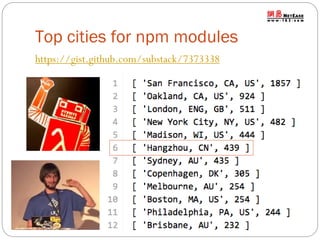
Top cities fornpm modules
https://gist.github.com/substack/7373338
The state ofpomelo
Fast, scalable, distributed game server
framework for node.js
Open sourced in 2012.11.20
Newest version: V0.7
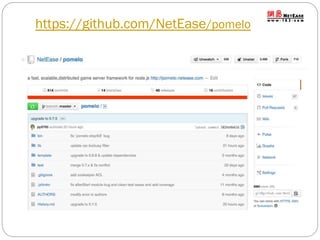
https://github.com/NetEase/pomelo
6.
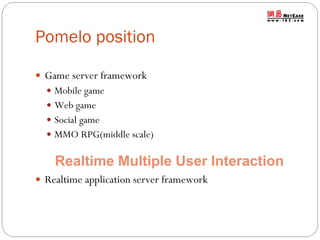
Pomelo position
Gameserver framework
Mobile game
Web game
Social game
MMO RPG(middle scale)
Realtime Multiple User Interaction
Realtime application server framework
7.
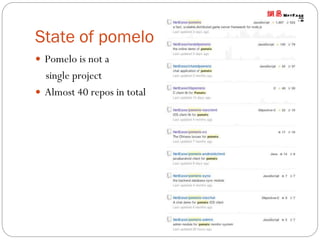
State of pomelo
Pomelo is not a
single project
Almost 40 repos in total
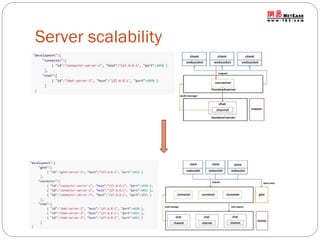
Scalability---Web and Gameserver
Web server
unlimited scalability
Game server
World record: world of tanks(bigworld), 74,536 online users
MMORPG:7k-8k maximum
Why?
18.
Why does gameserver not scale?
Reason 1: Long connection
Response time
Web response time: 2000ms
Game、realtime web: <100ms
Message direction
web: request/reponse
game: request/push/broadcast, bi-direction
19.
How to solve
Node.js to rescue
Perfect for:
Network-insentive application
Real-time application
Holding connections
Mqtt: 120,000 connections, 1 process, 10K/connection
Socket.io: 25,000 connections, 1 process, 50K/connection
20.
Why does gameserver not scale
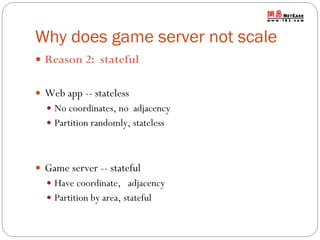
Reason 2: stateful
Web app -- stateless
No coordinates, no adjacency
Partition randomly, stateless
Game server -- stateful
Have coordinate, adjacency
Partition by area, stateful
21.
How to solve
No good solution in technical level
Depending on game design
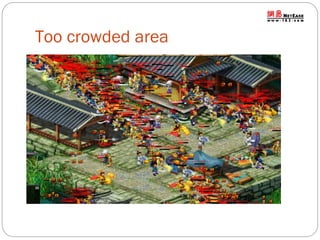
Don’t make one area too crowded
Balance of area
Why does gameserver not scale
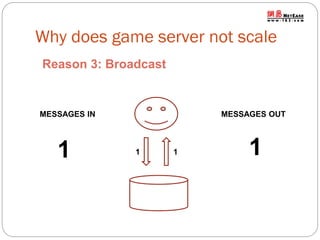
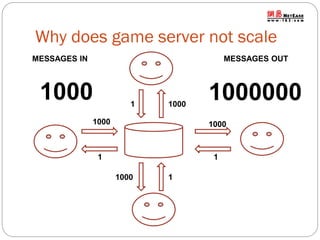
Reason 3: Broadcast
MESSAGES IN
1
MESSAGES OUT
1
1
1
25.
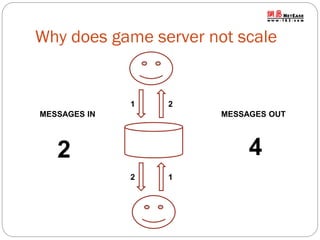
Why does gameserver not scale
1
2
MESSAGES IN
MESSAGES OUT
4
2
2
1
26.
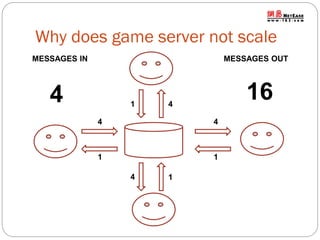
Why does gameserver not scale
MESSAGES IN
MESSAGES OUT
4
1
16
4
4
4
1
1
4
1
27.
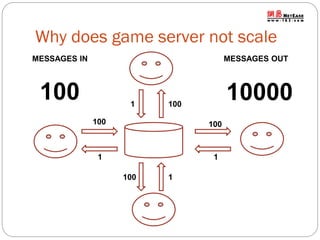
Why does gameserver not scale
MESSAGES IN
MESSAGES OUT
100
1
10000
100
100
100
1
1
100
1
28.
Why does gameserver not scale
MESSAGES IN
MESSAGES OUT
1000
1
1000
1000000
1000
1000
1
1
1000
1
29.
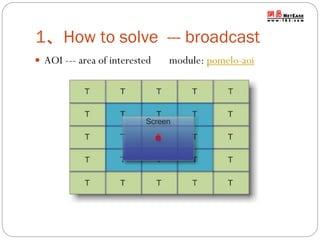
1、How to solve--- broadcast
AOI --- area of interested
module: pomelo-aoi
30.
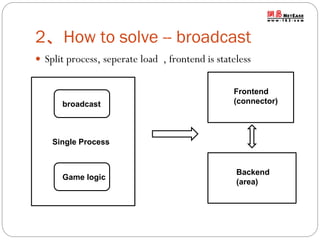
2、How to solve-- broadcast
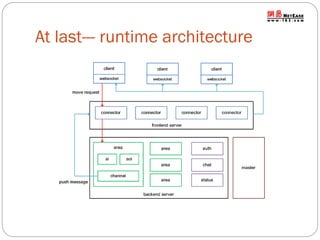
Split process, seperate load , frontend is stateless
broadcast
Frontend
(connector)
Single Process
Game logic
Backend
(area)
31.
3、How to solve– broadcast
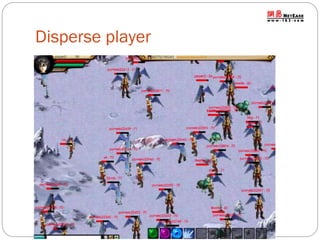
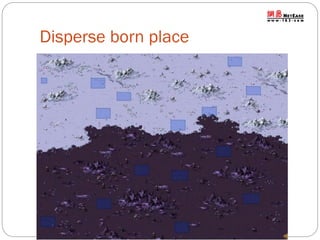
Game design, don’t make one place(in area) too crowded
Map size
Character density
Disperse born place
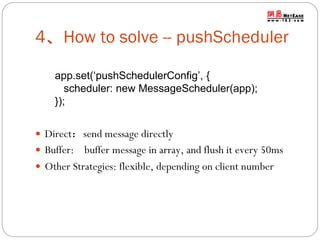
4、How to solve-- pushScheduler
app.set(‘pushSchedulerConfig’, {
scheduler: new MessageScheduler(app);
});
Direct:send message directly
Buffer:
buffer message in array, and flush it every 50ms
Other Strategies: flexible, depending on client number
34.
Why does gameserver not scale
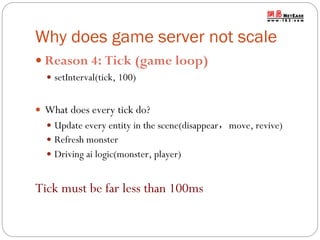
Reason 4: Tick (game loop)
setInterval(tick, 100)
What does every tick do?
Update every entity in the scene(disappear,move, revive)
Refresh monster
Driving ai logic(monster, player)
Tick must be far less than 100ms
35.
Problem of tick
The entity number should be limited
Pay attention to update algorithm: AI etc.
GC, full gc should be limited
V8 is good at GC when memory is under 500M, even full GC
Memory must be limited
Try to divide process
Framework --- designgoal
Abstract of servers(processes)
Auto extend server types
Auto extend servers
Abstract of request/response and broadcast/push
Zero config request
Simple broadcast api
Servers communication---rpc framework
Performance --- overview
The performance varies largely in different games,
applications
The variation
Application type: Game or realtime application
Game type: round or realtime fight, room or infinite
Game design: Map size, character density, balance of areas
Test parameters: Think time, test action
57.
Performance --- referencedata
Online users per process
next-gen: support 20,000 concurrent players in one area
World record – not one area
world of tanks(bigworld), 74,536 online users
But in real world(MMO rpg)
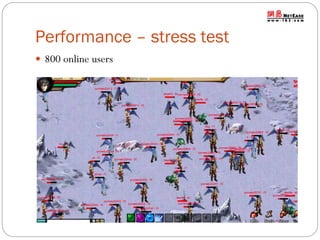
The real online data: maximum 800 concurrent users per area, 7,000
concurrent users per group game servers
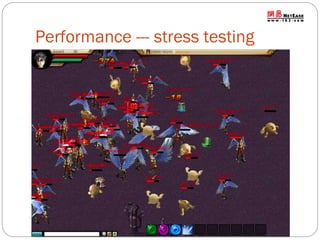
Performance --- stresstesting
Use Case 1: fight
Stress on single area(area 3), increasing step by step,
login every 2 seconds
Game logic: attack monstors or other players every
2~5 seconds
Performance – stresstest
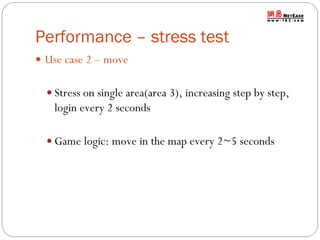
Use case 2 – move
Stress on single area(area 3), increasing step by step,
login every 2 seconds
Game logic: move in the map every 2~5 seconds
Performance --- stresstesting
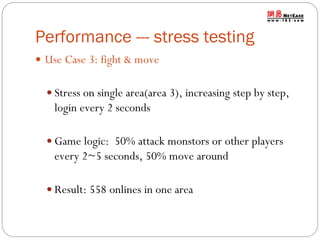
Use Case 3: fight & move
Stress on single area(area 3), increasing step by step,
login every 2 seconds
Game logic: 50% attack monstors or other players
every 2~5 seconds, 50% move around
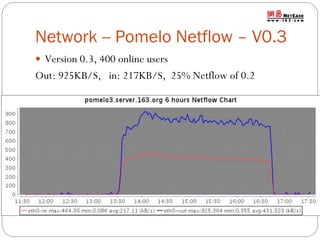
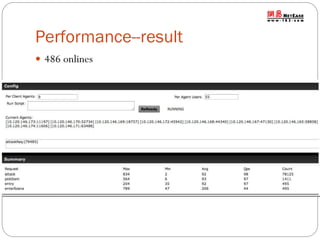
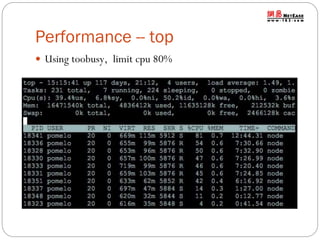
Result: 558 onlines in one area
Realtime app andgame
Many success stories in realtime application
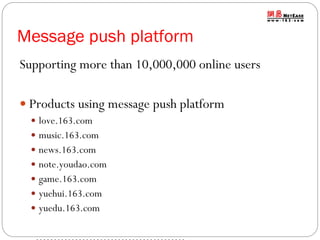
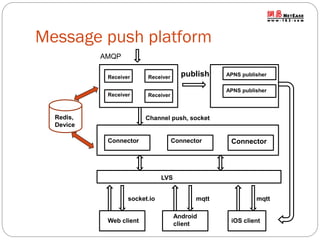
Message push platform in NetEase
ZhongQinBangBang
Not that frequent messages as game
Do do need that realtime (less than 50ms), we can use
different pushScheduler strategy
Much more scalable than game
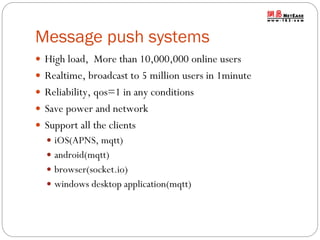
Message push systems
High load, More than 10,000,000 online users
Realtime, broadcast to 5 million users in 1minute
Reliability, qos=1 in any conditions
Save power and network
Support all the clients
iOS(APNS, mqtt)
android(mqtt)
browser(socket.io)
windows desktop application(mqtt)