

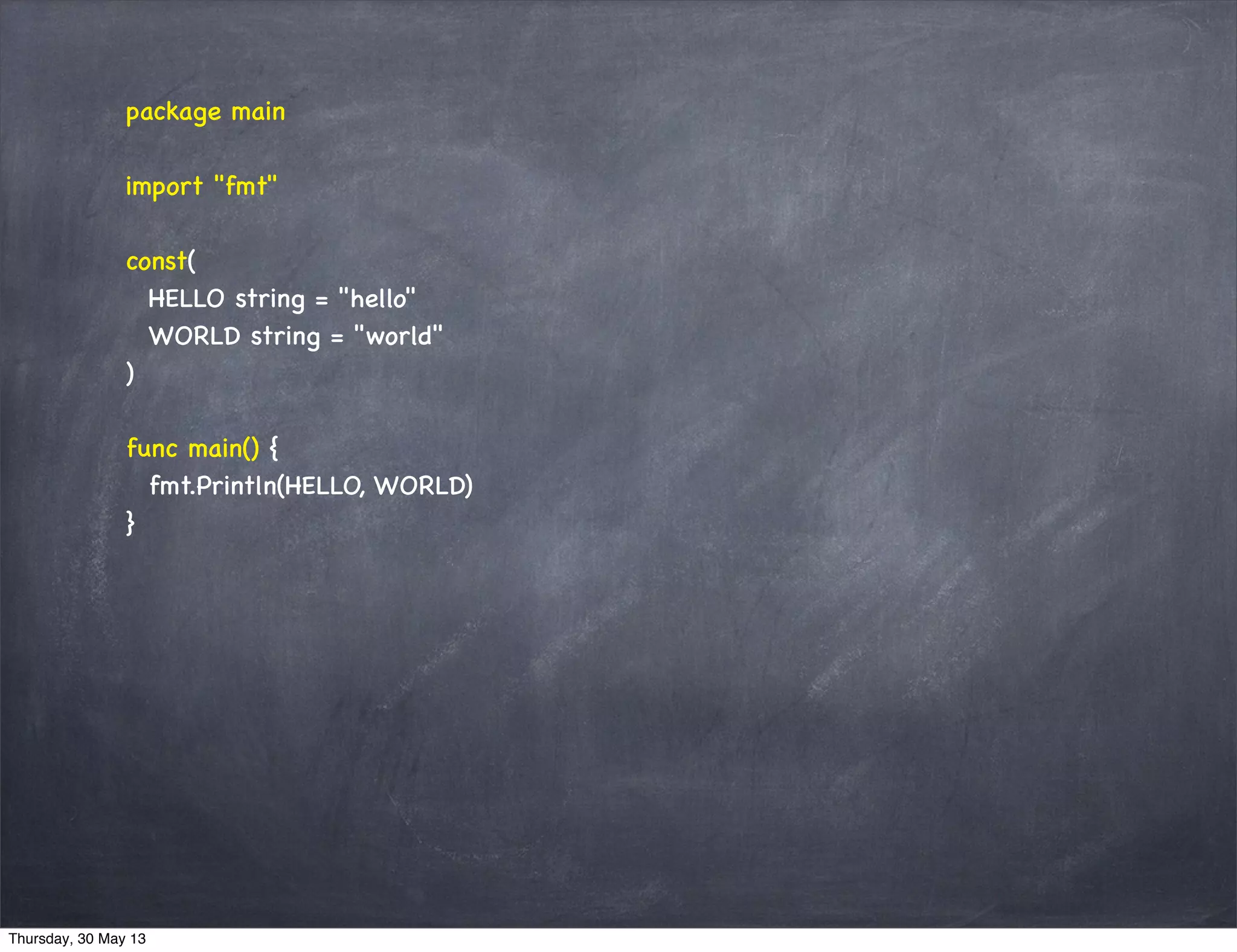
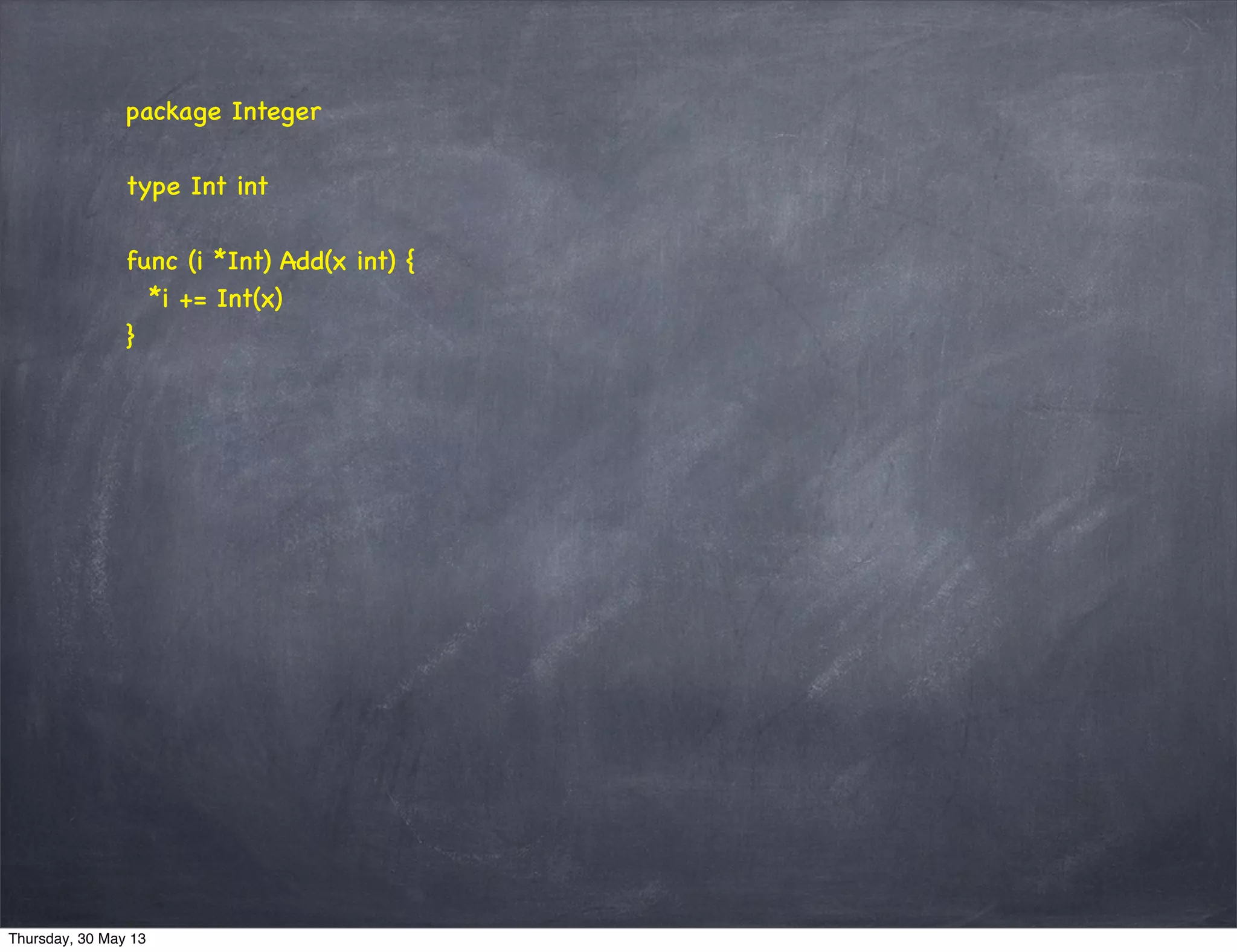
![package Integer
type Buffer []Int
func (b Buffer) Eq(o Buffer) (r bool) {
if len(b) == len(o) {
for i := len(b) - 1; i > 0; i-- {
if b[i] != o[i] {
return
}
}
r = true
}
return
}
func (b Buffer) Swap(i, j int) {
b[i], b[j] = b[j], b[i]
}
func (b Buffer) Clone() Buffer {
s := make(Buffer, len(b))
copy(s, b)
return s
}
func (b Buffer) Move(i, n int) {
if n > len(b) - i {
n = len(b) - i
}
segment_to_move := b[:i].Clone()
copy(b, b[i:i + n])
copy(b[n:i + n], segment_to_move)
}
Thursday, 30 May 13](https://image.slidesharecdn.com/golightly-130530144431-phpapp02/75/GoLightly-a-customisable-virtual-machine-written-in-Go-18-2048.jpg)
![package main
import "Integer"
func main() {
i := Integer.Buffer{0, 1, 2, 3, 4, 5}
b := i.Clone()
b.Swap(1, 2)
b.Move(3, 2)
b[0].Add(3)
println("b[:2] = {", b[0], ",", b[1], "}")
}
produces:
b[0:2] = { 6, 4 }
Thursday, 30 May 13](https://image.slidesharecdn.com/golightly-130530144431-phpapp02/75/GoLightly-a-customisable-virtual-machine-written-in-Go-19-2048.jpg)
![package Integer
import "testing"
func TestSwap(t *testing.T) {
i := Buffer{0, 1, 2, 3, 4, 5}
b := i.Clone()
b.Swap(1, 2)
if !b[1:3].Eq(Buffer{2, 1}) {
t.Fatalf("b[:5] = %v", b)
}
}
func TestMove(t *testing.T) {
i := Buffer{0, 1, 2, 3, 4, 5}
b := i.Clone()
b.Move(3, 2)
if !b.Eq(Buffer{3, 4, 0, 1, 2, 5}) {
t.Fatalf("b[:5] = %v", b)
}
}
func TestAdd(t *testing.T) {
i := Buffer{0, 1, 2, 3, 4, 5}
b := i.Clone()
b[0].Add(3)
if b[0] != i[0] + 3 {
t.Fatalf("b[:5] = %v", b)
}
}
Thursday, 30 May 13](https://image.slidesharecdn.com/golightly-130530144431-phpapp02/75/GoLightly-a-customisable-virtual-machine-written-in-Go-20-2048.jpg)
![package Vector
import . "Integer"
type Vector struct {
Buffer
}
func (v *Vector) Clone() Vector {
return Vector{v.Buffer.Clone()}
}
func (v *Vector) Slice(i, j int) Buffer {
return v.Buffer[i:j]
}
Thursday, 30 May 13](https://image.slidesharecdn.com/golightly-130530144431-phpapp02/75/GoLightly-a-customisable-virtual-machine-written-in-Go-22-2048.jpg)
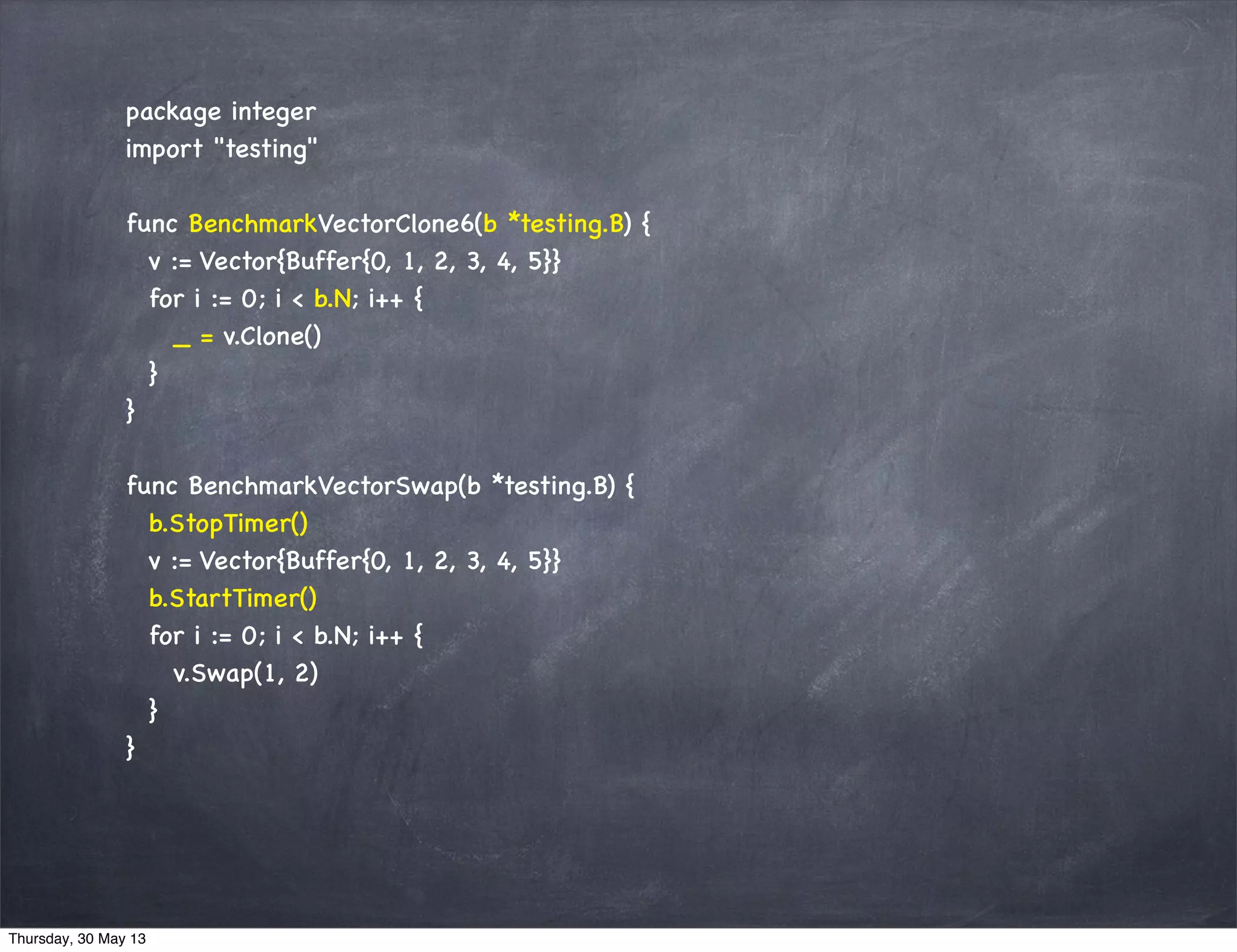
![package Integer
import "testing"
func TestVectorSwap(t *testing.T) {
i := Vector{Buffer{0, 1, 2, 3, 4, 5}}
v := i.Clone()
v.Swap(1, 2)
r := Vector{Buffer{0, 2, 1, 3, 4, 5}}
switch {
case !v.Match(&r):
fallthrough
case !v.Buffer.Match(r.Buffer):
t.Fatalf("b[:5] = %v", v)
}
}
Thursday, 30 May 13](https://image.slidesharecdn.com/golightly-130530144431-phpapp02/75/GoLightly-a-customisable-virtual-machine-written-in-Go-23-2048.jpg)
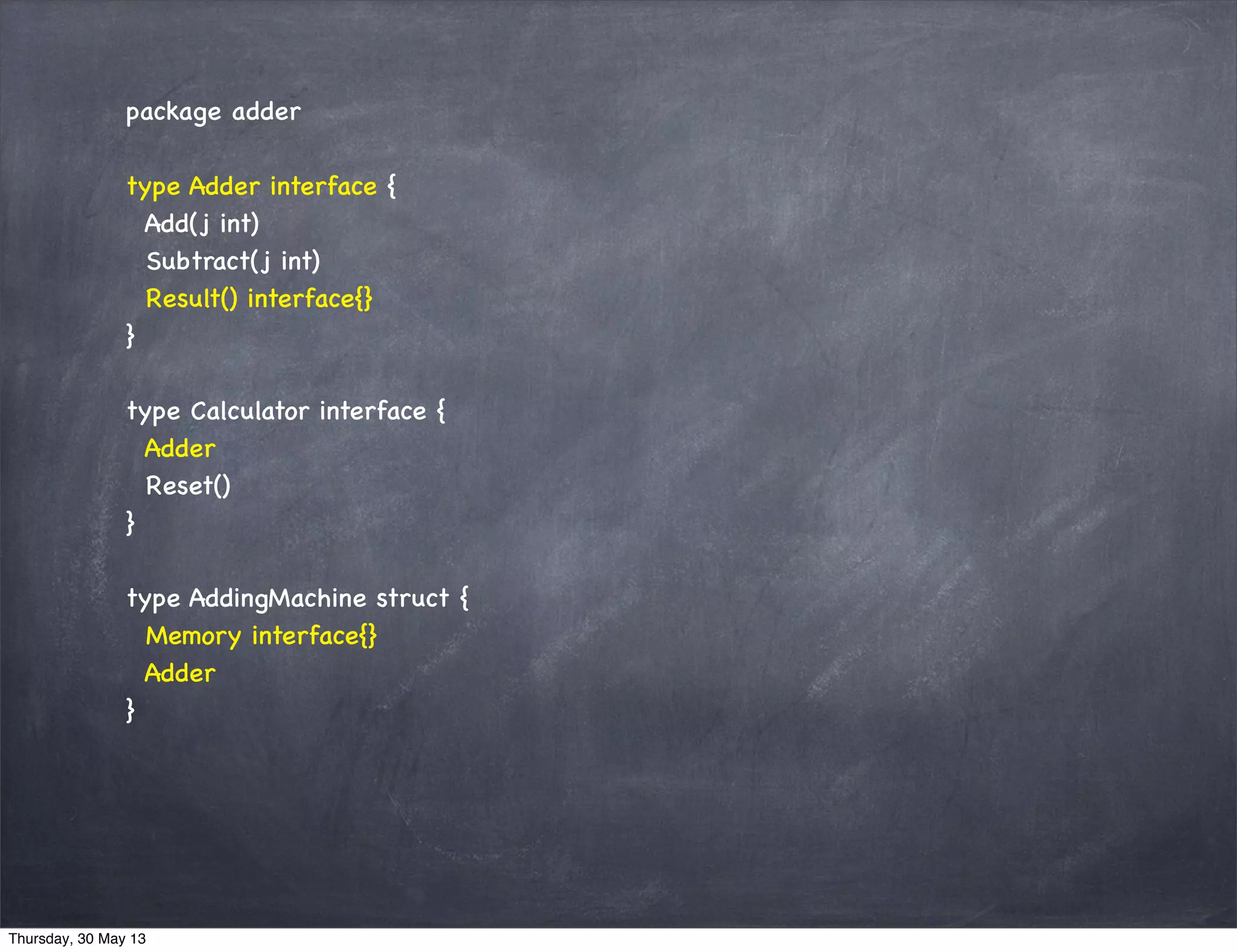
![package adder
type IAdder []int
func (i IAdder) Add(j int) {
i[0] += i[j]
}
func (i IAdder) Subtract(j int) {
i[0] -= i[j]
}
func (i IAdder) Result() interface{} {
return i[0]
}
func (i IAdder) Reset() {
i[0] = *new(int)
}
Thursday, 30 May 13](https://image.slidesharecdn.com/golightly-130530144431-phpapp02/75/GoLightly-a-customisable-virtual-machine-written-in-Go-28-2048.jpg)
![package adder
import "testing"
func TestIAdder(t *testing.T) {
error := "Result %v != %v"
i := IAdder{0, 1, 2}
i.Add(1)
if i.Result().(int) != 1 { t.Fatalf(error, i.Result(), 1) }
i.Subtract(2)
if i.Result().(int) != -1 { t.Fatalf(error, i.Result()), -1 }
var r Calculator = IAdder{-1, 1, 2}
for n, v := range r.(IAdder) {
if i[n] != v { t.Fatalf("Adder %v should be %v", i, r) }
}
r.Reset()
if r.Result().(int) != *new(int) {
t.Fatalf(error, r.Result(), *new(int))
}
}
Thursday, 30 May 13](https://image.slidesharecdn.com/golightly-130530144431-phpapp02/75/GoLightly-a-customisable-virtual-machine-written-in-Go-29-2048.jpg)
![package adder
import "testing"
func TestIAdder(t *testing.T) {
error := "Result %v != %v"
i := IAdder{0, 1, 2}
i.Add(1)
if i.Result() != 1 { t.Fatalf(error, i.Result(), 1) }
i.Subtract(2)
if i.Result() != -1 { t.Fatalf(error, i.Result()), -1 }
var r Calculator = IAdder{-1, 1, 2}
for n, v := range r.(IAdder) {
if i[n] != v { t.Fatalf("Adder %v should be %v", i, r) }
}
r.Reset()
if r.Result() != *new(int) {
t.Fatalf(error, r.Result(), *new(int))
}
}
Thursday, 30 May 13](https://image.slidesharecdn.com/golightly-130530144431-phpapp02/75/GoLightly-a-customisable-virtual-machine-written-in-Go-30-2048.jpg)
![package adder
type FAdder []float32
func (f FAdder) Add(j int) {
f[0] += f[j]
}
func (f FAdder) Subtract(j int) {
f[0] -= f[j]
}
func (f FAdder) Result() interface{} {
return f[0]
}
func (f FAdder) Reset() {
f[0] = *new(float32)
}
Thursday, 30 May 13](https://image.slidesharecdn.com/golightly-130530144431-phpapp02/75/GoLightly-a-customisable-virtual-machine-written-in-Go-31-2048.jpg)
![package adder
import "testing"
func TestFAdder(t *testing.T) {
error := "Result %v != %v"
f := FAdder{0.0, 1.0, 2.0}
f.Add(1)
if f.Result() != 1.0 { t.Fatalf(error, f.Result(), 1.0) }
f.Subtract(2)
if i.Result() != -1.0 { t.Fatalf(error, i.Result()), -1.0 }
var r Calculator = FAdder{-1.0, 1.0, 2.0}
for n, v := range r.(FAdder) {
if f[n] != v { t.Fatalf("Adder %v should be %v", f, r) }
}
r.Reset()
if r.Result() != *new(float32) {
t.Fatalf(error, r.Result(), *new(float32))
}
}
Thursday, 30 May 13](https://image.slidesharecdn.com/golightly-130530144431-phpapp02/75/GoLightly-a-customisable-virtual-machine-written-in-Go-32-2048.jpg)
![package adder
import "testing"
func TestAddingMachine(t *testing.T) {
error := "Result %v != %v"
a := &AddingMachine{ Adder: FAdder{0.0, 1.0, 2.0} }
a.Add(1)
if f, ok := a.Result().(float32); !ok {
t.Fatal("Result should be a float32")
} else if f != 1.0 {
t.Fatalf(error, a.Result(), 1.0)
}
a.Subtract(2)
if a.Result().(float32) != -1.0 { t.Fatalf(error, a.Result(), -1.0) }
r := FAdder{-1.0, 1.0, 2.0}
for n, v := range a.Adder.(FAdder) {
if r[n] != v { t.Fatalf("Adder %v should be %v", a, r) }
}
}
Thursday, 30 May 13](https://image.slidesharecdn.com/golightly-130530144431-phpapp02/75/GoLightly-a-customisable-virtual-machine-written-in-Go-33-2048.jpg)
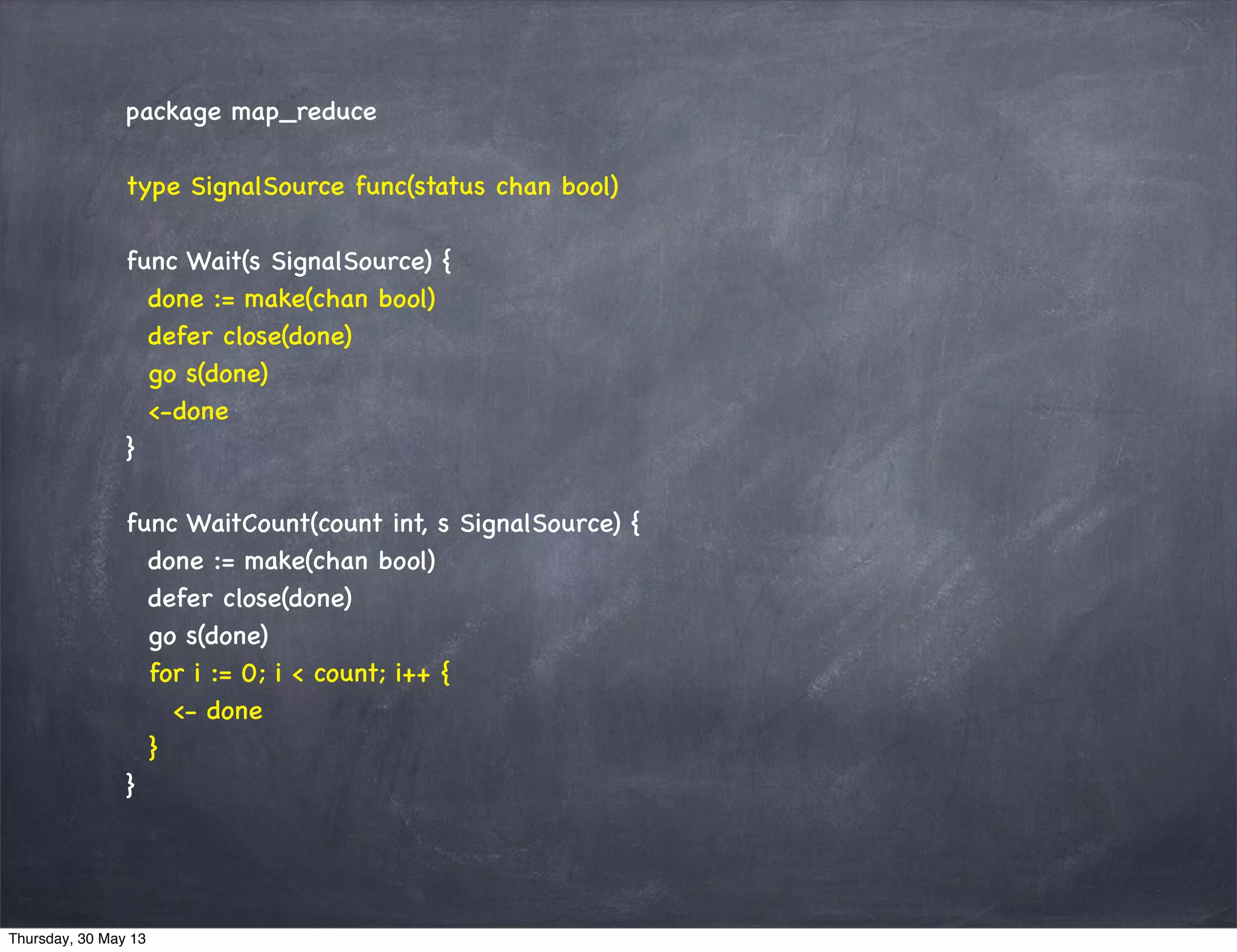
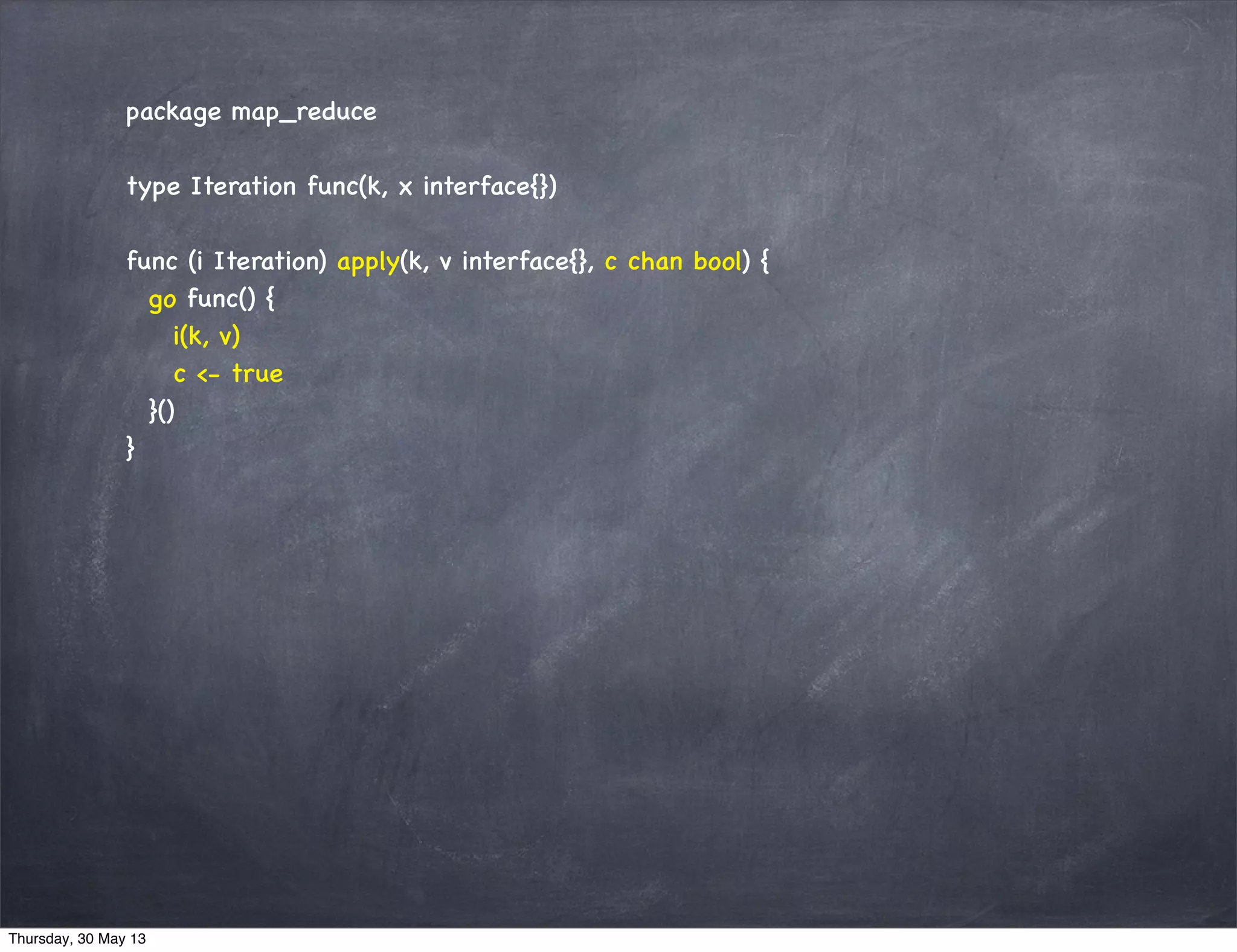
![package map_reduce
func Each(c interface{}, f Iteration) {
switch c := c.(type) {
case []int: WaitCount(len(c), func(done chan bool) {
for i, v := range c {
f.apply(i, v, done)
}
})
case map[int] int: WaitCount(len(c), func(done chan bool) {
for k, v := range c {
f.apply(k, v, done)
}
})
}
}
Thursday, 30 May 13](https://image.slidesharecdn.com/golightly-130530144431-phpapp02/75/GoLightly-a-customisable-virtual-machine-written-in-Go-40-2048.jpg)
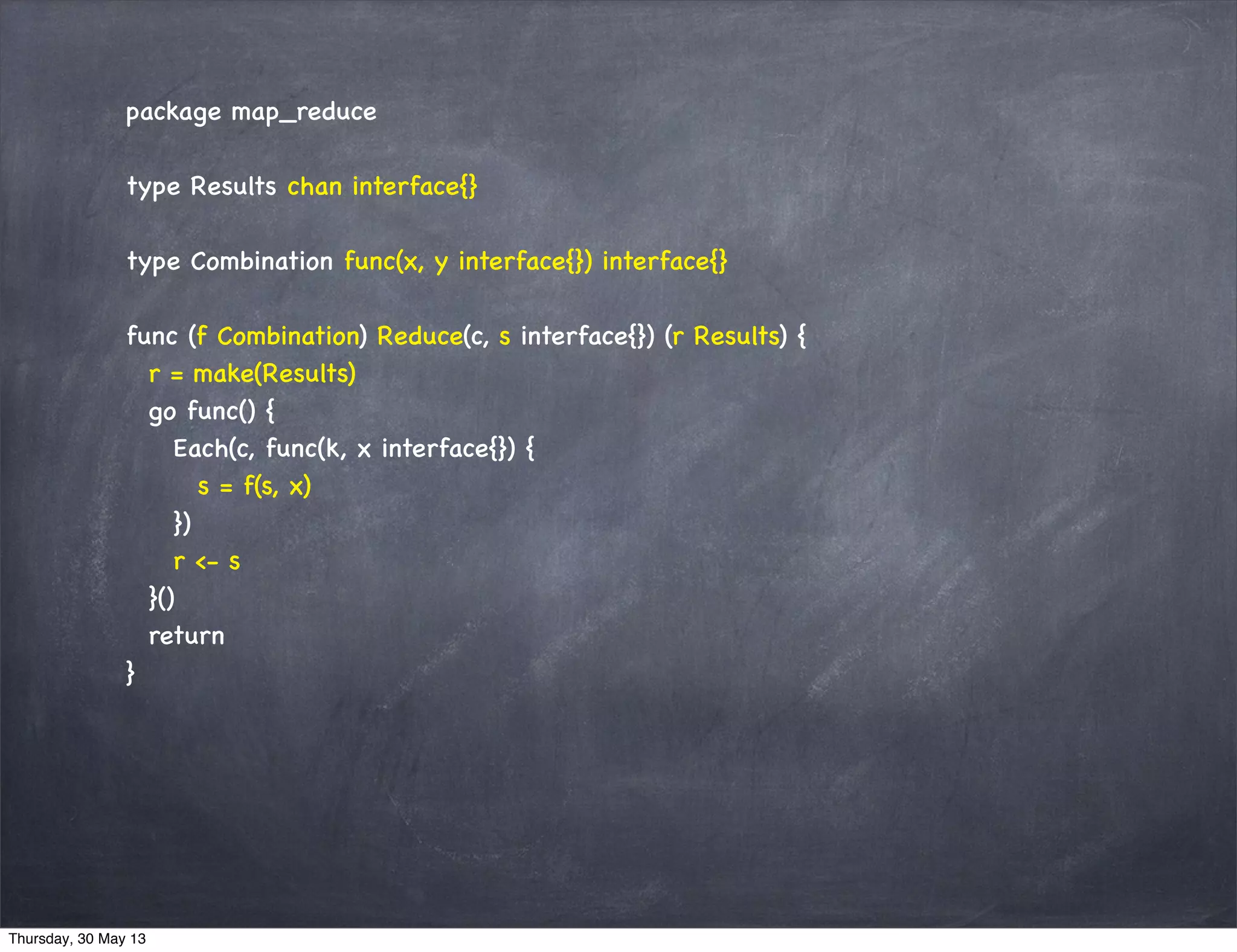
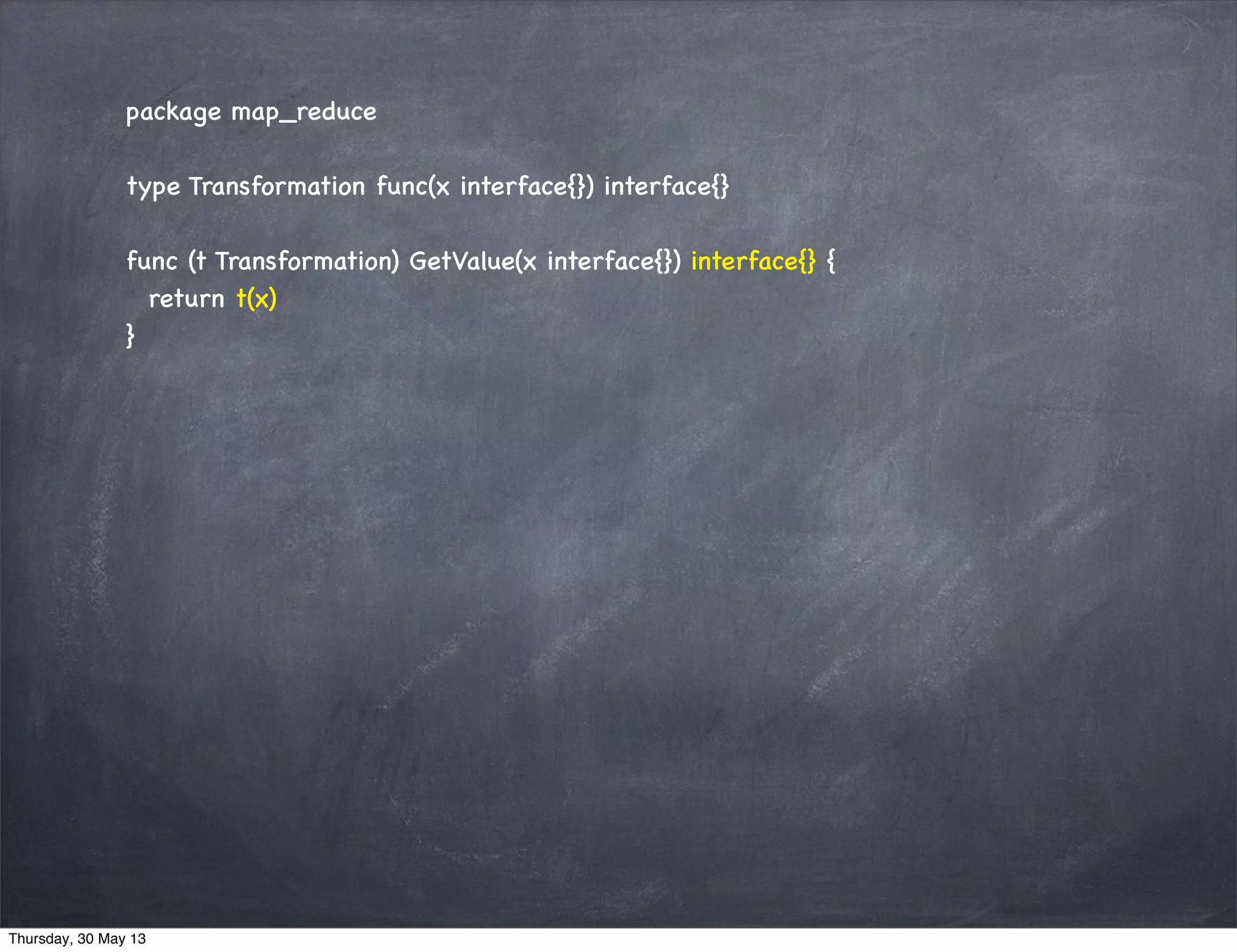
![func Map(c interface{}, t Transformation) (n interface{}) {
var i Iteration
switch c := c.(type) {
case []int: m := make([]int, len(c))
i = func(k, x interface{}) { m[k] = t.GetValue(x) }
n = m
case map[int] int: m := make(map[int] int)
i = func(k, x interface{}) { m[k] = t.GetValue(x) }
n = m
}
if i != nil {
Wait(func(done chan bool) {
Each(c, i)
done <- true
})
}
return
}
Thursday, 30 May 13](https://image.slidesharecdn.com/golightly-130530144431-phpapp02/75/GoLightly-a-customisable-virtual-machine-written-in-Go-43-2048.jpg)
![package main
import "fmt"
import . "map_reduce"
func main() {
m := "%v = %v, sum = %vn"
s := []int{0, 1, 2, 3, 4, 5}
sum := func(x, y interface{}) interface{} { return x.(int) + y.(int) }
d := Map(s, func(x interface{}) interface{} { return x.(int) * 2 })
x := <- Combination(sum).Reduce(s, 0)
fmt.Printf("s", s, x)
x = <- Combination(sum).Reduce(d, 0)
fmt.Printf("d", d, x)
}
produces:
s = [0 1 2 3 4 5], sum = 15
c = [0 2 4 6 8 10], sum = 30
Thursday, 30 May 13](https://image.slidesharecdn.com/golightly-130530144431-phpapp02/75/GoLightly-a-customisable-virtual-machine-written-in-Go-44-2048.jpg)
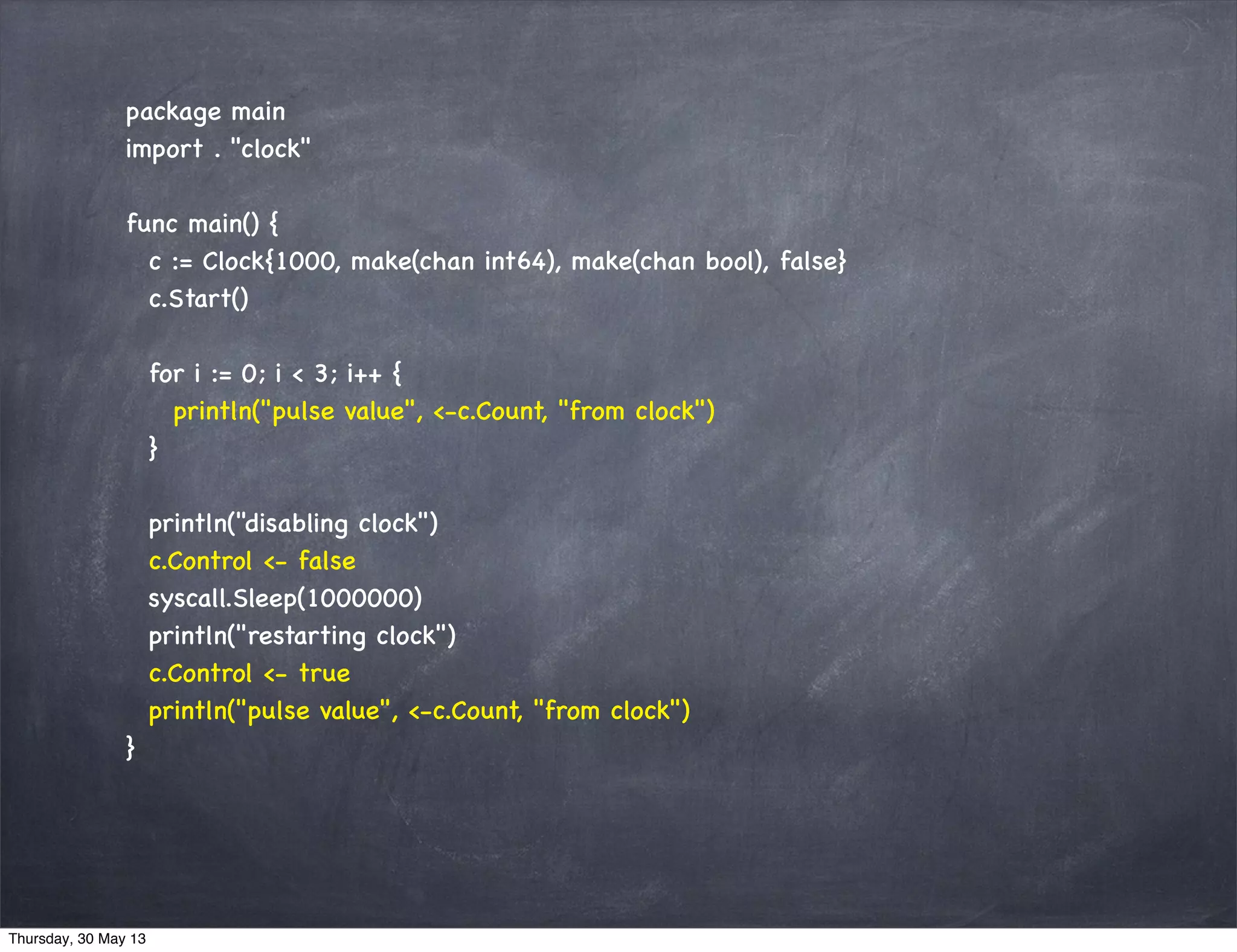
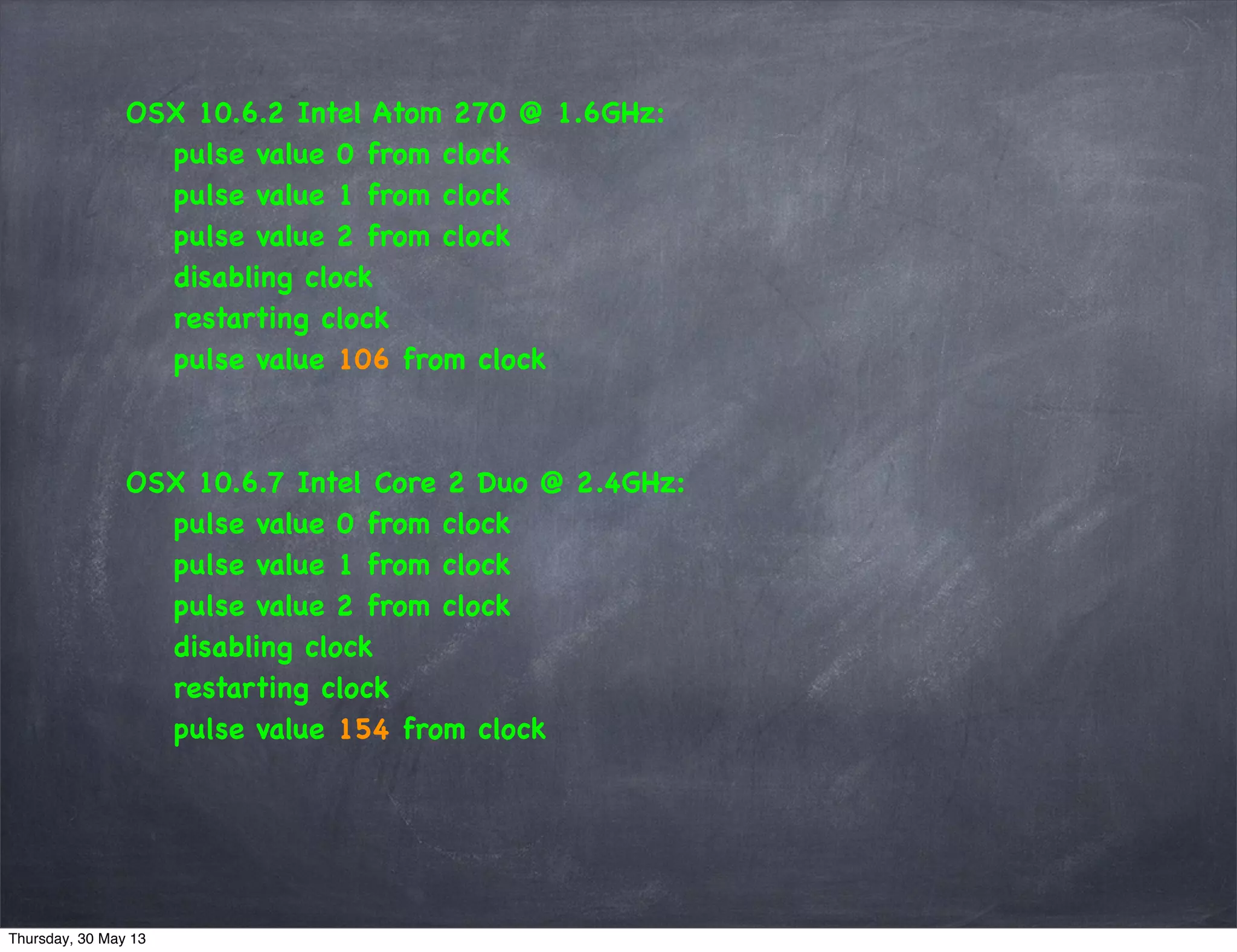
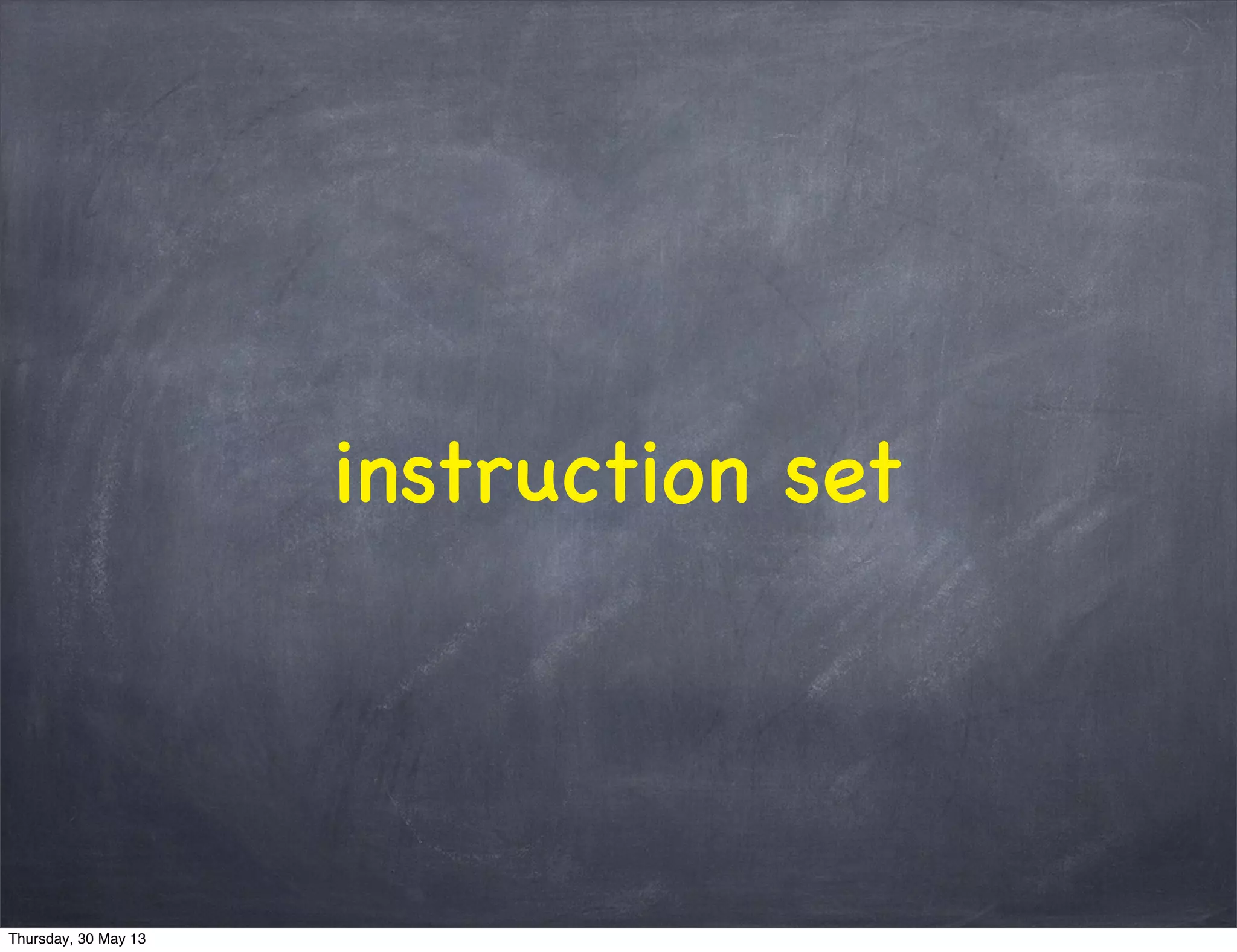
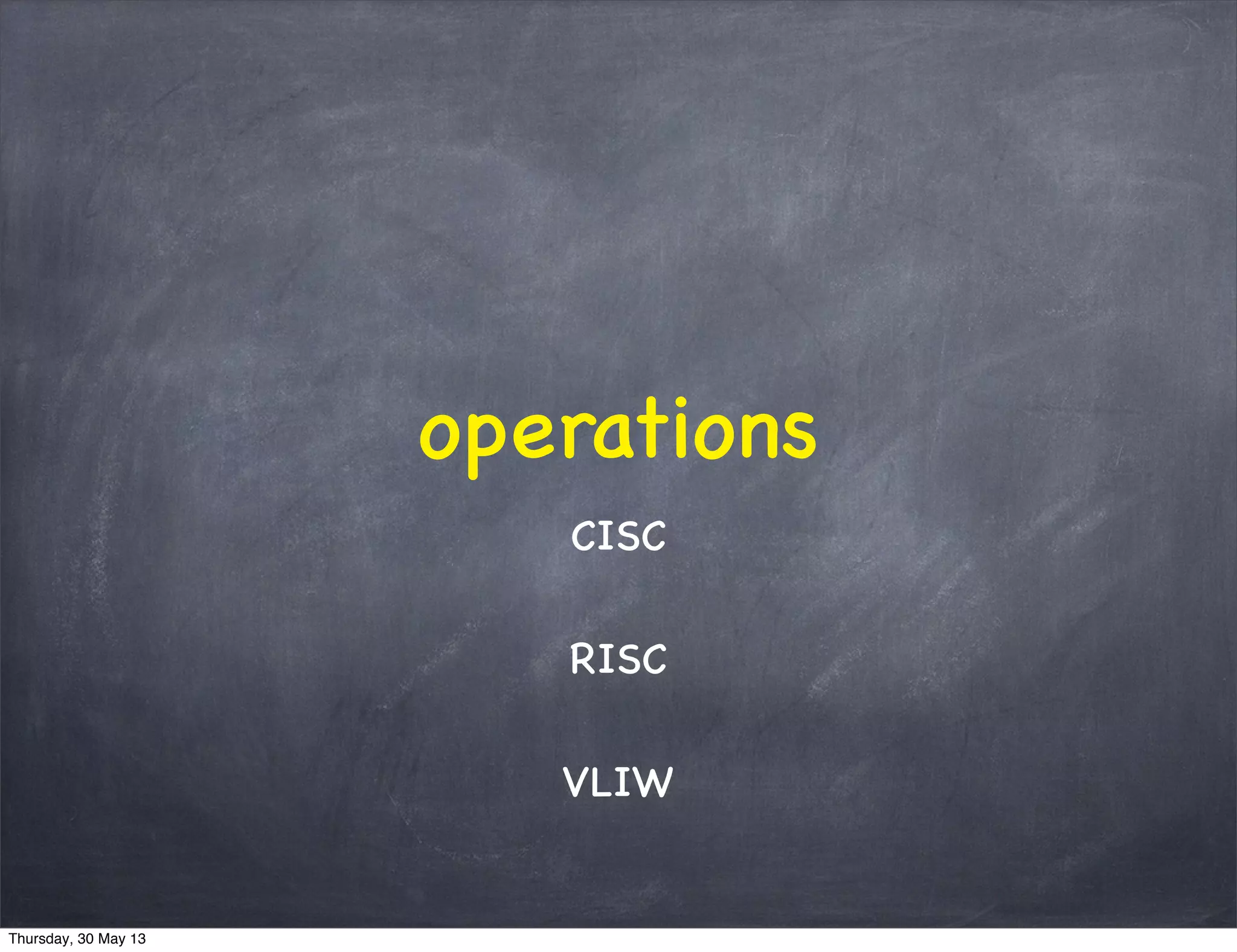
![package instructions
import "fmt"
type Operation func(o []int)
type Executable interface {
Opcode() int
Operands() []int
Execute(op Operation)
}
const INVALID_OPCODE = -1
type Program []Executable
func (p Program) Disassemble(a Assembler) {
for _, v := range p {
fmt.Println(a.Disassemble(v))
}
}
Thursday, 30 May 13](https://image.slidesharecdn.com/golightly-130530144431-phpapp02/75/GoLightly-a-customisable-virtual-machine-written-in-Go-53-2048.jpg)
![package instructions
type Instruction []int
func (i Instruction) Opcode() int {
if len(i) == 0 {
return INVALID_OPCODE
}
return i[0]
}
func (i Instruction) Operands() []int {
if len(i) < 2 {
return []int{}
}
return i[1:]
}
func (i Instruction) Execute(op Operation) {
op(i.Operands())
}
Thursday, 30 May 13](https://image.slidesharecdn.com/golightly-130530144431-phpapp02/75/GoLightly-a-customisable-virtual-machine-written-in-Go-54-2048.jpg)
![package instructions
type Assembler struct {
opcodes map[string] int
names map[int] string
}
func NewAssember(names... string) (a Assembler) {
a = Assembler{
opcodes: make(map[string] int),
names:make(map[int] string),
}
a.Define(names...)
return
}
func (a Assembler) Define(names... string) {
for _, name := range names {
a.opcodes[name] = len(a.names)
a.names[len(a.names)] = name
}
}
Thursday, 30 May 13](https://image.slidesharecdn.com/golightly-130530144431-phpapp02/75/GoLightly-a-customisable-virtual-machine-written-in-Go-55-2048.jpg)
![package instructions
func (a Assembler) Assemble(name string, params... int) (i Instruction) {
i = make(Instruction, len(params) + 1)
if opcode, ok := a.opcodes[name]; ok {
i[0] = opcode
} else {
i[0] = INVALID_OPCODE
}
copy(i[1:], params)
return
}
Thursday, 30 May 13](https://image.slidesharecdn.com/golightly-130530144431-phpapp02/75/GoLightly-a-customisable-virtual-machine-written-in-Go-56-2048.jpg)
![package instructions
import "fmt"
func (a Assembler) Disassemble(e Executable) (s string) {
if name, ok := a.names[e.Opcode()]; ok {
s = name
if params := e.Operands(); len(params) > 0 {
s = fmt.Sprintf("%vt%v", s, params[0])
for _, v := range params[1:] {
s = fmt.Sprintf("%v, %v", s, v)
}
}
} else {
s = "unknown"
}
return
}
Thursday, 30 May 13](https://image.slidesharecdn.com/golightly-130530144431-phpapp02/75/GoLightly-a-customisable-virtual-machine-written-in-Go-57-2048.jpg)
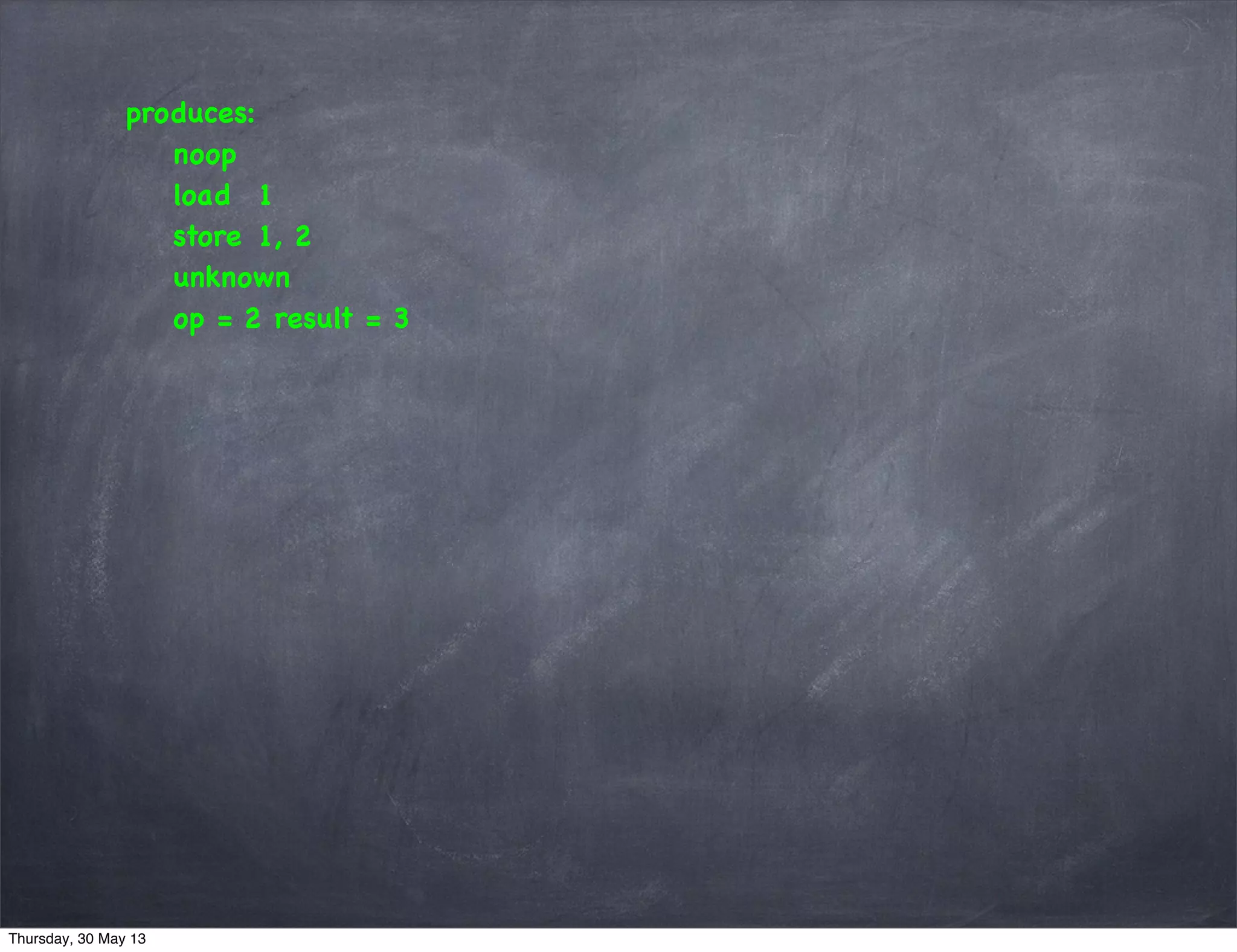
![package main
import . "instructions"
func main() {
a := NewAssembler("noop", "load", "store")
p := Program{ a.Assemble("noop"),
a.Assemble("load", 1),
a.Assemble("store", 1, 2),
a.Assemble("invalid", 3, 4, 5) }
p.Disassemble(a)
for _, v := range p {
if len(v.Operands()) == 2 {
v.Execute(func(o []int) {
o[0] += o[1]
})
println("op =", v.Opcode(), "result =", v.Operands()[0])
}
}
}
Thursday, 30 May 13](https://image.slidesharecdn.com/golightly-130530144431-phpapp02/75/GoLightly-a-customisable-virtual-machine-written-in-Go-58-2048.jpg)
![package processor
import . "instructions"
const PROCESSOR_READY = 0
const PROCESSOR_BUSY = 1
const CALL_STACK_UNDERFLOW = 2
const CALL_STACK_OVERFLOW = 4
const ILLEGAL_OPERATION = 8
const INVALID_ADDRESS = 16
type Processor interface {
Run(p []Executable)
}
type Core struct {
Running bool
PC, Flags, Ticks int
CS, M []int
OP Executable "Loaded OpCode"
I chan Executable "Interrupts"
}
Thursday, 30 May 13](https://image.slidesharecdn.com/golightly-130530144431-phpapp02/75/GoLightly-a-customisable-virtual-machine-written-in-Go-61-2048.jpg)
![package processor
import . "instructions"
func NewCore(CSS, MSS int, I chan Executable) *Core {
return &Core{
CS:make([]int, CSS)},
M: make([]int, MSS),
I: I,
}
}
func (c *Core) Reset() {
c.Running = false
c.Flags = PROCESSOR_READY
}
func (c *Core) Goto(addr int) {
c.PC = addr
}
Thursday, 30 May 13](https://image.slidesharecdn.com/golightly-130530144431-phpapp02/75/GoLightly-a-customisable-virtual-machine-written-in-Go-62-2048.jpg)
![package processor
func (c *Core) Call(addr int) {
top := len(c.CS)
if top >= cap(c.CS) - 1 { panic(CALL_STACK_OVERFLOW) }
c.CS = c.CS[:top + 1]
c.CS[top] = c.PC
c.PC = addr
}
func (c *Core) TailCall(addr int) {
c.CS[len(c.CS) - 1] = c.PC
c.PC = addr
}
func (c *Core) Return() {
top := len(c.CS)
if top == 0 { panic(CALL_STACK_UNDERFLOW) }
c.PC, c.CS = c.CS[top - 1], c.CS[:top]
}
Thursday, 30 May 13](https://image.slidesharecdn.com/golightly-130530144431-phpapp02/75/GoLightly-a-customisable-virtual-machine-written-in-Go-63-2048.jpg)
![package processor
import . "instructions"
func (c *Core) Run(p []Executable, dispatchers... func(c *Core)) {
defer func() {
c.Running = false
if x := recover(); x != nil { c.Flags &= x.(int) }
}()
switch {
case c.Running: panic(PROCESSOR_BUSY)
case len(dispatchers) == 0: panic(PROCESSOR_READY)
default:
c.Running = true
c.BusyLoop(dispatchers...)
}
}
func (c *Core) LoadInstruction(program []Executable) {
if c.PC >= len(program) { panic(PROCESSOR_READY) }
c.Executable = program[c.PC]
c.PC++
}
Thursday, 30 May 13](https://image.slidesharecdn.com/golightly-130530144431-phpapp02/75/GoLightly-a-customisable-virtual-machine-written-in-Go-64-2048.jpg)
![package processor
import . "instructions"
func (c *Core) BusyLoop(p []Executable, dispatchers... func(c *Core)) {
select {
case interrupt <- c.I:
op, pc := c.OP, c.PC
for c.PC = 0; c.Running; c.Ticks++ {
for _, f := range dispatchers { f(c) }
c.LoadInstruction(p)
}
c.OP, c.PC = op, pc
default:
for c.PC = 0; c.Running; c.Ticks++ {
c.LoadInstruction(p)
for _, f := range dispatchers { f(c) }
}
}
}
Thursday, 30 May 13](https://image.slidesharecdn.com/golightly-130530144431-phpapp02/75/GoLightly-a-customisable-virtual-machine-written-in-Go-65-2048.jpg)
![package processor
import . "instructions"
func (c *Core) RunExclusive(p []Executable, tracers... func(c *Core)) {
defer func() {
c.Running = false
if x := recover(); x != nil { c.Flags &= x.(int) }
}()
if c.Running { panic(PROCESSOR_BUSY) }
case len(dispatchers) == 0: panic(PROCESSOR_READY)
c.Running = true
for c.PC = 0; c.Running; c.Ticks++ {
c.LoadInstruction(p)
for _, f := range tracers { f(c) }
}
}
Thursday, 30 May 13](https://image.slidesharecdn.com/golightly-130530144431-phpapp02/75/GoLightly-a-customisable-virtual-machine-written-in-Go-66-2048.jpg)
![package main
import . "processor"
import . "instructions"
const( CALL = iota
GOTO
MOVE
RETURN
)
c := NewCore(10, 8, nil)
var dispatcher = func(c *Core) {
switch c.Opcode() {
case CALL: c.Execute(func(o []int) { c.Call(o[0]) })
case GOTO: c.Execute(func(o []int) { c.Goto(o[0]) })
case MOVE: c.Execute(func(o []int) { c.Goto(c.PC + o[0]) })
case RETURN: c.Execute(func(o []int) { c.Return() })
default: panic(ILLEGAL_OPERATION)
}
}
Thursday, 30 May 13](https://image.slidesharecdn.com/golightly-130530144431-phpapp02/75/GoLightly-a-customisable-virtual-machine-written-in-Go-67-2048.jpg)
![func main() {
p := []Executable{ Instruction{ CALL, 2 },
Instruction{ GOTO, 5 },
Instruction{ MOVE, 2 },
Instruction{ RETURN },
Instruction{ MOVE, -1 } }
c.RunExclusive(p, dispatcher)
fmt.Printf("Instructions Executed: %vnPC = %vn", c.Ticks, c.PC)
if c.Flags | PROCESSOR_READY == PROCESSOR_READY {
fmt.Println("Core Ready")
} else {
fmt.Println("Core Error:", c.Flags)
}
}
produces:
Instructions Executed: 2
PC = 5
Core Ready
Thursday, 30 May 13](https://image.slidesharecdn.com/golightly-130530144431-phpapp02/75/GoLightly-a-customisable-virtual-machine-written-in-Go-68-2048.jpg)
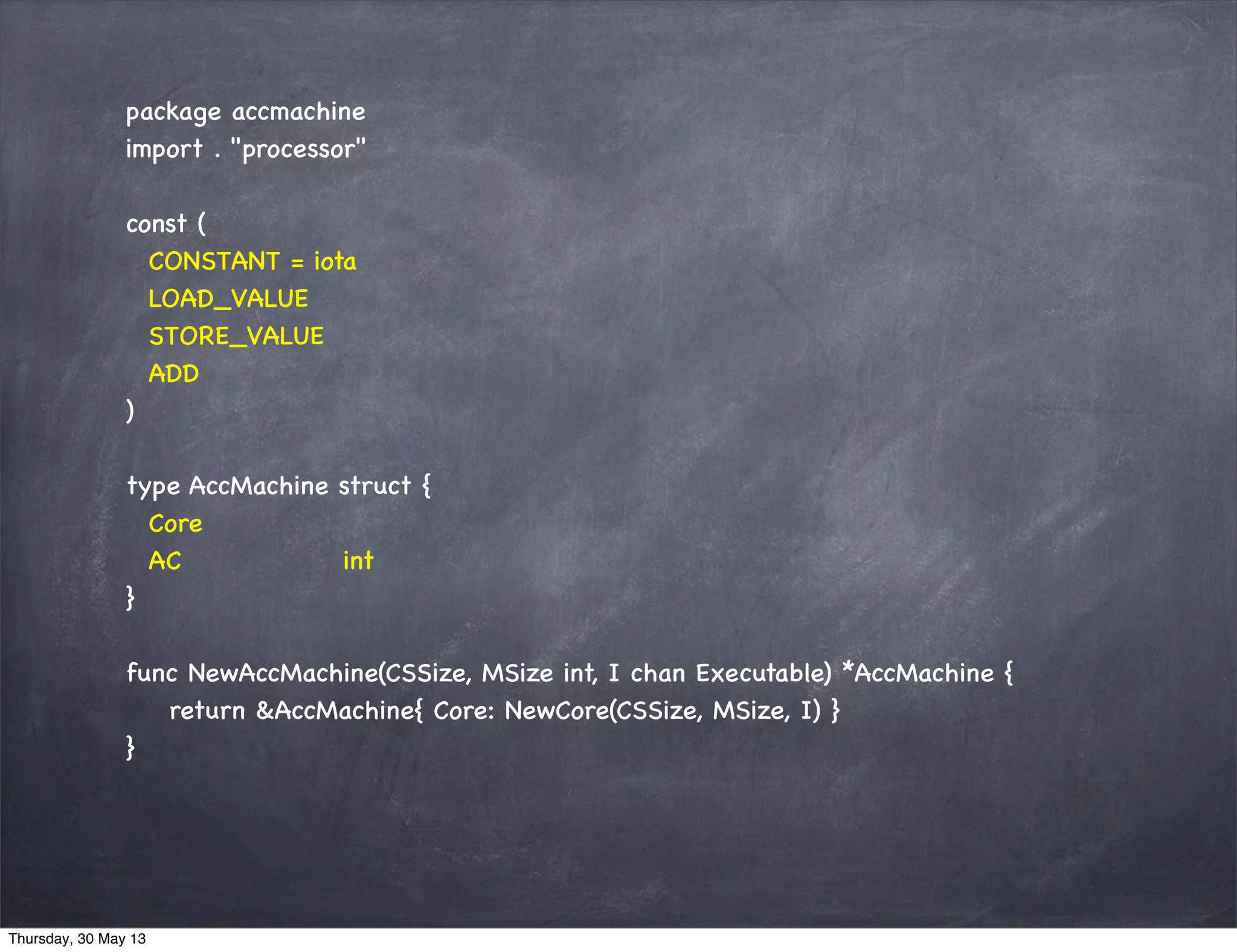
![package accmachine
import . "processor"
func (a *AccMachine) Run(program []Executable) {
a.RunExclusive(program, func() {
switch a.Opcode() {
case CONSTANT: a.Execute(func(o []int) { a.AC = o[0] })
case LOAD_VALUE: a.Execute(func(o []int) { a.AC = a.M[o[0]] })
case STORE_VALUE: a.Execute(func(o []int) { a.M[o[0]] = a.AC })
case ADD: a.Execute(func(o []int) { a.AC += a.M[o[0]] })
default: panic(ILLEGAL_OPERATION)
}
})
}
Thursday, 30 May 13](https://image.slidesharecdn.com/golightly-130530144431-phpapp02/75/GoLightly-a-customisable-virtual-machine-written-in-Go-71-2048.jpg)
![package main
import . "accmachine"
import . "instructions"
func main() {
a := NewAccMachine(10, 8, nil)
p := []Executable{ Instruction{CONSTANT, 27},
Instruction{STORE_VALUE, 0},
Instruction{CONSTANT, 13},
Instruction{STORE_VALUE, 1},
Instruction{CONSTANT, 10},
Instruction{ADD, 1},
Instruction{ADD, 0},
Instruction{STORE_VALUE, 2} }
a.Run(p)
fmt.Println("accumulated value =", a.AC)
}
produces:
accumulated value = 50
Thursday, 30 May 13](https://image.slidesharecdn.com/golightly-130530144431-phpapp02/75/GoLightly-a-customisable-virtual-machine-written-in-Go-72-2048.jpg)
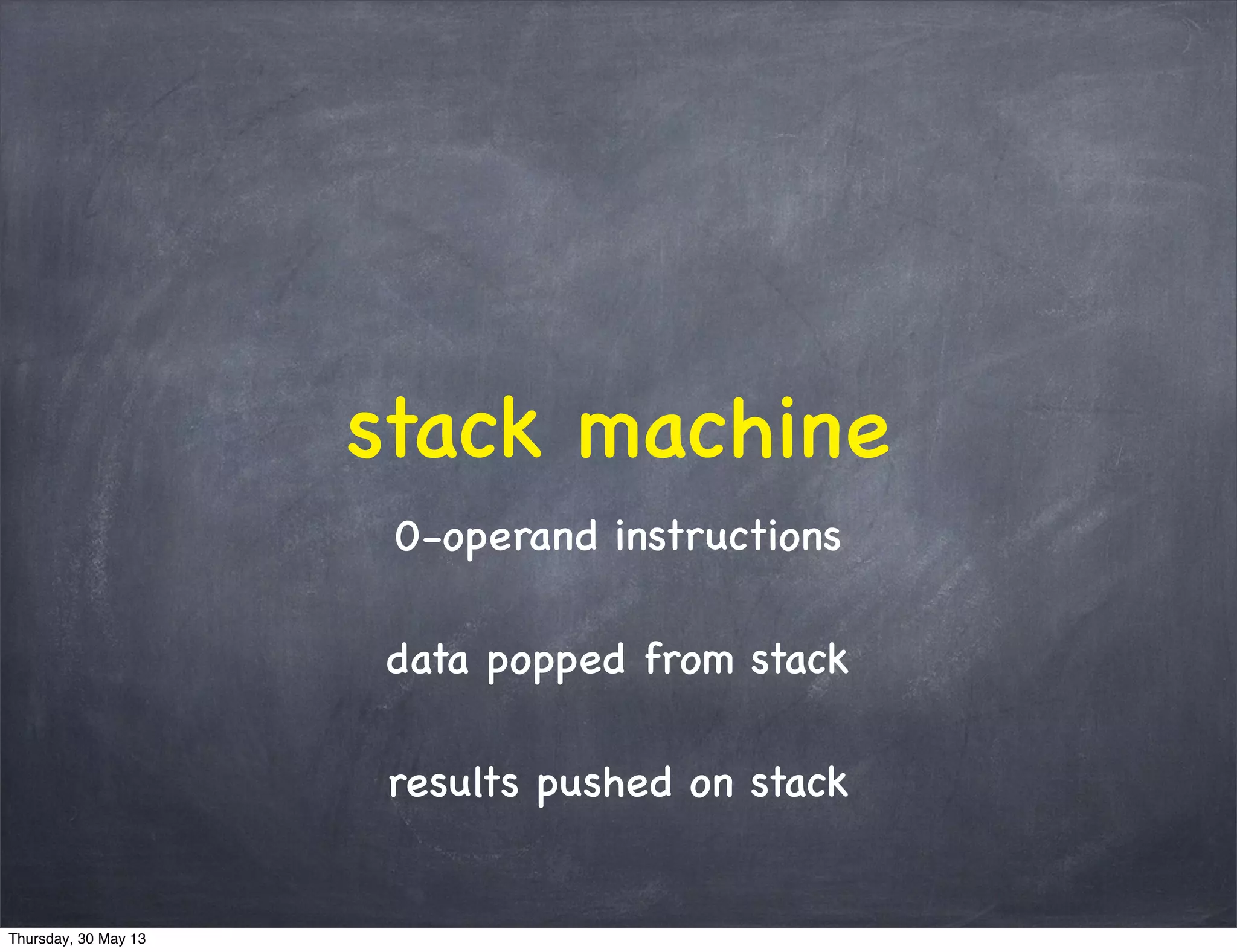
![package smachine
import . "processor"
const (
CONSTANT = iota
PUSH_VALUE
POP_VALUE
ADD
)
type StackMachine struct {
Core
DS []int
}
func NewStackM(CSSize, DSSize, MSize int, I chan Executable) *StackMachine {
return &StackMachine{DS: make([]int, 0, DSSize),
Core: NewCore(CSSize, MSize, I) }
}
Thursday, 30 May 13](https://image.slidesharecdn.com/golightly-130530144431-phpapp02/75/GoLightly-a-customisable-virtual-machine-written-in-Go-74-2048.jpg)
![package smachine
import . "processor"
func (s *StackMachine) Push(v int) {
top := len(s.DS)
s.DS, s.DS[top] = s.DS[:top + 1], v
}
func (s *StackMachine) Pop(addr int) {
top := len(s.DS) - 1
s.M[addr], s.DS = s.DS[top], s.DS[:top]
}
Thursday, 30 May 13](https://image.slidesharecdn.com/golightly-130530144431-phpapp02/75/GoLightly-a-customisable-virtual-machine-written-in-Go-75-2048.jpg)
![package smachine
import . "processor"
func (s *StackMachine) Run(program []Executable) {
s.RunExclusive(program, func() {
switch s.Opcode() {
case CONSTANT: s.Execute(func(o []int) { s.Push(o[0]) })
case PUSH_VALUE: s.Execute(func(o []int) { s.Push(s.M[o[0]]) })
case POP_VALUE: s.Execute(func(o []int) { s.Pop(s.M[o[0]]) })
case ADD: s.Execute(func(o []int) {
l := len(s.DS)
s.DS[l - 2] += s.DS[l - 1]
s.DS = s.DS[:l - 1]
})
default: panic(ILLEGAL_OPERATION)
}
})
}
Thursday, 30 May 13](https://image.slidesharecdn.com/golightly-130530144431-phpapp02/75/GoLightly-a-customisable-virtual-machine-written-in-Go-76-2048.jpg)
![package main
import . "smachine"
import . "instructions"
func main() {
s := NewStackM(10, 10, 8, nil)
p := []Executable{ Instruction{CONSTANT, 27},
Instruction{CONSTANT, 13},
Instruction{CONSTANT, 10},
Instruction{ADD},
Instruction{ADD} }
s.Run(p)
fmt.Println("data stack =", s.DS)
}
produces:
registers = [50 13 10 0 0 0 0 0 0 0]
Thursday, 30 May 13](https://image.slidesharecdn.com/golightly-130530144431-phpapp02/75/GoLightly-a-customisable-virtual-machine-written-in-Go-77-2048.jpg)
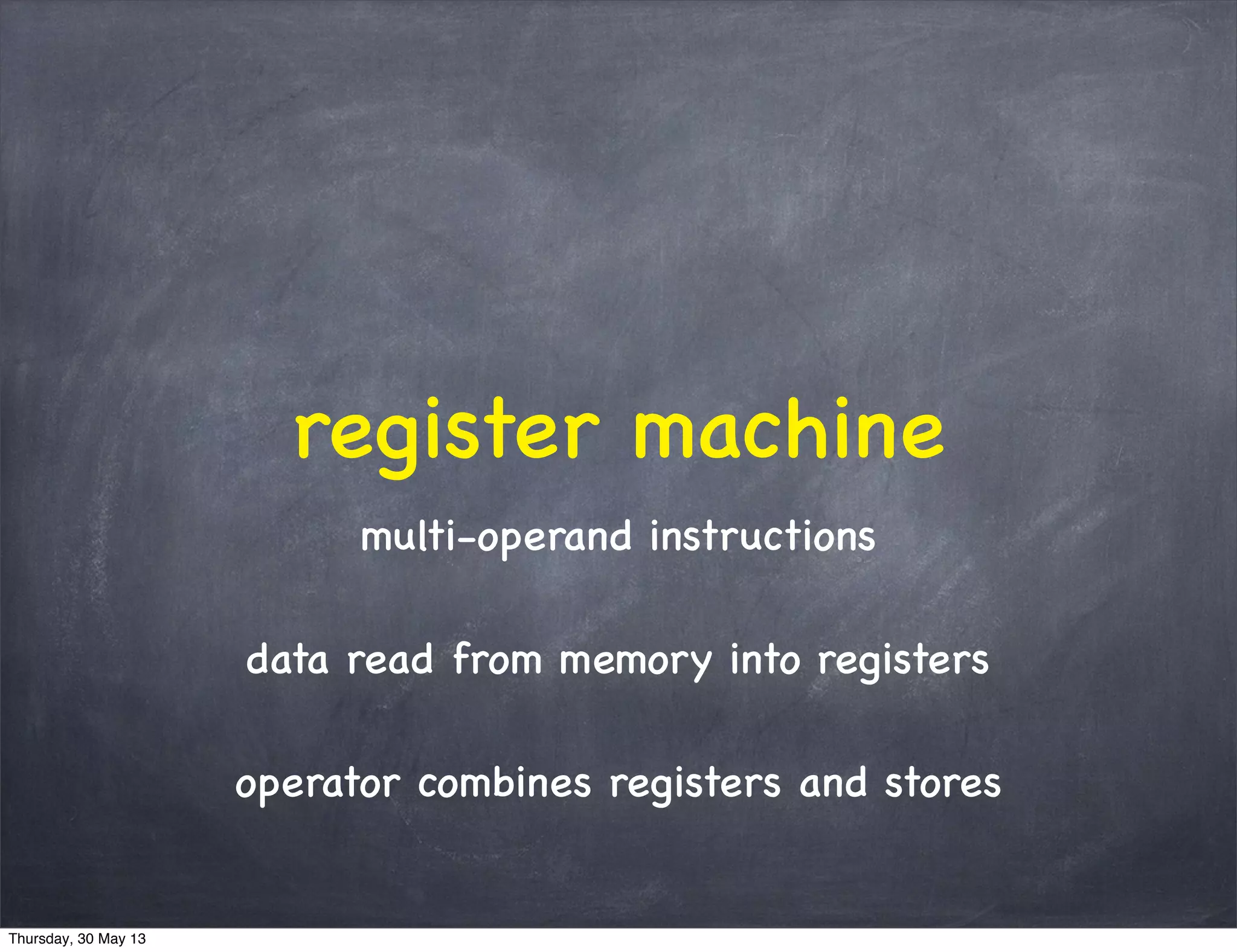
![package rmachine
import . "processor"
const (
CONSTANT = iota
LOAD_VALUE
STORE_VALUE
ADD
)
type RMachine struct {
Core
R []int
}
func NewRMachine(CSSize, RSize, MSize int, I chan Executable) *RMachine {
return &RMachine{ Core: NewCore(CSSize, MSize, I),
R: make([]int, RSize) }
}
Thursday, 30 May 13](https://image.slidesharecdn.com/golightly-130530144431-phpapp02/75/GoLightly-a-customisable-virtual-machine-written-in-Go-79-2048.jpg)
![package rmachine
import . "processor"
func (r *RMachine) Run(program []Executable) {
r.RunExclusive(program, func() {
switch r.Opcode() {
case CONSTANT: r.Execute(func(o []int) { r.R[o[0]] = o[1] })
case LOAD_VALUE: r.Execute(func(o []int) { r.R[o[0]] = r.M[o[1]] })
case STORE_VALUE: r.Execute(func(o []int) { r.M[o[0]] = r.R[o[1]] })
case ADD: r.Execute(func(o []int) { r.R[o[0]] += r.R[o[1]] })
default: panic(ILLEGAL_OPERATION)
}
})
}
Thursday, 30 May 13](https://image.slidesharecdn.com/golightly-130530144431-phpapp02/75/GoLightly-a-customisable-virtual-machine-written-in-Go-80-2048.jpg)
![package main
import . "rmachine"
import . "instructions"
func main() {
r := NewRMachine(10, 10, 8, nil)
p := []Executable{ Instruction{CONSTANT, 0, 27},
Instruction{CONSTANT, 1, 13},
Instruction{CONSTANT, 2, 10},
Instruction{ADD, 0, 1},
Instruction{ADD, 0, 2} }
r.Run(p)
fmt.Println("registers =", r.R)
}
produces:
registers = [50 13 10 0 0 0 0 0 0 0]
Thursday, 30 May 13](https://image.slidesharecdn.com/golightly-130530144431-phpapp02/75/GoLightly-a-customisable-virtual-machine-written-in-Go-81-2048.jpg)
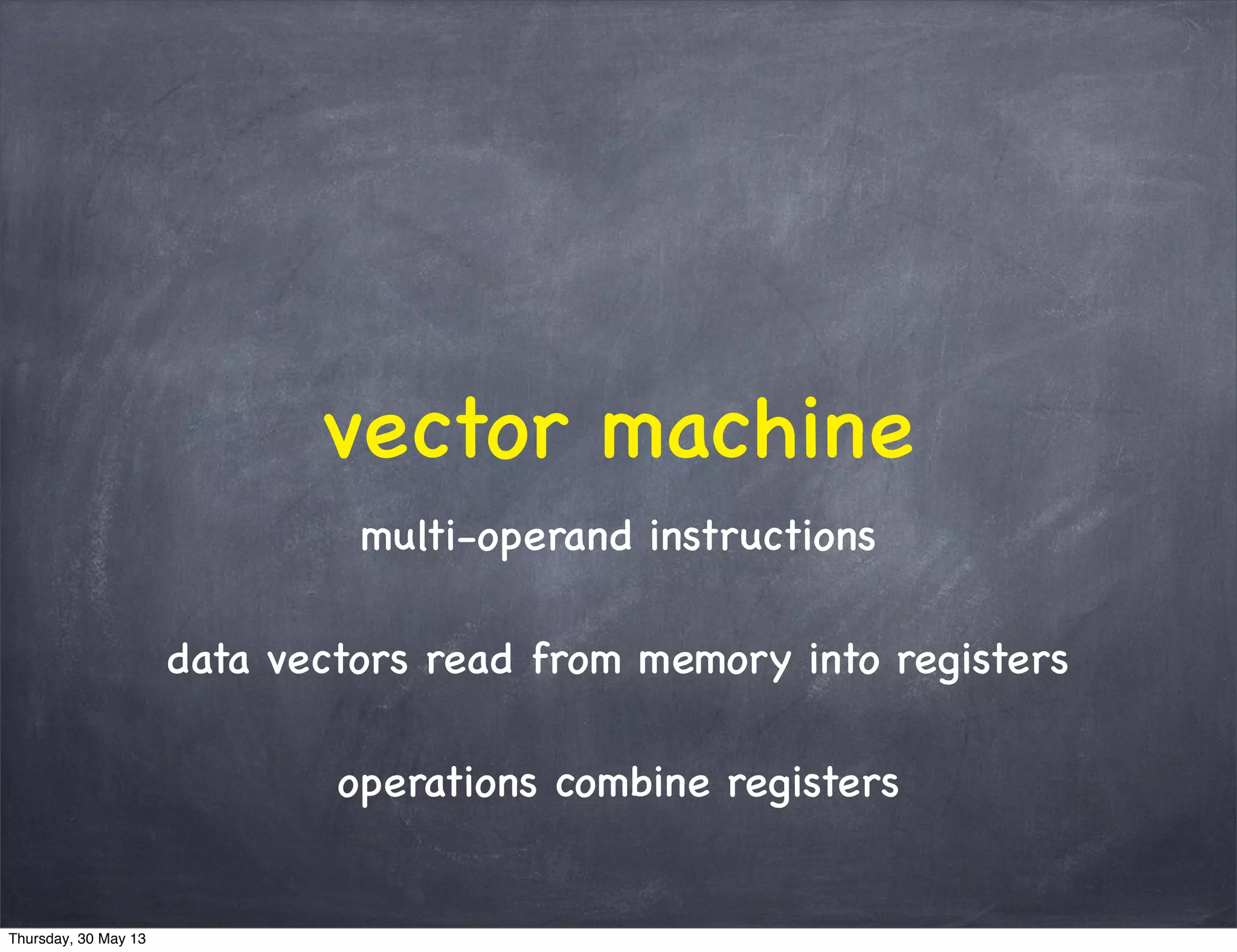
![package vmachine
import . "processor"
const (
CONSTANT = iota
LOAD_VALUE
STORE_VALUE
ADD
)
type VMachine struct {
Core
R [][]int
}
func NewVMachine(CSSize, RSize, MSize int, I chan Executable) *VMachine {
return &VectorMachine{ Core: NewCore(CSSize, MSize),
make([][]int, RSize) }
}
Thursday, 30 May 13](https://image.slidesharecdn.com/golightly-130530144431-phpapp02/75/GoLightly-a-customisable-virtual-machine-written-in-Go-83-2048.jpg)
![package vmachine
import . "processor"
func (v *VMachine) Load(r int, m []int) {
v.R[r] = make([]int, len(m))
copy(v.R[r], m)
}
Thursday, 30 May 13](https://image.slidesharecdn.com/golightly-130530144431-phpapp02/75/GoLightly-a-customisable-virtual-machine-written-in-Go-84-2048.jpg)
![package vmachine
import . "processor"
func (v *VMachine) Run(program []Executable) {
v.RunExclusive(program, func() {
switch v.Opcode() {
case CONSTANT: v.Execute(func(o []int) { v.Load(o[0], o[1:]) })
case STORE_VALUE: v.Execute(func(o []int) { copy(v.M[o[0]:], v.R[o[1]]) })
case LOAD_VALUE: v.Execute(func(o []int) {
v.Load(o[0], v.M[o[1]:o[1] + o[2]])
})
case ADD: v.Execute(func(o []int) {
a, b := v.R[o[0]], v.R[o[1]]
count := len(a)
if len(b) < len(a) { count := len(b) }
for ; count > 0; count-- { a[i] += b[i] }
})
default: panic(ILLEGAL_OPERATION)
}
})
}
Thursday, 30 May 13](https://image.slidesharecdn.com/golightly-130530144431-phpapp02/75/GoLightly-a-customisable-virtual-machine-written-in-Go-85-2048.jpg)
![package main
import . "vmachine"
import . "instructions"
func main() {
r := NewVMachine(10, 10, 8, nil)
p := []Executable{ Instruction{CONSTANT, 0, 27},
Instruction{CONSTANT, 1, 13},
Instruction{CONSTANT, 2, 10},
Instruction{ADD, 0, 1},
Instruction{ADD, 0, 2} }
r.Run(p)
fmt.Println("registers =", r.R)
}
produces:
vectors = [[50 50 50] [13 10 27] [10 27 13] [] [] [] [] [] [] []]
Thursday, 30 May 13](https://image.slidesharecdn.com/golightly-130530144431-phpapp02/75/GoLightly-a-customisable-virtual-machine-written-in-Go-86-2048.jpg)
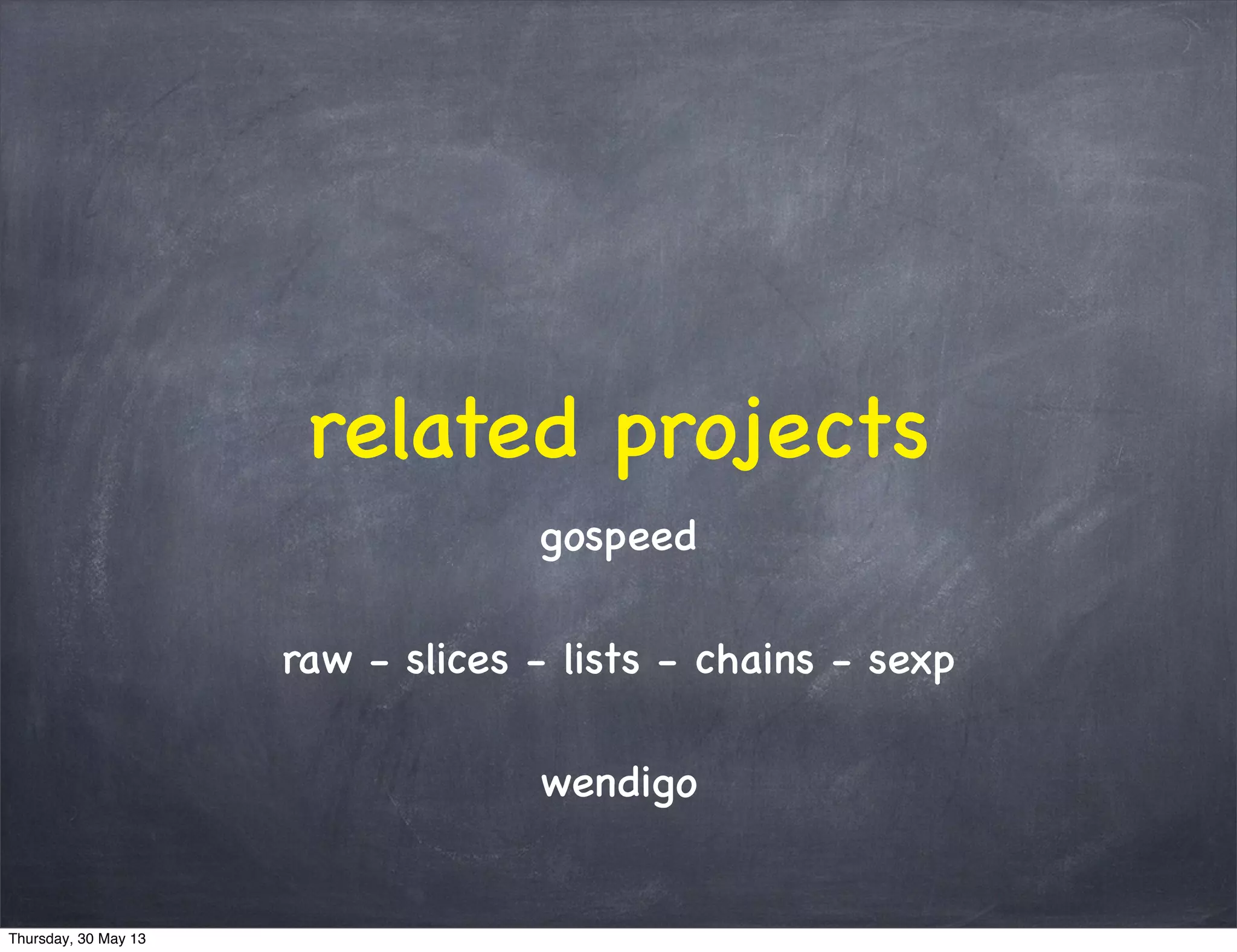


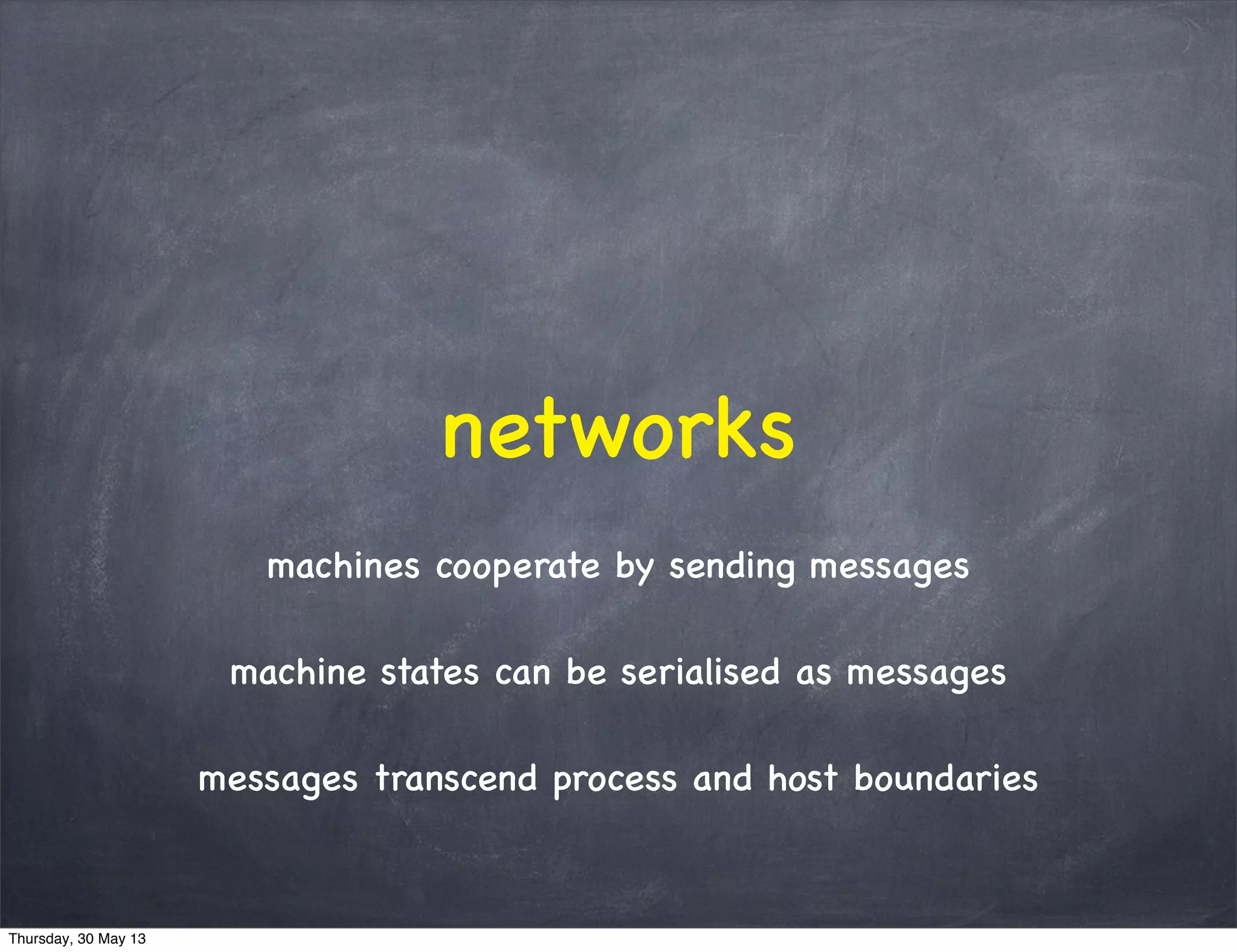
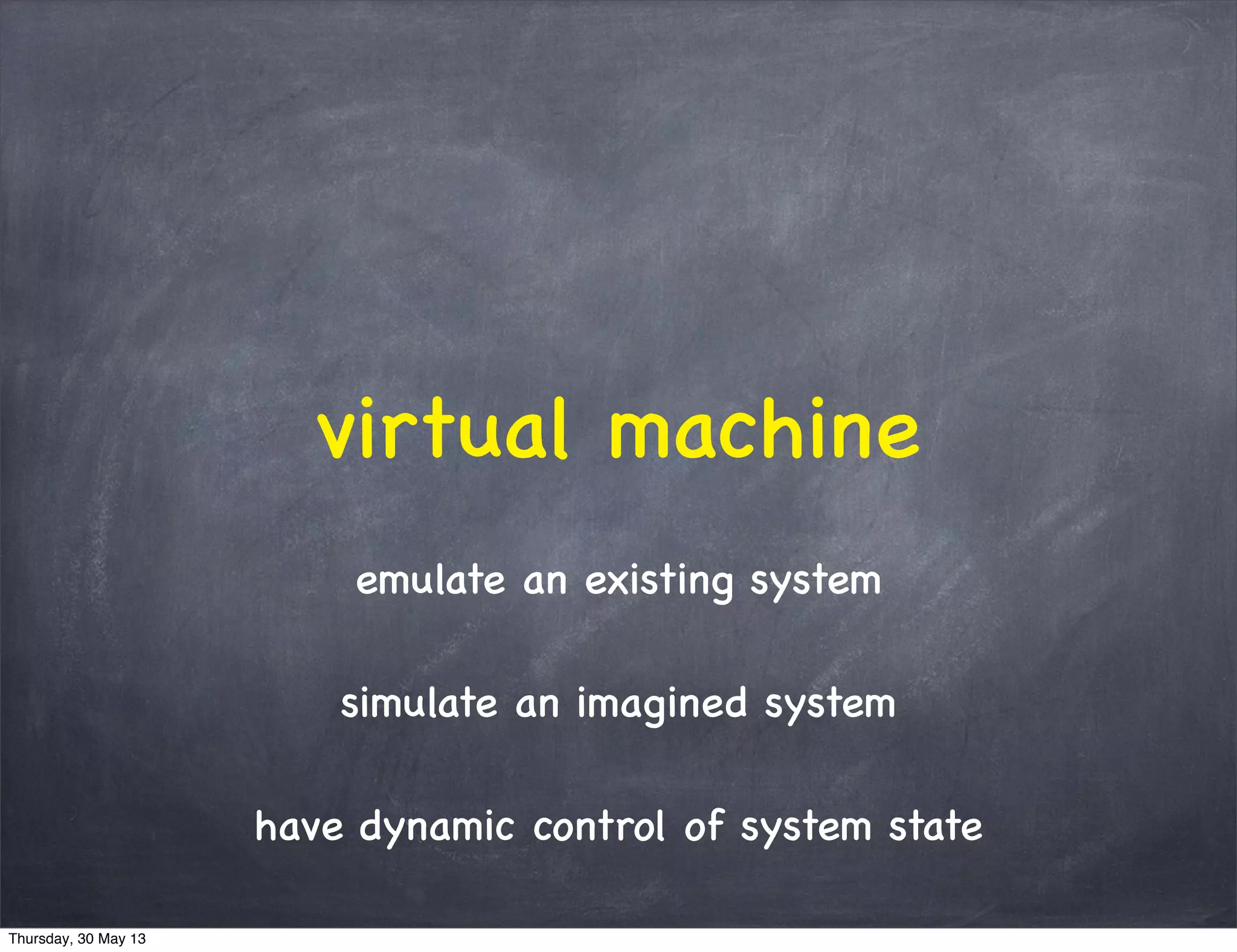
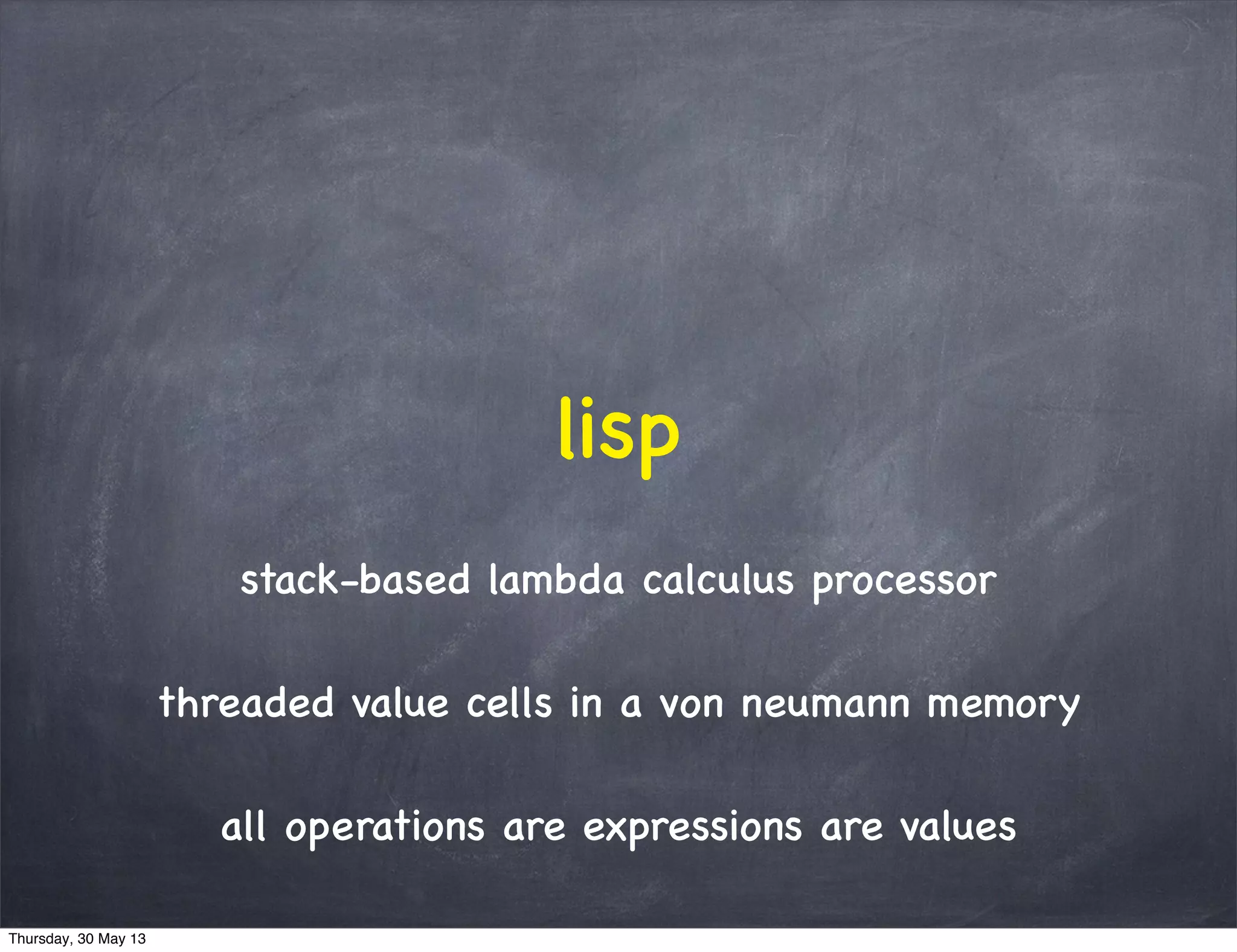
The document details a customizable virtual machine written in Go, discussing its features such as dynamic control of system state, concurrency with goroutines, and customizable operations for various data types. It includes examples of code snippets for creating user-defined types, implementing algorithms, and testing functionalities through Go's testing framework. Additionally, it covers concepts of software synchronization and virtual machine architecture, emphasizing performance and flexibility.


![[2024] An Introduction to Functional Programming with Go [Y Combinator Remix]...](https://cdn.slidesharecdn.com/ss_thumbnails/2024anintroductiontofunctionalprogrammingwithgoycombinatorremix-241007114312-7e90a89d-thumbnail.jpg?width=640&height=640&fit=bounds)
![An introduction to functional programming with Go [redux]](https://cdn.slidesharecdn.com/ss_thumbnails/anintroductiontofunctionalprogrammingwithgoredux-191022131211-thumbnail.jpg?width=640&height=640&fit=bounds)


![Implementing Software Machines in Ruby [Rough Cut]](https://cdn.slidesharecdn.com/ss_thumbnails/2025implementingsoftwaremachinesinruby-251209185925-628e9466-thumbnail.jpg?width=640&height=640&fit=bounds)
![A Gopher's Guide to *NIX Plumbing [workshop remixes!]](https://cdn.slidesharecdn.com/ss_thumbnails/2025agophersguidetonixplumbingworkshop-251009084052-82af3656-thumbnail.jpg?width=640&height=640&fit=bounds)


![The Browser Environment - A Systems Programmer's Perspective [sinatra edition]](https://cdn.slidesharecdn.com/ss_thumbnails/2022thebrowserenvironment-asystemsprogrammersperspectivesinatraedition-220314193951-thumbnail.jpg?width=640&height=640&fit=bounds)

![[2023] Putting the R! in R&D.pdf](https://cdn.slidesharecdn.com/ss_thumbnails/2023puttingtherinrd-231122234738-294b2909-thumbnail.jpg?width=640&height=640&fit=bounds)


