Avanzado
Parte I

Wednesday, January 30, 13
El Charlista

Wednesday, January 30, 13
@coto
Wednesday, January 30, 13
@coto
Wednesday, January 30, 13
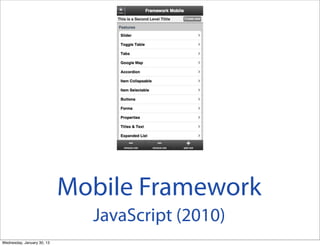
Mobile Framework
JavaScript (2010)
Wednesday, January 30, 13
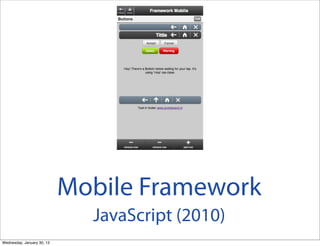
Mobile Framework
JavaScript (2010)
Wednesday, January 30, 13
coto@cotos-pro ~
02:15 > python
Python 3.3.0 (v3.3.0:bd8afb90ebf2, Sep 29 2012, 01:25:11)
[GCC 4.2.1 (Apple Inc. build 5666) (dot 3)] on darwin
Type "help", "copyright", "credits" or "license" for more information.
>>>

Wednesday, January 30, 13
Iniciar Python
coto@cotos-pro ~
02:15 > python
Python 3.3.0 (v3.3.0:bd8afb90ebf2, Sep 29 2012, 01:25:11)
[GCC 4.2.1 (Apple Inc. build 5666) (dot 3)] on darwin
Type "help", "copyright", "credits" or "license" for more information.
>>>

Wednesday, January 30, 13
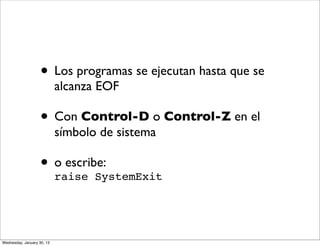
• Los programas se ejecutan hasta que se
alcanza EOF

• Con Control-D o Control-Z en el
símbolo de sistema

• o escribe:
raise SystemExit

Wednesday, January 30, 13
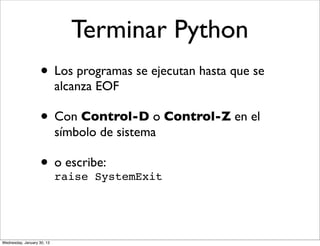
Terminar Python
• Los programas se ejecutan hasta que se
alcanza EOF

• Con Control-D o Control-Z en el
símbolo de sistema

• o escribe:
raise SystemExit

Wednesday, January 30, 13
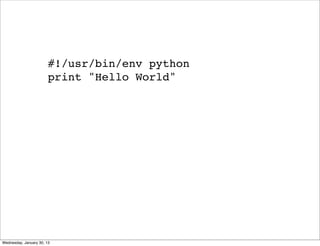
#!/usr/bin/env python
print "Hello World"

Wednesday, January 30, 13
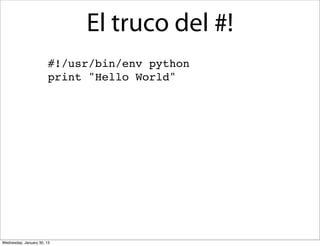
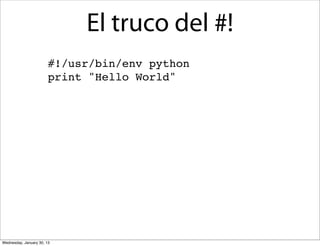
El truco del #!
#!/usr/bin/env python
print "Hello World"

Wednesday, January 30, 13
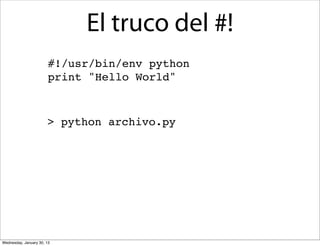
El truco del #!
#!/usr/bin/env python
print "Hello World"

> python archivo.py

Wednesday, January 30, 13
El truco del #!
#!/usr/bin/env python
print "Hello World"

Wednesday, January 30, 13
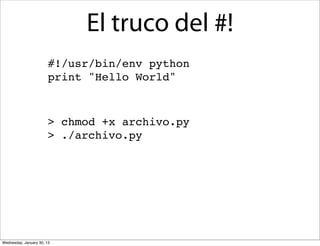
El truco del #!
#!/usr/bin/env python
print "Hello World"

> chmod +x archivo.py
> ./archivo.py

Wednesday, January 30, 13
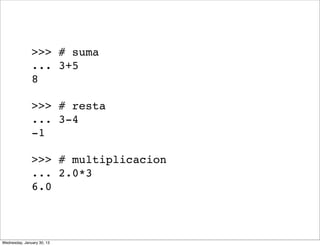
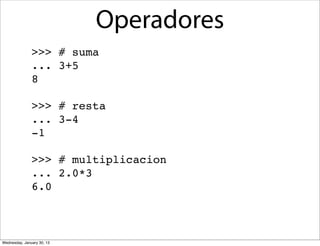
>>> # suma
... 3+5
8
>>> # resta
... 3-4
-1
>>> # multiplicacion
... 2.0*3
6.0

Wednesday, January 30, 13
Operadores
>>> # suma
... 3+5
8
>>> # resta
... 3-4
-1
>>> # multiplicacion
... 2.0*3
6.0

Wednesday, January 30, 13
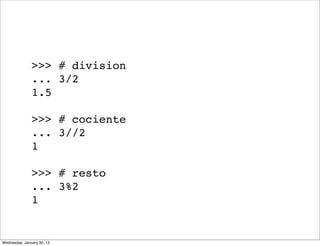
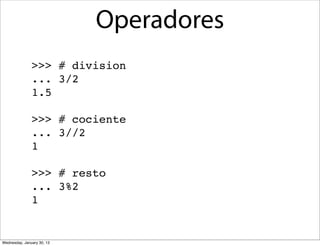
>>> # division
... 3/2
1.5
>>> # cociente
... 3//2
1
>>> # resto
... 3%2
1

Wednesday, January 30, 13
Operadores
>>> # division
... 3/2
1.5
>>> # cociente
... 3//2
1
>>> # resto
... 3%2
1

Wednesday, January 30, 13
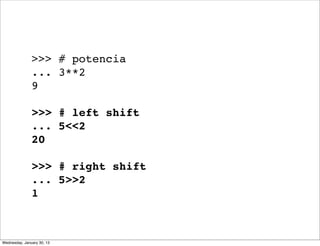
>>> # potencia
... 3**2
9
>>> # left shift
... 5<<2
20
>>> # right shift
... 5>>2
1

Wednesday, January 30, 13
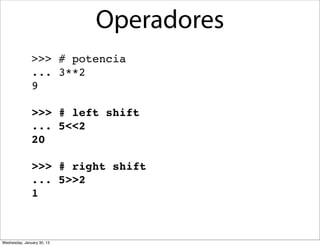
Operadores
>>> # potencia
... 3**2
9
>>> # left shift
... 5<<2
20
>>> # right shift
... 5>>2
1

Wednesday, January 30, 13
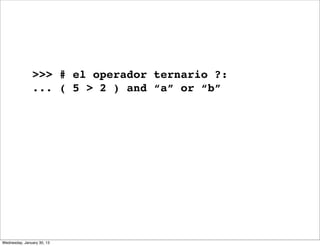
>>> # el operador ternario ?:
... ( 5 > 2 ) and “a” or “b”

Wednesday, January 30, 13
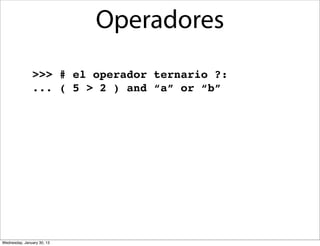
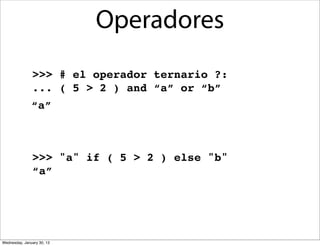
Operadores
>>> # el operador ternario ?:
... ( 5 > 2 ) and “a” or “b”

Wednesday, January 30, 13
Operadores
>>> # el operador ternario ?:
... ( 5 > 2 ) and “a” or “b”
“a”

Wednesday, January 30, 13
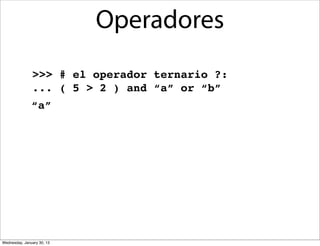
Operadores
>>> # el operador ternario ?:
... ( 5 > 2 ) and “a” or “b”
“a”

>>> "a" if ( 5 > 2 ) else "b"
“a”

Wednesday, January 30, 13
a
b
c
d
e

=
=
=
=
=

[2,
[2,
[]
[2,
a +

3, 4]
7, 3.5, "Hello"]
[a,b]]
b

#
#
#
#
#

list de enteros
lista mixta
lista vacia
Lista con otra lista
Unir dos listas

#
#
#
#

Obtén el 2º elemento
Obtén una sublista
Listas anidadas
Cambiar un elemento

Manipulando Listas
x = a[1]
y = b[1:3]
z = d[1][0][2]
b[0] = 42

Wednesday, January 30, 13
Listas
a
b
c
d
e

=
=
=
=
=

[2,
[2,
[]
[2,
a +

3, 4]
7, 3.5, "Hello"]
[a,b]]
b

#
#
#
#
#

list de enteros
lista mixta
lista vacia
Lista con otra lista
Unir dos listas

#
#
#
#

Obtén el 2º elemento
Obtén una sublista
Listas anidadas
Cambiar un elemento

Manipulando Listas
x = a[1]
y = b[1:3]
z = d[1][0][2]
b[0] = 42

Wednesday, January 30, 13
f = (2,3,4,5)
g = (,)
h = (2, [3,4], (10,11,12))

# tupla de enteros
# tupla vacia
# tupla mixta

Manipulando Tuplas
x = f[1]
y = f[1:3]
z = h[1][1]

Wednesday, January 30, 13

# Obtén el 2º elemento
# Obtén una porción
# Agrupamiento
Tuplas
f = (2,3,4,5)
g = (,)
h = (2, [3,4], (10,11,12))

# tupla de enteros
# tupla vacia
# tupla mixta

Manipulando Tuplas
x = f[1]
y = f[1:3]
z = h[1][1]

Wednesday, January 30, 13

# Obtén el 2º elemento
# Obtén una porción
# Agrupamiento
Tuplas
f = (2,3,4,5)
g = (,)
h = (2, [3,4], (10,11,12))

# tupla de enteros
# tupla vacia
# tupla mixta

Manipulando Tuplas
x = f[1]
y = f[1:3]
z = h[1][1]

# Obtén el 2º elemento
# Obtén una porción
# Agrupamiento

• Las tuplas son como las listas, pero con tamaño
definido.
• No se pueden reemplazar miembros.
Wednesday, January 30, 13
a = { }
b = { ’x’: 3, ’y’: 4 }
c = { ’uid’: 105,
’login’: ’beazley’,
’name’ : ’David Beazley’
}

Acceso a diccionarios
u = c[’uid’]
c[’shell’] = "/bin/sh"
“name” in c
c.get(“name”, “no value”)

Wednesday, January 30, 13

#
#
#
#

Acceso a un elemento
Crear elemento
Chequear elemento
Chequear elemento
Diccionarios
a = { }
b = { ’x’: 3, ’y’: 4 }
c = { ’uid’: 105,
’login’: ’beazley’,
’name’ : ’David Beazley’
}

Acceso a diccionarios
u = c[’uid’]
c[’shell’] = "/bin/sh"
“name” in c
c.get(“name”, “no value”)

Wednesday, January 30, 13

#
#
#
#

Acceso a un elemento
Crear elemento
Chequear elemento
Chequear elemento
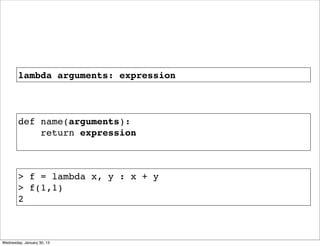
lambda arguments: expression

def name(arguments):
return expression

> f = lambda x, y : x + y
> f(1,1)
2

Wednesday, January 30, 13
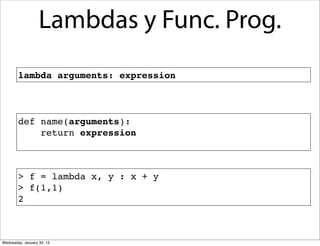
Lambdas y Func. Prog.
lambda arguments: expression

def name(arguments):
return expression

> f = lambda x, y : x + y
> f(1,1)
2

Wednesday, January 30, 13
> foo = [2, 18, 9, 22, 17, 24, 8, 12, 27]
> print map(lambda x: x * 2 + 10, foo)
...[14, 46, 28, 54, 44, 58, 26, 34, 64]
> foo = [2, 18, 9, 22, 17, 24, 8, 12, 27]
>>> print filter(lambda x: x % 3 == 0, foo)
...[18, 9, 24, 12, 27]
> foo = [2, 18, 9, 22, 17, 24, 8, 12, 27]
>>> print reduce(lambda x, y: x + y, foo)
...139

Wednesday, January 30, 13
Lambdas y Func. Prog.
> foo = [2, 18, 9, 22, 17, 24, 8, 12, 27]
> print map(lambda x: x * 2 + 10, foo)
...[14, 46, 28, 54, 44, 58, 26, 34, 64]
> foo = [2, 18, 9, 22, 17, 24, 8, 12, 27]
>>> print filter(lambda x: x % 3 == 0, foo)
...[18, 9, 24, 12, 27]
> foo = [2, 18, 9, 22, 17, 24, 8, 12, 27]
>>> print reduce(lambda x, y: x + y, foo)
...139

Wednesday, January 30, 13
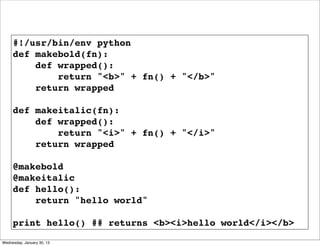
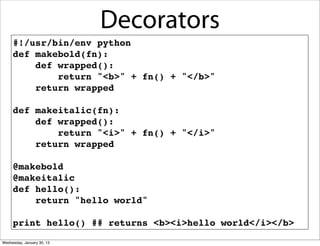
#!/usr/bin/env python
def makebold(fn):
def wrapped():
return "<b>" + fn() + "</b>"
return wrapped
def makeitalic(fn):
def wrapped():
return "<i>" + fn() + "</i>"
return wrapped
@makebold
@makeitalic
def hello():
return "hello world"
print hello() ## returns <b><i>hello world</i></b>
Wednesday, January 30, 13
Decorators
#!/usr/bin/env python
def makebold(fn):
def wrapped():
return "<b>" + fn() + "</b>"
return wrapped
def makeitalic(fn):
def wrapped():
return "<i>" + fn() + "</i>"
return wrapped
@makebold
@makeitalic
def hello():
return "hello world"
print hello() ## returns <b><i>hello world</i></b>
Wednesday, January 30, 13
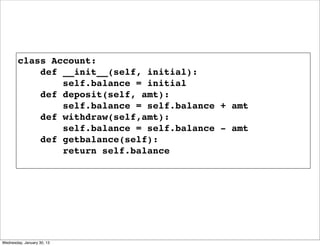
class Account:
def __init__(self, initial):
self.balance = initial
def deposit(self, amt):
self.balance = self.balance + amt
def withdraw(self,amt):
self.balance = self.balance - amt
def getbalance(self):
return self.balance

Wednesday, January 30, 13
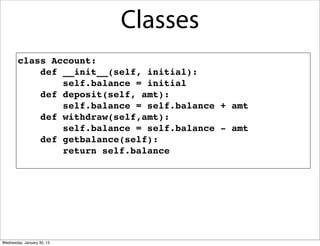
Classes
class Account:
def __init__(self, initial):
self.balance = initial
def deposit(self, amt):
self.balance = self.balance + amt
def withdraw(self,amt):
self.balance = self.balance - amt
def getbalance(self):
return self.balance

Wednesday, January 30, 13
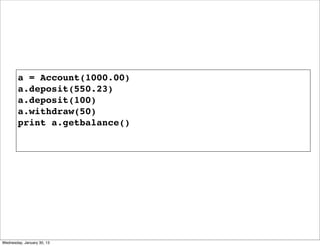
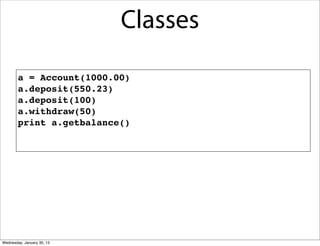
a = Account(1000.00)
a.deposit(550.23)
a.deposit(100)
a.withdraw(50)
print a.getbalance()

Wednesday, January 30, 13
Classes
a = Account(1000.00)
a.deposit(550.23)
a.deposit(100)
a.withdraw(50)
print a.getbalance()

Wednesday, January 30, 13
Classes
a = Account(1000.00)
a.deposit(550.23)
a.deposit(100)
a.withdraw(50)
print a.getbalance()

Wednesday, January 30, 13
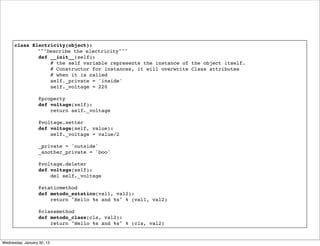
class Electricity(object):
!
"""Describe the electricity"""
def __init__(self):
# the self variable represents the instance of the object itself.
# Constructor for instances, it will overwrite Class attributes
# when it is called
self._private = 'inside'
self._voltage = 220
 
@property
def voltage(self):
return self._voltage
 
@voltage.setter
def voltage(self, value):
self._voltage = value/2
 
_private = 'outside'
_another_private = 'boo'
@voltage.deleter
def voltage(self):
del self._voltage
 
@staticmethod
def metodo_estatico(val1, val2):
return "Hello %s and %s" % (val1, val2)
 
@classmethod
def metodo_class(cls, val2):
return "Hello %s and %s" % (cls, val2)

Wednesday, January 30, 13
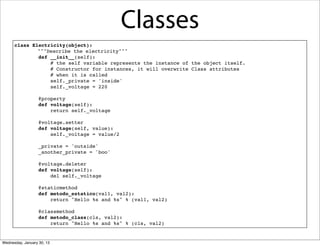
Classes
class Electricity(object):
!
"""Describe the electricity"""
def __init__(self):
# the self variable represents the instance of the object itself.
# Constructor for instances, it will overwrite Class attributes
# when it is called
self._private = 'inside'
self._voltage = 220
 
@property
def voltage(self):
return self._voltage
 
@voltage.setter
def voltage(self, value):
self._voltage = value/2
 
_private = 'outside'
_another_private = 'boo'
@voltage.deleter
def voltage(self):
del self._voltage
 
@staticmethod
def metodo_estatico(val1, val2):
return "Hello %s and %s" % (val1, val2)
 
@classmethod
def metodo_class(cls, val2):
return "Hello %s and %s" % (cls, val2)

Wednesday, January 30, 13
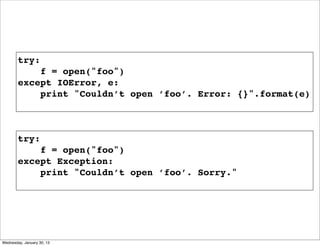
try:
f = open("foo")
except IOError, e:
print "Couldn’t open ’foo’. Error: {}".format(e)

try:
f = open("foo")
except Exception:
print "Couldn’t open ’foo’. Sorry."

Wednesday, January 30, 13
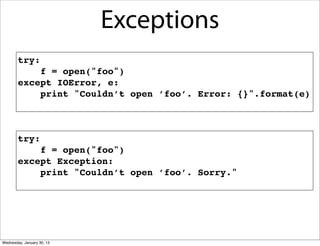
Exceptions
try:
f = open("foo")
except IOError, e:
print "Couldn’t open ’foo’. Error: {}".format(e)

try:
f = open("foo")
except Exception:
print "Couldn’t open ’foo’. Sorry."

Wednesday, January 30, 13
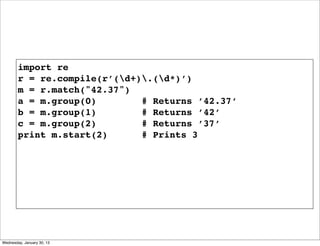
import re
r = re.compile(r’(d+).(d*)’)
m = r.match("42.37")
a = m.group(0)
# Returns ’42.37’
b = m.group(1)
# Returns ’42’
c = m.group(2)
# Returns ’37’
print m.start(2)
# Prints 3

Wednesday, January 30, 13
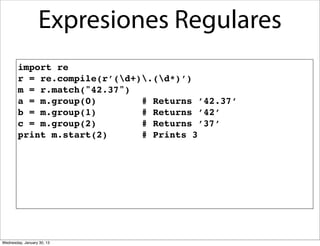
Expresiones Regulares
import re
r = re.compile(r’(d+).(d*)’)
m = r.match("42.37")
a = m.group(0)
# Returns ’42.37’
b = m.group(1)
# Returns ’42’
c = m.group(2)
# Returns ’37’
print m.start(2)
# Prints 3

Wednesday, January 30, 13
•
•
•
•
•
•
•

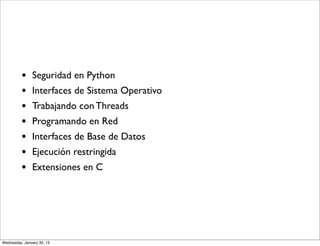
Seguridad en Python
Interfaces de Sistema Operativo
Trabajando con Threads
Programando en Red
Interfaces de Base de Datos
Ejecución restringida
Extensiones en C

Wednesday, January 30, 13
Próximamente...
•
•
•
•
•
•
•

Seguridad en Python
Interfaces de Sistema Operativo
Trabajando con Threads
Programando en Red
Interfaces de Base de Datos
Ejecución restringida
Extensiones en C

Wednesday, January 30, 13
Gracias!!
@coto
Wednesday, January 30, 13

Python avanzado - parte 1

  • 1.
  • 2.
  • 3.
  • 4.
  • 5.
  • 6.
  • 7.
  • 8.
  • 9.
  • 10.
  • 11.
    coto@cotos-pro ~ 02:15 >python Python 3.3.0 (v3.3.0:bd8afb90ebf2, Sep 29 2012, 01:25:11) [GCC 4.2.1 (Apple Inc. build 5666) (dot 3)] on darwin Type "help", "copyright", "credits" or "license" for more information. >>> Wednesday, January 30, 13
  • 12.
    Iniciar Python coto@cotos-pro ~ 02:15> python Python 3.3.0 (v3.3.0:bd8afb90ebf2, Sep 29 2012, 01:25:11) [GCC 4.2.1 (Apple Inc. build 5666) (dot 3)] on darwin Type "help", "copyright", "credits" or "license" for more information. >>> Wednesday, January 30, 13
  • 13.
    • Los programasse ejecutan hasta que se alcanza EOF • Con Control-D o Control-Z en el símbolo de sistema • o escribe: raise SystemExit Wednesday, January 30, 13
  • 14.
    Terminar Python • Losprogramas se ejecutan hasta que se alcanza EOF • Con Control-D o Control-Z en el símbolo de sistema • o escribe: raise SystemExit Wednesday, January 30, 13
  • 15.
    #!/usr/bin/env python print "HelloWorld" Wednesday, January 30, 13
  • 16.
    El truco del#! #!/usr/bin/env python print "Hello World" Wednesday, January 30, 13
  • 17.
    El truco del#! #!/usr/bin/env python print "Hello World" > python archivo.py Wednesday, January 30, 13
  • 18.
    El truco del#! #!/usr/bin/env python print "Hello World" Wednesday, January 30, 13
  • 19.
    El truco del#! #!/usr/bin/env python print "Hello World" > chmod +x archivo.py > ./archivo.py Wednesday, January 30, 13
  • 20.
    >>> # suma ...3+5 8 >>> # resta ... 3-4 -1 >>> # multiplicacion ... 2.0*3 6.0 Wednesday, January 30, 13
  • 21.
    Operadores >>> # suma ...3+5 8 >>> # resta ... 3-4 -1 >>> # multiplicacion ... 2.0*3 6.0 Wednesday, January 30, 13
  • 22.
    >>> # division ...3/2 1.5 >>> # cociente ... 3//2 1 >>> # resto ... 3%2 1 Wednesday, January 30, 13
  • 23.
    Operadores >>> # division ...3/2 1.5 >>> # cociente ... 3//2 1 >>> # resto ... 3%2 1 Wednesday, January 30, 13
  • 24.
    >>> # potencia ...3**2 9 >>> # left shift ... 5<<2 20 >>> # right shift ... 5>>2 1 Wednesday, January 30, 13
  • 25.
    Operadores >>> # potencia ...3**2 9 >>> # left shift ... 5<<2 20 >>> # right shift ... 5>>2 1 Wednesday, January 30, 13
  • 26.
    >>> # eloperador ternario ?: ... ( 5 > 2 ) and “a” or “b” Wednesday, January 30, 13
  • 27.
    Operadores >>> # eloperador ternario ?: ... ( 5 > 2 ) and “a” or “b” Wednesday, January 30, 13
  • 28.
    Operadores >>> # eloperador ternario ?: ... ( 5 > 2 ) and “a” or “b” “a” Wednesday, January 30, 13
  • 29.
    Operadores >>> # eloperador ternario ?: ... ( 5 > 2 ) and “a” or “b” “a” >>> "a" if ( 5 > 2 ) else "b" “a” Wednesday, January 30, 13
  • 30.
    a b c d e = = = = = [2, [2, [] [2, a + 3, 4] 7,3.5, "Hello"] [a,b]] b # # # # # list de enteros lista mixta lista vacia Lista con otra lista Unir dos listas # # # # Obtén el 2º elemento Obtén una sublista Listas anidadas Cambiar un elemento Manipulando Listas x = a[1] y = b[1:3] z = d[1][0][2] b[0] = 42 Wednesday, January 30, 13
  • 31.
    Listas a b c d e = = = = = [2, [2, [] [2, a + 3, 4] 7,3.5, "Hello"] [a,b]] b # # # # # list de enteros lista mixta lista vacia Lista con otra lista Unir dos listas # # # # Obtén el 2º elemento Obtén una sublista Listas anidadas Cambiar un elemento Manipulando Listas x = a[1] y = b[1:3] z = d[1][0][2] b[0] = 42 Wednesday, January 30, 13
  • 32.
    f = (2,3,4,5) g= (,) h = (2, [3,4], (10,11,12)) # tupla de enteros # tupla vacia # tupla mixta Manipulando Tuplas x = f[1] y = f[1:3] z = h[1][1] Wednesday, January 30, 13 # Obtén el 2º elemento # Obtén una porción # Agrupamiento
  • 33.
    Tuplas f = (2,3,4,5) g= (,) h = (2, [3,4], (10,11,12)) # tupla de enteros # tupla vacia # tupla mixta Manipulando Tuplas x = f[1] y = f[1:3] z = h[1][1] Wednesday, January 30, 13 # Obtén el 2º elemento # Obtén una porción # Agrupamiento
  • 34.
    Tuplas f = (2,3,4,5) g= (,) h = (2, [3,4], (10,11,12)) # tupla de enteros # tupla vacia # tupla mixta Manipulando Tuplas x = f[1] y = f[1:3] z = h[1][1] # Obtén el 2º elemento # Obtén una porción # Agrupamiento • Las tuplas son como las listas, pero con tamaño definido. • No se pueden reemplazar miembros. Wednesday, January 30, 13
  • 35.
    a = {} b = { ’x’: 3, ’y’: 4 } c = { ’uid’: 105, ’login’: ’beazley’, ’name’ : ’David Beazley’ } Acceso a diccionarios u = c[’uid’] c[’shell’] = "/bin/sh" “name” in c c.get(“name”, “no value”) Wednesday, January 30, 13 # # # # Acceso a un elemento Crear elemento Chequear elemento Chequear elemento
  • 36.
    Diccionarios a = {} b = { ’x’: 3, ’y’: 4 } c = { ’uid’: 105, ’login’: ’beazley’, ’name’ : ’David Beazley’ } Acceso a diccionarios u = c[’uid’] c[’shell’] = "/bin/sh" “name” in c c.get(“name”, “no value”) Wednesday, January 30, 13 # # # # Acceso a un elemento Crear elemento Chequear elemento Chequear elemento
  • 37.
    lambda arguments: expression defname(arguments): return expression > f = lambda x, y : x + y > f(1,1) 2 Wednesday, January 30, 13
  • 38.
    Lambdas y Func.Prog. lambda arguments: expression def name(arguments): return expression > f = lambda x, y : x + y > f(1,1) 2 Wednesday, January 30, 13
  • 39.
    > foo = [2, 18, 9, 22, 17, 24, 8, 12, 27] > print map(lambda x: x * 2 + 10, foo) ...[14, 46, 28, 54, 44, 58, 26, 34, 64] >foo = [2, 18, 9, 22, 17, 24, 8, 12, 27] >>> print filter(lambda x: x % 3 == 0, foo) ...[18, 9, 24, 12, 27] > foo = [2, 18, 9, 22, 17, 24, 8, 12, 27] >>> print reduce(lambda x, y: x + y, foo) ...139 Wednesday, January 30, 13
  • 40.
    Lambdas y Func.Prog. > foo = [2, 18, 9, 22, 17, 24, 8, 12, 27] > print map(lambda x: x * 2 + 10, foo) ...[14, 46, 28, 54, 44, 58, 26, 34, 64] > foo = [2, 18, 9, 22, 17, 24, 8, 12, 27] >>> print filter(lambda x: x % 3 == 0, foo) ...[18, 9, 24, 12, 27] > foo = [2, 18, 9, 22, 17, 24, 8, 12, 27] >>> print reduce(lambda x, y: x + y, foo) ...139 Wednesday, January 30, 13
  • 41.
    #!/usr/bin/env python def makebold(fn): defwrapped(): return "<b>" + fn() + "</b>" return wrapped def makeitalic(fn): def wrapped(): return "<i>" + fn() + "</i>" return wrapped @makebold @makeitalic def hello(): return "hello world" print hello() ## returns <b><i>hello world</i></b> Wednesday, January 30, 13
  • 42.
    Decorators #!/usr/bin/env python def makebold(fn): defwrapped(): return "<b>" + fn() + "</b>" return wrapped def makeitalic(fn): def wrapped(): return "<i>" + fn() + "</i>" return wrapped @makebold @makeitalic def hello(): return "hello world" print hello() ## returns <b><i>hello world</i></b> Wednesday, January 30, 13
  • 43.
    class Account: def __init__(self,initial): self.balance = initial def deposit(self, amt): self.balance = self.balance + amt def withdraw(self,amt): self.balance = self.balance - amt def getbalance(self): return self.balance Wednesday, January 30, 13
  • 44.
    Classes class Account: def __init__(self,initial): self.balance = initial def deposit(self, amt): self.balance = self.balance + amt def withdraw(self,amt): self.balance = self.balance - amt def getbalance(self): return self.balance Wednesday, January 30, 13
  • 45.
  • 46.
  • 47.
  • 48.
    class Electricity(object): ! """Describe theelectricity""" def __init__(self): # the self variable represents the instance of the object itself. # Constructor for instances, it will overwrite Class attributes # when it is called self._private = 'inside' self._voltage = 220   @property def voltage(self): return self._voltage   @voltage.setter def voltage(self, value): self._voltage = value/2   _private = 'outside' _another_private = 'boo' @voltage.deleter def voltage(self): del self._voltage   @staticmethod def metodo_estatico(val1, val2): return "Hello %s and %s" % (val1, val2)   @classmethod def metodo_class(cls, val2): return "Hello %s and %s" % (cls, val2) Wednesday, January 30, 13
  • 49.
    Classes class Electricity(object): ! """Describe theelectricity""" def __init__(self): # the self variable represents the instance of the object itself. # Constructor for instances, it will overwrite Class attributes # when it is called self._private = 'inside' self._voltage = 220   @property def voltage(self): return self._voltage   @voltage.setter def voltage(self, value): self._voltage = value/2   _private = 'outside' _another_private = 'boo' @voltage.deleter def voltage(self): del self._voltage   @staticmethod def metodo_estatico(val1, val2): return "Hello %s and %s" % (val1, val2)   @classmethod def metodo_class(cls, val2): return "Hello %s and %s" % (cls, val2) Wednesday, January 30, 13
  • 50.
    try: f = open("foo") exceptIOError, e: print "Couldn’t open ’foo’. Error: {}".format(e) try: f = open("foo") except Exception: print "Couldn’t open ’foo’. Sorry." Wednesday, January 30, 13
  • 51.
    Exceptions try: f = open("foo") exceptIOError, e: print "Couldn’t open ’foo’. Error: {}".format(e) try: f = open("foo") except Exception: print "Couldn’t open ’foo’. Sorry." Wednesday, January 30, 13
  • 52.
    import re r =re.compile(r’(d+).(d*)’) m = r.match("42.37") a = m.group(0) # Returns ’42.37’ b = m.group(1) # Returns ’42’ c = m.group(2) # Returns ’37’ print m.start(2) # Prints 3 Wednesday, January 30, 13
  • 53.
    Expresiones Regulares import re r= re.compile(r’(d+).(d*)’) m = r.match("42.37") a = m.group(0) # Returns ’42.37’ b = m.group(1) # Returns ’42’ c = m.group(2) # Returns ’37’ print m.start(2) # Prints 3 Wednesday, January 30, 13
  • 54.
    • • • • • • • Seguridad en Python Interfacesde Sistema Operativo Trabajando con Threads Programando en Red Interfaces de Base de Datos Ejecución restringida Extensiones en C Wednesday, January 30, 13
  • 55.
    Próximamente... • • • • • • • Seguridad en Python Interfacesde Sistema Operativo Trabajando con Threads Programando en Red Interfaces de Base de Datos Ejecución restringida Extensiones en C Wednesday, January 30, 13
  • 56.