implementing
virtual machines
in
Go & C
Eleanor McHugh
@feyeleanor
http://github.com/feyeleanor
I made my own machine
Yes, we're building steam
I hate the same routine
— Building Steam, Abney Park
software is where
machine meets thought
and as programmers we
think a lot about thinking
whilst thinking very little
about machines
we style ourselves
philosophers & wizards
when machines need us
to be engineers & analysts
so this is a talk about
machine philosophy
framed in a language we
humans can understand
so let's learn to love our
Turing machines
by building other Turing
machines' in their image
system virtualisation
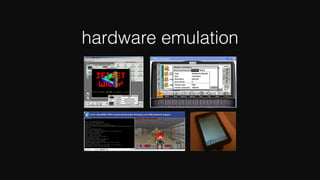
hardware emulation
program execution
timely
stateful
conversational
discrete
despatch loops
fetch instruction
decode
execute
c: switch
bytes or tokens
portable
#include <stdio.h>
#include <stdlib.h>
#include "stack.h"
#define READ_OPCODE *PC++
typedef enum {
PUSH = 0,
ADD,
PRINT,
EXIT
} opcodes;
int program [] = {
(int)PUSH, 13,
(int)PUSH, 28,
(int)ADD,
PRINT,
EXIT,
};
STACK *S;
void interpret(int *PC) {
int l, r;
while (1) {
switch(READ_OPCODE) {
case PUSH:
S = push(S, READ_OPCODE);
break;
case ADD:
S = pop(S, &l);
S = pop(S, &r);
S = push(S, l + r);
break;
case PRINT:
printf(“%d + %d = %dn, l, r, S->data);
break;
case EXIT:
return;
}
}
}
int main() {
interpret(program);
}
go: switch
constants
package main
import "fmt"
func main() {
interpret([]interface{}{
PUSH, 13,
PUSH, 28,
ADD,
PRINT,
EXIT,
})
}
type stack struct {
data int
tail *stack
}
func (s *stack) Push(v int) (r *stack) {
r = &stack{data: v, tail: s}
return
}
func (s *stack) Pop() (v int, r *stack) {
return s.data, s.tail
}
type OPCODE int
const (
PUSH = OPCODE(iota)
ADD
PRINT
EXIT
)
func interpret(p []interface{}) {
var l, r int
S := new(stack)
for PC := 0; ; PC++ {
if op, ok := p[PC].(OPCODE); ok {
switch op {
case PUSH:
PC++
S = S.Push(p[PC].(int))
case ADD:
l, S = S.Pop()
r, S = S.Pop()
S = S.Push(l + r)
case PRINT:
fmt.Printf("%v + %v = %vn", l, r, S.data)
case EXIT:
return
}
} else {
return
}
}
}
c: direct call
pointer to function
multi-byte
portable
#include <stdio.h>
#include <stdlib.h>
#include "stack.h"
#define READ_OPCODE *PC++
typedef void (*opcode)();
STACK *S;
opcode *PC;
void op_add_and_print() {
int l, r;
S = pop(S, &l);
S = pop(S, &r);
S = push(S, l + r);
printf("%d + %d = %dn", l, r, S->data);
}
void op_exit() {
exit(0);
}
opcode program [] = {
op_push, (opcode)(long)13,
op_push, (opcode)(long)28,
op_add_and_print,
op_exit
};
int main() {
PC = program;
while (1) {
(READ_OPCODE)();
}
}
go: direct call
package main
import "fmt"
import "os"
func main() {
p := new(Interpreter)
p.m = []interface{}{
p.Push, 13,
p.Push, 28,
p.Add, p.Print, p.Exit,
}
p.Run()
}
type stack struct {
data int
tail *stack
}
func (s *stack) Push(v int) (r *stack) {
return &stack{data: v, tail: s}
}
func (s *stack) Pop() (v int, r *stack) {
return s.data, s.tail
}
type Interpreter struct {
S *stack
l, r, PC int
m []interface{}
}
func (i *Interpreter) read_program() (r interface{}) {
return i.m[i.PC]
}
func (i *Interpreter) Run() {
for {
i.read_program().(func())()
i.PC++
}
}
func (i *Interpreter) Push() {
i.PC++
i.S = i.S.Push(i.read_program().(int))
}
func (i *Interpreter) Add() {
i.l, i.S = i.S.Pop()
i.r, i.S = i.S.Pop()
i.S = i.S.Push(i.l + i.r)
}
func (i *Interpreter) Print() {
fmt.Printf("%v + %v = %vn", i.l, i.r, i.S.data)
}
func (i *Interpreter) Exit() {
os.Exit(0)
}
go: direct call
raw closures
package main
import "fmt"
import "os"
type stack struct {
data int
tail *stack
}
func (s *stack) Push(v int) (r *stack) {
return &stack{data: v, tail: s}
}
func (s *stack) Pop() (v int, r *stack) {
return s.data, s.tail
}
type Primitive func(*Interpreter)
type Interpreter struct {
S *stack
l, r, PC int
m []Primitive
}
func (i *Interpreter) read_program() Primitive {
return i.m[i.PC]
}
func (i *Interpreter) Run() {
for {
i.read_program()(i)
i.PC++
}
}
func main() {
p := &Interpreter{
m: []Primitive{
func(i *Interpreter) { i.S = i.S.Push(13) },
func(i *Interpreter) { i.S = i.S.Push(28) },
func(i *Interpreter) {
i.l, i.S = i.S.Pop()
i.r, i.S = i.S.Pop()
i.S = i.S.Push(i.l + i.r)
},
func(i *Interpreter) {
fmt.Printf("%v + %v = %vn", i.l, i.r, i.S.data)
},
func (i *Interpreter) { os.Exit(0) },
},
}
p.Run()
}
go: direct call
raw closures
func main() {
p := &Interpreter{
m: []Primitive{
func(i *Interpreter) {
i.S = i.S.Push(13)
i.PC++
i.read_program()(i)
i.PC++
i.read_program()(i)
},
func(i *Interpreter) {
i.S = i.S.Push(28)
},
func(i *Interpreter) {
i.l, i.S = i.S.Pop()
i.r, i.S = i.S.Pop()
i.S = i.S.Push(i.l + i.r)
},
func(i *Interpreter) {
fmt.Printf("%v + %v = %vn", i.l, i.r, i.S.data)
},
func (i *Interpreter) {
os.Exit(0)
},
},
}
p.Run()
}
go: direct call
raw closures
type Primitive func()
func (i *Interpreter) Run() {
for {
i.read_program()()
i.PC++
}
}
func main() {
i := new(Interpreter)
npush := func(vals ...int) Primitive {
return func() {
for _, v := range vals {
i.S = i.S.Push(v)
}
}
}
i.m = []Primitive{
npush(13, 28),
func() {
i.l, i.S = i.S.Pop()
i.r, i.S = i.S.Pop()
i.S = i.S.Push(i.l + i.r)
},
func() {
fmt.Printf("%v + %v = %vn", i.l, i.r, i.S.data)
},
func() { os.Exit(0) },
}
i.Run()
}
go: direct call
raw closures
jit assembly
package main
import "fmt"
import "strings"
import "os"
type stack struct {
data int
tail *stack
}
func (s *stack) Push(v int) (r *stack) {
return &stack{data: v, tail: s}
}
func (s *stack) Pop() (v int, r *stack) {
return s.data, s.tail
}
func (s *stack) String() string {
r := []string{}
for i := s; i != nil; i = i.tail {
r = append(r, fmt.Sprint(i.data))
}
return "[" + strings.Join(r, ", ") + "]"
}
go: direct call
raw closures
jit assembly
type Label string
type labels map[Label] int
type VM struct {
S *stack
l, r, PC int
m []interface{}
labels
}
func (v *VM) read_program() interface{} {
return v.m[v.PC]
}
func (v *VM) String() string {
return fmt.Sprintf("@pc[%v] => #{%v}, %v",
v.PC, v.m[v.PC], v.S)
}
func (v *VM) Load(program ...interface{}) {
v.labels = make(labels)
v.PC = -1
for _, token := range program {
v.assemble(token)
}
}
func (v *VM) assemble(token interface{}) {
switch t := token.(type) {
case Label:
if i, ok := v.labels[t]; ok {
v.m = append(v.m, i)
} else {
v.labels[t] = v.PC
}
default:
v.m = append(v.m, token)
v.PC++
}
}
func (v *VM) Run() {
v.PC = -1
for {
v.PC++
v.read_program().(func())()
}
}
go: direct call
raw closures
jit assembly
type Interpreter struct { VM }
func (i *Interpreter) Push() {
i.PC++
i.S = i.S.Push(i.read_program().(int))
}
func (i *Interpreter) Add() {
i.l, i.S = i.S.Pop()
i.r, i.S = i.S.Pop()
i.S = i.S.Push(i.l + i.r)
}
func (i *Interpreter) JumpIfNotZero() {
i.PC++
if i.S.data != 0 {
i.PC = i.m[i.PC].(int)
}
}
func main() {
i := new(Interpreter)
print_state := func() {
fmt.Println(i)
}
skip := func() { i.PC++ }
i.Load(
i.Push, 13,
Label("decrement"),
func() {
i.S = i.S.Push(-1)
},
i.Add,
print_state,
skip,
print_state,
i.JumpIfNotZero, Label("decrement"),
print_state,
func() {
os.Exit(0)
},
)
i.Run()
}
c: indirect thread
local jumps
gcc/clang specific
indirect loading
#include <stdio.h>
#include <stdlib.h>
#include "stack.h"
typedef enum {
PUSH = 0, ADD, PRINT, EXIT
} opcodes;
void interpret(int *program) {
static void *opcodes [] = {
&&op_push,
&&op_add,
&&op_print,
&&op_exit
};
int l, r;
STACK *S;
int *PC = program;
goto *opcodes[*PC++];
op_push:
S = push(S, *PC++);
goto *opcodes[*PC++];
op_add:
S = pop(S, &l);
S = pop(S, &r);
S = push(S, l + r);
goto *opcodes[*PC++];
op_print:
printf("%d + %d = %dn", l, r, S->data);
goto *opcodes[*PC++];
op_exit:
return;
}
int main() {
int program [] = {
PUSH, 13,
PUSH, 28,
ADD,
PRINT,
EXIT
};
interpret(program);
}
c: direct thread
jit local jumps
gcc/clang specific
direct loading
void interpret(int *PC, int words) {
static void *dispatch_table[] = {
&&op_push,
&&op_add,
&&op_print,
&&op_exit
};
STACK *S;
int l, r;
void **program = compile(PC, words, dispatch_table);
if (program == NULL)
exit(1);
goto **program++;
op_push:
S = push(S, (int)(long)*program++);
goto **program++;
op_add:
S = pop(S, &l);
S = pop(S, &r);
S = push(S, l + r);
goto **program++;
op_print:
printf("%d + %d = %dn", l, r, S->data);
goto **program++;
op_exit:
return;
}
int main() {
int program[] = {
PUSH, 13,
PUSH, 28,
ADD,
PRINT,
EXIT
};
interpret(program, 7);
}
c: direct thread
#define INTERPRETER(body, ...) 
DISPATCHER(__VA_ARGS__); 
void **p = compile(PC, d); 
if (p == NULL) 
exit(1); 
EXECUTE_OPCODE 
body
#define DISPATCHER(...) 
static void *d[] = { __VA_ARGS__ }
#define READ_OPCODE 
*p++
#define EXECUTE_OPCODE 
goto *READ_OPCODE;
#define PRIMITIVE(name, body) 
name: body; 
EXECUTE_OPCODE
void interpret(int *PC) {
STACK *S;
int l, r;
INTERPRETER(
PRIMITIVE(push,
S = push(S, (int)(long)READ_OPCODE)
)
PRIMITIVE(add,
S = pop(S, &l);
S = pop(S, &r);
S = push(S, l + r)
)
PRIMITIVE(print,
printf("%d + %d = %dn", l, r, S->data)
)
PRIMITIVE(exit,
return
),
&&push, &&add, &&print, &&exit
)
}
c: direct thread
jit local jumps
gcc/clang specific
direct loading
void **compile(int *PC, int words, void *dispatch_table[]) {
static void *compiler [] = {
&&comp_push,
&&comp_add,
&&comp_print,
&&comp_exit
};
if (words < 1)
return NULL;
void **program = malloc(sizeof(void *) * words);
void **cp = program;
goto *compiler[*PC++];
comp_push:
*cp++ = dispatch_table[PUSH];
*cp++ = (void *)(long)*PC++;
words -= 2;
if (words == 0)
return program;
goto *compiler[*PC++];
comp_add:
*cp++ = dispatch_table[ADD];
words--;
if (words == 0)
return program;
goto *compiler[*PC++];
comp_print:
*cp++ = dispatch_table[PRINT];
words--;
if (words == 0)
return program;
goto *compiler[*PC++];
comp_exit:
*cp++ = dispatch_table[EXIT];
words--;
if (words == 0)
return program;
goto *compiler[*PC++];
}
registers
operands
local caching
vm harness
dispatch
program
program counter
package main
import "fmt"
type Label string
type labels map[Label] int
type VM struct {
PC int
m []interface{}
labels
}
func (v *VM) read_program() interface{} {
return v.m[v.PC]
}
func (v *VM) String() string {
return fmt.Sprintf("@pc[%v] => #{%v}, %v", v.PC, v.m[v.PC])
}
func (v *VM) Load(program ...interface{}) *VM {
v.labels = make(labels)
v.PC = -1
for _, token := range program {
v.assemble(token)
}
return v
}
func (v *VM) assemble(token interface{}) {
switch t := token.(type) {
case Label:
if i, ok := v.labels[t]; ok {
v.m = append(v.m, i)
} else {
v.labels[t] = v.PC
}
default:
v.m = append(v.m, token)
v.PC++
}
}
func (v *VM) Run() {
v.PC = -1
for {
v.PC++
v.read_program().(func())()
}
}
stack machine
zero operands
package main
import "fmt"
import "os"
type S []int
type StackMachine struct {
S
VM
}
func (s *StackMachine) String() string {
return fmt.Sprintf("%v, %v", s.VM, s.S)
}
func (s *StackMachine) Push() {
s.PC++
s.S = append(s.S, s.read_program().(int))
}
func (s *StackMachine) Add() {
s.S[len(s.S) - 2] += s.S[len(s.S) - 1]
s.S = s.S[:len(s.S) - 1]
}
func (s *StackMachine) JumpIfNotZero() {
s.PC++
if s.S[len(s.S) - 1] != 0 {
s.PC = s.m[s.PC].(int)
}
}
func main() {
s := new(StackMachine)
print_state := func() {
fmt.Println(s)
}
skip := func() { s.PC++ }
s.Load(
s.Push, 13,
Label("dec"),
func() { s.S = append(s.S, -1) },
s.Add,
print_state,
skip,
print_state,
s.JumpIfNotZero, Label("dec"),
print_state,
func() { os.Exit(0) },
).Run()
}
accumulator
machine
single register
single operand
package main
import "fmt"
import "os"
type AccMachine struct {
A int
VM
}
func (a *AccMachine) String() string {
return fmt.Sprintf("%v, A=%v", a.VM, a.A)
}
func (a *AccMachine) Clear() {
a.A = 0
}
func (a *AccMachine) LoadValue() {
a.PC++
a.A = a.read_program().(int)
}
func (a *AccMachine) Add() {
a.PC++
a.A += a.read_program().(int)
}
func (a *AccMachine) JumpIfNotZero() {
a.PC++
if a.A != 0 {
a.PC = a.m[a.PC].(int)
}
}
func main() {
a := new(AccMachine)
print_state := func() {
fmt.Println(a)
}
skip := func() { a.PC++ }
a.Load(
a.Clear,
a.LoadValue, 13,
Label("decrement"),
a.Add, -1,
print_state,
skip,
print_state,
a.JumpIfNotZero, Label("decrement"),
print_state,
func() { os.Exit(0) },
).Run()
}
register machine
multi-register
multi-operand
package main
import "fmt"
import "os"
type RegMachine struct {
R []int
VM
}
func (r *RegMachine) String() string {
return fmt.Sprintf("%v, R=%v", r.VM, r.R)
}
func (r *RegMachine) Clear() {
r.R = make([]int, 2, 2)
}
func (r *RegMachine) read_value() int {
r.PC++
return r.read_program().(int)
}
func (r *RegMachine) LoadValue() {
r.R[r.read_value()] = r.read_value()
}
func (r *RegMachine) Add() {
i := r.read_value()
j := r.read_value()
r.R[i] += r.R[j]
}
func (r *RegMachine) JumpIfNotZero() {
if r.R[r.read_value()] != 0 {
r.PC = r.read_value()
} else {
r.PC++
}
}
func main() {
r := new(RegMachine)
print_state := func() {
fmt.Println(r)
}
skip := func() { r.PC++ }
r.Load(
r.Clear,
r.LoadValue, 0, 13,
r.LoadValue, 1, -1,
Label("decrement"),
r.Add, 0, 1,
print_state,
skip,
print_state,
r.JumpIfNotZero, 0, Label("decrement"),
print_state,
func() { os.Exit(0) },
).Run()
}
vector machine
matrix machine
hypercube
graph processor
any datatype can be a register
memory model
instructions
computation
state
memory model
opcodes
stack
heap
heaps
word-aligned
contiguous
byte-addressable
go: slice heap
package main
import r "reflect"
import "unsafe"
type Memory []uintptr
var _BYTE_SLICE = r.TypeOf([]byte(nil))
var _MEMORY = r.TypeOf(Memory{})
var _MEMORY_BYTES = int(_MEMORY.Elem().Size())
func (m Memory) newHeader() (h r.SliceHeader) {
h = *(*r.SliceHeader)(unsafe.Pointer(&m))
h.Len = len(m) * _MEMORY_BYTES
h.Cap = cap(m) * _MEMORY_BYTES
return
}
func (m *Memory) Bytes() (b []byte) {
h := m.newHeader()
return *(*[]byte)(unsafe.Pointer(&h))
}
func (m *Memory) Serialise() (b []byte) {
h := m.newHeader()
b = make([]byte, h.Len)
copy(b, *(*[]byte)(unsafe.Pointer(&h)))
return
}
func (m *Memory) Overwrite(i interface{}) {
switch i := i.(type) {
case Memory:
copy(*m, i)
case []byte:
h := m.newHeader()
b := *(*[]byte)(unsafe.Pointer(&h))
copy(b, i)
}
}
func main() {
m := make(Memory, 2)
b := m.Bytes()
s := m.Serialise()
fmt.Println("m (cells) =", len(m), "of", cap(m), ":", m)
fmt.Println("b (bytes) =", len(b), "of", cap(b), ":", b)
fmt.Println("s (bytes) =", len(s), "of", cap(s), ":", s)
m.Overwrite(Memory{3, 5})
fmt.Println("m (cells) =", len(m), "of", cap(m), ":", m)
fmt.Println("b (bytes) =", len(b), "of", cap(b), ":", b)
fmt.Println("s (bytes) =", len(s), "of", cap(s), ":", s)
s = m.Serialise()
m.Overwrite([]byte{8, 7, 6, 5, 4, 3, 2, 1})
fmt.Println("m (cells) =", len(m), "of", cap(m), ":", m)
fmt.Println("b (bytes) =", len(b), "of", cap(b), ":", b)
fmt.Println("s (bytes) =", len(s), "of", cap(s), ":", s)
}
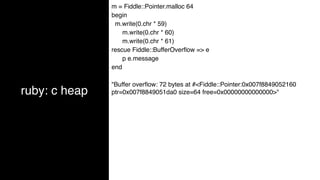
ruby: c heap
require "fiddle"
class Fiddle::Pointer
NIL = Pointer.new(0)
SIZE = Fixnum::SIZE
PACKING_PATTERN = case SIZE
when 2 then "S"
when 4 then "L"
when 8 then "Q"
end + "!"
def write(value)
str = Fiddle::format(value)
pad = Fiddle::padding(str)
l = pad + str.length
raise BufferOverflow.new(self, l) if l > size
self[0, l] = str + 0.chr * pad
self + l
end
def to_bin
[self].pack(PACKING_PATTERN)
end
end
Home (./index.html) Classes
(./index.html#classes) Methods
(./index.html#methods)
In Files
fiddle/closure.c
fiddle/fiddle.c
fiddle/lib/fiddle.rb
fiddle/lib/fiddle/closure.rb
fiddle/lib/fiddle/cparser.rb
fiddle/lib/fiddle/function.rb
fiddle/lib/fiddle/import.rb
fiddle/lib/fiddle/pack.rb
fiddle/lib/fiddle/struct.rb
fiddle/lib/fiddle/types.rb
fiddle/lib/fiddle/value.rb
Namespace
MODULE Fiddle::BasicTypes (Fiddle/BasicTypes.html)
MODULE Fiddle::CParser (Fiddle/CParser.html)
MODULE Fiddle::CStructBuilder (Fiddle/CStructBuilder.html)
MODULE Fiddle::Importer (Fiddle/Importer.html)
MODULE Fiddle::Win32Types (Fiddle/Win32Types.html)
CLASS Fiddle::CStruct (Fiddle/CStruct.html)
CLASS Fiddle::CStructEntity (Fiddle/CStructEntity.html)
CLASS Fiddle::CUnion (Fiddle/CUnion.html)
CLASS Fiddle::CUnionEntity (Fiddle/CUnionEntity.html)
CLASS Fiddle::Closure (Fiddle/Closure.html)
CLASS Fiddle::CompositeHandler (Fiddle/CompositeHandler.html)
Fiddle
A libffi wrapper for Ruby.
Description¶ (#module-Fiddle-label-Description) ↑ (#top)
Fiddle (Fiddle.html) is an extension to translate a foreign function interface (FFI) with
ruby.
It wraps libffi (http://sourceware.org/libffi/), a popular C library which provides a portable
interface that allows code written in one language to call code written in another
language.
Example¶ (#module-Fiddle-label-Example) ↑ (#top)
Here we will use Fiddle::Function (Fiddle/Function.html) to wrap floor(3) from libm
(http://linux.die.net/man/3/floor)
require 'fiddle'
libm = Fiddle.dlopen('/lib/libm.so.6')
floor = Fiddle::Function.new(
libm['floor'],
[Fiddle::TYPE_DOUBLE],
Fiddle::TYPE_DOUBLE
)
access DLLs
call C functions
Home (../index.html) Classes
(../index.html#classes) Methods
(../index.html#methods)
In Files
fiddle/closure.c
Parent
Object
Methods
::[] (#method-c-5B-5D)
::malloc (#method-c-malloc)
::new (#method-c-new)
::to_ptr (#method-c-to_ptr)
#+ (#method-i-2B)
#+@ (#method-i-2B-40)
#- (#method-i-2D)
#-@ (#method-i-2D-40)
#<=> (#method-i-3C-3D-3E)
#== (#method-i-3D-3D)
#[] (#method-i-5B-5D)
#[]= (#method-i-5B-5D-3D)
#eql? (#method-i-eql-3F)
#free (#method-i-free)
#free= (#method-i-free-3D)
#inspect (#method-i-inspect)
#null? (#method-i-null-3F)
Fiddle::Pointer
Fiddle::Pointer (Pointer.html) is a class to handle C pointers
Public Class Methods
Get the underlying pointer for ruby object val and return it as a Fiddle::Pointer (Pointer.html) object.
Allocate size bytes of memory and associate it with an optional freefunc that will be called when the
pointer is garbage collected.
freefunc must be an address pointing to a function or an instance of Fiddle::Function (Function.html)
Create a new pointer to address with an optional size and freefunc.
freefunc will be called when the instance is garbage collected.
Fiddle::Pointer[val] => cptr
to_ptr(val) => cptr
Fiddle::Pointer.malloc(size, freefunc = nil) => fiddle pointer instance
Fiddle::Pointer.new(address) => fiddle_cptr
new(address, size) => fiddle_cptr
new(address, size, freefunc) => fiddle_cptr
MRI stdlib
C pointers
malloc
not portable
ruby: c heap
def Fiddle::Pointer.format(value)
value.respond_to?(:to_bin) ? value.to_bin : Marshal.dump(value)
end
ruby: c heap
require "fiddle"
class Fiddle::Pointer
NIL = Pointer.new(0)
SIZE = Fixnum::SIZE
PACKING_PATTERN = case SIZE
when 2 then "S"
when 4 then "L"
when 8 then "Q"
end + "!"
def write(value)
str = Fiddle::format(value)
pad = Fiddle::padding(str)
l = pad + str.length
raise BufferOverflow.new(self, l) if l > size
self[0, l] = str + 0.chr * pad
self + l
end
def to_bin
[self].pack(PACKING_PATTERN)
end
end
ruby: c heap
class Fixnum
SIZE = 1.size
PACKING_PATTERN = case SIZE
when 2 then "s"
when 4 then "l"
when 8 then "q"
end + "!"
def to_bin
[self].pack(PACKING_PATTERN)
end
def self.read_bin(pointer)
pointer[0, SIZE].unpack(PACKING_PATTERN).first
end
end
ruby: c heap
m = Fiddle::Pointer.malloc 64
begin
m.write(0.chr * 59)
m.write(0.chr * 60)
m.write(0.chr * 61)
rescue Fiddle::BufferOverflow => e
p e.message
end
"Buffer overflow: 72 bytes at #<Fiddle::Pointer:0x007f8849052160
ptr=0x007f8849051da0 size=64 free=0x00000000000000>"
ruby: c heap
s = "Hello, Terrible Memory Bank!"
i = 4193
f = 17.00091
m.write(i)
puts m.read
q = m.write(-i)
puts m.read
q.write(s)
puts q.read(String)
r = q.write(s[0, s.length - 1])
puts q.read(String)
t = r.write(f)
puts r.read(Float)
t.write(-f)
puts t.read(Float)
=> 4193
=> -4193
=> Hello, Terrible Memory Bank!
=> Hello, Terrible Memory Bank
=> 17.00091
=> -17.00091
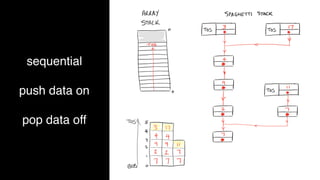
stacks
sequential
bounded depth
push & pop
sequential
push data on
pop data off
contiguous
bounded depth
c: array stack
fixed size
malloc to create
realloc to resize
#include <stdlib.h>
#define STACK_MAX 100
typedef enum {
STACK_OK = 0,
STACK_OVERFLOW,
STACK_UNDERFLOW
} STACK_STATUS;
typedef struct stack STACK;
struct stack {
int data[STACK_MAX];
int size;
};
STACK *NewStack() {
STACK *s;
s = malloc(sizeof(STACK));
s->size = 0;
return s;
}
int depth(STACK *s) {
return s->size;
}
STACK_STATUS push(STACK *s, int data) {
if (s->size < STACK_MAX) {
s->data[s->size++] = data;
return STACK_OK;
}
return STACK_OVERFLOW;
}
STACK_STATUS pop(STACK *s, int *r) {
if (s->size > 0) {
*r = s->data[s->size - 1];
s->size--;
return STACK_OK;
}
return STACK_UNDERFLOW;
}
go: slice stack
package main
import "fmt"
type stack []int
func (s *stack) Push(data int) {
(*s) = append((*s), data)
}
func (s *stack) Pop() (r int) {
sp := len(*s) - 1
r = (*s)[sp]
*s = (*s)[:sp]
return
}
func (s stack) Depth() int {
return len(s)
}
func main() {
s := new(stack)
s.Push(1)
s.Push(3)
fmt.Printf("depth = %dn", s.Depth())
l := s.Pop()
r := s.Pop()
fmt.Printf("%d + %d = %dn", l, r, l+r)
fmt.Printf("depth = %dn", s.Depth())
}
singly linked list
functional
shared elements
immutability
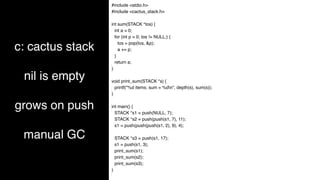
c: cactus stack
nil is empty
grows on push
manual GC
#include <stdlib.h>
typedef struct stack STACK;
struct stack {
int data;
STACK *next;
};
STACK *push(STACK *s, int data) {
STACK *r = malloc(sizeof(STACK));
r->data = data;
r->next = s;
return r;
}
STACK *pop(STACK *s, int *r) {
if (s == NULL)
exit(1);
*r = s->data;
return s->next;
}
int depth(STACK *s) {
int r = 0;
for (STACK *t = s; t != NULL; t = t->next) {
r++;
}
return r;
}
void gc(STACK **old, int items) {
STACK *t;
for (; items > 0 && *old != NULL; items--) {
t = *old;
*old = (*old)->next;
free(t);
}
}
c: cactus stack
nil is empty
grows on push
manual GC
#include <stdio.h>
#include <cactus_stack.h>
int sum(STACK *tos) {
int a = 0;
for (int p = 0; tos != NULL;) {
tos = pop(tos, &p);
a += p;
}
return a;
}
void print_sum(STACK *s) {
printf("%d items: sum = %dn", depth(s), sum(s));
}
int main() {
STACK *s1 = push(NULL, 7);
STACK *s2 = push(push(s1, 7), 11);
s1 = push(push(push(s1, 2), 9), 4);
STACK *s3 = push(s1, 17);
s1 = push(s1, 3);
print_sum(s1);
print_sum(s2);
print_sum(s3);
}
go: cactus stack
nil is empty
grows on push
automatic GC
package main
import "fmt"
type stack struct {
data int
tail *stack
}
func (s stack) Push(v int) (r stack) {
r = stack{data: v, tail: &s}
return
}
func (s stack) Pop() (v int, r stack) {
return s.data, *s.tail
}
func (s stack) Depth() (r int) {
for t := s.tail; t != nil; t = t.tail {
r++
}
return
}
func (s *stack) PrintSum() {
fmt.Printf("sum(%v): %vn", s.Depth(), s.Sum())
}
func (s stack) Sum() (r int) {
for t, n := s, 0; t.tail != nil; r += n {
n, t = t.Pop()
}
return
}
func main() {
s1 := new(stack).Push(7)
s2 := s1.Push(7).Push(11)
s1 = s1.Push(2).Push(9).Push(4)
s3 := s1.Push(17)
s1 = s1.Push(3)
s1.PrintSum()
s2.PrintSum()
s3.PrintSum()
}
caches
word-aligned
discontiguous
label-addressable
c: hash map
array
associative arrays
search
#include <limits.h>
struct map {
int size;
assoc_array_t **chains;
};
typedef struct map map_t;
map_t *map_new(int size) {
map_t *m = malloc(sizeof(map_t));
m->chains = malloc(sizeof(assoc_array_t*) * size);
for (int i = 0; i < size; i++) {
m->chains[i] = NULL;
}
m->size = size;
return m;
}
int map_chain(map_t *m, char *k) {
unsigned long int b;
for (int i = strlen(k) - 1; b < ULONG_MAX && i > 0; i--) {
b = b << 8;
b += k[i];
}
return b % m->size;
}
char *map_get(map_t *m, char *k) {
search_t *s = search_find(m->chains[map_chain(m, k)], k);
if (s != NULL) {
return s->value;
}
return NULL;
}
void map_set(map_t *m, char *k, char *v) {
int b = map_chain(m, k);
assoc_array_t *a = m->chains[b];
search_t *s = search_find(a, k);
if (s->value != NULL) {
s->cursor->value = strdup(v);
} else {
assoc_array_t *n = assoc_array_new(k, v);
if (s->cursor == a) {
n->next = s->cursor;
m->chains[b] = n;
} else if (s->cursor == NULL) {
s->memo->next = n;
} else {
n->next = s->cursor;
s->memo->next = n;
}
}
free(s);
}
c: hash map
array
associative arrays
search
#include <stdlib.h>
#include <string.h>
struct assoc_array {
char *key;
void *value;
struct assoc_array *next;
};
typedef struct assoc_array assoc_array_t;
assoc_array_t *assoc_array_new(char *k, char *v) {
assoc_array_t *a = malloc(sizeof(assoc_array_t));
a->key = strdup(k);
a->value = strdup(v);
a->next = NULL;
return a;
}
char *assoc_array_get_if(assoc_array_t *a, char *k) {
char *r = NULL;
if (a != NULL && strcmp(a->key, k) == 0) {
r = strdup(a->value);
}
return r;
}
c: hash map
array
associative arrays
search
struct search {
char *term, *value;
assoc_array_t *cursor, *memo;
};
typedef struct search search_t;
search_t *search_new(assoc_array_t *a, char *k) {
search_t *s = malloc(sizeof(search_t));
s->term = k;
s->value = NULL;
s->cursor = a;
s->memo = NULL;
return s;
}
void search_step(search_t *s) {
s->value = assoc_array_get_if(s->cursor, s->term);
}
int searching(search_t *s) {
return s->value == NULL && s->cursor != NULL;
}
search_t *search_find(assoc_array_t *a, char *k) {
search_t *s = search_new(a, k);
for (search_step(s); searching(s); search_step(s)) {
s->memo = s->cursor;
s->cursor = s->cursor->next;
}
return s;
}
c: hash map
array
associative arrays
search
#include <stdio.h>
#include “map.h
int main( int argc, char **argv ) {
map_t *m = map_new(1024);
map_set(m, "apple", "rosy");
printf("%sn", map_get(m, "apple"));
map_set(m, "blueberry", "sweet");
printf("%sn", map_get(m, "blueberry"));
map_set(m, "cherry", "pie");
printf("%sn", map_get(m, "cherry"));
map_set(m, "cherry", "tart");
printf("%sn", map_get(m, "cherry"));
printf("%sn", map_get(m, “tart"));
}
rosy
sweet
pie
tart
(null)
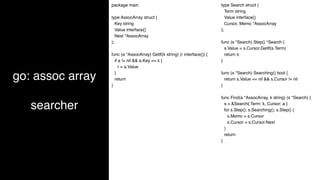
go: assoc array
searcher
package main
type AssocArray struct {
Key string
Value interface{}
Next *AssocArray
};
func (a *AssocArray) GetIf(k string) (r interface{}) {
if a != nil && a.Key == k {
r = a.Value
}
return
}
type Search struct {
Term string
Value interface{}
Cursor, Memo *AssocArray
};
func (s *Search) Step() *Search {
s.Value = s.Cursor.GetIf(s.Term)
return s
}
func (s *Search) Searching() bool {
return s.Value == nil && s.Cursor != nil
}
func Find(a *AssocArray, k string) (s *Search) {
s = &Search{ Term: k, Cursor: a }
for s.Step(); s.Searching(); s.Step() {
s.Memo = s.Cursor
s.Cursor = s.Cursor.Next
}
return
}
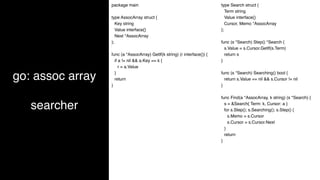
go: assoc array
searcher
package main
type AssocArray struct {
Key string
Value interface{}
Next *AssocArray
};
func (a *AssocArray) GetIf(k string) (r interface{}) {
if a != nil && a.Key == k {
r = a.Value
}
return
}
type Search struct {
Term string
Value interface{}
Cursor, Memo *AssocArray
};
func (s *Search) Step() *Search {
s.Value = s.Cursor.GetIf(s.Term)
return s
}
func (s *Search) Searching() bool {
return s.Value == nil && s.Cursor != nil
}
func Find(a *AssocArray, k string) (s *Search) {
s = &Search{ Term: k, Cursor: a }
for s.Step(); s.Searching(); s.Step() {
s.Memo = s.Cursor
s.Cursor = s.Cursor.Next
}
return
}
ruby: hash map
associative array
searcher
slice of arrays
package main
type Map []*AssocArray
func (m Map) Chain(k string) int {
var c uint
for i := len(k) - 1; i > 0; i-- {
c = c << 8
c += (uint)(k[i])
}
return int(c) % len(m)
}
func (m Map) Get(k string) (r interface{}) {
if s := Find(m[m.Chain(k)], k); s != nil {
r = s.Value
}
return
}
func (m Map) Set(k string, v interface{}) {
c := m.Chain(k)
a := m[c]
s := Find(a, k)
if s.Value != nil {
s.Cursor.Value = v
} else {
n := &AssocArray{ Key: k, Value: v }
switch {
case s.Cursor == a:
n.Next = s.Cursor
m[c] = n
case s.Cursor == nil:
s.Memo.Next = n
default:
n.Next = s.Cursor
s.Memo.Next = n
}
}
}
ruby: map
hashmap v. native
package main
import "fmt"
func main() {
hashmap():
nativemap();
}
func hashmap() {
m := make(Map, 1024)
m.Set("apple", "rosy")
fmt.Printf("%vn", m.Get("apple"))
m.Set("blueberry", "sweet")
fmt.Printf("%vn", m.Get("blueberry"))
m.Set("cherry", "pie")
fmt.Printf("%vn", m.Get("cherry"))
m.Set("cherry", "tart")
fmt.Printf("%vn", m.Get("cherry"))
fmt.Printf("%vn", m.Get("tart"))
}
func nativemap() {
m := make(map[string] interface{})
m["apple"] = "rosy"
fmt.Printf("%vn", m["apple"])
m["blueberry"] = "sweet"
fmt.Printf("%vn", m["blueberry"])
m["cherry"] = "pie"
fmt.Printf("%vn", m["cherry"])
m["cherry"] = "tart"
fmt.Printf("%vn", m["cherry"])
fmt.Printf("%vn", m["tart"])
}
Go & cgo: integrating
existing C code with Go
Andreas Krennmair <ak@synflood.at>
Golang User Group Berlin
Twitter: @der_ak
cgo
inline c
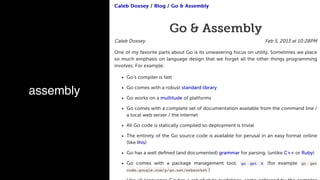
Feb 5, 2013 at 10:28PM
Caleb DoxseyCaleb Doxsey // BlogBlog // Go & AssemblyGo & Assembly
Go & AssemblyGo & Assembly
Caleb Doxsey
One of my favorite parts about Go is its unwavering focus on utility. Sometimes we place
so much emphasis on language design that we forget all the other things programming
involves. For example:
Go's compiler is fast
Go comes with a robust standard library
Go works on a multitude of platforms
Go comes with a complete set of documentation available from the command line /
a local web server / the internet
All Go code is statically compiled so deployment is trivial
The entirety of the Go source code is available for perusal in an easy format online
(like this)
Go has a well defined (and documented) grammar for parsing. (unlike C++ or Ruby)
Go comes with a package management tool. go get X (for example go get
code.google.com/p/go.net/websocket )
assembly
SIMD
branch prediction
cache misses
memory latency
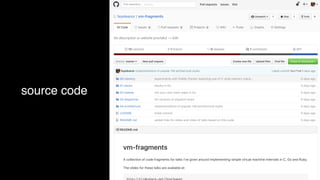
This repository Pull requests Issues Gist
No description or website provided. — Edit
00 memory experiments with Fiddle::Pointer exploring use of C-style memory mana… 5 days ago
01 stacks stacks in Go 5 days ago
02 hashes roll-your-own hash maps in Go 5 days ago
03 dispatcher Go versions of dispatch loops 5 days ago
04 architecture implementations of popular VM architectural styles 5 days ago
LICENSE Initial commit 5 days ago
README.md added links for slides and video of talks based on this code 5 days ago
Search
feyeleanor / vm-fragments
Code Issues 0 Pull requests 0 Projects 0 Wiki Pulse Graphs Settings
13 commits 1 branch 0 releases 1 contributor MIT
Clone or downloadClone or downloadCreate new file Upload files Find filemasterBranch: New pull request
Latest commit 9ee7fe0 5 days agofeyeleanor implementations of popular VM architectural styles
README.md
vm-fragments
A collection of code fragments for talks I've given around implementing simple virtual machine internals in C, Go and Ruby.
The slides for these talks are available at:
1 01Unwatch Star Fork
source code
Implementing Virtual Machines in Go & C

Implementing Virtual Machines in Go & C

  • 1.
    implementing virtual machines in Go &C Eleanor McHugh @feyeleanor http://github.com/feyeleanor
  • 2.
    I made myown machine Yes, we're building steam I hate the same routine — Building Steam, Abney Park
  • 3.
  • 4.
    and as programmerswe think a lot about thinking
  • 5.
    whilst thinking verylittle about machines
  • 6.
  • 7.
    when machines needus to be engineers & analysts
  • 8.
    so this isa talk about machine philosophy
  • 9.
    framed in alanguage we humans can understand
  • 10.
    so let's learnto love our Turing machines
  • 11.
    by building otherTuring machines' in their image
  • 12.
  • 13.
  • 14.
  • 15.
  • 16.
  • 17.
    c: switch bytes ortokens portable #include <stdio.h> #include <stdlib.h> #include "stack.h" #define READ_OPCODE *PC++ typedef enum { PUSH = 0, ADD, PRINT, EXIT } opcodes; int program [] = { (int)PUSH, 13, (int)PUSH, 28, (int)ADD, PRINT, EXIT, }; STACK *S; void interpret(int *PC) { int l, r; while (1) { switch(READ_OPCODE) { case PUSH: S = push(S, READ_OPCODE); break; case ADD: S = pop(S, &l); S = pop(S, &r); S = push(S, l + r); break; case PRINT: printf(“%d + %d = %dn, l, r, S->data); break; case EXIT: return; } } } int main() { interpret(program); }
  • 18.
    go: switch constants package main import"fmt" func main() { interpret([]interface{}{ PUSH, 13, PUSH, 28, ADD, PRINT, EXIT, }) } type stack struct { data int tail *stack } func (s *stack) Push(v int) (r *stack) { r = &stack{data: v, tail: s} return } func (s *stack) Pop() (v int, r *stack) { return s.data, s.tail } type OPCODE int const ( PUSH = OPCODE(iota) ADD PRINT EXIT ) func interpret(p []interface{}) { var l, r int S := new(stack) for PC := 0; ; PC++ { if op, ok := p[PC].(OPCODE); ok { switch op { case PUSH: PC++ S = S.Push(p[PC].(int)) case ADD: l, S = S.Pop() r, S = S.Pop() S = S.Push(l + r) case PRINT: fmt.Printf("%v + %v = %vn", l, r, S.data) case EXIT: return } } else { return } } }
  • 19.
    c: direct call pointerto function multi-byte portable #include <stdio.h> #include <stdlib.h> #include "stack.h" #define READ_OPCODE *PC++ typedef void (*opcode)(); STACK *S; opcode *PC; void op_add_and_print() { int l, r; S = pop(S, &l); S = pop(S, &r); S = push(S, l + r); printf("%d + %d = %dn", l, r, S->data); } void op_exit() { exit(0); } opcode program [] = { op_push, (opcode)(long)13, op_push, (opcode)(long)28, op_add_and_print, op_exit }; int main() { PC = program; while (1) { (READ_OPCODE)(); } }
  • 20.
    go: direct call packagemain import "fmt" import "os" func main() { p := new(Interpreter) p.m = []interface{}{ p.Push, 13, p.Push, 28, p.Add, p.Print, p.Exit, } p.Run() } type stack struct { data int tail *stack } func (s *stack) Push(v int) (r *stack) { return &stack{data: v, tail: s} } func (s *stack) Pop() (v int, r *stack) { return s.data, s.tail } type Interpreter struct { S *stack l, r, PC int m []interface{} } func (i *Interpreter) read_program() (r interface{}) { return i.m[i.PC] } func (i *Interpreter) Run() { for { i.read_program().(func())() i.PC++ } } func (i *Interpreter) Push() { i.PC++ i.S = i.S.Push(i.read_program().(int)) } func (i *Interpreter) Add() { i.l, i.S = i.S.Pop() i.r, i.S = i.S.Pop() i.S = i.S.Push(i.l + i.r) } func (i *Interpreter) Print() { fmt.Printf("%v + %v = %vn", i.l, i.r, i.S.data) } func (i *Interpreter) Exit() { os.Exit(0) }
  • 21.
    go: direct call rawclosures package main import "fmt" import "os" type stack struct { data int tail *stack } func (s *stack) Push(v int) (r *stack) { return &stack{data: v, tail: s} } func (s *stack) Pop() (v int, r *stack) { return s.data, s.tail } type Primitive func(*Interpreter) type Interpreter struct { S *stack l, r, PC int m []Primitive } func (i *Interpreter) read_program() Primitive { return i.m[i.PC] } func (i *Interpreter) Run() { for { i.read_program()(i) i.PC++ } } func main() { p := &Interpreter{ m: []Primitive{ func(i *Interpreter) { i.S = i.S.Push(13) }, func(i *Interpreter) { i.S = i.S.Push(28) }, func(i *Interpreter) { i.l, i.S = i.S.Pop() i.r, i.S = i.S.Pop() i.S = i.S.Push(i.l + i.r) }, func(i *Interpreter) { fmt.Printf("%v + %v = %vn", i.l, i.r, i.S.data) }, func (i *Interpreter) { os.Exit(0) }, }, } p.Run() }
  • 22.
    go: direct call rawclosures func main() { p := &Interpreter{ m: []Primitive{ func(i *Interpreter) { i.S = i.S.Push(13) i.PC++ i.read_program()(i) i.PC++ i.read_program()(i) }, func(i *Interpreter) { i.S = i.S.Push(28) }, func(i *Interpreter) { i.l, i.S = i.S.Pop() i.r, i.S = i.S.Pop() i.S = i.S.Push(i.l + i.r) }, func(i *Interpreter) { fmt.Printf("%v + %v = %vn", i.l, i.r, i.S.data) }, func (i *Interpreter) { os.Exit(0) }, }, } p.Run() }
  • 23.
    go: direct call rawclosures type Primitive func() func (i *Interpreter) Run() { for { i.read_program()() i.PC++ } } func main() { i := new(Interpreter) npush := func(vals ...int) Primitive { return func() { for _, v := range vals { i.S = i.S.Push(v) } } } i.m = []Primitive{ npush(13, 28), func() { i.l, i.S = i.S.Pop() i.r, i.S = i.S.Pop() i.S = i.S.Push(i.l + i.r) }, func() { fmt.Printf("%v + %v = %vn", i.l, i.r, i.S.data) }, func() { os.Exit(0) }, } i.Run() }
  • 24.
    go: direct call rawclosures jit assembly package main import "fmt" import "strings" import "os" type stack struct { data int tail *stack } func (s *stack) Push(v int) (r *stack) { return &stack{data: v, tail: s} } func (s *stack) Pop() (v int, r *stack) { return s.data, s.tail } func (s *stack) String() string { r := []string{} for i := s; i != nil; i = i.tail { r = append(r, fmt.Sprint(i.data)) } return "[" + strings.Join(r, ", ") + "]" }
  • 25.
    go: direct call rawclosures jit assembly type Label string type labels map[Label] int type VM struct { S *stack l, r, PC int m []interface{} labels } func (v *VM) read_program() interface{} { return v.m[v.PC] } func (v *VM) String() string { return fmt.Sprintf("@pc[%v] => #{%v}, %v", v.PC, v.m[v.PC], v.S) } func (v *VM) Load(program ...interface{}) { v.labels = make(labels) v.PC = -1 for _, token := range program { v.assemble(token) } } func (v *VM) assemble(token interface{}) { switch t := token.(type) { case Label: if i, ok := v.labels[t]; ok { v.m = append(v.m, i) } else { v.labels[t] = v.PC } default: v.m = append(v.m, token) v.PC++ } } func (v *VM) Run() { v.PC = -1 for { v.PC++ v.read_program().(func())() } }
  • 26.
    go: direct call rawclosures jit assembly type Interpreter struct { VM } func (i *Interpreter) Push() { i.PC++ i.S = i.S.Push(i.read_program().(int)) } func (i *Interpreter) Add() { i.l, i.S = i.S.Pop() i.r, i.S = i.S.Pop() i.S = i.S.Push(i.l + i.r) } func (i *Interpreter) JumpIfNotZero() { i.PC++ if i.S.data != 0 { i.PC = i.m[i.PC].(int) } } func main() { i := new(Interpreter) print_state := func() { fmt.Println(i) } skip := func() { i.PC++ } i.Load( i.Push, 13, Label("decrement"), func() { i.S = i.S.Push(-1) }, i.Add, print_state, skip, print_state, i.JumpIfNotZero, Label("decrement"), print_state, func() { os.Exit(0) }, ) i.Run() }
  • 27.
    c: indirect thread localjumps gcc/clang specific indirect loading #include <stdio.h> #include <stdlib.h> #include "stack.h" typedef enum { PUSH = 0, ADD, PRINT, EXIT } opcodes; void interpret(int *program) { static void *opcodes [] = { &&op_push, &&op_add, &&op_print, &&op_exit }; int l, r; STACK *S; int *PC = program; goto *opcodes[*PC++]; op_push: S = push(S, *PC++); goto *opcodes[*PC++]; op_add: S = pop(S, &l); S = pop(S, &r); S = push(S, l + r); goto *opcodes[*PC++]; op_print: printf("%d + %d = %dn", l, r, S->data); goto *opcodes[*PC++]; op_exit: return; } int main() { int program [] = { PUSH, 13, PUSH, 28, ADD, PRINT, EXIT }; interpret(program); }
  • 28.
    c: direct thread jitlocal jumps gcc/clang specific direct loading void interpret(int *PC, int words) { static void *dispatch_table[] = { &&op_push, &&op_add, &&op_print, &&op_exit }; STACK *S; int l, r; void **program = compile(PC, words, dispatch_table); if (program == NULL) exit(1); goto **program++; op_push: S = push(S, (int)(long)*program++); goto **program++; op_add: S = pop(S, &l); S = pop(S, &r); S = push(S, l + r); goto **program++; op_print: printf("%d + %d = %dn", l, r, S->data); goto **program++; op_exit: return; } int main() { int program[] = { PUSH, 13, PUSH, 28, ADD, PRINT, EXIT }; interpret(program, 7); }
  • 29.
    c: direct thread #defineINTERPRETER(body, ...) DISPATCHER(__VA_ARGS__); void **p = compile(PC, d); if (p == NULL) exit(1); EXECUTE_OPCODE body #define DISPATCHER(...) static void *d[] = { __VA_ARGS__ } #define READ_OPCODE *p++ #define EXECUTE_OPCODE goto *READ_OPCODE; #define PRIMITIVE(name, body) name: body; EXECUTE_OPCODE void interpret(int *PC) { STACK *S; int l, r; INTERPRETER( PRIMITIVE(push, S = push(S, (int)(long)READ_OPCODE) ) PRIMITIVE(add, S = pop(S, &l); S = pop(S, &r); S = push(S, l + r) ) PRIMITIVE(print, printf("%d + %d = %dn", l, r, S->data) ) PRIMITIVE(exit, return ), &&push, &&add, &&print, &&exit ) }
  • 30.
    c: direct thread jitlocal jumps gcc/clang specific direct loading void **compile(int *PC, int words, void *dispatch_table[]) { static void *compiler [] = { &&comp_push, &&comp_add, &&comp_print, &&comp_exit }; if (words < 1) return NULL; void **program = malloc(sizeof(void *) * words); void **cp = program; goto *compiler[*PC++]; comp_push: *cp++ = dispatch_table[PUSH]; *cp++ = (void *)(long)*PC++; words -= 2; if (words == 0) return program; goto *compiler[*PC++]; comp_add: *cp++ = dispatch_table[ADD]; words--; if (words == 0) return program; goto *compiler[*PC++]; comp_print: *cp++ = dispatch_table[PRINT]; words--; if (words == 0) return program; goto *compiler[*PC++]; comp_exit: *cp++ = dispatch_table[EXIT]; words--; if (words == 0) return program; goto *compiler[*PC++]; }
  • 31.
  • 32.
    vm harness dispatch program program counter packagemain import "fmt" type Label string type labels map[Label] int type VM struct { PC int m []interface{} labels } func (v *VM) read_program() interface{} { return v.m[v.PC] } func (v *VM) String() string { return fmt.Sprintf("@pc[%v] => #{%v}, %v", v.PC, v.m[v.PC]) } func (v *VM) Load(program ...interface{}) *VM { v.labels = make(labels) v.PC = -1 for _, token := range program { v.assemble(token) } return v } func (v *VM) assemble(token interface{}) { switch t := token.(type) { case Label: if i, ok := v.labels[t]; ok { v.m = append(v.m, i) } else { v.labels[t] = v.PC } default: v.m = append(v.m, token) v.PC++ } } func (v *VM) Run() { v.PC = -1 for { v.PC++ v.read_program().(func())() } }
  • 33.
    stack machine zero operands packagemain import "fmt" import "os" type S []int type StackMachine struct { S VM } func (s *StackMachine) String() string { return fmt.Sprintf("%v, %v", s.VM, s.S) } func (s *StackMachine) Push() { s.PC++ s.S = append(s.S, s.read_program().(int)) } func (s *StackMachine) Add() { s.S[len(s.S) - 2] += s.S[len(s.S) - 1] s.S = s.S[:len(s.S) - 1] } func (s *StackMachine) JumpIfNotZero() { s.PC++ if s.S[len(s.S) - 1] != 0 { s.PC = s.m[s.PC].(int) } } func main() { s := new(StackMachine) print_state := func() { fmt.Println(s) } skip := func() { s.PC++ } s.Load( s.Push, 13, Label("dec"), func() { s.S = append(s.S, -1) }, s.Add, print_state, skip, print_state, s.JumpIfNotZero, Label("dec"), print_state, func() { os.Exit(0) }, ).Run() }
  • 34.
    accumulator machine single register single operand packagemain import "fmt" import "os" type AccMachine struct { A int VM } func (a *AccMachine) String() string { return fmt.Sprintf("%v, A=%v", a.VM, a.A) } func (a *AccMachine) Clear() { a.A = 0 } func (a *AccMachine) LoadValue() { a.PC++ a.A = a.read_program().(int) } func (a *AccMachine) Add() { a.PC++ a.A += a.read_program().(int) } func (a *AccMachine) JumpIfNotZero() { a.PC++ if a.A != 0 { a.PC = a.m[a.PC].(int) } } func main() { a := new(AccMachine) print_state := func() { fmt.Println(a) } skip := func() { a.PC++ } a.Load( a.Clear, a.LoadValue, 13, Label("decrement"), a.Add, -1, print_state, skip, print_state, a.JumpIfNotZero, Label("decrement"), print_state, func() { os.Exit(0) }, ).Run() }
  • 35.
    register machine multi-register multi-operand package main import"fmt" import "os" type RegMachine struct { R []int VM } func (r *RegMachine) String() string { return fmt.Sprintf("%v, R=%v", r.VM, r.R) } func (r *RegMachine) Clear() { r.R = make([]int, 2, 2) } func (r *RegMachine) read_value() int { r.PC++ return r.read_program().(int) } func (r *RegMachine) LoadValue() { r.R[r.read_value()] = r.read_value() } func (r *RegMachine) Add() { i := r.read_value() j := r.read_value() r.R[i] += r.R[j] } func (r *RegMachine) JumpIfNotZero() { if r.R[r.read_value()] != 0 { r.PC = r.read_value() } else { r.PC++ } } func main() { r := new(RegMachine) print_state := func() { fmt.Println(r) } skip := func() { r.PC++ } r.Load( r.Clear, r.LoadValue, 0, 13, r.LoadValue, 1, -1, Label("decrement"), r.Add, 0, 1, print_state, skip, print_state, r.JumpIfNotZero, 0, Label("decrement"), print_state, func() { os.Exit(0) }, ).Run() }
  • 36.
    vector machine matrix machine hypercube graphprocessor any datatype can be a register
  • 37.
  • 38.
  • 39.
  • 40.
    go: slice heap packagemain import r "reflect" import "unsafe" type Memory []uintptr var _BYTE_SLICE = r.TypeOf([]byte(nil)) var _MEMORY = r.TypeOf(Memory{}) var _MEMORY_BYTES = int(_MEMORY.Elem().Size()) func (m Memory) newHeader() (h r.SliceHeader) { h = *(*r.SliceHeader)(unsafe.Pointer(&m)) h.Len = len(m) * _MEMORY_BYTES h.Cap = cap(m) * _MEMORY_BYTES return } func (m *Memory) Bytes() (b []byte) { h := m.newHeader() return *(*[]byte)(unsafe.Pointer(&h)) } func (m *Memory) Serialise() (b []byte) { h := m.newHeader() b = make([]byte, h.Len) copy(b, *(*[]byte)(unsafe.Pointer(&h))) return } func (m *Memory) Overwrite(i interface{}) { switch i := i.(type) { case Memory: copy(*m, i) case []byte: h := m.newHeader() b := *(*[]byte)(unsafe.Pointer(&h)) copy(b, i) } } func main() { m := make(Memory, 2) b := m.Bytes() s := m.Serialise() fmt.Println("m (cells) =", len(m), "of", cap(m), ":", m) fmt.Println("b (bytes) =", len(b), "of", cap(b), ":", b) fmt.Println("s (bytes) =", len(s), "of", cap(s), ":", s) m.Overwrite(Memory{3, 5}) fmt.Println("m (cells) =", len(m), "of", cap(m), ":", m) fmt.Println("b (bytes) =", len(b), "of", cap(b), ":", b) fmt.Println("s (bytes) =", len(s), "of", cap(s), ":", s) s = m.Serialise() m.Overwrite([]byte{8, 7, 6, 5, 4, 3, 2, 1}) fmt.Println("m (cells) =", len(m), "of", cap(m), ":", m) fmt.Println("b (bytes) =", len(b), "of", cap(b), ":", b) fmt.Println("s (bytes) =", len(s), "of", cap(s), ":", s) }
  • 41.
    ruby: c heap require"fiddle" class Fiddle::Pointer NIL = Pointer.new(0) SIZE = Fixnum::SIZE PACKING_PATTERN = case SIZE when 2 then "S" when 4 then "L" when 8 then "Q" end + "!" def write(value) str = Fiddle::format(value) pad = Fiddle::padding(str) l = pad + str.length raise BufferOverflow.new(self, l) if l > size self[0, l] = str + 0.chr * pad self + l end def to_bin [self].pack(PACKING_PATTERN) end end
  • 42.
    Home (./index.html) Classes (./index.html#classes)Methods (./index.html#methods) In Files fiddle/closure.c fiddle/fiddle.c fiddle/lib/fiddle.rb fiddle/lib/fiddle/closure.rb fiddle/lib/fiddle/cparser.rb fiddle/lib/fiddle/function.rb fiddle/lib/fiddle/import.rb fiddle/lib/fiddle/pack.rb fiddle/lib/fiddle/struct.rb fiddle/lib/fiddle/types.rb fiddle/lib/fiddle/value.rb Namespace MODULE Fiddle::BasicTypes (Fiddle/BasicTypes.html) MODULE Fiddle::CParser (Fiddle/CParser.html) MODULE Fiddle::CStructBuilder (Fiddle/CStructBuilder.html) MODULE Fiddle::Importer (Fiddle/Importer.html) MODULE Fiddle::Win32Types (Fiddle/Win32Types.html) CLASS Fiddle::CStruct (Fiddle/CStruct.html) CLASS Fiddle::CStructEntity (Fiddle/CStructEntity.html) CLASS Fiddle::CUnion (Fiddle/CUnion.html) CLASS Fiddle::CUnionEntity (Fiddle/CUnionEntity.html) CLASS Fiddle::Closure (Fiddle/Closure.html) CLASS Fiddle::CompositeHandler (Fiddle/CompositeHandler.html) Fiddle A libffi wrapper for Ruby. Description¶ (#module-Fiddle-label-Description) ↑ (#top) Fiddle (Fiddle.html) is an extension to translate a foreign function interface (FFI) with ruby. It wraps libffi (http://sourceware.org/libffi/), a popular C library which provides a portable interface that allows code written in one language to call code written in another language. Example¶ (#module-Fiddle-label-Example) ↑ (#top) Here we will use Fiddle::Function (Fiddle/Function.html) to wrap floor(3) from libm (http://linux.die.net/man/3/floor) require 'fiddle' libm = Fiddle.dlopen('/lib/libm.so.6') floor = Fiddle::Function.new( libm['floor'], [Fiddle::TYPE_DOUBLE], Fiddle::TYPE_DOUBLE ) access DLLs call C functions
  • 43.
    Home (../index.html) Classes (../index.html#classes)Methods (../index.html#methods) In Files fiddle/closure.c Parent Object Methods ::[] (#method-c-5B-5D) ::malloc (#method-c-malloc) ::new (#method-c-new) ::to_ptr (#method-c-to_ptr) #+ (#method-i-2B) #+@ (#method-i-2B-40) #- (#method-i-2D) #-@ (#method-i-2D-40) #<=> (#method-i-3C-3D-3E) #== (#method-i-3D-3D) #[] (#method-i-5B-5D) #[]= (#method-i-5B-5D-3D) #eql? (#method-i-eql-3F) #free (#method-i-free) #free= (#method-i-free-3D) #inspect (#method-i-inspect) #null? (#method-i-null-3F) Fiddle::Pointer Fiddle::Pointer (Pointer.html) is a class to handle C pointers Public Class Methods Get the underlying pointer for ruby object val and return it as a Fiddle::Pointer (Pointer.html) object. Allocate size bytes of memory and associate it with an optional freefunc that will be called when the pointer is garbage collected. freefunc must be an address pointing to a function or an instance of Fiddle::Function (Function.html) Create a new pointer to address with an optional size and freefunc. freefunc will be called when the instance is garbage collected. Fiddle::Pointer[val] => cptr to_ptr(val) => cptr Fiddle::Pointer.malloc(size, freefunc = nil) => fiddle pointer instance Fiddle::Pointer.new(address) => fiddle_cptr new(address, size) => fiddle_cptr new(address, size, freefunc) => fiddle_cptr MRI stdlib C pointers malloc not portable
  • 44.
    ruby: c heap defFiddle::Pointer.format(value) value.respond_to?(:to_bin) ? value.to_bin : Marshal.dump(value) end
  • 45.
    ruby: c heap require"fiddle" class Fiddle::Pointer NIL = Pointer.new(0) SIZE = Fixnum::SIZE PACKING_PATTERN = case SIZE when 2 then "S" when 4 then "L" when 8 then "Q" end + "!" def write(value) str = Fiddle::format(value) pad = Fiddle::padding(str) l = pad + str.length raise BufferOverflow.new(self, l) if l > size self[0, l] = str + 0.chr * pad self + l end def to_bin [self].pack(PACKING_PATTERN) end end
  • 46.
    ruby: c heap classFixnum SIZE = 1.size PACKING_PATTERN = case SIZE when 2 then "s" when 4 then "l" when 8 then "q" end + "!" def to_bin [self].pack(PACKING_PATTERN) end def self.read_bin(pointer) pointer[0, SIZE].unpack(PACKING_PATTERN).first end end
  • 47.
    ruby: c heap m= Fiddle::Pointer.malloc 64 begin m.write(0.chr * 59) m.write(0.chr * 60) m.write(0.chr * 61) rescue Fiddle::BufferOverflow => e p e.message end "Buffer overflow: 72 bytes at #<Fiddle::Pointer:0x007f8849052160 ptr=0x007f8849051da0 size=64 free=0x00000000000000>"
  • 48.
    ruby: c heap s= "Hello, Terrible Memory Bank!" i = 4193 f = 17.00091 m.write(i) puts m.read q = m.write(-i) puts m.read q.write(s) puts q.read(String) r = q.write(s[0, s.length - 1]) puts q.read(String) t = r.write(f) puts r.read(Float) t.write(-f) puts t.read(Float) => 4193 => -4193 => Hello, Terrible Memory Bank! => Hello, Terrible Memory Bank => 17.00091 => -17.00091
  • 49.
  • 50.
  • 51.
  • 52.
    c: array stack fixedsize malloc to create realloc to resize #include <stdlib.h> #define STACK_MAX 100 typedef enum { STACK_OK = 0, STACK_OVERFLOW, STACK_UNDERFLOW } STACK_STATUS; typedef struct stack STACK; struct stack { int data[STACK_MAX]; int size; }; STACK *NewStack() { STACK *s; s = malloc(sizeof(STACK)); s->size = 0; return s; } int depth(STACK *s) { return s->size; } STACK_STATUS push(STACK *s, int data) { if (s->size < STACK_MAX) { s->data[s->size++] = data; return STACK_OK; } return STACK_OVERFLOW; } STACK_STATUS pop(STACK *s, int *r) { if (s->size > 0) { *r = s->data[s->size - 1]; s->size--; return STACK_OK; } return STACK_UNDERFLOW; }
  • 53.
    go: slice stack packagemain import "fmt" type stack []int func (s *stack) Push(data int) { (*s) = append((*s), data) } func (s *stack) Pop() (r int) { sp := len(*s) - 1 r = (*s)[sp] *s = (*s)[:sp] return } func (s stack) Depth() int { return len(s) } func main() { s := new(stack) s.Push(1) s.Push(3) fmt.Printf("depth = %dn", s.Depth()) l := s.Pop() r := s.Pop() fmt.Printf("%d + %d = %dn", l, r, l+r) fmt.Printf("depth = %dn", s.Depth()) }
  • 54.
  • 55.
    c: cactus stack nilis empty grows on push manual GC #include <stdlib.h> typedef struct stack STACK; struct stack { int data; STACK *next; }; STACK *push(STACK *s, int data) { STACK *r = malloc(sizeof(STACK)); r->data = data; r->next = s; return r; } STACK *pop(STACK *s, int *r) { if (s == NULL) exit(1); *r = s->data; return s->next; } int depth(STACK *s) { int r = 0; for (STACK *t = s; t != NULL; t = t->next) { r++; } return r; } void gc(STACK **old, int items) { STACK *t; for (; items > 0 && *old != NULL; items--) { t = *old; *old = (*old)->next; free(t); } }
  • 56.
    c: cactus stack nilis empty grows on push manual GC #include <stdio.h> #include <cactus_stack.h> int sum(STACK *tos) { int a = 0; for (int p = 0; tos != NULL;) { tos = pop(tos, &p); a += p; } return a; } void print_sum(STACK *s) { printf("%d items: sum = %dn", depth(s), sum(s)); } int main() { STACK *s1 = push(NULL, 7); STACK *s2 = push(push(s1, 7), 11); s1 = push(push(push(s1, 2), 9), 4); STACK *s3 = push(s1, 17); s1 = push(s1, 3); print_sum(s1); print_sum(s2); print_sum(s3); }
  • 57.
    go: cactus stack nilis empty grows on push automatic GC package main import "fmt" type stack struct { data int tail *stack } func (s stack) Push(v int) (r stack) { r = stack{data: v, tail: &s} return } func (s stack) Pop() (v int, r stack) { return s.data, *s.tail } func (s stack) Depth() (r int) { for t := s.tail; t != nil; t = t.tail { r++ } return } func (s *stack) PrintSum() { fmt.Printf("sum(%v): %vn", s.Depth(), s.Sum()) } func (s stack) Sum() (r int) { for t, n := s, 0; t.tail != nil; r += n { n, t = t.Pop() } return } func main() { s1 := new(stack).Push(7) s2 := s1.Push(7).Push(11) s1 = s1.Push(2).Push(9).Push(4) s3 := s1.Push(17) s1 = s1.Push(3) s1.PrintSum() s2.PrintSum() s3.PrintSum() }
  • 58.
  • 59.
    c: hash map array associativearrays search #include <limits.h> struct map { int size; assoc_array_t **chains; }; typedef struct map map_t; map_t *map_new(int size) { map_t *m = malloc(sizeof(map_t)); m->chains = malloc(sizeof(assoc_array_t*) * size); for (int i = 0; i < size; i++) { m->chains[i] = NULL; } m->size = size; return m; } int map_chain(map_t *m, char *k) { unsigned long int b; for (int i = strlen(k) - 1; b < ULONG_MAX && i > 0; i--) { b = b << 8; b += k[i]; } return b % m->size; } char *map_get(map_t *m, char *k) { search_t *s = search_find(m->chains[map_chain(m, k)], k); if (s != NULL) { return s->value; } return NULL; } void map_set(map_t *m, char *k, char *v) { int b = map_chain(m, k); assoc_array_t *a = m->chains[b]; search_t *s = search_find(a, k); if (s->value != NULL) { s->cursor->value = strdup(v); } else { assoc_array_t *n = assoc_array_new(k, v); if (s->cursor == a) { n->next = s->cursor; m->chains[b] = n; } else if (s->cursor == NULL) { s->memo->next = n; } else { n->next = s->cursor; s->memo->next = n; } } free(s); }
  • 60.
    c: hash map array associativearrays search #include <stdlib.h> #include <string.h> struct assoc_array { char *key; void *value; struct assoc_array *next; }; typedef struct assoc_array assoc_array_t; assoc_array_t *assoc_array_new(char *k, char *v) { assoc_array_t *a = malloc(sizeof(assoc_array_t)); a->key = strdup(k); a->value = strdup(v); a->next = NULL; return a; } char *assoc_array_get_if(assoc_array_t *a, char *k) { char *r = NULL; if (a != NULL && strcmp(a->key, k) == 0) { r = strdup(a->value); } return r; }
  • 61.
    c: hash map array associativearrays search struct search { char *term, *value; assoc_array_t *cursor, *memo; }; typedef struct search search_t; search_t *search_new(assoc_array_t *a, char *k) { search_t *s = malloc(sizeof(search_t)); s->term = k; s->value = NULL; s->cursor = a; s->memo = NULL; return s; } void search_step(search_t *s) { s->value = assoc_array_get_if(s->cursor, s->term); } int searching(search_t *s) { return s->value == NULL && s->cursor != NULL; } search_t *search_find(assoc_array_t *a, char *k) { search_t *s = search_new(a, k); for (search_step(s); searching(s); search_step(s)) { s->memo = s->cursor; s->cursor = s->cursor->next; } return s; }
  • 62.
    c: hash map array associativearrays search #include <stdio.h> #include “map.h int main( int argc, char **argv ) { map_t *m = map_new(1024); map_set(m, "apple", "rosy"); printf("%sn", map_get(m, "apple")); map_set(m, "blueberry", "sweet"); printf("%sn", map_get(m, "blueberry")); map_set(m, "cherry", "pie"); printf("%sn", map_get(m, "cherry")); map_set(m, "cherry", "tart"); printf("%sn", map_get(m, "cherry")); printf("%sn", map_get(m, “tart")); } rosy sweet pie tart (null)
  • 63.
    go: assoc array searcher packagemain type AssocArray struct { Key string Value interface{} Next *AssocArray }; func (a *AssocArray) GetIf(k string) (r interface{}) { if a != nil && a.Key == k { r = a.Value } return } type Search struct { Term string Value interface{} Cursor, Memo *AssocArray }; func (s *Search) Step() *Search { s.Value = s.Cursor.GetIf(s.Term) return s } func (s *Search) Searching() bool { return s.Value == nil && s.Cursor != nil } func Find(a *AssocArray, k string) (s *Search) { s = &Search{ Term: k, Cursor: a } for s.Step(); s.Searching(); s.Step() { s.Memo = s.Cursor s.Cursor = s.Cursor.Next } return }
  • 64.
    go: assoc array searcher packagemain type AssocArray struct { Key string Value interface{} Next *AssocArray }; func (a *AssocArray) GetIf(k string) (r interface{}) { if a != nil && a.Key == k { r = a.Value } return } type Search struct { Term string Value interface{} Cursor, Memo *AssocArray }; func (s *Search) Step() *Search { s.Value = s.Cursor.GetIf(s.Term) return s } func (s *Search) Searching() bool { return s.Value == nil && s.Cursor != nil } func Find(a *AssocArray, k string) (s *Search) { s = &Search{ Term: k, Cursor: a } for s.Step(); s.Searching(); s.Step() { s.Memo = s.Cursor s.Cursor = s.Cursor.Next } return }
  • 65.
    ruby: hash map associativearray searcher slice of arrays package main type Map []*AssocArray func (m Map) Chain(k string) int { var c uint for i := len(k) - 1; i > 0; i-- { c = c << 8 c += (uint)(k[i]) } return int(c) % len(m) } func (m Map) Get(k string) (r interface{}) { if s := Find(m[m.Chain(k)], k); s != nil { r = s.Value } return } func (m Map) Set(k string, v interface{}) { c := m.Chain(k) a := m[c] s := Find(a, k) if s.Value != nil { s.Cursor.Value = v } else { n := &AssocArray{ Key: k, Value: v } switch { case s.Cursor == a: n.Next = s.Cursor m[c] = n case s.Cursor == nil: s.Memo.Next = n default: n.Next = s.Cursor s.Memo.Next = n } } }
  • 66.
    ruby: map hashmap v.native package main import "fmt" func main() { hashmap(): nativemap(); } func hashmap() { m := make(Map, 1024) m.Set("apple", "rosy") fmt.Printf("%vn", m.Get("apple")) m.Set("blueberry", "sweet") fmt.Printf("%vn", m.Get("blueberry")) m.Set("cherry", "pie") fmt.Printf("%vn", m.Get("cherry")) m.Set("cherry", "tart") fmt.Printf("%vn", m.Get("cherry")) fmt.Printf("%vn", m.Get("tart")) } func nativemap() { m := make(map[string] interface{}) m["apple"] = "rosy" fmt.Printf("%vn", m["apple"]) m["blueberry"] = "sweet" fmt.Printf("%vn", m["blueberry"]) m["cherry"] = "pie" fmt.Printf("%vn", m["cherry"]) m["cherry"] = "tart" fmt.Printf("%vn", m["cherry"]) fmt.Printf("%vn", m["tart"]) }
  • 67.
    Go & cgo:integrating existing C code with Go Andreas Krennmair <ak@synflood.at> Golang User Group Berlin Twitter: @der_ak cgo inline c
  • 68.
    Feb 5, 2013at 10:28PM Caleb DoxseyCaleb Doxsey // BlogBlog // Go & AssemblyGo & Assembly Go & AssemblyGo & Assembly Caleb Doxsey One of my favorite parts about Go is its unwavering focus on utility. Sometimes we place so much emphasis on language design that we forget all the other things programming involves. For example: Go's compiler is fast Go comes with a robust standard library Go works on a multitude of platforms Go comes with a complete set of documentation available from the command line / a local web server / the internet All Go code is statically compiled so deployment is trivial The entirety of the Go source code is available for perusal in an easy format online (like this) Go has a well defined (and documented) grammar for parsing. (unlike C++ or Ruby) Go comes with a package management tool. go get X (for example go get code.google.com/p/go.net/websocket ) assembly
  • 69.
  • 70.
    This repository Pullrequests Issues Gist No description or website provided. — Edit 00 memory experiments with Fiddle::Pointer exploring use of C-style memory mana… 5 days ago 01 stacks stacks in Go 5 days ago 02 hashes roll-your-own hash maps in Go 5 days ago 03 dispatcher Go versions of dispatch loops 5 days ago 04 architecture implementations of popular VM architectural styles 5 days ago LICENSE Initial commit 5 days ago README.md added links for slides and video of talks based on this code 5 days ago Search feyeleanor / vm-fragments Code Issues 0 Pull requests 0 Projects 0 Wiki Pulse Graphs Settings 13 commits 1 branch 0 releases 1 contributor MIT Clone or downloadClone or downloadCreate new file Upload files Find filemasterBranch: New pull request Latest commit 9ee7fe0 5 days agofeyeleanor implementations of popular VM architectural styles README.md vm-fragments A collection of code fragments for talks I've given around implementing simple virtual machine internals in C, Go and Ruby. The slides for these talks are available at: 1 01Unwatch Star Fork source code