DR. SHAGUFTA RIAZ
Introduction to Garment Manufacturing
(TE- 2114)
Sampling and sampling procedure
LECTURE 3
 Sampling
 Types of Samples
 Steps involved in Sampling
3
SAMPLING
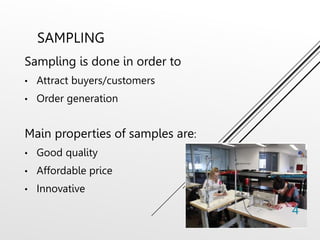
Sampling is done in order to
• Attract buyers/customers
• Order generation
Main properties of samples are:
• Good quality
• Affordable price
• Innovative
4
SAMPLING PROCEDURE IN GARMENT
MANUFACTURING
Sample Development:
“The process of making garments with specific measurements”
 Garment samples are inevitably important before starting the
bulk production.
 The buyers generally places the order after they are satisfied with
the quality of the Samples.
 Buyers require different types of sample from different stages of
the order process.
 Usually produced by a small section called sampling section.
 Supervised by the pattern master and/or designer.
5
PURPOSE OF SAMPLE DEVELOPMENT
 To allow the buyer to judge the production capabilities
of the manufacturer.
 To provide a means for making revisions in the bulk
production process.
 To let the manufacturer estimate the thread and fabric
consumption,
 To develop cost quotations.
 To grab the potential customers.
6
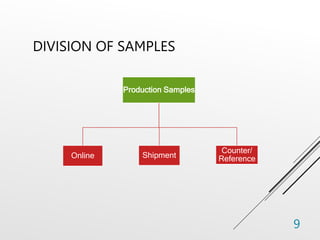
DIVISION OF SAMPLES
Development Sample - Initial stage of garment
manufacturing. These samples are made before
production.
Production Sample - Last stage of garment
manufacturing. By this, a buyer can know the bulk
production condition of a garment industry.
7
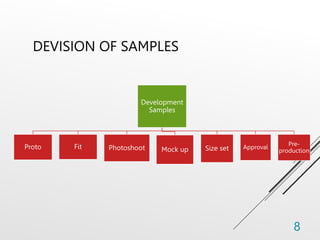
DEVISION OF SAMPLES
8
Development
Samples
Proto Fit Photoshoot Mock up Size set Approval
Pre-
production
DIVISION OF SAMPLES
9
Production Samples
Online Shipment
Counter/
Reference
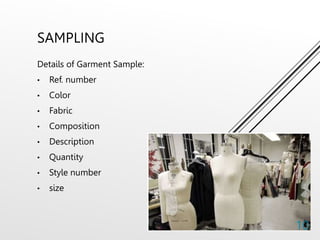
SAMPLING
Details of Garment Sample:
• Ref. number
• Color
• Fabric
• Composition
• Description
• Quantity
• Style number
• size
10
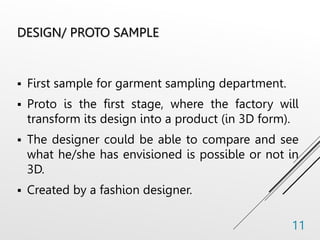
DESIGN/ PROTO SAMPLE
 First sample for garment sampling department.
 Proto is the first stage, where the factory will
transform its design into a product (in 3D form).
 The designer could be able to compare and see
what he/she has envisioned is possible or not in
3D.
 Created by a fashion designer.
11
DESIGN/ PROTO SAMPLE
 Proto sample is made in available similar fabrics
but in the actual measurements and
specifications.
 In one size, as specified by the buyer.
 Not mentioned fit and fabric details in this stage.
12
WHY PROTO SAMPLE?
 Ensures manufacturer and apparel brand are on
the same page
 Leads to more accuracy and fewer rejections
 Saves time and money
 Protects against misinterpretation on style
detailing
 Expressively improves efficiency and productivity
13
IMPORTANCE OF PROTO SAMPLE FOR
ORGANIZATION
 By making this sample the factory learn about
the:
 Style
 Its construction
 Machine requirement
 Processes to be used to make quality product
14
IMPORTANCE OF PROTO SAMPLE FOR
ORGANIZATION
 What could be the all difficulties during bulk
production
 The suggestion of alternates to the buyers / get
their approval to avoid the problem at later
stage.
 The patterns may be altered
 Effective to reduce the material consumption /
CMT.
15
IMPORTANCE OF PROTO SAMPLE FOR
ORGANIZATION
 Use of existing machinery or purchase of new
machines
 The suitability of the intended fabrics and
process is established for mass production
 At the sampling stage, the quantities of fabric
and trimmings are re-established
16
VIRTUAL PROTOTYPING
 It is first stage where only aesthetics are judged
in sample
 Virtual prototyping is a technique used in the
process of product development through CAD,
CAM.
 Virtual prototyping is effective and time saving
way to communicate with buyer without sending
physical sample.
17
FIT SAMPLE
 For making a fit sample, fashion designers are
using dummy.
 Fit samples are prepared by buyer order sheet
measurement.
18
PHOTOSHOOT SAMPLE
 When the fit sample is approved the photo shoot
sample is made.
 Taking Photo shoot for the buyer where samples
will be worn by the models or dummy.
 Actual fabrics and accessories are compulsory
19
MOCK UP SAMPLE
 Not a complete sample.
 For buyer few parts of garments are made.
 The part of garments such as sleeve, collar, front
panel, leg parts etc.
20
SIZE SET SAMPLE
 Garment has different sizes such as S, L, M, XL,
XXL, etc.
 To check the fit of the garment in different sizes.
 Size set sample is very important because
without this approval, the cutting would not be
started
21
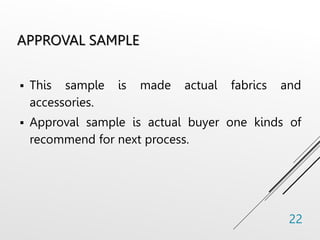
APPROVAL SAMPLE
 This sample is made actual fabrics and
accessories.
 Approval sample is actual buyer one kinds of
recommend for next process.
22
PRE-PRODUCTION SAMPLE
 Last stage of development sample.
 In apparel industry, short name of this sample
is PP sample.
 Garment bulk production depends on
approval of pre-production sample from
buyer
23
ONLINE SAMPLE
 A sample which is collected from the first
stage of production process.
 For production follow up, a buyer must
collect this sample from the apparel industry.
 Use original fabrics and accessories.
24
SHIPMENT SAMPLE
 In this stage production has done.
 Use original fabrics and accessories.
 For sending this sample to the buyer, need all packing
accessories such as:
• hanger,
• packing list,
• bar code sticker,
• hang tag,
• price tag, etc.
25
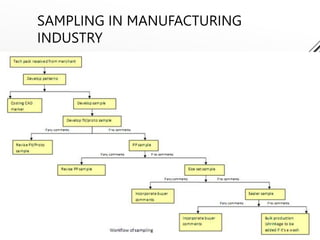
SAMPLING IN MANUFACTURING
INDUSTRY
STEPS IN SAMPLING PROCESS
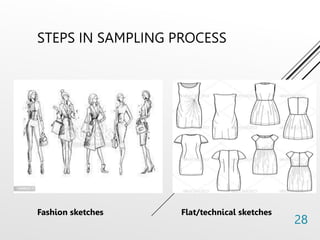
1- Design/Sketch
• Designer draws several sketches in the sketch
book
• No detail at first moment but a number of
sketches
• Analysis and selection of sketches by a panel of
designers
• Flat drawings are made that help pattern
makers in patterns
27
STEPS IN SAMPLING PROCESS
Fashion sketches Flat/technical sketches
28
STEPS IN SAMPLING PROCESS
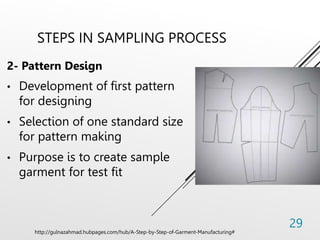
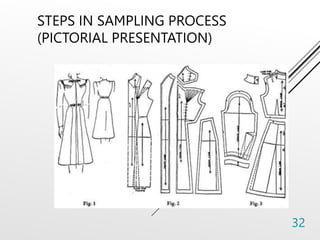
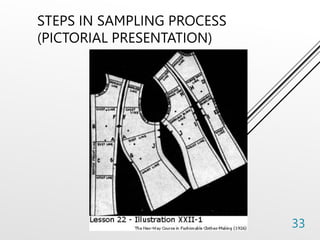
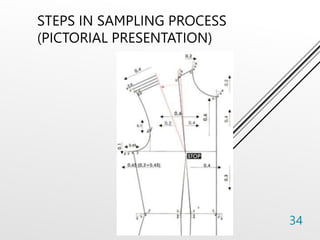
2- Pattern Design
• Development of first pattern
for designing
• Selection of one standard size
for pattern making
• Purpose is to create sample
garment for test fit
http://gulnazahmad.hubpages.com/hub/A-Step-by-Step-of-Garment-Manufacturing#
29
STEPS IN SAMPLING PROCESS
3- Sample Making
• Sending of first pattern into assembly for
garment making
• Sample is constructed to analyze pattern fit and
design
• Sample analysis by a panel of designers, pattern
makers and sewing specialist.
• Changes are made according to comments.
http://gulnazahmad.hubpages.com/hub/A-Step-by-Step-of-Garment-Manufacturing#
30
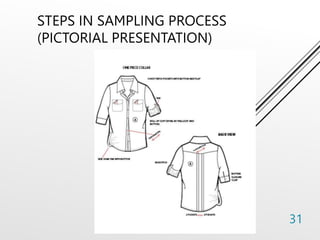
STEPS IN SAMPLING PROCESS
(PICTORIAL PRESENTATION)
31
STEPS IN SAMPLING PROCESS
(PICTORIAL PRESENTATION)
32
STEPS IN SAMPLING PROCESS
(PICTORIAL PRESENTATION)
33
STEPS IN SAMPLING PROCESS
(PICTORIAL PRESENTATION)
34
Thank You!

GM NTU W 3.pptx

  • 1.
    DR. SHAGUFTA RIAZ Introductionto Garment Manufacturing (TE- 2114) Sampling and sampling procedure
  • 3.
    LECTURE 3  Sampling Types of Samples  Steps involved in Sampling 3
  • 4.
    SAMPLING Sampling is donein order to • Attract buyers/customers • Order generation Main properties of samples are: • Good quality • Affordable price • Innovative 4
  • 5.
    SAMPLING PROCEDURE INGARMENT MANUFACTURING Sample Development: “The process of making garments with specific measurements”  Garment samples are inevitably important before starting the bulk production.  The buyers generally places the order after they are satisfied with the quality of the Samples.  Buyers require different types of sample from different stages of the order process.  Usually produced by a small section called sampling section.  Supervised by the pattern master and/or designer. 5
  • 6.
    PURPOSE OF SAMPLEDEVELOPMENT  To allow the buyer to judge the production capabilities of the manufacturer.  To provide a means for making revisions in the bulk production process.  To let the manufacturer estimate the thread and fabric consumption,  To develop cost quotations.  To grab the potential customers. 6
  • 7.
    DIVISION OF SAMPLES DevelopmentSample - Initial stage of garment manufacturing. These samples are made before production. Production Sample - Last stage of garment manufacturing. By this, a buyer can know the bulk production condition of a garment industry. 7
  • 8.
    DEVISION OF SAMPLES 8 Development Samples ProtoFit Photoshoot Mock up Size set Approval Pre- production
  • 9.
    DIVISION OF SAMPLES 9 ProductionSamples Online Shipment Counter/ Reference
  • 10.
    SAMPLING Details of GarmentSample: • Ref. number • Color • Fabric • Composition • Description • Quantity • Style number • size 10
  • 11.
    DESIGN/ PROTO SAMPLE First sample for garment sampling department.  Proto is the first stage, where the factory will transform its design into a product (in 3D form).  The designer could be able to compare and see what he/she has envisioned is possible or not in 3D.  Created by a fashion designer. 11
  • 12.
    DESIGN/ PROTO SAMPLE Proto sample is made in available similar fabrics but in the actual measurements and specifications.  In one size, as specified by the buyer.  Not mentioned fit and fabric details in this stage. 12
  • 13.
    WHY PROTO SAMPLE? Ensures manufacturer and apparel brand are on the same page  Leads to more accuracy and fewer rejections  Saves time and money  Protects against misinterpretation on style detailing  Expressively improves efficiency and productivity 13
  • 14.
    IMPORTANCE OF PROTOSAMPLE FOR ORGANIZATION  By making this sample the factory learn about the:  Style  Its construction  Machine requirement  Processes to be used to make quality product 14
  • 15.
    IMPORTANCE OF PROTOSAMPLE FOR ORGANIZATION  What could be the all difficulties during bulk production  The suggestion of alternates to the buyers / get their approval to avoid the problem at later stage.  The patterns may be altered  Effective to reduce the material consumption / CMT. 15
  • 16.
    IMPORTANCE OF PROTOSAMPLE FOR ORGANIZATION  Use of existing machinery or purchase of new machines  The suitability of the intended fabrics and process is established for mass production  At the sampling stage, the quantities of fabric and trimmings are re-established 16
  • 17.
    VIRTUAL PROTOTYPING  Itis first stage where only aesthetics are judged in sample  Virtual prototyping is a technique used in the process of product development through CAD, CAM.  Virtual prototyping is effective and time saving way to communicate with buyer without sending physical sample. 17
  • 18.
    FIT SAMPLE  Formaking a fit sample, fashion designers are using dummy.  Fit samples are prepared by buyer order sheet measurement. 18
  • 19.
    PHOTOSHOOT SAMPLE  Whenthe fit sample is approved the photo shoot sample is made.  Taking Photo shoot for the buyer where samples will be worn by the models or dummy.  Actual fabrics and accessories are compulsory 19
  • 20.
    MOCK UP SAMPLE Not a complete sample.  For buyer few parts of garments are made.  The part of garments such as sleeve, collar, front panel, leg parts etc. 20
  • 21.
    SIZE SET SAMPLE Garment has different sizes such as S, L, M, XL, XXL, etc.  To check the fit of the garment in different sizes.  Size set sample is very important because without this approval, the cutting would not be started 21
  • 22.
    APPROVAL SAMPLE  Thissample is made actual fabrics and accessories.  Approval sample is actual buyer one kinds of recommend for next process. 22
  • 23.
    PRE-PRODUCTION SAMPLE  Laststage of development sample.  In apparel industry, short name of this sample is PP sample.  Garment bulk production depends on approval of pre-production sample from buyer 23
  • 24.
    ONLINE SAMPLE  Asample which is collected from the first stage of production process.  For production follow up, a buyer must collect this sample from the apparel industry.  Use original fabrics and accessories. 24
  • 25.
    SHIPMENT SAMPLE  Inthis stage production has done.  Use original fabrics and accessories.  For sending this sample to the buyer, need all packing accessories such as: • hanger, • packing list, • bar code sticker, • hang tag, • price tag, etc. 25
  • 26.
  • 27.
    STEPS IN SAMPLINGPROCESS 1- Design/Sketch • Designer draws several sketches in the sketch book • No detail at first moment but a number of sketches • Analysis and selection of sketches by a panel of designers • Flat drawings are made that help pattern makers in patterns 27
  • 28.
    STEPS IN SAMPLINGPROCESS Fashion sketches Flat/technical sketches 28
  • 29.
    STEPS IN SAMPLINGPROCESS 2- Pattern Design • Development of first pattern for designing • Selection of one standard size for pattern making • Purpose is to create sample garment for test fit http://gulnazahmad.hubpages.com/hub/A-Step-by-Step-of-Garment-Manufacturing# 29
  • 30.
    STEPS IN SAMPLINGPROCESS 3- Sample Making • Sending of first pattern into assembly for garment making • Sample is constructed to analyze pattern fit and design • Sample analysis by a panel of designers, pattern makers and sewing specialist. • Changes are made according to comments. http://gulnazahmad.hubpages.com/hub/A-Step-by-Step-of-Garment-Manufacturing# 30
  • 31.
    STEPS IN SAMPLINGPROCESS (PICTORIAL PRESENTATION) 31
  • 32.
    STEPS IN SAMPLINGPROCESS (PICTORIAL PRESENTATION) 32
  • 33.
    STEPS IN SAMPLINGPROCESS (PICTORIAL PRESENTATION) 33
  • 34.
    STEPS IN SAMPLINGPROCESS (PICTORIAL PRESENTATION) 34
  • 35.