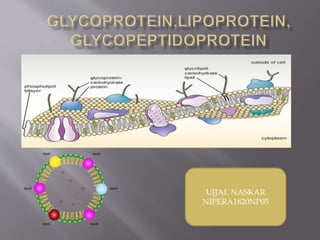
UJJAL NASKAR
NIPERA1820NP05
 Glycoproteins are proteins having covalently
bound carbohydrate.
 This process is known as glycosylation.
 The history of glycoproteins goes back to as
early as 1805, when Bostock first characterized
the mucus substance of the animal body as
chemically distinct from what we now
recognize as protein.
 They are classified into three groups
1. O-Linked oligosaccharides
2. N-linked oligosaccharides
3. Glyco phosphatidyl inositol
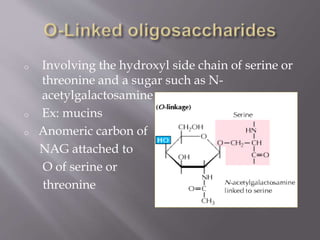
o Involving the hydroxyl side chain of serine or
threonine and a sugar such as N-
acetylgalactosamine
o Ex: mucins
o Anomeric carbon of
NAG attached to
O of serine or
threonine
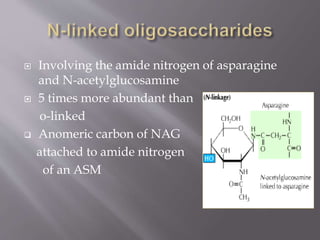
 Involving the amide nitrogen of asparagine
and N-acetylglucosamine
 5 times more abundant than
o-linked
 Anomeric carbon of NAG
attached to amide nitrogen
of an ASM
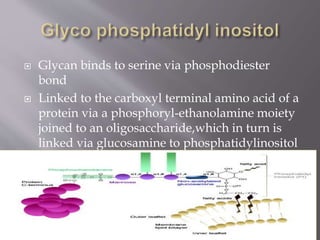
 Glycan binds to serine via phosphodiester
bond
 Linked to the carboxyl terminal amino acid of a
protein via a phosphoryl-ethanolamine moiety
joined to an oligosaccharide,which in turn is
linked via glucosamine to phosphatidylinositol
 Structural molecule. Ex: collagens
 Lubricant and protective agent. Ex: mucins
 Regulation of enzyme. Ex: alkaline phosphate
 Regulation of transport molecule.
Ex: transferin
 Affect folding of certain protein.Ex: calnexin
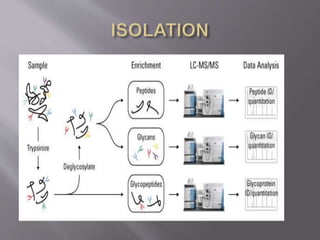
 Lectin can be used to purify glycoprotein
 Immobilized lectins are used in affinity
chromatography to selectively capture
glycoproteins and glycopeptides.
 primary lectins used ..........
1.wheat germ (Triticum vulgaris)
2. Concanavalin A
 Periodic acid-Schiff stain: Detects glycoproteins as
pink bands after electrophoretic separation.
• The glycoproteins were found to be
degraded more rapidly than unfractionated
proteins
• Glycoproteins from liver tend to be slightly
larger and more acidic than average
proteins
• So poly- peptide size and net charge are
known to influence protein half-lives, these
factors undoubtedly contribute to the more
rapid degradation of glycoproteins

Glycoprotein and Lipoprotein

  • 1.
  • 2.
     Glycoproteins areproteins having covalently bound carbohydrate.  This process is known as glycosylation.  The history of glycoproteins goes back to as early as 1805, when Bostock first characterized the mucus substance of the animal body as chemically distinct from what we now recognize as protein.
  • 3.
     They areclassified into three groups 1. O-Linked oligosaccharides 2. N-linked oligosaccharides 3. Glyco phosphatidyl inositol
  • 4.
    o Involving thehydroxyl side chain of serine or threonine and a sugar such as N- acetylgalactosamine o Ex: mucins o Anomeric carbon of NAG attached to O of serine or threonine
  • 5.
     Involving theamide nitrogen of asparagine and N-acetylglucosamine  5 times more abundant than o-linked  Anomeric carbon of NAG attached to amide nitrogen of an ASM
  • 6.
     Glycan bindsto serine via phosphodiester bond  Linked to the carboxyl terminal amino acid of a protein via a phosphoryl-ethanolamine moiety joined to an oligosaccharide,which in turn is linked via glucosamine to phosphatidylinositol
  • 7.
     Structural molecule.Ex: collagens  Lubricant and protective agent. Ex: mucins  Regulation of enzyme. Ex: alkaline phosphate  Regulation of transport molecule. Ex: transferin  Affect folding of certain protein.Ex: calnexin
  • 9.
     Lectin canbe used to purify glycoprotein  Immobilized lectins are used in affinity chromatography to selectively capture glycoproteins and glycopeptides.  primary lectins used .......... 1.wheat germ (Triticum vulgaris) 2. Concanavalin A  Periodic acid-Schiff stain: Detects glycoproteins as pink bands after electrophoretic separation.
  • 10.
    • The glycoproteinswere found to be degraded more rapidly than unfractionated proteins • Glycoproteins from liver tend to be slightly larger and more acidic than average proteins • So poly- peptide size and net charge are known to influence protein half-lives, these factors undoubtedly contribute to the more rapid degradation of glycoproteins