GLUTAMETERGIC SYSTEM
Department of Pharmaceutical Engineering and Technology ,IITBHU, Varanasi
By- Arghya Chowdhury (Roll no.: 18162027), M.Pharm(1st Year)
Outline
▪ Introduction
▪ Glutamate: biosynthesis
▪ Glutamate: Physiology
▪ Types of glutamate receptors
▪ NMDA Receptors: features
▪ AMPA Receptor: features
▪ Kainate Receptor: features
▪ Metabotropic glutamate receptors: features and overview
▪ Excitotoxicity
▪ Disease associated with Glutamate
▪ Approved drugs acting via Glutamate Receptor
▪ Conclusion
INTRODUCTION
It is the major excitatory neurotransmitter in the mammalian central
nervous system (CNS).
Glutamate in the CNS comes mainly from either glucose(via the
Krebs's cycle) or Glutamine, which is synthesized by glial cells and
taken up by the neurons.
Responsible for neural communication , memory formation , learning
and regulation.
The action of glutamate is terminated mainly by carrier-mediated
reuptake into the nerve terminals and neighboring astrocytes.
It is also the precursor for GABA-the brain’s main inhibitory
neurotransmitter.
Glutamate: Biosynthesis and metabolism
H.P Rang and M.M Dale, “Pharmacology”, Elsevier Churchill Livingstone, 8th edition, 2015,Edinburg , 455.
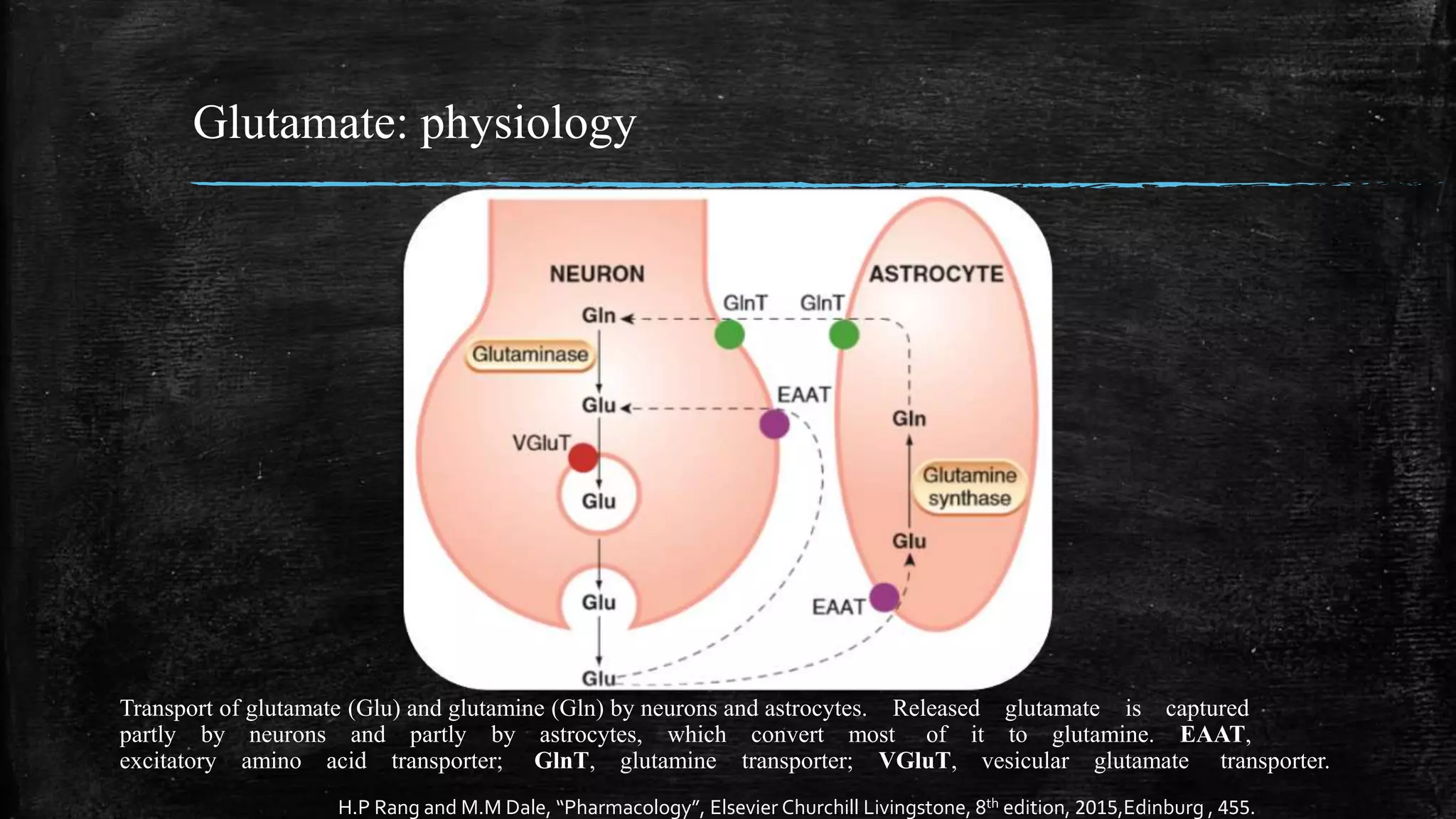
Glutamate: physiology
Transport of glutamate (Glu) and glutamine (Gln) by neurons and astrocytes. Released glutamate is captured
partly by neurons and partly by astrocytes, which convert most of it to glutamine. EAAT,
excitatory amino acid transporter; GlnT, glutamine transporter; VGluT, vesicular glutamate transporter.
H.P Rang and M.M Dale, “Pharmacology”, Elsevier Churchill Livingstone, 8th edition, 2015,Edinburg , 455.
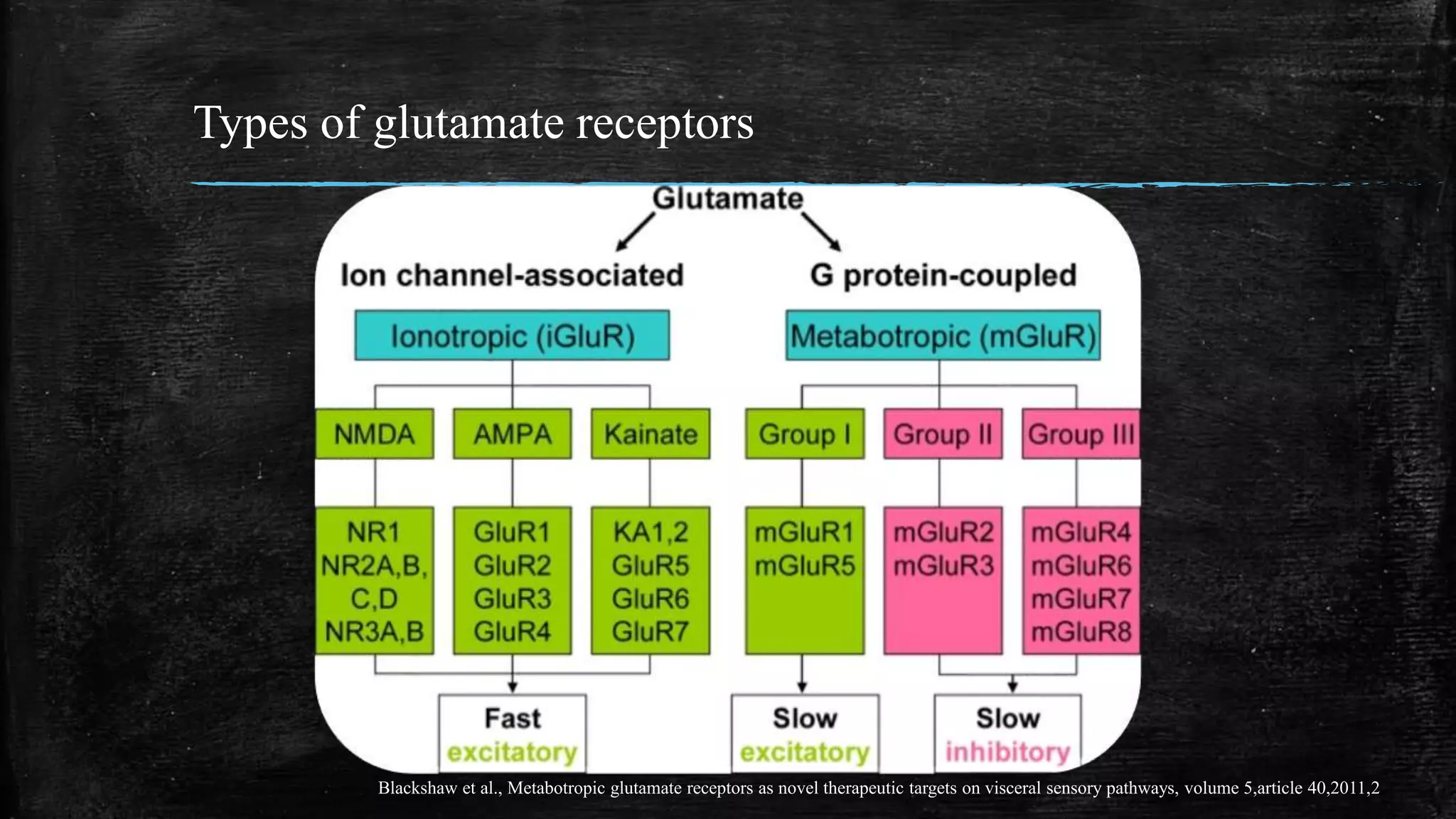
Types of glutamate receptors
Blackshaw et al., Metabotropic glutamate receptors as novel therapeutic targets on visceral sensory pathways, volume 5,article 40,2011,2
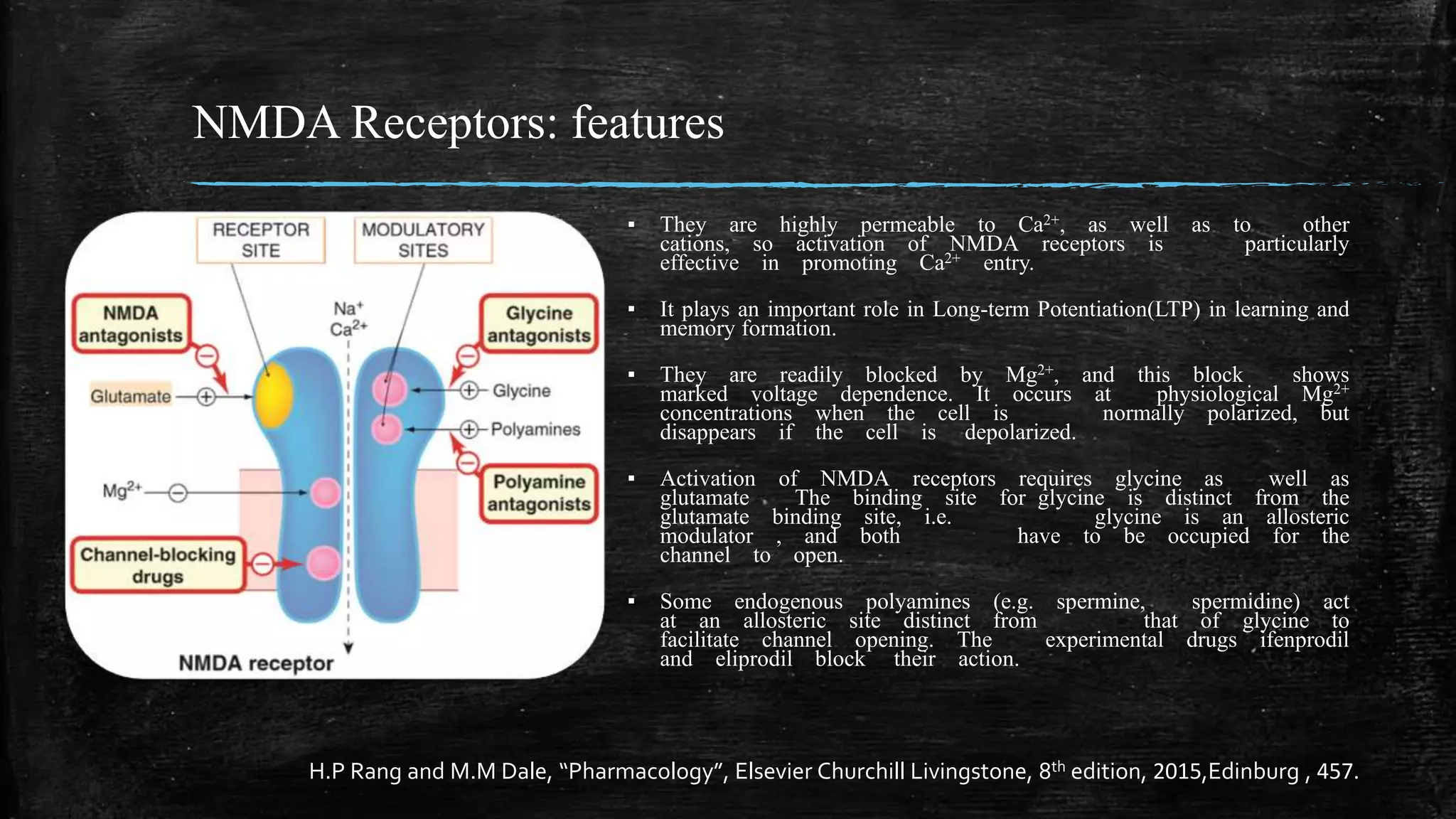
NMDA Receptors: features
▪ They are highly permeable to Ca2+, as well as to other
cations, so activation of NMDA receptors is particularly
effective in promoting Ca2+ entry.
▪ It plays an important role in Long-term Potentiation(LTP) in learning and
memory formation.
▪ They are readily blocked by Mg2+, and this block shows
marked voltage dependence. It occurs at physiological Mg2+
concentrations when the cell is normally polarized, but
disappears if the cell is depolarized.
▪ Activation of NMDA receptors requires glycine as well as
glutamate The binding site for glycine is distinct from the
glutamate binding site, i.e. glycine is an allosteric
modulator , and both have to be occupied for the
channel to open.
▪ Some endogenous polyamines (e.g. spermine, spermidine) act
at an allosteric site distinct from that of glycine to
facilitate channel opening. The experimental drugs ifenprodil
and eliprodil block their action.
H.P Rang and M.M Dale, “Pharmacology”, Elsevier Churchill Livingstone, 8th edition, 2015,Edinburg , 457.
AMPA Receptor: features
▪ Also known as quisqualate receptor.
▪ Each AMPAR has four sites to which an agonist
(such as glutamate) can bind, one for each subunit.
▪ It is a non-NMDA type ionotropic transmembrane
receptor for glutamate that mediate fast synaptic
transmission in the CNS.
▪ They are found in many parts of the brain.
▪ AMPA receptors play a key role in the generation
and spread of epileptic seizures. Kainic acid, a
convulsant that is widely used in epilepsy research
induces seizures via activation of AMPA receptors.
int. j. mol. sci. 2017, 18, 135; doi:10.3390/ijms18010135
Kainate Receptor: features
▪ Presynaptic kainate receptor facilitate or
reduce the neurotransmission depending on
where they are in brain.
▪ Postsynaptic kainate receptor can directly
mediate excitatory transmission.
▪ The ion channel formed by Kainate
receptors is permeable
to sodium and potassium ions.
▪ Unlike AMPA receptors, Kainate receptors
play only a minor role in signaling
at synapses.
WIREs Membr Transp Signal 2012, 1:31-44. doi: 10.1002/wmts.23
Metabotropic glutamate receptors: features
▪ There are eight different metabotropic glutamate receptors (mGlu1–8) which
are unusual in showing no sequence homology with other G
protein-coupled receptors.
▪ They function as homo and heterodimers cross-linked by a
disulfide bridge across the extracellular domain of each protein.
▪ They are members of class C G protein-coupled receptors,
possessing a large extracellular N-terminus domain that forms a
Venus fly trap- like structure into which glutamate binds.
▪ They can be divided into three groups on the basis of their
sequence homology, G protein coupling and pharmacology.
▪ Neuronal group 1 mGlu receptors are located postsynaptically
and are largely excitatory. By raising intracellular [Ca2+], they
modify responses through ionotropic glutamate receptors
▪ Group 2 and 3 mGlu receptors are mostly presynaptic receptors
and their activation tends to reduce synaptic transmission and
neuronal excitability. They can be autoreceptors, involved in
reducing glutamate release e.g. when present on GABA-containing
terminals.
Kenny PJ, Markou A. The ups and downs of addiction: role of metabotropic glutamate receptors. Trends Pharmacol Sci 25: 265-272
Metabotropic glutamate receptors: overview
H.P Rang and M.M Dale, “Pharmacology”, Elsevier Churchill Livingstone, 8th edition, 2015,Edinburg , 459.
Excitotoxicity
▪ High concentration of glutamate lead
to neuronal cell death by the cascade
of events thought to be triggered by
excessive activation of NMDA or
AMPA/Kinate receptors, allowing
significant influx of Ca2+ into neurons.
▪ Glutamate-mediated excitotoxicity
may underlie the damage occurs after
ischemia or hypoglycemia in the brain,
during which a massive release and
impaired reuptake of glutamate in the
synapse leads to excess stimulation of
glutamate receptors and subsequent
cell death.
Goodman and gilman’s,the pharmacological basis of therapeutics,12e,381
Disease associated with Glutamate
Parkinson’s Disease
▪ Late onset symptoms may be partially due to NMDA and AMPA receptors.
▪ Research also suggests that the metabotropic mGlu4 receptor is directly involved in movement
disorders associated with the basal ganglia through selectively modulating glutamate in the
striatum.
Seizures
▪ Glutamate receptors have been discovered to have a role in the onset of epilepsy.
▪ In rodent models,it was found that mGlu1 and mGlu5 are the primary cause of seizing,so
applying an antagonist to these receptors helps in preventing convulsions.
https://en.wikipedia.org/wiki/Glutamate_receptor
Disease associated with Glutamate
Multiple Sclerosis
▪ Research has found that a group of drugs interact with NMDA,AMPA and Kainate glutamate
receptors to control neurovascular permeability, inflammatory mediator synthesis and resident
glial cell functions including CNS myelination.
▪ The myelination dysfunction in MS is partly due to the excitotoxicity of those cells.
Ischemia
▪ This is linked to an inadequate supply of ATP,which drives the glutamate transport levels that
keep the concentration of glutamate in balance.
▪ This usually leads to excitotoxicity.
▪ Antagonists for NMDA and AMPA receptors seem to have a large(time-dependent ) benefit in
this case.
https://en.wikipedia.org/wiki/Glutamate_receptor
Approved drugs acting via Glutamate Receptor
▪ Memantine : Alzheimer’s disease
▪ Ketamine : General Anaesthetic
▪ Felbamate : Seizure disorder
▪ Riluzole : Huntington’s disease
▪ Topiramate : Migraine, Seizure disorder
▪ Perampanel : Epilepsy
▪ Acamprosate : Alcohol addiction
https://en.wikipedia.org/wiki/Glutamate_receptor
Conclusion
▪ Glutamate receptors are involved in the pathophysiology of several
diseases ,mainly neurodegenerative diseases(i.e. Parkinson’s disease,
Huntington's disease, Alzheimer's disease).
▪ So ,a better understanding of glutamate neurotransmission gives rise to
the discovery of several promising drug targets which will definitely
open treatments for aforementioned diseases in future.
Thanks for listening

Glutamatergic system by Arghya

  • 1.
    GLUTAMETERGIC SYSTEM Department ofPharmaceutical Engineering and Technology ,IITBHU, Varanasi By- Arghya Chowdhury (Roll no.: 18162027), M.Pharm(1st Year)
  • 2.
    Outline ▪ Introduction ▪ Glutamate:biosynthesis ▪ Glutamate: Physiology ▪ Types of glutamate receptors ▪ NMDA Receptors: features ▪ AMPA Receptor: features ▪ Kainate Receptor: features ▪ Metabotropic glutamate receptors: features and overview ▪ Excitotoxicity ▪ Disease associated with Glutamate ▪ Approved drugs acting via Glutamate Receptor ▪ Conclusion
  • 3.
    INTRODUCTION It is themajor excitatory neurotransmitter in the mammalian central nervous system (CNS). Glutamate in the CNS comes mainly from either glucose(via the Krebs's cycle) or Glutamine, which is synthesized by glial cells and taken up by the neurons. Responsible for neural communication , memory formation , learning and regulation. The action of glutamate is terminated mainly by carrier-mediated reuptake into the nerve terminals and neighboring astrocytes. It is also the precursor for GABA-the brain’s main inhibitory neurotransmitter.
  • 4.
    Glutamate: Biosynthesis andmetabolism H.P Rang and M.M Dale, “Pharmacology”, Elsevier Churchill Livingstone, 8th edition, 2015,Edinburg , 455.
  • 5.
    Glutamate: physiology Transport ofglutamate (Glu) and glutamine (Gln) by neurons and astrocytes. Released glutamate is captured partly by neurons and partly by astrocytes, which convert most of it to glutamine. EAAT, excitatory amino acid transporter; GlnT, glutamine transporter; VGluT, vesicular glutamate transporter. H.P Rang and M.M Dale, “Pharmacology”, Elsevier Churchill Livingstone, 8th edition, 2015,Edinburg , 455.
  • 6.
    Types of glutamatereceptors Blackshaw et al., Metabotropic glutamate receptors as novel therapeutic targets on visceral sensory pathways, volume 5,article 40,2011,2
  • 7.
    NMDA Receptors: features ▪They are highly permeable to Ca2+, as well as to other cations, so activation of NMDA receptors is particularly effective in promoting Ca2+ entry. ▪ It plays an important role in Long-term Potentiation(LTP) in learning and memory formation. ▪ They are readily blocked by Mg2+, and this block shows marked voltage dependence. It occurs at physiological Mg2+ concentrations when the cell is normally polarized, but disappears if the cell is depolarized. ▪ Activation of NMDA receptors requires glycine as well as glutamate The binding site for glycine is distinct from the glutamate binding site, i.e. glycine is an allosteric modulator , and both have to be occupied for the channel to open. ▪ Some endogenous polyamines (e.g. spermine, spermidine) act at an allosteric site distinct from that of glycine to facilitate channel opening. The experimental drugs ifenprodil and eliprodil block their action. H.P Rang and M.M Dale, “Pharmacology”, Elsevier Churchill Livingstone, 8th edition, 2015,Edinburg , 457.
  • 8.
    AMPA Receptor: features ▪Also known as quisqualate receptor. ▪ Each AMPAR has four sites to which an agonist (such as glutamate) can bind, one for each subunit. ▪ It is a non-NMDA type ionotropic transmembrane receptor for glutamate that mediate fast synaptic transmission in the CNS. ▪ They are found in many parts of the brain. ▪ AMPA receptors play a key role in the generation and spread of epileptic seizures. Kainic acid, a convulsant that is widely used in epilepsy research induces seizures via activation of AMPA receptors. int. j. mol. sci. 2017, 18, 135; doi:10.3390/ijms18010135
  • 9.
    Kainate Receptor: features ▪Presynaptic kainate receptor facilitate or reduce the neurotransmission depending on where they are in brain. ▪ Postsynaptic kainate receptor can directly mediate excitatory transmission. ▪ The ion channel formed by Kainate receptors is permeable to sodium and potassium ions. ▪ Unlike AMPA receptors, Kainate receptors play only a minor role in signaling at synapses. WIREs Membr Transp Signal 2012, 1:31-44. doi: 10.1002/wmts.23
  • 10.
    Metabotropic glutamate receptors:features ▪ There are eight different metabotropic glutamate receptors (mGlu1–8) which are unusual in showing no sequence homology with other G protein-coupled receptors. ▪ They function as homo and heterodimers cross-linked by a disulfide bridge across the extracellular domain of each protein. ▪ They are members of class C G protein-coupled receptors, possessing a large extracellular N-terminus domain that forms a Venus fly trap- like structure into which glutamate binds. ▪ They can be divided into three groups on the basis of their sequence homology, G protein coupling and pharmacology. ▪ Neuronal group 1 mGlu receptors are located postsynaptically and are largely excitatory. By raising intracellular [Ca2+], they modify responses through ionotropic glutamate receptors ▪ Group 2 and 3 mGlu receptors are mostly presynaptic receptors and their activation tends to reduce synaptic transmission and neuronal excitability. They can be autoreceptors, involved in reducing glutamate release e.g. when present on GABA-containing terminals. Kenny PJ, Markou A. The ups and downs of addiction: role of metabotropic glutamate receptors. Trends Pharmacol Sci 25: 265-272
  • 11.
    Metabotropic glutamate receptors:overview H.P Rang and M.M Dale, “Pharmacology”, Elsevier Churchill Livingstone, 8th edition, 2015,Edinburg , 459.
  • 12.
    Excitotoxicity ▪ High concentrationof glutamate lead to neuronal cell death by the cascade of events thought to be triggered by excessive activation of NMDA or AMPA/Kinate receptors, allowing significant influx of Ca2+ into neurons. ▪ Glutamate-mediated excitotoxicity may underlie the damage occurs after ischemia or hypoglycemia in the brain, during which a massive release and impaired reuptake of glutamate in the synapse leads to excess stimulation of glutamate receptors and subsequent cell death. Goodman and gilman’s,the pharmacological basis of therapeutics,12e,381
  • 13.
    Disease associated withGlutamate Parkinson’s Disease ▪ Late onset symptoms may be partially due to NMDA and AMPA receptors. ▪ Research also suggests that the metabotropic mGlu4 receptor is directly involved in movement disorders associated with the basal ganglia through selectively modulating glutamate in the striatum. Seizures ▪ Glutamate receptors have been discovered to have a role in the onset of epilepsy. ▪ In rodent models,it was found that mGlu1 and mGlu5 are the primary cause of seizing,so applying an antagonist to these receptors helps in preventing convulsions. https://en.wikipedia.org/wiki/Glutamate_receptor
  • 14.
    Disease associated withGlutamate Multiple Sclerosis ▪ Research has found that a group of drugs interact with NMDA,AMPA and Kainate glutamate receptors to control neurovascular permeability, inflammatory mediator synthesis and resident glial cell functions including CNS myelination. ▪ The myelination dysfunction in MS is partly due to the excitotoxicity of those cells. Ischemia ▪ This is linked to an inadequate supply of ATP,which drives the glutamate transport levels that keep the concentration of glutamate in balance. ▪ This usually leads to excitotoxicity. ▪ Antagonists for NMDA and AMPA receptors seem to have a large(time-dependent ) benefit in this case. https://en.wikipedia.org/wiki/Glutamate_receptor
  • 15.
    Approved drugs actingvia Glutamate Receptor ▪ Memantine : Alzheimer’s disease ▪ Ketamine : General Anaesthetic ▪ Felbamate : Seizure disorder ▪ Riluzole : Huntington’s disease ▪ Topiramate : Migraine, Seizure disorder ▪ Perampanel : Epilepsy ▪ Acamprosate : Alcohol addiction https://en.wikipedia.org/wiki/Glutamate_receptor
  • 16.
    Conclusion ▪ Glutamate receptorsare involved in the pathophysiology of several diseases ,mainly neurodegenerative diseases(i.e. Parkinson’s disease, Huntington's disease, Alzheimer's disease). ▪ So ,a better understanding of glutamate neurotransmission gives rise to the discovery of several promising drug targets which will definitely open treatments for aforementioned diseases in future.
  • 17.