PTSD AND NEUROGENESIS
Submitted by,
Arghya Chowdhury
18162027
M.Pharm 2nd semester
Submitted to,
Dr. Vinod Tiwari
Assistant Professor
Department of pharmaceutical engineering and technology, IIT(BHU),Varanasi
What is it
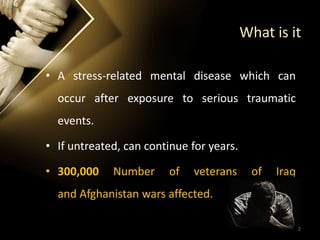
• A stress-related mental disease which can
occur after exposure to serious traumatic
events.
• If untreated, can continue for years.
• 300,000 Number of veterans of Iraq
and Afghanistan wars affected.
2
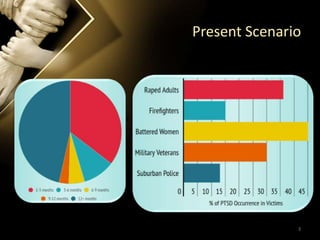
Present Scenario
Click to add text
3
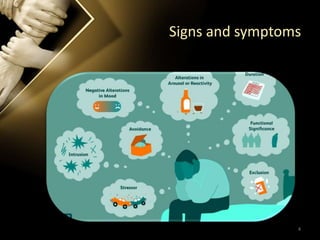
Signs and symptoms
4
Hypothesis
• New neurons(neurogenesis) are important for
recovery of normal behavior and hippocampal
structure altered in PTSD.
• The ventral CA1 region as a potential key
mediator of stress-induced anxiety-like behavior.
5
Experimental animals
• Transgenic male rats expressing Herpes Simplex Virus
Thymidine Kinase (HSV-TK) .
• VGCV (Valganciclovir) was administered (4 mg/rat) to all WT
and TK rats twice weekly starting at 16 weeks of age prior to
stress and continued until the animals were perfused.
• 12 hr light–dark cycle maintained.
• Followed the Institute of Laboratory Animal Research
guidelines.
6
Experimental design
• Experiment 1
• WT and TK rats underwent SPS at 16 weeks of age .
• n = 8–9
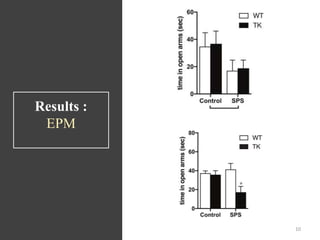
• Underwent the tests (EPM, NSF) beginning 9 days after stress.
• All rats were perfused 31 days following stress .
• Experiment 2
• WT and TK rats underwent SPS at 16 weeks of age .
• n = 10–11
• Underwent the tests (EPM, NSF) beginning 36 days after stress.
• All rats were perfused 58 days following stress .
7
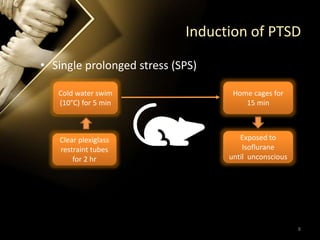
Induction of PTSD
• Single prolonged stress (SPS)
Clear plexiglass
restraint tubes
for 2 hr
Cold water swim
(10°C) for 5 min
Home cages for
15 min
Exposed to
Isoflurane
until unconscious
8
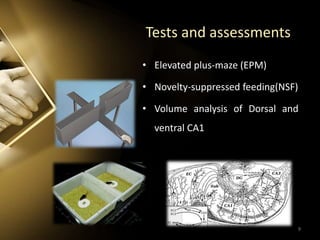
Tests and assessments
• Elevated plus-maze (EPM)
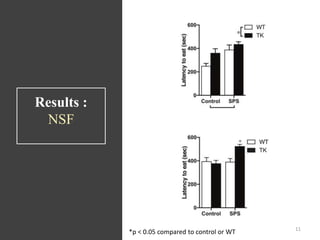
• Novelty-suppressed feeding(NSF)
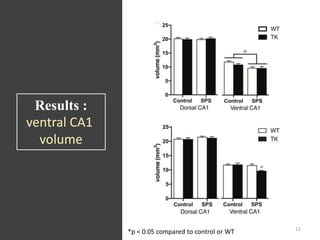
• Volume analysis of Dorsal and
ventral CA1
9
Results :
EPM
10
Results :
NSF
*p < 0.05 compared to control or WT 11
Results :
ventral CA1
volume
*p < 0.05 compared to control or WT 12
CONCLUSION
• Circuit-based approaches suggest that ventral CA1
regions of hippocampus are uniquely involved in anxiety-
like behavior in rodents.
• This research suggest a progression of susceptibility to
stress-induced volumetric decrease from ventral CA1 and
also demonstrated ongoing neurogenesis in the dentate
gyrus is critical for recovery of ventral CA1 volume and
associated anxiety-like behaviors in PTSD .
13
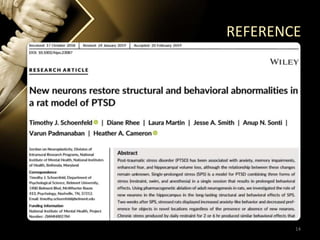
REFERENCE
14
Don’t worry; be happy
Thanks you

Ptsd by arghya

  • 1.
    PTSD AND NEUROGENESIS Submittedby, Arghya Chowdhury 18162027 M.Pharm 2nd semester Submitted to, Dr. Vinod Tiwari Assistant Professor Department of pharmaceutical engineering and technology, IIT(BHU),Varanasi
  • 2.
    What is it •A stress-related mental disease which can occur after exposure to serious traumatic events. • If untreated, can continue for years. • 300,000 Number of veterans of Iraq and Afghanistan wars affected. 2
  • 3.
  • 4.
  • 5.
    Hypothesis • New neurons(neurogenesis)are important for recovery of normal behavior and hippocampal structure altered in PTSD. • The ventral CA1 region as a potential key mediator of stress-induced anxiety-like behavior. 5
  • 6.
    Experimental animals • Transgenicmale rats expressing Herpes Simplex Virus Thymidine Kinase (HSV-TK) . • VGCV (Valganciclovir) was administered (4 mg/rat) to all WT and TK rats twice weekly starting at 16 weeks of age prior to stress and continued until the animals were perfused. • 12 hr light–dark cycle maintained. • Followed the Institute of Laboratory Animal Research guidelines. 6
  • 7.
    Experimental design • Experiment1 • WT and TK rats underwent SPS at 16 weeks of age . • n = 8–9 • Underwent the tests (EPM, NSF) beginning 9 days after stress. • All rats were perfused 31 days following stress . • Experiment 2 • WT and TK rats underwent SPS at 16 weeks of age . • n = 10–11 • Underwent the tests (EPM, NSF) beginning 36 days after stress. • All rats were perfused 58 days following stress . 7
  • 8.
    Induction of PTSD •Single prolonged stress (SPS) Clear plexiglass restraint tubes for 2 hr Cold water swim (10°C) for 5 min Home cages for 15 min Exposed to Isoflurane until unconscious 8
  • 9.
    Tests and assessments •Elevated plus-maze (EPM) • Novelty-suppressed feeding(NSF) • Volume analysis of Dorsal and ventral CA1 9
  • 10.
  • 11.
    Results : NSF *p <0.05 compared to control or WT 11
  • 12.
    Results : ventral CA1 volume *p< 0.05 compared to control or WT 12
  • 13.
    CONCLUSION • Circuit-based approachessuggest that ventral CA1 regions of hippocampus are uniquely involved in anxiety- like behavior in rodents. • This research suggest a progression of susceptibility to stress-induced volumetric decrease from ventral CA1 and also demonstrated ongoing neurogenesis in the dentate gyrus is critical for recovery of ventral CA1 volume and associated anxiety-like behaviors in PTSD . 13
  • 14.
  • 15.
    Don’t worry; behappy Thanks you