NMDA RECEPTORS; STRUCTURE, FUNTION, DISEASE AND
DRUG ASSOCIATED.
BY
OLUWADAYO EMMANUEL OMONIYI
&
EZEOFOR OBIAJULU CHINWENWA
PHA 702 (BIOLOGICAL MEMBRANE)
DR A.M. AJAYI
NOVEMBER, 2023
1
1
OUTLINE/CONTENT
INTRODUCTION
IONOTROPIC GLUTAMATE RECEPTORS
STRUCTURE OF NMDA RECEPTOR
NMDA RECEPTOR FUNCTIONS
NMDA RECEPTOR AND DISEASE ASSOCIATED
DRUGS THAT ACT ON NMDA
2
2
INTRODUCTION
The N-methyl-D-aspartate (NMDA) receptor is a glutamate and
ion channel protein receptor found in the neurons, they are
ligand gated ion channels that mediate majority of the fast
synaptic transmission in the brain.( hippocampus and cerebral
cortex)
NMDA receptor is one of three types of ionotropic glutamate
receptors, the other two being AMPA and kainate receptors.
NMDA receptors are proteins that are embedded in the
membrane of post-synaptic neurons and allows the passage of
ions through the cell membrane.
3
3
INTRODUCTION
Depending on the subunit composition of the NMDA receptor, its
ligands are glutamate and glycine . They control the opening
and closing of the ion channel while the current flow through the
ion channel is voltage-dependent.
NMDA receptors are expressed throughout the central nervous
system and their activation triggers multiple calcium dependent
intracellular responses that play key physiological roles in
synaptic function, such as synaptic plasticity, long term
potentiation, learning, and memory. NMDA receptors are also
implicated in the pathophysiology of several CNS disorders
5
4
IONOTROPIC GLUTAMATE
RECEPTORS
GLUTAMATE
RECEPTORS
NMDA RECEPTOR
KAINITE RECEPTOR
AMPA RECEPTOR
6
5
STRUCTURE OF NMDA RECEPTORS
8
6
FIGURE 2: THE SCHEME OF N-METHYL-D-ASPARTIC ACID (NMDA) RECPTOR STRUCTURE
SOURCE: Krzytanek and Palasz, (2019)
STRUCTURE OF NMDA RECEPTORS
 NMDA receptors has various sub types, they are heterotetramers
comprising different combinations of the GluN1, GluN2 (A-D),
and GluN3 (A-B) subunits
They May consist of two N1 subunit with any two N2 subunits or
Two N1 subunits with two N3 subunits
 The receptor has four modular binding domains:
1. Extracellular amino terminal
2. Extracellular ligand binding domain
3. The transmembrane domain forming the ion channel
4. The intracellular C terminal domain
5
7
STRUCTURE OF NMDA RECEPTORS
 The N1/N2 NMDA receptor complex is of primary physiological relevance
because pharmacological and biophysical activity of NMDA receptor is
determined mainly by N2 subunits.
 All NMDA receptor subunits are strictly structurally and functionally
connected, therefore modulatory sites of N2 affect the glycine/D-serine
binding site on N1 subunit.
 Glycine and glutamate binding sites are located in the homologous domains
of N1 and N2A/B subunits respectively.
 Mg2+ blocks the NMDA receptor channel in a voltage-dependent manner
and The channels are highly permeable to Ca2+ upon activation
 Several regulatory domains of the N2 subunit can bind numerous endo- and
exogenous factors, including drugs such as polyamines, protons, zinc ions,
glutathione, neurosteroids, ifenprodil, eliprodil.
5
8
 NMDA receptors are ligand gated ion channel which is
activated by the binding of its ligands (glutamate and
glycine).
 NMDA receptors display a certain degree of voltage-
dependent Mg2+ block and marked permeability to Ca2+
after removal of the Mg2+ block
 Full activation of NMDA receptors is both voltage-gated
and ligand-gated and The ion channels opens only if the
post-synaptic membrane has already been depolarized
enough and the neurotransmitters glutamate and glycine are
attached
NMDA RECEPTOR FUNCTION
11
9
NMDA RECEPTOR FUNCTION
9
10
 AMPA and NMDA receptors often co exist at the post synaptic
membrane. When the presynaptic neuron is stimulated by a weak
signal, only a small amount of glutamate is released and the
glutamate-binding result in only limited Ca2+ conductance, In these
instance, only AMPA receptors mediate the excitatory postsynaptic
potential through conductance of Na+ and K+
 In the presence of strong signal, AMPA receptors depolarize the
membrane enough to dislodge Mg2+ from the NMDA receptor
channel. This allows NMDA receptors to respond to glutamate-
binding and permit the flow of large amounts of Ca2+, Na+ and K+
through the channel. NMDA receptors therefore function as
molecular coincidence detectors, requiring both glutamate binding
and a strong depolarizing signal/ stimulus.
NMDA RECEPTOR FUNCTION
9
11
 The amount of Ca2+ entering the cell, as modulated by NMDA
receptors, affects an array of local signal transduction complexes in
which Ca2+ act as a secondary messenger in several signaling
cascades.
 Such as: activation of calcium/calmodulin-dependent kinase II
(CaMKII), upregulation of AMPA receptor expression at the synaptic
membrane, and subsequent phosphorylation of the GluA2 AMPA
receptor subunit( making AMPA receptors more responsive to
glutamate),
 There is increased influx of Na + and K+ into the post synaptic
membrane, thus, maintains the membrane potential, synaptic
enhancement and long-term potentiation.
FIGURE 3: RELATIONSHIP BETWEEN NMDAAND AMPA RECEPTOR
SOURCE: HanSen K.B (2018)
NMDA RECEPTOR AND AMPA RECPTOR
10
12
Neurodegenerative diseases believed to be linked to NMDA receptors
malfunction include:
Alzheimer's disease
Amyotrophic lateral sclerosis (ALS)
Huntington's disease
Parkinson's disease
Other central nervous system conditions with suspected NMDA receptor
involvement include:
Fibromyalgia
Chronic fatigue syndrome
Anxiety
Schizophrenia
NMDA RECEPTOR AND ASSOCIATED DISEASES
12
13
ALZHEIMER’S DISEASE
 The actual cause of Alzheimer’s disease is not fully understood, it is
characterized by neurodegeneration and death of brain cells, as the brain cell die
in a person with Alzheimer's disease, they release excess amount of glutamate.
 Excessive NMDA receptor activity causes excitotoxicity and promotes cell
death, leading to further neurodegeneration in Alzheimer’s disease.
 NMDA receptor antagonist: memantine been approved in the U.S. and Europe
as a treatment for Alzheimer's disease.
 Memantine is used in combination with cholinesterase inhibitor to treat
Alzheimer Disease, resulting in modest improvements in cognition and global
outcomes in patients with advanced disease.
 Side effects of memantine includes dizziness, headache and constipation and in
rare cases confusion
NMDA RECEPTOR AND ASSOCIATED DISEASES
12
14
HUNTINGTON’ S DISEASE
 Huntington’s disease is a neurodegenerative hereditary illness originated
by the mutation of the gene encoding the Huntington protein.
 Several animal studies have shown the involvement of NMDA receptor
mediated excitotoxity in the progression of Huntington’s disease
 Amantadine, a noncompetitive antagonist of the NMDA receptor, is used
along with other drugs in the management of the movement disorder
associated with Huntington's disease.
 Side effects includes drowsiness, confusion, dizziness, lightheadedness
NMDA RECEPTOR AND ASSOCIATED DISEASES
12
15
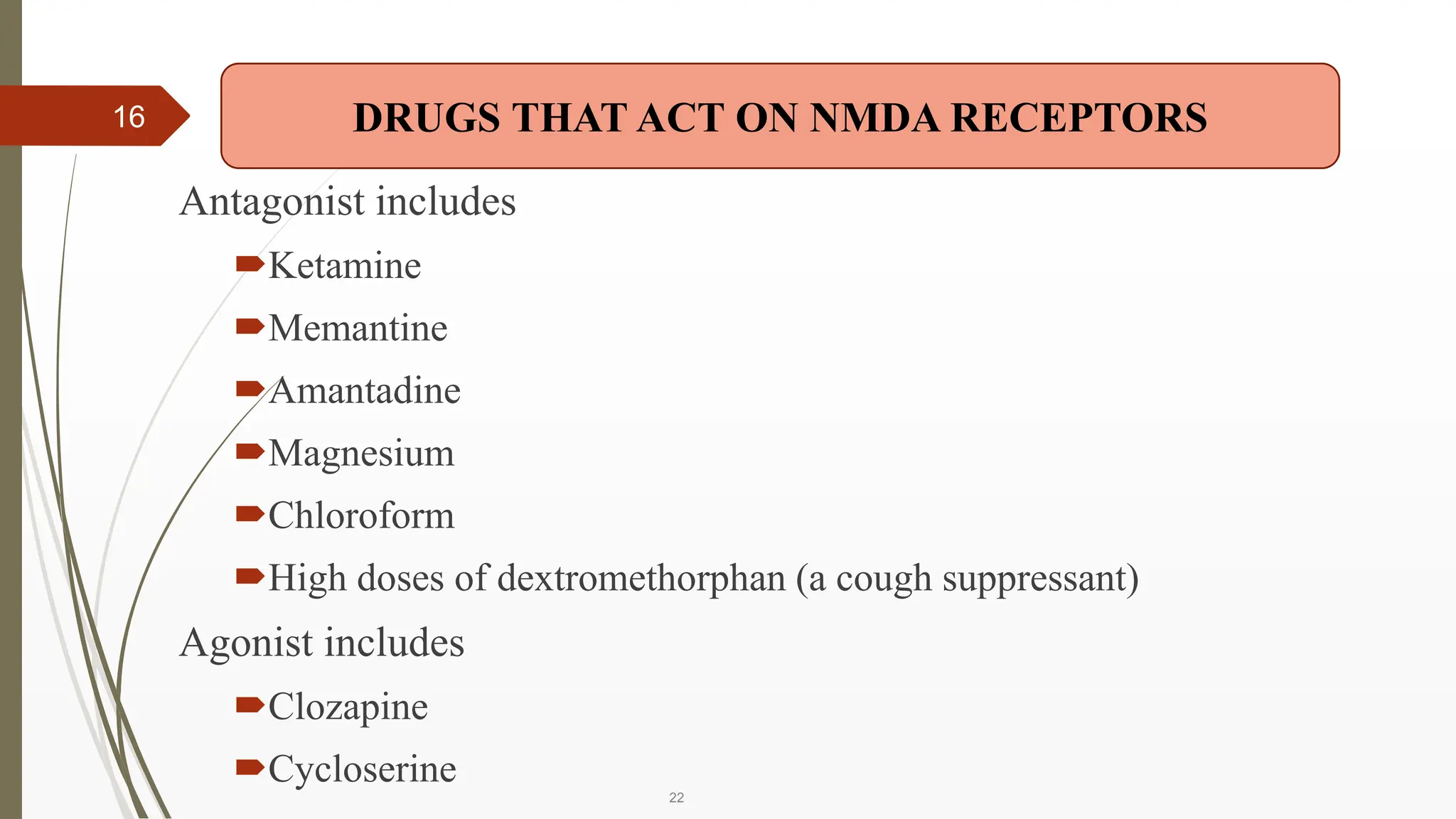
Antagonist includes
Ketamine
Memantine
Amantadine
Magnesium
Chloroform
High doses of dextromethorphan (a cough suppressant)
Agonist includes
Clozapine
Cycloserine
DRUGS THAT ACT ON NMDA RECEPTORS
22
16
Ketamine
Ketamine is a rapid-acting general anesthetic and NMDA
receptor antagonist, typically combine with muscle relaxant.
Ketamine mechanism of action involves interaction with
NMDA, opioid, monoaminergic and muscarinic receptor. Unlike
other general anesthestic agent, ketamine does not interact with
GABA receptors
Ketamine enhances descending inhibiting serotoninergic
pathways and can exert antidepressive effects.
Ketamine exhibit analgesic behaviour by the inhibition of nitric
oxide synthesis
DRUGS THAT ACT ON NMDA RECEPTORS
22
17
Clozapine
Clozapine is a second generation antipsychotic drug used in
treatment-resistnace Schizophrenia.
The exact mechanism of action of clozapine is unknown.
However, it has been proposed that the therapeutic effect of
clozapine in schizophrenia is mediated through antagonism of
dopamine type 2 and serotonin type 2A receptors.
Clozapine has mild agonist action on NMDA receptor.
Clozapine abnormal expression of NMDA receptors is thought to
contribute to negative symptoms and cognitive deficits.
DRUGS THAT ACT ON NMDA RECEPTORS
22
18
 Chatterton, J.E.; Awobuluyi, M.; Premkumar, L.S.; Takahashi, H.; Talantova, M.; Shin,
Y.; Cui, J.; Tu, S.; Sevarino, K.A.; Nakanishi, N.; et al. Excitatory glycine receptors
containing the NR3 family of NMDA receptor subunits. Nature 2002,413, 793–798.
[CrossRef]
 Jewett BE, Thapa B. Physiology, NMDA Receptor. [Updated 2022 Dec 11]. In:
StatPearls [Internet]. Treasure Island (FL): StatPearls Publishing; 2023 Jan-. Available
from: https://www.ncbi.nlm.nih.gov/books/NBK519495/
 Johnson, J. W. & Ascher, P. Voltage-dependent block by intracellular Mg2+ of N-
methyl-D-aspartate-activated channels. Biophys. J. 57, 1085–90 (1990).
 Moretti, L.; Pentikäinen, O.T.; Settimo, L.; Johnson, M.S. Model structures of the
NMDA receptor subunit NR1 explain the molecular recognition of agonist and
antagonist ligands. Journal of Structural Biology. 2004, 145,205-215.
REFERENCES
23
19
 Ondo WG, Mejia NI, Hunter CB. A pilot study of the clinical efficacy and safety of
memantine for Huntington's disease. Parkinsonism Related Disorder. 2007
Oct;13(7):453-4. [PubMed]
 Purves, D., Augustine, G. J. & Fitzpatrick, D. Neuroscience, 4th Edition. Nature
Reviews Neuroscience (2008). doi:978-0878937257
 Verhagen Metman L, Morris MJ, Farmer C, Gillespie M, Mosby K, Wuu J, Chase TN.
Huntington's disease: a randomized, controlled trial using the NMDA-antagonist
amantadine. Neurology. 2002 Sep 10;59(5):694-9. [PubMed]
REFERENCES
24
20
Thank you for Listening
25
21

NMDA receptors and agonist as well as antagonist.pptx

  • 1.
    NMDA RECEPTORS; STRUCTURE,FUNTION, DISEASE AND DRUG ASSOCIATED. BY OLUWADAYO EMMANUEL OMONIYI & EZEOFOR OBIAJULU CHINWENWA PHA 702 (BIOLOGICAL MEMBRANE) DR A.M. AJAYI NOVEMBER, 2023 1 1
  • 2.
    OUTLINE/CONTENT INTRODUCTION IONOTROPIC GLUTAMATE RECEPTORS STRUCTUREOF NMDA RECEPTOR NMDA RECEPTOR FUNCTIONS NMDA RECEPTOR AND DISEASE ASSOCIATED DRUGS THAT ACT ON NMDA 2 2
  • 3.
    INTRODUCTION The N-methyl-D-aspartate (NMDA)receptor is a glutamate and ion channel protein receptor found in the neurons, they are ligand gated ion channels that mediate majority of the fast synaptic transmission in the brain.( hippocampus and cerebral cortex) NMDA receptor is one of three types of ionotropic glutamate receptors, the other two being AMPA and kainate receptors. NMDA receptors are proteins that are embedded in the membrane of post-synaptic neurons and allows the passage of ions through the cell membrane. 3 3
  • 4.
    INTRODUCTION Depending on thesubunit composition of the NMDA receptor, its ligands are glutamate and glycine . They control the opening and closing of the ion channel while the current flow through the ion channel is voltage-dependent. NMDA receptors are expressed throughout the central nervous system and their activation triggers multiple calcium dependent intracellular responses that play key physiological roles in synaptic function, such as synaptic plasticity, long term potentiation, learning, and memory. NMDA receptors are also implicated in the pathophysiology of several CNS disorders 5 4
  • 5.
  • 6.
    STRUCTURE OF NMDARECEPTORS 8 6 FIGURE 2: THE SCHEME OF N-METHYL-D-ASPARTIC ACID (NMDA) RECPTOR STRUCTURE SOURCE: Krzytanek and Palasz, (2019)
  • 7.
    STRUCTURE OF NMDARECEPTORS  NMDA receptors has various sub types, they are heterotetramers comprising different combinations of the GluN1, GluN2 (A-D), and GluN3 (A-B) subunits They May consist of two N1 subunit with any two N2 subunits or Two N1 subunits with two N3 subunits  The receptor has four modular binding domains: 1. Extracellular amino terminal 2. Extracellular ligand binding domain 3. The transmembrane domain forming the ion channel 4. The intracellular C terminal domain 5 7
  • 8.
    STRUCTURE OF NMDARECEPTORS  The N1/N2 NMDA receptor complex is of primary physiological relevance because pharmacological and biophysical activity of NMDA receptor is determined mainly by N2 subunits.  All NMDA receptor subunits are strictly structurally and functionally connected, therefore modulatory sites of N2 affect the glycine/D-serine binding site on N1 subunit.  Glycine and glutamate binding sites are located in the homologous domains of N1 and N2A/B subunits respectively.  Mg2+ blocks the NMDA receptor channel in a voltage-dependent manner and The channels are highly permeable to Ca2+ upon activation  Several regulatory domains of the N2 subunit can bind numerous endo- and exogenous factors, including drugs such as polyamines, protons, zinc ions, glutathione, neurosteroids, ifenprodil, eliprodil. 5 8
  • 9.
     NMDA receptorsare ligand gated ion channel which is activated by the binding of its ligands (glutamate and glycine).  NMDA receptors display a certain degree of voltage- dependent Mg2+ block and marked permeability to Ca2+ after removal of the Mg2+ block  Full activation of NMDA receptors is both voltage-gated and ligand-gated and The ion channels opens only if the post-synaptic membrane has already been depolarized enough and the neurotransmitters glutamate and glycine are attached NMDA RECEPTOR FUNCTION 11 9
  • 10.
    NMDA RECEPTOR FUNCTION 9 10 AMPA and NMDA receptors often co exist at the post synaptic membrane. When the presynaptic neuron is stimulated by a weak signal, only a small amount of glutamate is released and the glutamate-binding result in only limited Ca2+ conductance, In these instance, only AMPA receptors mediate the excitatory postsynaptic potential through conductance of Na+ and K+  In the presence of strong signal, AMPA receptors depolarize the membrane enough to dislodge Mg2+ from the NMDA receptor channel. This allows NMDA receptors to respond to glutamate- binding and permit the flow of large amounts of Ca2+, Na+ and K+ through the channel. NMDA receptors therefore function as molecular coincidence detectors, requiring both glutamate binding and a strong depolarizing signal/ stimulus.
  • 11.
    NMDA RECEPTOR FUNCTION 9 11 The amount of Ca2+ entering the cell, as modulated by NMDA receptors, affects an array of local signal transduction complexes in which Ca2+ act as a secondary messenger in several signaling cascades.  Such as: activation of calcium/calmodulin-dependent kinase II (CaMKII), upregulation of AMPA receptor expression at the synaptic membrane, and subsequent phosphorylation of the GluA2 AMPA receptor subunit( making AMPA receptors more responsive to glutamate),  There is increased influx of Na + and K+ into the post synaptic membrane, thus, maintains the membrane potential, synaptic enhancement and long-term potentiation.
  • 12.
    FIGURE 3: RELATIONSHIPBETWEEN NMDAAND AMPA RECEPTOR SOURCE: HanSen K.B (2018) NMDA RECEPTOR AND AMPA RECPTOR 10 12
  • 13.
    Neurodegenerative diseases believedto be linked to NMDA receptors malfunction include: Alzheimer's disease Amyotrophic lateral sclerosis (ALS) Huntington's disease Parkinson's disease Other central nervous system conditions with suspected NMDA receptor involvement include: Fibromyalgia Chronic fatigue syndrome Anxiety Schizophrenia NMDA RECEPTOR AND ASSOCIATED DISEASES 12 13
  • 14.
    ALZHEIMER’S DISEASE  Theactual cause of Alzheimer’s disease is not fully understood, it is characterized by neurodegeneration and death of brain cells, as the brain cell die in a person with Alzheimer's disease, they release excess amount of glutamate.  Excessive NMDA receptor activity causes excitotoxicity and promotes cell death, leading to further neurodegeneration in Alzheimer’s disease.  NMDA receptor antagonist: memantine been approved in the U.S. and Europe as a treatment for Alzheimer's disease.  Memantine is used in combination with cholinesterase inhibitor to treat Alzheimer Disease, resulting in modest improvements in cognition and global outcomes in patients with advanced disease.  Side effects of memantine includes dizziness, headache and constipation and in rare cases confusion NMDA RECEPTOR AND ASSOCIATED DISEASES 12 14
  • 15.
    HUNTINGTON’ S DISEASE Huntington’s disease is a neurodegenerative hereditary illness originated by the mutation of the gene encoding the Huntington protein.  Several animal studies have shown the involvement of NMDA receptor mediated excitotoxity in the progression of Huntington’s disease  Amantadine, a noncompetitive antagonist of the NMDA receptor, is used along with other drugs in the management of the movement disorder associated with Huntington's disease.  Side effects includes drowsiness, confusion, dizziness, lightheadedness NMDA RECEPTOR AND ASSOCIATED DISEASES 12 15
  • 16.
    Antagonist includes Ketamine Memantine Amantadine Magnesium Chloroform High dosesof dextromethorphan (a cough suppressant) Agonist includes Clozapine Cycloserine DRUGS THAT ACT ON NMDA RECEPTORS 22 16
  • 17.
    Ketamine Ketamine is arapid-acting general anesthetic and NMDA receptor antagonist, typically combine with muscle relaxant. Ketamine mechanism of action involves interaction with NMDA, opioid, monoaminergic and muscarinic receptor. Unlike other general anesthestic agent, ketamine does not interact with GABA receptors Ketamine enhances descending inhibiting serotoninergic pathways and can exert antidepressive effects. Ketamine exhibit analgesic behaviour by the inhibition of nitric oxide synthesis DRUGS THAT ACT ON NMDA RECEPTORS 22 17
  • 18.
    Clozapine Clozapine is asecond generation antipsychotic drug used in treatment-resistnace Schizophrenia. The exact mechanism of action of clozapine is unknown. However, it has been proposed that the therapeutic effect of clozapine in schizophrenia is mediated through antagonism of dopamine type 2 and serotonin type 2A receptors. Clozapine has mild agonist action on NMDA receptor. Clozapine abnormal expression of NMDA receptors is thought to contribute to negative symptoms and cognitive deficits. DRUGS THAT ACT ON NMDA RECEPTORS 22 18
  • 19.
     Chatterton, J.E.;Awobuluyi, M.; Premkumar, L.S.; Takahashi, H.; Talantova, M.; Shin, Y.; Cui, J.; Tu, S.; Sevarino, K.A.; Nakanishi, N.; et al. Excitatory glycine receptors containing the NR3 family of NMDA receptor subunits. Nature 2002,413, 793–798. [CrossRef]  Jewett BE, Thapa B. Physiology, NMDA Receptor. [Updated 2022 Dec 11]. In: StatPearls [Internet]. Treasure Island (FL): StatPearls Publishing; 2023 Jan-. Available from: https://www.ncbi.nlm.nih.gov/books/NBK519495/  Johnson, J. W. & Ascher, P. Voltage-dependent block by intracellular Mg2+ of N- methyl-D-aspartate-activated channels. Biophys. J. 57, 1085–90 (1990).  Moretti, L.; Pentikäinen, O.T.; Settimo, L.; Johnson, M.S. Model structures of the NMDA receptor subunit NR1 explain the molecular recognition of agonist and antagonist ligands. Journal of Structural Biology. 2004, 145,205-215. REFERENCES 23 19
  • 20.
     Ondo WG,Mejia NI, Hunter CB. A pilot study of the clinical efficacy and safety of memantine for Huntington's disease. Parkinsonism Related Disorder. 2007 Oct;13(7):453-4. [PubMed]  Purves, D., Augustine, G. J. & Fitzpatrick, D. Neuroscience, 4th Edition. Nature Reviews Neuroscience (2008). doi:978-0878937257  Verhagen Metman L, Morris MJ, Farmer C, Gillespie M, Mosby K, Wuu J, Chase TN. Huntington's disease: a randomized, controlled trial using the NMDA-antagonist amantadine. Neurology. 2002 Sep 10;59(5):694-9. [PubMed] REFERENCES 24 20
  • 21.
    Thank you forListening 25 21

Editor's Notes