Learning Biology With
Sudarshan
Sudarshan Mandal
M.Sc in Zoology(Banaras Hindu
University)
Qualified in Net Ls,Gate,IIT jam ,Bhu
Pet,Wbset
Definition
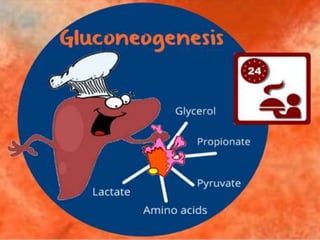
• Gluconeogenesis is a major regulatory process
in the liver and kidneys by which
noncarbohydrate substrates; namely glycerol,
lactate, propionate, and glucogenic amino
acids; are converted to glucose 6-phosphate
(Glc-6-P), and then to either free glucose or
glycogen
Site
• The liver and kidneys are the major organs
containing the full complement of
gluconeogenic enzymes (i.e., pyruvate
carboxylase, PEP carboxykinase, fructose 1,6-
bisphosphatase, and glucose 6-phosphatase)
• It occurs in all animal ,plants ,fungi and micro-
organism.
Reaction of Gluconeogenesis
• Gluconeogenesis and glycolysis are not
identical pathways running in opposite
directions,although they do share several
steps .
• 7 out of 10 enzymatic reactions of
gluconeogenesis are reverse of glycolytic
reaction.
• Three reactions of glycolysis are esentially
irreversible .
Reaction of Gluconeogenesis
• Three irreversible steps are –
1.Conversion of glucose 6 phosphate catalyzed
by hexokinase.
2.The conversion of fructose 6-phosphate to
fructose 1,6 bis phosphate by PFK-1.
3.The conversion of phosphoenol pyruvate by
pyruvate kinase.
Reaction of Gluconeogenesis
• These three reactions are characterized by a
large negative free energy change ,where as
other glycolytic reaction have ΔG near 0.
• In Gluconeogenesis these irreversible steps
are bypassed by a separate set of enzymes.
Reaction of Gluconeogenesis
conversion of Pyruvate to PEP
• Pyruvate can not be converted directly to PEP.
The conversion requires two reactions that
serve to bypass irreversible step of glycolysis.
• Pyruvate is first transported from the cytosol
into mitochondria or is generated from
alanine within mitpchondria by
transamination.
Reaction of gluconeogenesis
• Then pyruvate carboxylase ,mitochondrial
enzyme that requires the coenzyme
biotin,converts pruvate to oxaloacetate.
•
Pyruvate+Hco3-+ATP
oxaloacetate+ADP+Pi
Reaction of gluconeogenesis
• Oxaloacetate cannot directly cross the inner
mitochondrial membrane. Therefore, it is
converted to malate or to aspartate, which can
cross the mitochondrial membrane and be
reconverted to oxaloacetate in the cytosol.
• Oxaloacetate is decarboxylated by
phosphoenolpyruvate carboxykinase to form
phosphoenolpyruvate. This reaction requires
GTP.
Reactions of Gluconeogenesis
• Phosphoenolpyruvate is converted to fructose
1,6-bisphosphate by reversal of the glycolytic
reactions.
Reactions of Gluconeogenesis
Conversion of 1,6 BP to F-6 P
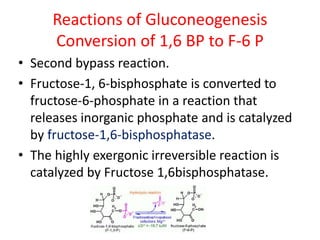
• Second bypass reaction.
• Fructose-1, 6-bisphosphate is converted to
fructose-6-phosphate in a reaction that
releases inorganic phosphate and is catalyzed
by fructose-1,6-bisphosphatase.
• The highly exergonic irreversible reaction is
catalyzed by Fructose 1,6bisphosphatase.
Reactions of Gluconeogenesis
(Conversion of G-6 P to Glucose)
• Third bypass.
• Glucose-6-phosphate releases inorganic
phosphate, which produces free glucose that
enters the blood. The enzyme involved is
glucose 6-phosphatase.
Net requirements to make one glucose
molecule
• Thus, the net requirements to make one
glucose molecule are:
• Two pyruvate.
• Four ATP and two GTP.
• Two NADH.
• Six H2O
•
Significance
• Gluconeogenesis is needed to meet the
demands for plasma glucose between meals,
which then becomes particularly important as
an energy substrate for nerves, erythrocytes,
and other largely anaerobic cell types. Failure
of this process can lead to brain dysfunction,
coma, and death.
Gluconeogenesis ppt gate notes pptx.pptx

Gluconeogenesis ppt gate notes pptx.pptx

  • 1.
    Learning Biology With Sudarshan SudarshanMandal M.Sc in Zoology(Banaras Hindu University) Qualified in Net Ls,Gate,IIT jam ,Bhu Pet,Wbset
  • 3.
    Definition • Gluconeogenesis isa major regulatory process in the liver and kidneys by which noncarbohydrate substrates; namely glycerol, lactate, propionate, and glucogenic amino acids; are converted to glucose 6-phosphate (Glc-6-P), and then to either free glucose or glycogen
  • 4.
    Site • The liverand kidneys are the major organs containing the full complement of gluconeogenic enzymes (i.e., pyruvate carboxylase, PEP carboxykinase, fructose 1,6- bisphosphatase, and glucose 6-phosphatase) • It occurs in all animal ,plants ,fungi and micro- organism.
  • 6.
    Reaction of Gluconeogenesis •Gluconeogenesis and glycolysis are not identical pathways running in opposite directions,although they do share several steps . • 7 out of 10 enzymatic reactions of gluconeogenesis are reverse of glycolytic reaction. • Three reactions of glycolysis are esentially irreversible .
  • 7.
  • 8.
  • 9.
    Reaction of Gluconeogenesis •Three irreversible steps are – 1.Conversion of glucose 6 phosphate catalyzed by hexokinase. 2.The conversion of fructose 6-phosphate to fructose 1,6 bis phosphate by PFK-1. 3.The conversion of phosphoenol pyruvate by pyruvate kinase.
  • 10.
    Reaction of Gluconeogenesis •These three reactions are characterized by a large negative free energy change ,where as other glycolytic reaction have ΔG near 0. • In Gluconeogenesis these irreversible steps are bypassed by a separate set of enzymes.
  • 11.
    Reaction of Gluconeogenesis conversionof Pyruvate to PEP • Pyruvate can not be converted directly to PEP. The conversion requires two reactions that serve to bypass irreversible step of glycolysis. • Pyruvate is first transported from the cytosol into mitochondria or is generated from alanine within mitpchondria by transamination.
  • 12.
    Reaction of gluconeogenesis •Then pyruvate carboxylase ,mitochondrial enzyme that requires the coenzyme biotin,converts pruvate to oxaloacetate. • Pyruvate+Hco3-+ATP oxaloacetate+ADP+Pi
  • 13.
    Reaction of gluconeogenesis •Oxaloacetate cannot directly cross the inner mitochondrial membrane. Therefore, it is converted to malate or to aspartate, which can cross the mitochondrial membrane and be reconverted to oxaloacetate in the cytosol. • Oxaloacetate is decarboxylated by phosphoenolpyruvate carboxykinase to form phosphoenolpyruvate. This reaction requires GTP.
  • 14.
    Reactions of Gluconeogenesis •Phosphoenolpyruvate is converted to fructose 1,6-bisphosphate by reversal of the glycolytic reactions.
  • 15.
    Reactions of Gluconeogenesis Conversionof 1,6 BP to F-6 P • Second bypass reaction. • Fructose-1, 6-bisphosphate is converted to fructose-6-phosphate in a reaction that releases inorganic phosphate and is catalyzed by fructose-1,6-bisphosphatase. • The highly exergonic irreversible reaction is catalyzed by Fructose 1,6bisphosphatase.
  • 16.
    Reactions of Gluconeogenesis (Conversionof G-6 P to Glucose) • Third bypass. • Glucose-6-phosphate releases inorganic phosphate, which produces free glucose that enters the blood. The enzyme involved is glucose 6-phosphatase.
  • 17.
    Net requirements tomake one glucose molecule • Thus, the net requirements to make one glucose molecule are: • Two pyruvate. • Four ATP and two GTP. • Two NADH. • Six H2O •
  • 18.
    Significance • Gluconeogenesis isneeded to meet the demands for plasma glucose between meals, which then becomes particularly important as an energy substrate for nerves, erythrocytes, and other largely anaerobic cell types. Failure of this process can lead to brain dysfunction, coma, and death.