Glucokinase activator in Computer-
Aided Drug Design for Type 2
Diabetes
Seminar by : Laith Jawad Abdulredha
INTRODUCTION
Diabetes is a metabolic disorder that requires
multiple therapeutic approaches.
The pancreas loses its functionality to properly
produce the insulin hormone in patients with
diabetes mellitus.
In 2012, more than one million people worldwide
died as a result of diabetes, which was the eighth
leading cause of death.
Novel approach
• Most drugs currently available and approved by the U.S. Food
and Drug Administration cannot reach an adequate level of
glycemic control in diabetic patients, and have many side
effects.
• For these reasons , new classes of compounds are required.
• Efforts based on computer-aided drug design (CADD) and
molecular docking can mine a large number of databases to
produce new and potent hits and minimize the requirement of
time and dollars for new discoveries.
History
• The average cost of launching a new drug
onto the market is estimated to 1.8 billion
dollars, and few drugs make it to the
market.
• From 1999 to 2008, only 50 compounds
were approved by the FDA in the U.S., out
of which 17 were identified as arising from
target-based drug design methods
Advantages of CADD :
• Offer new suggestions for molecular
structures for new synthesis can help in
making cost-effective decisions before the
costly process of drug synthesis begins.
• Computer-aided drug design can increase
the hit rate of novel anti-diabetic drug like
compounds.
Drug design strategies
• Quantitative structure-activity relationship
(QSAR), pharmacophore and biological assays
can be helpful to optimize and design new
leads.
• Structure based drug design helps to provide
potent and significant compounds more
productively in the drug discovery process
Virtual screening
• Virtual screening uses high-performance computing to screen large
chemical databases and prioritize compounds for synthesis.
• Current databases allow rapid virtual screening of up to 100,000
molecules per day using parallel computing techniques
• The databases of three-dimensional structures directly available for
virtual screening are:
 Advanced Chemistry Development
 InfoChem GmbH database
 MDL Drug Data Report
 MDPI database
Docking programs for drug design
• Several computer programs have been developed and used in research
leading to drug discoveries for various diseases.
• They are based on computational techniques of drug design, using different
algorithms and scoring functions.
• Some of the programs for virtual screening and docking studies are:
 AutoDock
 CLC drug discovery work bench
 DOCK [
 FlexX
 FRED
 Glide
 GOLD
 MOE
Pharmacophore models
• The effective pharmacophore models depend
on two factors:
 the definite understanding and placement of
pharmacophoric features.
 the alignment method used for overlaying the
three-dimensional pharmacophore model with
a set of ligand compounds of screened data
QSAR methods
• QSAR methods can be used to optimize lead compounds.
• Modern three-dimensional QSAR methods involve:
 the interaction fields around a molecule by calculating the
interaction energy in a grid.
 well-known three dimensional QSAR techniques are comparative
molecular field analysis and comparative molecular similarity index
analysis
• These approaches calculate molecular properties including steric,
electronic, hydrogen bonding, and hydrophobic fields.
• Some of the programs used in research and that are available for
two-dimensional and three dimensional QSAR analyses are:
 CODESSA
 Dragon
Case study
• Ligand-based Virtual Screening Followed
by in vitro Bioassay Discovered
Glucokinase Activator
Glucokinase activator (GKA)
• Glucokinase activator (GKA) has been recently shown to be a valid anti-
diabetic target.
• GKA serves as a glucose sensor in the insulin-producing pancreatic beta-cells,
and determines the rate of glucose metabolism by regulating the amount of
insulin produced and released from pancreatic beta-cells in response to the
amount of glucose in the blood.
• Elevated levels of glucose will increase GKA levels in the pancreas, thereby
increasing the release of insulin
Target protein structure
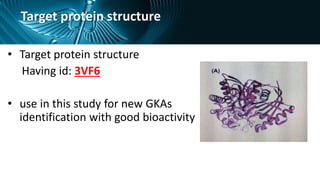
• Target protein structure
Having id: 3VF6
• use in this study for new GKAs
identification with good bioactivity
Target protein structure
• In this study the researcher used a multistage
approach:
 Integrating pharmacophore modeling
 QSAR analysis
 virtual screening of the NCI library of 238,819
compounds.
• Pharmacophore exploration of GKA was performed
using Catalyst software.
Target protein structure
• The authors concluded that a novel GKA activation pharmacophore model appeared in
the optimal QSAR equation.
• The resulting pharmacophore model yielded a good receiver operating characteristic on
validation, and therefore this information was used as three-dimensional search query
to screen the NCI database for new GKA activators
• Virtual screening identified 10 promising bioactivators from the NCI library of
compounds.
• The most potent NCI hit illustrated 6.3-fold GKA activation at 10 μM
• GKA leads for subsequent development into potential antidiabetic agents .
The potent hit
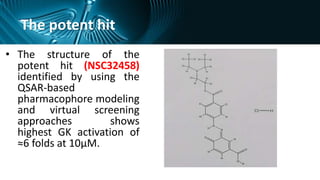
• The structure of the
potent hit (NSC32458)
identified by using the
QSAR-based
pharmacophore modeling
and virtual screening
approaches shows
highest GK activation of
≈6 folds at 10μM.
• novel compounds that show improved safety and tolerability profiles
for known adverse effects related to marketed agents such as
gastrointestinal side effects, hypoglycemic risk and weight gain.
• Further optimization and clinical studies will help to generate a useful
drug in a short period of time from these compounds.
• This agents may potentially control glucose levels and improve
outcomes in patients with type 2diabetes.
• We expect computer-aided drug design
techniques to contribute to improvement
of the compounds and acceleration of
novel diabetes drug development
• Drug design approaches should include
consideration of insilico methods to estimate the
absorption, distribution, metabolism, excretion
and toxicity (ADMET) profile into the early stages
of drug design process.
• Once a model is built, a number of new
structures can be tested in a short time and side
effects can be predicted for a given structure
REFERENCES
• Shabana Bibi and Katsumi Sakata( Current
Computer-Aided Drug Design) Bentham
science , 2016, 12, 167-177
Glucokinase activator in docking system

Glucokinase activator in docking system

  • 1.
    Glucokinase activator inComputer- Aided Drug Design for Type 2 Diabetes Seminar by : Laith Jawad Abdulredha
  • 2.
    INTRODUCTION Diabetes is ametabolic disorder that requires multiple therapeutic approaches. The pancreas loses its functionality to properly produce the insulin hormone in patients with diabetes mellitus. In 2012, more than one million people worldwide died as a result of diabetes, which was the eighth leading cause of death.
  • 3.
    Novel approach • Mostdrugs currently available and approved by the U.S. Food and Drug Administration cannot reach an adequate level of glycemic control in diabetic patients, and have many side effects. • For these reasons , new classes of compounds are required. • Efforts based on computer-aided drug design (CADD) and molecular docking can mine a large number of databases to produce new and potent hits and minimize the requirement of time and dollars for new discoveries.
  • 4.
    History • The averagecost of launching a new drug onto the market is estimated to 1.8 billion dollars, and few drugs make it to the market. • From 1999 to 2008, only 50 compounds were approved by the FDA in the U.S., out of which 17 were identified as arising from target-based drug design methods
  • 5.
    Advantages of CADD: • Offer new suggestions for molecular structures for new synthesis can help in making cost-effective decisions before the costly process of drug synthesis begins. • Computer-aided drug design can increase the hit rate of novel anti-diabetic drug like compounds.
  • 6.
    Drug design strategies •Quantitative structure-activity relationship (QSAR), pharmacophore and biological assays can be helpful to optimize and design new leads. • Structure based drug design helps to provide potent and significant compounds more productively in the drug discovery process
  • 7.
    Virtual screening • Virtualscreening uses high-performance computing to screen large chemical databases and prioritize compounds for synthesis. • Current databases allow rapid virtual screening of up to 100,000 molecules per day using parallel computing techniques • The databases of three-dimensional structures directly available for virtual screening are:  Advanced Chemistry Development  InfoChem GmbH database  MDL Drug Data Report  MDPI database
  • 8.
    Docking programs fordrug design • Several computer programs have been developed and used in research leading to drug discoveries for various diseases. • They are based on computational techniques of drug design, using different algorithms and scoring functions. • Some of the programs for virtual screening and docking studies are:  AutoDock  CLC drug discovery work bench  DOCK [  FlexX  FRED  Glide  GOLD  MOE
  • 9.
    Pharmacophore models • Theeffective pharmacophore models depend on two factors:  the definite understanding and placement of pharmacophoric features.  the alignment method used for overlaying the three-dimensional pharmacophore model with a set of ligand compounds of screened data
  • 10.
    QSAR methods • QSARmethods can be used to optimize lead compounds. • Modern three-dimensional QSAR methods involve:  the interaction fields around a molecule by calculating the interaction energy in a grid.  well-known three dimensional QSAR techniques are comparative molecular field analysis and comparative molecular similarity index analysis • These approaches calculate molecular properties including steric, electronic, hydrogen bonding, and hydrophobic fields. • Some of the programs used in research and that are available for two-dimensional and three dimensional QSAR analyses are:  CODESSA  Dragon
  • 11.
    Case study • Ligand-basedVirtual Screening Followed by in vitro Bioassay Discovered Glucokinase Activator
  • 12.
    Glucokinase activator (GKA) •Glucokinase activator (GKA) has been recently shown to be a valid anti- diabetic target. • GKA serves as a glucose sensor in the insulin-producing pancreatic beta-cells, and determines the rate of glucose metabolism by regulating the amount of insulin produced and released from pancreatic beta-cells in response to the amount of glucose in the blood. • Elevated levels of glucose will increase GKA levels in the pancreas, thereby increasing the release of insulin
  • 13.
    Target protein structure •Target protein structure Having id: 3VF6 • use in this study for new GKAs identification with good bioactivity
  • 14.
    Target protein structure •In this study the researcher used a multistage approach:  Integrating pharmacophore modeling  QSAR analysis  virtual screening of the NCI library of 238,819 compounds. • Pharmacophore exploration of GKA was performed using Catalyst software.
  • 15.
    Target protein structure •The authors concluded that a novel GKA activation pharmacophore model appeared in the optimal QSAR equation. • The resulting pharmacophore model yielded a good receiver operating characteristic on validation, and therefore this information was used as three-dimensional search query to screen the NCI database for new GKA activators • Virtual screening identified 10 promising bioactivators from the NCI library of compounds. • The most potent NCI hit illustrated 6.3-fold GKA activation at 10 μM • GKA leads for subsequent development into potential antidiabetic agents .
  • 16.
    The potent hit •The structure of the potent hit (NSC32458) identified by using the QSAR-based pharmacophore modeling and virtual screening approaches shows highest GK activation of ≈6 folds at 10μM.
  • 17.
    • novel compoundsthat show improved safety and tolerability profiles for known adverse effects related to marketed agents such as gastrointestinal side effects, hypoglycemic risk and weight gain. • Further optimization and clinical studies will help to generate a useful drug in a short period of time from these compounds. • This agents may potentially control glucose levels and improve outcomes in patients with type 2diabetes.
  • 18.
    • We expectcomputer-aided drug design techniques to contribute to improvement of the compounds and acceleration of novel diabetes drug development
  • 19.
    • Drug designapproaches should include consideration of insilico methods to estimate the absorption, distribution, metabolism, excretion and toxicity (ADMET) profile into the early stages of drug design process. • Once a model is built, a number of new structures can be tested in a short time and side effects can be predicted for a given structure
  • 20.
    REFERENCES • Shabana Bibiand Katsumi Sakata( Current Computer-Aided Drug Design) Bentham science , 2016, 12, 167-177