Reporter: KIMBERLY H. SAKALURAN
 It is a reality which shapes and directs the lives of people in
nearly all countries, whether as active players or objects,
and as winners or losers.
 Globalization is the process of interlinking the national
economy with the world economy.
 The extent of the impact of globalization in different
countries is determined by its interactions with nationalism
 refers to the increasing the unification of
the world's economic order through
reduction of such barriers to
international trade as tariffs, export fees,
and import quotas.
 The goal is to increase material wealth,
goods, and services through an
international division of labor by
efficiencies catalyzed by international
relations, specialization and competition.
 It describes the process by which
regional economies, societies, and
cultures have become integrated through
communication, transportation, and
trade
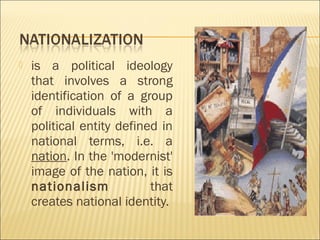
 is a political ideology
that involves a strong
identification of a group
of individuals with a
political entity defined in
national terms, i.e. a
nation. In the 'modernist'
image of the nation, it is
nationalism that
creates national identity.
 emphasizes collective identity - a 'people'
must be autonomous, united, and express a
single national culture. Integral nationalism
is a belief that a nation is an organic unit,
with a social hierarchy, co-operation
between the different social classes and
common political goals.
 Mainstream Concepts
 Emerging Concepts
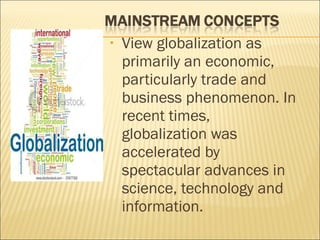
• View globalization as
primarily an economic,
particularly trade and
business phenomenon. In
recent times,
globalization was
accelerated by
spectacular advances in
science, technology and
information.
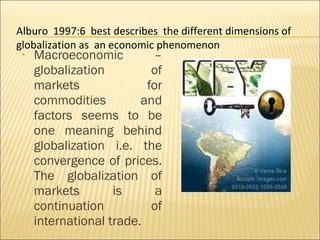
• Macroeconomic –
globalization of
markets for
commodities and
factors seems to be
one meaning behind
globalization i.e. the
convergence of prices.
The globalization of
markets is a
continuation of
international trade.
Alburo 1997:6 best describes the different dimensions of
globalization as an economic phenomenon
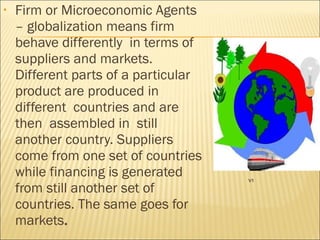
• Firm or Microeconomic Agents
– globalization means firm
behave differently in terms of
suppliers and markets.
Different parts of a particular
product are produced in
different countries and are
then assembled in still
another country. Suppliers
come from one set of countries
while financing is generated
from still another set of
countries. The same goes for
markets.
V1
 Microeconomics is the study of decisions that people and
businesses make regarding the allocation of resources
and prices of goods and services. Microeconomics
focuses on supply and demand and other forces that
determine the price levels seen in the economy.

Macroeconomics, is the field of economics that studies
the behavior of the economy as a whole and not just on
specific companies, but entire industries and economies.
This looks at economy-wide phenomena, such as
Gross National Product (GDP) and how it is affected by
changes in unemployment, national income, rate of
growth, and price levels.
• Global Firms today are both small and
large, and nimble
• Globalization is changes in nature of
investment beyond simple equity
purchases
• Globalization is change in location of
international production
 Globalization is change in nature of
production process and organization
 Globalization is changes in international
governance. Globalization involves going
beyond legal systems and relying
increasingly on private systems of
disputes settlements and arbitration.
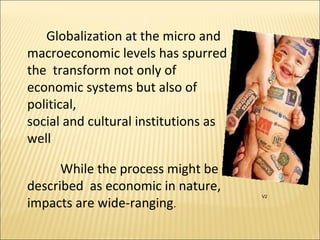
Globalization at the micro and
macroeconomic levels has spurred
the transform not only of
economic systems but also of
political,
social and cultural institutions as
well
While the process might be
described as economic in nature,
impacts are wide-ranging.
V2
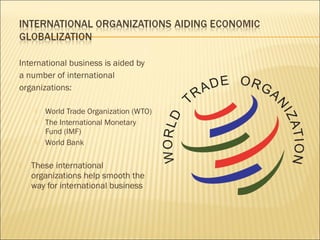
International business is aided by
a number of international
organizations:
 World Trade Organization (WTO)
 The International Monetary
Fund (IMF)
 World Bank
 These international
organizations help smooth the
way for international business
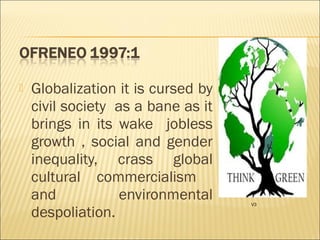
 Globalization it is cursed by
civil society as a bane as it
brings in its wake jobless
growth , social and gender
inequality, crass global
cultural commercialism
and environmental
despoliation.
V3
 Globalization process as a challenge to
government policymakers. According to them,
government should formulate policies which would
result in maximum benefits for the country.
Choices have to be made among priority concerns.
Policy responses to trends in globalization can
range from carefully calibrated but complex policy
choices to simple and administratively easy policy
decisions. 
 views the Political transformations occurring in
the wake of globalization as opportunities for
civil society, according to her civil society takes
on an increasingly powerful role in development
and in influencing policies. Globalization has
meant a retreat in the role of the state as
market forces and market actors determine the
course of growth.
 This rearrangement of roles between the
market, the state and people gives more space
for the civil society to take to organize itself to
effectively voice the interests of the people and
of the common good. It also gives more
responsibility to the civil society to take up the
interests of the people whose voices would
otherwise be overwhelmed and drowned by the
powers of business interests and of the
politically powerful.
 Emerging Concepts Sarah Timson,
Resident Representative of the United
Nations Development Program (UNDP),
views international movements, actions
and initiatives on democracy, human right,
environmental and social development as
part of globalization.
Emerging Concepts
 Pro-democracy movements and human
rights campaigns have become global
concerns. Problems of social development-
poverty, unemployment, social disintegration
and gender issues are also the subject of
worldwide campaigns.
 The work of the United Nations Development
Program and other United Nations
Organizations has contributed much to the
globalization. The series of global UN summits
on social development, women, population and
housing has focused global attention on these
concerns. Government have made
commitments and set specific targets as their
contribution to global solutions.
 Economy
 Political Institutions and Governance
 Social Institutions and Culture
 Science and Technology
1. Economy
Trade Liberalization and Structural Adjustment
Structural adjustment accelerated the opening
up of economy to, the winds of globalization.
This included trade liberalization, reform in the
financial sector, privatization, fiscal and
monetary policy measures (particularly
reduction of budget deficits and restructuring of
the Central Bank) and other globalization
friendly economic policies.
Levels of Governance
• Global Governance are exemplified by
multilateral institutions like the UN, WB and the
IMF whose policies regulate relationships
among member countries and bind them to
commitments and conditionalities
• National Governance –  any political organization
that is put in place to maintain control of a nation
• Regional Governance where countries commit
themselves to regional organizations which are
created for political and trade purposes
Administrative Reforms
 The traditional structures of government could
not cope with the requirement of accelerated
globalization. This is particularly true of
governments of developing countries. Hence ,
there is an inexorable call for administrative
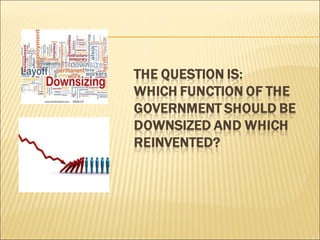
reforms. There is a general agreement that
governments badly need downsizing and
reinventing.
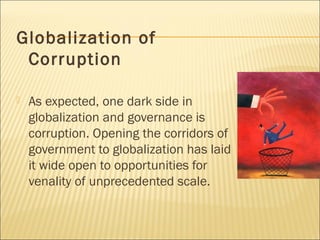
Globalization of
Corruption
 As expected, one dark side in
globalization and governance is
corruption. Opening the corridors of
government to globalization has laid
it wide open to opportunities for
venality of unprecedented scale.
The Role of Civil Society
 (Parr 1997:1-2) In the globalizing world of the
21st
century, the Civil Society takes on an
increasingly powerful role in development and
in influencing policies. Globalization has meant
a retreat in the role of the state, as market
forces determine the course of growth.
 The rearrangement of roles, between the
market, the state and people gives more space
for the civil society to organize itself to
effectively voice the interests of the people and
of the common good. It also gives more
responsibility to the civil society to take up the
interest of the people whose voices would
otherwise be overwhelmed and drowned by the
powers of business interests and of the
politically powerful
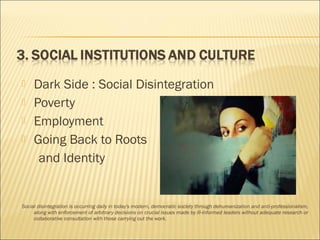
 Dark Side : Social Disintegration
 Poverty
 Employment
 Going Back to Roots
and Identity
Social disintegration is occurring daily in today's modern, democratic society through dehumanization and anti-professionalism,
along with enforcement of arbitrary decisions on crucial issues made by ill-informed leaders without adequate research or
collaborative consultation with those carrying out the work.
• Keeping Abreast
• Moral and Philosophical
Questions
• Bottom Line for globalization
and Science and Technology
• Human Development
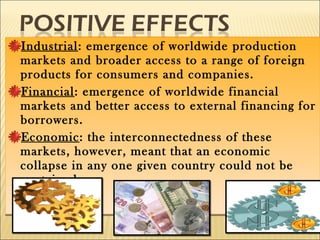
Industrial: emergence of worldwide production
markets and broader access to a range of foreign
products for consumers and companies.
Financial: emergence of worldwide financial
markets and better access to external financing for
borrowers.
Economic: the interconnectedness of these
markets, however, meant that an economic
collapse in any one given country could not be
contained.
Industrial: emergence of worldwide production
markets and broader access to a range of foreign
products for consumers and companies.
Financial: emergence of worldwide financial
markets and better access to external financing for
borrowers.
Economic: the interconnectedness of these
markets, however, meant that an economic
collapse in any one given country could not be
contained.
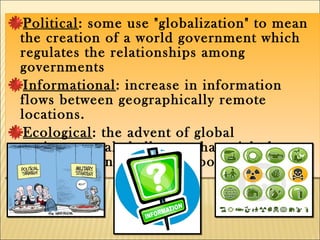
Political: some use "globalization" to mean
the creation of a world government which
regulates the relationships among
governments
Informational: increase in information
flows between geographically remote
locations.
Ecological: the advent of global
environmental challenges that might be
solved with international cooperation
Political: some use "globalization" to mean
the creation of a world government which
regulates the relationships among
governments
Informational: increase in information
flows between geographically remote
locations.
Ecological: the advent of global
environmental challenges that might be
solved with international cooperation
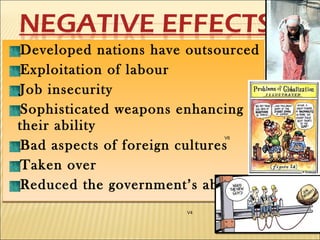
Developed nations have outsourced
Exploitation of labour
Job insecurity
Sophisticated weapons enhancing
their ability
Bad aspects of foreign cultures
Taken over
Reduced the government’s ability
Developed nations have outsourced
Exploitation of labour
Job insecurity
Sophisticated weapons enhancing
their ability
Bad aspects of foreign cultures
Taken over
Reduced the government’s ability
V4
V6
 What is Public Administration at present?
 How should we now define Public
Administration in a borderless, globalizing
world?
Public Administration is not limited to
National Administration. Agreements and
commitments crafted at the global and
regional levels oftentimes provide the policy
framework for national Public Administration
Controversial commitments made during the
APEC Summit are well known examples of
global and regional commitment which are
translated into national policies
 Existing laws and policies need to be overhauled to
comply with the requirement of such commitments
 In the Agricultural Sector for example it is said that
over 100 laws need to be repealed to comply with
APEC Commitments
V5
Brief History about APEC (Asia – Pacific Economic Cooperation)
* The idea of APEC was firstly publicly broached by former Prime Minister of
Australia, Mr Bob Hawke, during a speech in Seoul, Korea in January 1989.
Later that year, 12 Asia-Pacific economies met in Canberra, Australia to
establish APEC. The founding members were:
Australia, Brunei Darussalam, Canada, Indonesia, Japan, Korea, Malaysia,
New Zealand, the Philippines, Singapore, Thailand and the United States.
* China, Hong Kong, China and Chinese Taipei joined in 1991. Mexico and
Papua New Guinea followed in 1993. Chile acceded in 1994. And in 1998, Peru,
Russia and Viet Nam joined, taking the full membership to 21.
•Between 1989 and 1992, APEC met as an informal senior official and
Ministerial level dialogue. In 1993, former United States President, Mr Bill
Clinton, established the practice of an annual APEC Economic Leaders'
Meeting.
Mission of APEC
APEC is the premier Asia-Pacific economic forum. Our primary goal is to support
sustainable economic growth and prosperity in the Asia-Pacific region.
We are united in our drive to build a dynamic and harmonious Asia-Pacific
community by championing free and open trade and investment, promoting and
accelerating regional economic integration, encouraging economic and technical
cooperation, enhancing human security, and facilitating a favorable and sustainable
business environment. Our initiatives turn policy goals into concrete results and
agreements into tangible benefits.
The current, immediate past and the next APEC host economy are China, Indonesia,
and the Philippines, respectively. The APEC economies that currently contribute,
financially or in-kind, to the PSU are: Australia; Chinese Taipei; Indonesia; Japan;
Republic of Korea; Malaysia; New Zealand; Singapore; and the United States.
The APEC Secretariat Executive Director, PSU Director, and Chairs of the Committee
on Trade and Investment (CTI), the Economic Committee (EC) and the Senior
Finance Officials' Meeting (SFOM) attend Board meetings in an ex-officio capacity.
The Chair of the Board is the Senior Official of the current host economy. The Vice-
Chair is a Senior Official from the next host economy.
 No less than the Philippine Constitution needs
to be amended since many of its provisions are
not complementary with requirements of
GATT/WTO and APEC.
 Philippine membership in GATT/WTO is under
obligation to comply with policies, rules and
regulations mandated by the WTO
 In the area of social development, commitments
made during the UNDP summits on social
development , Women and Environment are
expected to be translated into actual policies,
programs and projects
Reestablishing the Locus and Focus of Public
Administration. In light of rapid global, regional
and national changes, it is time to determine
once more the locus and focus of the field of
public administration. It Is possible that both
are in danger of disappearing under the
onslaught of globalization
 Clarifying Concepts on the
Role of the State, the Private
Sector and Civil Society
 Reviewing Theories of the
Bureaucracy
 Socioeconomic Transformation
 Governance
 Decentralization - in the
administrative sense can facilitate
implementation of global
 governance at the local level.
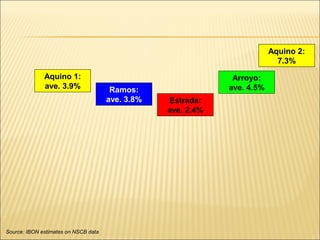
Aquino 1:
ave. 3.9% Ramos:
ave. 3.8% Estrada:
ave. 2.4%
Arroyo:
ave. 4.5%
Aquino 2:
7.3%
Source: IBON estimates on NSCB data
THANK YOU!!!THANK YOU!!!

Globalizationnationalismandpublicadministration 111023094429-phpapp01

  • 1.
  • 2.
     It isa reality which shapes and directs the lives of people in nearly all countries, whether as active players or objects, and as winners or losers.  Globalization is the process of interlinking the national economy with the world economy.  The extent of the impact of globalization in different countries is determined by its interactions with nationalism
  • 3.
     refers tothe increasing the unification of the world's economic order through reduction of such barriers to international trade as tariffs, export fees, and import quotas.  The goal is to increase material wealth, goods, and services through an international division of labor by efficiencies catalyzed by international relations, specialization and competition.  It describes the process by which regional economies, societies, and cultures have become integrated through communication, transportation, and trade
  • 4.
     is apolitical ideology that involves a strong identification of a group of individuals with a political entity defined in national terms, i.e. a nation. In the 'modernist' image of the nation, it is nationalism that creates national identity.
  • 5.
     emphasizes collectiveidentity - a 'people' must be autonomous, united, and express a single national culture. Integral nationalism is a belief that a nation is an organic unit, with a social hierarchy, co-operation between the different social classes and common political goals.
  • 7.
     Mainstream Concepts Emerging Concepts
  • 8.
    • View globalizationas primarily an economic, particularly trade and business phenomenon. In recent times, globalization was accelerated by spectacular advances in science, technology and information.
  • 9.
    • Macroeconomic – globalizationof markets for commodities and factors seems to be one meaning behind globalization i.e. the convergence of prices. The globalization of markets is a continuation of international trade. Alburo 1997:6 best describes the different dimensions of globalization as an economic phenomenon
  • 10.
    • Firm orMicroeconomic Agents – globalization means firm behave differently in terms of suppliers and markets. Different parts of a particular product are produced in different countries and are then assembled in still another country. Suppliers come from one set of countries while financing is generated from still another set of countries. The same goes for markets. V1
  • 11.
     Microeconomics isthe study of decisions that people and businesses make regarding the allocation of resources and prices of goods and services. Microeconomics focuses on supply and demand and other forces that determine the price levels seen in the economy.  Macroeconomics, is the field of economics that studies the behavior of the economy as a whole and not just on specific companies, but entire industries and economies. This looks at economy-wide phenomena, such as Gross National Product (GDP) and how it is affected by changes in unemployment, national income, rate of growth, and price levels.
  • 12.
    • Global Firmstoday are both small and large, and nimble • Globalization is changes in nature of investment beyond simple equity purchases • Globalization is change in location of international production
  • 13.
     Globalization ischange in nature of production process and organization  Globalization is changes in international governance. Globalization involves going beyond legal systems and relying increasingly on private systems of disputes settlements and arbitration.
  • 14.
    Globalization at themicro and macroeconomic levels has spurred the transform not only of economic systems but also of political, social and cultural institutions as well While the process might be described as economic in nature, impacts are wide-ranging. V2
  • 15.
    International business isaided by a number of international organizations:  World Trade Organization (WTO)  The International Monetary Fund (IMF)  World Bank  These international organizations help smooth the way for international business
  • 16.
     Globalization itis cursed by civil society as a bane as it brings in its wake jobless growth , social and gender inequality, crass global cultural commercialism and environmental despoliation. V3
  • 17.
     Globalization processas a challenge to government policymakers. According to them, government should formulate policies which would result in maximum benefits for the country. Choices have to be made among priority concerns. Policy responses to trends in globalization can range from carefully calibrated but complex policy choices to simple and administratively easy policy decisions. 
  • 18.
     views thePolitical transformations occurring in the wake of globalization as opportunities for civil society, according to her civil society takes on an increasingly powerful role in development and in influencing policies. Globalization has meant a retreat in the role of the state as market forces and market actors determine the course of growth.
  • 19.
     This rearrangementof roles between the market, the state and people gives more space for the civil society to take to organize itself to effectively voice the interests of the people and of the common good. It also gives more responsibility to the civil society to take up the interests of the people whose voices would otherwise be overwhelmed and drowned by the powers of business interests and of the politically powerful.
  • 20.
     Emerging ConceptsSarah Timson, Resident Representative of the United Nations Development Program (UNDP), views international movements, actions and initiatives on democracy, human right, environmental and social development as part of globalization. Emerging Concepts
  • 21.
     Pro-democracy movementsand human rights campaigns have become global concerns. Problems of social development- poverty, unemployment, social disintegration and gender issues are also the subject of worldwide campaigns.
  • 22.
     The workof the United Nations Development Program and other United Nations Organizations has contributed much to the globalization. The series of global UN summits on social development, women, population and housing has focused global attention on these concerns. Government have made commitments and set specific targets as their contribution to global solutions.
  • 23.
     Economy  PoliticalInstitutions and Governance  Social Institutions and Culture  Science and Technology
  • 24.
    1. Economy Trade Liberalizationand Structural Adjustment Structural adjustment accelerated the opening up of economy to, the winds of globalization. This included trade liberalization, reform in the financial sector, privatization, fiscal and monetary policy measures (particularly reduction of budget deficits and restructuring of the Central Bank) and other globalization friendly economic policies.
  • 25.
    Levels of Governance •Global Governance are exemplified by multilateral institutions like the UN, WB and the IMF whose policies regulate relationships among member countries and bind them to commitments and conditionalities • National Governance –  any political organization that is put in place to maintain control of a nation • Regional Governance where countries commit themselves to regional organizations which are created for political and trade purposes
  • 26.
    Administrative Reforms  Thetraditional structures of government could not cope with the requirement of accelerated globalization. This is particularly true of governments of developing countries. Hence , there is an inexorable call for administrative reforms. There is a general agreement that governments badly need downsizing and reinventing.
  • 28.
    Globalization of Corruption  Asexpected, one dark side in globalization and governance is corruption. Opening the corridors of government to globalization has laid it wide open to opportunities for venality of unprecedented scale.
  • 29.
    The Role ofCivil Society  (Parr 1997:1-2) In the globalizing world of the 21st century, the Civil Society takes on an increasingly powerful role in development and in influencing policies. Globalization has meant a retreat in the role of the state, as market forces determine the course of growth.
  • 30.
     The rearrangementof roles, between the market, the state and people gives more space for the civil society to organize itself to effectively voice the interests of the people and of the common good. It also gives more responsibility to the civil society to take up the interest of the people whose voices would otherwise be overwhelmed and drowned by the powers of business interests and of the politically powerful
  • 31.
     Dark Side: Social Disintegration  Poverty  Employment  Going Back to Roots and Identity Social disintegration is occurring daily in today's modern, democratic society through dehumanization and anti-professionalism, along with enforcement of arbitrary decisions on crucial issues made by ill-informed leaders without adequate research or collaborative consultation with those carrying out the work.
  • 32.
    • Keeping Abreast •Moral and Philosophical Questions • Bottom Line for globalization and Science and Technology • Human Development
  • 33.
    Industrial: emergence ofworldwide production markets and broader access to a range of foreign products for consumers and companies. Financial: emergence of worldwide financial markets and better access to external financing for borrowers. Economic: the interconnectedness of these markets, however, meant that an economic collapse in any one given country could not be contained. Industrial: emergence of worldwide production markets and broader access to a range of foreign products for consumers and companies. Financial: emergence of worldwide financial markets and better access to external financing for borrowers. Economic: the interconnectedness of these markets, however, meant that an economic collapse in any one given country could not be contained.
  • 34.
    Political: some use"globalization" to mean the creation of a world government which regulates the relationships among governments Informational: increase in information flows between geographically remote locations. Ecological: the advent of global environmental challenges that might be solved with international cooperation Political: some use "globalization" to mean the creation of a world government which regulates the relationships among governments Informational: increase in information flows between geographically remote locations. Ecological: the advent of global environmental challenges that might be solved with international cooperation
  • 35.
    Developed nations haveoutsourced Exploitation of labour Job insecurity Sophisticated weapons enhancing their ability Bad aspects of foreign cultures Taken over Reduced the government’s ability Developed nations have outsourced Exploitation of labour Job insecurity Sophisticated weapons enhancing their ability Bad aspects of foreign cultures Taken over Reduced the government’s ability V4 V6
  • 38.
     What isPublic Administration at present?  How should we now define Public Administration in a borderless, globalizing world?
  • 39.
    Public Administration isnot limited to National Administration. Agreements and commitments crafted at the global and regional levels oftentimes provide the policy framework for national Public Administration Controversial commitments made during the APEC Summit are well known examples of global and regional commitment which are translated into national policies
  • 40.
     Existing lawsand policies need to be overhauled to comply with the requirement of such commitments  In the Agricultural Sector for example it is said that over 100 laws need to be repealed to comply with APEC Commitments V5
  • 41.
    Brief History aboutAPEC (Asia – Pacific Economic Cooperation) * The idea of APEC was firstly publicly broached by former Prime Minister of Australia, Mr Bob Hawke, during a speech in Seoul, Korea in January 1989. Later that year, 12 Asia-Pacific economies met in Canberra, Australia to establish APEC. The founding members were: Australia, Brunei Darussalam, Canada, Indonesia, Japan, Korea, Malaysia, New Zealand, the Philippines, Singapore, Thailand and the United States. * China, Hong Kong, China and Chinese Taipei joined in 1991. Mexico and Papua New Guinea followed in 1993. Chile acceded in 1994. And in 1998, Peru, Russia and Viet Nam joined, taking the full membership to 21. •Between 1989 and 1992, APEC met as an informal senior official and Ministerial level dialogue. In 1993, former United States President, Mr Bill Clinton, established the practice of an annual APEC Economic Leaders' Meeting.
  • 42.
    Mission of APEC APECis the premier Asia-Pacific economic forum. Our primary goal is to support sustainable economic growth and prosperity in the Asia-Pacific region. We are united in our drive to build a dynamic and harmonious Asia-Pacific community by championing free and open trade and investment, promoting and accelerating regional economic integration, encouraging economic and technical cooperation, enhancing human security, and facilitating a favorable and sustainable business environment. Our initiatives turn policy goals into concrete results and agreements into tangible benefits. The current, immediate past and the next APEC host economy are China, Indonesia, and the Philippines, respectively. The APEC economies that currently contribute, financially or in-kind, to the PSU are: Australia; Chinese Taipei; Indonesia; Japan; Republic of Korea; Malaysia; New Zealand; Singapore; and the United States. The APEC Secretariat Executive Director, PSU Director, and Chairs of the Committee on Trade and Investment (CTI), the Economic Committee (EC) and the Senior Finance Officials' Meeting (SFOM) attend Board meetings in an ex-officio capacity. The Chair of the Board is the Senior Official of the current host economy. The Vice- Chair is a Senior Official from the next host economy.
  • 43.
     No lessthan the Philippine Constitution needs to be amended since many of its provisions are not complementary with requirements of GATT/WTO and APEC.  Philippine membership in GATT/WTO is under obligation to comply with policies, rules and regulations mandated by the WTO
  • 44.
     In thearea of social development, commitments made during the UNDP summits on social development , Women and Environment are expected to be translated into actual policies, programs and projects
  • 45.
    Reestablishing the Locusand Focus of Public Administration. In light of rapid global, regional and national changes, it is time to determine once more the locus and focus of the field of public administration. It Is possible that both are in danger of disappearing under the onslaught of globalization
  • 46.
     Clarifying Conceptson the Role of the State, the Private Sector and Civil Society  Reviewing Theories of the Bureaucracy
  • 47.
     Socioeconomic Transformation Governance  Decentralization - in the administrative sense can facilitate implementation of global  governance at the local level.
  • 51.
    Aquino 1: ave. 3.9%Ramos: ave. 3.8% Estrada: ave. 2.4% Arroyo: ave. 4.5% Aquino 2: 7.3% Source: IBON estimates on NSCB data
  • 52.