LEARNING OUTCOMES
1. Identifyand explain the types of market integration, including preferential trade
agreements, common markets, and economic unions, and understand their
implications on global trade and economic cooperation.
2. Analyze and evaluate the benefits and challenges of market integration for
businesses, considering factors such as market access, economies of scale,
competition, and regulatory harmonization.
3. Examine case studies of successful market integration initiatives, such as the
European Single Market and the ASEAN Economic Community, to understand practical
applications and outcomes of market integration on business strategies and economic
development.
4. Relate the concept of market integration to the field of Business Administration by
recognizing its impact on organizational strategies, market expansion, and
competitiveness. Understand how market integration influences business decisions,
market dynamics, and global opportunities for BSBA students.
4.
• Market integrationis a crucial concept in the
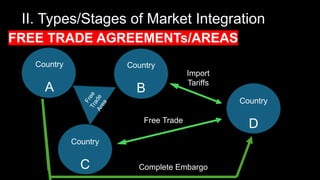
global business environment, shaping the
interconnectedness of markets, trade relations,
and economic cooperation among nations.
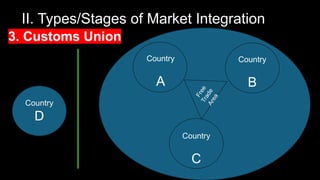
5.
1. What isMarket Integration?
Market integration refers to the process
of creating a UNIFIED MARKETPLACE
where goods, services, and capital can
FLOW FREELY between Countries or
Regions.
6.
1. What isMarket Integration?
It is a Central aspect of Economic
Globalization, which refers to the increasing
interconnectedness of economies, and
societies around the world.
7.
1. What isMarket Integration?
MARKET INTEGRATION can take MANY FORMS
including the REDUCTION OF TRADE BARRIERS
such as;
1. Tariffs (taxes),
2. Adoption of a COMMON CURRENCY (like E.U.)
3. The HARMONIZATION of REGULATORY
STANDARDS.
4. Development of Infrastructure to facilitate
transportation and communication.
8.
1. What isMarket Integration?
When these measures are implemented, they
can help to INCREASE the efficiency of the
market by allowing for
a. Greater Specialization
b. Economies of scale and
c. Increased competition
9.
I. What isMarket Integration?
One of the main benefits of Market
Integration is that it allows firms to access a
larger pool of customers and suppliers.
Simply saying, having a LARGER MARKET to
sell your GOODS or SERVICES that you are
offering.
10.
I. What isMarket Integration?
Which can increase your profits and lead to
higher levels of economic growth.
But, at the same time, MARKET
INTEGRATION can create winners and losers,
with some industries and regions benefiting
more than others.
11.
I. What isMarket Integration?
Ex:
Firms in industries that CAN COMPETE
internationally may thrive or prosper in a MORE
integrated market.
Meaning, if you have a BIGGER CAPITAL, you
have a BETTER chance to COMPETE or TRADE
internationally, you have a BIGGER MARKET.
12.
I. What isMarket Integration?
Ex:
While Firms in industries that are not globally
competitive, may SUFFER.
Maybe because they are NOT BIG ENOUGH to
EXPAND their market INTERNATIONALLY.
13.
I. What isMarket Integration?
Overall, Market Integration is an important
aspect of ECONOMIC GLOBALIZATION.
As it can help to increase Economic efficiency
and promote growth.
14.
I. What isMarket Integration?
However, it is important to ENSURE that
BENEFITS of integration are SHARED FAIRLY
and that MEASURES are TAKEN to ADDRESS
the NEGATIVE IMPACTS that can arise or occur
for certain INDUSTRIES or REGIONS
15.
II. Types/Stages ofMarket Integration
PREFERENTIAL TRADE AGREEMENTs/AREAS
1. Preferential Trade Agreements/Areas (PTAs)
is a TRADING BLOC that gives PREFERENTIAL
ACCESS to CERTAIN PRODUCTS from certain
COUNTRIES
- Usually carried out by reducing, but not
eliminating tariffs/taxes.
16.
II. Types/Stages ofMarket Integration
PREFERENTIAL TRADE AGREEMENTs/AREAS
Ex:
European Union and the African, Caribbean,
and the Pacific (ACP) group states.
17.
II. Types/Stages ofMarket Integration
2. FREE TRADE AGREEMENTs/AREAS
is an agreement made between countries,
where countries agreed to TRADE FREELY
AMONG THEMSELVES but are able to trade
with other countries OUTSIDE of the Free Trade
Area in whatever way they wish.
18.
II. Types/Stages ofMarket Integration
Ex:
North American Free Trade Area/Agreement
(NAFTA) was established in 1994 by USA,
Mexico, and Canada.
19.
II. Types/Stages ofMarket Integration
FREE TRADE AGREEMENTs/AREAS
Country
D
Import
Tariffs
Free Trade
Country
A
Country
B
Country
C
F
r
e
e
T
r
a
d
e
A
r
e
a
Complete Embargo
20.
II. Types/Stages ofMarket Integration
3. Customs Union
Is an agreement made between countries,
where the countries agreed to trade freely
among themselves, and they also agree to
adopt common external barriers against any
country attempting to import into the Customs
Union.
21.
II. Types/Stages ofMarket Integration
3. Customs Union
All common markets and economics and
monetary unions are also Customs Union; thus,
European Union has a customs union.
22.
II. Types/Stages ofMarket Integration
Customs Union
3. Customs Union
Country
A
Country
B
Country
C
F
r
e
e
T
r
a
d
e
A
r
e
a
23.
II. Types/Stages ofMarket Integration
4. Common Markets
Is a Customs Union with common policies on
product regulation, and free movement of
goods, services, capital, and labor,
The European Union is a Common Market
24.
II. Types/Stages ofMarket Integration
3. Common Markets
Ex: Labor (International Football Players)
Once the EU as a common market, International
were able to travel freely within the Common
Market and gain employment. Before that,
Labor was not “common” (need for work
permits, etc,)
25.
II. Types/Stages ofMarket Integration
5. Economic and Monetary Union
is a Common market with a common currency
and a Central Bank.
Ex.: Eurozone, which includes the member
countries of European Union that have adopted
euro € as their currency and have the European
Central Bank (ECB) as their central bank.
26.
II. Types/Stages ofMarket Integration
5. Economic and Monetary Union
Advantages:
- No exchange rate fluctuation
- More stable currency
- Business confidence tends to improve
- Promote internal growth and trade
- Transaction cost between member countries
is eliminated
27.
II. Types/Stages ofMarket Integration
5. Economic and Monetary Union
Disdvantages:
- Loss control of their own Central Bank
- Loss control of their interest rates because
of external Central Bank
- Difficulty of managing Inflation rate,
unemployment rate, rate of economic growth
- Dependent on Strong member countries for
bailouts
28.
II. Types/Stages ofMarket Integration
6. Complete Economic Integration
The FINAL STAGE of Economic Integration at
which point the Individual countries involved
WOULD HAVE NO CONTROL of ECONOMIC
POLICY, FULL MONETARY UNION, and
COMPLETE HARMONIZATION OF FISCAL
POLICY.
The Eurozone is moving towards this end.



![WEEK 3 MARKET INTEGRATION LECTURE [Autosaved].pptx](https://cdn.slidesharecdn.com/ss_thumbnails/week3marketintegrationlectureautosaved-250307192702-00a75125-thumbnail.jpg?width=640&height=640&fit=bounds)


