McGraw-Hill/Irwin
International Management
© 2005 The McGraw-Hill Companies, Inc., All Rights Reserved.
International Management
Phatak, Bhagat, and Kashlak
McGraw-Hill/Irwin
International Management
© 2005 The McGraw-Hill Companies, Inc., All Rights Reserved.
Chapter 4
The International Legal Environment
of Business
4-3
Learning Objectives
Integrate the legal environment into the political and economic
frameworks developed in previous chapters.
Identify the three levels of law that comprise the international
legal system for business.
Discuss the sources and characteristics of international, regional,
and national law, and the implications of each for the
multinational firm.
Describe the implications of various international treaties
concerning intellectual property rights.
Understand the Foreign Corrupt Practices Act and the
implications of it on a firm’s global operations.
4-4
Chapter Topics
Understanding Laws in the International Context
International Law
International Law and the Risk of Intellectual Property Theft
Laws of Regional Trading Blocs
Laws of Nation States
Host Country-Specific Laws
The Foreign Corrupt Practices Act and Antibribery Provisions
The Convention on Combating Bribery
4-5
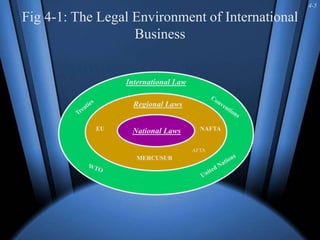
Regional Laws
EU
MERCUSUR
NAFTANational Laws
International Law
AFTA
Fig 4-1: The Legal Environment of International
Business
4-6
Basic Characteristics of Law
Law is a norm that prescribes what is assumed to be a
proper mode of behavior
Law not only prescribes a certain pattern of behavior,
but also requires that the prescribed mode be followed
Law includes a process approved by society for
applying coercive sanctions against those who do not
obey and therefore perform illegal acts
4-7
The Requirements of an Effective Legal System
1) The people in the society must clearly understand and
have knowledge of what the society prescribes as
legal behavior
2) The members of society, the subjects of the legal
system, must have agreed that the laws deserve to be
obeyed, that is, they must regard the laws as being
fair and unjust
3) An effective system for punishing illegal behavior
must be in place
4-8
Functions of Law
1) Law communicates to individuals in a society their
rights and duties in their daily interactions with other
people in the society
2) Law helps in controlling and preventing behavior that
the society considers undesirable
3) Governments use law to promote the social and
economic welfare of society
4) Laws of a society reflect the norms, values, aims, and
general beliefs of a society
4-9
The International Court of Justice
(The World Court)
There are three scenarios under which disputes could
arise:
1) Between two countries
2) Between a country and a company
3) Between two companies
The International Court of Justice can adjudicate
disputes between two countries only when both
governments involved agree to submit to the
authority of the International Court of Justice
4-10
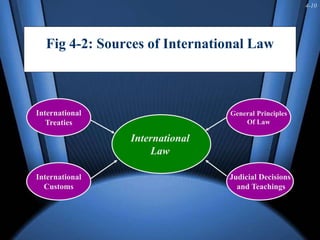
Fig 4-2: Sources of International Law
International
Law
International
Treaties
International
Customs
Judicial Decisions
and Teachings
General Principles
Of Law
4-11
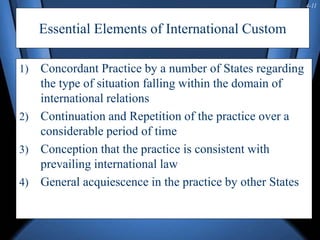
Essential Elements of International Custom
1) Concordant Practice by a number of States regarding
the type of situation falling within the domain of
international relations
2) Continuation and Repetition of the practice over a
considerable period of time
3) Conception that the practice is consistent with
prevailing international law
4) General acquiescence in the practice by other States
4-12
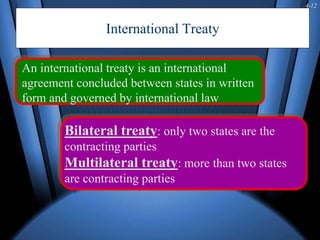
International Treaty
An international treaty is an international
agreement concluded between states in written
form and governed by international law
Bilateral treaty: only two states are the
contracting parties
Multilateral treaty: more than two states
are contracting parties
4-13
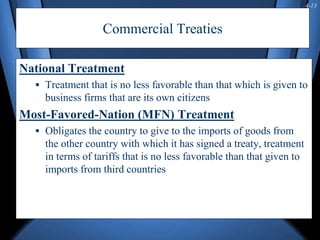
Commercial Treaties
National Treatment
 Treatment that is no less favorable than that which is given to
business firms that are its own citizens
Most-Favored-Nation (MFN) Treatment
 Obligates the country to give to the imports of goods from
the other country with which it has signed a treaty, treatment
in terms of tariffs that is no less favorable than that given to
imports from third countries
4-14
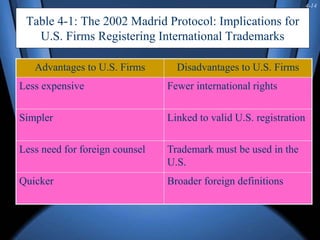
Table 4-1: The 2002 Madrid Protocol: Implications for
U.S. Firms Registering International Trademarks
Advantages to U.S. Firms Disadvantages to U.S. Firms
Less expensive Fewer international rights
Simpler Linked to valid U.S. registration
Less need for foreign counsel Trademark must be used in the
U.S.
Quicker Broader foreign definitions
4-15
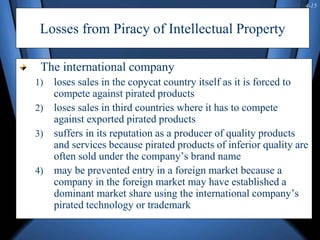
Losses from Piracy of Intellectual Property
The international company
1) loses sales in the copycat country itself as it is forced to
compete against pirated products
2) loses sales in third countries where it has to compete
against exported pirated products
3) suffers in its reputation as a producer of quality products
and services because pirated products of inferior quality are
often sold under the company’s brand name
4) may be prevented entry in a foreign market because a
company in the foreign market may have established a
dominant market share using the international company’s
pirated technology or trademark
4-16
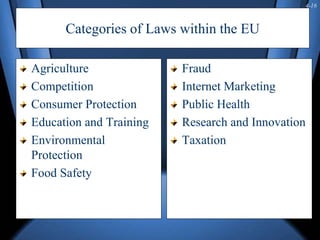
Categories of Laws within the EU
Agriculture
Competition
Consumer Protection
Education and Training
Environmental
Protection
Food Safety
Fraud
Internet Marketing
Public Health
Research and Innovation
Taxation
4-17
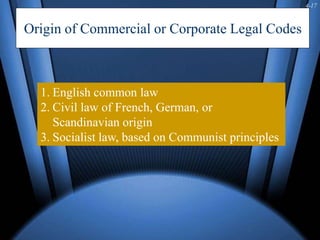
Origin of Commercial or Corporate Legal Codes
1. English common law
2. Civil law of French, German, or
Scandinavian origin
3. Socialist law, based on Communist principles
4-18
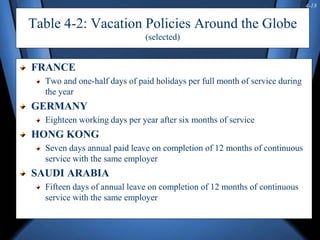
Table 4-2: Vacation Policies Around the Globe
(selected)
FRANCE
Two and one-half days of paid holidays per full month of service during
the year
GERMANY
Eighteen working days per year after six months of service
HONG KONG
Seven days annual paid leave on completion of 12 months of continuous
service with the same employer
SAUDI ARABIA
Fifteen days of annual leave on completion of 12 months of continuous
service with the same employer
4-19
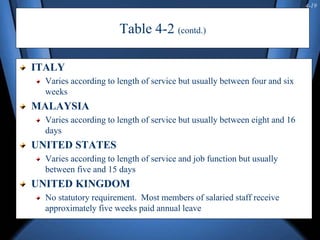
Table 4-2 (contd.)
ITALY
Varies according to length of service but usually between four and six
weeks
MALAYSIA
Varies according to length of service but usually between eight and 16
days
UNITED STATES
Varies according to length of service and job function but usually
between five and 15 days
UNITED KINGDOM
No statutory requirement. Most members of salaried staff receive
approximately five weeks paid annual leave
4-20
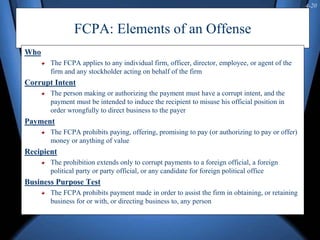
FCPA: Elements of an Offense
Who
The FCPA applies to any individual firm, officer, director, employee, or agent of the
firm and any stockholder acting on behalf of the firm
Corrupt Intent
The person making or authorizing the payment must have a corrupt intent, and the
payment must be intended to induce the recipient to misuse his official position in
order wrongfully to direct business to the payer
Payment
The FCPA prohibits paying, offering, promising to pay (or authorizing to pay or offer)
money or anything of value
Recipient
The prohibition extends only to corrupt payments to a foreign official, a foreign
political party or party official, or any candidate for foreign political office
Business Purpose Test
The FCPA prohibits payment made in order to assist the firm in obtaining, or retaining
business for or with, or directing business to, any person
4-21
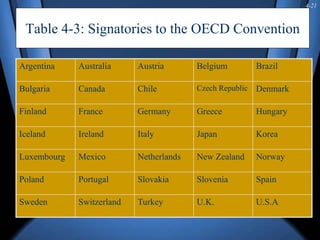
Table 4-3: Signatories to the OECD Convention
Argentina Australia Austria Belgium Brazil
Bulgaria Canada Chile Czech Republic Denmark
Finland France Germany Greece Hungary
Iceland Ireland Italy Japan Korea
Luxembourg Mexico Netherlands New Zealand Norway
Poland Portugal Slovakia Slovenia Spain
Sweden Switzerland Turkey U.K. U.S.A
4-22
Key Terms and Concepts
International law
International customs
International treaties and conventions
Intellectual property rights
The Madrid Protocol
Common law
Civil law
Islamic law
Foreign Corrupt Practices Act

Legal enviorment

  • 1.
    McGraw-Hill/Irwin International Management © 2005The McGraw-Hill Companies, Inc., All Rights Reserved. International Management Phatak, Bhagat, and Kashlak
  • 2.
    McGraw-Hill/Irwin International Management © 2005The McGraw-Hill Companies, Inc., All Rights Reserved. Chapter 4 The International Legal Environment of Business
  • 3.
    4-3 Learning Objectives Integrate thelegal environment into the political and economic frameworks developed in previous chapters. Identify the three levels of law that comprise the international legal system for business. Discuss the sources and characteristics of international, regional, and national law, and the implications of each for the multinational firm. Describe the implications of various international treaties concerning intellectual property rights. Understand the Foreign Corrupt Practices Act and the implications of it on a firm’s global operations.
  • 4.
    4-4 Chapter Topics Understanding Lawsin the International Context International Law International Law and the Risk of Intellectual Property Theft Laws of Regional Trading Blocs Laws of Nation States Host Country-Specific Laws The Foreign Corrupt Practices Act and Antibribery Provisions The Convention on Combating Bribery
  • 5.
    4-5 Regional Laws EU MERCUSUR NAFTANational Laws InternationalLaw AFTA Fig 4-1: The Legal Environment of International Business
  • 6.
    4-6 Basic Characteristics ofLaw Law is a norm that prescribes what is assumed to be a proper mode of behavior Law not only prescribes a certain pattern of behavior, but also requires that the prescribed mode be followed Law includes a process approved by society for applying coercive sanctions against those who do not obey and therefore perform illegal acts
  • 7.
    4-7 The Requirements ofan Effective Legal System 1) The people in the society must clearly understand and have knowledge of what the society prescribes as legal behavior 2) The members of society, the subjects of the legal system, must have agreed that the laws deserve to be obeyed, that is, they must regard the laws as being fair and unjust 3) An effective system for punishing illegal behavior must be in place
  • 8.
    4-8 Functions of Law 1)Law communicates to individuals in a society their rights and duties in their daily interactions with other people in the society 2) Law helps in controlling and preventing behavior that the society considers undesirable 3) Governments use law to promote the social and economic welfare of society 4) Laws of a society reflect the norms, values, aims, and general beliefs of a society
  • 9.
    4-9 The International Courtof Justice (The World Court) There are three scenarios under which disputes could arise: 1) Between two countries 2) Between a country and a company 3) Between two companies The International Court of Justice can adjudicate disputes between two countries only when both governments involved agree to submit to the authority of the International Court of Justice
  • 10.
    4-10 Fig 4-2: Sourcesof International Law International Law International Treaties International Customs Judicial Decisions and Teachings General Principles Of Law
  • 11.
    4-11 Essential Elements ofInternational Custom 1) Concordant Practice by a number of States regarding the type of situation falling within the domain of international relations 2) Continuation and Repetition of the practice over a considerable period of time 3) Conception that the practice is consistent with prevailing international law 4) General acquiescence in the practice by other States
  • 12.
    4-12 International Treaty An internationaltreaty is an international agreement concluded between states in written form and governed by international law Bilateral treaty: only two states are the contracting parties Multilateral treaty: more than two states are contracting parties
  • 13.
    4-13 Commercial Treaties National Treatment Treatment that is no less favorable than that which is given to business firms that are its own citizens Most-Favored-Nation (MFN) Treatment  Obligates the country to give to the imports of goods from the other country with which it has signed a treaty, treatment in terms of tariffs that is no less favorable than that given to imports from third countries
  • 14.
    4-14 Table 4-1: The2002 Madrid Protocol: Implications for U.S. Firms Registering International Trademarks Advantages to U.S. Firms Disadvantages to U.S. Firms Less expensive Fewer international rights Simpler Linked to valid U.S. registration Less need for foreign counsel Trademark must be used in the U.S. Quicker Broader foreign definitions
  • 15.
    4-15 Losses from Piracyof Intellectual Property The international company 1) loses sales in the copycat country itself as it is forced to compete against pirated products 2) loses sales in third countries where it has to compete against exported pirated products 3) suffers in its reputation as a producer of quality products and services because pirated products of inferior quality are often sold under the company’s brand name 4) may be prevented entry in a foreign market because a company in the foreign market may have established a dominant market share using the international company’s pirated technology or trademark
  • 16.
    4-16 Categories of Lawswithin the EU Agriculture Competition Consumer Protection Education and Training Environmental Protection Food Safety Fraud Internet Marketing Public Health Research and Innovation Taxation
  • 17.
    4-17 Origin of Commercialor Corporate Legal Codes 1. English common law 2. Civil law of French, German, or Scandinavian origin 3. Socialist law, based on Communist principles
  • 18.
    4-18 Table 4-2: VacationPolicies Around the Globe (selected) FRANCE Two and one-half days of paid holidays per full month of service during the year GERMANY Eighteen working days per year after six months of service HONG KONG Seven days annual paid leave on completion of 12 months of continuous service with the same employer SAUDI ARABIA Fifteen days of annual leave on completion of 12 months of continuous service with the same employer
  • 19.
    4-19 Table 4-2 (contd.) ITALY Variesaccording to length of service but usually between four and six weeks MALAYSIA Varies according to length of service but usually between eight and 16 days UNITED STATES Varies according to length of service and job function but usually between five and 15 days UNITED KINGDOM No statutory requirement. Most members of salaried staff receive approximately five weeks paid annual leave
  • 20.
    4-20 FCPA: Elements ofan Offense Who The FCPA applies to any individual firm, officer, director, employee, or agent of the firm and any stockholder acting on behalf of the firm Corrupt Intent The person making or authorizing the payment must have a corrupt intent, and the payment must be intended to induce the recipient to misuse his official position in order wrongfully to direct business to the payer Payment The FCPA prohibits paying, offering, promising to pay (or authorizing to pay or offer) money or anything of value Recipient The prohibition extends only to corrupt payments to a foreign official, a foreign political party or party official, or any candidate for foreign political office Business Purpose Test The FCPA prohibits payment made in order to assist the firm in obtaining, or retaining business for or with, or directing business to, any person
  • 21.
    4-21 Table 4-3: Signatoriesto the OECD Convention Argentina Australia Austria Belgium Brazil Bulgaria Canada Chile Czech Republic Denmark Finland France Germany Greece Hungary Iceland Ireland Italy Japan Korea Luxembourg Mexico Netherlands New Zealand Norway Poland Portugal Slovakia Slovenia Spain Sweden Switzerland Turkey U.K. U.S.A
  • 22.
    4-22 Key Terms andConcepts International law International customs International treaties and conventions Intellectual property rights The Madrid Protocol Common law Civil law Islamic law Foreign Corrupt Practices Act