VII. Globalization
and
Technological
Advancement
While globalization has been much criticized
for its possible negative side effects, this
shows that globalization has amplified the
spread of technology across borders in two
ways. First, globalization allows countries to
gain easier access to foreign knowledge.
S econd, it enhances international
competition—including as a result of the rise
of emerging market firms—and this
strengthens firms’incentives to innovate and
adopt foreign technologies.
Technological advancement
is the generation or discovery
of knowledge that advances
the understanding of science
or technology. The phrase
“discovery of knowledge” is
often misunderstood.
A. THE ADVENT OF MASS PRODUCTION
Mass production is the manufacturing of large
quantities of standardized products, often using
assembly lines or automation technology.
• An early example of mass
production dates back to 1913
when Henry Ford pioneered
the first assembly line
technique for his famous
Ford Model T.
• Ford's automobiles became
available at a lower price
because of the efficiency of
the method.
Advantages of
Mass Production
• Increase productivity
• Lower cost
• Higher quality of life
• Faster Production
• Safer Medicine
• Less error
• Increase worker safety
• Rapid evolution
Disadvantages of
Mass Production
• Initial Cost
• Less flexibility
• Pollution
• Affect employee's wellbeing
B. Machination of Progress
Machination of progress refers to the discovery of new
and improved methods of producing goods. Changes in
machination leads to an increase in labor, capital and
other factors of production.
Phases of Technological Progress
• Invention
• Innovation
• Diffusion
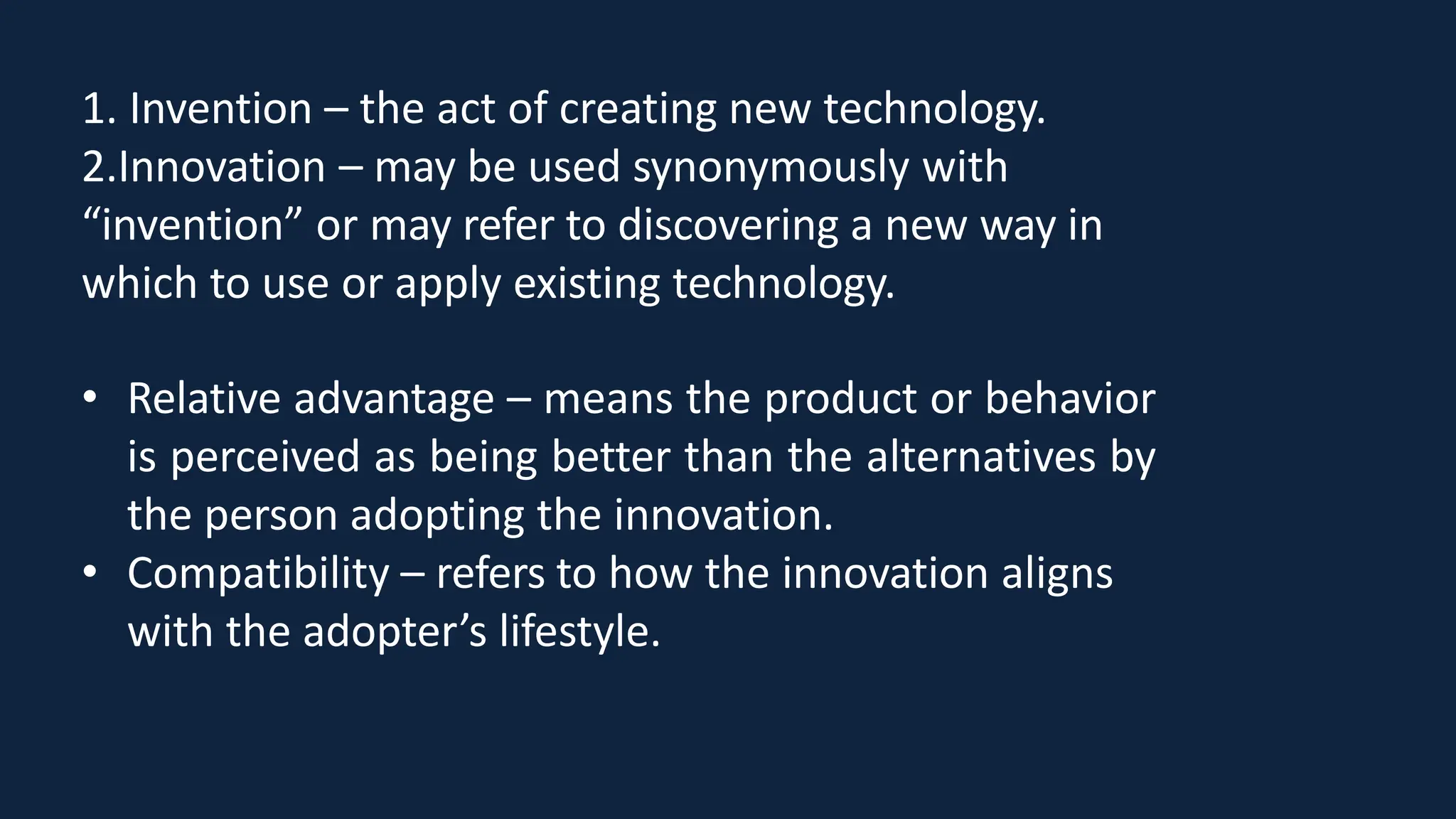
1. Invention – the act of creating new technology.
2.Innovation – may be used synonymously with
“invention” or may refer to discovering a new way in
which to use or apply existing technology.
• Relative advantage – means the product or behavior
is perceived as being better than the alternatives by
the person adopting the innovation.
• Compatibility – refers to how the innovation aligns
with the adopter’s lifestyle.
• Complexity – how easy or difficult innovation is to
understand.
• Trialability – the process of testing the innovation
• Observability – involves seeing the product or behavior
in action.
3. Diffusion – refers to the spread of technology throughout
a society or industry.
Why machination of
progress important?
GLOBALIZING TRADE
What is Globalization?
is the word used to describe the growing interdependence
of the world’s economies, cultures, and populations,
brought about by cross-border trade in goods and
services, technology, and flows of investment, people, and
information.
What is Trade?
 Trade is the buying and selling of goods and services between
different countries around the world.
 Goods that are brought into a country
are called
 _IMPORTS, and those that are sold to
another country are called EXPORTS .
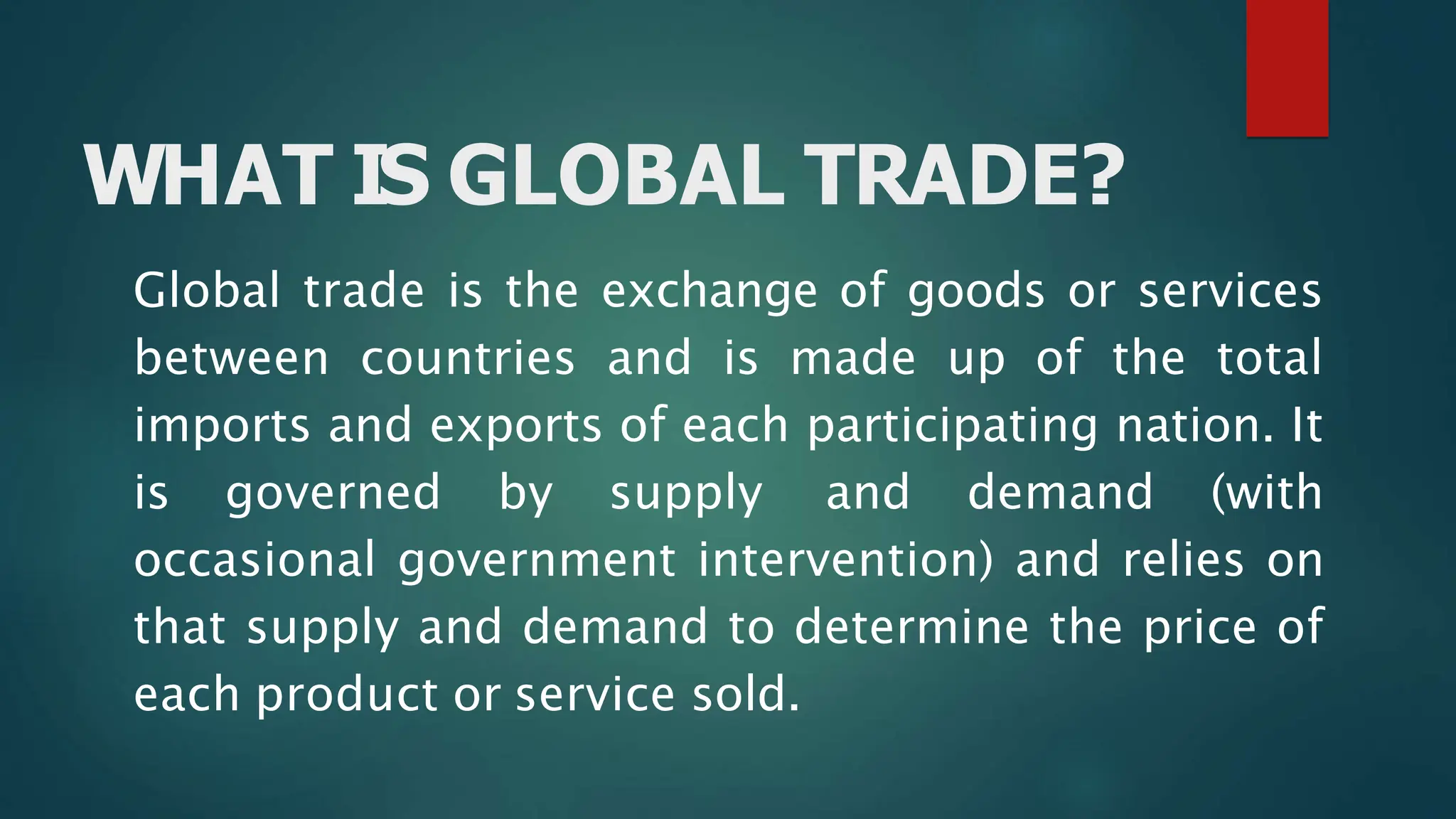
WHAT IS GLOBAL TRADE?
Global trade is the exchange of goods or services
between countries and is made up of the total
imports and exports of each participating nation. It
is governed by supply and demand (with
occasional government intervention) and relies on
that supply and demand to determine the price of
each product or service sold.
Some nations choose to specialize in various
products and services and have a comparative
advantage over other nations. Countries with an
absolute advantage on a good or service are the
best at producing that good or service and are
most likely to export these to other nations. That
is how the global economy is formed – trade
between nations.
FREE TRADE
is a pact between two or more nations to reduce
barriers to imports and exports among them.
Under a free trade policy, goods and services can
be bought and sold across international borders
with little or no government tariffs, quotas,
subsidies, or prohibitions to inhibit their
exchange.
PROTECTIONISM
is the practice of following protectionist trade policies.
A protectionist trade policy allows the government of a
country to promote domestic producers, and thereby
boost the domestic production of goods and services
by imposing tariffs or otherwise limiting foreign goods
and services in the marketplace.
Some of the main tools used to accomplish
PROTECTIONISM are:
TARIFFS
SUBSIDIES
QUOTAS
EMBARGOS
Top Trade Sectors
The top trade sectors in the global trade market have
remained relatively consistent in spite seen significant
market fluctuation in the past decade. Entities wishing to
trade globally might consider some of these sectors.
According to the CIA World Factbook, these are top 10 most traded
commodities since 2017.
1.Electrical Machinery – Including Computers (14.8%)
2.Mineral Fuels – (14.4%)
3.Nuclear Reactors – (8.9%)
4. Vehicles – (8.9%)
5.Scientific and Precision Instruments – (3.5%)
6.Plastics – (3.4%) 7.Iron
and Steel – (2.7%)
8. Organic Chemicals – (2.6% )
9. Pharmaceutical Products – (2.6%)
10.Precious Stones – (1.9%)
Other significant trade areas include service/labor and intellectual
property.
The US currently spends nearly $2.361 trillion annually
on imports and the top 3 commodities include:
1.Industrial Supplies (32.9%)
2.Consumer Goods (31.8%)
3.Capital Goods (30.4%)
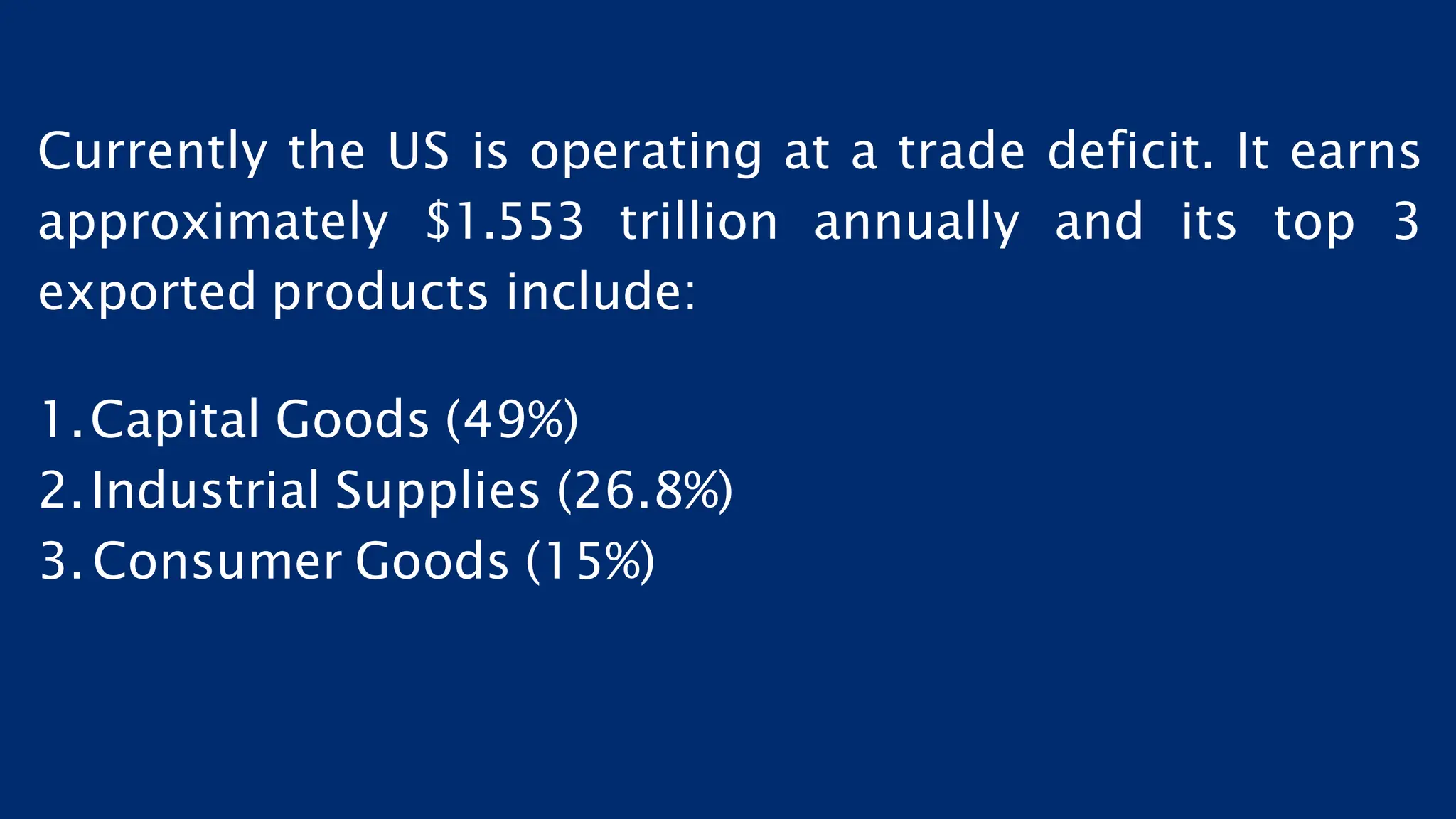
Currently the US is operating at a trade deficit. It earns
approximately $1.553 trillion annually and its top 3
exported products include:
1.Capital Goods (49%)
2.Industrial Supplies (26.8%)
3.Consumer Goods (15%)
Advantages and Disadvantages
of Global Trade
•Building blocks for international growth – once a business is able
to successfully expand to one foreign market, they increase their
likelihood of spreading to others. They can increase brand
awareness in the region, spark interest in neighboring countries,
and pull the brand into those countries as well.
•Increases competition – The more sellers in the marketplace, the
cheaper and better the products are for the consumer.
Advantages
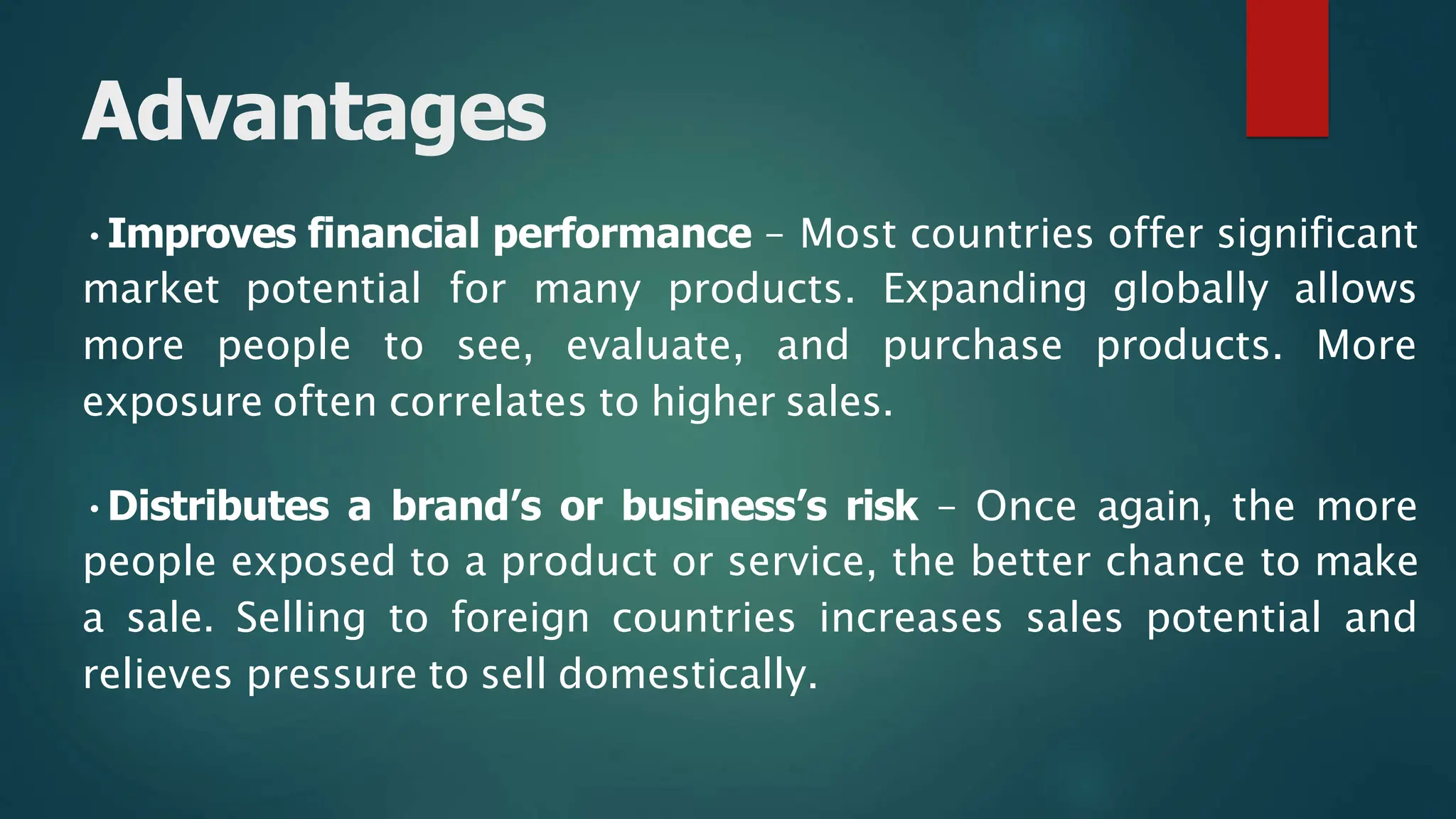
•Improves financial performance – Most countries offer significant
market potential for many products. Expanding globally allows
more people to see, evaluate, and purchase products. More
exposure often correlates to higher sales.
•Distributes a brand’s or business’s risk – Once again, the more
people exposed to a product or service, the better chance to make
a sale. Selling to foreign countries increases sales potential and
relieves pressure to sell domestically.
Advantages
Disadvantages
•Political risk – Operating in foreign nations means operating with
foreign governments, laws, and customs as well as with potential
political unrest. Shifting political climates can often pose disruption
to global trade.
•Cultural complications – This can take many forms and can be
difficult to anticipate. Some of the major gaffs come from language
barriers, physical mannerisms, or religious offenses. These mistakes
can be costly if enacted improperly.
Disadvantages
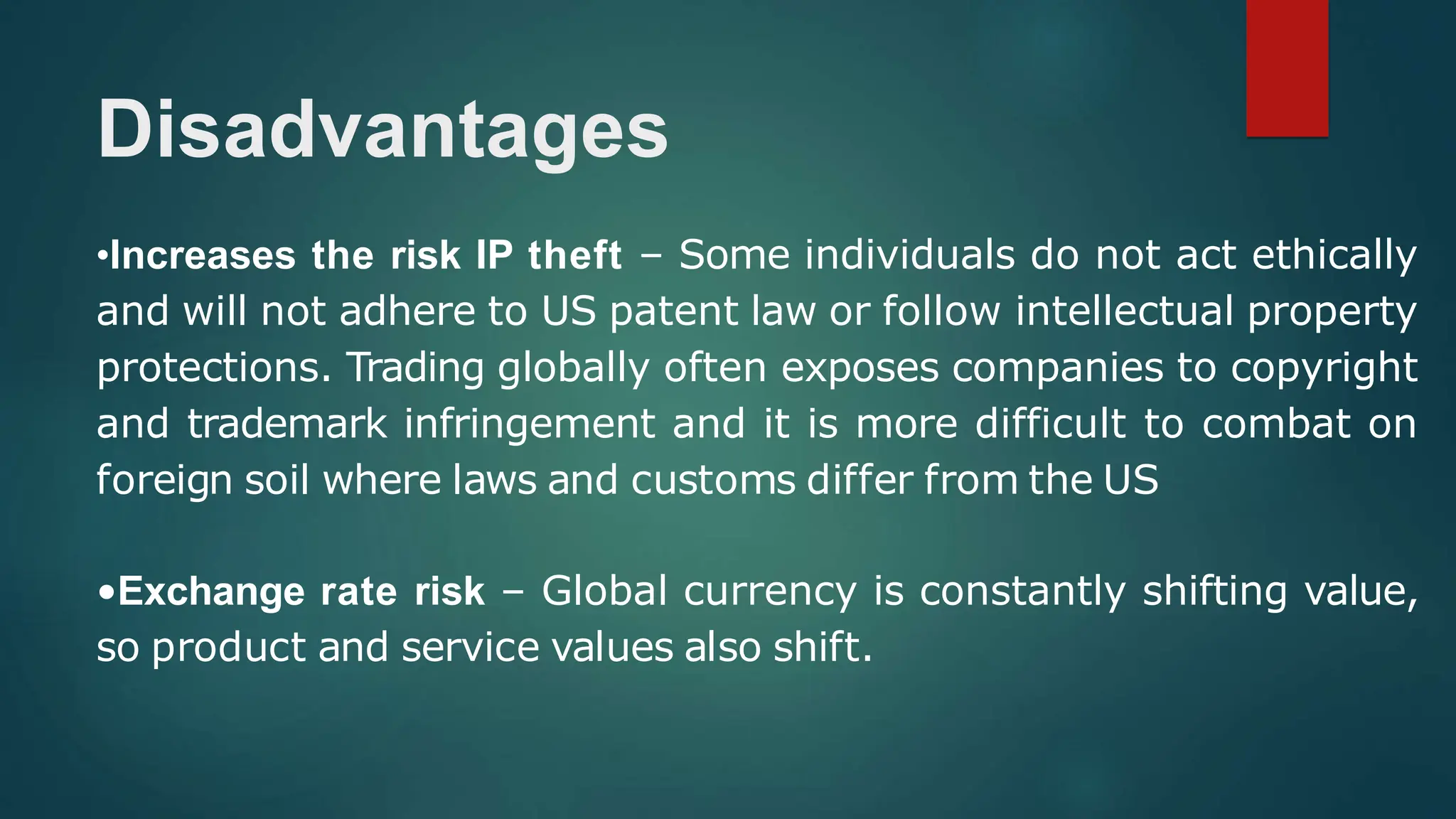
•Increases the risk IP theft – Some individuals do not act ethically
and will not adhere to US patent law or follow intellectual property
protections. Trading globally often exposes companies to copyright
and trademark infringement and it is more difficult to combat on
foreign soil where laws and customs differ from the US
•Exchange rate risk – Global currency is constantly shifting value,
so product and service values also shift.
Global trade has been the backbone of the
global economy and continues to grow
today. There are many advantages and
disadvantages associated with it, and
many more strategies on what is the best
way to do it
https://www.thebalancemoney.com/free-trade-agreement-pros-and-cons-
3305845#:~:text=FTAs%20can%20force%20local%20industries,livelihoods%2C
%20and%20local%20employment%20issues.
https://www.investopedia.com/terms/f/free-
trade.asp#:~:text=A%20free%20trade%20agreement%20is,prohibitions%20to
%20inhibit%20their%20exchange.
THANK YOU!
Mass production and Globalization of technology

Mass production and Globalization of technology

  • 1.
  • 2.
    While globalization hasbeen much criticized for its possible negative side effects, this shows that globalization has amplified the spread of technology across borders in two ways. First, globalization allows countries to gain easier access to foreign knowledge. S econd, it enhances international competition—including as a result of the rise of emerging market firms—and this strengthens firms’incentives to innovate and adopt foreign technologies.
  • 3.
    Technological advancement is thegeneration or discovery of knowledge that advances the understanding of science or technology. The phrase “discovery of knowledge” is often misunderstood.
  • 4.
    A. THE ADVENTOF MASS PRODUCTION Mass production is the manufacturing of large quantities of standardized products, often using assembly lines or automation technology.
  • 5.
    • An earlyexample of mass production dates back to 1913 when Henry Ford pioneered the first assembly line technique for his famous Ford Model T. • Ford's automobiles became available at a lower price because of the efficiency of the method.
  • 8.
  • 9.
    • Increase productivity •Lower cost • Higher quality of life • Faster Production • Safer Medicine • Less error • Increase worker safety • Rapid evolution
  • 10.
  • 11.
    • Initial Cost •Less flexibility • Pollution • Affect employee's wellbeing
  • 12.
  • 13.
    Machination of progressrefers to the discovery of new and improved methods of producing goods. Changes in machination leads to an increase in labor, capital and other factors of production. Phases of Technological Progress • Invention • Innovation • Diffusion
  • 14.
    1. Invention –the act of creating new technology. 2.Innovation – may be used synonymously with “invention” or may refer to discovering a new way in which to use or apply existing technology. • Relative advantage – means the product or behavior is perceived as being better than the alternatives by the person adopting the innovation. • Compatibility – refers to how the innovation aligns with the adopter’s lifestyle.
  • 15.
    • Complexity –how easy or difficult innovation is to understand. • Trialability – the process of testing the innovation • Observability – involves seeing the product or behavior in action. 3. Diffusion – refers to the spread of technology throughout a society or industry.
  • 16.
  • 17.
  • 18.
    What is Globalization? isthe word used to describe the growing interdependence of the world’s economies, cultures, and populations, brought about by cross-border trade in goods and services, technology, and flows of investment, people, and information.
  • 19.
    What is Trade? Trade is the buying and selling of goods and services between different countries around the world.  Goods that are brought into a country are called  _IMPORTS, and those that are sold to another country are called EXPORTS .
  • 20.
    WHAT IS GLOBALTRADE? Global trade is the exchange of goods or services between countries and is made up of the total imports and exports of each participating nation. It is governed by supply and demand (with occasional government intervention) and relies on that supply and demand to determine the price of each product or service sold.
  • 21.
    Some nations chooseto specialize in various products and services and have a comparative advantage over other nations. Countries with an absolute advantage on a good or service are the best at producing that good or service and are most likely to export these to other nations. That is how the global economy is formed – trade between nations.
  • 22.
    FREE TRADE is apact between two or more nations to reduce barriers to imports and exports among them. Under a free trade policy, goods and services can be bought and sold across international borders with little or no government tariffs, quotas, subsidies, or prohibitions to inhibit their exchange.
  • 23.
    PROTECTIONISM is the practiceof following protectionist trade policies. A protectionist trade policy allows the government of a country to promote domestic producers, and thereby boost the domestic production of goods and services by imposing tariffs or otherwise limiting foreign goods and services in the marketplace.
  • 24.
    Some of themain tools used to accomplish PROTECTIONISM are: TARIFFS SUBSIDIES QUOTAS EMBARGOS
  • 25.
    Top Trade Sectors Thetop trade sectors in the global trade market have remained relatively consistent in spite seen significant market fluctuation in the past decade. Entities wishing to trade globally might consider some of these sectors.
  • 26.
    According to theCIA World Factbook, these are top 10 most traded commodities since 2017. 1.Electrical Machinery – Including Computers (14.8%) 2.Mineral Fuels – (14.4%) 3.Nuclear Reactors – (8.9%) 4. Vehicles – (8.9%) 5.Scientific and Precision Instruments – (3.5%) 6.Plastics – (3.4%) 7.Iron and Steel – (2.7%) 8. Organic Chemicals – (2.6% ) 9. Pharmaceutical Products – (2.6%) 10.Precious Stones – (1.9%) Other significant trade areas include service/labor and intellectual property.
  • 27.
    The US currentlyspends nearly $2.361 trillion annually on imports and the top 3 commodities include: 1.Industrial Supplies (32.9%) 2.Consumer Goods (31.8%) 3.Capital Goods (30.4%)
  • 28.
    Currently the USis operating at a trade deficit. It earns approximately $1.553 trillion annually and its top 3 exported products include: 1.Capital Goods (49%) 2.Industrial Supplies (26.8%) 3.Consumer Goods (15%)
  • 29.
  • 30.
    •Building blocks forinternational growth – once a business is able to successfully expand to one foreign market, they increase their likelihood of spreading to others. They can increase brand awareness in the region, spark interest in neighboring countries, and pull the brand into those countries as well. •Increases competition – The more sellers in the marketplace, the cheaper and better the products are for the consumer. Advantages
  • 31.
    •Improves financial performance– Most countries offer significant market potential for many products. Expanding globally allows more people to see, evaluate, and purchase products. More exposure often correlates to higher sales. •Distributes a brand’s or business’s risk – Once again, the more people exposed to a product or service, the better chance to make a sale. Selling to foreign countries increases sales potential and relieves pressure to sell domestically. Advantages
  • 32.
    Disadvantages •Political risk –Operating in foreign nations means operating with foreign governments, laws, and customs as well as with potential political unrest. Shifting political climates can often pose disruption to global trade. •Cultural complications – This can take many forms and can be difficult to anticipate. Some of the major gaffs come from language barriers, physical mannerisms, or religious offenses. These mistakes can be costly if enacted improperly.
  • 33.
    Disadvantages •Increases the riskIP theft – Some individuals do not act ethically and will not adhere to US patent law or follow intellectual property protections. Trading globally often exposes companies to copyright and trademark infringement and it is more difficult to combat on foreign soil where laws and customs differ from the US •Exchange rate risk – Global currency is constantly shifting value, so product and service values also shift.
  • 34.
    Global trade hasbeen the backbone of the global economy and continues to grow today. There are many advantages and disadvantages associated with it, and many more strategies on what is the best way to do it
  • 35.