Presented By:
Under the guidance of : Alekhamani Mohanty
Mr Sashi Bhusan Parida Branch : CST(A)
Regd. No : 2101289270
Global Wireless e-voting
Department of computer science & Techonology
Contents :-
 Introduction
 What is Global Wireless e-voting
 Present system
 Proposed system
 Architecture of GSM
 Working principle of whole system
 Applications
 Advantages
 Disadvantages
Introduction…
In India voting is an important part of democracy.Voting system is the vital
process in India. So to make it efficient and secured in the vision of modern
technology we are using “Global Wireless e-voting”.
Global wireless e-voting system provides candidate to vote online. The aim of
the project is to integrate an electronic voting scheme by using eye retina
scanner.
Here the machine is intelligent enough to recognise if
the candidate is eligible for voting or not.
What is Global wireless e-voting ?
▪ “Global Wireless E-Voting” machine we can determine the
eligibility of the voter by scanning the retina pattern.
▪ Vote count is made to be stored in a remote server by converting
them into radio waves.
▪ Hence there won’t be any scope of corruption in the vote count.
▪ Even machine fails; there won’t be any problem to
the vote are casted as they are saved in the server.
Present system:-
In a present system each and every section is a given a electronic
machine which stores the vote of people.
control of present system is given to the in-charge officer .
If eligible , then allow to voting.
Finally we collect all the voting machine at a place and go for counting.
Disadvantages of present system :-
After voting if any technical problems or damages created by
machines it may leads to reelection.
The machine is not able to recognize the eligibility of a candidate.
This system is not a cost effective one. Since we need sequrity, in
charge officers, sequred place for counting and election place.
Proposed System :-
In our system we trying to keep counting of votes into a remote
secured system.
In this system we are using a electronic circuit which enable the voter
to vote and transfer this vote to the remote system by converting it to
radio wave through the mobile tower.
Corruption is eliminated by using this process.
Here we need not to go for the re-election.
We can vote from anywhere even through being an voter of another
region.
Cost is reduced as we don’t need transportation and sequrity.
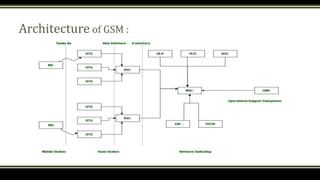
Architecture of GSM :
Continue…
MS(Mobile Station) – In mobile station, we use wireless communication device that connects
to a cellular network and allow to communicate with each other.
BTS(Base Transceiver Station) – In BTS it is a fixed radio transceiver in a mobile network. It
connect mobile device to the network by sending and receiving signals.
BSC(Base Station Controller) – It basically control the BTS.
MSC(Mobile Switching Center) – It is of a network switching subsystem(call
setup,release,routing…).
HLR(Home Location Register) – It is a database that contains information about mobile
subscribers.
VLR(Visitor Location Register) – It is a database that stores information about mobile station.
AUS(Authentication center) – It is responsible for authenticating and validating the identity.
EIR(Equipment Identity Register) – It is a database that stores list of IMEI numbers.
PSTN(Public Switched Telephone Network) – It is a telecommunication network that allows
people to communicate by voice in different locations.
Working principle of whole system :-
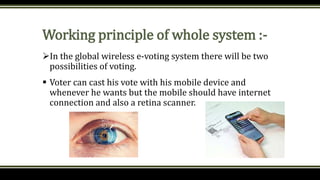
In the global wireless e-voting system there will be two
possibilities of voting.
 Voter can cast his vote with his mobile device and
whenever he wants but the mobile should have internet
connection and also a retina scanner.
Block diagram of e-voting :-
 Coming to the another process voter has go to the voting booth to
cast his vote , some of the voters won’t have mobile device. To help
those people to cast their votes,we go for this process.
• First voter scan his retina pattern with the help of retina scanner.
• If scanning confirmed , voting machine turned on
• Then machine allow to cast their vote .
• Once casting confirmed ,the total information together with the
scanned retina pattern and the vote sent to the interfacing device .
• Once the details are authenticated and if it found valid then a positive
acknowledgement is send to the voter, and the vote is counted.
Applications of e-voting :-
Enhanced Sequrity :- With the use of advanced
encryption and authentication technologies, global
wireless e-voting can provide a high level sequrity for
electronic voting system.
Faster results :- It can speed up the vote counting
process,reducing the time it takes to declare the results
of an election.
Improved Accessibility :- E-voting can make the voting
process more accessible to individuals with disabilities. It
can provides screen readers, which can help blind or
visually impaired to cast their vote.
ADVANTAGES OF E-VOTING :-
Faster vote count and tabulation.
More accurate results as human error excluded.
Increased convenience for voters.
Increased accessbility.
Cost saving.
Disadvantages of e-voting
Lack of transparency.
Possibility of fraud through largescale manipulation by a small
group of insiders.
Limited recount possibilities.
Possible lack of public trust in e-voting based elections.
Risk of manipulation by insiders with privileged access to the
system or by hackers .
ANY QUESTION ??
THANK
YOU

Global Wireless e-voting ..pptx

  • 1.
    Presented By: Under theguidance of : Alekhamani Mohanty Mr Sashi Bhusan Parida Branch : CST(A) Regd. No : 2101289270 Global Wireless e-voting Department of computer science & Techonology
  • 2.
    Contents :-  Introduction What is Global Wireless e-voting  Present system  Proposed system  Architecture of GSM  Working principle of whole system  Applications  Advantages  Disadvantages
  • 3.
    Introduction… In India votingis an important part of democracy.Voting system is the vital process in India. So to make it efficient and secured in the vision of modern technology we are using “Global Wireless e-voting”. Global wireless e-voting system provides candidate to vote online. The aim of the project is to integrate an electronic voting scheme by using eye retina scanner. Here the machine is intelligent enough to recognise if the candidate is eligible for voting or not.
  • 4.
    What is Globalwireless e-voting ? ▪ “Global Wireless E-Voting” machine we can determine the eligibility of the voter by scanning the retina pattern. ▪ Vote count is made to be stored in a remote server by converting them into radio waves. ▪ Hence there won’t be any scope of corruption in the vote count. ▪ Even machine fails; there won’t be any problem to the vote are casted as they are saved in the server.
  • 5.
    Present system:- In apresent system each and every section is a given a electronic machine which stores the vote of people. control of present system is given to the in-charge officer . If eligible , then allow to voting. Finally we collect all the voting machine at a place and go for counting. Disadvantages of present system :- After voting if any technical problems or damages created by machines it may leads to reelection. The machine is not able to recognize the eligibility of a candidate. This system is not a cost effective one. Since we need sequrity, in charge officers, sequred place for counting and election place.
  • 6.
    Proposed System :- Inour system we trying to keep counting of votes into a remote secured system. In this system we are using a electronic circuit which enable the voter to vote and transfer this vote to the remote system by converting it to radio wave through the mobile tower. Corruption is eliminated by using this process. Here we need not to go for the re-election. We can vote from anywhere even through being an voter of another region. Cost is reduced as we don’t need transportation and sequrity.
  • 7.
  • 8.
    Continue… MS(Mobile Station) –In mobile station, we use wireless communication device that connects to a cellular network and allow to communicate with each other. BTS(Base Transceiver Station) – In BTS it is a fixed radio transceiver in a mobile network. It connect mobile device to the network by sending and receiving signals. BSC(Base Station Controller) – It basically control the BTS. MSC(Mobile Switching Center) – It is of a network switching subsystem(call setup,release,routing…). HLR(Home Location Register) – It is a database that contains information about mobile subscribers. VLR(Visitor Location Register) – It is a database that stores information about mobile station. AUS(Authentication center) – It is responsible for authenticating and validating the identity. EIR(Equipment Identity Register) – It is a database that stores list of IMEI numbers. PSTN(Public Switched Telephone Network) – It is a telecommunication network that allows people to communicate by voice in different locations.
  • 9.
    Working principle ofwhole system :- In the global wireless e-voting system there will be two possibilities of voting.  Voter can cast his vote with his mobile device and whenever he wants but the mobile should have internet connection and also a retina scanner.
  • 10.
    Block diagram ofe-voting :-
  • 11.
     Coming tothe another process voter has go to the voting booth to cast his vote , some of the voters won’t have mobile device. To help those people to cast their votes,we go for this process. • First voter scan his retina pattern with the help of retina scanner. • If scanning confirmed , voting machine turned on • Then machine allow to cast their vote . • Once casting confirmed ,the total information together with the scanned retina pattern and the vote sent to the interfacing device . • Once the details are authenticated and if it found valid then a positive acknowledgement is send to the voter, and the vote is counted.
  • 12.
    Applications of e-voting:- Enhanced Sequrity :- With the use of advanced encryption and authentication technologies, global wireless e-voting can provide a high level sequrity for electronic voting system. Faster results :- It can speed up the vote counting process,reducing the time it takes to declare the results of an election. Improved Accessibility :- E-voting can make the voting process more accessible to individuals with disabilities. It can provides screen readers, which can help blind or visually impaired to cast their vote.
  • 13.
    ADVANTAGES OF E-VOTING:- Faster vote count and tabulation. More accurate results as human error excluded. Increased convenience for voters. Increased accessbility. Cost saving.
  • 14.
    Disadvantages of e-voting Lackof transparency. Possibility of fraud through largescale manipulation by a small group of insiders. Limited recount possibilities. Possible lack of public trust in e-voting based elections. Risk of manipulation by insiders with privileged access to the system or by hackers .
  • 15.
  • 16.