BY
JESSI JENIFER
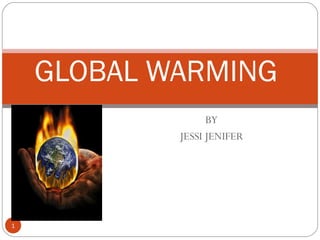
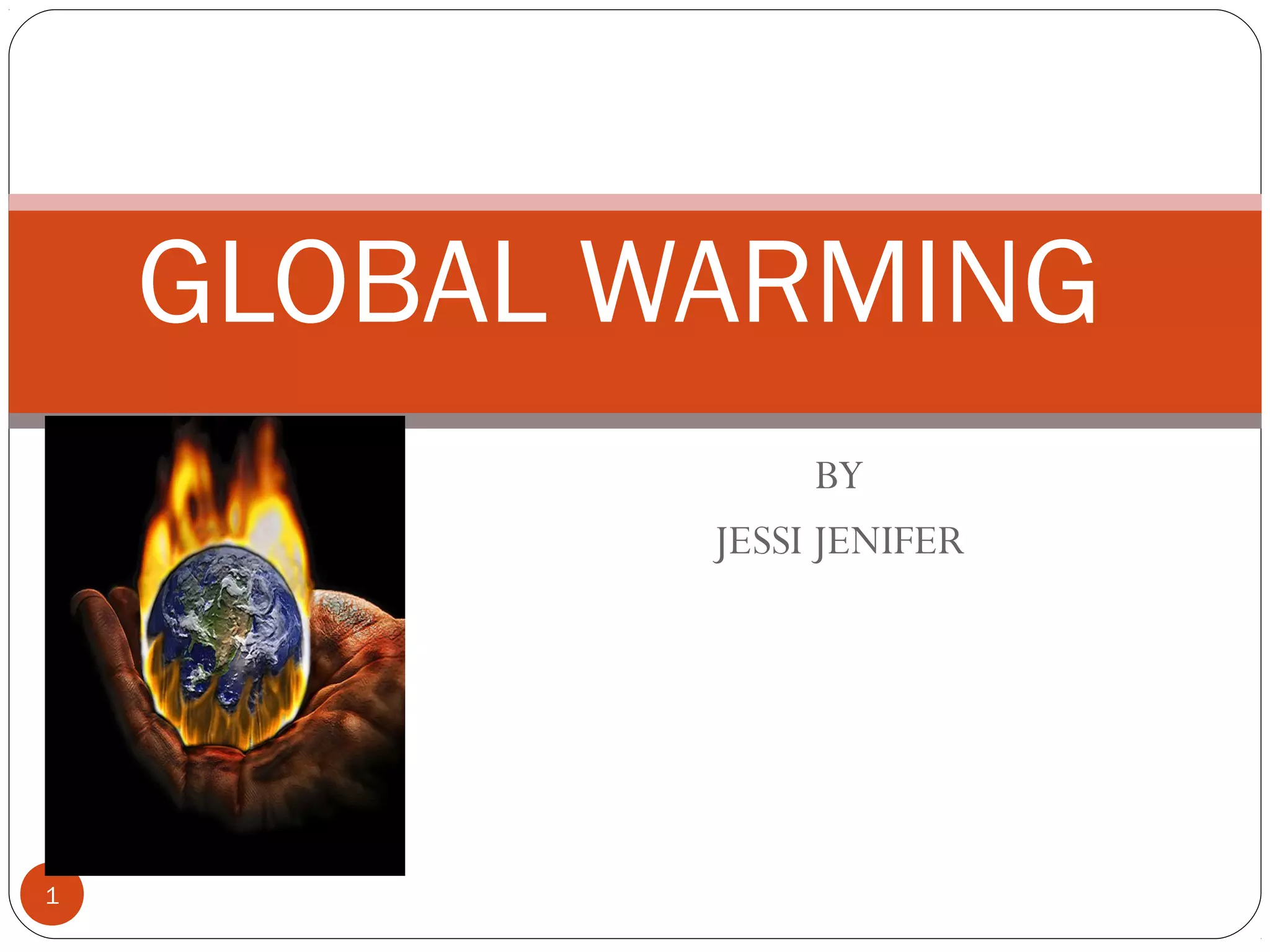
GLOBAL WARMING
1
Global Warming
2
GLOBAL WARMING
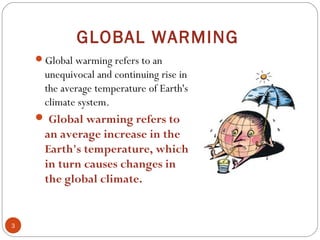
Global warming refers to an
unequivocal and continuing rise in
the average temperature of Earth's
climate system.
 Global warming refers to
an average increase in the
Earth's temperature, which
in turn causes changes in
the global climate.
3
Green House Gases
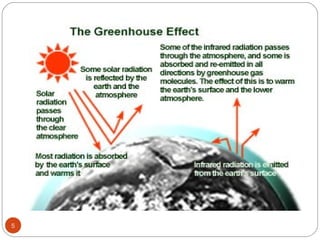
Many chemical compounds found in the Earth’s atmosphere
act as “greenhouse gases.” These gases allow sunlight, which
is radiated in the visible and ultraviolet spectra, to enter the
atmosphere unimpeded. When it strikes the Earth’s surface,
some of the sunlight is reflected as infrared radiation (heat).
Greenhouse gases tend to absorb this infrared radiation as it
is reflected back towards space, trapping the heat in the
atmosphere.
Carbon dioxide is without doubt the most well known greenhouse
gas,primarily through burning fossil fuels.
4
5
6
GHG Emissions Increase
Since pre-industrial times atmospheric concentrations of CO2,
CH4 and N2O have climbed by over 31%, 15% and 17%,
respectively.
Scientists have confirmed this is primarily due to human activity.
Carbon dioxide
combustion of solid waste, fossil fuels (oil, natural gas,
and coal), and wood and wood products
Methane :
production and transport of coal, natural gas, and oil.
Methane emissions also result from the decomposition of
organic wastes in municipal solid waste landfills, and the
raising of livestock.7
Nitrous oxide
 agricultural and industrial activities, as well as during
combustion of solid waste and fossil fuels.
 hydrofluorocarbons (HFCs), perfluorocarbons (PFCs), and
sulfur hexafluoride (SF6).
 The average house is responsible for more air pollution
and carbon dioxide emissions than is the average car.
8
Effects Of Global Warming
In South Asia
The effects of global warming on the
Indian subcontinent vary from the
submergence of low-lying islands and
coastal lands to the melting of glaciers in
the Indian Himalayas, threatening the
volumetric flow rate of many of the most
important rivers of India and South Asia.
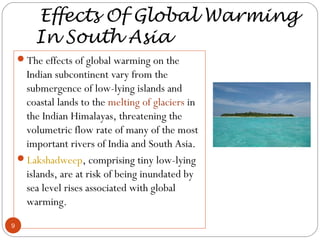
Lakshadweep, comprising tiny low-lying
islands, are at risk of being inundated by
sea level rises associated with global
warming.
9
Methane emission
from rice fields :
Methanogenesis, the process
responsible for methane
formation, occurs in all anaerobic
environments in which organic
matter undergoes
decomposition.
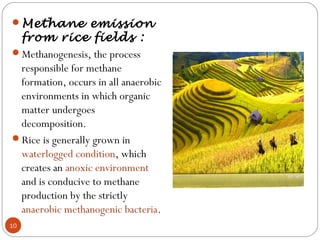
Rice is generally grown in
waterlogged condition, which
creates an anoxic environment
and is conducive to methane
production by the strictly
anaerobic methanogenic bacteria.
10
EFFECTS :-
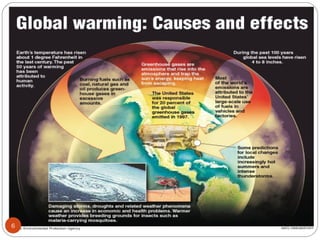
The effects of global warming are the ecological and social
changes caused (directly or indirectly) by human emissions of
greenhouse gases.
Hurricanes and other storms are likely to become stronger.
Floods and droughts will become more common.
Some diseases will spread, such as malaria carried by
mosquitoes.
Ecosystems will change—some species will move farther .
11
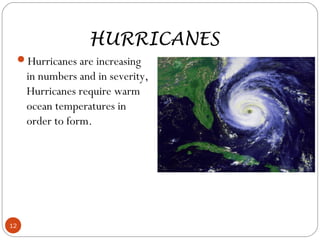
HURRICANES
Hurricanes are increasing
in numbers and in severity,
Hurricanes require warm
ocean temperatures in
order to form.
12
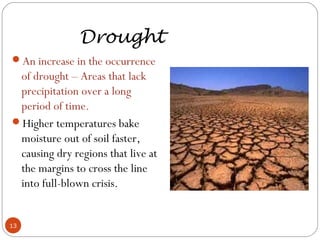
Drought
An increase in the occurrence
of drought – Areas that lack
precipitation over a long
period of time.
Higher temperatures bake
moisture out of soil faster,
causing dry regions that live at
the margins to cross the line
into full-blown crisis.
13
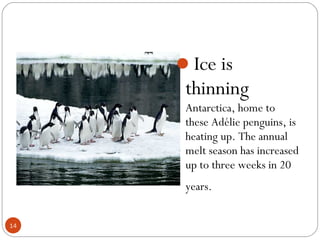
Ice is
thinning
Antarctica, home to
these Adélie penguins, is
heating up. The annual
melt season has increased
up to three weeks in 20
years.
14
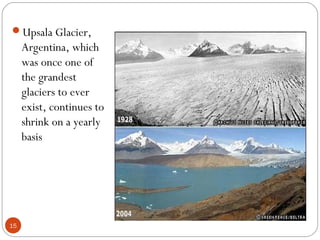
Upsala Glacier,
Argentina, which
was once one of
the grandest
glaciers to ever
exist, continues to
shrink on a yearly
basis
15
Prevention
 Promotion of Measures to Reduce CO2 Emissions
that Measures Related to Energy Supply and
Demand.
Strengthening Energy Efficiency Standards of Housing
and Buildings :  The standards should target a 20%
reduction in energy consumption for heating and cooling for
housing and a 10% reduction for other buildings.
s Financial incentives should be offered for energy efficient
housing and buildings
16
Stop Deforestation
Because trees also take carbon dioxide from the air, cutting down
large numbers of trees causes carbon dioxide levels to rise even
further. 
Promotion of Energy Supply Side Measures to Reduce
CO2 Emissions :
 Promoting Construction of Nuclear Power Plants
Promoting Measures for Electrical Load Balancing
Promotion of Measures Involving CO2 Sinks Such as
Afforestation, etc.
17
 we must make the changes to our own lives that will
better benefit the environment and global warming as a
whole. Believe it or not, one person can make a
difference!
So what will you do
?
18
19
Top 10 Things You can
do to stop Global
Warming
10.Plant a couple of additional trees around your
home.CO2 reduction = 20 lbs/year
9.Use a push mower to cut your lawn instead of a power
mower.CO2 reduction = 80 lbs/year
8.Replace your home’s refrigerator with a high-
efficiency model.CO2 reduction = 220 lbs/year
7.Buy food or other products with reusable or recyclable
packaging instead of non-recyclable packaging.CO2
reduction=230 lbs/year
6.Replace your washing machine with a low-energy,
low-water-use machine.CO2 reduction = 440
lbs/year
20
5.  Install a solar thermal system to help provide your
hot water.CO2 reduction = 720 lbs/year
4.  Recycle all of your homes waste: newsprint,
cardboard, glass and metal.CO2 reduction = 850
lbs/year
3.Leave your car at home two days a week (walk, bike
or take public transportation to work instead).CO2
reduction = 1,590 lbs/year
2.  Insulate your home, tune up your furnace, and install
energy efficient shower heads.CO2 reductions =
2,480 lbs/year
1.Purchase a fuel efficient car (rated up to 32 mpg or
more) to replace your most frequently used
automobile. 
21
22

global warming

  • 1.
  • 2.
  • 3.
    GLOBAL WARMING Global warmingrefers to an unequivocal and continuing rise in the average temperature of Earth's climate system.  Global warming refers to an average increase in the Earth's temperature, which in turn causes changes in the global climate. 3
  • 4.
    Green House Gases Manychemical compounds found in the Earth’s atmosphere act as “greenhouse gases.” These gases allow sunlight, which is radiated in the visible and ultraviolet spectra, to enter the atmosphere unimpeded. When it strikes the Earth’s surface, some of the sunlight is reflected as infrared radiation (heat). Greenhouse gases tend to absorb this infrared radiation as it is reflected back towards space, trapping the heat in the atmosphere. Carbon dioxide is without doubt the most well known greenhouse gas,primarily through burning fossil fuels. 4
  • 5.
  • 6.
  • 7.
    GHG Emissions Increase Sincepre-industrial times atmospheric concentrations of CO2, CH4 and N2O have climbed by over 31%, 15% and 17%, respectively. Scientists have confirmed this is primarily due to human activity. Carbon dioxide combustion of solid waste, fossil fuels (oil, natural gas, and coal), and wood and wood products Methane : production and transport of coal, natural gas, and oil. Methane emissions also result from the decomposition of organic wastes in municipal solid waste landfills, and the raising of livestock.7
  • 8.
    Nitrous oxide  agriculturaland industrial activities, as well as during combustion of solid waste and fossil fuels.  hydrofluorocarbons (HFCs), perfluorocarbons (PFCs), and sulfur hexafluoride (SF6).  The average house is responsible for more air pollution and carbon dioxide emissions than is the average car. 8
  • 9.
    Effects Of GlobalWarming In South Asia The effects of global warming on the Indian subcontinent vary from the submergence of low-lying islands and coastal lands to the melting of glaciers in the Indian Himalayas, threatening the volumetric flow rate of many of the most important rivers of India and South Asia. Lakshadweep, comprising tiny low-lying islands, are at risk of being inundated by sea level rises associated with global warming. 9
  • 10.
    Methane emission from ricefields : Methanogenesis, the process responsible for methane formation, occurs in all anaerobic environments in which organic matter undergoes decomposition. Rice is generally grown in waterlogged condition, which creates an anoxic environment and is conducive to methane production by the strictly anaerobic methanogenic bacteria. 10
  • 11.
    EFFECTS :- The effectsof global warming are the ecological and social changes caused (directly or indirectly) by human emissions of greenhouse gases. Hurricanes and other storms are likely to become stronger. Floods and droughts will become more common. Some diseases will spread, such as malaria carried by mosquitoes. Ecosystems will change—some species will move farther . 11
  • 12.
    HURRICANES Hurricanes are increasing innumbers and in severity, Hurricanes require warm ocean temperatures in order to form. 12
  • 13.
    Drought An increase inthe occurrence of drought – Areas that lack precipitation over a long period of time. Higher temperatures bake moisture out of soil faster, causing dry regions that live at the margins to cross the line into full-blown crisis. 13
  • 14.
    Ice is thinning Antarctica, hometo these Adélie penguins, is heating up. The annual melt season has increased up to three weeks in 20 years. 14
  • 15.
    Upsala Glacier, Argentina, which wasonce one of the grandest glaciers to ever exist, continues to shrink on a yearly basis 15
  • 16.
    Prevention  Promotion of Measuresto Reduce CO2 Emissions that Measures Related to Energy Supply and Demand. Strengthening Energy Efficiency Standards of Housing and Buildings :  The standards should target a 20% reduction in energy consumption for heating and cooling for housing and a 10% reduction for other buildings. s Financial incentives should be offered for energy efficient housing and buildings 16
  • 17.
    Stop Deforestation Because treesalso take carbon dioxide from the air, cutting down large numbers of trees causes carbon dioxide levels to rise even further.  Promotion of Energy Supply Side Measures to Reduce CO2 Emissions :  Promoting Construction of Nuclear Power Plants Promoting Measures for Electrical Load Balancing Promotion of Measures Involving CO2 Sinks Such as Afforestation, etc. 17
  • 18.
     we mustmake the changes to our own lives that will better benefit the environment and global warming as a whole. Believe it or not, one person can make a difference! So what will you do ? 18
  • 19.
  • 20.
    Top 10 ThingsYou can do to stop Global Warming 10.Plant a couple of additional trees around your home.CO2 reduction = 20 lbs/year 9.Use a push mower to cut your lawn instead of a power mower.CO2 reduction = 80 lbs/year 8.Replace your home’s refrigerator with a high- efficiency model.CO2 reduction = 220 lbs/year 7.Buy food or other products with reusable or recyclable packaging instead of non-recyclable packaging.CO2 reduction=230 lbs/year 6.Replace your washing machine with a low-energy, low-water-use machine.CO2 reduction = 440 lbs/year 20
  • 21.
    5.  Install asolar thermal system to help provide your hot water.CO2 reduction = 720 lbs/year 4.  Recycle all of your homes waste: newsprint, cardboard, glass and metal.CO2 reduction = 850 lbs/year 3.Leave your car at home two days a week (walk, bike or take public transportation to work instead).CO2 reduction = 1,590 lbs/year 2.  Insulate your home, tune up your furnace, and install energy efficient shower heads.CO2 reductions = 2,480 lbs/year 1.Purchase a fuel efficient car (rated up to 32 mpg or more) to replace your most frequently used automobile.  21
  • 22.