Attract, recruit & empower quality candidates with 2015 insights
from one of the world’s largest studies of recent job changers
Why read this report
Candidates are more open to your jobs now
than in the past 5 years yet it’s still hard to get
their attention. To help you cut through the
clutter & appeal to people’s deepest motives
for changing jobs, we asked 10.5K+ LinkedIn
members why they switched. We discovered a
wealth of information to help you:
1. Attract: Persuade with the right messages
2. Recruit: Prioritize the right sources of hire
3. Empower: Retain those who would’ve
stayed
Learn more job changer insights inside.
Why & How People Change Jobs 3
5 findings about why & how people change jobs
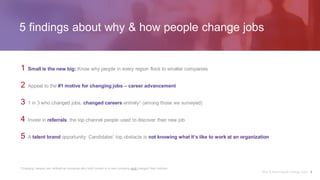
1 Small is the new big: Know why people in every region flock to smaller companies
2 Appeal to the #1 motive for changing jobs – career advancement
3 1 in 3 who changed jobs, changed careers entirely1 (among those we surveyed)
4 Invest in referrals, the top channel people used to discover their new job
5 A talent brand opportunity: Candidates’ top obstacle is not knowing what it’s like to work at an organization
1Changing careers are defined as someone who both moved to a new company and changed their function
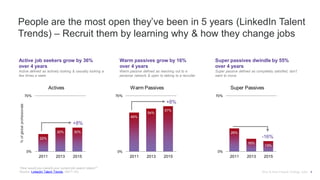
People are the most open they’ve been in 5 years (LinkedIn Talent
Trends) – Recruit them by learning why & how they change jobs
“How would you classify your current job search status?”
Source: LinkedIn Talent Trends, (2011-15).
Active job seekers grow by 36%
over 4 years
Active defined as actively looking & casually looking a
few times a week
22%
30% 30%
0%
70%
2011 2013 2015
Actives
%ofglobalprofessionals
49%
54%
57%
0%
70%
2011 2013 2015
Warm Passives
Warm passives grow by 16%
over 4 years
Warm passive defined as reaching out to a
personal network & open to talking to a recruiter
+8%
+8%
Super passives dwindle by 55%
over 4 years
Super passive defined as completely satisfied; don’t
want to move
29%
16%
13%
0%
70%
2011 2013 2015
Super Passives
-16%
Why & How People Change Jobs 4
We analyzed the job changing behaviors of
millions of LinkedIn members and here’s
what we found:
 Small is the new big: Know why people in
every region flock to smaller companies
1 Who changed
jobs & where
they went
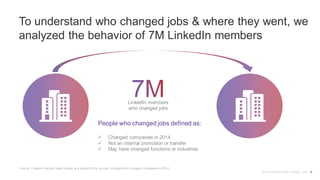
To understand who changed jobs & where they went, we
analyzed the behavior of 7M LinkedIn members
Why & How People Change Jobs 6
Source: LinkedIn member data looking at a subset of the number of people who changed companies in 2014.
People who changed jobs defined as:
 Changed companies in 2014
 Not an internal promotion or transfer
 May have changed functions or industries
LinkedIn members
who changed jobs
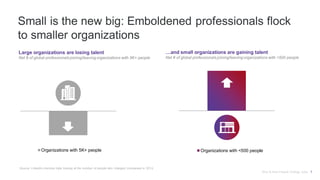
Small is the new big: Emboldened professionals flock
to smaller organizations
Source: LinkedIn member data looking at the number of people who changed companies in 2014.
Large organizations are losing talent
Net # of global professionals joining/leaving organizations with 5K+ people
…and small organizations are gaining talent
Net # of global professionals joining/leaving organizations with <500 people
Why & How People Change Jobs 7
Organizations with <500 peopleOrganizations with 5K+ people
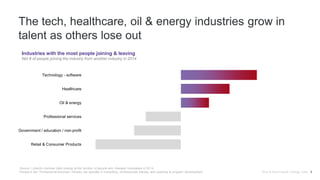
The tech, healthcare, oil & energy industries grow in
talent as others lose out
Industries with the most people joining & leaving
Net # of people joining the industry from another industry in 2014
Technology - software
Healthcare
Oil & energy
Professional services
Government / education / non-profit
Retail & Consumer Products
Source: LinkedIn member data looking at the number of people who changed companies in 2014.
People in the “Professional Services” industry are typically in consulting, professionals training and coaching & program development. Why & How People Change Jobs 8
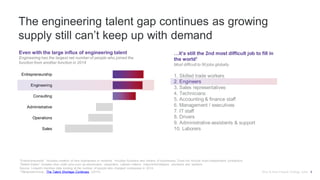
The engineering talent gap continues as growing
supply still can’t keep up with demand
“Entrepreneurship” includes creation of new businesses or ventures. Includes founders and owners of businesses. Does not include most independent contractors.
“Skilled trades” includes blue collar jobs such as electricians, carpenters, cabinet makers, masons/bricklayers, plumbers and welders.
Source: LinkedIn member data looking at the number of people who changed companies in 2014.
1 ManpowerGroup, The Talent Shortage Continues, (2014).
…it’s still the 2nd most difficult job to fill in
the world1
Most difficult to fill jobs globally
1. Skilled trade workers
2. Engineers
3. Sales representatives
4. Technicians
5. Accounting & finance staff
6. Management / executives
7. IT staff
8. Drivers
9. Administrative assistants & support
10. Laborers
Even with the large influx of engineering talent
Engineering has the largest net number of people who joined the
function from another function in 2014
Entrepreneurship
Engineering
Consulting
Administrative
Operations
Sales
Why & How People Change Jobs 9
3 tips to tailor your recruiting strategy to who changed
jobs & where they went in 2015
1 Infuse your employer value proposition with small organization traits: In every part of the world, people are flocking to
smaller organizations. Recruit entrepreneurially-minded professionals by appealing to what attracts people to small
organizations (next chapter).
2 Play hardball for engineering talent: Engineering talent surges but not enough to fill demand. Know the functions and
skills you’re recruiting for cold, use data and smart Boolean search tactics to uncover hidden pools of STEM talent, rally your
employees to refer their STEM contacts, and train your recruiters to be best-in-class at networking for referrals.
3 Know your talent pool & uncover hidden gems: Know how many people are in your target talent pool by using essential
job criteria to search for them. To uncover hidden talent pools, use Search Insights in LinkedIn Recruiter to view your talent pool
by company, school, location, skills, and more.
Why & How People Change Jobs 10
2 Why people
change jobs
We asked 10.5K people why they changed
jobs and here’s what we found:
 Appeal to the #1 motive for changing jobs –
career opportunity
 1 in 3 who changed jobs, changed careers
entirely
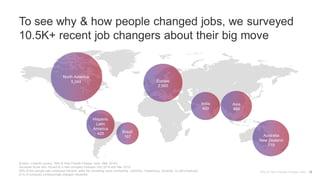
To see why & how people changed jobs, we surveyed
10.5K+ recent job changers about their big move
North America
5,344
Brazil
167
Europe
2,993
India
400
Asia
484
Australia
New Zealand
719
Hispanic
Latin
America
425
Why & How People Change Jobs 12
Source: LinkedIn survey, Why & How People Change Jobs, (Mar 2015).
Surveyed those who moved to a new company between Dec 2014 and Mar 2015.
90% of the sample was employed full-time while the remaining were contracting, part-time, freelancing, students, or self employed.
51% of surveyed professionals changed industries.
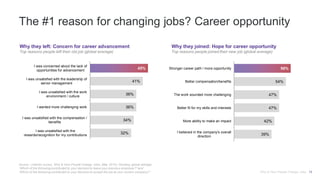
The #1 reason for changing jobs? Career opportunity
Source: LinkedIn survey, Why & How People Change Jobs, (Mar 2015). Showing global average.
“Which of the following contributed to your decision to leave your previous employer?” and
“Which of the following contributed to your decision to accept the job at your current company?”
Why they left: Concern for career advancement
Top reasons people left their old job (global average)
Why they joined: Hope for career opportunity
Top reasons people joined their new job (global average)
45%
41%
36%
36%
34%
32%
I was concerned about the lack of
opportunities for advancement
I was unsatisfied with the leadership of
senior management
I was unsatisfied with the work
environment / culture
I wanted more challenging work
I was unsatisfied with the compensation /
benefits
I was unsatisfied with the
rewards/recognition for my contributions
59%
54%
47%
47%
42%
39%
Stronger career path / more opportunity
Better compensation/benefits
The work sounded more challenging
Better fit for my skills and interests
More ability to make an impact
I believed in the company's overall
direction
Why & How People Change Jobs 13
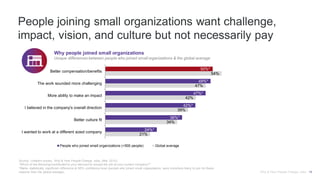
People joining small organizations want challenge,
impact, vision, and culture but not necessarily pay
21%
34%
39%
42%
47%
54%
24%*
36%*
42%*
47%*
49%*
50%*
I wanted to work at a different sized company
Better culture fit
I believed in the company's overall direction
More ability to make an impact
The work sounded more challenging
Better compensation/benefits
People who joined small organizations (<500 people) Global average
Why people joined small organizations
Unique differences between people who joined small organizations & the global average
Source: LinkedIn survey, Why & How People Change Jobs, (Mar 2015).
“Which of the following contributed to your decision to accept the job at your current company?”
*Marks statistically significant difference at 95% confidence level (people who joined small organizations were more/less likely to join for these
reasons than the global average). Why & How People Change Jobs 14
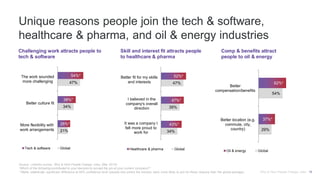
Unique reasons people join the tech & software,
healthcare & pharma, and oil & energy industries
Challenging work attracts people to
tech & software
21%
34%
47%
26%*
38%*
54%*
More flexibility with
work arrangements
Better culture fit
The work sounded
more challenging
Tech & software Global
34%
39%
47%
43%*
47%*
52%*
It was a company I
felt more proud to
work for
I believed in the
company's overall
direction
Better fit for my skills
and interests
Healthcare & pharma Global
29%
54%
37%*
62%*
Better location (e.g.
commute, city,
country)
Better
compensation/benefits
Oil & energy Global
Skill and interest fit attracts people
to healthcare & pharma
Comp & benefits attract
people to oil & energy
Source: LinkedIn survey, Why & How People Change Jobs, (Mar 2015).
“Which of the following contributed to your decision to accept the job at your current company?”
* Marks statistically significant difference at 95% confidence level (people who joined the industry were more likely to join for these reasons than the global average). Why & How People Change Jobs 15
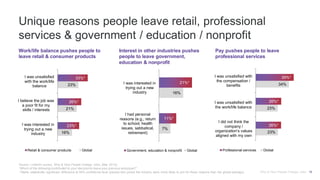
Unique reasons people leave retail, professional
services & government / education / nonprofit
Work/life balance pushes people to
leave retail & consumer products
Pay pushes people to leave
professional services
Interest in other industries pushes
people to leave government,
education & nonprofit
16%
21%
23%
23%*
26%*
33%*
I was interested in
trying out a new
industry
I believe the job was
a poor fit for my
skills / interests
I was unsatisfied
with the work/life
balance
Retail & consumer products Global
23%
23%
34%
26%*
26%*
39%*
I did not think the
company /
organization's values
aligned with my own
I was unsatisfied with
the work/life balance
I was unsatisfied with
the compensation /
benefits
Professional services Global
7%
16%
11%*
21%*
I had personal
reasons (e.g., return
to school, health
issues, sabbatical,
retirement)
I was interested in
trying out a new
industry
Government, education & nonprofit Global
Source: LinkedIn survey, Why & How People Change Jobs, (Mar 2015).
“Which of the following contributed to your decision to leave your previous employer?”
* Marks statistically significant difference at 95% confidence level (people who joined the industry were more likely to join for these reasons than the global average). Why & How People Change Jobs 16
25%
23%
22%
50%BC
35%BC
Source: LinkedIn survey, Why & How People Change Jobs, (Mar 2015).
“Which of the following contributed to your decision to leave your previous employer?”
ABC Marks statistically significant difference at 95% confidence level (people in one generation was were more/less likely to cite these reasons than other generations).
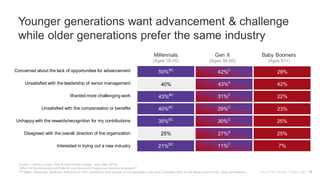
Younger generations want advancement & challenge
while older generations prefer the same industry
Why & How People Change Jobs 17
Concerned about the lack of opportunities for advancement
Unsatisfied with the leadership of senior management
Wanted more challenging work
Unsatisfied with the compensation or benefits
Unhappy with the rewards/recognition for my contributions
Disagreed with the overall direction of the organization
Interested in trying out a new industry
Millennials
(Ages 18-35)
Gen X
(Ages 36-50)
Baby Boomers
(Ages 51+)
43%BC
42%C
28%
43%A
42%40%
31%C
40%BC
29%C
7%
27%A
25%
30%C
25%
21%BC
11%C
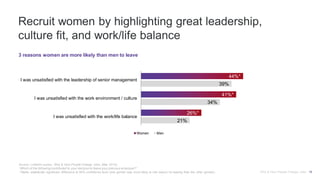
Recruit women by highlighting great leadership,
culture fit, and work/life balance
Source: LinkedIn survey, Why & How People Change Jobs, (Mar 2015).
“Which of the following contributed to your decision to leave your previous employer?”
* Marks statistically significant difference at 95% confidence level (one gender was more likely to cite reason for leaving than the other gender).
3 reasons women are more likely than men to leave
21%
34%
39%
26%*
41%*
44%*
I was unsatisfied with the work/life balance
I was unsatisfied with the work environment / culture
I was unsatisfied with the leadership of senior management
Women Men
Why & How People Change Jobs 18
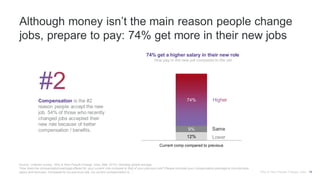
Although money isn’t the main reason people change
jobs, prepare to pay: 74% get more in their new jobs
Source: LinkedIn survey, Why & How People Change Jobs, (Mar 2015). Showing global average.
“How does the compensation package offered for your current role compare to that of your previous role? Please consider your compensation package to include base
salary and bonuses. Compared to my previous role, my current compensation is…”
Compensation is the #2
reason people accept the new
job. 54% of those who recently
changed jobs accepted their
new role because of better
compensation / benefits.
74% get a higher salary in their new role
How pay in the new job compares to the old
12%
9%
74%
Current comp compared to previous
Same
Lower
Why & How People Change Jobs 19
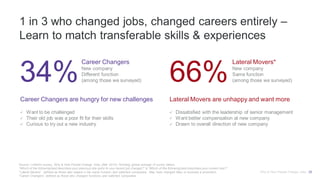
1 in 3 who changed jobs, changed careers entirely –
Learn to match transferable skills & experiences
Source: LinkedIn survey, Why & How People Change Jobs, (Mar 2015). Showing global average of survey takers.
“Which of the following best describes your previous role (prior to your recent job change)?” & “Which of the following best describes your current role?”
“Lateral Movers” defined as those who stayed in the same function and switched companies. May have changed titles or received a promotion.
“Career Changers” defined as those who changed functions and switched companies.
Career Changers
New company
Different function
(among those we surveyed)
Lateral Movers*
New company
Same function
(among those we surveyed)66%34%
Lateral Movers are unhappy and want more
 Dissatisfied with the leadership of senior management
 Want better compensation at new company
 Drawn to overall direction of new company
Career Changers are hungry for new challenges
 Want to be challenged
 Their old job was a poor fit for their skills
 Curious to try out a new industry
Why & How People Change Jobs 20
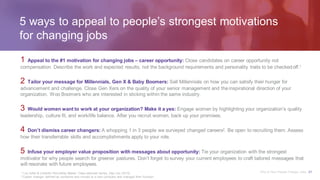
5 ways to appeal to people’s strongest motivations
for changing jobs
1 Appeal to the #1 motivation for changing jobs – career opportunity: Close candidates on career opportunity not
compensation. Describe the work and expected results, not the background requirements and personality traits to be checkedoff.1
2 Tailor your message for Millennials, Gen X & Baby Boomers: Sell Millennials on how you can satisfy their hunger for
advancement and challenge. Close Gen Xers on the quality of your senior management and the inspirational direction of your
organization. Woo Boomers who are interested in sticking within the same industry.
3 Would women want to work at your organization? Make it a yes: Engage women by highlighting your organization’s quality
leadership, culture fit, and work/life balance. After you recruit women, back up your promises.
4 Don’t dismiss career changers: A whopping 1 in 3 people we surveyed changed careers2. Be open to recruiting them. Assess
how their transferrable skills and accomplishments apply to your role.
5 Infuse your employer value proposition with messages about opportunity: Tie your organization with the strongest
motivator for why people search for greener pastures. Don’t forget to survey your current employees to craft tailored messages that
will resonate with future employees.
Why & How People Change Jobs 211 Lou Adler & LinkedIn Recruiting Master Class webcast series, (Apr-Jun 2015).
2 Career changer defined as someone who moved to a new company and changed their function.
3 How people
change jobs
We asked 10.5K people how they changed
jobs and here’s what we found:
 Invest in referrals, the top channel people
first hear about the new job
 Showcase your talent brand: Candidates’
top obstacle is not knowing what it’s like to
work at an organization
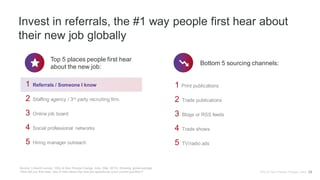
Invest in referrals, the #1 way people first hear about
their new job globally
Source: LinkedIn survey, Why & How People Change Jobs, (Mar 2015). Showing global average
“How did you first read, see or hear about the new job opportunity (your current position)?”
1 Print publications
2 Trade publications
3 Blogs or RSS feeds
4 Trade shows
5 TV/radio ads
1 Referrals / Someone I know
2 Staffing agency / 3rd party recruiting firm
3 Online job board
4 Social professional networks
5 Hiring manager outreach
Why & How People Change Jobs 23
Top 5 places people first hear
about the new job:
Bottom 5 sourcing channels:
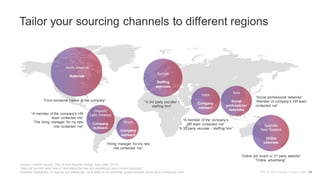
Source: LinkedIn survey, Why & How People Change Jobs, (Mar 2015).
“How did you first read, see or hear about the new job opportunity (your current position)”
Channels highlighted for regions are statistically more likely to be used than global average at the 90% confidence level.
North America
Referrals
Brazil
Company
outreach
Europe
Staffing
agencies
India
Company
outreach
Asia
Social
professional
networks
Australia
New Zealand
Online
channels
Hispanic
Latin America
Company
outreach
Tailor your sourcing channels to different regions
“From someone I knew at the company”
“A member of the company's HR
team contacted me”
“The hiring manager for my new
role contacted me”
“A 3rd party recruiter /
staffing firm”
“Social professional networks”
“Member of company’s HR team
contacted me”
“Online job board or 3rd party website”
“Online advertising”
“A member of the company’s
HR team contacted me”
“A 3rd party recruiter / staffing firm”
Why & How People Change Jobs 24
“Hiring manager for my new
role contacted me”
Millennials
(Ages 18-35)
Gen X
(Ages 36-50)
Baby Boomers
(Ages 51+)
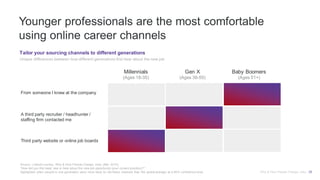
Younger professionals are the most comfortable
using online career channels
Tailor your sourcing channels to different generations
Unique differences between how different generations first hear about the new job
Source: LinkedIn survey, Why & How People Change Jobs, (Mar 2015).
“How did you first read, see or hear about the new job opportunity (your current position)?”
Highlighted when people in one generation were more likely to cite these channels than the global average at a 90% confidence level.
From someone I knew at the company
A third party recruiter / headhunter /
staffing firm contacted me
Third party website or online job boards
Why & How People Change Jobs 25
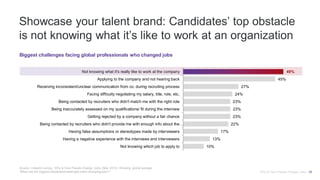
Showcase your talent brand: Candidates’ top obstacle
is not knowing what it’s like to work at an organization
Source: LinkedIn survey, Why & How People Change Jobs, (Mar 2015). Showing global average.
“What are the biggest obstacles/challenges when changing jobs?”
Biggest challenges facing global professionals who changed jobs
49%
45%
27%
24%
23%
23%
23%
22%
17%
13%
10%
Not knowing what it's really like to work at the company
Applying to the company and not hearing back
Receiving inconsistent/unclear communication from co. during recruiting process
Facing difficulty negotiating my salary, title, role, etc.
Being contacted by recruiters who didn't match me with the right role
Being inaccurately assessed on my qualifications/ fit during the interview
Getting rejected by a company without a fair chance
Being contacted by recruiters who didn't provide me with enough info about the…
Having false assumptions or stereotypes made by interviewers
Having a negative experience with the interviews and interviewers
Not knowing which job to apply to
Why & How People Change Jobs 26
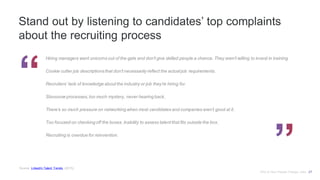
Stand out by listening to candidates’ top complaints
about the recruiting process
Hiring managers want unicorns out of the gate and don't give skilled people a chance. They aren't willing to invest in training.
Cookie cutter job descriptionsthat don't necessarily reflect the actual job requirements.
Recruiters’ lack of knowledge about the industry or job they’re hiring for.
Slooooow processes, too much mystery, never hearing back.
There’s so much pressure on networking when most candidates and companies aren’t good at it.
Too focused on checking off the boxes. Inability to assess talent that fits outside the box.
Recruiting is overdue for reinvention.
Source: LinkedIn Talent Trends, (2015).
Why & How People Change Jobs 27
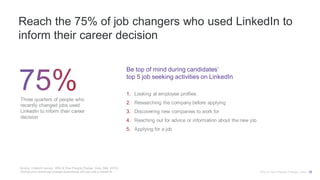
Reach the 75% of job changers who used LinkedIn to
inform their career decision
Source: LinkedIn survey, Why & How People Change Jobs, (Mar 2015).
“During your recent job change experience,did you use LinkedIn to…”
Three quarters of people who
recently changed jobs used
LinkedIn to inform their career
decision
Be top of mind during candidates’
top 5 job seeking activities on LinkedIn
1. Looking at employee profiles
2. Researching the company before applying
3. Discovering new companies to work for
4. Reaching out for advice or information about the new job
5. Applying for a job
Why & How People Change Jobs 28
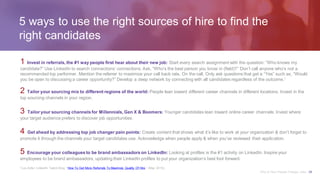
5 ways to use the right sources of hire to find the
right candidates
1 Invest in referrals, the #1 way people first hear about their new job: Start every search assignment with the question: “Who knows my
candidate?” Use LinkedIn to search connections’ connections. Ask, “Who’s the best person you know in (field)?” Don’t call anyone who’s not a
recommended top performer. Mention the referrer to maximize your call back rate. On the call, Only ask questions that get a “Yes” such as, “Would
you be open to discussing a career opportunity?” Develop a deep network by connecting with all candidates regardless of the outcome.1
2 Tailor your sourcing mix to different regions of the world: People lean toward different career channels in different locations. Invest in the
top sourcing channels in your region.
3 Tailor your sourcing channels for Millennials, Gen X & Boomers: Younger candidates lean toward online career channels. Invest where
your target audience prefers to discover job opportunities.
4 Get ahead by addressing top job changer pain points: Create content that shows what it’s like to work at your organization & don’t forget to
promote it through the channels your target candidates use. Acknowledge when people apply & when you’ve reviewed their application.
5 Encourage your colleagues to be brand ambassadors on LinkedIn: Looking at profiles is the #1 activity on LinkedIn. Inspire your
employees to be brand ambassadors, updating their LinkedIn profiles to put your organization’s best foot forward.
1 Lou Adler, LinkedIn Talent Blog, “How To Get More Referrals To Maximize Quality Of Hire,” (May 2015).
Why & How People Change Jobs 29
People are leaving their jobs in search of
better career opportunities. Yet recruiting
leaders still have a hard time getting quality
candidates to respond. Cut through the clutter
by showing how your jobs & talent brand
connect with people’s deepest career
aspirations. Reach out to them through
friends, family & former colleagues they trust.
Attract & recruit the 75% of job changers who
used LinkedIn to inform their career decision. If
you do that, you’ll transform their careers &
your own.
Offer career
growth, not jobs
Methodology
We analyzed the job changing behaviors of 7M LinkedIn members globally by looking at members who changed companies (i.e. members who departed one
company and moved to a different company) between January and December of 2014. Anyone who was promoted within their company or transferred to a
new team internally was not taken into account in this report.
To determine where people moved from / to by company size, industry and job function, we grouped members by their previous company size, previous
industry, and previous job title and separately their new current company size, industry, and job title. Once grouped, we com pared the overall previous and
current company size groups, industry groups, and function groups by net movement during 2014 to calculate net increases or decreases.
The results of this analysis represent the world as seen through the lens of LinkedIn data. As such, it is influenced by how members chose to use the site,
which can vary based on professional, social, and regional culture, as well as overall site availability and accessibility. These variances were not accounted
for in the analysis. Additionally, nationality and visa status are not fields included in the LinkedIn profile. Therefore, we cannot make any inferences on the
citizenship of our members who were included in this analysis.
We surveyed 10,536 people who changed companiesbetween Dec 2014 and Mar 2015, as self reported on their LinkedIn profiles and confirmed in the
survey. We invited LinkedIn members to participate in this survey through an e-mail invite sent by LinkedIn in March 2015. We offered the survey in English
only without incentives. We did not weight the data. The theoretical margin of error for this survey was +/- 1% at the 90% to 95% confidence interval and is
higher for sub-groups.
• European countries surveyed: United Kingdom, Netherlands, Ireland, Denmark, Sweden, Romania, Belgium, Germany, Italy, France, Greece,
Switzerland, Finland, Spain, Portugal, Israel, Poland, Turkey, Hungary, Norway, Czech Republic, Slovakia, Croatia, Ukraine, Russian Federation,
Bulgaria, Lithuania, Austria, Luxembourg, Latvia, Slovenia, Bosnia and Herzegovina, Cyprus, Estonia, Iceland, Georgia, Albania & Belarus.
• Asian countries surveyed: Singapore, Philippines, Indonesia, Malaysia, China (including Hong Kong & Taiwan), Japan, Sri Lanka, Bangladesh,
Thailand, Korea, Vietnam, Myanmar, Cambodia, Kazakhstan & Nepal.
• Latin American countries surveyed: Brazil, Mexico, Argentina, Colombia, Puerto Rico, Chile, Costa Rica, Peru, Trinidad and Tobago, Venezuela,
Dominican Republic, Ecuador, Uruguay, El Salvador, Guatemala, Bermuda, Bolivia, Bahamas, Honduras, Jamaica, Panama, Belize, Haiti, Nicaragua &
Suriname.
• ANZ includes Australia & New Zealand.
• North America includes Canada & the USA.
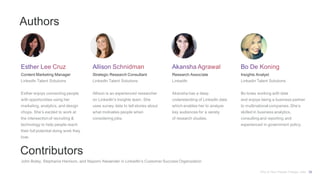
Authors
Content Marketing Manager
LinkedIn Talent Solutions
Esther enjoys connecting people
with opportunities using her
marketing, analytics, and design
chops. She’s excited to work at
the intersection of recruiting &
technology to help people reach
their full potential doing work they
love.
Strategic Research Consultant
LinkedIn Talent Solutions
Allison is an experienced researcher
on LinkedIn’s Insights team. She
uses survey data to tell stories about
what motivates people when
considering jobs.
Research Associate
LinkedIn
Akansha has a deep
understanding of LinkedIn data
which enables her to analyze
key audiences for a variety
of research studies.
Insights Analyst
Linkedin Talent Solutions
Bo loves working with data
and enjoys being a business partner
to multinational companies. She’s
skilled in business analytics,
consulting and reporting and
experienced in government policy.
Contributors
John Boley, Stephanie Harrison, and Nayomi Alexander in LinkedIn’s Customer Success Organization
Why & How People Change Jobs 32
Attract, recruit & empower the best people for your business with LinkedIn. Get access to quality candidates – active and passive,
external and internal – on the world’s largest professional network of 364M+ candidates. Hire better, faster with LinkedIn’s free and
paid social recruiting tools.
Learn more about our recruiting tools
Request free demo
©2015 LinkedIn Corporation. All Rights Reserved.
About LinkedIn Talent Solutions

Global report final

  • 1.
    Attract, recruit &empower quality candidates with 2015 insights from one of the world’s largest studies of recent job changers
  • 2.
    Why read thisreport Candidates are more open to your jobs now than in the past 5 years yet it’s still hard to get their attention. To help you cut through the clutter & appeal to people’s deepest motives for changing jobs, we asked 10.5K+ LinkedIn members why they switched. We discovered a wealth of information to help you: 1. Attract: Persuade with the right messages 2. Recruit: Prioritize the right sources of hire 3. Empower: Retain those who would’ve stayed Learn more job changer insights inside.
  • 3.
    Why & HowPeople Change Jobs 3 5 findings about why & how people change jobs 1 Small is the new big: Know why people in every region flock to smaller companies 2 Appeal to the #1 motive for changing jobs – career advancement 3 1 in 3 who changed jobs, changed careers entirely1 (among those we surveyed) 4 Invest in referrals, the top channel people used to discover their new job 5 A talent brand opportunity: Candidates’ top obstacle is not knowing what it’s like to work at an organization 1Changing careers are defined as someone who both moved to a new company and changed their function
  • 4.
    People are themost open they’ve been in 5 years (LinkedIn Talent Trends) – Recruit them by learning why & how they change jobs “How would you classify your current job search status?” Source: LinkedIn Talent Trends, (2011-15). Active job seekers grow by 36% over 4 years Active defined as actively looking & casually looking a few times a week 22% 30% 30% 0% 70% 2011 2013 2015 Actives %ofglobalprofessionals 49% 54% 57% 0% 70% 2011 2013 2015 Warm Passives Warm passives grow by 16% over 4 years Warm passive defined as reaching out to a personal network & open to talking to a recruiter +8% +8% Super passives dwindle by 55% over 4 years Super passive defined as completely satisfied; don’t want to move 29% 16% 13% 0% 70% 2011 2013 2015 Super Passives -16% Why & How People Change Jobs 4
  • 5.
    We analyzed thejob changing behaviors of millions of LinkedIn members and here’s what we found:  Small is the new big: Know why people in every region flock to smaller companies 1 Who changed jobs & where they went
  • 6.
    To understand whochanged jobs & where they went, we analyzed the behavior of 7M LinkedIn members Why & How People Change Jobs 6 Source: LinkedIn member data looking at a subset of the number of people who changed companies in 2014. People who changed jobs defined as:  Changed companies in 2014  Not an internal promotion or transfer  May have changed functions or industries LinkedIn members who changed jobs
  • 7.
    Small is thenew big: Emboldened professionals flock to smaller organizations Source: LinkedIn member data looking at the number of people who changed companies in 2014. Large organizations are losing talent Net # of global professionals joining/leaving organizations with 5K+ people …and small organizations are gaining talent Net # of global professionals joining/leaving organizations with <500 people Why & How People Change Jobs 7 Organizations with <500 peopleOrganizations with 5K+ people
  • 8.
    The tech, healthcare,oil & energy industries grow in talent as others lose out Industries with the most people joining & leaving Net # of people joining the industry from another industry in 2014 Technology - software Healthcare Oil & energy Professional services Government / education / non-profit Retail & Consumer Products Source: LinkedIn member data looking at the number of people who changed companies in 2014. People in the “Professional Services” industry are typically in consulting, professionals training and coaching & program development. Why & How People Change Jobs 8
  • 9.
    The engineering talentgap continues as growing supply still can’t keep up with demand “Entrepreneurship” includes creation of new businesses or ventures. Includes founders and owners of businesses. Does not include most independent contractors. “Skilled trades” includes blue collar jobs such as electricians, carpenters, cabinet makers, masons/bricklayers, plumbers and welders. Source: LinkedIn member data looking at the number of people who changed companies in 2014. 1 ManpowerGroup, The Talent Shortage Continues, (2014). …it’s still the 2nd most difficult job to fill in the world1 Most difficult to fill jobs globally 1. Skilled trade workers 2. Engineers 3. Sales representatives 4. Technicians 5. Accounting & finance staff 6. Management / executives 7. IT staff 8. Drivers 9. Administrative assistants & support 10. Laborers Even with the large influx of engineering talent Engineering has the largest net number of people who joined the function from another function in 2014 Entrepreneurship Engineering Consulting Administrative Operations Sales Why & How People Change Jobs 9
  • 10.
    3 tips totailor your recruiting strategy to who changed jobs & where they went in 2015 1 Infuse your employer value proposition with small organization traits: In every part of the world, people are flocking to smaller organizations. Recruit entrepreneurially-minded professionals by appealing to what attracts people to small organizations (next chapter). 2 Play hardball for engineering talent: Engineering talent surges but not enough to fill demand. Know the functions and skills you’re recruiting for cold, use data and smart Boolean search tactics to uncover hidden pools of STEM talent, rally your employees to refer their STEM contacts, and train your recruiters to be best-in-class at networking for referrals. 3 Know your talent pool & uncover hidden gems: Know how many people are in your target talent pool by using essential job criteria to search for them. To uncover hidden talent pools, use Search Insights in LinkedIn Recruiter to view your talent pool by company, school, location, skills, and more. Why & How People Change Jobs 10
  • 11.
    2 Why people changejobs We asked 10.5K people why they changed jobs and here’s what we found:  Appeal to the #1 motive for changing jobs – career opportunity  1 in 3 who changed jobs, changed careers entirely
  • 12.
    To see why& how people changed jobs, we surveyed 10.5K+ recent job changers about their big move North America 5,344 Brazil 167 Europe 2,993 India 400 Asia 484 Australia New Zealand 719 Hispanic Latin America 425 Why & How People Change Jobs 12 Source: LinkedIn survey, Why & How People Change Jobs, (Mar 2015). Surveyed those who moved to a new company between Dec 2014 and Mar 2015. 90% of the sample was employed full-time while the remaining were contracting, part-time, freelancing, students, or self employed. 51% of surveyed professionals changed industries.
  • 13.
    The #1 reasonfor changing jobs? Career opportunity Source: LinkedIn survey, Why & How People Change Jobs, (Mar 2015). Showing global average. “Which of the following contributed to your decision to leave your previous employer?” and “Which of the following contributed to your decision to accept the job at your current company?” Why they left: Concern for career advancement Top reasons people left their old job (global average) Why they joined: Hope for career opportunity Top reasons people joined their new job (global average) 45% 41% 36% 36% 34% 32% I was concerned about the lack of opportunities for advancement I was unsatisfied with the leadership of senior management I was unsatisfied with the work environment / culture I wanted more challenging work I was unsatisfied with the compensation / benefits I was unsatisfied with the rewards/recognition for my contributions 59% 54% 47% 47% 42% 39% Stronger career path / more opportunity Better compensation/benefits The work sounded more challenging Better fit for my skills and interests More ability to make an impact I believed in the company's overall direction Why & How People Change Jobs 13
  • 14.
    People joining smallorganizations want challenge, impact, vision, and culture but not necessarily pay 21% 34% 39% 42% 47% 54% 24%* 36%* 42%* 47%* 49%* 50%* I wanted to work at a different sized company Better culture fit I believed in the company's overall direction More ability to make an impact The work sounded more challenging Better compensation/benefits People who joined small organizations (<500 people) Global average Why people joined small organizations Unique differences between people who joined small organizations & the global average Source: LinkedIn survey, Why & How People Change Jobs, (Mar 2015). “Which of the following contributed to your decision to accept the job at your current company?” *Marks statistically significant difference at 95% confidence level (people who joined small organizations were more/less likely to join for these reasons than the global average). Why & How People Change Jobs 14
  • 15.
    Unique reasons peoplejoin the tech & software, healthcare & pharma, and oil & energy industries Challenging work attracts people to tech & software 21% 34% 47% 26%* 38%* 54%* More flexibility with work arrangements Better culture fit The work sounded more challenging Tech & software Global 34% 39% 47% 43%* 47%* 52%* It was a company I felt more proud to work for I believed in the company's overall direction Better fit for my skills and interests Healthcare & pharma Global 29% 54% 37%* 62%* Better location (e.g. commute, city, country) Better compensation/benefits Oil & energy Global Skill and interest fit attracts people to healthcare & pharma Comp & benefits attract people to oil & energy Source: LinkedIn survey, Why & How People Change Jobs, (Mar 2015). “Which of the following contributed to your decision to accept the job at your current company?” * Marks statistically significant difference at 95% confidence level (people who joined the industry were more likely to join for these reasons than the global average). Why & How People Change Jobs 15
  • 16.
    Unique reasons peopleleave retail, professional services & government / education / nonprofit Work/life balance pushes people to leave retail & consumer products Pay pushes people to leave professional services Interest in other industries pushes people to leave government, education & nonprofit 16% 21% 23% 23%* 26%* 33%* I was interested in trying out a new industry I believe the job was a poor fit for my skills / interests I was unsatisfied with the work/life balance Retail & consumer products Global 23% 23% 34% 26%* 26%* 39%* I did not think the company / organization's values aligned with my own I was unsatisfied with the work/life balance I was unsatisfied with the compensation / benefits Professional services Global 7% 16% 11%* 21%* I had personal reasons (e.g., return to school, health issues, sabbatical, retirement) I was interested in trying out a new industry Government, education & nonprofit Global Source: LinkedIn survey, Why & How People Change Jobs, (Mar 2015). “Which of the following contributed to your decision to leave your previous employer?” * Marks statistically significant difference at 95% confidence level (people who joined the industry were more likely to join for these reasons than the global average). Why & How People Change Jobs 16
  • 17.
    25% 23% 22% 50%BC 35%BC Source: LinkedIn survey,Why & How People Change Jobs, (Mar 2015). “Which of the following contributed to your decision to leave your previous employer?” ABC Marks statistically significant difference at 95% confidence level (people in one generation was were more/less likely to cite these reasons than other generations). Younger generations want advancement & challenge while older generations prefer the same industry Why & How People Change Jobs 17 Concerned about the lack of opportunities for advancement Unsatisfied with the leadership of senior management Wanted more challenging work Unsatisfied with the compensation or benefits Unhappy with the rewards/recognition for my contributions Disagreed with the overall direction of the organization Interested in trying out a new industry Millennials (Ages 18-35) Gen X (Ages 36-50) Baby Boomers (Ages 51+) 43%BC 42%C 28% 43%A 42%40% 31%C 40%BC 29%C 7% 27%A 25% 30%C 25% 21%BC 11%C
  • 18.
    Recruit women byhighlighting great leadership, culture fit, and work/life balance Source: LinkedIn survey, Why & How People Change Jobs, (Mar 2015). “Which of the following contributed to your decision to leave your previous employer?” * Marks statistically significant difference at 95% confidence level (one gender was more likely to cite reason for leaving than the other gender). 3 reasons women are more likely than men to leave 21% 34% 39% 26%* 41%* 44%* I was unsatisfied with the work/life balance I was unsatisfied with the work environment / culture I was unsatisfied with the leadership of senior management Women Men Why & How People Change Jobs 18
  • 19.
    Although money isn’tthe main reason people change jobs, prepare to pay: 74% get more in their new jobs Source: LinkedIn survey, Why & How People Change Jobs, (Mar 2015). Showing global average. “How does the compensation package offered for your current role compare to that of your previous role? Please consider your compensation package to include base salary and bonuses. Compared to my previous role, my current compensation is…” Compensation is the #2 reason people accept the new job. 54% of those who recently changed jobs accepted their new role because of better compensation / benefits. 74% get a higher salary in their new role How pay in the new job compares to the old 12% 9% 74% Current comp compared to previous Same Lower Why & How People Change Jobs 19
  • 20.
    1 in 3who changed jobs, changed careers entirely – Learn to match transferable skills & experiences Source: LinkedIn survey, Why & How People Change Jobs, (Mar 2015). Showing global average of survey takers. “Which of the following best describes your previous role (prior to your recent job change)?” & “Which of the following best describes your current role?” “Lateral Movers” defined as those who stayed in the same function and switched companies. May have changed titles or received a promotion. “Career Changers” defined as those who changed functions and switched companies. Career Changers New company Different function (among those we surveyed) Lateral Movers* New company Same function (among those we surveyed)66%34% Lateral Movers are unhappy and want more  Dissatisfied with the leadership of senior management  Want better compensation at new company  Drawn to overall direction of new company Career Changers are hungry for new challenges  Want to be challenged  Their old job was a poor fit for their skills  Curious to try out a new industry Why & How People Change Jobs 20
  • 21.
    5 ways toappeal to people’s strongest motivations for changing jobs 1 Appeal to the #1 motivation for changing jobs – career opportunity: Close candidates on career opportunity not compensation. Describe the work and expected results, not the background requirements and personality traits to be checkedoff.1 2 Tailor your message for Millennials, Gen X & Baby Boomers: Sell Millennials on how you can satisfy their hunger for advancement and challenge. Close Gen Xers on the quality of your senior management and the inspirational direction of your organization. Woo Boomers who are interested in sticking within the same industry. 3 Would women want to work at your organization? Make it a yes: Engage women by highlighting your organization’s quality leadership, culture fit, and work/life balance. After you recruit women, back up your promises. 4 Don’t dismiss career changers: A whopping 1 in 3 people we surveyed changed careers2. Be open to recruiting them. Assess how their transferrable skills and accomplishments apply to your role. 5 Infuse your employer value proposition with messages about opportunity: Tie your organization with the strongest motivator for why people search for greener pastures. Don’t forget to survey your current employees to craft tailored messages that will resonate with future employees. Why & How People Change Jobs 211 Lou Adler & LinkedIn Recruiting Master Class webcast series, (Apr-Jun 2015). 2 Career changer defined as someone who moved to a new company and changed their function.
  • 22.
    3 How people changejobs We asked 10.5K people how they changed jobs and here’s what we found:  Invest in referrals, the top channel people first hear about the new job  Showcase your talent brand: Candidates’ top obstacle is not knowing what it’s like to work at an organization
  • 23.
    Invest in referrals,the #1 way people first hear about their new job globally Source: LinkedIn survey, Why & How People Change Jobs, (Mar 2015). Showing global average “How did you first read, see or hear about the new job opportunity (your current position)?” 1 Print publications 2 Trade publications 3 Blogs or RSS feeds 4 Trade shows 5 TV/radio ads 1 Referrals / Someone I know 2 Staffing agency / 3rd party recruiting firm 3 Online job board 4 Social professional networks 5 Hiring manager outreach Why & How People Change Jobs 23 Top 5 places people first hear about the new job: Bottom 5 sourcing channels:
  • 24.
    Source: LinkedIn survey,Why & How People Change Jobs, (Mar 2015). “How did you first read, see or hear about the new job opportunity (your current position)” Channels highlighted for regions are statistically more likely to be used than global average at the 90% confidence level. North America Referrals Brazil Company outreach Europe Staffing agencies India Company outreach Asia Social professional networks Australia New Zealand Online channels Hispanic Latin America Company outreach Tailor your sourcing channels to different regions “From someone I knew at the company” “A member of the company's HR team contacted me” “The hiring manager for my new role contacted me” “A 3rd party recruiter / staffing firm” “Social professional networks” “Member of company’s HR team contacted me” “Online job board or 3rd party website” “Online advertising” “A member of the company’s HR team contacted me” “A 3rd party recruiter / staffing firm” Why & How People Change Jobs 24 “Hiring manager for my new role contacted me”
  • 25.
    Millennials (Ages 18-35) Gen X (Ages36-50) Baby Boomers (Ages 51+) Younger professionals are the most comfortable using online career channels Tailor your sourcing channels to different generations Unique differences between how different generations first hear about the new job Source: LinkedIn survey, Why & How People Change Jobs, (Mar 2015). “How did you first read, see or hear about the new job opportunity (your current position)?” Highlighted when people in one generation were more likely to cite these channels than the global average at a 90% confidence level. From someone I knew at the company A third party recruiter / headhunter / staffing firm contacted me Third party website or online job boards Why & How People Change Jobs 25
  • 26.
    Showcase your talentbrand: Candidates’ top obstacle is not knowing what it’s like to work at an organization Source: LinkedIn survey, Why & How People Change Jobs, (Mar 2015). Showing global average. “What are the biggest obstacles/challenges when changing jobs?” Biggest challenges facing global professionals who changed jobs 49% 45% 27% 24% 23% 23% 23% 22% 17% 13% 10% Not knowing what it's really like to work at the company Applying to the company and not hearing back Receiving inconsistent/unclear communication from co. during recruiting process Facing difficulty negotiating my salary, title, role, etc. Being contacted by recruiters who didn't match me with the right role Being inaccurately assessed on my qualifications/ fit during the interview Getting rejected by a company without a fair chance Being contacted by recruiters who didn't provide me with enough info about the… Having false assumptions or stereotypes made by interviewers Having a negative experience with the interviews and interviewers Not knowing which job to apply to Why & How People Change Jobs 26
  • 27.
    Stand out bylistening to candidates’ top complaints about the recruiting process Hiring managers want unicorns out of the gate and don't give skilled people a chance. They aren't willing to invest in training. Cookie cutter job descriptionsthat don't necessarily reflect the actual job requirements. Recruiters’ lack of knowledge about the industry or job they’re hiring for. Slooooow processes, too much mystery, never hearing back. There’s so much pressure on networking when most candidates and companies aren’t good at it. Too focused on checking off the boxes. Inability to assess talent that fits outside the box. Recruiting is overdue for reinvention. Source: LinkedIn Talent Trends, (2015). Why & How People Change Jobs 27
  • 28.
    Reach the 75%of job changers who used LinkedIn to inform their career decision Source: LinkedIn survey, Why & How People Change Jobs, (Mar 2015). “During your recent job change experience,did you use LinkedIn to…” Three quarters of people who recently changed jobs used LinkedIn to inform their career decision Be top of mind during candidates’ top 5 job seeking activities on LinkedIn 1. Looking at employee profiles 2. Researching the company before applying 3. Discovering new companies to work for 4. Reaching out for advice or information about the new job 5. Applying for a job Why & How People Change Jobs 28
  • 29.
    5 ways touse the right sources of hire to find the right candidates 1 Invest in referrals, the #1 way people first hear about their new job: Start every search assignment with the question: “Who knows my candidate?” Use LinkedIn to search connections’ connections. Ask, “Who’s the best person you know in (field)?” Don’t call anyone who’s not a recommended top performer. Mention the referrer to maximize your call back rate. On the call, Only ask questions that get a “Yes” such as, “Would you be open to discussing a career opportunity?” Develop a deep network by connecting with all candidates regardless of the outcome.1 2 Tailor your sourcing mix to different regions of the world: People lean toward different career channels in different locations. Invest in the top sourcing channels in your region. 3 Tailor your sourcing channels for Millennials, Gen X & Boomers: Younger candidates lean toward online career channels. Invest where your target audience prefers to discover job opportunities. 4 Get ahead by addressing top job changer pain points: Create content that shows what it’s like to work at your organization & don’t forget to promote it through the channels your target candidates use. Acknowledge when people apply & when you’ve reviewed their application. 5 Encourage your colleagues to be brand ambassadors on LinkedIn: Looking at profiles is the #1 activity on LinkedIn. Inspire your employees to be brand ambassadors, updating their LinkedIn profiles to put your organization’s best foot forward. 1 Lou Adler, LinkedIn Talent Blog, “How To Get More Referrals To Maximize Quality Of Hire,” (May 2015). Why & How People Change Jobs 29
  • 30.
    People are leavingtheir jobs in search of better career opportunities. Yet recruiting leaders still have a hard time getting quality candidates to respond. Cut through the clutter by showing how your jobs & talent brand connect with people’s deepest career aspirations. Reach out to them through friends, family & former colleagues they trust. Attract & recruit the 75% of job changers who used LinkedIn to inform their career decision. If you do that, you’ll transform their careers & your own. Offer career growth, not jobs
  • 31.
    Methodology We analyzed thejob changing behaviors of 7M LinkedIn members globally by looking at members who changed companies (i.e. members who departed one company and moved to a different company) between January and December of 2014. Anyone who was promoted within their company or transferred to a new team internally was not taken into account in this report. To determine where people moved from / to by company size, industry and job function, we grouped members by their previous company size, previous industry, and previous job title and separately their new current company size, industry, and job title. Once grouped, we com pared the overall previous and current company size groups, industry groups, and function groups by net movement during 2014 to calculate net increases or decreases. The results of this analysis represent the world as seen through the lens of LinkedIn data. As such, it is influenced by how members chose to use the site, which can vary based on professional, social, and regional culture, as well as overall site availability and accessibility. These variances were not accounted for in the analysis. Additionally, nationality and visa status are not fields included in the LinkedIn profile. Therefore, we cannot make any inferences on the citizenship of our members who were included in this analysis. We surveyed 10,536 people who changed companiesbetween Dec 2014 and Mar 2015, as self reported on their LinkedIn profiles and confirmed in the survey. We invited LinkedIn members to participate in this survey through an e-mail invite sent by LinkedIn in March 2015. We offered the survey in English only without incentives. We did not weight the data. The theoretical margin of error for this survey was +/- 1% at the 90% to 95% confidence interval and is higher for sub-groups. • European countries surveyed: United Kingdom, Netherlands, Ireland, Denmark, Sweden, Romania, Belgium, Germany, Italy, France, Greece, Switzerland, Finland, Spain, Portugal, Israel, Poland, Turkey, Hungary, Norway, Czech Republic, Slovakia, Croatia, Ukraine, Russian Federation, Bulgaria, Lithuania, Austria, Luxembourg, Latvia, Slovenia, Bosnia and Herzegovina, Cyprus, Estonia, Iceland, Georgia, Albania & Belarus. • Asian countries surveyed: Singapore, Philippines, Indonesia, Malaysia, China (including Hong Kong & Taiwan), Japan, Sri Lanka, Bangladesh, Thailand, Korea, Vietnam, Myanmar, Cambodia, Kazakhstan & Nepal. • Latin American countries surveyed: Brazil, Mexico, Argentina, Colombia, Puerto Rico, Chile, Costa Rica, Peru, Trinidad and Tobago, Venezuela, Dominican Republic, Ecuador, Uruguay, El Salvador, Guatemala, Bermuda, Bolivia, Bahamas, Honduras, Jamaica, Panama, Belize, Haiti, Nicaragua & Suriname. • ANZ includes Australia & New Zealand. • North America includes Canada & the USA.
  • 32.
    Authors Content Marketing Manager LinkedInTalent Solutions Esther enjoys connecting people with opportunities using her marketing, analytics, and design chops. She’s excited to work at the intersection of recruiting & technology to help people reach their full potential doing work they love. Strategic Research Consultant LinkedIn Talent Solutions Allison is an experienced researcher on LinkedIn’s Insights team. She uses survey data to tell stories about what motivates people when considering jobs. Research Associate LinkedIn Akansha has a deep understanding of LinkedIn data which enables her to analyze key audiences for a variety of research studies. Insights Analyst Linkedin Talent Solutions Bo loves working with data and enjoys being a business partner to multinational companies. She’s skilled in business analytics, consulting and reporting and experienced in government policy. Contributors John Boley, Stephanie Harrison, and Nayomi Alexander in LinkedIn’s Customer Success Organization Why & How People Change Jobs 32
  • 33.
    Attract, recruit &empower the best people for your business with LinkedIn. Get access to quality candidates – active and passive, external and internal – on the world’s largest professional network of 364M+ candidates. Hire better, faster with LinkedIn’s free and paid social recruiting tools. Learn more about our recruiting tools Request free demo ©2015 LinkedIn Corporation. All Rights Reserved. About LinkedIn Talent Solutions