INTRODUCTION
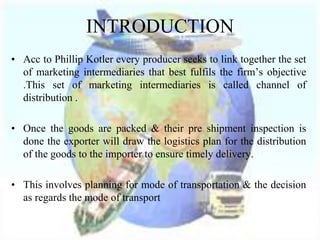
• Acc to Phillip Kotler every producer seeks to link together the set
of marketing intermediaries that best fulfils the firm’s objective
.This set of marketing intermediaries is called channel of
distribution .
• Once the goods are packed & their pre shipment inspection is
done the exporter will draw the logistics plan for the distribution
of the goods to the importer to ensure timely delivery.
• This involves planning for mode of transportation & the decision
as regards the mode of transport
Following factors must be kept in mind before
drawing the logistics plan.
• Alternative modes of transport
• The the mode which is optimal from the point of view of
the total cost
Necessary inputs to the exporter with regard to the decision
of logistics is provided by Clearing & Forwarding agent
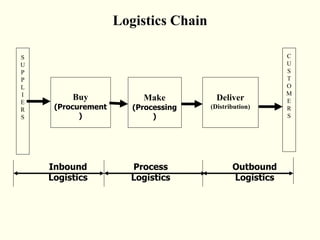
Logistics Chain
Buy
(Procurement
)
Make
(Processing
)
Deliver
(Distribution)
C
U
S
T
O
M
E
R
S
S
U
P
P
L
I
E
R
S
Inbound
Logistics
Process
Logistics
Outbound
Logistics
Logistics Chain
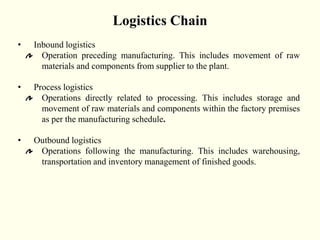
• Inbound logistics
Operation preceding manufacturing. This includes movement of raw
materials and components from supplier to the plant.
• Process logistics
Operations directly related to processing. This includes storage and
movement of raw materials and components within the factory premises
as per the manufacturing schedule.
• Outbound logistics
Operations following the manufacturing. This includes warehousing,
transportation and inventory management of finished goods.
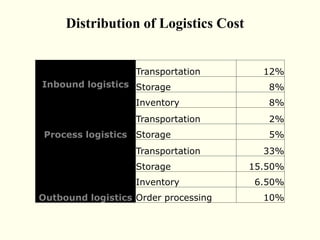
Distribution of Logistics Cost
Inbound logistics
Transportation 12%
Storage 8%
Inventory 8%
Process logistics
Transportation 2%
Storage 5%
Outbound logistics
Transportation 33%
Storage 15.50%
Inventory 6.50%
Order processing 10%
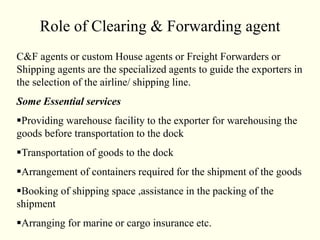
Role of Clearing & Forwarding agent
C&F agents or custom House agents or Freight Forwarders or
Shipping agents are the specialized agents to guide the exporters in
the selection of the airline/ shipping line.
Some Essential services
Providing warehouse facility to the exporter for warehousing the
goods before transportation to the dock
Transportation of goods to the dock
Arrangement of containers required for the shipment of the goods
Booking of shipping space ,assistance in the packing of the
shipment
Arranging for marine or cargo insurance etc.
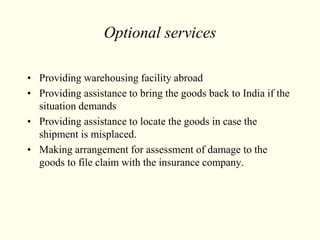
Optional services
• Providing warehousing facility abroad
• Providing assistance to bring the goods back to India if the
situation demands
• Providing assistance to locate the goods in case the
shipment is misplaced.
• Making arrangement for assessment of damage to the
goods to file claim with the insurance company.
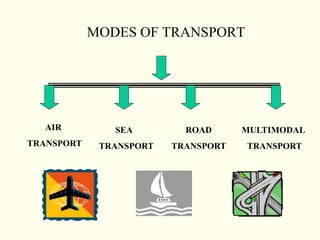
MODES OF TRANSPORT
AIR
TRANSPORT
SEA
TRANSPORT
ROAD
TRANSPORT
MULTIMODAL
TRANSPORT
Factors affecting Selection of the Mode
of Transport
 Cost of distribution
 Nature of the Product
 Delivery time
 Value & Volume of cargo
 Speed,frequency,Reliability, safety& appropriateness of
the mode of transport.
AIR TRANSPORT
• Involves sending shipment of goods through one of the
international airlines
• This job is done in a cost effective manner by the C&F Agent.
The export order may provide for
 Direct Shipment i.e. the same airline carry the cargo from the
port of loading to the port of discharge
 Transhipment - Involves change of plane on the way to the
destination of the cargo.
Airway Bill
• The airline issues the transport document known as Airway
Bill when it accepts the cargo for transportation.
ITS CONTENTS
 General description of the nature of the goods
 Particular marks necessary for identifying of goods
 No. of packages ,quantity & the weight of the goods .
 Place of Discharge .
 Transit Airport
The Airway Bill is not a document of title & consequently not
negotiable.
Advantages of Air
Transport
 The movement of goods is very
fast
 The warehousing costs are
reduced to minimum
 Suitable for perishable goods
 Risk of Deterioration &
obsolescence of goods is
reduced.
 Insurance premium is low as
compared to sea transport
 Losses due to rough handling,
breakage,& pilferage are also
reduced to the minimum.
Disadvantages of Air
Transport
 Freight cost is very
high as compared to
transport of goods by
Sea
SEA TRANSPORT
• Involves carriage of goods by ship to the port of discharge.
• It involves a contract between the shipper & the shipping
Line (carrier) for the transportation of goods against
remuneration
• One who sends the goods is the consignor
• The person to whom the goods are sent is consignee.
• Carrier is the party contracting the shipper to carry the
goods
Bill of Lading
 When the goods are accepted by carrier for transportation
then he issues a transport document called Bill of Lading.
 It is a negotiable instrument & can be transferred by
endorsement & Delivery
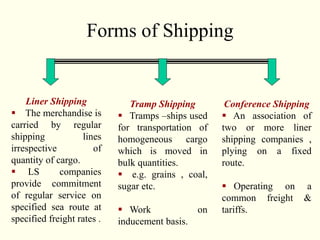
Forms of Shipping
Liner Shipping
 The merchandise is
carried by regular
shipping lines
irrespective of
quantity of cargo.
 LS companies
provide commitment
of regular service on
specified sea route at
specified freight rates .
Tramp Shipping
 Tramps –ships used
for transportation of
homogeneous cargo
which is moved in
bulk quantities.
 e.g. grains , coal,
sugar etc.
 Work on
inducement basis.
Conference Shipping
 An association of
two or more liner
shipping companies ,
plying on a fixed
route.
 Operating on a
common freight &
tariffs.
TRANSPORTATION
BY ROAD
 The exporters from India can send their export
shipments by road to Bangladesh ,Nepal,
Pakistan& Myanmar.
 Acc to MMT of goods Act 1993 MMT means carriage of
goods by more than one mode of transport.from the place
of goods in India to a place of delivery
 Also called combined Transport.
 Consignor entrusts the goods to the carrier or the body
called Multi Modal Transport Operator(MTO) who
undertakes to organize MMT
 MMT is arranged on the basis of a single contract with the
MTO
MULTI MODAL TRANSPORT
Advantages
 The movement of cargo if faster
 Eliminate the loss of pilferage ,risk of loss, & damage to
cargo incidental to conventional segmented transport.
 The consignor has to deal with only one agency-MTO
 The through rate offered by MTO make it easier for the
exporter to negotiate sales contracts with foreign buyers on
the basis of delivered prices.
Containerization
 Method of distribution of goods using Containers.
 The enactment of MMT Act 1993 has enabled exporters from
India to use containers for transport of Export cargo.
 The containers are carried by train or road to the the sea ports.
 The exporters do not need to carry the cargo to the seaports
any longer they can approach the container freight station or
the inland container depot to book the cargo there for
transportation to the destination.
Types of Containers
• General purpose containers- closed & are suitable for the
carriage of all types general cargo both solid & liquid.
• Insulated containers- Such containers are used with a blown
air refrigeration system to protect Perishable or other cargo
which needs to be carried under temperature control.
• Fruit containers- Insulated container with internal dimensions
slightly longer.
• Refrigerated Containers- these containers are are fitted with
their own refrigeration units which require an electrical supply.
• Bulk Container-designed for carriage of Dry powders & gram
substances in bulk.
Contd…
• Ventilated Containers- have ventilation galleries.
• Open Top Containers- have top loading facility suitable in
those cases where height of cargo is in excess of the height
of the standard general purpose container .
• Hanger Containers-equipped with removable beams in the
upper part & used for shipment of garments on hangers .
• Bin Containers- have no doors & are ideal for heavy
cargoes such as steel, pipes etc.
Advantages
• Risk of damage due to pilferage & mishandling is reduced
substantially.
• Created better impression of exporter in mind of the
importer.
• The packing cost are reduced substantially.
inter logistics-2.ppt

inter logistics-2.ppt

  • 2.
    INTRODUCTION • Acc toPhillip Kotler every producer seeks to link together the set of marketing intermediaries that best fulfils the firm’s objective .This set of marketing intermediaries is called channel of distribution . • Once the goods are packed & their pre shipment inspection is done the exporter will draw the logistics plan for the distribution of the goods to the importer to ensure timely delivery. • This involves planning for mode of transportation & the decision as regards the mode of transport
  • 3.
    Following factors mustbe kept in mind before drawing the logistics plan. • Alternative modes of transport • The the mode which is optimal from the point of view of the total cost Necessary inputs to the exporter with regard to the decision of logistics is provided by Clearing & Forwarding agent
  • 4.
  • 5.
    Logistics Chain • Inboundlogistics Operation preceding manufacturing. This includes movement of raw materials and components from supplier to the plant. • Process logistics Operations directly related to processing. This includes storage and movement of raw materials and components within the factory premises as per the manufacturing schedule. • Outbound logistics Operations following the manufacturing. This includes warehousing, transportation and inventory management of finished goods.
  • 6.
    Distribution of LogisticsCost Inbound logistics Transportation 12% Storage 8% Inventory 8% Process logistics Transportation 2% Storage 5% Outbound logistics Transportation 33% Storage 15.50% Inventory 6.50% Order processing 10%
  • 7.
    Role of Clearing& Forwarding agent C&F agents or custom House agents or Freight Forwarders or Shipping agents are the specialized agents to guide the exporters in the selection of the airline/ shipping line. Some Essential services Providing warehouse facility to the exporter for warehousing the goods before transportation to the dock Transportation of goods to the dock Arrangement of containers required for the shipment of the goods Booking of shipping space ,assistance in the packing of the shipment Arranging for marine or cargo insurance etc.
  • 8.
    Optional services • Providingwarehousing facility abroad • Providing assistance to bring the goods back to India if the situation demands • Providing assistance to locate the goods in case the shipment is misplaced. • Making arrangement for assessment of damage to the goods to file claim with the insurance company.
  • 9.
  • 10.
    Factors affecting Selectionof the Mode of Transport  Cost of distribution  Nature of the Product  Delivery time  Value & Volume of cargo  Speed,frequency,Reliability, safety& appropriateness of the mode of transport.
  • 11.
    AIR TRANSPORT • Involvessending shipment of goods through one of the international airlines • This job is done in a cost effective manner by the C&F Agent. The export order may provide for  Direct Shipment i.e. the same airline carry the cargo from the port of loading to the port of discharge  Transhipment - Involves change of plane on the way to the destination of the cargo.
  • 12.
    Airway Bill • Theairline issues the transport document known as Airway Bill when it accepts the cargo for transportation. ITS CONTENTS  General description of the nature of the goods  Particular marks necessary for identifying of goods  No. of packages ,quantity & the weight of the goods .  Place of Discharge .  Transit Airport The Airway Bill is not a document of title & consequently not negotiable.
  • 13.
    Advantages of Air Transport The movement of goods is very fast  The warehousing costs are reduced to minimum  Suitable for perishable goods  Risk of Deterioration & obsolescence of goods is reduced.  Insurance premium is low as compared to sea transport  Losses due to rough handling, breakage,& pilferage are also reduced to the minimum. Disadvantages of Air Transport  Freight cost is very high as compared to transport of goods by Sea
  • 14.
    SEA TRANSPORT • Involvescarriage of goods by ship to the port of discharge. • It involves a contract between the shipper & the shipping Line (carrier) for the transportation of goods against remuneration • One who sends the goods is the consignor • The person to whom the goods are sent is consignee. • Carrier is the party contracting the shipper to carry the goods
  • 15.
    Bill of Lading When the goods are accepted by carrier for transportation then he issues a transport document called Bill of Lading.  It is a negotiable instrument & can be transferred by endorsement & Delivery
  • 16.
    Forms of Shipping LinerShipping  The merchandise is carried by regular shipping lines irrespective of quantity of cargo.  LS companies provide commitment of regular service on specified sea route at specified freight rates . Tramp Shipping  Tramps –ships used for transportation of homogeneous cargo which is moved in bulk quantities.  e.g. grains , coal, sugar etc.  Work on inducement basis. Conference Shipping  An association of two or more liner shipping companies , plying on a fixed route.  Operating on a common freight & tariffs.
  • 17.
    TRANSPORTATION BY ROAD  Theexporters from India can send their export shipments by road to Bangladesh ,Nepal, Pakistan& Myanmar.
  • 18.
     Acc toMMT of goods Act 1993 MMT means carriage of goods by more than one mode of transport.from the place of goods in India to a place of delivery  Also called combined Transport.  Consignor entrusts the goods to the carrier or the body called Multi Modal Transport Operator(MTO) who undertakes to organize MMT  MMT is arranged on the basis of a single contract with the MTO MULTI MODAL TRANSPORT
  • 19.
    Advantages  The movementof cargo if faster  Eliminate the loss of pilferage ,risk of loss, & damage to cargo incidental to conventional segmented transport.  The consignor has to deal with only one agency-MTO  The through rate offered by MTO make it easier for the exporter to negotiate sales contracts with foreign buyers on the basis of delivered prices.
  • 20.
    Containerization  Method ofdistribution of goods using Containers.  The enactment of MMT Act 1993 has enabled exporters from India to use containers for transport of Export cargo.  The containers are carried by train or road to the the sea ports.  The exporters do not need to carry the cargo to the seaports any longer they can approach the container freight station or the inland container depot to book the cargo there for transportation to the destination.
  • 21.
    Types of Containers •General purpose containers- closed & are suitable for the carriage of all types general cargo both solid & liquid. • Insulated containers- Such containers are used with a blown air refrigeration system to protect Perishable or other cargo which needs to be carried under temperature control. • Fruit containers- Insulated container with internal dimensions slightly longer. • Refrigerated Containers- these containers are are fitted with their own refrigeration units which require an electrical supply. • Bulk Container-designed for carriage of Dry powders & gram substances in bulk.
  • 22.
    Contd… • Ventilated Containers-have ventilation galleries. • Open Top Containers- have top loading facility suitable in those cases where height of cargo is in excess of the height of the standard general purpose container . • Hanger Containers-equipped with removable beams in the upper part & used for shipment of garments on hangers . • Bin Containers- have no doors & are ideal for heavy cargoes such as steel, pipes etc.
  • 23.
    Advantages • Risk ofdamage due to pilferage & mishandling is reduced substantially. • Created better impression of exporter in mind of the importer. • The packing cost are reduced substantially.