26
GLOBAL INNOVATION AND KNOWLEDGE SHARING IN HR
Colin Dicke, American Express Graduate Research Assistant
As human resource management evolves into an ever-increasing means of competitive advantage for
multinational corporations (MNC’s) greater importance is being placed on a corporation’s ability to
manage and share human resource innovations. This paper discusses the concept of knowledge
management (KM) as it pertains to a firm’s ability to share innovative HR practices from one HR
function to another across both local and international boundaries. I will give background information on
KM and its’ relationship to organizational learning from a corporate perspective and then narrow my
focus to the relationship of intellectual, social, organizational, and human capital to creating HR
innovation and sharing HR knowledge. Next, I will share how regional differences can impact sharing
HR knowledge, and then I will highlight two case examples of MNC’s sharing HR knowledge across
boundaries.
As more MNC’s use KM and knowledge sharing practices to help their global workforce obtain
competitive advantages and higher total profits, they are turning to their human resource department for
support (Wright & Holwerda, CAHRS). Effective knowledge sharing and HR initiatives share a common
denominator, communication (Hackett, 2000). But, HR divisions need to be careful that, as they help their
corporation with KM and knowledge sharing initiatives they do not neglect their own “learning
capabilities” within HR. Learning capability in the HR context is defined as, “an HR unit’s ability to
generate new ideas for HR practices, disseminate practices in an effective and efficient manner, and
implement practices within their existing operations.” These capabilities are broken down further into
three sub-categories; creation capability, transfer capability, and implementation capability. Interestingly,
of the three sub-categories HR units scored highest in their transfer capabilities. This may be due to the
fact that communication is rooted in most every aspect of HR, thus creating a common vision that sharing
practices is vital to HR success (Wright & Holwerda, CAHRS). For the purposes of this paper, I will
spend some time discussing creation capability but focus primarily on the transfer capability of HR units.
Knowledge Management & Organizational Learning
To understand how corporations are using knowledge management (KM) and organizational learning
(OL) to support HR innovation it is important to have a base comprehension of these concepts and how
they are linked.
In a study done by Brian Hackett (2000) titled, “ Beyond Knowledge Management: New Ways to Work
and Learn,” knowledge management is defined as,” An integrated, systematic approach to identifying,
managing, and sharing all of an enterprise’s information assets, including databases, documents, policies,
and procedures, as well as previously unarticulated expertise and experience held by individual workers.”
In essence, it is gathering all the information and resources of a corporation and making them available to
the individual employee. In turn, the employee uses these resources to create new innovative processes
and thus, gives back to the firm.
Organizational learning (OL) is defined as, “A process that enables an organization to adapt to change
and move forward by acquiring new knowledge, skills, or behaviors, and thereby transform itself.”
Examples of successful OL are seen in continuous learning, knowledge sharing, cultural support of
learning, as well as critical thinking and risk taking with new ideas (Hackett, 2000).
Traditionally the challenge of linking KM with OL, as described by Janet McAllister, former Vice
President, Global Learning, IBM, has been that, “focus on KM comes from strategy and marketing
executives and the focus on learning comes from corporate training and HR staffs (Hackett, 2000).” At
the strategic level, these groups have very different functions within an organization, thus, making it very
27
difficult for them to communicate with one another. That said, the drivers of KM and OL within
organizations have begun to recognize commonalities through tools and practices that create a concept of
“shared learning” or knowledge sharing that views KM and OL as two sides of the same coin (ibid).
Major studies analyzing different KM and OL initiatives have highlighted knowledge-sharing cultures as
a primary necessity for success. Through initiatives rooted in knowledge sharing, organizations have
been able to achieve significant financial gains (ibid).
Intellectual, Social, Organizational & Human Capital
For successful innovation and knowledge sharing to occur corporations need to pay attention to the
relationship of their intellectual, social, organizational, and human capital. Intellectual capital refers to
the ability of individuals as well as the unit as a whole, to create innovative processes and procedures.
Social capital, such as communication channels and social networks, help the intellectual capital
disseminate the new information. Organizational capital, such as HR information systems, gives
corporations the ability to capture new information required for proper implementation. Finally, human
capital, which can be broken down further into local and international human capital, is vital in that, if
you do not have people with the correct knowledge, skills, and abilities to perform in new and ever
changing environments, the whole relationship collapses (Wright & Holwerda, CAHRS).
Management of the relationship of all these forms of capital is both complex and dynamic. Systems, local
and abroad, that incorporate human capital are particularly difficult to manage because of the unique
nature of individuals; no one person is the same.
Creating HR Innovation
In trying to better understand different conditions that impact the creation of HR innovation within HR
units around the globe Shad Morris and Scott Snell (CAHRS), performed research to determine whether
different forms of capital were able to provide, “sustainable competitive advantages through specific
knowledge flows.” More specifically, a component of the study looked for relationships between human
capital and HR units’ practice creation capability or innovation creation. What Morris and Snell
(CAHRS) found was that local and international HR human capital is positively associated with
innovation. In addition, the research determined that there was a negative association between network
focus and innovation creation.
Possible explanations for the positive association with local capital gravitate towards the accepted
wisdom that local capital has an intimate knowledge of the host country politics, legal systems, cultural
norms, unique client and supplier needs, as well as the general competitive environment (Morris & Snell,
CAHRS). While international capital’s knowledge surrounding specific communities is not as intimate as
their local counterparts, notions surrounding their positive association with innovation highlight a
confidence they possess around custom frameworks they have developed through personal experiences on
how to search for and meet the needs of different local communities. Human capital with extensive
international experience has also been found to base more decisions off local considerations versus
corporate pressures, thus further supporting innovation (ibid). Finally, hypotheses concerning the negative
association between network focus and innovation creation share similar characteristics to that of
groupthink. The thought being that as HR divisions continually refer back to the same network without
exploring other avenues they trap themselves in a cycle of making decisions based on a relatively limited
amount of information and opinions (ibid).
In stepping back, one interesting piece of information concerning HR innovations’ relation to learning
capabilities in HR units is that creation capability was found, overall, to be the least developed of the
three learning capabilities. So, it seems that as HR units are increasingly involved in supporting
28
innovation creation within other divisions of their corporations they may be less comfortable generating
new practices within their own units (Wright & Holwerda, CAHRS).
Sharing HR Knowledge
In much of the research I have found related to HR innovation, some mention of transfer capability or
knowledge sharing is highlighted as being paramount to the success of both local and global HR
innovation. Morris and Snell (CAHRS) focused a component of their research specifically on the
relationship between an HR units transfer capability, or knowledge sharing, and their human, social, and
organizational capital. Overall, Morris and Snell (CAHRS) found a strong relationship between
knowledge sharing and shared vision, a moderate relationship between knowledge sharing and
information systems, and a negative relationship between knowledge sharing and international human
capital.
The strong relationship with shared vision may be supported by the concept that when people share a
common bond or purpose they are more likely to share information or more specifically different HR
practices. The insignificant relationship between sharing and information system may be due to the fact
that information systems are simply a technological tool. If, for instance, a corporation is lacking a shared
vision or the system does not support existing social structures there may be no incentive to use the
information system. The negative relationship between sharing and international human capital may be a
product of overconfidence on the part of the international capital that can lead to a feeling of “having
everything they need.” This negative relationship also creates a unique challenge because there is a
positive relationship between international capital and innovation creation. Therefore, companies will
have to place close attention to their international human capital and make sure there is an appropriate
balance to accommodate both innovation creation and knowledge sharing (Morris & Snell, CAHRS).
It is important to note that social capital’s relationship with HR knowledge sharing within MNC’s is
essential because it focuses on HR’s ability to tap into and disseminate new ideas. “Without aspects of
social capital for linking knowledge, pockets of intelligence may remain isolated and ultimately swept
from the organizational system (Snell, Youndt, & Wright, 1996).”
Regional Differences
Individuals and groups find support through a myriad of complex HR systems. This fact is highlighted by
the differences found in HR processes across cultural boundaries. Research published in the International
Journal of Human Resource Management, by Markus Pudelko (2005) looks at knowledge sharing across
American, Japanese, and German fortune 500 companies. Pudelko’s (2005) research found that HRM
managers expect to see a convergence of HRM models that would be a hybrid of what models used
currently in these three countries. To determine whether it was worth learning HRM practices from other
countries, members of each country were asked if they had seen any trends within their companies, in the
last twenty years, which migrated towards one country model over another.
Quantitative analysis determined that the largest amount of interest was oriented around attributes
associated with the American HRM model (by a significant margin), followed by interest in Japan’s
model, and interest in the German’s model coming in at a distant third. Questions related to future trends
in interest uncovered a sharp decline in future interest in the Japanese model by German and American
HR experts and an increase in interest in the German model from Japanese HR experts. These trends
indicate an overall dissatisfaction and disinterest in the Japanese model (Pudelko, 2005).
Qualitative data helped determine specific interests in attributes of HRM across the country models.
Japanese companies indicated an interest in American employee assessment and promotion criteria, in
29
both past and future trends. Broken down further, interest was oriented primarily around ‘performance
orientation,’ followed by ‘result and objective orientation.’ This again illustrates a potential
dissatisfaction in Japanese companies concerning their own HRM model. German HR experts chose U.S
‘strategies’ as their primary interest followed by ‘employee incentives (ibid).’
In contrast, American firms showed very little interest in the Japanese model other than information on
the past concerning Japanese ‘processes.’ German interest in the Japanese model was considerably higher
and also focused primarily on the past with Japanese ‘processes,’ then ‘superior-subordinate
relationships,’ followed by ‘employee incentives (ibid).’
Pudelko (2005) found very little interest in the adoption of German HRM attributes by U.S. or Japanese
HR experts and as a result, abstained from charting the results. This lack of interest highlights the low
degree to which the German model is considered a role model for other countries. Further probing for
reasons as to why the German model is not considered to be a role model uncovered an answer not related
to the perceived worth of the model, but rather, a lack of knowledge concerning the German model.
Basically, U.S. and Japanese HR experts know very little about the German model, and thus, discount it
(ibid).
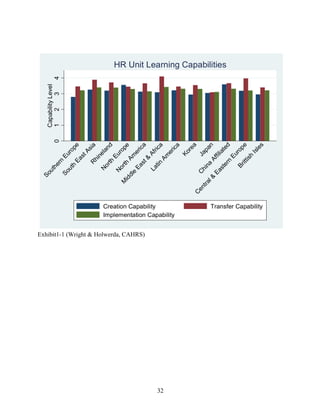
Wright and Holwerda (CAHRS) also uncovered regional trends associated with knowledge management
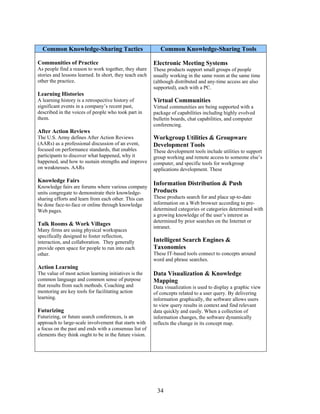
and “learning capabilities”, specifically “transfer capabilities (see exhibits 1-1).” They found that Africa,
Central and Eastern Europe, and the Middle East exhibited comparatively high levels of transfer
capability compared to other regions in their study. Thoughts discern this trend may be due to the fact
that these sub-regions tend to be less developed than other sub-regions and this may lower their
confidence in their abilities to create and implement, thus, producing a higher reliance on HR support
(Wright & Holwerda, CAHRS).
Is it worth learning processes of HRM models from other countries? Research from Pudelko’s (2005)
study indicates that it is better to look at other HRM models as sources of ‘inspiration’ that can be
customized to considerations that are unique to the different countries versus a direct adoption of a
particular process.
Case Examples
While I have been able to locate two case examples on knowledge sharing of HR innovations it is
important to note that there are very few examples available highlighting this relationship. That said,
additional research is available on KM and knowledge sharing in a more general context, as it relates to
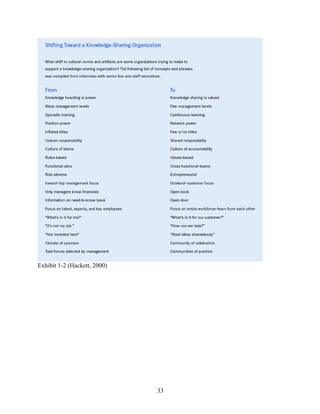
firms. I have attached exhibits 1-2, 1-3, and1-4 for points of reference as you read through these two
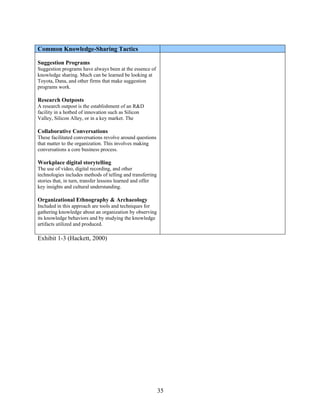
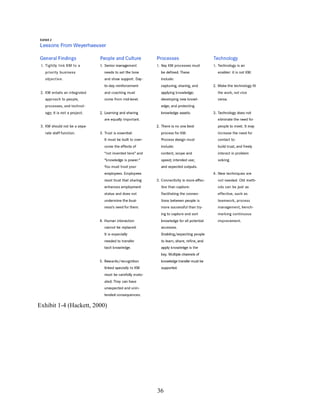
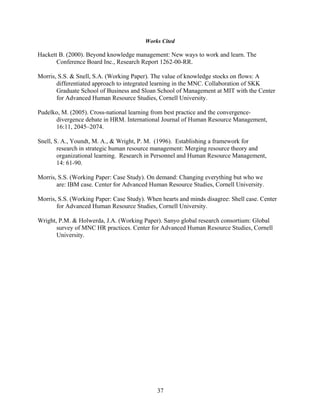
examples (Hackett, 2000). Exhibit 1-2 is a list of concepts and phrases, compiled from interviews, related
to shifting towards a knowledge-sharing organization. Exhibit 1-3 lists common knowledge sharing
tactics and tools. Finally, Exhibit 1-4 is a summary of lessons learned from Weyerhauser implementing
KM initiatives into their organization. You will find that some issues highlighted in these exhibits hold
similarities to the case examples below.
IBM Example (CAHRS: Case Study)
In recent years, IBM has had robust discussions around how to make their HR managers to be more
consultative—more strategic. To develop successful global HR practices they focused on two areas: One,
thought leadership from countries, regions, and divisions, and two, buy-in. IBM’s approach to knowledge
sharing within their HR divisions has a strong emphasis on providing local branches with extensive
autonomy. Bob Calamai stated, “we are trying to be less paternalistic, and want people and managers to
own more of their stuff…to do this we had to make sure that our line managers know that this is their
30
company and you make the decisions.” A byproduct of being locally focused has been increased
knowledge sharing of HR practices across regional boundaries. One local HR manager attributes strong
connections and knowledge sharing with her HR community to, “principles of being company and
customer oriented no matter what central rules might be broken.”
IBM corporate supplies support for their local HR units through various means. One form of support
comes from creating programs that can be adapted locally to shifts in the environment. This enables HR
subunits ability to develop custom systems and practices with an ever-watchful eye on the constant
changing needs of IBM clients. Another example is corporate allowing the definition of employee
performance to be relative. This allowed regional leaders to base performance ratings for their employees
off peers within the region rather than corporate-wide. A final illustration of increased autonomy is IBM
corporate turning the distribution of compensation over to regional managers. Corporate understands that
empowering local autonomy can be very complex and requires extensive creativity and innovation.
IBM places a strong emphasis on training as a strong driver of knowledge sharing. Currently IBM
budgets $700 million annually towards formal classroom training and online learning. They have created
an On Demand learning strategy that, according to Nancy Lewis, Vice President, IBM On Demand
Learning, allows IBM to bring, “’the learning to work,’-- an exciting new era of learning that promises to
leverage the collective expertise of employees, teams, and organizations throughout its enterprise.”
Internationally, IBM has faced unique challenges. For instance, in Europe the branches are highly
integrated in knowledge sharing within their region but run into difficultly extracting relevant knowledge
from the U.S. or other outside regions. They also recognize that different geographies and even different
business units may require varied levels of HR expertise. To combat these challenges IBM focuses on
three things: One, eighteen to twenty-four month job rotations, two, numerous training opportunities, and
three, the “Five-minute Drill.” Training focuses on doing HR in countries outside of their own and can be
in the form of formal training, paid school, workshops, as well as other options. The “Five-minute Drill”
refers to checking in periodically on key employees and is used exclusively in Europe.
IBM’s Asia-Pacific divisions incorporate a tremendous amount of new practice development and
knowledge sharing among their HR groups. For instance, the VP of HR for Asia-Pacific has a monthly
knowledge sharing meeting with a leadership team consisting of members from all reporting countries.
Typically there is always some form of customization that occurs due to language. For example, even if
English is used there needs to be some form of translation.
It is typically thought that almost all HR innovation has its’ roots in IBM’s corporate U.S. office but it is
important to note that this is not the case. There are times when practices formed in the U.S. are simply
deemed unacceptable in other countries. One example sighted refers to corporate policies on diversity,
gay and lesbian issues. These policies clash with Asian culture, thus, IBM forgoes gay and lesbian
policies in Asia. Latin American divisions have also been found to supply innovative HR practices and
they use a large amount of knowledge sharing.
Shell Example (CAHRS: Case Study)
Shell has taken a decidedly different approach to the formulation of their global HR practices. While a
primary driver for their success comes from their strength in locally managing diverse people in diverse
settings they are finding this local connectedness to be insufficient in the face of increasing market
integration. One HR manager voiced a commonly held belief at Shell that, “there was too much local
reinvention going on.” This belief was elaborated by another who stated, “We haven’t figured out how to
get rid of redundancy. We are locked with a legacy of a lot of redundancy. For example, we still have 20
different payroll systems in Europe.”
31
Shell felt the response to increasing market integration should be through simplifying and integrating
systems that offered standardized practices and processes in this globalized market. The challenge then
became convincing HR managers that they should put equal or greater emphasis on locating and using
HR practices from within Shell rather than strategic development of locally focused HR practices. The
previous HR entrepreneurial culture had diverted attention away from implementation and integration and
created a strong localized mentality that felt, “what works in one country or region won’t work in
another.” Historically knowledge sharing was not strong at Shell. One HR manager clarified by stating,
“Communication is minimal among the businesses. Upstream people do not talk to downstream people.”
Shell also struggled with older locations that held deeply engrained models because they made employees
more resistant to change compared to their younger counterparts.
Initially, Shell heavily invested time and money in creating a logical explanation as to why they should
have a stronger more integrated HR system. They produced a good argument but still found resistance
around change. Simon Fitzpatrick, Deputy Leader of HR Futures, The Hague, said it best by stating, “I
think we have won the intellectual battle of the wisdom of simplifying and standardizing HR globally.
But now we need to get the hearts in the local managers persuaded to yield to one global standard.” Shell
was moving towards a model where practices developed at the corporate level should always be executed
and practices acquired from other local levels are optional.
Shell’s first step in tackling this challenge was through slowly obtaining buy-in from HR managers. Top
executives brought together key HR players by forming HR networks that met on a regular basis. Next,
Shell encouraged the creation of other social networks and instituted uniform information systems for all
business divisions. These helped improve knowledge sharing across business division and company
boundaries while simultaneously increasing standardization. Social ties also helped HR players solve
indifferences particularly in Shell’s Asia-Pacific divisions because, unlike, the U.S. and Europe that are
deemed low-touch environments, Asia is high touch. As a result, the Asia-Pacific division established
regional HR manager meetings that meet three times a year to improve relationships. The U.S. also
established networks that meet three times a year but they seem to make more use of emailing lists and
teleconferencing versus face-to-face meetings.
Other forms of knowledge sharing come in the form of network councils that include an “HR best
practice network.” These networks are connected to a larger intranet information system where
information can be stored and retrieved for use and implementation. Another type of information system
that Shell has incorporated into their arsenal is called “Livelink.” Livelink creates the ability for team
members, regional and global alike; to work together on a project using one share drive. Shell also
encourages HR managers to join external councils because many HR practices are not industry specific so
it is entirely plausible to learn an HR best practice from a firm in a completely unrelated industry.
Conclusion
There is extensive complexity in relation to knowledge sharing of HR innovation across MNC’s. In order
to gain an appreciation for what is required to share HR knowledge across local and international
boundaries corporations must build a base understanding of; corporate level KM and OL; the impact of
intellectual, social, organizational, and human capital on innovation creation and knowledge sharing
among HR units; regional distinctions; as well as sharing HR knowledge within different business
strategies. It is important to note that after performing extensive research on sharing HR knowledge and
innovation across MNC’s, my primary source of information became working papers supplied by
CAHRS. I am stating this to highlight the fact that current research on this topic is very rare. Therefore,
in order to gain a more thorough understanding of these relationships more case studies should be
performed on different industries as well as different business models.
32
01234
CapabilityLevel
Southern
Europe
South
EastAsiaR
hineland
N
orth
Europe
N
orth
Am
erica
M
iddle
East&
Africa
Latin
Am
erica
Korea
Japan
C
hina
Affiliated
C
entral&
Eastern
Europe
Brittish
Isles
HR Unit Learning Capabilities
Creation Capability Transfer Capability
Implementation Capability
Exhibit1-1 (Wright & Holwerda, CAHRS)
33
Exhibit 1-2 (Hackett, 2000)
34
Common Knowledge-Sharing Tactics Common Knowledge-Sharing Tools
Communities of Practice
As people find a reason to work together, they share
stories and lessons learned. In short, they teach each
other the practice.
Learning Histories
A learning history is a retrospective history of
significant events in a company’s recent past,
described in the voices of people who took part in
them.
After Action Reviews
The U.S. Army defines After Action Reviews
(AARs) as a professional discussion of an event,
focused on performance standards, that enables
participants to discover what happened, why it
happened, and how to sustain strengths and improve
on weaknesses. AARs
Knowledge Fairs
Knowledge fairs are forums where various company
units congregate to demonstrate their knowledge-
sharing efforts and learn from each other. This can
be done face-to-face or online through knowledge
Web pages.
Talk Rooms & Work Villages
Many firms are using physical workspaces
specifically designed to foster reflection,
interaction, and collaboration. They generally
provide open space for people to run into each
other.
Action Learning
The value of most action learning initiatives is the
common language and common sense of purpose
that results from such methods. Coaching and
mentoring are key tools for facilitating action
learning.
Futurizing
Futurizing, or future search conferences, is an
approach to large-scale involvement that starts with
a focus on the past and ends with a consensus list of
elements they think ought to be in the future vision.
Electronic Meeting Systems
These products support small groups of people
usually working in the same room at the same time
(although distributed and any-time access are also
supported), each with a PC.
Virtual Communities
Virtual communities are being supported with a
package of capabilities including highly evolved
bulletin boards, chat capabilities, and computer
conferencing.
Workgroup Utilities & Groupware
Development Tools
These development tools include utilities to support
group working and remote access to someone else’s
computer, and specific tools for workgroup
applications development. These
Information Distribution & Push
Products
These products search for and place up-to-date
information on a Web browser according to pre-
determined categories or categories determined with
a growing knowledge of the user’s interest as
determined by prior searches on the Internet or
intranet.
Intelligent Search Engines &
Taxonomies
These IT-based tools connect to concepts around
word and phrase searches.
Data Visualization & Knowledge
Mapping
Data visualization is used to display a graphic view
of concepts related to a user query. By delivering
information graphically, the software allows users
to view query results in context and find relevant
data quickly and easily. When a collection of
information changes, the software dynamically
reflects the change in its concept map.
35
Common Knowledge-Sharing Tactics
Suggestion Programs
Suggestion programs have always been at the essence of
knowledge sharing. Much can be learned be looking at
Toyota, Dana, and other firms that make suggestion
programs work.
Research Outposts
A research outpost is the establishment of an R&D
facility in a hotbed of innovation such as Silicon
Valley, Silicon Alley, or in a key market. The
Collaborative Conversations
These facilitated conversations revolve around questions
that matter to the organization. This involves making
conversations a core business process.
Workplace digital storytelling
The use of video, digital recording, and other
technologies includes methods of telling and transferring
stories that, in turn, transfer lessons learned and offer
key insights and cultural understanding.
Organizational Ethnography & Archaeology
Included in this approach are tools and techniques for
gathering knowledge about an organization by observing
its knowledge behaviors and by studying the knowledge
artifacts utilized and produced.
Exhibit 1-3 (Hackett, 2000)
36
Exhibit 1-4 (Hackett, 2000)
37
Works Cited
Hackett B. (2000). Beyond knowledge management: New ways to work and learn. The
Conference Board Inc., Research Report 1262-00-RR.
Morris, S.S. & Snell, S.A. (Working Paper). The value of knowledge stocks on flows: A
differentiated approach to integrated learning in the MNC. Collaboration of SKK
Graduate School of Business and Sloan School of Management at MIT with the Center
for Advanced Human Resource Studies, Cornell University.
Pudelko, M. (2005). Cross-national learning from best practice and the convergence-
divergence debate in HRM. International Journal of Human Resource Management,
16:11, 2045–2074.
Snell, S. A., Youndt, M. A., & Wright, P. M. (1996). Establishing a framework for
research in strategic human resource management: Merging resource theory and
organizational learning. Research in Personnel and Human Resource Management,
14: 61-90.
Morris, S.S. (Working Paper: Case Study). On demand: Changing everything but who we
are: IBM case. Center for Advanced Human Resource Studies, Cornell University.
Morris, S.S. (Working Paper: Case Study). When hearts and minds disagree: Shell case. Center
for Advanced Human Resource Studies, Cornell University.
Wright, P.M. & Holwerda, J.A. (Working Paper). Sanyo global research consortium: Global
survey of MNC HR practices. Center for Advanced Human Resource Studies, Cornell
University.
38
Annotated Bibliography
Hackett B. (2000). Beyond knowledge management: New ways to work and learn. The
Conference Board Inc., Research Report 1262-00-RR.
Abstract: Companies around the world have begun to make real business contributions through practices
associated with knowledge management (KM) and organizational learning (OL). Knowledge
management and organizational learning have different distinctions and approaches at the strategic level,
but they are increasingly similar in terms of the tactics and tools they employ. Implementing KM or OL
on an enterprise-wide basis can be expensive and politically sensitive. It should also be viewed as a long-
term investment that involves all segments of the business. Leading KM and OL practitioners and
observers believe that the current efforts are only a prelude to a bigger payoff—building deeper customer
relationships with a fully engaged workforce.
Morris, S.S. & Snell, S.A. (Working Paper). The value of knowledge stocks on flows: A
differentiated approach to integrated learning in the MNC. Collaboration of SKK Graduate
School of Business and Sloan School of Management at MIT with the Center for Advanced
Human Resource Studies, Cornell University.
Abstract: This paper addresses how the use of differentiated knowledge stocks (human, social, and
organizational capital) provides sustainable competitive advantages through specific knowledge flows.
The authors conduct research using a sample of 187 HR subunits from 20 different MNCs. The overall
implications of the findings from this study are that learning capabilities require a differentiated approach
in terms of knowledge stock investment and development.
Pudelko, M. (2005). Cross-national learning from best practice and the convergence-divergence
debate in HRM. International Journal of Human Resource Management, 16:11, 2045–
2074.
Abstract: The purpose of this paper is to develop suggestions as to how to learn from best practices in
HRM across national borders. The suggestions are based on survey data gathered from 232 HRM
managers from American, Japanese and German top 500 companies. The empirical data suggest that HR
managers from all three countries expect a partial convergence towards a hybrid model.
Snell, S. A., Youndt, M. A., & Wright, P. M. (1996). Establishing a framework for research in
strategic human resource management: Merging resource theory and organizational l
earning. Research in Personnel and Human Resource Management, 14: 61-90.
Abstract: This paper draws upon resource-based theory of sustained competitive advantage,
organizational learning, and organizational configurations to develop a framework for thinking about
contemporary research issues in strategic human resource management. Several areas are highlighted in
which SHRM can play a role in building and renewing a firms competitive advantage and in which
configurational research can help expand prior notions of internal and external fit in SHRM.
39
Morris, S.S. (Working Paper: Case Study). On demand: Changing everything but who we are:
IBM case. Center for Advanced Human Resource Studies, Cornell University.
Abstract: This case delivers a past present comparison of IBM’s coordination and flexibility in order to
provide insight on how IBM has been able to achieve success in producing consistent, high-quality
products and services throughout the world with a localized touch. Detailed background information is
provided on IBM’s corporate structure as well as short and long-term business strategies. IBM’s HR
functions are broken down into all its’ sub-units in order to highlight how they are transformed to
contribute to IBM’s success. To develop successful global HR practices IBM focused on two areas: One,
thought leadership from countries, regions, and divisions, and two, buy-in. IBM’s overarching goal
revolves around increasing the autonomy of regional groups so they are more able to provide customized
service to their clients.
Morris, S.S. (Working Paper: Case Study). When hearts and minds disagree: Shell case. Center
for Advanced Human Resource Studies, Cornell University.
Abstract: This case discusses how Shell’s past HR success has come from their ability to locally manage
diverse people in diverse settings but market integration is challenging this approach and forcing Shell to
rethink their strategy. Shell is now focusing on a more simplified and integrated HR system that is able to
offer standardized practices and processes in a globalized market. The case discusses detailed steps Shell
is taking to achieve increased standardization in HR as well as the barriers they have faced with during
the process.
Wright, P.M. & Holwerda, J.A. (working paper). Sanyo global research consortium: Global survey
of MNC HR practices. Center for Advanced Human Resource Studies, Cornell University.
Abstract: With the rise in global competition and the increasing presence of multinational companies
(MNC’s), numerous questions have been raised regarding differences in human resource (HR) practices
across the globe. This study gathered data from 239 respondents across 36 countries from within 20
MNC’s to examine the similarities and differences across countries or sub-regions. General results
indicated a trend towards convergence with regard to beliefs in the effectiveness of HR best practices, but
divergence with regard to their actual implementation or usage.

Global innovation hr_knowledgesharing

  • 1.
    26 GLOBAL INNOVATION ANDKNOWLEDGE SHARING IN HR Colin Dicke, American Express Graduate Research Assistant As human resource management evolves into an ever-increasing means of competitive advantage for multinational corporations (MNC’s) greater importance is being placed on a corporation’s ability to manage and share human resource innovations. This paper discusses the concept of knowledge management (KM) as it pertains to a firm’s ability to share innovative HR practices from one HR function to another across both local and international boundaries. I will give background information on KM and its’ relationship to organizational learning from a corporate perspective and then narrow my focus to the relationship of intellectual, social, organizational, and human capital to creating HR innovation and sharing HR knowledge. Next, I will share how regional differences can impact sharing HR knowledge, and then I will highlight two case examples of MNC’s sharing HR knowledge across boundaries. As more MNC’s use KM and knowledge sharing practices to help their global workforce obtain competitive advantages and higher total profits, they are turning to their human resource department for support (Wright & Holwerda, CAHRS). Effective knowledge sharing and HR initiatives share a common denominator, communication (Hackett, 2000). But, HR divisions need to be careful that, as they help their corporation with KM and knowledge sharing initiatives they do not neglect their own “learning capabilities” within HR. Learning capability in the HR context is defined as, “an HR unit’s ability to generate new ideas for HR practices, disseminate practices in an effective and efficient manner, and implement practices within their existing operations.” These capabilities are broken down further into three sub-categories; creation capability, transfer capability, and implementation capability. Interestingly, of the three sub-categories HR units scored highest in their transfer capabilities. This may be due to the fact that communication is rooted in most every aspect of HR, thus creating a common vision that sharing practices is vital to HR success (Wright & Holwerda, CAHRS). For the purposes of this paper, I will spend some time discussing creation capability but focus primarily on the transfer capability of HR units. Knowledge Management & Organizational Learning To understand how corporations are using knowledge management (KM) and organizational learning (OL) to support HR innovation it is important to have a base comprehension of these concepts and how they are linked. In a study done by Brian Hackett (2000) titled, “ Beyond Knowledge Management: New Ways to Work and Learn,” knowledge management is defined as,” An integrated, systematic approach to identifying, managing, and sharing all of an enterprise’s information assets, including databases, documents, policies, and procedures, as well as previously unarticulated expertise and experience held by individual workers.” In essence, it is gathering all the information and resources of a corporation and making them available to the individual employee. In turn, the employee uses these resources to create new innovative processes and thus, gives back to the firm. Organizational learning (OL) is defined as, “A process that enables an organization to adapt to change and move forward by acquiring new knowledge, skills, or behaviors, and thereby transform itself.” Examples of successful OL are seen in continuous learning, knowledge sharing, cultural support of learning, as well as critical thinking and risk taking with new ideas (Hackett, 2000). Traditionally the challenge of linking KM with OL, as described by Janet McAllister, former Vice President, Global Learning, IBM, has been that, “focus on KM comes from strategy and marketing executives and the focus on learning comes from corporate training and HR staffs (Hackett, 2000).” At the strategic level, these groups have very different functions within an organization, thus, making it very
  • 2.
    27 difficult for themto communicate with one another. That said, the drivers of KM and OL within organizations have begun to recognize commonalities through tools and practices that create a concept of “shared learning” or knowledge sharing that views KM and OL as two sides of the same coin (ibid). Major studies analyzing different KM and OL initiatives have highlighted knowledge-sharing cultures as a primary necessity for success. Through initiatives rooted in knowledge sharing, organizations have been able to achieve significant financial gains (ibid). Intellectual, Social, Organizational & Human Capital For successful innovation and knowledge sharing to occur corporations need to pay attention to the relationship of their intellectual, social, organizational, and human capital. Intellectual capital refers to the ability of individuals as well as the unit as a whole, to create innovative processes and procedures. Social capital, such as communication channels and social networks, help the intellectual capital disseminate the new information. Organizational capital, such as HR information systems, gives corporations the ability to capture new information required for proper implementation. Finally, human capital, which can be broken down further into local and international human capital, is vital in that, if you do not have people with the correct knowledge, skills, and abilities to perform in new and ever changing environments, the whole relationship collapses (Wright & Holwerda, CAHRS). Management of the relationship of all these forms of capital is both complex and dynamic. Systems, local and abroad, that incorporate human capital are particularly difficult to manage because of the unique nature of individuals; no one person is the same. Creating HR Innovation In trying to better understand different conditions that impact the creation of HR innovation within HR units around the globe Shad Morris and Scott Snell (CAHRS), performed research to determine whether different forms of capital were able to provide, “sustainable competitive advantages through specific knowledge flows.” More specifically, a component of the study looked for relationships between human capital and HR units’ practice creation capability or innovation creation. What Morris and Snell (CAHRS) found was that local and international HR human capital is positively associated with innovation. In addition, the research determined that there was a negative association between network focus and innovation creation. Possible explanations for the positive association with local capital gravitate towards the accepted wisdom that local capital has an intimate knowledge of the host country politics, legal systems, cultural norms, unique client and supplier needs, as well as the general competitive environment (Morris & Snell, CAHRS). While international capital’s knowledge surrounding specific communities is not as intimate as their local counterparts, notions surrounding their positive association with innovation highlight a confidence they possess around custom frameworks they have developed through personal experiences on how to search for and meet the needs of different local communities. Human capital with extensive international experience has also been found to base more decisions off local considerations versus corporate pressures, thus further supporting innovation (ibid). Finally, hypotheses concerning the negative association between network focus and innovation creation share similar characteristics to that of groupthink. The thought being that as HR divisions continually refer back to the same network without exploring other avenues they trap themselves in a cycle of making decisions based on a relatively limited amount of information and opinions (ibid). In stepping back, one interesting piece of information concerning HR innovations’ relation to learning capabilities in HR units is that creation capability was found, overall, to be the least developed of the three learning capabilities. So, it seems that as HR units are increasingly involved in supporting
  • 3.
    28 innovation creation withinother divisions of their corporations they may be less comfortable generating new practices within their own units (Wright & Holwerda, CAHRS). Sharing HR Knowledge In much of the research I have found related to HR innovation, some mention of transfer capability or knowledge sharing is highlighted as being paramount to the success of both local and global HR innovation. Morris and Snell (CAHRS) focused a component of their research specifically on the relationship between an HR units transfer capability, or knowledge sharing, and their human, social, and organizational capital. Overall, Morris and Snell (CAHRS) found a strong relationship between knowledge sharing and shared vision, a moderate relationship between knowledge sharing and information systems, and a negative relationship between knowledge sharing and international human capital. The strong relationship with shared vision may be supported by the concept that when people share a common bond or purpose they are more likely to share information or more specifically different HR practices. The insignificant relationship between sharing and information system may be due to the fact that information systems are simply a technological tool. If, for instance, a corporation is lacking a shared vision or the system does not support existing social structures there may be no incentive to use the information system. The negative relationship between sharing and international human capital may be a product of overconfidence on the part of the international capital that can lead to a feeling of “having everything they need.” This negative relationship also creates a unique challenge because there is a positive relationship between international capital and innovation creation. Therefore, companies will have to place close attention to their international human capital and make sure there is an appropriate balance to accommodate both innovation creation and knowledge sharing (Morris & Snell, CAHRS). It is important to note that social capital’s relationship with HR knowledge sharing within MNC’s is essential because it focuses on HR’s ability to tap into and disseminate new ideas. “Without aspects of social capital for linking knowledge, pockets of intelligence may remain isolated and ultimately swept from the organizational system (Snell, Youndt, & Wright, 1996).” Regional Differences Individuals and groups find support through a myriad of complex HR systems. This fact is highlighted by the differences found in HR processes across cultural boundaries. Research published in the International Journal of Human Resource Management, by Markus Pudelko (2005) looks at knowledge sharing across American, Japanese, and German fortune 500 companies. Pudelko’s (2005) research found that HRM managers expect to see a convergence of HRM models that would be a hybrid of what models used currently in these three countries. To determine whether it was worth learning HRM practices from other countries, members of each country were asked if they had seen any trends within their companies, in the last twenty years, which migrated towards one country model over another. Quantitative analysis determined that the largest amount of interest was oriented around attributes associated with the American HRM model (by a significant margin), followed by interest in Japan’s model, and interest in the German’s model coming in at a distant third. Questions related to future trends in interest uncovered a sharp decline in future interest in the Japanese model by German and American HR experts and an increase in interest in the German model from Japanese HR experts. These trends indicate an overall dissatisfaction and disinterest in the Japanese model (Pudelko, 2005). Qualitative data helped determine specific interests in attributes of HRM across the country models. Japanese companies indicated an interest in American employee assessment and promotion criteria, in
  • 4.
    29 both past andfuture trends. Broken down further, interest was oriented primarily around ‘performance orientation,’ followed by ‘result and objective orientation.’ This again illustrates a potential dissatisfaction in Japanese companies concerning their own HRM model. German HR experts chose U.S ‘strategies’ as their primary interest followed by ‘employee incentives (ibid).’ In contrast, American firms showed very little interest in the Japanese model other than information on the past concerning Japanese ‘processes.’ German interest in the Japanese model was considerably higher and also focused primarily on the past with Japanese ‘processes,’ then ‘superior-subordinate relationships,’ followed by ‘employee incentives (ibid).’ Pudelko (2005) found very little interest in the adoption of German HRM attributes by U.S. or Japanese HR experts and as a result, abstained from charting the results. This lack of interest highlights the low degree to which the German model is considered a role model for other countries. Further probing for reasons as to why the German model is not considered to be a role model uncovered an answer not related to the perceived worth of the model, but rather, a lack of knowledge concerning the German model. Basically, U.S. and Japanese HR experts know very little about the German model, and thus, discount it (ibid). Wright and Holwerda (CAHRS) also uncovered regional trends associated with knowledge management and “learning capabilities”, specifically “transfer capabilities (see exhibits 1-1).” They found that Africa, Central and Eastern Europe, and the Middle East exhibited comparatively high levels of transfer capability compared to other regions in their study. Thoughts discern this trend may be due to the fact that these sub-regions tend to be less developed than other sub-regions and this may lower their confidence in their abilities to create and implement, thus, producing a higher reliance on HR support (Wright & Holwerda, CAHRS). Is it worth learning processes of HRM models from other countries? Research from Pudelko’s (2005) study indicates that it is better to look at other HRM models as sources of ‘inspiration’ that can be customized to considerations that are unique to the different countries versus a direct adoption of a particular process. Case Examples While I have been able to locate two case examples on knowledge sharing of HR innovations it is important to note that there are very few examples available highlighting this relationship. That said, additional research is available on KM and knowledge sharing in a more general context, as it relates to firms. I have attached exhibits 1-2, 1-3, and1-4 for points of reference as you read through these two examples (Hackett, 2000). Exhibit 1-2 is a list of concepts and phrases, compiled from interviews, related to shifting towards a knowledge-sharing organization. Exhibit 1-3 lists common knowledge sharing tactics and tools. Finally, Exhibit 1-4 is a summary of lessons learned from Weyerhauser implementing KM initiatives into their organization. You will find that some issues highlighted in these exhibits hold similarities to the case examples below. IBM Example (CAHRS: Case Study) In recent years, IBM has had robust discussions around how to make their HR managers to be more consultative—more strategic. To develop successful global HR practices they focused on two areas: One, thought leadership from countries, regions, and divisions, and two, buy-in. IBM’s approach to knowledge sharing within their HR divisions has a strong emphasis on providing local branches with extensive autonomy. Bob Calamai stated, “we are trying to be less paternalistic, and want people and managers to own more of their stuff…to do this we had to make sure that our line managers know that this is their
  • 5.
    30 company and youmake the decisions.” A byproduct of being locally focused has been increased knowledge sharing of HR practices across regional boundaries. One local HR manager attributes strong connections and knowledge sharing with her HR community to, “principles of being company and customer oriented no matter what central rules might be broken.” IBM corporate supplies support for their local HR units through various means. One form of support comes from creating programs that can be adapted locally to shifts in the environment. This enables HR subunits ability to develop custom systems and practices with an ever-watchful eye on the constant changing needs of IBM clients. Another example is corporate allowing the definition of employee performance to be relative. This allowed regional leaders to base performance ratings for their employees off peers within the region rather than corporate-wide. A final illustration of increased autonomy is IBM corporate turning the distribution of compensation over to regional managers. Corporate understands that empowering local autonomy can be very complex and requires extensive creativity and innovation. IBM places a strong emphasis on training as a strong driver of knowledge sharing. Currently IBM budgets $700 million annually towards formal classroom training and online learning. They have created an On Demand learning strategy that, according to Nancy Lewis, Vice President, IBM On Demand Learning, allows IBM to bring, “’the learning to work,’-- an exciting new era of learning that promises to leverage the collective expertise of employees, teams, and organizations throughout its enterprise.” Internationally, IBM has faced unique challenges. For instance, in Europe the branches are highly integrated in knowledge sharing within their region but run into difficultly extracting relevant knowledge from the U.S. or other outside regions. They also recognize that different geographies and even different business units may require varied levels of HR expertise. To combat these challenges IBM focuses on three things: One, eighteen to twenty-four month job rotations, two, numerous training opportunities, and three, the “Five-minute Drill.” Training focuses on doing HR in countries outside of their own and can be in the form of formal training, paid school, workshops, as well as other options. The “Five-minute Drill” refers to checking in periodically on key employees and is used exclusively in Europe. IBM’s Asia-Pacific divisions incorporate a tremendous amount of new practice development and knowledge sharing among their HR groups. For instance, the VP of HR for Asia-Pacific has a monthly knowledge sharing meeting with a leadership team consisting of members from all reporting countries. Typically there is always some form of customization that occurs due to language. For example, even if English is used there needs to be some form of translation. It is typically thought that almost all HR innovation has its’ roots in IBM’s corporate U.S. office but it is important to note that this is not the case. There are times when practices formed in the U.S. are simply deemed unacceptable in other countries. One example sighted refers to corporate policies on diversity, gay and lesbian issues. These policies clash with Asian culture, thus, IBM forgoes gay and lesbian policies in Asia. Latin American divisions have also been found to supply innovative HR practices and they use a large amount of knowledge sharing. Shell Example (CAHRS: Case Study) Shell has taken a decidedly different approach to the formulation of their global HR practices. While a primary driver for their success comes from their strength in locally managing diverse people in diverse settings they are finding this local connectedness to be insufficient in the face of increasing market integration. One HR manager voiced a commonly held belief at Shell that, “there was too much local reinvention going on.” This belief was elaborated by another who stated, “We haven’t figured out how to get rid of redundancy. We are locked with a legacy of a lot of redundancy. For example, we still have 20 different payroll systems in Europe.”
  • 6.
    31 Shell felt theresponse to increasing market integration should be through simplifying and integrating systems that offered standardized practices and processes in this globalized market. The challenge then became convincing HR managers that they should put equal or greater emphasis on locating and using HR practices from within Shell rather than strategic development of locally focused HR practices. The previous HR entrepreneurial culture had diverted attention away from implementation and integration and created a strong localized mentality that felt, “what works in one country or region won’t work in another.” Historically knowledge sharing was not strong at Shell. One HR manager clarified by stating, “Communication is minimal among the businesses. Upstream people do not talk to downstream people.” Shell also struggled with older locations that held deeply engrained models because they made employees more resistant to change compared to their younger counterparts. Initially, Shell heavily invested time and money in creating a logical explanation as to why they should have a stronger more integrated HR system. They produced a good argument but still found resistance around change. Simon Fitzpatrick, Deputy Leader of HR Futures, The Hague, said it best by stating, “I think we have won the intellectual battle of the wisdom of simplifying and standardizing HR globally. But now we need to get the hearts in the local managers persuaded to yield to one global standard.” Shell was moving towards a model where practices developed at the corporate level should always be executed and practices acquired from other local levels are optional. Shell’s first step in tackling this challenge was through slowly obtaining buy-in from HR managers. Top executives brought together key HR players by forming HR networks that met on a regular basis. Next, Shell encouraged the creation of other social networks and instituted uniform information systems for all business divisions. These helped improve knowledge sharing across business division and company boundaries while simultaneously increasing standardization. Social ties also helped HR players solve indifferences particularly in Shell’s Asia-Pacific divisions because, unlike, the U.S. and Europe that are deemed low-touch environments, Asia is high touch. As a result, the Asia-Pacific division established regional HR manager meetings that meet three times a year to improve relationships. The U.S. also established networks that meet three times a year but they seem to make more use of emailing lists and teleconferencing versus face-to-face meetings. Other forms of knowledge sharing come in the form of network councils that include an “HR best practice network.” These networks are connected to a larger intranet information system where information can be stored and retrieved for use and implementation. Another type of information system that Shell has incorporated into their arsenal is called “Livelink.” Livelink creates the ability for team members, regional and global alike; to work together on a project using one share drive. Shell also encourages HR managers to join external councils because many HR practices are not industry specific so it is entirely plausible to learn an HR best practice from a firm in a completely unrelated industry. Conclusion There is extensive complexity in relation to knowledge sharing of HR innovation across MNC’s. In order to gain an appreciation for what is required to share HR knowledge across local and international boundaries corporations must build a base understanding of; corporate level KM and OL; the impact of intellectual, social, organizational, and human capital on innovation creation and knowledge sharing among HR units; regional distinctions; as well as sharing HR knowledge within different business strategies. It is important to note that after performing extensive research on sharing HR knowledge and innovation across MNC’s, my primary source of information became working papers supplied by CAHRS. I am stating this to highlight the fact that current research on this topic is very rare. Therefore, in order to gain a more thorough understanding of these relationships more case studies should be performed on different industries as well as different business models.
  • 7.
  • 8.
  • 9.
    34 Common Knowledge-Sharing TacticsCommon Knowledge-Sharing Tools Communities of Practice As people find a reason to work together, they share stories and lessons learned. In short, they teach each other the practice. Learning Histories A learning history is a retrospective history of significant events in a company’s recent past, described in the voices of people who took part in them. After Action Reviews The U.S. Army defines After Action Reviews (AARs) as a professional discussion of an event, focused on performance standards, that enables participants to discover what happened, why it happened, and how to sustain strengths and improve on weaknesses. AARs Knowledge Fairs Knowledge fairs are forums where various company units congregate to demonstrate their knowledge- sharing efforts and learn from each other. This can be done face-to-face or online through knowledge Web pages. Talk Rooms & Work Villages Many firms are using physical workspaces specifically designed to foster reflection, interaction, and collaboration. They generally provide open space for people to run into each other. Action Learning The value of most action learning initiatives is the common language and common sense of purpose that results from such methods. Coaching and mentoring are key tools for facilitating action learning. Futurizing Futurizing, or future search conferences, is an approach to large-scale involvement that starts with a focus on the past and ends with a consensus list of elements they think ought to be in the future vision. Electronic Meeting Systems These products support small groups of people usually working in the same room at the same time (although distributed and any-time access are also supported), each with a PC. Virtual Communities Virtual communities are being supported with a package of capabilities including highly evolved bulletin boards, chat capabilities, and computer conferencing. Workgroup Utilities & Groupware Development Tools These development tools include utilities to support group working and remote access to someone else’s computer, and specific tools for workgroup applications development. These Information Distribution & Push Products These products search for and place up-to-date information on a Web browser according to pre- determined categories or categories determined with a growing knowledge of the user’s interest as determined by prior searches on the Internet or intranet. Intelligent Search Engines & Taxonomies These IT-based tools connect to concepts around word and phrase searches. Data Visualization & Knowledge Mapping Data visualization is used to display a graphic view of concepts related to a user query. By delivering information graphically, the software allows users to view query results in context and find relevant data quickly and easily. When a collection of information changes, the software dynamically reflects the change in its concept map.
  • 10.
    35 Common Knowledge-Sharing Tactics SuggestionPrograms Suggestion programs have always been at the essence of knowledge sharing. Much can be learned be looking at Toyota, Dana, and other firms that make suggestion programs work. Research Outposts A research outpost is the establishment of an R&D facility in a hotbed of innovation such as Silicon Valley, Silicon Alley, or in a key market. The Collaborative Conversations These facilitated conversations revolve around questions that matter to the organization. This involves making conversations a core business process. Workplace digital storytelling The use of video, digital recording, and other technologies includes methods of telling and transferring stories that, in turn, transfer lessons learned and offer key insights and cultural understanding. Organizational Ethnography & Archaeology Included in this approach are tools and techniques for gathering knowledge about an organization by observing its knowledge behaviors and by studying the knowledge artifacts utilized and produced. Exhibit 1-3 (Hackett, 2000)
  • 11.
  • 12.
    37 Works Cited Hackett B.(2000). Beyond knowledge management: New ways to work and learn. The Conference Board Inc., Research Report 1262-00-RR. Morris, S.S. & Snell, S.A. (Working Paper). The value of knowledge stocks on flows: A differentiated approach to integrated learning in the MNC. Collaboration of SKK Graduate School of Business and Sloan School of Management at MIT with the Center for Advanced Human Resource Studies, Cornell University. Pudelko, M. (2005). Cross-national learning from best practice and the convergence- divergence debate in HRM. International Journal of Human Resource Management, 16:11, 2045–2074. Snell, S. A., Youndt, M. A., & Wright, P. M. (1996). Establishing a framework for research in strategic human resource management: Merging resource theory and organizational learning. Research in Personnel and Human Resource Management, 14: 61-90. Morris, S.S. (Working Paper: Case Study). On demand: Changing everything but who we are: IBM case. Center for Advanced Human Resource Studies, Cornell University. Morris, S.S. (Working Paper: Case Study). When hearts and minds disagree: Shell case. Center for Advanced Human Resource Studies, Cornell University. Wright, P.M. & Holwerda, J.A. (Working Paper). Sanyo global research consortium: Global survey of MNC HR practices. Center for Advanced Human Resource Studies, Cornell University.
  • 13.
    38 Annotated Bibliography Hackett B.(2000). Beyond knowledge management: New ways to work and learn. The Conference Board Inc., Research Report 1262-00-RR. Abstract: Companies around the world have begun to make real business contributions through practices associated with knowledge management (KM) and organizational learning (OL). Knowledge management and organizational learning have different distinctions and approaches at the strategic level, but they are increasingly similar in terms of the tactics and tools they employ. Implementing KM or OL on an enterprise-wide basis can be expensive and politically sensitive. It should also be viewed as a long- term investment that involves all segments of the business. Leading KM and OL practitioners and observers believe that the current efforts are only a prelude to a bigger payoff—building deeper customer relationships with a fully engaged workforce. Morris, S.S. & Snell, S.A. (Working Paper). The value of knowledge stocks on flows: A differentiated approach to integrated learning in the MNC. Collaboration of SKK Graduate School of Business and Sloan School of Management at MIT with the Center for Advanced Human Resource Studies, Cornell University. Abstract: This paper addresses how the use of differentiated knowledge stocks (human, social, and organizational capital) provides sustainable competitive advantages through specific knowledge flows. The authors conduct research using a sample of 187 HR subunits from 20 different MNCs. The overall implications of the findings from this study are that learning capabilities require a differentiated approach in terms of knowledge stock investment and development. Pudelko, M. (2005). Cross-national learning from best practice and the convergence-divergence debate in HRM. International Journal of Human Resource Management, 16:11, 2045– 2074. Abstract: The purpose of this paper is to develop suggestions as to how to learn from best practices in HRM across national borders. The suggestions are based on survey data gathered from 232 HRM managers from American, Japanese and German top 500 companies. The empirical data suggest that HR managers from all three countries expect a partial convergence towards a hybrid model. Snell, S. A., Youndt, M. A., & Wright, P. M. (1996). Establishing a framework for research in strategic human resource management: Merging resource theory and organizational l earning. Research in Personnel and Human Resource Management, 14: 61-90. Abstract: This paper draws upon resource-based theory of sustained competitive advantage, organizational learning, and organizational configurations to develop a framework for thinking about contemporary research issues in strategic human resource management. Several areas are highlighted in which SHRM can play a role in building and renewing a firms competitive advantage and in which configurational research can help expand prior notions of internal and external fit in SHRM.
  • 14.
    39 Morris, S.S. (WorkingPaper: Case Study). On demand: Changing everything but who we are: IBM case. Center for Advanced Human Resource Studies, Cornell University. Abstract: This case delivers a past present comparison of IBM’s coordination and flexibility in order to provide insight on how IBM has been able to achieve success in producing consistent, high-quality products and services throughout the world with a localized touch. Detailed background information is provided on IBM’s corporate structure as well as short and long-term business strategies. IBM’s HR functions are broken down into all its’ sub-units in order to highlight how they are transformed to contribute to IBM’s success. To develop successful global HR practices IBM focused on two areas: One, thought leadership from countries, regions, and divisions, and two, buy-in. IBM’s overarching goal revolves around increasing the autonomy of regional groups so they are more able to provide customized service to their clients. Morris, S.S. (Working Paper: Case Study). When hearts and minds disagree: Shell case. Center for Advanced Human Resource Studies, Cornell University. Abstract: This case discusses how Shell’s past HR success has come from their ability to locally manage diverse people in diverse settings but market integration is challenging this approach and forcing Shell to rethink their strategy. Shell is now focusing on a more simplified and integrated HR system that is able to offer standardized practices and processes in a globalized market. The case discusses detailed steps Shell is taking to achieve increased standardization in HR as well as the barriers they have faced with during the process. Wright, P.M. & Holwerda, J.A. (working paper). Sanyo global research consortium: Global survey of MNC HR practices. Center for Advanced Human Resource Studies, Cornell University. Abstract: With the rise in global competition and the increasing presence of multinational companies (MNC’s), numerous questions have been raised regarding differences in human resource (HR) practices across the globe. This study gathered data from 239 respondents across 36 countries from within 20 MNC’s to examine the similarities and differences across countries or sub-regions. General results indicated a trend towards convergence with regard to beliefs in the effectiveness of HR best practices, but divergence with regard to their actual implementation or usage.