Fuster Morell, M. Governance of online creation communities for the building of digital commons: Viewed 
through   the   framework   of   the   institutional   analysis   and   development.   Madison,   M.   J.,   Strandburg,   K.,   & 
Frischmann, B. Frischmann, B., Strandburg, K. & M. Madison (eds.). Governing the Knowledge Commons. Oxford 
University Press.
 Governance of online creation communities for the building of digital commons:
Viewed through the framework of the institutional analysis and development
Mayo Fuster Morell, PhD
Fellow. Berkman center for Internet and society
www.onlinecreation.info
Abstract:  This chapter addresses the governance of a specific type of constructed common­
pool resource, online creation communities (OCCs). OCCs are communities of individuals that 
mainly interact via a platform of online participation, with the goal of building and sharing a 
common­pool resource resulting from collaboratively systematizing and integrating dispersed 
information and knowledge resources. Previous research of the governance of OCCs has been 
based on analyzing specific aspects of the governance. However, there has been a gap in the 
literature, one of lacking a comprehensive and holistic view of what governance means in 
collective action online. This chapter provides a set of dimensions that define the governance 
of OCCs. Particularly, most previous work did not consider infrastructure provision in their 
analysis.   This   chapter   challenges   previous   literature   by   questioning   the   neutrality   of 
infrastructure for collective action.  The governance of OCCs is here analyzed through the 
institutional analysis and development (IAD) framework, building on Madison, Frischmann, 
and Strandburg’s (2010) adaptation of this framework to constructing commons in the cultural 
environment. References to Schweik and English’s adaptation of IAD to free and open source 
communities will also be made. The empirical data are drawn from a statistical analysis of 50 
cases and four case studies on OCCs (Wikipedia, Flickr, Wikihow, and Openesf). The empirical 
analysis results in a set of models of OCCs governance. The conclusions provide an assessment 
of the utility of IAD in the analysis of OCCs, and Madison, Frischmann, and Strandburg’s 
adaptation. Additionally, it ends by addressing the defining characteristics of digital commons. 
1
Fuster Morell, M. Governance of online creation communities for the building of digital commons: Viewed 
through   the   framework   of   the   institutional   analysis   and   development.   Madison,   M.   J.,   Strandburg,   K.,   & 
Frischmann, B. Frischmann, B., Strandburg, K. & M. Madison (eds.). Governing the Knowledge Commons. Oxford 
University Press.
I. Introduction
Natural commons have been studied substantially using the Institutional Analysis and 
Development (IAD) framework of Ostrom (1990) and many others. More recently, a new type 
of   commons   has   also   attracted   the   attention   of   researchers.   (Hess   and   Ostrom   2005) 
Constructing commons in the cultural environment as characterized by Madison, Frischmann, 
and  Strandburg   (2010) refers to   a  broader  set of  commons in the field  of  culture  and 
knowledge.   This   chapter   addresses   a   specific   type   of   constructed   cultural   common­pool 
resource: online creation communities.
With the adoption of information and communication technologies (ICTs), diverse types 
of communities of individuals  following  common goals through  technologically mediated 
communication have emerged. (Benkler 2006) Online creation communities (OCCs) are a 
particular type of online community whose goal is knowledge­making and sharing. OCCs are 
communities of individuals that mainly interact via a platform for online participation, with 
the goal of building and sharing a common­pool resource (or common pool of resources) 
resulting   from   collaboratively   systematizing   and   integrating   dispersed   information   and 
knowledge resources and cognitive capacities. 
Previous work on the governance of OCCs
One of the more lively debates in contemporary organizational research concerns how 
the coordination and governance of distributed knowledge in globally dispersed settings – such 
as the case of OCCs – takes place, and how it can be accounted for. (Becker 2001; Hansen 
1999; Orlikowski  2002)  Unlike other types  of  online communities, OCCs must  integrate 
individual contributions into a common pool, which can heighten interdependencies and the 
2
Fuster Morell, M. Governance of online creation communities for the building of digital commons: Viewed 
through   the   framework   of   the   institutional   analysis   and   development.   Madison,   M.   J.,   Strandburg,   K.,   & 
Frischmann, B. Frischmann, B., Strandburg, K. & M. Madison (eds.). Governing the Knowledge Commons. Oxford 
University Press.
need for coordination and governance. Yet little is known about how OCCs which organize 
around production govern themselves. 
The scant empirical research on OCCs governance is mainly concentrated on the case of 
Free and Open Software Projects (FLOSS), (Crowston and Howison 2005; Lanzara and Morner 
2004; O’Mahony 2007;  O’Mahony and Ferraro 2007;  Weber 2004) and more recently on 
Wikipedia. (Burke and Kraut 2008; Ciffolilli 2003; Kittur, Suh, Pendleton, and Chi 2007; 
Kriplean, Beschastnikh, McDonald, and Golder 2007; Loubser and Pentzold 2009; O'Neil 2009; 
Reagle 2007; Stadler and Hirsh 2002; Tkacz 2007; Viégas, Wattenberg, and Mckeon 2007) 
These analyses focus on the community, (Konieczny, 2009; Greenstein and Devereau 2009; 
Tkacz 2007) particularly in terms of policy­making in the community, (Kriplean, Beschastnikh, 
McDonald, and Golder 2007; Loubser, and Pentzold 2009; Viégas, Wattenberg, and Mckeon 
2007) its decentralized character, (Forte and Bruckman 2008; Malone 2004) and forms of 
conflict resolution. (Kittur, Suh, Pendleton, and Chi 2007; Matei and Caius 2011) The nature 
of authority has also been analyzed, (Ciffolilli 2003; O'Neil 2009; Stadler and Hirsh 2002) 
together with studies on modes of selection of administrators, their roles, (Burke and Kraut 
2008) and leadership. (Reagle 2007) Fuster Morell (2010) considered the institutional frame 
or, more specifically, the role of the Wikimedia Foundation as platform provider. 
Although the number of articles on community governance has increased, their range of 
topics remains limited. Previous research has mostly focused on analyzing the policy­making 
processes developed by the participants to govern their interaction. However, there was a gap 
in the literature, lacking a comprehensive and holistic view of what governance means in 
collective action online. 
This chapter aims to move beyond the analysis of specific aspects of the governance of 
OCCs, to provide a comprehensive understanding of the diverse aspects that drive governance 
of OCCs. This chapter provides a set of dimensions that define the governance of OCCs. In 
particular, most previous work did not consider infrastructure provision in their analysis. In 
3
Fuster Morell, M. Governance of online creation communities for the building of digital commons: Viewed 
through   the   framework   of   the   institutional   analysis   and   development.   Madison,   M.   J.,   Strandburg,   K.,   & 
Frischmann, B. Frischmann, B., Strandburg, K. & M. Madison (eds.). Governing the Knowledge Commons. Oxford 
University Press.
this   regard,   the   chapter   challenges   previous   literature   by   questioning   the   neutrality   of 
infrastructure for collective action. 
Empirical analysis: Institutional Analysis and Development (IAD) framework
The   governance   of   OCCs   will   be   analyzed   though   the   Institutional   Analysis   and 
Development (IAD) framework, building on the work of Madison, Frischmann and Strandburg 
who adapt IAD from natural commons to constructed commons in the cultural environment. 
References to Schweik and English’s (2012) adaptation of IAD to FLOSS will also be made. In 
this regard, the chapter will also provide an assessment of IAD in the analysis of OCCs.
The empirical data were drawn from a statistical analysis of 50 cases and four case 
study comparisons on OCCs conducted in 2010. (Fuster and Morell 2010)
For the statistical analysis of 50 units, a codebook was used to collect the data from 
digital threads available at the OCCs websites. In the case of OCCs, random selection is 
difficult given that the universe is unknown. Nevertheless, the sample tried to reflect the 
heterogeneity of OCCs. For the sampling, a snowball method was used. The strategy employed 
in selecting the units for the sample was based on selecting the cases which fulfilled the OCCs 
definition and had a global scope. From the cases that conformed to these two criteria, the 
cases covered were a variety of OCCs following two central sampling guidelines. First, there 
had to be a balance between more recent and older organizations. Secondly, there had to be a 
balance between the several types of technological base and knowledge goal central interests 
of the OCCs  (e.g., multi­media archives, libraries, encyclopedias, dictionaries, information 
nodes, software programs, collective social memory, among others). 
The statistical analysis pointed to four models of governance that will be presented 
though the chapter. These informed the selection of the four case studies, each associated with 
one of the four models. The four case studies were Wikipedia, Wikihow, Flickr, and the Social 
4
Fuster Morell, M. Governance of online creation communities for the building of digital commons: Viewed 
through   the   framework   of   the   institutional   analysis   and   development.   Madison,   M.   J.,   Strandburg,   K.,   & 
Frischmann, B. Frischmann, B., Strandburg, K. & M. Madison (eds.). Governing the Knowledge Commons. Oxford 
University Press.
Forums Memory project. Wikipedia is an encyclopedia made up of free content that emerged 
from 2001. Editors collaborate to create encyclopedic articles. Its infrastructure is provided by 
the Wikimedia Foundation. Wikihow is a collaborative "how to" manual. The Wikihow provider 
is a start up with the same name founded in 2005. Flickr is a platform provided by Yahoo! for 
sharing and archiving visual materials. Participants interact to improve and comment on each 
other’s pictures, collaborate to create “albums” of photos around a particular topic, or create 
learning groups around photography techniques.  Openesf.net is a platform provided by the 
European Social Forum, a collectivity of social movements in Europe. Openesf.net was set up 
to support collectible document forums. The case studies were based on virtual ethnography, 
interviews and participative observations at events. Data was collected in 2008 and 2010.i
 
II. Online creation communities viewed through an analytical framework directed at 
institutional analysis and development
This section views OCCs through the analytical framework of institutional analysis and 
development   (IAD).   Reference   is   made   to   the   adaptation   of   Madison,   Frischmann   and 
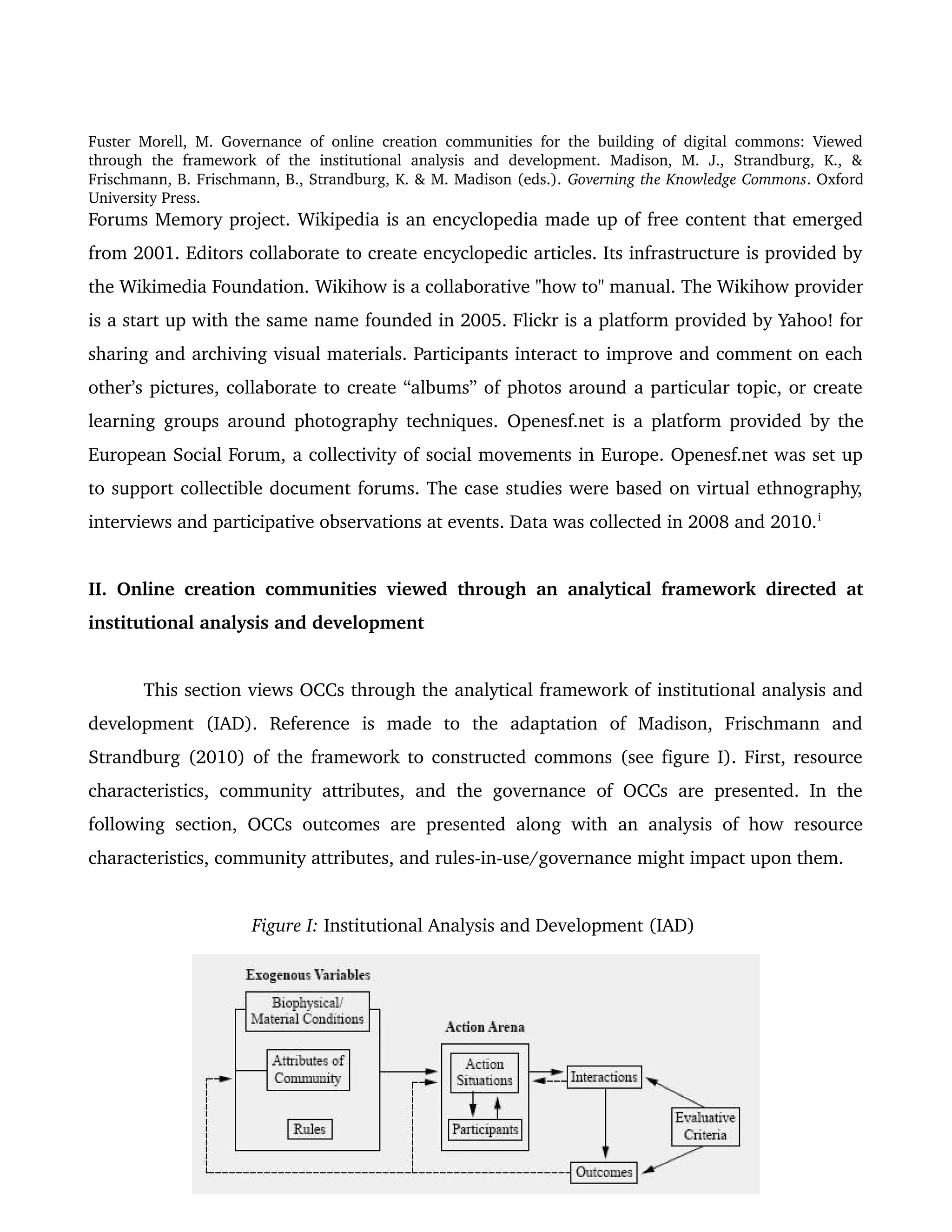
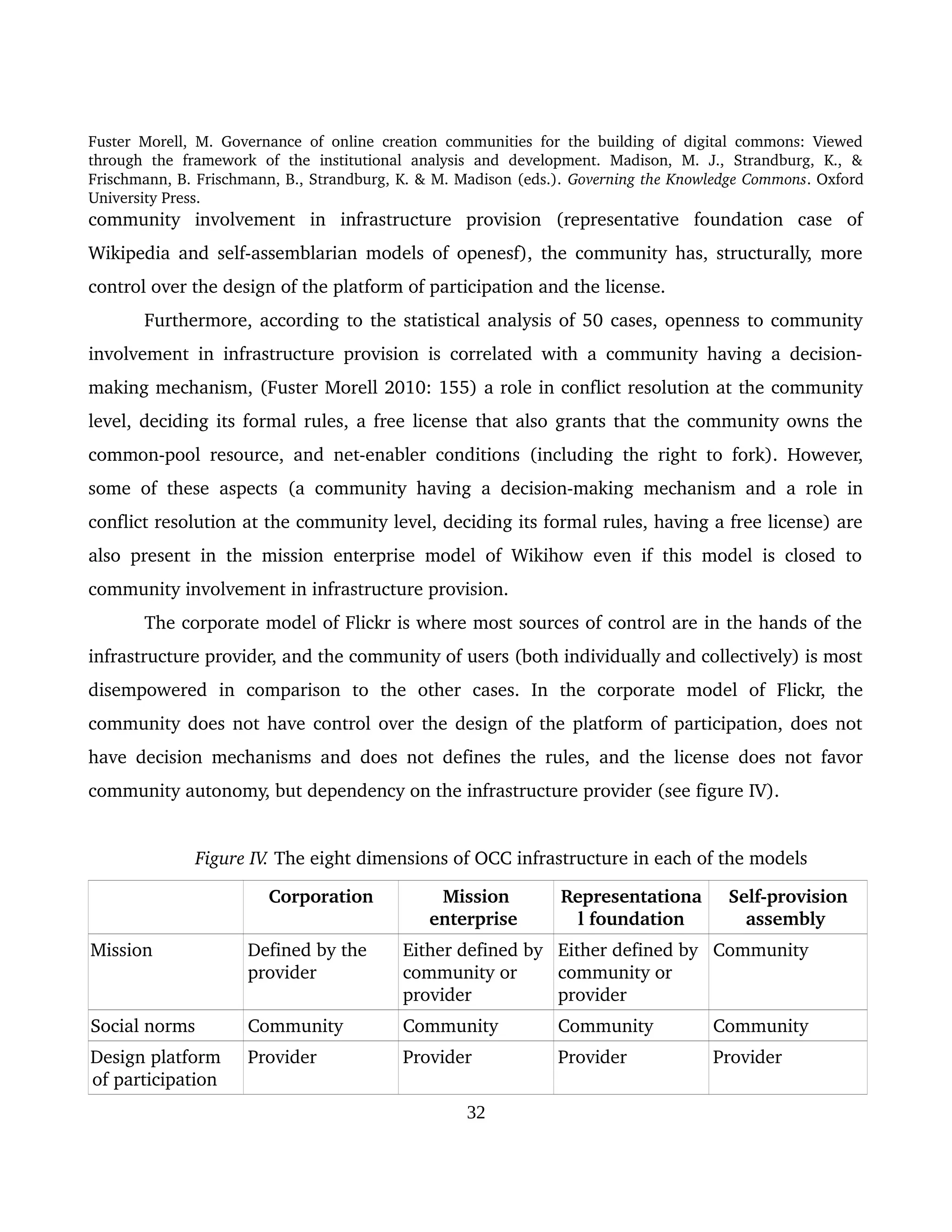
Strandburg (2010) of the framework to constructed commons (see figure I). First, resource 
characteristics, community attributes, and the governance of OCCs are presented. In the 
following section, OCCs outcomes are presented along with an analysis of how resource 
characteristics, community attributes, and rules­in­use/governance might impact upon them. 
Figure I: Institutional Analysis and Development (IAD) 
5
Fuster Morell, M. Governance of online creation communities for the building of digital commons: Viewed 
through   the   framework   of   the   institutional   analysis   and   development.   Madison,   M.   J.,   Strandburg,   K.,   & 
Frischmann, B. Frischmann, B., Strandburg, K. & M. Madison (eds.). Governing the Knowledge Commons. Oxford 
University Press.
Madison,   Frischmann   and   Strandburg   provide   a   characterization   of   the   cultural 
environment as being that within which commons construction emerges. They also recognize 
that the background environment for a particular commons may need further specification and 
analysis   in   order   to   situate   the   description,   classification   and   analysis   of   resource 
characteristics, community attributes, and governance institutions. In the analysis of OCCs, a 
specific environmental setting is involved and needs to be considered. The Internet is the 
specific environment within which OCCs emerge and their common­pool resource is hosted. 
The Internet as an environment is shaped by the digital culture, the technological constraints 
of virtual spheres, as well as the legal frameworks that regulate it. 
A.  Resource characteristics of OCCs 
The pooled resources in OCCs are not given resources that need to be “preserved” as in 
natural commons­pool resources. Rather, they are resources that need to be built. OCCs, 
indeed, arise from the collective goal of building a specific resource. The building process is 
characterized by the pooling of dispersed information and cognitive capacities  in evolving 
bodies of shared knowledge. The resource tends to be conceived of as a permanent work in 
progress, and in most of the cases, without a specific moment of definitive conclusion. 
The OCCs are immaterial in nature, consisting of information and knowledge. As public 
goods, they are non­rivalrous and non­excludable. Madison, Frischmann, and Strandburg 
(2010) classify constructed commons goals as existing in a milieu of Intellectual Property (IP) 
6
Fuster Morell, M. Governance of online creation communities for the building of digital commons: Viewed 
through   the   framework   of   the   institutional   analysis   and   development.   Madison,   M.   J.,   Strandburg,   K.,   & 
Frischmann, B. Frischmann, B., Strandburg, K. & M. Madison (eds.). Governing the Knowledge Commons. Oxford 
University Press.
rights, that is existing only because of the IP rights, or mediating among communities with 
different default norms. Most OCCs, including the four case studies considered here, fall into 
the first category, as they exist as part of IP rights. 
According   to   Madison,   Frischmann,   and   Strandburg   (2010)   cultural   commons   are 
diverse in terms of the level at which their pooled resources are most easily identifiable or 
recognized. OCCs form a case where pooled resources are easily identifiable – an archive that 
gathers   and   coherently   systematizes   the   contributions.   Indeed,   the   construction   of   an 
integrated and identifiable piece of knowledge is what distinguishes OCCs from other online 
communities such as networking  sites or communities of support or shared interest. An 
encyclopedia is the main common resource in the case of Wikipedia, a picture repository in the 
case of Flickr, how to manuals in the case of Wikihow, and organizational information linked to 
a forum in the case of Openesf. However, beyond their principal resources, all the cases 
agglutinate  other secondary  “pooled  resources”  which  deepen one another. For  example, 
Wikipedia is not only an encyclopedia, but also hosts a repository of audio­visual sources as a 
commons. Additionally, even if the knowledge resource is the central goal around which OCCs 
interact,   OCCs   also   depend   on   an   infrastructure   to   support   interaction,   and   so   an 
infrastructure architecture also results from the process. However, this is considered in deep, 
“infrastructure,”, meaning something that sustains the main goal, but is not itself the central 
goal of the process.  
 Schweik and English (2012) have previously attempted to apply IAD to OCCs in the 
specific case of FLOSS. Regarding resources characteristics, our approaches differ in two ways 
to Schweik and English. On the one hand, Schweik and English do not specify the type of 
resource. However, when analyzing diverse OCCs as is the case in this chapter, specifying the 
type of resource is appropriate. On the other hand, Schweik and English present as resources 
characteristics aspects, such as the participation platform design, that are integrated as part of 
governance, not as resources characteristics, in the present work. 
7
Fuster Morell, M. Governance of online creation communities for the building of digital commons: Viewed 
through   the   framework   of   the   institutional   analysis   and   development.   Madison,   M.   J.,   Strandburg,   K.,   & 
Frischmann, B. Frischmann, B., Strandburg, K. & M. Madison (eds.). Governing the Knowledge Commons. Oxford 
University Press.
B. Community attributes of OCCs 
It was pointed out above that pooled resources in OCCs are easily identifiable but that 
the same cannot be said of their communities. In terms of communities of constituents, OCCs 
are complex. OCCs are open to participation, and it is difficult to identify their boundaries. For 
none of the four case studies or in the sample of fifty cases of OCCs looked at herein, were 
clear boundaries or membership established. The communities of OCCs may include any 
person potentially willing to contribute to the common­pool resource or to use it. 
Community size
OCCs are generally open to participation, but such openness does not necessarily result 
in actual participation. The size of the community of participants depends substantially on the 
goal of each OCC, ranging from more broad to more restricted sets of interests.  One  rightly 
expects   that   an   encyclopedia   attracts   more   participants   than   a   site   organized   around 
visualization techniques. 
In terms of the participation in the four case studies, Wikipedia achieves a high level of 
participation. Almost 18 million registered users were part of Wikipedia in November 2012. 
Flickr also draws a large amount of  participation. In 2007, one  estimate put the Flickr 
community at 7.7 million users. (Negoescu and Gatica­Perez 2008) Wikihow has substantially 
fewer participants. As of April 2010, the number of registered Wikihow participants was 
around 213,204. 
The levels of participation at openesf.net are low, with less than 1200 people 
registered at their highest point.ii 
Voluntary engagement
8
Fuster Morell, M. Governance of online creation communities for the building of digital commons: Viewed 
through   the   framework   of   the   institutional   analysis   and   development.   Madison,   M.   J.,   Strandburg,   K.,   & 
Frischmann, B. Frischmann, B., Strandburg, K. & M. Madison (eds.). Governing the Knowledge Commons. Oxford 
University Press.
Participants in OCCs are volunteers. They do not have a contractual labor relationship 
with the community, even if some participants may make their contributions as part of their 
work outside the community. All four cases share this characteristic of voluntary participation. 
Notably, however, professional photographers who use Flickr as part of their work form a 
significant part of the Flickr population. (Burgess 2007)
As a consequence of the voluntary character of OCCs, each participant assumes the 
costs of participation. The participants are able to contribute according to their own resources 
of time, skills or money.  According to the civic voluntarism model, (Verba, Schlozman, and 
Brady 1995) resources are a key factor in understanding why some people participate whereas 
others do not. Resource­rich participants with free time, connectivity, skills and money can 
contribute more easily than those without such resources. And so the resource­rich tend to be 
disproportionately represented among participants. However, a lack of resources may not be 
the   only   explanatory   variable   behind   non­participation.  Even   people   with   the   necessary 
resources may decide not to participate for a variety of reasons such as questions of identity or 
personality. People who identify themselves as creative, for example, and/or are more used to 
public exposure may be more likely to participate. This is the case for younger generations. 
According   to   Preece,   Nonnecke   and   Andrews   (2004),   other   reasons   why   people   do   not 
participate in OCCs are as follows:   thinking that they were being helpful by not posting; 
wanting to learn more about the community before diving in;  not being able to use the 
software because of poor usability;  not liking the dynamics that they observed within the 
group; or feeling represented in what was said by other participants. 
Community heterogeneity
Several authors have pointed out that OCCs are very diverse in terms of the motivations 
9
Fuster Morell, M. Governance of online creation communities for the building of digital commons: Viewed 
through   the   framework   of   the   institutional   analysis   and   development.   Madison,   M.   J.,   Strandburg,   K.,   & 
Frischmann, B. Frischmann, B., Strandburg, K. & M. Madison (eds.). Governing the Knowledge Commons. Oxford 
University Press.
and interest that drive their participation. (e.g., Benkler 2006; Weber 2004) However, Schweik 
and English (2012) point out that their surveys of participants in FLOSS show a high level of 
homogeneity in terms of social composition, in concrete, in terms of gender (predominantly 
male), age (predominantly young) and geographical origin (predominantly Europe and USA). 
Our own analysis of gender distribution at openesf.net also shows that the predominance of 
male   participation   was   also   repeated   in   the   case   of  openesf.net,   where   36%   of   active 
participants are women according to their name or/and presentation in their user page. In the 
case of Wikipedia, previous research has concluded that women accounted for around 12% of 
the editor community. (Glott, Schmidt, and Ghosh 2009) According to Wikihow Inc, the 
Wikihow community has a higher women’s participation rate of around 40%. (Interview, 
Wikihow founder, 2008)  
External relationships
Madison,  Frischmann,  and  Strandburg  (2010)  suggest,  with  respect to  community 
attributes,   analyzing   external   relationships   of   community   and   common­pool   resources 
regarding markets, industries or firms. For the specific case of FLOSS, several studies have 
pointed out how corporations and foundations engage with the common­pool resource, which 
Schweik and English (2012, 15) refer to with the label “open­source ecosystem”. The external 
relationships of OCCs may explain their capacity to mobilize participation. However, research 
in this area is very limited, and there is not a unique pattern of interaction with markets, 
industries or firms.  In the cases presented here we can observe the development of “net 
districts” similar to an industrial district. OCCs that are part of a “net district” and cooperate 
with each other. This is the case of Wikipedia and Wikihow that adopt the same license or 
protocols to facilitate the flow of content and participation between their platforms. 
10
Fuster Morell, M. Governance of online creation communities for the building of digital commons: Viewed 
through   the   framework   of   the   institutional   analysis   and   development.   Madison,   M.   J.,   Strandburg,   K.,   & 
Frischmann, B. Frischmann, B., Strandburg, K. & M. Madison (eds.). Governing the Knowledge Commons. Oxford 
University Press.
C. Rules­in­use or governance of OCCs 
Ostrom (2005: 3) defines institutions (referred to herein as bodies with governance or 
rules­in­use) as “the prescriptions that humans use to organize all forms of repetitive and 
structured interactions.” Institutions raise and channel interaction among participants. They 
provide direction, control and coordination of the collective action. Institutions are set by 
social norms and formalized rules, together with the forms in which those rules are created 
and enforced. (Ostrom 2005)
The governance, or the direction, control and coordination of a process, is embedded or 
operates though aspects or points/sources of power. According to the analysis reported here, 
there   are   eight   main   aspects   that   are   in   a   complex   juxtaposition   or   interaction   which 
determine and drive governance in OCCs. The eight dimensions (that operate at the different 
operational, collective choice and constitutional levels) that give OCCs direction, control and 
coordination are: 
i) Collective mission or goal of the process.
ii) Cultural principles/Social norms. 
iii) Design of the platform of participation (where regulation is embedded in the code).
iv) Self­management of contributions: autonomous condition of participants in allocating 
their contribution to the building process. 
v) Formal rules or policies applied to community interaction.
vi) License. 
vii)Decision­making and conflict resolution systems with regard to community interaction.
viii) Infrastructure provision.iii
The   eight   dimensions   are   interrelated   rather   than   narrowly   discrete.   Additionally, 
governance is not “static”, but dynamic and might evolve over time. It might not be linear in its 
11
Fuster Morell, M. Governance of online creation communities for the building of digital commons: Viewed 
through   the   framework   of   the   institutional   analysis   and   development.   Madison,   M.   J.,   Strandburg,   K.,   & 
Frischmann, B. Frischmann, B., Strandburg, K. & M. Madison (eds.). Governing the Knowledge Commons. Oxford 
University Press.
evolution, with “incoherent” moves in the diverse aspects on occasion. 
Governance is very much shaped on the basis of how and who decides and manages 
these dimensions. Each of the dimensions might be managed in a more open to participation 
or inclusive way or not. They may encourage involvement or consideration of the views and 
interests of the participants as individuals and/or community as a whole. Or they may be 
contrasted by the infrastructure provider. Another important dimension is whether it is more 
decentralized / fragmented / ad hoc or more centralized and established.
Some of these aspects are similarly present in other forms of collective action, while 
others are specific to the OCCs. This might be connected to the background environment 
within which OCCs operate, particularly the functioning of the digital environment. OCCs take 
place in an environment that shapes them in terms of technical and legal constraints. The 
emerging governance of OCCs in this environment cannot be qualified as simple. Indeed it is a 
highly complex system.
In the following section each of these eight aspects will be presented in detail. 
i) Collective mission or goal of the process
In   general,   the   goal   or   mission   of   OCCs   is   building   and   sharing   a   common­pool 
resource. The specific mission is defined by the early participants or by the infrastructure 
provider. Then, the overall system is shaped by experiences with fulfillment of this initial 
mission. However, participants do not  need  to identify with the mission or the project as a 
whole in order to contribute. 
It is common in OCCs to define their goals in terms of a sentence that describes their 
mission. Wikipedia’s mission reads, "Imagine a world in which every single human being can  
freely share in the sum of all knowledge".  Wikihow’s mission is  "to build the world's largest, 
highest quality, free how­to manual in many languages".  Openesf.net does not have its own 
12
Fuster Morell, M. Governance of online creation communities for the building of digital commons: Viewed 
through   the   framework   of   the   institutional   analysis   and   development.   Madison,   M.   J.,   Strandburg,   K.,   & 
Frischmann, B. Frischmann, B., Strandburg, K. & M. Madison (eds.). Governing the Knowledge Commons. Oxford 
University Press.
mission, but is a "tool" for supporting the working groups in their roles within a much larger 
process, the ESF, whose goal or motto is that  "another world is possible".  Flickr’s mission is 
"Share your photos. Watch the world."
Generally, the mission is defined by the founder of the OCCs. In OCCs culture, the 
founders tend to be considered relevant and visible figures, especially with Wikipedia where 
there is just one. The role of the founder might change over time, from more central and with 
formal power, to less central or only symbolic, such as the case of Jimmy Wales for Wikipedia, 
or the founders of Flickr. In the case of Wikihow, the figure of the founder maintained its 
position over time, as owner of Wikihow Inc. In contrast, Openesf did not generate such a 
figure,   but   the   founders   of   the   process   are   connected,   keeping   their   position.   Giving 
importance to the figure of the founder is connected to a social norm (meritocracy) and is 
presented in the following section which considers importance given to values merited.
ii) Cultural principles/social norms 
There is a set of cultural principles and values that tend to be present transversally in 
the culture of OCCs. These also feed the way these eight dimensions are performed and 
function. Among these key principles are: openness and “freedom to operate”, meritocracy, and 
flexibility. Openness and “freedom to operate” without seeking permission or preclearance by a 
manager or property owner (in Benkler’s terms, 2006, 2013), might be present though the 
license that favors freedom to access and use the resource, or freedom though the openness of 
the process and the autonomy of the participants to allocate his or her own participation. 
Meritocracy or “doacracy” refers to valuing individuals on the base of the quantity and quality of their contributions, not on the basis of “who” 
they are in terms of external credentials or their opinions. Doacracy also refers to the tendency in some OCCs for whoever does something to 
also have authority over it. Flexibility refers to the methods or pre­established formats. OCCs tend to be more mission oriented – accomplish 
something – than method oriented – to do something in a particular manner. Benkler (2013) refers to this question by pointing to the “in­
determinity” of the governance of peer production. 
In the following section, further social norms will be presented, as they are also present 
13
Fuster Morell, M. Governance of online creation communities for the building of digital commons: Viewed 
through   the   framework   of   the   institutional   analysis   and   development.   Madison,   M.   J.,   Strandburg,   K.,   & 
Frischmann, B. Frischmann, B., Strandburg, K. & M. Madison (eds.). Governing the Knowledge Commons. Oxford 
University Press.
in the way the platform is designed. 
iii) Design of the platform of participation (where regulation is embedded in the code)
In OCCs,  it is relatively rare for individuals to be involved in direct dialogues and 
negotiations   amongst   themselves.   Instead,  individuals   interact   with   the   platform   design. 
Platform design thus influences participation and interaction. In this section, the design of the 
platform of participation and social norms is presented. As we will see from the analysis, the 
way in which the environment is designed by the code of the platforms is very much in line 
with the OCC’s social norms. 
The design of the participation platform is embedded and regulated in the code. Many 
diverse code programs can support a platform of participation. Here we present a set of 
principles embedded in the platforms that embody and guide participation in OCCs. The 
provision of the platform is controlled by the infrastructure provider. More or less involvement 
from   the   community   in   the   platform   design   depends   on   the   level   of   openness   of   the 
infrastructure providing community involvement. 
1. Openness 
1.1 Openness as it applies to the access to the resource 
Openness as applied to the access to the resource is defined by Madison, Frischmann 
and Strandburg (2010, 695) as “our capacity to relate to a resource by accessing and using it”. 
In terms of the conditions of access and use of the resources in OCCs, as we will see 
later, free licenses favor free use. Yet how the knowledge resources are actually made available 
also determines the possibility of accessing and using them. In this regard, it is common for the 
14
Fuster Morell, M. Governance of online creation communities for the building of digital commons: Viewed 
through   the   framework   of   the   institutional   analysis   and   development.   Madison,   M.   J.,   Strandburg,   K.,   & 
Frischmann, B. Frischmann, B., Strandburg, K. & M. Madison (eds.). Governing the Knowledge Commons. Oxford 
University Press.
common­pool resource in OCCs to be hosted by a participation platform made accessible in an 
open access condition. The open access condition of the resources should not however lead us 
to think they are not regulated, as they are. 
These knowledge resources are open access through their license and through being 
made openly available online. The open access condition of the resources does not imply 
openness when understood as the degree of control and intervention in decision making of 
those conditions. Deciding the license terms and how the resource is made available online are 
in the hands of the infrastructure provider. The level of openness to decision making about the 
conditions of use of the resources (as stated in the license and embedded in the platform of 
participation), here again, depends on the level of openness of the infrastructure provider. 
1.2 Openness as it applies to the community building the resource
Openness to interrelation and participation within the community for collaborative 
common­pool  resource   building  is   a  significant   principle  at  work  in   OCCs.   Openness   to 
participation is made operative through the provision of channels that allow intervention in 
content creation, as well as through the protocols that guide those channels. Protocols refer, 
for example, to low requirements for credentials to participate. 
According to the statistical analysis conducted for 50 cases, (Fuster Morell 2010) OCCs 
usually have an average of four different channels of participation (i.e., the possibility to add 
comments to a specific section of the content, upload materials, and edit Web pages, among 
others). The protocols that guide participation in OCCs appear to incentivize participation in a 
high percentage of the cases (i.e., 80% of the registration systems allow automatic registration 
without requiring any filter to become part of the platform). This contributes to lowering the 
transaction costs involved in becoming an active contributor.  In all of the four case studies 
discussed here, indicators for the importance of openness are present: they all employ easy to 
use technology and channels for open participation, and they do not ask for credentials or 
15
Fuster Morell, M. Governance of online creation communities for the building of digital commons: Viewed 
through   the   framework   of   the   institutional   analysis   and   development.   Madison,   M.   J.,   Strandburg,   K.,   & 
Frischmann, B. Frischmann, B., Strandburg, K. & M. Madison (eds.). Governing the Knowledge Commons. Oxford 
University Press.
other requirements in order to intervene. 
However, even if openness to participation is embedded in the technology of OCCs, not 
all OCCs are equally accessible. The level of inclusion of OCCs and the willingness or capacity 
to ensure there are no barriers to participation vary. For example, an analysis of OCC inclusion 
shows   OCCs   to   be   exclusive   in   terms   of   accessibility   for   people   with   relevant   physical 
disabilities. (Fuster Morell 2010)
The principle of openness to participation is not only embedded in the design of the 
platform of participation, it is also present in social norms. For instance, in OCC discourses, it 
is emphasized that the community is provided accessibility for participation. In this line, 
Wikipedia is presented as "the encyclopedia that anyone can edit".iv
 
2. Modularity and decentralized participation 
Another aspect embedded in the code of the platform of participation is the modular 
organization of the platform. Essentially, this involves splitting content into separate units 
(such as articles, software packages, thematic albums of pictures, etc.). The design of OCCs 
does not imply that all participants are involved in all projects or modules. Instead, and 
particularly as the OCC grows, there is a tendency for participation to split or fragment into 
projects or modules. Modularity favors the decentralization of activity. In addition, distributing 
tasks between modules favors increased participation. The participation of many people in a 
single (central) place could be more difficult to handle than that of many small groups. 
Modular design and the resulting decentralization of participation are features present in the 
Wikipedia, Wikihow and openesf.net cases. 
Concerning the Wikipedia case, activities which involve the entire Wikipedia community 
are extremely rare. Most of the activities of Wikipedia are based on interactions of small 
groups. The same finding was uncovered in the Wikihow case. In openesf.net, 41.5% of the 
16
Fuster Morell, M. Governance of online creation communities for the building of digital commons: Viewed 
through   the   framework   of   the   institutional   analysis   and   development.   Madison,   M.   J.,   Strandburg,   K.,   & 
Frischmann, B. Frischmann, B., Strandburg, K. & M. Madison (eds.). Governing the Knowledge Commons. Oxford 
University Press.
projects are composed by only one member, and projects with 3 members are the most 
frequent following this (20.8%). The Flickr case is different because its primary unit of content 
is not based on collective "projects" such as an article in Wikipedia, but on individual acts 
(uploading photos). In this regard, rather than decentralization as such, we find structural 
individualization at the base of the design of the participation platform. However, in Flickr too, 
we find the feature of the formation of separate groups around common interests. According to 
Sieberg, there were 300,000 groups on Flickr by 2007. (Sieberg 2007) 
3. Participation is mostly asynchronous and online
As presented in the previous section, participation is decentralized to projects in OCCs. 
Furthermore, it is not implied in terms of either the platform design or social norms that 
participants congregate at the same time within the platform. Asynchronous participation in 
the platform is common to all the case studies. 
One moment at which some participants might congregate at the same time and place is 
during   physical   encounters.   Even   if   OCCs   are   mainly   developed   online,   participants   do 
sometimes meet physically. In the Wikipedia and openesf.net cases, regular local meetings of 
participants are organized. Plus, both of these case study OCCs hold an annual meeting. 
Wikihow and Flickr participants meet much more infrequently.
4. Transparency of participation
OCCs are developed in public, indeed it would be accurate to say that OCCs  live  in 
public. The analysis of 50 cases of OCCs showed that in 88%  of the cases the content of 
communications among participants is publicly accessible. That is, it is possible to read the 
content of communications among participants without registering on the site. 
17
Fuster Morell, M. Governance of online creation communities for the building of digital commons: Viewed 
through   the   framework   of   the   institutional   analysis   and   development.   Madison,   M.   J.,   Strandburg,   K.,   & 
Frischmann, B. Frischmann, B., Strandburg, K. & M. Madison (eds.). Governing the Knowledge Commons. Oxford 
University Press.
The public, or transparent, character of the organizational process favors openness to 
participation. Public organizing also favors the training of new participants, and the building 
of trust. New participants can see how others perform some tasks. Finally, it also favors the 
autonomy and decentralization of participation and the coordination of participation without a 
predefined plan or a gatekeeper distributing roles. Participants themselves can identify where 
contributions are needed and to what level they wish to get involved. According to O'Mahony’s 
(2007: 148) research on FLOSS communities “a public or transparent development process is 
necessary to support decentralized decision­making so that a large body of people can learn  
enough to participate in decisions.” (O'Mahony 2007: 148)
In the Wikipedia case the whole drafting process, not only the resulting content, is 
visible to all. The channels that host the interaction (such as Wikis, mailing lists, meet­ups, 
etc.) are public by default. The same is true of Wikihow. In the case of openesf.net, each 
project creator may choose how public each project will be. They decide whether the project 
will be accessible to the general public, only to people registered at openesf.net, or only to 
members of that particular project. However, the majority of the projects have a public 
character. The same may be said concerning Flickr, albeit at an individual level. On Flickr, each 
individual   chooses   if   their   content   is   publicly   accessible   or   not   and,   thereby,   if   the 
communication surrounding the content is public or not. 
iv)   Self­management   of   contributions:   The   autonomous   condition   of   participants  in 
contributing to the building process 
As pointed out in the previous section, the design of the platform of participation 
determines, to a large degree, the type of interaction and actions that can be performed by 
participants. Still, the participants have great flexibility in terms of the types of activities they 
develop   and   degrees   of   involvement   they   undertake.  Participants   decide   their   level   of 
18
Fuster Morell, M. Governance of online creation communities for the building of digital commons: Viewed 
through   the   framework   of   the   institutional   analysis   and   development.   Madison,   M.   J.,   Strandburg,   K.,   & 
Frischmann, B. Frischmann, B., Strandburg, K. & M. Madison (eds.). Governing the Knowledge Commons. Oxford 
University Press.
commitment   and   how   they  want  to   contribute  freely   and  automatically  on  the  basis  of 
personal interests, motivations, resources and abilities. The distribution of participation is not 
based on centralized planning of user activities, but on decentralized, volunteers deciding for 
themselves. There is no gatekeeper or similar role in charge of prodding participants along in a 
particular direction. In the designed platform participants choose what to do. Participation is 
not   driven   by   command,   but   by   self­direction.   Additionally,   participants   "build"   or   "do". 
Participation is mainly based on implementing tasks by directly creating or editing content. 
This is not a major risk. Online interaction facilitates the undoing of actions, and so mistakes 
are not irreparable. This implies that there is no separation between decision­making and 
implementation, or between a delegation and an implementation body. Those who take care of 
a task also have the authority to decide about how to perform it. This form of participation 
opens up the idea of doography or "implementation democracy". Finally, the coordination of 
participation  is not  the  result  of  a  strict,  absolute  and   fixed   plan.  Rather  it is  open  to 
uncertainty and variation, based on principles of randomness and the serendipitous. 
This is so for the four case studies. That said, the Flickr platform is the most restrictive 
in terms of the types of activities that can be performed. Additionally, for some of the activities 
on Flickr, in contrast to the other cases, participants must pay for access, which may restrict 
access to some of the population.
High flexibility on the typology and degree of involvement
Not all participants necessarily carry out the same tasks. They choose among several, 
such as adding new content, editing content, and classifying content, among others. One 
person may contribute unedited information while another participant takes care of editing it 
and increasing its quality. Some tasks may require more effort and commitment than others, 
however, and in most cases, tasks are highly divided so that each participant can contribute 
19
Fuster Morell, M. Governance of online creation communities for the building of digital commons: Viewed 
through   the   framework   of   the   institutional   analysis   and   development.   Madison,   M.   J.,   Strandburg,   K.,   & 
Frischmann, B. Frischmann, B., Strandburg, K. & M. Madison (eds.). Governing the Knowledge Commons. Oxford 
University Press.
either just a small part of a module or a large part, facilitating the scaling of participation. 
Again, this must not be confused with a lack of structure. On the contrary the platforms are 
highly structured. There are also different levels of commitment to the platform in terms of 
time and active task performance. Participants’ freedom to decide their level of contribution 
results   in  a  very   common   distribution   feature   in   OCCs.   Research   on   the  distribution  of 
participation suggests a very unequal distribution known as the 90/9/1 principle or a power 
law. (Hill, Hollan, Wroblewski, and McCandless 1992; Nielsen 1997) 90% of visitors to OCCs 
tend to be lurkers who read or observe but never contribute, 9% contribute a little from time 
to time, and 1% contribute often and account for almost all the content and system activity. 
(Nielsen, 2006) In other words, there are three main profiles of participation: strong or very 
active, weak, and non­participant, each playing a role. Very active participants have a high 
degree of commitment to the process and dedicate a great deal of time and a large volume of 
work   or   complex   effort   to   it.   Low   level   participants   are  people   who   contribute   only 
sporadically.   Weak   participation   may   favor   greater   connectivity   of   the   OCC   with   other 
processes. Weak ties favor reaching larger areas of information. (Granovetter 1983) Beyond 
strong and weak participation, non­participation or unintended participation is also present 
and plays a role. 
Non­participation could be characterized as free riding behavior. However, free riding, 
and   in   general   the   fact   that   a   large   percentage   of   people   do   not   contribute,   does   not 
necessarily constitute a problem or put at risk the achievement of the common goals of OCCs.v 
With exhaustible goods, such as natural resources which can be “used up” and are costly to 
extract, free riding constitutes a problem. But in a context where ICTs have substantially 
decreased the cost of reproduction of information and information­based goods, like those 
provided by OCCs, OCCs do not necessarily face scarcity problems linked to the resource use. 
When goods are non­exhaustible, non­competitive and exclusion from their use is costly, then 
free riding is not necessarily a problem. It has even been said that OCCs are anti­rival. (Weber, 
20
Fuster Morell, M. Governance of online creation communities for the building of digital commons: Viewed 
through   the   framework   of   the   institutional   analysis   and   development.   Madison,   M.   J.,   Strandburg,   K.,   & 
Frischmann, B. Frischmann, B., Strandburg, K. & M. Madison (eds.). Governing the Knowledge Commons. Oxford 
University Press.
2004) They are not  only  non­rival in the sense that they can tolerate free riding without 
reducing their stock of value, but are actually anti­rival in the sense that OCCs positively 
benefit from free riders. That is, ironically, the  comedy of the commons, the value of the 
outcome of OCCs increases when more people use them. (Frischmann 2012; Rose 1994) This 
implies that for any participant, contributor or "free rider", mere "use" implies a contribution. 
Nevertheless, this is only so where there is a sufficient number of contributors that assure the 
building of the resource.
The value of the information resources resulting from OCCs increases through several 
mechanisms as more people "use" them. First, non­participants contribute due to positive 
network effects. A network effect is that effect that one participant in an OCC has on the value 
of that OCC for other people, even if this was not intentional. When network effects appear 
more people become involved in an OCC, and the more valuable it becomes. For example, as 
more people use Flickr as a tool to connect with others, the more valuable it becomes since 
users can potentially connect with a larger number of people through it.
Second, in online environments most actions are translated into digital information, 
known as digital threads, and the elaboration of these digital threads form a source of very 
valuable information for the improvement of content and the functioning of the environment. 
They can provide, for example, relational and attention data. The environment can learn about 
the connections between content according to how users navigate, or the number of times an 
article was visited or downloaded could be used as an indicator of the quality of that article. 
Third, non­participants also play a role as an audience. Free rider audiences increase the 
relevance and value of a platform’s content and increase the motives for participation. 
Finally, it is also worth considering that even though exclusion is present in OCCs, 
restricting access to non­participants can be costly. Technically this might be challenging. 
Additionally, digital culture values “simple”, “easy­to­use” solutions. To incorporate filters 
might constitute an additional step that reduces the simplicity of the system and restricts its 
21
Fuster Morell, M. Governance of online creation communities for the building of digital commons: Viewed 
through   the   framework   of   the   institutional   analysis   and   development.   Madison,   M.   J.,   Strandburg,   K.,   & 
Frischmann, B. Frischmann, B., Strandburg, K. & M. Madison (eds.). Governing the Knowledge Commons. Oxford 
University Press.
openness.  
The distinction between strong/weak/non­participants is also present in the four case 
studies. 
Previous analyses of Wikipedia have addressed the question of participation distribution 
and showed that contributions to Wikipedia also present strong inequalities. Ortega and 
Gonzalez­Barahona  (2007)  and  Ortega (2009) conclude  that less  than 10%  of  the total 
number of authors are responsible for more than 90% of the total number of contributions or, 
conversely, 90% of active editors are responsible for less than 10% of the total number of 
contributions. The evolution of this inequality has remained very stable over time (with a 
typical value of between 80% and 85% of content produced by a "core team"). However, the 
authors also point out that the “core team” of very active participants is not necessarily formed 
by the same individuals over time. 
Concerning the Wikihow case, from the analysis of a random day, it emerged that the 
top   ten   participants   were   responsible   for   almost   half   of   the   content   produced   that   day 
(46.5%).vi
 Wikihow interviewees reported a similarly unequal distribution of participation as 
that found in Wikipedia. (B. Megas, Interview, August 28, 2009; N. Willson, Interview, August 
28, 2009) In the words of Wikihow’s founder: "Wikihow follows power law. . . . You have to 
support the very minimal contribution or the very small contributions of people who wouldn’t  
actually interact with it – while it’s not obvious that they create value for the whole, they really  
do. So you need to allow the whole thing, so the ecosystem flourishes and can be successful." (J. 
Herrick, Interview, December 4, 2008)
Shirky   reports   that   the   top   ten   participants   among   the   total   118   contributors 
contributed half of the content on an event uploaded on Flickr. (2008: 123) The analysis of 
openesf.net   showed   that   18%   of   the   participants   generated   content   and   82%   of   the 
participants did not. Within the 18% of content generators, 3.7% were very active participants 
and 14.3 % were less active participants. 
22
Fuster Morell, M. Governance of online creation communities for the building of digital commons: Viewed 
through   the   framework   of   the   institutional   analysis   and   development.   Madison,   M.   J.,   Strandburg,   K.,   & 
Frischmann, B. Frischmann, B., Strandburg, K. & M. Madison (eds.). Governing the Knowledge Commons. Oxford 
University Press.
This unequal distribution of participation does not seem to be interpreted as a problem 
in OCCs. On the contrary, equal participation and contributions are not expected. GerardM, an 
active wikipedian, spoke out in a mailing list against the idea of regular equal contributors and 
for valuing all community forms: “When you divide people up in groups, when you single out the  
‘most valuable’" ones (because they contribute more), you in effect divide the community. . . .  
When you label groups of people, you divide them and it is exactly the egalitarian aspect  
(independently of their contribution) that makes the community thrive.” (GerardM e­mail to the 
mailing list Wiki­research­l, October 21, 2008) Additionally, from an outcomes perspective, the 
Wikipedia community accomplishes its goal. Wikipedia is the largest encyclopedia in history. 
Sue Gardner, executive director of the Foundation, puts it in these terms: "We need sufficient 
people   to   do   the  work   that  needs   to   be   done.   (...)   But   the  purpose   of   the   project   is   not  
participation." (Angwin and Fowler 2009) There does not seem to be a problem with a lack of 
participation in Wikipedia. On the contrary, in some instances problems linked to "too much 
participation" occur. This happens when levels of participation are so high that technically the 
system is not able to sustain the amount of activity and collapses. This occurred after the 11 
September 2001 attacks and Obama’s election, when many people wanted to keep Wikipedia 
updated. (T. Finc, Interview, November 20, 2009) 
v) Formal rules or policies applied to community interaction
OCCs, particularly as they evolve from more initial stages, tend to establish formal 
rules. Formal rules may be restricted and limited to rules defined by the legal framework in 
which the OCCs operates (terms of use and license), or they may be more or less expansive 
including a set of principles or complex bureaucratic policies. However, O'Mahony (2003) 
points   out   that   developers   in   FLOSS   resist   formal   methods.   The   existence   of   too   many 
established rules and procedures is generally perceived  as problematic in OCCs.  Benkler 
23
Fuster Morell, M. Governance of online creation communities for the building of digital commons: Viewed 
through   the   framework   of   the   institutional   analysis   and   development.   Madison,   M.   J.,   Strandburg,   K.,   & 
Frischmann, B. Frischmann, B., Strandburg, K. & M. Madison (eds.). Governing the Knowledge Commons. Oxford 
University Press.
(2013) points to a relative feature in the non­definitive character of governance mechanism in 
peer production: even with formal rules, there is also the social norm that a rule can be broken 
if that makes sense for fulfilling a task. 
Lanzara and Morner (2003) pointed out that it is not that traditional mechanisms of 
governance   and   coordination   are   non­existent   or   irrelevant   in   OCCs.   In   this   sense,   the 
governance of FLOSS projects results in a combination of formal organizational mechanisms 
and decentralized and spontaneous mechanisms for the community platform. (Lanzara and 
Morner 2003) According to these authors, the presence of formal organizational features, 
however, does not really play a dominant or pervasive role in FLOSS projects, and taken alone 
would not be strong enough to account for the impressive performance of large size projects. 
In terms of the possibility to control and intervene in the definition of rules, on some 
occasions rules (and when applied roles) are defined by the communities. According to the 
analysis of 50 cases, in 51% of cases it is the community that is considered to be in charge of 
deciding policies and the distribution of tasks and  roles. In the rest of the cases, rules are 
defined by the infrastructure provider. 
  In   the   cases   of   Wikipedia,   openesf.net   and   Wikihow,   the   approach   is   that   the 
community is in charge of defining policies, and also of choosing the people to fulfill roles 
where these are created, such as site administrators. 
In the case of Wikipedia, the community collaborates in wiki pages to define common 
policies and administrators are chosen through elections. However, there is a general feeling 
among the participants that there are too many policies and that their overwhelming number 
results in the exclusion of new participants. (Lih 2009) 
Wikihow follows the same approach as Wikipedia, although the Wikihow case sees 
more intervention from the provider. For example, administrators are not selected by the 
community but by the provider. 
In the case of openesf.net, there is no distinction between providers and community and 
24
Fuster Morell, M. Governance of online creation communities for the building of digital commons: Viewed 
through   the   framework   of   the   institutional   analysis   and   development.   Madison,   M.   J.,   Strandburg,   K.,   & 
Frischmann, B. Frischmann, B., Strandburg, K. & M. Madison (eds.). Governing the Knowledge Commons. Oxford 
University Press.
so all infrastructure governance is based on community self­governance. However, these were 
defined during physical meetings of the web team charged with maintaining openesf.net, not 
by the openesf.net platform participants as the platform did not generate enough participation 
to develop a community dynamic of interaction.
In the case of Flickr, although each individual can choose conditions of access and other 
aspects that will apply to the content they generate, participants cannot decide the policies and 
rules of overall interaction. Furthermore, no roles or responsibilities for the maintenance of the 
platform are assigned to participants. Importantly, there is no collective decision­making over 
the  roles  and   rules  of  the  platform,  these  are  defined   by  Yahoo!.   In this  regard,  Flickr 
participation does not imply participation in governance in terms of defining the rules that 
govern community interaction. 
vi) License (of the common­pool resource and code) 
The license is a foundational rule in OCCs in the sense that it defines the resource 
management regime for the common­pool resource, the resources contributed and shared. The 
license also mediates the relationships between the constructed commons regime and the 
intellectual   property   regimes,   where   relevant.   There   are   various   types   of   licenses   (from 
copyright, to several options of creative commons licenses that are more flexible on users’ 
rights,   and   others).   The   license   applies   to   both   the   common­pool   resource   (and   the 
contributions of the participants) and the software code of the platform of participation. 
Most OCCs in this study adopted free licenses for their content (68.1% of cases). (Fuster 
Morell 2010) This favors the free use of the common­pool resource by all and the freedom to 
use the resources under less restrictive conditions. Additionally, where the software is also free 
(78% of the cases), this means that the platform of participation may be replicated somewhere 
else independently of the infrastructure provider. In this case, content can be moved, and it is 
25
Fuster Morell, M. Governance of online creation communities for the building of digital commons: Viewed 
through   the   framework   of   the   institutional   analysis   and   development.   Madison,   M.   J.,   Strandburg,   K.,   & 
Frischmann, B. Frischmann, B., Strandburg, K. & M. Madison (eds.). Governing the Knowledge Commons. Oxford 
University Press.
possible to re­launch interaction in a different context. This is known as forking. Forkability 
empowers the community with respect to the infrastructure provider as the community can 
leave and start interacting somewhere else. (Weber 2004)  However, not all OCCs have the 
conditions that allow this. 
Wikipedia, Wikihow and openesf.net are all based on FLOSS and collective free licenses, 
and are therefore forkable. Flickr is based on individually defined licenses and proprietary 
software – its content is only free insofar as individual participants choose free licenses for 
their content. 
vii) Decision­making and conflict resolution systems in community interaction
Governance   of   OCCs   depends   on  decision   making   institutions,   including   conflict 
resolution. Consensus decision­making is common in OCCs, yet they are also characterized by 
the pluralism of methods or polymorphism that involves the coexistence of several working or 
decision­making styles. This implies that there is no single way to solve all the situations of the 
platform, but a flexible approach that adopts several methods. The methodological pluralism 
of OCCs may appear to signal a lack of coherence in the overall system. However, for some 
researchers, this apparently chaotic diversity becomes a powerful resource for knowledge 
making and innovation. (Brown and Duguid 1991) The plurality of methods is also linked to 
the fact that OCCs tend to select methods according to their effectiveness in fulfilling their 
mission.  The famous FLOSS catchphrase,  "rough consensus and running code"  captures the 
sense that actions which contribute to the accomplishment of the mission are more valuable 
than the precise use of a method. 
In terms of polymorphy or plural methods, in Wikipedia most activity is primarily based 
on open groups on specific articles using consensus decision­making. However, the community 
combines this with a heterogeneous, sometimes secondary, mechanism to  force decision­
26
Fuster Morell, M. Governance of online creation communities for the building of digital commons: Viewed 
through   the   framework   of   the   institutional   analysis   and   development.   Madison,   M.   J.,   Strandburg,   K.,   & 
Frischmann, B. Frischmann, B., Strandburg, K. & M. Madison (eds.). Governing the Knowledge Commons. Oxford 
University Press.
making, block the violation of policies and contain the process within certain margins. On 
some occasions alternative forms of decision­making such as polls and voting are adopted. 
There are also administrators with particular powers, tasks assigned historically to respected 
individuals and a charismatic leader (the founder). 
In terms of plural methods Wikihow follows a similar approach to Wikipedia. Openesf 
uses mainly consensus decision making. Flickr is different to the other cases because the norms 
and   in   general   the   overall   governance   system   are   not   defined   by   the   community   of 
participants, but by Yahoo! as Flickr’s provider. 
viii) Infrastructure provision (technically, legally and economically sustains the platform 
of participation)
Infrastructure provision solves some of the other questions OCCs raise, and very much 
define the process and shape OCCs governance.  Frischmann  (2012) has also approached 
infrastructure in terms of its management as a commons. Infrastructure providers technically, 
legally and economically sustain the platform of participation where the community interacts. 
It involves the management of the  servers and domain name, and covering the costs these 
involve, among others.  O'Mahony (2007)  and Lanzara and Morner (2003)  have researched 
provision in the case of FLOSS. However, previous analyses of OCCs have dedicated little 
attention to this issue and infrastructure governance is considered a “backstage” question in 
OCCs. 
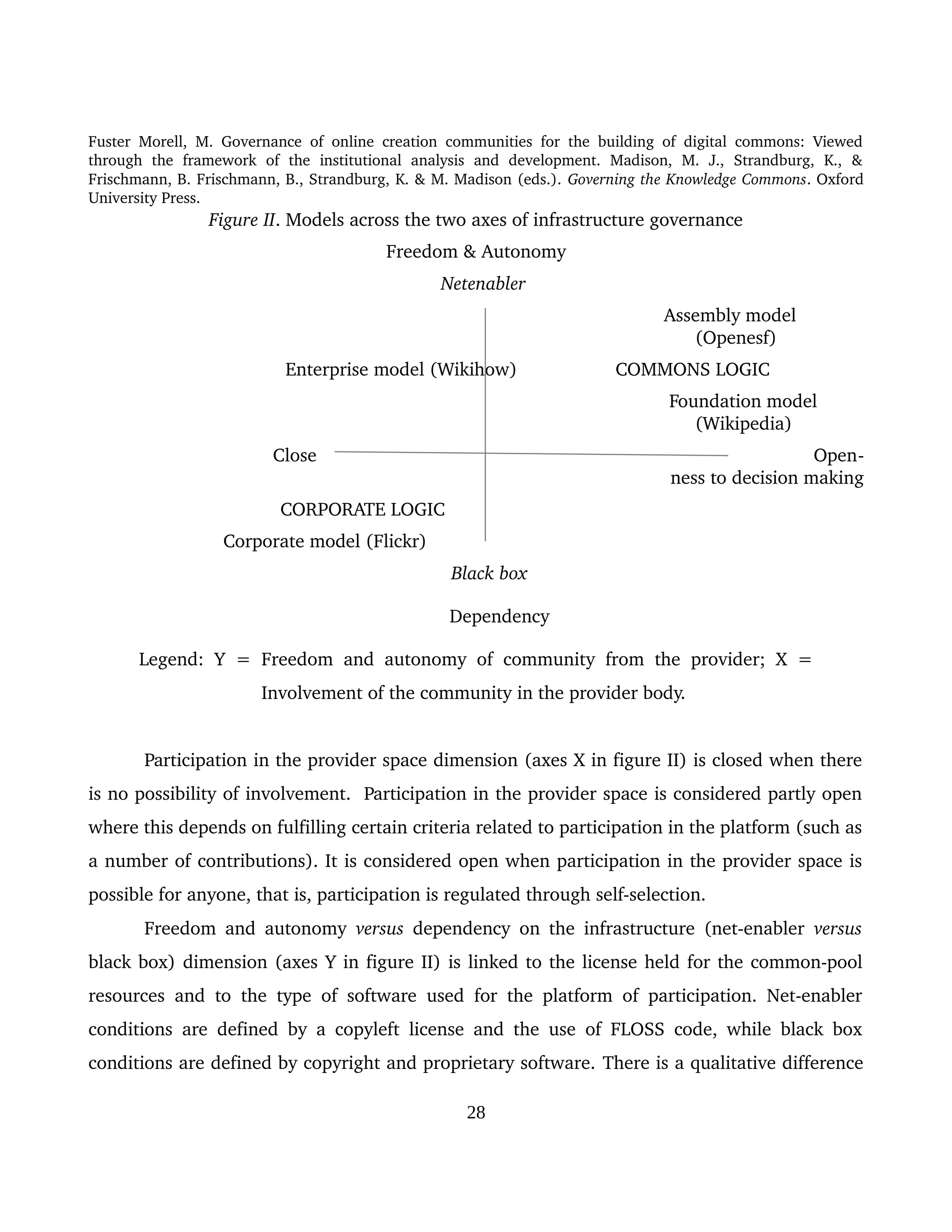
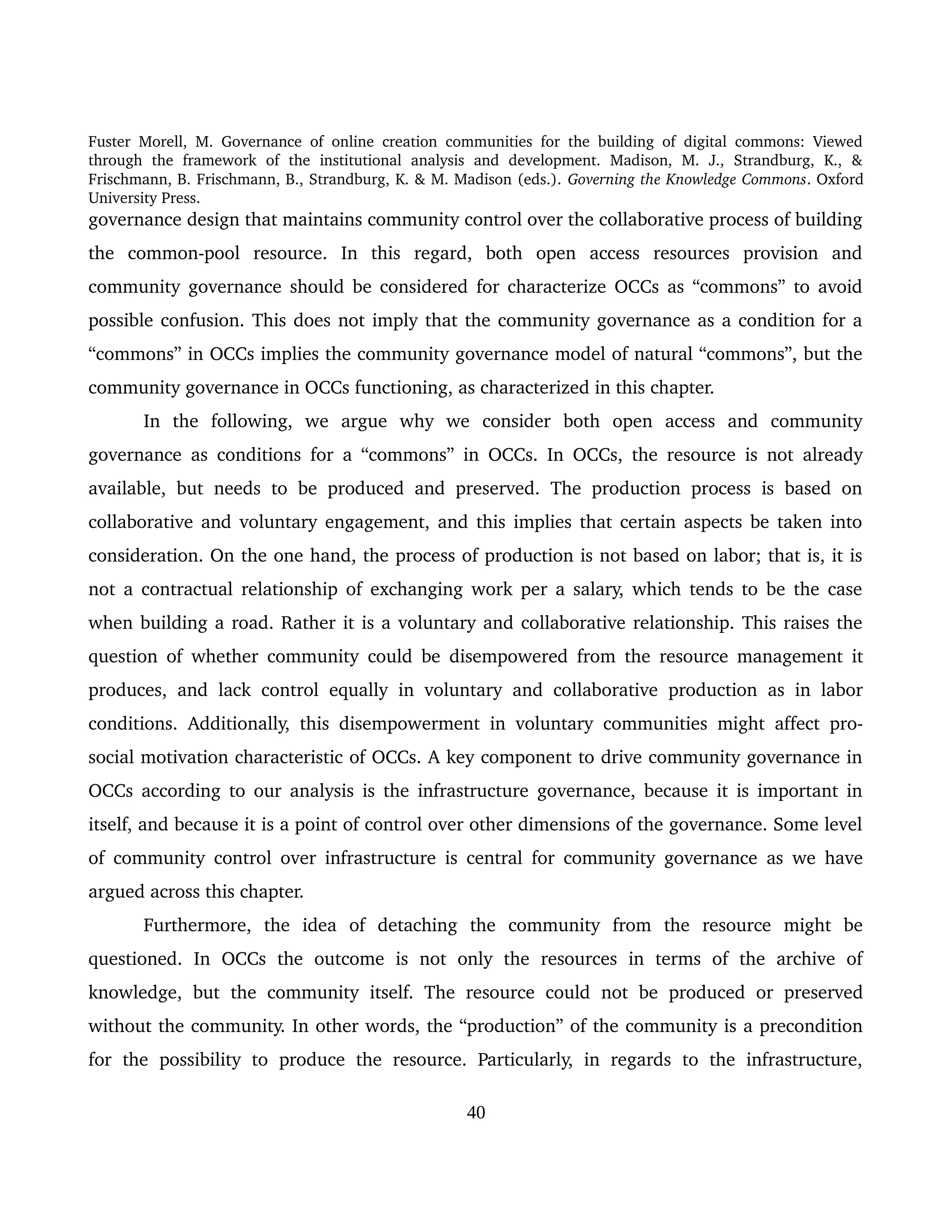
Infrastructure provision can function and be governed in diverse ways. Two main axes 
concerning infrastructure provision strategies can be distinguished: open  versus  closed to 
community   involvement   in   infrastructure   provision,   and   freedom   and   autonomy  versus 
dependency on infrastructure (see figure II). 
27
Fuster Morell, M. Governance of online creation communities for the building of digital commons: Viewed 
through   the   framework   of   the   institutional   analysis   and   development.   Madison,   M.   J.,   Strandburg,   K.,   & 
Frischmann, B. Frischmann, B., Strandburg, K. & M. Madison (eds.). Governing the Knowledge Commons. Oxford 
University Press.
Figure II. Models across the two axes of infrastructure governance
Freedom & Autonomy
                                                                    Netenabler
                                                                                                               Assembly model 
(Openesf)
                                      Enterprise model (Wikihow)                   COMMONS LOGIC
                                                                                                                Foundation model 
(Wikipedia)
                                  Close                                                                                                Open­
ness to decision making
                                     CORPORATE LOGIC
                          Corporate model (Flickr)
                                                                      Black box
         Dependency
Legend:  Y  =  Freedom  and  autonomy  of  community  from  the  provider;  X  = 
Involvement of the community in the provider body. 
Participation in the provider space dimension (axes X in figure II) is closed when there 
is no possibility of involvement.  Participation in the provider space is considered partly open 
where this depends on fulfilling certain criteria related to participation in the platform (such as 
a number of contributions). It is considered open when participation in the provider space is 
possible for anyone, that is, participation is regulated through self­selection. 
Freedom and autonomy  versus  dependency on the infrastructure (net­enabler  versus 
black box) dimension (axes Y in figure II) is linked to the license held for the common­pool 
resources and to the type of software used for the platform of participation. Net­enabler 
conditions are defined by a copyleft license and the use of FLOSS code, while black box 
conditions are defined by copyright and proprietary software. There is a qualitative difference 
28
Fuster Morell, M. Governance of online creation communities for the building of digital commons: Viewed 
through   the   framework   of   the   institutional   analysis   and   development.   Madison,   M.   J.,   Strandburg,   K.,   & 
Frischmann, B. Frischmann, B., Strandburg, K. & M. Madison (eds.). Governing the Knowledge Commons. Oxford 
University Press.
between relational settings in which the OCCs is “locked” into the platform, and those where 
the community interaction is free and autonomous with respect to the platform. If the platform 
cannot be reproduced, the community relationship is "closed" within the specific platform 
which is dependent on the provider. If the platform can be replicated (can be forkable), the 
relationships are free from the specific platform provider. FLOSS and copyleft licensing allow 
platforms to be replicated, while proprietary software and  restrictive or less open copyright 
license regimes  do not. In other words, the use of FLOSS and a copyleft license creates 
conditions in which the community can have greater autonomy and freedom from the platform 
provider. 
An  analysis  of   how   50   cases   perform   on  the  two   specified   axes  of   infrastructure 
governance was developed. (Fuster Morell 2010) From the analysis resulted four clusters of 
cases. These four provision models can be defined: corporation service (which is the case of 
Flickr), mission enterprise (Wikihow), autonomous representational foundation (Wikipedia) 
and assemblarian self­provision models (openesf.net) (see figure II).
The corporation model applies to cases of infrastructure platforms owned by companies 
with large pools of technological skills such as Yahoo!, the provider of Flickr. The corporate 
model of infrastructure governance is characterized by a provider body closed to participant 
involvement and based on black box conditions. It follows a for­profit strategy. Participants are 
“trapped”   in   the   platform   (unless   they   exit),   as   the   copyright   and   proprietary   software 
framework restricts the freedom and autonomy of the participants in the platform. 
The mission enterprise model is characterized by being for­profit, and hence closed to 
participant involvement. Importantly, the enterprise model is based on net­enabler conditions, 
which favor the autonomy of collaboration. Furthermore, according to the statistical analysis, 
the enterprise model is characterized by more net­enabler conditions than the foundation 
model. The enterprise  model applies to  startups  which  maintain  independence from big 
communications companies. It is a strategy for developing new business models which are 
29
Fuster Morell, M. Governance of online creation communities for the building of digital commons: Viewed 
through   the   framework   of   the   institutional   analysis   and   development.   Madison,   M.   J.,   Strandburg,   K.,   & 
Frischmann, B. Frischmann, B., Strandburg, K. & M. Madison (eds.). Governing the Knowledge Commons. Oxford 
University Press.
compatible with net­enabler conditions. This is the case of Wikihow.
The autonomous representational foundation model is characterized by a provider body 
which is (relatively) open to participant involvement as it uses some formal filters. This model 
is also characterized by promoting the freedom and autonomy of collaboration (net­enabler). 
Additionally, they are non­profit. Being relatively open to participant involvement implies that 
they are formal and involve some requirement to take part, not based only on the self­selection 
of participants. In this regard it can be considered a hybrid form (partly open, partly closed). 
OCCs following this model are less open than the assembly model, which is based on total 
openness   of   the   provision   body.   They   are   also   less   net­enabler   than   the   assembly   and 
enterprise models. The foundation model comprises the case of Wikipedia. O'Mahony (2007) 
researched the governance of FLOSS communities via case studies based on the autonomous 
representation   foundation   model   (2007).   She   characterized   the   foundation   model   as 
community management. However, she left the questions of the characteristics of governance 
models other than community management and the degree to which community management 
can be applied to types of providers other than open foundations.        
The self­provision assembly model is characterized by being the most open in terms of 
provision. A self­selected community of participants can be part of the provision body in this 
model. It follows an informal organizing logic (without a board or legal entity) and is non­
profit oriented. Additionally, the assembly model assures the most net­enabler conditions. The 
assembly model applies to openesf.net.
III. Models of OCCs governance
In the previous sections, the eight dimensions that give direction and govern OCCs were 
presented. In this section, we present how these eight dimensions link one another. 
The analysis of the juxtaposition or interaction between the eight dimensions reveals 
30
Fuster Morell, M. Governance of online creation communities for the building of digital commons: Viewed 
through   the   framework   of   the   institutional   analysis   and   development.   Madison,   M.   J.,   Strandburg,   K.,   & 
Frischmann, B. Frischmann, B., Strandburg, K. & M. Madison (eds.). Governing the Knowledge Commons. Oxford 
University Press.
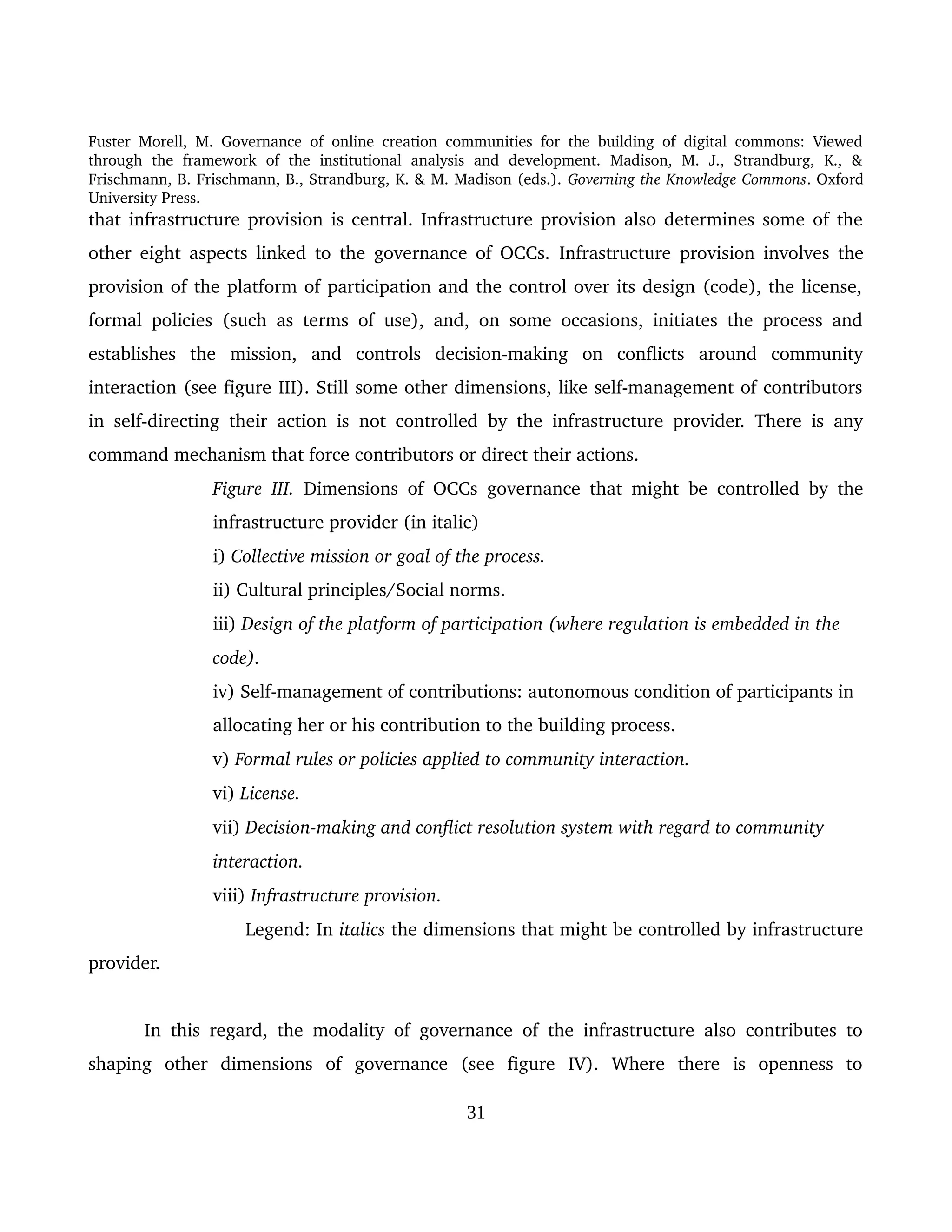
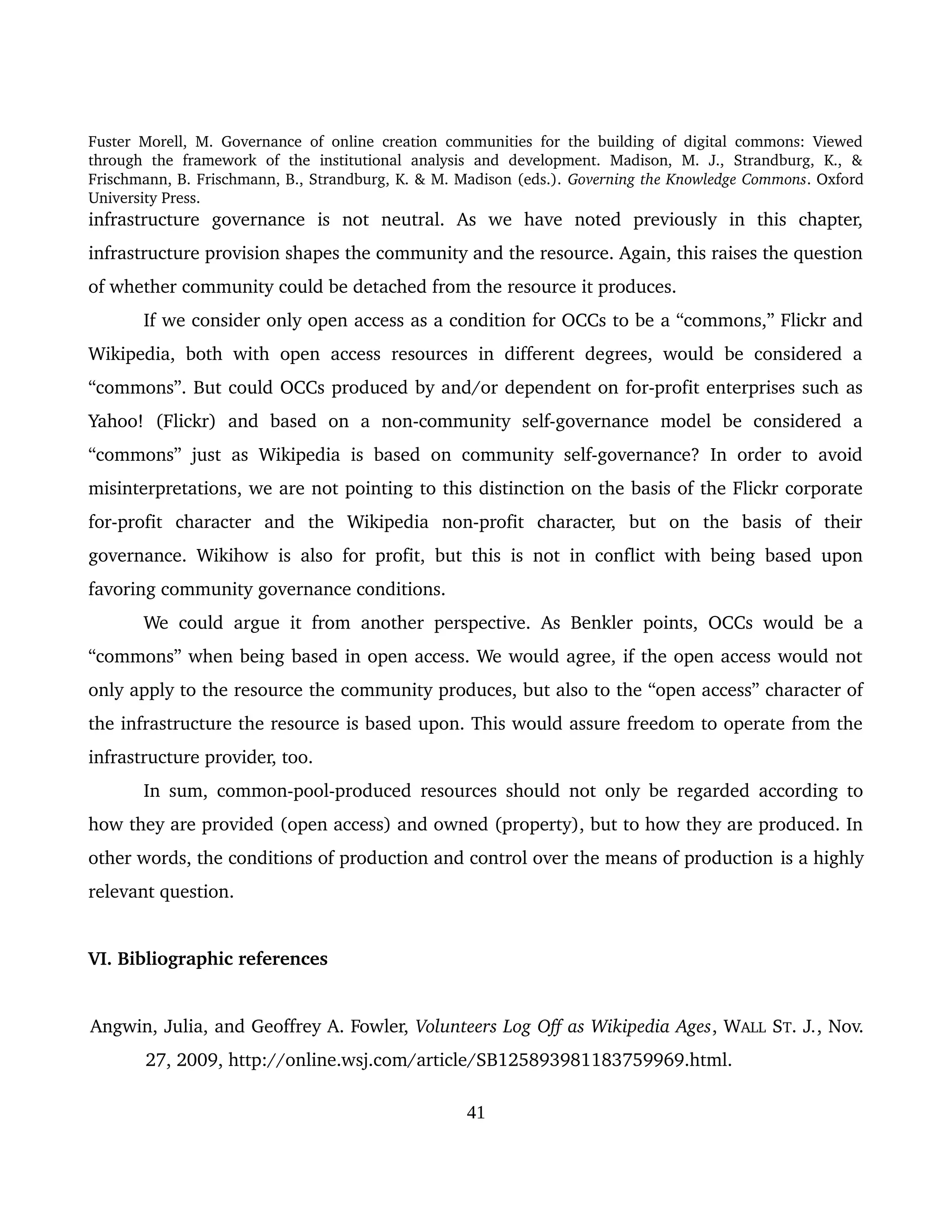
that infrastructure provision is central. Infrastructure provision also determines some of the 
other eight aspects linked to the governance of OCCs.  Infrastructure  provision involves the 
provision of the platform of participation and the control over its design (code), the license, 
formal policies (such as terms of use), and, on some occasions, initiates the process and 
establishes   the   mission,   and   controls   decision­making   on   conflicts   around   community 
interaction (see figure III). Still some other dimensions, like self­management of contributors 
in self­directing their action is not controlled by the infrastructure provider. There is any 
command mechanism that force contributors or direct their actions. 
Figure III.  Dimensions of OCCs governance that might be controlled by the 
infrastructure provider (in italic)
i) Collective mission or goal of the process.
ii) Cultural principles/Social norms. 
iii) Design of the platform of participation (where regulation is embedded in the 
code).
iv) Self­management of contributions: autonomous condition of participants in 
allocating her or his contribution to the building process.
v) Formal rules or policies applied to community interaction.
vi) License. 
vii) Decision­making and conflict resolution system with regard to community 
interaction.
viii) Infrastructure provision. 
                          Legend: In italics the dimensions that might be controlled by infrastructure 
provider. 
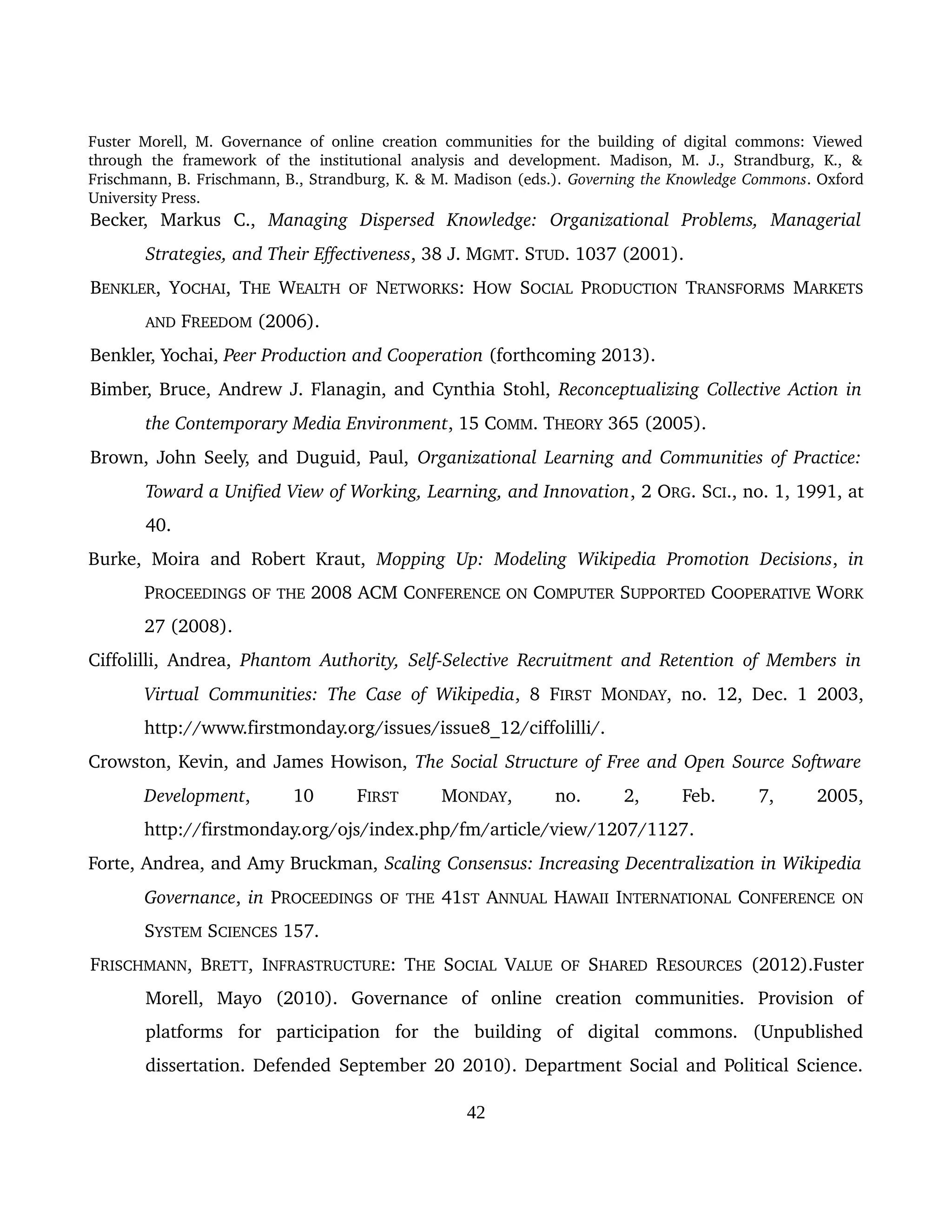
In this regard, the modality of governance of the infrastructure also contributes to 
shaping   other   dimensions   of   governance   (see   figure   IV).   Where   there   is   openness   to 
31
Fuster Morell, M. Governance of online creation communities for the building of digital commons: Viewed 
through   the   framework   of   the   institutional   analysis   and   development.   Madison,   M.   J.,   Strandburg,   K.,   & 
Frischmann, B. Frischmann, B., Strandburg, K. & M. Madison (eds.). Governing the Knowledge Commons. Oxford 
University Press.
community   involvement   in   infrastructure   provision   (representative   foundation   case   of 
Wikipedia and self­assemblarian models of openesf), the community has, structurally, more 
control over the design of the platform of participation and the license. 
Furthermore, according to the statistical analysis of 50 cases, openness to community 
involvement in infrastructure provision is correlated with a community having a decision­
making mechanism, (Fuster Morell 2010: 155) a role in conflict resolution at the community 
level, deciding its formal rules, a free license that also grants that the community owns the 
common­pool resource, and net­enabler conditions (including the right to fork). However, 
some of these aspects (a community having a decision­making mechanism and a role in 
conflict resolution at the community level, deciding its formal rules, having a free license) are 
also present in the mission enterprise model of Wikihow even if this model is closed to 
community involvement in infrastructure provision. 
The corporate model of Flickr is where most sources of control are in the hands of the 
infrastructure provider, and the community of users (both individually and collectively) is most 
disempowered   in   comparison   to   the   other   cases.   In   the   corporate   model   of   Flickr,   the 
community does not have control over the design of the platform of participation, does not 
have decision mechanisms and does not defines the rules, and the license does not favor 
community autonomy, but dependency on the infrastructure provider (see figure IV). 
Figure IV. The eight dimensions of OCC infrastructure in each of the models 
Corporation Mission 
enterprise 
Representationa
l foundation
Self­provision 
assembly 
Mission Defined by the 
provider
Either defined by 
community or 
provider
Either defined by 
community or 
provider
Community
Social norms  Community Community Community Community
Design platform 
of participation
Provider Provider Provider Provider
32
Fuster Morell, M. Governance of online creation communities for the building of digital commons: Viewed 
through   the   framework   of   the   institutional   analysis   and   development.   Madison,   M.   J.,   Strandburg,   K.,   & 
Frischmann, B. Frischmann, B., Strandburg, K. & M. Madison (eds.). Governing the Knowledge Commons. Oxford 
University Press.
Participants self­
allocation and 
management
Yes Yes Yes Yes
Formal policies  Provider Provider Community Community
License  Provider
Proprietary 
license & 
software
Provider
Free license & 
software
Provider
Free license & 
software
Community 
Free license & 
software
Decision­making 
& conflict 
resolution at 
community level
No Yes Yes Yes
Infrastructure 
provision 
Closed Closed Open, filtered by 
representation
Open
In   sum,   the   level   of   control   and   power   over   governance   of   the   community   of 
participants,   in   contrast   to   the   infrastructure   provision,   are   higher   in   the   self­provision 
assembly model of openesf, followed  by  the representative  foundation of Wikipedia, the 
mission enterprise of Wikihow, and finally the corporation model of Flickr. However, in all of 
the cases, participants self­manage their own contribution, and the infrastructure provider 
depends importantly on the participants in developing the content. 
IV. OCCs outcomes 
Following IAD the three exogenous aspects presented in the previous section ­ resource 
characteristics, community attributes and governance ­ contribute to shape the action arena. 
The action arena is defined by action situations, that is, the design of the situation in which a 
particular person takes the decision to contribute or not. They can encourage individuals’ 
decisions to participate and collaborate ­ by solving collective action dilemmas ­ or on the 
opposite side discourage them. For Ostrom, (2008: 52) action situations are “composed of 
33
Fuster Morell, M. Governance of online creation communities for the building of digital commons: Viewed 
through   the   framework   of   the   institutional   analysis   and   development.   Madison,   M.   J.,   Strandburg,   K.,   & 
Frischmann, B. Frischmann, B., Strandburg, K. & M. Madison (eds.). Governing the Knowledge Commons. Oxford 
University Press.
participants in positions choosing among actions at a particular stage of a decision process in 
light of their control over a choice node, the information they have, the outcomes that are 
likely, and the benefits and costs they perceive for these outcomes”. Action arenas result in 
patterns of interaction and, ultimately, those patterns result in particular outcomes. For the 
sake of space we will not analyze action situations in the context of this chapter.
Additionally, the IAD framework points out that action arenas impact OCCs outcomes. 
OCCs and cultural commons more generally are building processes. They are not provided by 
nature as in natural commons, but are constructed and this process is organic to common­pool 
resources. The ability or inability of OCCs to end in outcomes is a relevant aspect for the IAD. 
However,   it   is   not   clear   if   Madison,   Frischmann   and   Strandburg   take   outcomes   into 
consideration in their reframing of the IAD model. However, they do stress that “a cultural 
commons should be assessed not only in light of its ostensible purposes but also in light of its 
consequences. This aspect of the case study approach should both identify the consequences 
and describe relevant criteria for evaluating them.” (2008: 705)
In terms of outcomes of OCCs, we would like to differentiate between two sets of 
outcomes:   outcomes   in   terms   of   common­pool   resources   (amount   of   content,   quality   of 
content, usage of content, etc.) and the building process. As common­pool resources in OCCs 
are built rather than simply "there", we consider it relevant to integrate the capacity of IAD to 
engage with participation and collaboration in the evaluation of OCCs outcomes, in order to 
see whether it contributes more benefits than costs and is worth sustaining. 
According to the analysis of 50 cases, the four different infrastructure governance 
models highlighted have different capacities to engage with participation and collaboration in 
OCCs. First, the analysis suggests that not all the models are able to generate the same size of 
community. Second, not all the models are able to engage or increase collaboration levels. 
Third, some models are more suited to complex collaboration than others. 
Concerning   the   two   axes   ordering   infrastructure   governance,   dependency   on 
34
Fuster Morell, M. Governance of online creation communities for the building of digital commons: Viewed 
through   the   framework   of   the   institutional   analysis   and   development.   Madison,   M.   J.,   Strandburg,   K.,   & 
Frischmann, B. Frischmann, B., Strandburg, K. & M. Madison (eds.). Governing the Knowledge Commons. Oxford 
University Press.
infrastructure (black box) favors an increase in the size of communities, but impacts negatively 
on collaboration. Autonomy and freedom from infrastructure (net­enabler conditions) favors 
more complex collaboration, but negatively affects the size of the community. In other words, 
larger communities do not require freedom and autonomy conditions if it does not involve 
complexity in the interaction, but the engagement of complex interaction does. 
Concerning the axis of open versus closed to community involvement, the effect is more 
complex. Openness to involvement in provision favors collaboration where there is some 
formal   organization   of   participation   in   the   infrastructure   provision.   Being   closed   to 
participation in provision favors an increase in size, but only where provision is based on a for­
profit strategy. 
In terms of how each of the four models shapes the community, none of the models 
combine a large community size with collaborativeness. The corporation model generates the 
biggest   communities,   based   on   lower   levels   of   collaboration   while   the   foundation   and 
enterprise models are able to raise mid­sized communities, and are more collaborative. Finally, 
the assembly model is the weakest in terms of generating (active) OCCs. According to the case 
studies analysis, these diverse performances could be linked to the diverse ability to generate 
resources, the ability to manage resources according to organizational strategy, the ability to 
inspire   trust   and   motivate   contributions,   and   the   ability   to   create   conditions   favoring 
collaboration (or not) through the type of license and software and the design of the platform 
of participation. 
In sum, more empowering conditions of the community favor outcomes in terms of 
collaborativeness, but not size. Of the eight "design principles" that Ostrom (1990) identifies in 
stable local common pool resource management, two refer to self­governance (collective­
choice arrangements that allow most resource appropriators to participate in the decision­
making   process   and  self­determination   of   the   community   recognized   by   higher­level 
authorities). According to the analysis of OCCs, higher self­governance favors collaboration, 
35
Fuster Morell, M. Governance of online creation communities for the building of digital commons: Viewed 
through   the   framework   of   the   institutional   analysis   and   development.   Madison,   M.   J.,   Strandburg,   K.,   & 
Frischmann, B. Frischmann, B., Strandburg, K. & M. Madison (eds.). Governing the Knowledge Commons. Oxford 
University Press.
but not a high level of participation in OCCs. 
V. Conclusions 
OCCs are a particular type of cultural or knowledge commons.  In this chapter,  we 
provided a characterization of OCCs governance as a complex system in which eight critical 
aspects   define   their   direction:  collective   mission   or   goal   of   the   process;  cultural 
principles/social norms; design of the platform of participation (where regulation is embedded 
in   the   code);  self­management   of   contributions;  formal   policies   applied   to   community 
interaction; license; decision­making and conflict resolution systems with regard to community 
interaction; and infrastructure provision.
The sustainable model is also a critical question for OCCs. However, we did not expand 
on this aspect in the chapter and it might be considered for further research.
The   empirical   analysis   of   fifty   statistical   cases   and   four   case   studies   reveals   the 
centrality of one of the dimensions in configuring some of the other governance dimensions 
and in determining the outcomes. However, the self­direction or autonomy of the contributors 
in allocating their own resources (without command mechanisms) is also a relevant aspect 
determining the power interplays in OCCs. 
Applicability of IAD to OCCs 
In this chapter, we have adapted and applied the IAD framework to OCCs by analyzing 
the resource characteristics of OCCs, their community attributes and governance, and to then 
approach how governance of OCCs might explain their ability to raise participation and 
collaboration. 
Clearly   this   was   a   very   limited   application   of   IAD,   as   action   situations   were   not 
36
Fuster Morell, M. Governance of online creation communities for the building of digital commons: Viewed 
through   the   framework   of   the   institutional   analysis   and   development.   Madison,   M.   J.,   Strandburg,   K.,   & 
Frischmann, B. Frischmann, B., Strandburg, K. & M. Madison (eds.). Governing the Knowledge Commons. Oxford 
University Press.
analyzed, nor the interplay between the different aspects presented. Still we hope it provides 
an overview of OCCs as an important case of constructed commons and how IAD could be 
applied. 
IAD is a very useful framework to analyze OCCs, as it allows us to approach  the 
interplay between the characteristics of a common­pool resource,  the characteristics of a 
community and the  political and institutional arrangements for its governance, and explain 
how these link to action arenas and ultimately, to outcomes. (Ostrom 2007)
In applying  IAD,  we build  upon previous adaptations.  (Madison,  Frischmann, and 
Strandburg, 2010; Schweik and English 2012)
In line with Ostrom’s original IAD and Schweik and English’s (2012) adaptation of it to 
the   FLOSS   case,   we   consider   it   useful   to   retain   the   differentiation   between   resource 
characteristics,  community  attributes,  and  rules of  law. In  contrast,  it  is  stressed  less  in 
Madison, Frischmann and Strandburg (2010).  Beyond finding it useful to stress the distinction 
between resource characteristics, community attributes and rules of law as Schweik and 
English (2012) do in their analysis of FLOSS, we do not fully share Schweik and English’s 
organization of aspects within those three areas. In concrete, Schweik and English present 
some technological attributes as resource characteristics that are in our opinion part of the 
regulatory frame of governance, and not a given characteristic of the resource
In line with Lessig (1999), code is law, and rules embedded in the code refer to features 
that govern interaction among participants and that are inscribed in the technological design 
of the platform of participation within which the community interacts. Schweik and English 
seem to consider design principles that are embedded in the platform program and code not to 
be part of the governance, but as technological attributes in their own right, similar to 
biophysical characteristics for Ostrom. In our view, rules embedded in the code govern the 
interaction as much as other rules, and need to be integrated and considered as such in the 
governance   dimension.   In   a   similar  vein,   Schweik  and   English   consider  aspects  such   as 
37
Fuster Morell, M. Governance of online creation communities for the building of digital commons: Viewed 
through   the   framework   of   the   institutional   analysis   and   development.   Madison,   M.   J.,   Strandburg,   K.,   & 
Frischmann, B. Frischmann, B., Strandburg, K. & M. Madison (eds.). Governing the Knowledge Commons. Oxford 
University Press.
leadership or financing as part of community attributes, while we consider these as part of the 
governance, too.
Coming back to Madison, Frischmann, and Strandburg (2012), the authors seem to 
suggest de­emphasizing how the clusters of issues to consider are related to the dimensions of 
outcomes, or the question of the outcome more generally. At least, they note that given the 
complex dynamics involved, it may be difficult to separate outcomes from the resources and 
communities that produce them over time. Still, we emphasize that even if difficult, analysis of 
outcomes is useful. Adopting an IAD based approach may result in expanding the number of 
variables to consider, which along with the richness of the framework makes it worthwhile. 
However, without the outcome dimension (or explanatory analysis more generally) we see 
difficulties for other researchers to adopt the frame, as presenting the clusters suggested by 
Madison, Frischmann and Strandburg becomes a research project of its own without a similar 
or specific explanatory line to engage with. 
Madison, Frischmann and Strandburgs frame applies to constructing cultural commons 
as a category. It is the case that constructed cultural or knowledge common­pool resources 
share some commonalities (more than they do with natural commons); however, it is still a 
very   diverse   set.  The  constructing   cultural   commons  category   might  be  useful  for   some 
purposes, but in our view, it is too broad a category to apply IAD equally or uniformly. In this 
line, the background environment described by Madison, Frischmann and Strandburg does not 
totally apply or capture the context of OCCs. As Ostrom points out, the evil is in the context 
and the details (1990). Even if the overall frame of IAD is useful, the clusters of issues related 
to resource characteristics, community attributes, rules in use, action arenas and outcomes 
needed   to   apply   IAD   to   a   particular   commons   need   to   be   much   more   specified   and 
contextualized for each type of constructed commons. 
What defines OCCs as “commons”? 
38
Fuster Morell, M. Governance of online creation communities for the building of digital commons: Viewed 
through   the   framework   of   the   institutional   analysis   and   development.   Madison,   M.   J.,   Strandburg,   K.,   & 
Frischmann, B. Frischmann, B., Strandburg, K. & M. Madison (eds.). Governing the Knowledge Commons. Oxford 
University Press.
IAD was developed initially to investigate natural “commons”. In this last section, we 
would   like   to   address   the   question   of   the   conditions   that   define   the   diverse   types   of 
“commons” as “commons”. 
Natural “commons” has received substantial attention. (Ostrom 1990) OCCs are a case, 
together with many others, of other typology of “commons”. In this regard, Hess (2008) 
provided a rich classification of “new” types of “commons”. However, it remains unclear what 
“commons” have in common. In this line, Benkler (this volume) addresses this issue by raising 
a very important question: How can we integrate two diverse trajectories of commons – 
“Spanish huertas” (referring to natural commons) and “open roads” – in a general theory of 
“commons”?
Benkler points out that the resources provided under open access – such as open roads, 
but that is also the case of OCCs – are also “commons”. This is independent of whether they 
are provided by markets, states, nature or social sources (self­organization). In general, this is 
a   very   valuable   contribution.   Furthermore,   it   expands   the   “commons”   to   other   central 
resources of the system. An open road should be considered a “common” because of its open 
access character, even if it is provided and governed by the state. However, this question 
becomes more complex when applied to other types of open access “commons”: put concretely, 
those based   on  collaborative  production  and   voluntary  engagement  of  the  common­pool 
resource, such as OCCs. What is defined as a “common” in open roads is diverse for Spanish 
huertas (referring to natural resources), as Benkler pointed out, but also for OCCs in our view. 
That “commons” should not only consider “instances of self­governance applied to discrete 
resources sets” (from Benkler this volume) does not imply that governance should not be 
considered for any type of open access resource. 
In our view, for the specific case of OCCs, open access alone is not a sufficient condition. 
To the open access of the common­pool resource (which Benkler points to) we must add a 
39
Fuster Morell, M. Governance of online creation communities for the building of digital commons: Viewed 
through   the   framework   of   the   institutional   analysis   and   development.   Madison,   M.   J.,   Strandburg,   K.,   & 
Frischmann, B. Frischmann, B., Strandburg, K. & M. Madison (eds.). Governing the Knowledge Commons. Oxford 
University Press.
governance design that maintains community control over the collaborative process of building 
the   common­pool   resource.   In   this   regard,   both   open   access   resources   provision   and 
community governance should be considered for characterize OCCs as “commons” to avoid 
possible confusion. This does not imply that the community governance as a condition for a 
“commons” in OCCs implies the community governance model of natural “commons”, but the 
community governance in OCCs functioning, as characterized in this chapter. 
In   the   following,   we   argue   why   we   consider   both   open   access   and   community 
governance as conditions for a “commons” in OCCs. In OCCs, the resource is not already 
available, but needs to be produced and preserved. The production process is based on 
collaborative and voluntary engagement, and this implies that certain aspects be taken into 
consideration. On the one hand, the process of production is not based on labor; that is, it is 
not a contractual relationship of exchanging work per a salary, which tends to be the case 
when building a road. Rather it is a voluntary and collaborative relationship. This raises the 
question of whether community could be disempowered from the resource management it 
produces, and lack control equally in voluntary and collaborative production as in labor 
conditions. Additionally, this disempowerment in voluntary communities might affect pro­
social motivation characteristic of OCCs. A key component to drive community governance in 
OCCs according to our analysis is the infrastructure governance, because it is important in 
itself, and because it is a point of control over other dimensions of the governance. Some level 
of community control over infrastructure is central for community governance as we have 
argued across this chapter.  
Furthermore,   the   idea   of   detaching   the   community   from   the   resource   might   be 
questioned.   In   OCCs   the   outcome   is   not   only   the   resources   in   terms   of   the   archive   of 
knowledge,  but  the community  itself. The resource could   not be produced  or preserved 
without the community. In other words, the “production” of the community is a precondition 
for   the   possibility  to   produce  the  resource.   Particularly,  in  regards   to   the  infrastructure, 
40
Fuster Morell, M. Governance of online creation communities for the building of digital commons: Viewed 
through   the   framework   of   the   institutional   analysis   and   development.   Madison,   M.   J.,   Strandburg,   K.,   & 
Frischmann, B. Frischmann, B., Strandburg, K. & M. Madison (eds.). Governing the Knowledge Commons. Oxford 
University Press.
infrastructure   governance   is   not   neutral.   As   we   have   noted   previously   in   this   chapter, 
infrastructure provision shapes the community and the resource. Again, this raises the question 
of whether community could be detached from the resource it produces. 
If we consider only open access as a condition for OCCs to be a “commons,” Flickr and 
Wikipedia, both with open access resources in different degrees, would be considered a 
“commons”. But could OCCs produced by and/or dependent on for­profit enterprises such as 
Yahoo!   (Flickr)   and   based   on   a   non­community   self­governance   model   be   considered   a 
“commons” just as Wikipedia is based on community self­governance? In order to avoid 
misinterpretations, we are not pointing to this distinction on the basis of the Flickr corporate 
for­profit   character   and   the   Wikipedia   non­profit   character,   but   on   the   basis   of   their 
governance. Wikihow is also for profit, but this is not in conflict with being based upon 
favoring community governance conditions. 
We could argue it from another perspective. As Benkler points, OCCs would be a 
“commons” when being based in open access. We would agree, if the open access would not 
only apply to the resource the community produces, but also to the “open access” character of 
the infrastructure the resource is based upon. This would assure freedom to operate from the 
infrastructure provider, too.
In sum, common­pool­produced resources should not only be regarded according to 
how they are provided (open access) and owned (property), but to how they are produced. In 
other words, the conditions of production and control over the means of production is a highly 
relevant question.
VI. Bibliographic references
Angwin, Julia, and Geoffrey A. Fowler, Volunteers Log Off as Wikipedia Ages, WALL ST. J., Nov. 
27, 2009, http://online.wsj.com/article/SB125893981183759969.html.
41
Fuster Morell, M. Governance of online creation communities for the building of digital commons: Viewed 
through   the   framework   of   the   institutional   analysis   and   development.   Madison,   M.   J.,   Strandburg,   K.,   & 
Frischmann, B. Frischmann, B., Strandburg, K. & M. Madison (eds.). Governing the Knowledge Commons. Oxford 
University Press.
Becker,   Markus   C.,  Managing   Dispersed   Knowledge:   Organizational   Problems,   Managerial  
Strategies, and Their Effectiveness, 38 J. MGMT. STUD. 1037 (2001). 
BENKLER, YOCHAI,  THE  WEALTH  OF  NETWORKS: HOW  SOCIAL  PRODUCTION  TRANSFORMS  MARKETS 
AND FREEDOM (2006).
Benkler, Yochai, Peer Production and Cooperation (forthcoming 2013).
Bimber, Bruce, Andrew J. Flanagin, and Cynthia Stohl, Reconceptualizing Collective Action in 
the Contemporary Media Environment, 15 COMM. THEORY 365 (2005). 
Brown, John Seely, and Duguid, Paul, Organizational Learning and Communities of Practice: 
Toward a Unified View of Working, Learning, and Innovation, 2 ORG. SCI., no. 1, 1991, at 
40. 
Burke, Moira and Robert Kraut,  Mopping Up: Modeling Wikipedia Promotion  Decisions,  in 
PROCEEDINGS OF THE 2008 ACM CONFERENCE ON COMPUTER SUPPORTED COOPERATIVE WORK 
27 (2008).
Ciffolilli, Andrea,  Phantom Authority, Self­Selective Recruitment and Retention of Members in 
Virtual Communities: The Case of Wikipedia, 8  FIRST  MONDAY, no. 12, Dec. 1 2003, 
http://www.firstmonday.org/issues/issue8_12/ciffolilli/.
Crowston, Kevin, and James Howison, The Social Structure of Free and Open Source Software 
Development,   10  FIRST  MONDAY,   no.   2,   Feb.   7,   2005, 
http://firstmonday.org/ojs/index.php/fm/article/view/1207/1127.
Forte, Andrea, and Amy Bruckman, Scaling Consensus: Increasing Decentralization in Wikipedia 
Governance, in PROCEEDINGS OF THE 41ST ANNUAL HAWAII INTERNATIONAL CONFERENCE ON 
SYSTEM SCIENCES 157.
FRISCHMANN, BRETT,  INFRASTRUCTURE: THE  SOCIAL  VALUE  OF  SHARED  RESOURCES  (2012).Fuster 
Morell,   Mayo   (2010).   Governance   of   online   creation   communities.   Provision   of 
platforms   for   participation   for   the   building   of   digital   commons.   (Unpublished 
dissertation. Defended September 20 2010). Department Social and Political Science. 
42
Fuster Morell, M. Governance of online creation communities for the building of digital commons: Viewed 
through   the   framework   of   the   institutional   analysis   and   development.   Madison,   M.   J.,   Strandburg,   K.,   & 
Frischmann, B. Frischmann, B., Strandburg, K. & M. Madison (eds.). Governing the Knowledge Commons. Oxford 
University Press.
European   University   Institute,   Florence.  Retrieved   from: 
http://www.onlinecreation.info/outline_design
Glott, R., Schmidt, P., and Ghosh, R. (2009). Wikipedia survey. Working draft. Unu ­ Merit.
Granovetter, Mark, The Strength of Weak Ties: A Network Theory Revisited, in 1 SOCIOLOGICAL 
THEORY 201 (R. Collins ed., 1983).
Greenstein, S., and Devereaux, M. (2009). Wikipedia in the Spotlight. Kellogg Case Number: 
5­306­507;   HBS   Case   Number:   KEL253.   Case   Collection   at   the   Kellogg   School   of 
Management.   Retrieved 
fromhttp://www.kellogg.northwestern.edu/faculty/greenstein/images/htm/Research/C
ases/Wikipedia_RVFinal_0709.pdf
Hansen, Morton T., The Search­Transfer Problem: The Role of Weak Ties in Sharing Knowledge  
Across Organization Subunits, 44 ADMIN. SCI. Q. 82 (1999). 
Hess, Charlotte (2008). Mapping the new commons. Conference Governing Shared Resources: 
Connecting Local Experience to Global Challenges, the Twelfth Biennial Conference of 
the International Association for the Study of Commons. Cheltenham, England. July 14­
18, 2008. Retrieved from http://dlc.dlib.indiana.edu/dlc/handle/10535/304
Hess, Charlotte and Elinor Ostrom, UNDERSTANDING KNOWLEDGE AS A COMMONS: FROM THEORY 
TO PRACTICE (2005).
Hill, William C., James D. Hollan, Dave Wroblewski, and Tim McCandless, Edit Wear and Read 
Wear,  in  PROCEEDINGS  OF  THE  SIGCHI CONFERENCE  ON  HUMAN  FACTORS  IN  COMPUTING 
SYSTEMS 3, 1992.Kittur, A., E. Chi, B. Pendleton, B. Suh, and T. Mytkowicz, Power of the 
Few vs. Wisdom of the Crowd: Wikipedia and the Rise of the Bourgeoisie, in CHI ’07: 
PROCEEDINGS  OF  THE  SIGCHI CONFERENCE  ON  HUMAN  FACTORS  IN  COMPUTING  SYSTEMS 
(2007)..
Konieczny, Piotr, Governance, Organization, and Democracy on the Internet: The Iron Law and  
43
Fuster Morell, M. Governance of online creation communities for the building of digital commons: Viewed 
through   the   framework   of   the   institutional   analysis   and   development.   Madison,   M.   J.,   Strandburg,   K.,   & 
Frischmann, B. Frischmann, B., Strandburg, K. & M. Madison (eds.). Governing the Knowledge Commons. Oxford 
University Press.
the Evolution of Wikipedia, 24 SOC. F., no. 1, Mar. 2009, at 162. 
Kriplean, Travis, Ivan Beschastnikh, David W. McDonald, and Scott A. Golder,  Community, 
Consensus,   Coercion,   Control:   CS*W   or   How   Policy   Mediates   Mass   Participation,  in 
PROCEEDINGS OF THE 2007 INTERNATIONAL ACM CONFERENCE SUPPORTING GROUP WORK 167 
(2007).
Lanzara,   Giovan   Francesco,   and   Michele   Morner,  The   Knowledge   Ecology   of   Open­Source 
Software Projects, Paper presented at the 19th
 European Group of Organizational Studies 
(EGOS) Colloquium, Copenhagen, Denmark (July 3­5, 2003).
Lanzara, Giovan Francesco, and Michele Morner, Making and Sharing Knowledge at Electronic 
Crossroads:  The  Evolutionary Ecology of Open Source, Paper presented at the Fifth 
European   Conference   on   Organizational   Knowledge,   Learning   and   Capabilities, 
Innsbruck,   Austria   (2004), 
http://www2.warwick.ac.uk/fac/soc/wbs/conf/olkc/archive/oklc5/papers/j­
3_lanzara.pdf.
LESSIG, LAWRENCE, CODE AND OTHER LAWS OF CYBERSPACE (1999).
LIH, ANDREW, THE  WIKIPEDIA  REVOLUTION: HOW  A  BUNCH  OF  NOBODIES  CREATED  THE  WORLD’S 
GREATEST ENCYCLOPEDIA (2009).
Loubser, Max, and Pentzold, Christian (2009). Rule Dynamics and Rule effects in Commons­
Based Peer Production. Section: Internet and Politics. Panel: Contemporary Collective 
Action Dilemmas. 5th ECPR General Conference, Potsdam/Germany, 10­12 September 
2009.
Madison,   Michael   J.,   Brett   M.   Frischmann,   and   Katherine   J.   Strandburg,  Constructing 
Commons in the Cultural Environment, Cornell Law Review (2010). 
MALONE, THOMAS W., THE FUTURE OF WORK (2004).Matei, S. A., Caius and Dobrescu. (2011). 
Wikipedia’s “Neutral Point of View:”Settling conflict through ambiguity. The Information 
Society, 27, 1­12. doi:10.1080/01972243.2011.534368
44
Fuster Morell, M. Governance of online creation communities for the building of digital commons: Viewed 
through   the   framework   of   the   institutional   analysis   and   development.   Madison,   M.   J.,   Strandburg,   K.,   & 
Frischmann, B. Frischmann, B., Strandburg, K. & M. Madison (eds.). Governing the Knowledge Commons. Oxford 
University Press.
Negoescu, Radu Andrei, and Daniel Gatica­Perez,  Analyzing Flickr Groups,  in  PROCEEDINGS 
OFTHE 2008 INTERNATIONAL CONFERENCE ON CONTENT­BASED IMAGE AND VIDEO RETRIEVAL 
417 (2008).
Nielsen, Jakob, Community Is Dead; Long Live Mega­Collaboration, JAKOB NIELSEN'S ALERTBOX 
(Aug. 15, 1997), http://www.useit.com/alertbox/9708b.html.
Nielsen,   Jakob,   Participation   Inequality:   Encouraging   More   Users   to   Contribute,  JAKOB 
NIELSEN'S  ALERTBOX  (Oct.   9,   2006), 
http://www.useit.com/alertbox/participation_inequality.html.
O'NEIL, MATHIEU, CYBERCHIEFS: AUTONOMY AND AUTHORITY IN ONLINE TRIBES (2009).
O’Mahony,   Siobhan,  Guarding   the   Commons:   How   Community   Managed   Software   Projects 
Protect Their Work, 32 RES. POL’Y 1179 (2003).
O’Mahony, Siobhan,  The Governance of Open Source Initiatives: What Does It Mean To Be  
Community Managed?, 11 J. MGMT. & GOVERNANCE 139 (2007).
O’Mahony, Siobhan, and Fabrizio Ferraro,  The Emergence of Governance in an Open Source 
Community, 50 ACAD. MGMT. J. 1079 (2007).
Orlikowski, Wanda J.,  The Duality of Technology: Rethinking the Concept of Technology in 
Organizations, 3 ORG. SCI. 398 (1992).
Ortega, Felipe, Wikipedia: A quantitative analysis. (2009) (unpublished Ph.D. dissertation, 
Universidad   Rey   Juan   Carlos),  available   at  http://libresoft.es/Members/jfelipe/phd­
thesis.
Ortega,   Felipe,  and  Jesus   M.   Gonzalez­Barahona,   Quantitative   Analysis   of   the  Wikipedia 
Community of Users, in PROCEEDINGS OF THE 2007 INTERNATIONAL SYMPOSIUM ON WIKIS 
75 (2007).
OSTROM, ELINOR, GOVERNING  THE  COMMONS: THE  EVOLUTION  OF  INSTITUTIONS  FOR  COLLECTIVE 
ACTION (1990).
Preece, Jenny, Blair Nonnecke, and Dorine Andrews, The Top 5 Reasons for Lurking: Improving 
45
Fuster Morell, M. Governance of online creation communities for the building of digital commons: Viewed 
through   the   framework   of   the   institutional   analysis   and   development.   Madison,   M.   J.,   Strandburg,   K.,   & 
Frischmann, B. Frischmann, B., Strandburg, K. & M. Madison (eds.). Governing the Knowledge Commons. Oxford 
University Press.
Community Experiences for Everyone, 20 COMPUTERS HUM. BEHAV., 2004, at 201.
Reagle.,   Joseph   Jr.,   Open   Content   Communities,   7  M/C   J.,  no.   3,   July   2004, 
http://journal.media­culture.org.au/0406/06_Reagle.rft.php.
Rose, Carol M., The Comedy of the Commons: Commerce, Custom and Inherently Public 
Property,  in  Property and Persuasion: Essays on the History, Theory and Rhetoric of 
Ownership 105 (1994).
SCHWEIK, CHARLES M. AND ROBERT C. ENGLISH, INTERNET SUCCESS (2012).
SHIRKY, CLAY, HERE  COMES  EVERYBODY: THE  POWER  OF  ORGANIZING  WITHOUT  ORGANIZATIONS 
(2008).
Sieberg, Daniel, Flickr on the Fly, 28 TORCH: U. VICTORIA ALUMNI MAG., no. 1, Spring 2007, 
http://web.uvic.ca/torch/torch2007s/feature_5.htm.
Stalder, Felix, and Jesse Hirsh, Open Source Intelligence, 7 FIRST MONDAY, no. 6, June 3, 2002, 
http://www.firstmonday.org/ojs/index.php/fm/article/view/961.
Stanoevska­Slabeva, Katarina, Toward a Community­Oriented Design of Internet Platforms, 6 
INT’L J. ELECTRONIC COM. 71 (2002).
Tkacz, Nathaniel, Power, Visibility, Wikipedia, 40 S. REV.: COMM., POL. & CULTURE, no. 2, 2007, 
at 5.
Viégas, Fernanda B., Martin Wattenberg, and Matthew M. Mckeon,  The Hidden Order of 
Wikipedia, in EONLINE COMMUNITIES AND SOCIAL COMPUTING 445 (2007).
WEBER, STEVEN, THE SUCCESS OF OPEN SOURCE (2004).
46
i
A further specification of the methods (codebook, criteria for interview selection, etc.) 
could be found at http://www.onlinecreation.info/outline_design
ii
  Sources:   Wikipedia   http://meta.wikimedia.org/wiki/List_of_Wikipedias#Grand_Total; 
Wikihow http://www.wikihow.com/wikiHow:Statistics; and, opennesf entrance website. 
iii
Weber  (2004,   189)  also   highlights   the   role   of   leadership   in   FLOSS   governance.   Here, 
leadership is integrated as part of social norms where informal, and as part of decision­making 
mechanisms if formal. 
iv
Source Wikipedia main entrance
v
See Frischmann (2012: ch. 8).   In addition, Bimber, Flanagin and Stohl (2005) suggest that 
the free­riding analysis of costs and benefits as applied to information goods is challenged by 
some of the emerging characteristics of online communities. In the authors’ approach the 
perceived cost of contributing to collective actions via contemporary electronic tools is a 
relatively weak or even an unimportant factor in explaining individuals’ decisions to contribute 
to information repositories. In their words:  "When (contribution) is costly, boundary crossing 
typically takes on the characteristics of a discrete decision. When participation is easy and not  
costly, it is less of an issue of a decision”  (2005, 378). Second, some contributions do not 
necessarily   involve   a   decision.   For   example,   in   their  side   effects  contributions   become 
“unintended”, there is no decision to contribute, the contribution is the result of some other 
intention, such as using the content. 
vi
Sources: Wikihow statistics page http://www.wikihow.com/Special:Statistics Wikihow daily 
statistics page for 16 April 2010. 

Governance of online creation communities for the building of the digital commons

  • 1.
    Fuster Morell, M. Governance of online creation communities for the building of digital commons: Viewed  through   the  framework   of   the   institutional   analysis   and   development.   Madison,   M.   J.,   Strandburg,   K.,   &  Frischmann, B. Frischmann, B., Strandburg, K. & M. Madison (eds.). Governing the Knowledge Commons. Oxford  University Press.  Governance of online creation communities for the building of digital commons: Viewed through the framework of the institutional analysis and development Mayo Fuster Morell, PhD Fellow. Berkman center for Internet and society www.onlinecreation.info Abstract:  This chapter addresses the governance of a specific type of constructed common­ pool resource, online creation communities (OCCs). OCCs are communities of individuals that  mainly interact via a platform of online participation, with the goal of building and sharing a  common­pool resource resulting from collaboratively systematizing and integrating dispersed  information and knowledge resources. Previous research of the governance of OCCs has been  based on analyzing specific aspects of the governance. However, there has been a gap in the  literature, one of lacking a comprehensive and holistic view of what governance means in  collective action online. This chapter provides a set of dimensions that define the governance  of OCCs. Particularly, most previous work did not consider infrastructure provision in their  analysis.   This   chapter   challenges   previous   literature   by   questioning   the   neutrality   of  infrastructure for collective action.  The governance of OCCs is here analyzed through the  institutional analysis and development (IAD) framework, building on Madison, Frischmann,  and Strandburg’s (2010) adaptation of this framework to constructing commons in the cultural  environment. References to Schweik and English’s adaptation of IAD to free and open source  communities will also be made. The empirical data are drawn from a statistical analysis of 50  cases and four case studies on OCCs (Wikipedia, Flickr, Wikihow, and Openesf). The empirical  analysis results in a set of models of OCCs governance. The conclusions provide an assessment  of the utility of IAD in the analysis of OCCs, and Madison, Frischmann, and Strandburg’s  adaptation. Additionally, it ends by addressing the defining characteristics of digital commons.  1
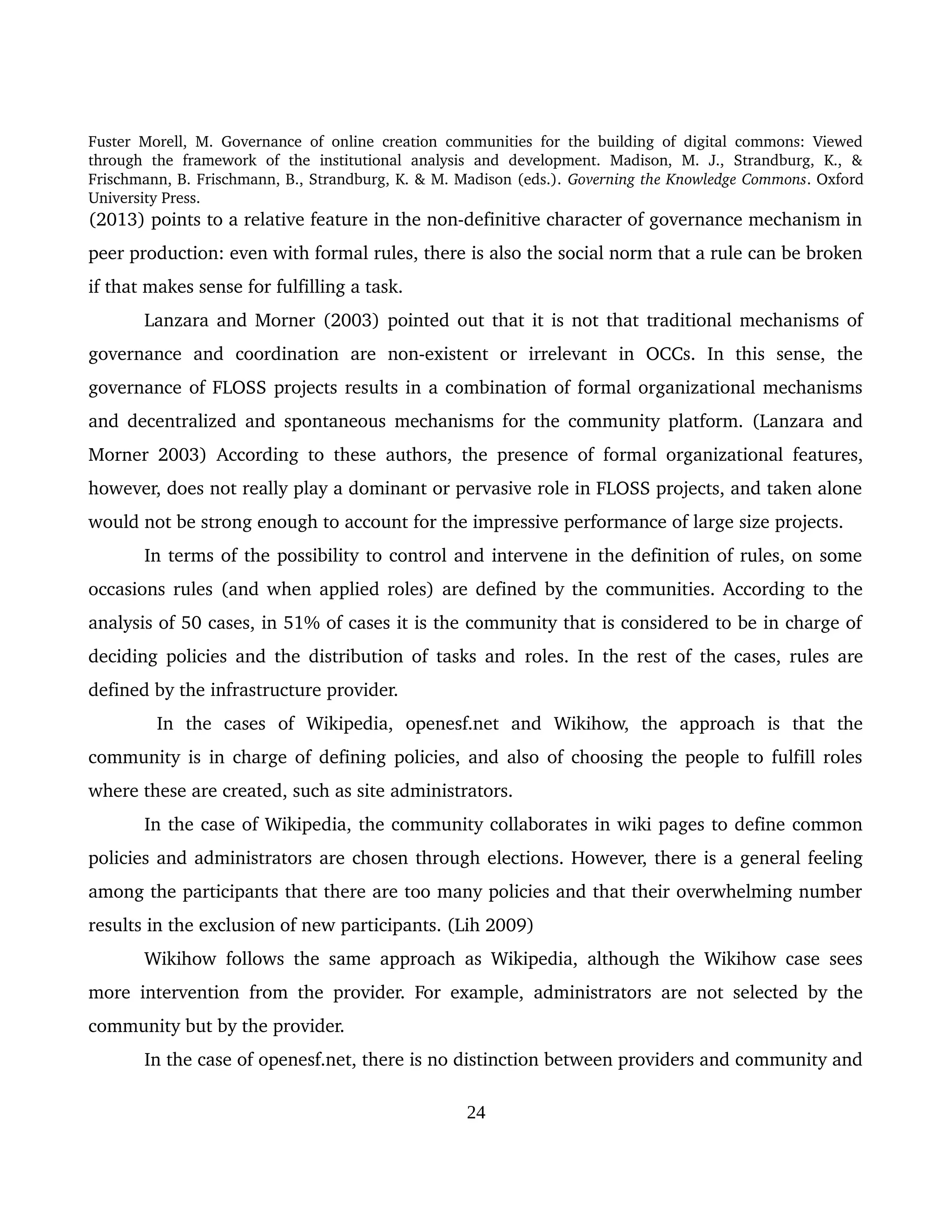
  • 2.
    Fuster Morell, M. Governance of online creation communities for the building of digital commons: Viewed  through   the  framework   of   the   institutional   analysis   and   development.   Madison,   M.   J.,   Strandburg,   K.,   &  Frischmann, B. Frischmann, B., Strandburg, K. & M. Madison (eds.). Governing the Knowledge Commons. Oxford  University Press. I. Introduction Natural commons have been studied substantially using the Institutional Analysis and  Development (IAD) framework of Ostrom (1990) and many others. More recently, a new type  of   commons   has   also   attracted   the   attention   of   researchers.   (Hess   and   Ostrom   2005)  Constructing commons in the cultural environment as characterized by Madison, Frischmann,  and  Strandburg   (2010) refers to   a  broader  set of  commons in the field  of  culture  and  knowledge.   This   chapter   addresses   a   specific   type   of   constructed   cultural   common­pool  resource: online creation communities. With the adoption of information and communication technologies (ICTs), diverse types  of communities of individuals  following  common goals through  technologically mediated  communication have emerged. (Benkler 2006) Online creation communities (OCCs) are a  particular type of online community whose goal is knowledge­making and sharing. OCCs are  communities of individuals that mainly interact via a platform for online participation, with  the goal of building and sharing a common­pool resource (or common pool of resources)  resulting   from   collaboratively   systematizing   and   integrating   dispersed   information   and  knowledge resources and cognitive capacities.  Previous work on the governance of OCCs One of the more lively debates in contemporary organizational research concerns how  the coordination and governance of distributed knowledge in globally dispersed settings – such  as the case of OCCs – takes place, and how it can be accounted for. (Becker 2001; Hansen  1999; Orlikowski  2002)  Unlike other types  of  online communities, OCCs must  integrate  individual contributions into a common pool, which can heighten interdependencies and the  2
  • 3.
    Fuster Morell, M. Governance of online creation communities for the building of digital commons: Viewed  through   the  framework   of   the   institutional   analysis   and   development.   Madison,   M.   J.,   Strandburg,   K.,   &  Frischmann, B. Frischmann, B., Strandburg, K. & M. Madison (eds.). Governing the Knowledge Commons. Oxford  University Press. need for coordination and governance. Yet little is known about how OCCs which organize  around production govern themselves.  The scant empirical research on OCCs governance is mainly concentrated on the case of  Free and Open Software Projects (FLOSS), (Crowston and Howison 2005; Lanzara and Morner  2004; O’Mahony 2007;  O’Mahony and Ferraro 2007;  Weber 2004) and more recently on  Wikipedia. (Burke and Kraut 2008; Ciffolilli 2003; Kittur, Suh, Pendleton, and Chi 2007;  Kriplean, Beschastnikh, McDonald, and Golder 2007; Loubser and Pentzold 2009; O'Neil 2009;  Reagle 2007; Stadler and Hirsh 2002; Tkacz 2007; Viégas, Wattenberg, and Mckeon 2007)  These analyses focus on the community, (Konieczny, 2009; Greenstein and Devereau 2009;  Tkacz 2007) particularly in terms of policy­making in the community, (Kriplean, Beschastnikh,  McDonald, and Golder 2007; Loubser, and Pentzold 2009; Viégas, Wattenberg, and Mckeon  2007) its decentralized character, (Forte and Bruckman 2008; Malone 2004) and forms of  conflict resolution. (Kittur, Suh, Pendleton, and Chi 2007; Matei and Caius 2011) The nature  of authority has also been analyzed, (Ciffolilli 2003; O'Neil 2009; Stadler and Hirsh 2002)  together with studies on modes of selection of administrators, their roles, (Burke and Kraut  2008) and leadership. (Reagle 2007) Fuster Morell (2010) considered the institutional frame  or, more specifically, the role of the Wikimedia Foundation as platform provider.  Although the number of articles on community governance has increased, their range of  topics remains limited. Previous research has mostly focused on analyzing the policy­making  processes developed by the participants to govern their interaction. However, there was a gap  in the literature, lacking a comprehensive and holistic view of what governance means in  collective action online.  This chapter aims to move beyond the analysis of specific aspects of the governance of  OCCs, to provide a comprehensive understanding of the diverse aspects that drive governance  of OCCs. This chapter provides a set of dimensions that define the governance of OCCs. In  particular, most previous work did not consider infrastructure provision in their analysis. In  3
  • 4.
    Fuster Morell, M. Governance of online creation communities for the building of digital commons: Viewed  through   the  framework   of   the   institutional   analysis   and   development.   Madison,   M.   J.,   Strandburg,   K.,   &  Frischmann, B. Frischmann, B., Strandburg, K. & M. Madison (eds.). Governing the Knowledge Commons. Oxford  University Press. this   regard,   the   chapter   challenges   previous   literature   by   questioning   the   neutrality   of  infrastructure for collective action.  Empirical analysis: Institutional Analysis and Development (IAD) framework The   governance   of   OCCs   will   be   analyzed   though   the   Institutional   Analysis   and  Development (IAD) framework, building on the work of Madison, Frischmann and Strandburg  who adapt IAD from natural commons to constructed commons in the cultural environment.  References to Schweik and English’s (2012) adaptation of IAD to FLOSS will also be made. In  this regard, the chapter will also provide an assessment of IAD in the analysis of OCCs. The empirical data were drawn from a statistical analysis of 50 cases and four case  study comparisons on OCCs conducted in 2010. (Fuster and Morell 2010) For the statistical analysis of 50 units, a codebook was used to collect the data from  digital threads available at the OCCs websites. In the case of OCCs, random selection is  difficult given that the universe is unknown. Nevertheless, the sample tried to reflect the  heterogeneity of OCCs. For the sampling, a snowball method was used. The strategy employed  in selecting the units for the sample was based on selecting the cases which fulfilled the OCCs  definition and had a global scope. From the cases that conformed to these two criteria, the  cases covered were a variety of OCCs following two central sampling guidelines. First, there  had to be a balance between more recent and older organizations. Secondly, there had to be a  balance between the several types of technological base and knowledge goal central interests  of the OCCs  (e.g., multi­media archives, libraries, encyclopedias, dictionaries, information  nodes, software programs, collective social memory, among others).  The statistical analysis pointed to four models of governance that will be presented  though the chapter. These informed the selection of the four case studies, each associated with  one of the four models. The four case studies were Wikipedia, Wikihow, Flickr, and the Social  4
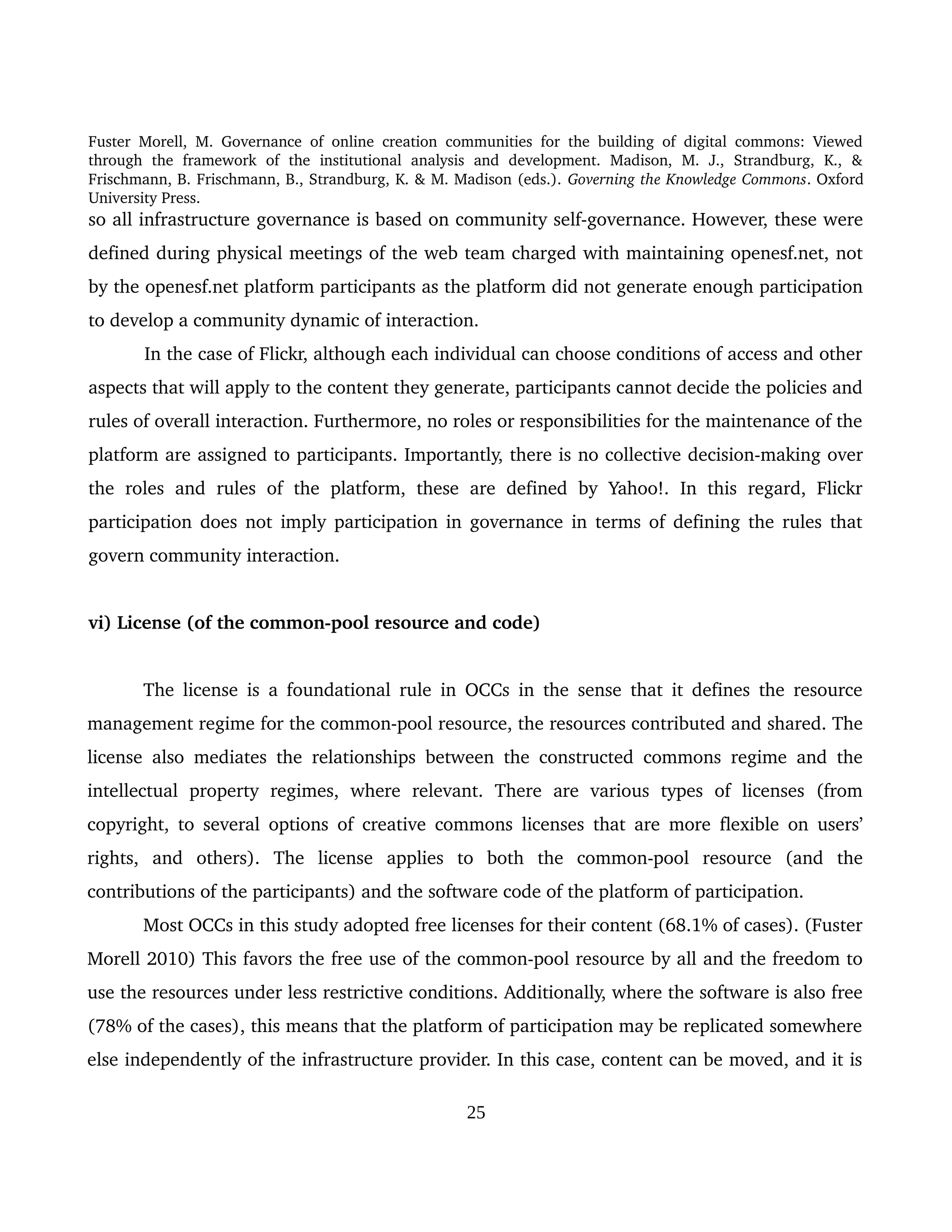
  • 5.
    Fuster Morell, M. Governance of online creation communities for the building of digital commons: Viewed  through   the  framework   of   the   institutional   analysis   and   development.   Madison,   M.   J.,   Strandburg,   K.,   &  Frischmann, B. Frischmann, B., Strandburg, K. & M. Madison (eds.). Governing the Knowledge Commons. Oxford  University Press. Forums Memory project. Wikipedia is an encyclopedia made up of free content that emerged  from 2001. Editors collaborate to create encyclopedic articles. Its infrastructure is provided by  the Wikimedia Foundation. Wikihow is a collaborative "how to" manual. The Wikihow provider  is a start up with the same name founded in 2005. Flickr is a platform provided by Yahoo! for  sharing and archiving visual materials. Participants interact to improve and comment on each  other’s pictures, collaborate to create “albums” of photos around a particular topic, or create  learning groups around photography techniques.  Openesf.net is a platform provided by the  European Social Forum, a collectivity of social movements in Europe. Openesf.net was set up  to support collectible document forums. The case studies were based on virtual ethnography,  interviews and participative observations at events. Data was collected in 2008 and 2010.i   II. Online creation communities viewed through an analytical framework directed at  institutional analysis and development This section views OCCs through the analytical framework of institutional analysis and  development   (IAD).   Reference   is   made   to   the   adaptation   of   Madison,   Frischmann   and  Strandburg (2010) of the framework to constructed commons (see figure I). First, resource  characteristics, community attributes, and the governance of OCCs are presented. In the  following section, OCCs outcomes are presented along with an analysis of how resource  characteristics, community attributes, and rules­in­use/governance might impact upon them.  Figure I: Institutional Analysis and Development (IAD)  5
  • 6.
    Fuster Morell, M. Governance of online creation communities for the building of digital commons: Viewed  through   the  framework   of   the   institutional   analysis   and   development.   Madison,   M.   J.,   Strandburg,   K.,   &  Frischmann, B. Frischmann, B., Strandburg, K. & M. Madison (eds.). Governing the Knowledge Commons. Oxford  University Press. Madison,   Frischmann   and   Strandburg   provide   a   characterization   of   the   cultural  environment as being that within which commons construction emerges. They also recognize  that the background environment for a particular commons may need further specification and  analysis   in   order   to   situate   the   description,   classification   and   analysis   of   resource  characteristics, community attributes, and governance institutions. In the analysis of OCCs, a  specific environmental setting is involved and needs to be considered. The Internet is the  specific environment within which OCCs emerge and their common­pool resource is hosted.  The Internet as an environment is shaped by the digital culture, the technological constraints  of virtual spheres, as well as the legal frameworks that regulate it.  A.  Resource characteristics of OCCs  The pooled resources in OCCs are not given resources that need to be “preserved” as in  natural commons­pool resources. Rather, they are resources that need to be built. OCCs,  indeed, arise from the collective goal of building a specific resource. The building process is  characterized by the pooling of dispersed information and cognitive capacities  in evolving  bodies of shared knowledge. The resource tends to be conceived of as a permanent work in  progress, and in most of the cases, without a specific moment of definitive conclusion.  The OCCs are immaterial in nature, consisting of information and knowledge. As public  goods, they are non­rivalrous and non­excludable. Madison, Frischmann, and Strandburg  (2010) classify constructed commons goals as existing in a milieu of Intellectual Property (IP)  6
  • 7.
    Fuster Morell, M. Governance of online creation communities for the building of digital commons: Viewed  through   the  framework   of   the   institutional   analysis   and   development.   Madison,   M.   J.,   Strandburg,   K.,   &  Frischmann, B. Frischmann, B., Strandburg, K. & M. Madison (eds.). Governing the Knowledge Commons. Oxford  University Press. rights, that is existing only because of the IP rights, or mediating among communities with  different default norms. Most OCCs, including the four case studies considered here, fall into  the first category, as they exist as part of IP rights.  According   to   Madison,   Frischmann,   and   Strandburg   (2010)   cultural   commons   are  diverse in terms of the level at which their pooled resources are most easily identifiable or  recognized. OCCs form a case where pooled resources are easily identifiable – an archive that  gathers   and   coherently   systematizes   the   contributions.   Indeed,   the   construction   of   an  integrated and identifiable piece of knowledge is what distinguishes OCCs from other online  communities such as networking  sites or communities of support or shared interest. An  encyclopedia is the main common resource in the case of Wikipedia, a picture repository in the  case of Flickr, how to manuals in the case of Wikihow, and organizational information linked to  a forum in the case of Openesf. However, beyond their principal resources, all the cases  agglutinate  other secondary  “pooled  resources”  which  deepen one another. For  example,  Wikipedia is not only an encyclopedia, but also hosts a repository of audio­visual sources as a  commons. Additionally, even if the knowledge resource is the central goal around which OCCs  interact,   OCCs   also   depend   on   an   infrastructure   to   support   interaction,   and   so   an  infrastructure architecture also results from the process. However, this is considered in deep,  “infrastructure,”, meaning something that sustains the main goal, but is not itself the central  goal of the process.    Schweik and English (2012) have previously attempted to apply IAD to OCCs in the  specific case of FLOSS. Regarding resources characteristics, our approaches differ in two ways  to Schweik and English. On the one hand, Schweik and English do not specify the type of  resource. However, when analyzing diverse OCCs as is the case in this chapter, specifying the  type of resource is appropriate. On the other hand, Schweik and English present as resources  characteristics aspects, such as the participation platform design, that are integrated as part of  governance, not as resources characteristics, in the present work.  7
  • 8.
    Fuster Morell, M. Governance of online creation communities for the building of digital commons: Viewed  through   the  framework   of   the   institutional   analysis   and   development.   Madison,   M.   J.,   Strandburg,   K.,   &  Frischmann, B. Frischmann, B., Strandburg, K. & M. Madison (eds.). Governing the Knowledge Commons. Oxford  University Press. B. Community attributes of OCCs  It was pointed out above that pooled resources in OCCs are easily identifiable but that  the same cannot be said of their communities. In terms of communities of constituents, OCCs  are complex. OCCs are open to participation, and it is difficult to identify their boundaries. For  none of the four case studies or in the sample of fifty cases of OCCs looked at herein, were  clear boundaries or membership established. The communities of OCCs may include any  person potentially willing to contribute to the common­pool resource or to use it.  Community size OCCs are generally open to participation, but such openness does not necessarily result  in actual participation. The size of the community of participants depends substantially on the  goal of each OCC, ranging from more broad to more restricted sets of interests.  One  rightly  expects   that   an   encyclopedia   attracts   more   participants   than   a   site   organized   around  visualization techniques.  In terms of the participation in the four case studies, Wikipedia achieves a high level of  participation. Almost 18 million registered users were part of Wikipedia in November 2012.  Flickr also draws a large amount of  participation. In 2007, one  estimate put the Flickr  community at 7.7 million users. (Negoescu and Gatica­Perez 2008) Wikihow has substantially  fewer participants. As of April 2010, the number of registered Wikihow participants was  around 213,204.  The levels of participation at openesf.net are low, with less than 1200 people  registered at their highest point.ii  Voluntary engagement 8
  • 9.
    Fuster Morell, M. Governance of online creation communities for the building of digital commons: Viewed  through   the  framework   of   the   institutional   analysis   and   development.   Madison,   M.   J.,   Strandburg,   K.,   &  Frischmann, B. Frischmann, B., Strandburg, K. & M. Madison (eds.). Governing the Knowledge Commons. Oxford  University Press. Participants in OCCs are volunteers. They do not have a contractual labor relationship  with the community, even if some participants may make their contributions as part of their  work outside the community. All four cases share this characteristic of voluntary participation.  Notably, however, professional photographers who use Flickr as part of their work form a  significant part of the Flickr population. (Burgess 2007) As a consequence of the voluntary character of OCCs, each participant assumes the  costs of participation. The participants are able to contribute according to their own resources  of time, skills or money.  According to the civic voluntarism model, (Verba, Schlozman, and  Brady 1995) resources are a key factor in understanding why some people participate whereas  others do not. Resource­rich participants with free time, connectivity, skills and money can  contribute more easily than those without such resources. And so the resource­rich tend to be  disproportionately represented among participants. However, a lack of resources may not be  the   only   explanatory   variable   behind   non­participation.  Even   people   with   the   necessary  resources may decide not to participate for a variety of reasons such as questions of identity or  personality. People who identify themselves as creative, for example, and/or are more used to  public exposure may be more likely to participate. This is the case for younger generations.  According   to   Preece,   Nonnecke   and   Andrews   (2004),   other   reasons   why   people   do   not  participate in OCCs are as follows:   thinking that they were being helpful by not posting;  wanting to learn more about the community before diving in;  not being able to use the  software because of poor usability;  not liking the dynamics that they observed within the  group; or feeling represented in what was said by other participants.  Community heterogeneity Several authors have pointed out that OCCs are very diverse in terms of the motivations  9
  • 10.
    Fuster Morell, M. Governance of online creation communities for the building of digital commons: Viewed  through   the  framework   of   the   institutional   analysis   and   development.   Madison,   M.   J.,   Strandburg,   K.,   &  Frischmann, B. Frischmann, B., Strandburg, K. & M. Madison (eds.). Governing the Knowledge Commons. Oxford  University Press. and interest that drive their participation. (e.g., Benkler 2006; Weber 2004) However, Schweik  and English (2012) point out that their surveys of participants in FLOSS show a high level of  homogeneity in terms of social composition, in concrete, in terms of gender (predominantly  male), age (predominantly young) and geographical origin (predominantly Europe and USA).  Our own analysis of gender distribution at openesf.net also shows that the predominance of  male   participation   was   also   repeated   in   the   case   of  openesf.net,   where   36%   of   active  participants are women according to their name or/and presentation in their user page. In the  case of Wikipedia, previous research has concluded that women accounted for around 12% of  the editor community. (Glott, Schmidt, and Ghosh 2009) According to Wikihow Inc, the  Wikihow community has a higher women’s participation rate of around 40%. (Interview,  Wikihow founder, 2008)   External relationships Madison,  Frischmann,  and  Strandburg  (2010)  suggest,  with  respect to  community  attributes,   analyzing   external   relationships   of   community   and   common­pool   resources  regarding markets, industries or firms. For the specific case of FLOSS, several studies have  pointed out how corporations and foundations engage with the common­pool resource, which  Schweik and English (2012, 15) refer to with the label “open­source ecosystem”. The external  relationships of OCCs may explain their capacity to mobilize participation. However, research  in this area is very limited, and there is not a unique pattern of interaction with markets,  industries or firms.  In the cases presented here we can observe the development of “net  districts” similar to an industrial district. OCCs that are part of a “net district” and cooperate  with each other. This is the case of Wikipedia and Wikihow that adopt the same license or  protocols to facilitate the flow of content and participation between their platforms.  10
  • 11.
    Fuster Morell, M. Governance of online creation communities for the building of digital commons: Viewed  through   the  framework   of   the   institutional   analysis   and   development.   Madison,   M.   J.,   Strandburg,   K.,   &  Frischmann, B. Frischmann, B., Strandburg, K. & M. Madison (eds.). Governing the Knowledge Commons. Oxford  University Press. C. Rules­in­use or governance of OCCs  Ostrom (2005: 3) defines institutions (referred to herein as bodies with governance or  rules­in­use) as “the prescriptions that humans use to organize all forms of repetitive and  structured interactions.” Institutions raise and channel interaction among participants. They  provide direction, control and coordination of the collective action. Institutions are set by  social norms and formalized rules, together with the forms in which those rules are created  and enforced. (Ostrom 2005) The governance, or the direction, control and coordination of a process, is embedded or  operates though aspects or points/sources of power. According to the analysis reported here,  there   are   eight   main   aspects   that   are   in   a   complex   juxtaposition   or   interaction   which  determine and drive governance in OCCs. The eight dimensions (that operate at the different  operational, collective choice and constitutional levels) that give OCCs direction, control and  coordination are:  i) Collective mission or goal of the process. ii) Cultural principles/Social norms.  iii) Design of the platform of participation (where regulation is embedded in the code). iv) Self­management of contributions: autonomous condition of participants in allocating  their contribution to the building process.  v) Formal rules or policies applied to community interaction. vi) License.  vii)Decision­making and conflict resolution systems with regard to community interaction. viii) Infrastructure provision.iii The   eight   dimensions   are   interrelated   rather   than   narrowly   discrete.   Additionally,  governance is not “static”, but dynamic and might evolve over time. It might not be linear in its  11
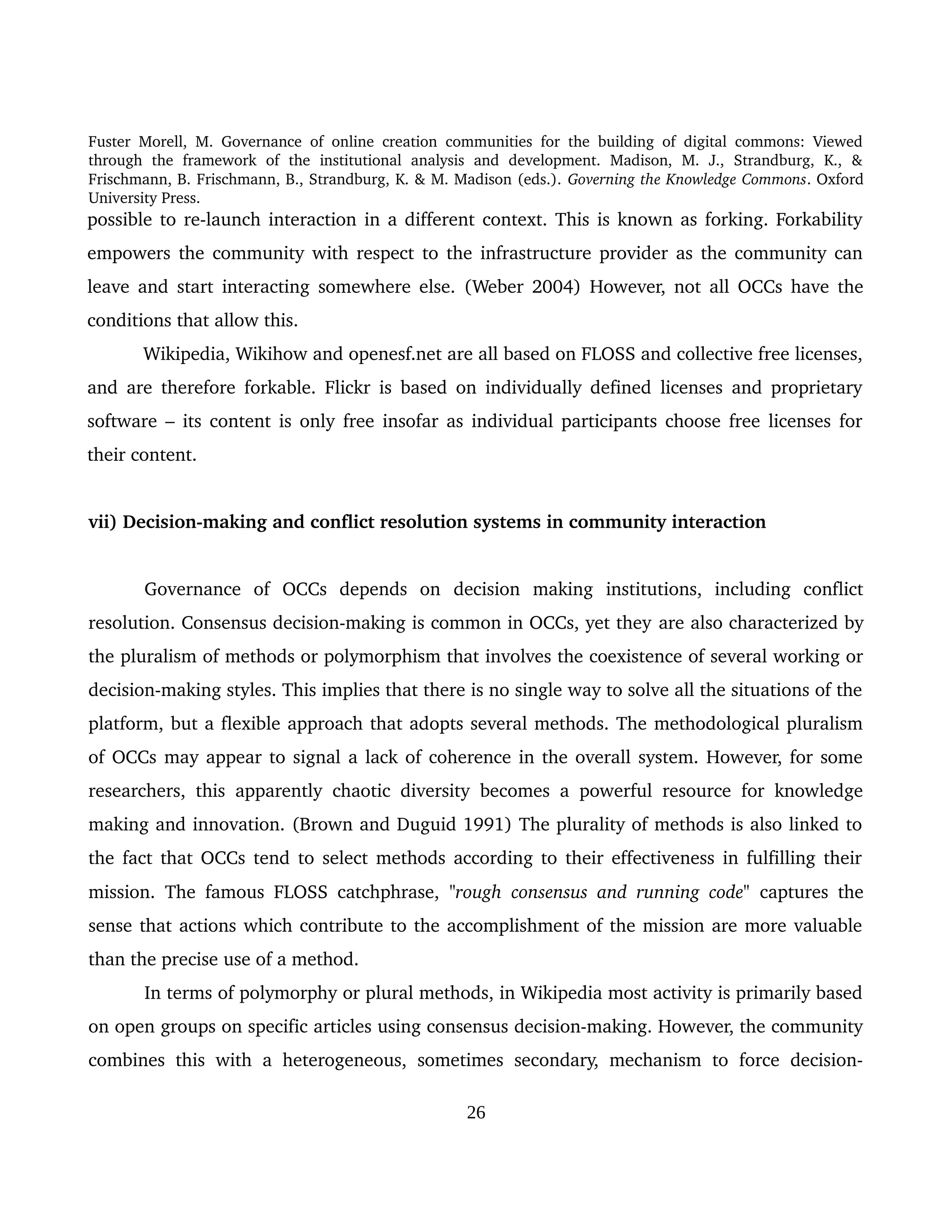
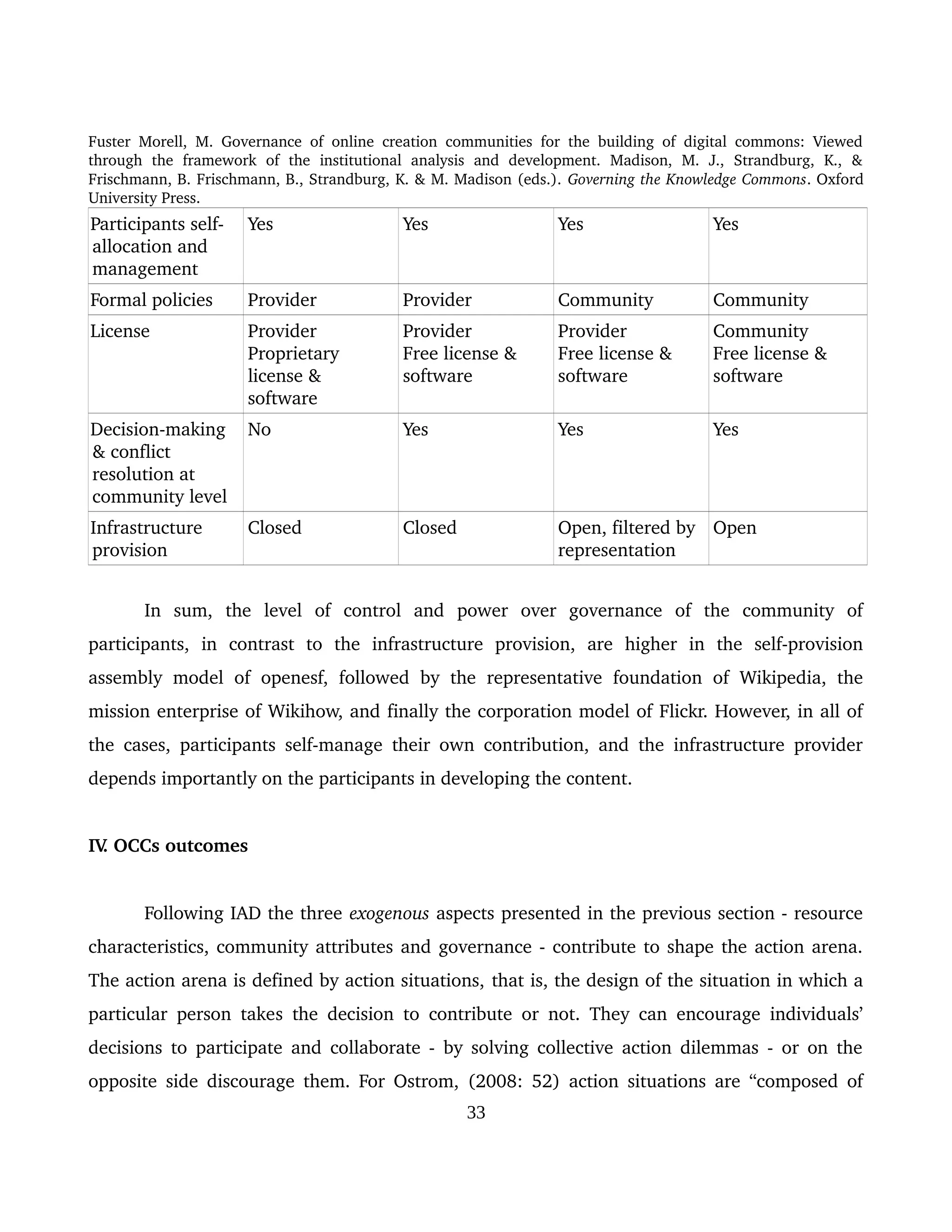
  • 12.
    Fuster Morell, M. Governance of online creation communities for the building of digital commons: Viewed  through   the  framework   of   the   institutional   analysis   and   development.   Madison,   M.   J.,   Strandburg,   K.,   &  Frischmann, B. Frischmann, B., Strandburg, K. & M. Madison (eds.). Governing the Knowledge Commons. Oxford  University Press. evolution, with “incoherent” moves in the diverse aspects on occasion.  Governance is very much shaped on the basis of how and who decides and manages  these dimensions. Each of the dimensions might be managed in a more open to participation  or inclusive way or not. They may encourage involvement or consideration of the views and  interests of the participants as individuals and/or community as a whole. Or they may be  contrasted by the infrastructure provider. Another important dimension is whether it is more  decentralized / fragmented / ad hoc or more centralized and established. Some of these aspects are similarly present in other forms of collective action, while  others are specific to the OCCs. This might be connected to the background environment  within which OCCs operate, particularly the functioning of the digital environment. OCCs take  place in an environment that shapes them in terms of technical and legal constraints. The  emerging governance of OCCs in this environment cannot be qualified as simple. Indeed it is a  highly complex system. In the following section each of these eight aspects will be presented in detail.  i) Collective mission or goal of the process In   general,   the   goal   or   mission   of   OCCs   is   building   and   sharing   a   common­pool  resource. The specific mission is defined by the early participants or by the infrastructure  provider. Then, the overall system is shaped by experiences with fulfillment of this initial  mission. However, participants do not  need  to identify with the mission or the project as a  whole in order to contribute.  It is common in OCCs to define their goals in terms of a sentence that describes their  mission. Wikipedia’s mission reads, "Imagine a world in which every single human being can   freely share in the sum of all knowledge".  Wikihow’s mission is  "to build the world's largest,  highest quality, free how­to manual in many languages".  Openesf.net does not have its own  12
  • 13.
    Fuster Morell, M. Governance of online creation communities for the building of digital commons: Viewed  through   the  framework   of   the   institutional   analysis   and   development.   Madison,   M.   J.,   Strandburg,   K.,   &  Frischmann, B. Frischmann, B., Strandburg, K. & M. Madison (eds.). Governing the Knowledge Commons. Oxford  University Press. mission, but is a "tool" for supporting the working groups in their roles within a much larger  process, the ESF, whose goal or motto is that  "another world is possible".  Flickr’s mission is  "Share your photos. Watch the world." Generally, the mission is defined by the founder of the OCCs. In OCCs culture, the  founders tend to be considered relevant and visible figures, especially with Wikipedia where  there is just one. The role of the founder might change over time, from more central and with  formal power, to less central or only symbolic, such as the case of Jimmy Wales for Wikipedia,  or the founders of Flickr. In the case of Wikihow, the figure of the founder maintained its  position over time, as owner of Wikihow Inc. In contrast, Openesf did not generate such a  figure,   but   the   founders   of   the   process   are   connected,   keeping   their   position.   Giving  importance to the figure of the founder is connected to a social norm (meritocracy) and is  presented in the following section which considers importance given to values merited. ii) Cultural principles/social norms  There is a set of cultural principles and values that tend to be present transversally in  the culture of OCCs. These also feed the way these eight dimensions are performed and  function. Among these key principles are: openness and “freedom to operate”, meritocracy, and  flexibility. Openness and “freedom to operate” without seeking permission or preclearance by a  manager or property owner (in Benkler’s terms, 2006, 2013), might be present though the  license that favors freedom to access and use the resource, or freedom though the openness of  the process and the autonomy of the participants to allocate his or her own participation.  Meritocracy or “doacracy” refers to valuing individuals on the base of the quantity and quality of their contributions, not on the basis of “who”  they are in terms of external credentials or their opinions. Doacracy also refers to the tendency in some OCCs for whoever does something to  also have authority over it. Flexibility refers to the methods or pre­established formats. OCCs tend to be more mission oriented – accomplish  something – than method oriented – to do something in a particular manner. Benkler (2013) refers to this question by pointing to the “in­ determinity” of the governance of peer production.  In the following section, further social norms will be presented, as they are also present  13
  • 14.
    Fuster Morell, M. Governance of online creation communities for the building of digital commons: Viewed  through   the  framework   of   the   institutional   analysis   and   development.   Madison,   M.   J.,   Strandburg,   K.,   &  Frischmann, B. Frischmann, B., Strandburg, K. & M. Madison (eds.). Governing the Knowledge Commons. Oxford  University Press. in the way the platform is designed.  iii) Design of the platform of participation (where regulation is embedded in the code) In OCCs,  it is relatively rare for individuals to be involved in direct dialogues and  negotiations   amongst   themselves.   Instead,  individuals   interact   with   the   platform   design.  Platform design thus influences participation and interaction. In this section, the design of the  platform of participation and social norms is presented. As we will see from the analysis, the  way in which the environment is designed by the code of the platforms is very much in line  with the OCC’s social norms.  The design of the participation platform is embedded and regulated in the code. Many  diverse code programs can support a platform of participation. Here we present a set of  principles embedded in the platforms that embody and guide participation in OCCs. The  provision of the platform is controlled by the infrastructure provider. More or less involvement  from   the   community   in   the   platform   design   depends   on   the   level   of   openness   of   the  infrastructure providing community involvement.  1. Openness  1.1 Openness as it applies to the access to the resource  Openness as applied to the access to the resource is defined by Madison, Frischmann  and Strandburg (2010, 695) as “our capacity to relate to a resource by accessing and using it”.  In terms of the conditions of access and use of the resources in OCCs, as we will see  later, free licenses favor free use. Yet how the knowledge resources are actually made available  also determines the possibility of accessing and using them. In this regard, it is common for the  14
  • 15.
    Fuster Morell, M. Governance of online creation communities for the building of digital commons: Viewed  through   the  framework   of   the   institutional   analysis   and   development.   Madison,   M.   J.,   Strandburg,   K.,   &  Frischmann, B. Frischmann, B., Strandburg, K. & M. Madison (eds.). Governing the Knowledge Commons. Oxford  University Press. common­pool resource in OCCs to be hosted by a participation platform made accessible in an  open access condition. The open access condition of the resources should not however lead us  to think they are not regulated, as they are.  These knowledge resources are open access through their license and through being  made openly available online. The open access condition of the resources does not imply  openness when understood as the degree of control and intervention in decision making of  those conditions. Deciding the license terms and how the resource is made available online are  in the hands of the infrastructure provider. The level of openness to decision making about the  conditions of use of the resources (as stated in the license and embedded in the platform of  participation), here again, depends on the level of openness of the infrastructure provider.  1.2 Openness as it applies to the community building the resource Openness to interrelation and participation within the community for collaborative  common­pool  resource   building  is   a  significant   principle  at  work  in   OCCs.   Openness   to  participation is made operative through the provision of channels that allow intervention in  content creation, as well as through the protocols that guide those channels. Protocols refer,  for example, to low requirements for credentials to participate.  According to the statistical analysis conducted for 50 cases, (Fuster Morell 2010) OCCs  usually have an average of four different channels of participation (i.e., the possibility to add  comments to a specific section of the content, upload materials, and edit Web pages, among  others). The protocols that guide participation in OCCs appear to incentivize participation in a  high percentage of the cases (i.e., 80% of the registration systems allow automatic registration  without requiring any filter to become part of the platform). This contributes to lowering the  transaction costs involved in becoming an active contributor.  In all of the four case studies  discussed here, indicators for the importance of openness are present: they all employ easy to  use technology and channels for open participation, and they do not ask for credentials or  15
  • 16.
    Fuster Morell, M. Governance of online creation communities for the building of digital commons: Viewed  through   the  framework   of   the   institutional   analysis   and   development.   Madison,   M.   J.,   Strandburg,   K.,   &  Frischmann, B. Frischmann, B., Strandburg, K. & M. Madison (eds.). Governing the Knowledge Commons. Oxford  University Press. other requirements in order to intervene.  However, even if openness to participation is embedded in the technology of OCCs, not  all OCCs are equally accessible. The level of inclusion of OCCs and the willingness or capacity  to ensure there are no barriers to participation vary. For example, an analysis of OCC inclusion  shows   OCCs   to   be   exclusive   in   terms   of   accessibility   for   people   with   relevant   physical  disabilities. (Fuster Morell 2010) The principle of openness to participation is not only embedded in the design of the  platform of participation, it is also present in social norms. For instance, in OCC discourses, it  is emphasized that the community is provided accessibility for participation. In this line,  Wikipedia is presented as "the encyclopedia that anyone can edit".iv   2. Modularity and decentralized participation  Another aspect embedded in the code of the platform of participation is the modular  organization of the platform. Essentially, this involves splitting content into separate units  (such as articles, software packages, thematic albums of pictures, etc.). The design of OCCs  does not imply that all participants are involved in all projects or modules. Instead, and  particularly as the OCC grows, there is a tendency for participation to split or fragment into  projects or modules. Modularity favors the decentralization of activity. In addition, distributing  tasks between modules favors increased participation. The participation of many people in a  single (central) place could be more difficult to handle than that of many small groups.  Modular design and the resulting decentralization of participation are features present in the  Wikipedia, Wikihow and openesf.net cases.  Concerning the Wikipedia case, activities which involve the entire Wikipedia community  are extremely rare. Most of the activities of Wikipedia are based on interactions of small  groups. The same finding was uncovered in the Wikihow case. In openesf.net, 41.5% of the  16
  • 17.
    Fuster Morell, M. Governance of online creation communities for the building of digital commons: Viewed  through   the  framework   of   the   institutional   analysis   and   development.   Madison,   M.   J.,   Strandburg,   K.,   &  Frischmann, B. Frischmann, B., Strandburg, K. & M. Madison (eds.). Governing the Knowledge Commons. Oxford  University Press. projects are composed by only one member, and projects with 3 members are the most  frequent following this (20.8%). The Flickr case is different because its primary unit of content  is not based on collective "projects" such as an article in Wikipedia, but on individual acts  (uploading photos). In this regard, rather than decentralization as such, we find structural  individualization at the base of the design of the participation platform. However, in Flickr too,  we find the feature of the formation of separate groups around common interests. According to  Sieberg, there were 300,000 groups on Flickr by 2007. (Sieberg 2007)  3. Participation is mostly asynchronous and online As presented in the previous section, participation is decentralized to projects in OCCs.  Furthermore, it is not implied in terms of either the platform design or social norms that  participants congregate at the same time within the platform. Asynchronous participation in  the platform is common to all the case studies.  One moment at which some participants might congregate at the same time and place is  during   physical   encounters.   Even   if   OCCs   are   mainly   developed   online,   participants   do  sometimes meet physically. In the Wikipedia and openesf.net cases, regular local meetings of  participants are organized. Plus, both of these case study OCCs hold an annual meeting.  Wikihow and Flickr participants meet much more infrequently. 4. Transparency of participation OCCs are developed in public, indeed it would be accurate to say that OCCs  live  in  public. The analysis of 50 cases of OCCs showed that in 88%  of the cases the content of  communications among participants is publicly accessible. That is, it is possible to read the  content of communications among participants without registering on the site.  17
  • 18.
    Fuster Morell, M. Governance of online creation communities for the building of digital commons: Viewed  through   the  framework   of   the   institutional   analysis   and   development.   Madison,   M.   J.,   Strandburg,   K.,   &  Frischmann, B. Frischmann, B., Strandburg, K. & M. Madison (eds.). Governing the Knowledge Commons. Oxford  University Press. The public, or transparent, character of the organizational process favors openness to  participation. Public organizing also favors the training of new participants, and the building  of trust. New participants can see how others perform some tasks. Finally, it also favors the  autonomy and decentralization of participation and the coordination of participation without a  predefined plan or a gatekeeper distributing roles. Participants themselves can identify where  contributions are needed and to what level they wish to get involved. According to O'Mahony’s  (2007: 148) research on FLOSS communities “a public or transparent development process is  necessary to support decentralized decision­making so that a large body of people can learn   enough to participate in decisions.” (O'Mahony 2007: 148) In the Wikipedia case the whole drafting process, not only the resulting content, is  visible to all. The channels that host the interaction (such as Wikis, mailing lists, meet­ups,  etc.) are public by default. The same is true of Wikihow. In the case of openesf.net, each  project creator may choose how public each project will be. They decide whether the project  will be accessible to the general public, only to people registered at openesf.net, or only to  members of that particular project. However, the majority of the projects have a public  character. The same may be said concerning Flickr, albeit at an individual level. On Flickr, each  individual   chooses   if   their   content   is   publicly   accessible   or   not   and,   thereby,   if   the  communication surrounding the content is public or not.  iv)   Self­management   of   contributions:   The   autonomous   condition   of   participants  in  contributing to the building process  As pointed out in the previous section, the design of the platform of participation  determines, to a large degree, the type of interaction and actions that can be performed by  participants. Still, the participants have great flexibility in terms of the types of activities they  develop   and   degrees   of   involvement   they   undertake.  Participants   decide   their   level   of  18
  • 19.
    Fuster Morell, M. Governance of online creation communities for the building of digital commons: Viewed  through   the  framework   of   the   institutional   analysis   and   development.   Madison,   M.   J.,   Strandburg,   K.,   &  Frischmann, B. Frischmann, B., Strandburg, K. & M. Madison (eds.). Governing the Knowledge Commons. Oxford  University Press. commitment   and   how   they  want  to   contribute  freely   and  automatically  on  the  basis  of  personal interests, motivations, resources and abilities. The distribution of participation is not  based on centralized planning of user activities, but on decentralized, volunteers deciding for  themselves. There is no gatekeeper or similar role in charge of prodding participants along in a  particular direction. In the designed platform participants choose what to do. Participation is  not   driven   by   command,   but   by   self­direction.   Additionally,   participants   "build"   or   "do".  Participation is mainly based on implementing tasks by directly creating or editing content.  This is not a major risk. Online interaction facilitates the undoing of actions, and so mistakes  are not irreparable. This implies that there is no separation between decision­making and  implementation, or between a delegation and an implementation body. Those who take care of  a task also have the authority to decide about how to perform it. This form of participation  opens up the idea of doography or "implementation democracy". Finally, the coordination of  participation  is not  the  result  of  a  strict,  absolute  and   fixed   plan.  Rather  it is  open  to  uncertainty and variation, based on principles of randomness and the serendipitous.  This is so for the four case studies. That said, the Flickr platform is the most restrictive  in terms of the types of activities that can be performed. Additionally, for some of the activities  on Flickr, in contrast to the other cases, participants must pay for access, which may restrict  access to some of the population. High flexibility on the typology and degree of involvement Not all participants necessarily carry out the same tasks. They choose among several,  such as adding new content, editing content, and classifying content, among others. One  person may contribute unedited information while another participant takes care of editing it  and increasing its quality. Some tasks may require more effort and commitment than others,  however, and in most cases, tasks are highly divided so that each participant can contribute  19
  • 20.
    Fuster Morell, M. Governance of online creation communities for the building of digital commons: Viewed  through   the  framework   of   the   institutional   analysis   and   development.   Madison,   M.   J.,   Strandburg,   K.,   &  Frischmann, B. Frischmann, B., Strandburg, K. & M. Madison (eds.). Governing the Knowledge Commons. Oxford  University Press. either just a small part of a module or a large part, facilitating the scaling of participation.  Again, this must not be confused with a lack of structure. On the contrary the platforms are  highly structured. There are also different levels of commitment to the platform in terms of  time and active task performance. Participants’ freedom to decide their level of contribution  results   in  a  very   common   distribution   feature   in   OCCs.   Research   on   the  distribution  of  participation suggests a very unequal distribution known as the 90/9/1 principle or a power  law. (Hill, Hollan, Wroblewski, and McCandless 1992; Nielsen 1997) 90% of visitors to OCCs  tend to be lurkers who read or observe but never contribute, 9% contribute a little from time  to time, and 1% contribute often and account for almost all the content and system activity.  (Nielsen, 2006) In other words, there are three main profiles of participation: strong or very  active, weak, and non­participant, each playing a role. Very active participants have a high  degree of commitment to the process and dedicate a great deal of time and a large volume of  work   or   complex   effort   to   it.   Low   level   participants   are  people   who   contribute   only  sporadically.   Weak   participation   may   favor   greater   connectivity   of   the   OCC   with   other  processes. Weak ties favor reaching larger areas of information. (Granovetter 1983) Beyond  strong and weak participation, non­participation or unintended participation is also present  and plays a role.  Non­participation could be characterized as free riding behavior. However, free riding,  and   in   general   the   fact   that   a   large   percentage   of   people   do   not   contribute,   does   not  necessarily constitute a problem or put at risk the achievement of the common goals of OCCs.v  With exhaustible goods, such as natural resources which can be “used up” and are costly to  extract, free riding constitutes a problem. But in a context where ICTs have substantially  decreased the cost of reproduction of information and information­based goods, like those  provided by OCCs, OCCs do not necessarily face scarcity problems linked to the resource use.  When goods are non­exhaustible, non­competitive and exclusion from their use is costly, then  free riding is not necessarily a problem. It has even been said that OCCs are anti­rival. (Weber,  20
  • 21.
    Fuster Morell, M. Governance of online creation communities for the building of digital commons: Viewed  through   the  framework   of   the   institutional   analysis   and   development.   Madison,   M.   J.,   Strandburg,   K.,   &  Frischmann, B. Frischmann, B., Strandburg, K. & M. Madison (eds.). Governing the Knowledge Commons. Oxford  University Press. 2004) They are not  only  non­rival in the sense that they can tolerate free riding without  reducing their stock of value, but are actually anti­rival in the sense that OCCs positively  benefit from free riders. That is, ironically, the  comedy of the commons, the value of the  outcome of OCCs increases when more people use them. (Frischmann 2012; Rose 1994) This  implies that for any participant, contributor or "free rider", mere "use" implies a contribution.  Nevertheless, this is only so where there is a sufficient number of contributors that assure the  building of the resource. The value of the information resources resulting from OCCs increases through several  mechanisms as more people "use" them. First, non­participants contribute due to positive  network effects. A network effect is that effect that one participant in an OCC has on the value  of that OCC for other people, even if this was not intentional. When network effects appear  more people become involved in an OCC, and the more valuable it becomes. For example, as  more people use Flickr as a tool to connect with others, the more valuable it becomes since  users can potentially connect with a larger number of people through it. Second, in online environments most actions are translated into digital information,  known as digital threads, and the elaboration of these digital threads form a source of very  valuable information for the improvement of content and the functioning of the environment.  They can provide, for example, relational and attention data. The environment can learn about  the connections between content according to how users navigate, or the number of times an  article was visited or downloaded could be used as an indicator of the quality of that article.  Third, non­participants also play a role as an audience. Free rider audiences increase the  relevance and value of a platform’s content and increase the motives for participation.  Finally, it is also worth considering that even though exclusion is present in OCCs,  restricting access to non­participants can be costly. Technically this might be challenging.  Additionally, digital culture values “simple”, “easy­to­use” solutions. To incorporate filters  might constitute an additional step that reduces the simplicity of the system and restricts its  21
  • 22.
    Fuster Morell, M. Governance of online creation communities for the building of digital commons: Viewed  through   the  framework   of   the   institutional   analysis   and   development.   Madison,   M.   J.,   Strandburg,   K.,   &  Frischmann, B. Frischmann, B., Strandburg, K. & M. Madison (eds.). Governing the Knowledge Commons. Oxford  University Press. openness.   The distinction between strong/weak/non­participants is also present in the four case  studies.  Previous analyses of Wikipedia have addressed the question of participation distribution  and showed that contributions to Wikipedia also present strong inequalities. Ortega and  Gonzalez­Barahona  (2007)  and  Ortega (2009) conclude  that less  than 10%  of  the total  number of authors are responsible for more than 90% of the total number of contributions or,  conversely, 90% of active editors are responsible for less than 10% of the total number of  contributions. The evolution of this inequality has remained very stable over time (with a  typical value of between 80% and 85% of content produced by a "core team"). However, the  authors also point out that the “core team” of very active participants is not necessarily formed  by the same individuals over time.  Concerning the Wikihow case, from the analysis of a random day, it emerged that the  top   ten   participants   were   responsible   for   almost   half   of   the   content   produced   that   day  (46.5%).vi  Wikihow interviewees reported a similarly unequal distribution of participation as  that found in Wikipedia. (B. Megas, Interview, August 28, 2009; N. Willson, Interview, August  28, 2009) In the words of Wikihow’s founder: "Wikihow follows power law. . . . You have to  support the very minimal contribution or the very small contributions of people who wouldn’t   actually interact with it – while it’s not obvious that they create value for the whole, they really   do. So you need to allow the whole thing, so the ecosystem flourishes and can be successful." (J.  Herrick, Interview, December 4, 2008) Shirky   reports   that   the   top   ten   participants   among   the   total   118   contributors  contributed half of the content on an event uploaded on Flickr. (2008: 123) The analysis of  openesf.net   showed   that   18%   of   the   participants   generated   content   and   82%   of   the  participants did not. Within the 18% of content generators, 3.7% were very active participants  and 14.3 % were less active participants.  22
  • 23.
    Fuster Morell, M. Governance of online creation communities for the building of digital commons: Viewed  through   the  framework   of   the   institutional   analysis   and   development.   Madison,   M.   J.,   Strandburg,   K.,   &  Frischmann, B. Frischmann, B., Strandburg, K. & M. Madison (eds.). Governing the Knowledge Commons. Oxford  University Press. This unequal distribution of participation does not seem to be interpreted as a problem  in OCCs. On the contrary, equal participation and contributions are not expected. GerardM, an  active wikipedian, spoke out in a mailing list against the idea of regular equal contributors and  for valuing all community forms: “When you divide people up in groups, when you single out the   ‘most valuable’" ones (because they contribute more), you in effect divide the community. . . .   When you label groups of people, you divide them and it is exactly the egalitarian aspect   (independently of their contribution) that makes the community thrive.” (GerardM e­mail to the  mailing list Wiki­research­l, October 21, 2008) Additionally, from an outcomes perspective, the  Wikipedia community accomplishes its goal. Wikipedia is the largest encyclopedia in history.  Sue Gardner, executive director of the Foundation, puts it in these terms: "We need sufficient  people   to   do   the  work   that  needs   to   be   done.   (...)   But   the  purpose   of   the   project   is   not   participation." (Angwin and Fowler 2009) There does not seem to be a problem with a lack of  participation in Wikipedia. On the contrary, in some instances problems linked to "too much  participation" occur. This happens when levels of participation are so high that technically the  system is not able to sustain the amount of activity and collapses. This occurred after the 11  September 2001 attacks and Obama’s election, when many people wanted to keep Wikipedia  updated. (T. Finc, Interview, November 20, 2009)  v) Formal rules or policies applied to community interaction OCCs, particularly as they evolve from more initial stages, tend to establish formal  rules. Formal rules may be restricted and limited to rules defined by the legal framework in  which the OCCs operates (terms of use and license), or they may be more or less expansive  including a set of principles or complex bureaucratic policies. However, O'Mahony (2003)  points   out   that   developers   in   FLOSS   resist   formal   methods.   The   existence   of   too   many  established rules and procedures is generally perceived  as problematic in OCCs.  Benkler  23
  • 24.
    Fuster Morell, M. Governance of online creation communities for the building of digital commons: Viewed  through   the  framework   of   the   institutional   analysis   and   development.   Madison,   M.   J.,   Strandburg,   K.,   &  Frischmann, B. Frischmann, B., Strandburg, K. & M. Madison (eds.). Governing the Knowledge Commons. Oxford  University Press. (2013) points to a relative feature in the non­definitive character of governance mechanism in  peer production: even with formal rules, there is also the social norm that a rule can be broken  if that makes sense for fulfilling a task.  Lanzara and Morner (2003) pointed out that it is not that traditional mechanisms of  governance   and   coordination   are   non­existent   or   irrelevant   in   OCCs.   In   this   sense,   the  governance of FLOSS projects results in a combination of formal organizational mechanisms  and decentralized and spontaneous mechanisms for the community platform. (Lanzara and  Morner 2003) According to these authors, the presence of formal organizational features,  however, does not really play a dominant or pervasive role in FLOSS projects, and taken alone  would not be strong enough to account for the impressive performance of large size projects.  In terms of the possibility to control and intervene in the definition of rules, on some  occasions rules (and when applied roles) are defined by the communities. According to the  analysis of 50 cases, in 51% of cases it is the community that is considered to be in charge of  deciding policies and the distribution of tasks and  roles. In the rest of the cases, rules are  defined by the infrastructure provider.    In   the   cases   of   Wikipedia,   openesf.net   and   Wikihow,   the   approach   is   that   the  community is in charge of defining policies, and also of choosing the people to fulfill roles  where these are created, such as site administrators.  In the case of Wikipedia, the community collaborates in wiki pages to define common  policies and administrators are chosen through elections. However, there is a general feeling  among the participants that there are too many policies and that their overwhelming number  results in the exclusion of new participants. (Lih 2009)  Wikihow follows the same approach as Wikipedia, although the Wikihow case sees  more intervention from the provider. For example, administrators are not selected by the  community but by the provider.  In the case of openesf.net, there is no distinction between providers and community and  24
  • 25.
    Fuster Morell, M. Governance of online creation communities for the building of digital commons: Viewed  through   the  framework   of   the   institutional   analysis   and   development.   Madison,   M.   J.,   Strandburg,   K.,   &  Frischmann, B. Frischmann, B., Strandburg, K. & M. Madison (eds.). Governing the Knowledge Commons. Oxford  University Press. so all infrastructure governance is based on community self­governance. However, these were  defined during physical meetings of the web team charged with maintaining openesf.net, not  by the openesf.net platform participants as the platform did not generate enough participation  to develop a community dynamic of interaction. In the case of Flickr, although each individual can choose conditions of access and other  aspects that will apply to the content they generate, participants cannot decide the policies and  rules of overall interaction. Furthermore, no roles or responsibilities for the maintenance of the  platform are assigned to participants. Importantly, there is no collective decision­making over  the  roles  and   rules  of  the  platform,  these  are  defined   by  Yahoo!.   In this  regard,  Flickr  participation does not imply participation in governance in terms of defining the rules that  govern community interaction.  vi) License (of the common­pool resource and code)  The license is a foundational rule in OCCs in the sense that it defines the resource  management regime for the common­pool resource, the resources contributed and shared. The  license also mediates the relationships between the constructed commons regime and the  intellectual   property   regimes,   where   relevant.   There   are   various   types   of   licenses   (from  copyright, to several options of creative commons licenses that are more flexible on users’  rights,   and   others).   The   license   applies   to   both   the   common­pool   resource   (and   the  contributions of the participants) and the software code of the platform of participation.  Most OCCs in this study adopted free licenses for their content (68.1% of cases). (Fuster  Morell 2010) This favors the free use of the common­pool resource by all and the freedom to  use the resources under less restrictive conditions. Additionally, where the software is also free  (78% of the cases), this means that the platform of participation may be replicated somewhere  else independently of the infrastructure provider. In this case, content can be moved, and it is  25
  • 26.
    Fuster Morell, M. Governance of online creation communities for the building of digital commons: Viewed  through   the  framework   of   the   institutional   analysis   and   development.   Madison,   M.   J.,   Strandburg,   K.,   &  Frischmann, B. Frischmann, B., Strandburg, K. & M. Madison (eds.). Governing the Knowledge Commons. Oxford  University Press. possible to re­launch interaction in a different context. This is known as forking. Forkability  empowers the community with respect to the infrastructure provider as the community can  leave and start interacting somewhere else. (Weber 2004)  However, not all OCCs have the  conditions that allow this.  Wikipedia, Wikihow and openesf.net are all based on FLOSS and collective free licenses,  and are therefore forkable. Flickr is based on individually defined licenses and proprietary  software – its content is only free insofar as individual participants choose free licenses for  their content.  vii) Decision­making and conflict resolution systems in community interaction Governance   of   OCCs   depends   on  decision   making   institutions,   including   conflict  resolution. Consensus decision­making is common in OCCs, yet they are also characterized by  the pluralism of methods or polymorphism that involves the coexistence of several working or  decision­making styles. This implies that there is no single way to solve all the situations of the  platform, but a flexible approach that adopts several methods. The methodological pluralism  of OCCs may appear to signal a lack of coherence in the overall system. However, for some  researchers, this apparently chaotic diversity becomes a powerful resource for knowledge  making and innovation. (Brown and Duguid 1991) The plurality of methods is also linked to  the fact that OCCs tend to select methods according to their effectiveness in fulfilling their  mission.  The famous FLOSS catchphrase,  "rough consensus and running code"  captures the  sense that actions which contribute to the accomplishment of the mission are more valuable  than the precise use of a method.  In terms of polymorphy or plural methods, in Wikipedia most activity is primarily based  on open groups on specific articles using consensus decision­making. However, the community  combines this with a heterogeneous, sometimes secondary, mechanism to  force decision­ 26
  • 27.
    Fuster Morell, M. Governance of online creation communities for the building of digital commons: Viewed  through   the  framework   of   the   institutional   analysis   and   development.   Madison,   M.   J.,   Strandburg,   K.,   &  Frischmann, B. Frischmann, B., Strandburg, K. & M. Madison (eds.). Governing the Knowledge Commons. Oxford  University Press. making, block the violation of policies and contain the process within certain margins. On  some occasions alternative forms of decision­making such as polls and voting are adopted.  There are also administrators with particular powers, tasks assigned historically to respected  individuals and a charismatic leader (the founder).  In terms of plural methods Wikihow follows a similar approach to Wikipedia. Openesf  uses mainly consensus decision making. Flickr is different to the other cases because the norms  and   in   general   the   overall   governance   system   are   not   defined   by   the   community   of  participants, but by Yahoo! as Flickr’s provider.  viii) Infrastructure provision (technically, legally and economically sustains the platform  of participation) Infrastructure provision solves some of the other questions OCCs raise, and very much  define the process and shape OCCs governance.  Frischmann  (2012) has also approached  infrastructure in terms of its management as a commons. Infrastructure providers technically,  legally and economically sustain the platform of participation where the community interacts.  It involves the management of the  servers and domain name, and covering the costs these  involve, among others.  O'Mahony (2007)  and Lanzara and Morner (2003)  have researched  provision in the case of FLOSS. However, previous analyses of OCCs have dedicated little  attention to this issue and infrastructure governance is considered a “backstage” question in  OCCs.  Infrastructure provision can function and be governed in diverse ways. Two main axes  concerning infrastructure provision strategies can be distinguished: open  versus  closed to  community   involvement   in   infrastructure   provision,   and   freedom   and   autonomy  versus  dependency on infrastructure (see figure II).  27
  • 28.
    Fuster Morell, M. Governance of online creation communities for the building of digital commons: Viewed  through   the  framework   of   the   institutional   analysis   and   development.   Madison,   M.   J.,   Strandburg,   K.,   &  Frischmann, B. Frischmann, B., Strandburg, K. & M. Madison (eds.). Governing the Knowledge Commons. Oxford  University Press. Figure II. Models across the two axes of infrastructure governance Freedom & Autonomy                                                                     Netenabler                                                                                                                Assembly model  (Openesf)                                       Enterprise model (Wikihow)                   COMMONS LOGIC                                                                                                                 Foundation model  (Wikipedia)                                   Close                                                                                                Open­ ness to decision making                                      CORPORATE LOGIC                           Corporate model (Flickr)                                                                       Black box          Dependency Legend:  Y  =  Freedom  and  autonomy  of  community  from  the  provider;  X  =  Involvement of the community in the provider body.  Participation in the provider space dimension (axes X in figure II) is closed when there  is no possibility of involvement.  Participation in the provider space is considered partly open  where this depends on fulfilling certain criteria related to participation in the platform (such as  a number of contributions). It is considered open when participation in the provider space is  possible for anyone, that is, participation is regulated through self­selection.  Freedom and autonomy  versus  dependency on the infrastructure (net­enabler  versus  black box) dimension (axes Y in figure II) is linked to the license held for the common­pool  resources and to the type of software used for the platform of participation. Net­enabler  conditions are defined by a copyleft license and the use of FLOSS code, while black box  conditions are defined by copyright and proprietary software. There is a qualitative difference  28
  • 29.
    Fuster Morell, M. Governance of online creation communities for the building of digital commons: Viewed  through   the  framework   of   the   institutional   analysis   and   development.   Madison,   M.   J.,   Strandburg,   K.,   &  Frischmann, B. Frischmann, B., Strandburg, K. & M. Madison (eds.). Governing the Knowledge Commons. Oxford  University Press. between relational settings in which the OCCs is “locked” into the platform, and those where  the community interaction is free and autonomous with respect to the platform. If the platform  cannot be reproduced, the community relationship is "closed" within the specific platform  which is dependent on the provider. If the platform can be replicated (can be forkable), the  relationships are free from the specific platform provider. FLOSS and copyleft licensing allow  platforms to be replicated, while proprietary software and  restrictive or less open copyright  license regimes  do not. In other words, the use of FLOSS and a copyleft license creates  conditions in which the community can have greater autonomy and freedom from the platform  provider.  An  analysis  of   how   50   cases   perform   on  the  two   specified   axes  of   infrastructure  governance was developed. (Fuster Morell 2010) From the analysis resulted four clusters of  cases. These four provision models can be defined: corporation service (which is the case of  Flickr), mission enterprise (Wikihow), autonomous representational foundation (Wikipedia)  and assemblarian self­provision models (openesf.net) (see figure II). The corporation model applies to cases of infrastructure platforms owned by companies  with large pools of technological skills such as Yahoo!, the provider of Flickr. The corporate  model of infrastructure governance is characterized by a provider body closed to participant  involvement and based on black box conditions. It follows a for­profit strategy. Participants are  “trapped”   in   the   platform   (unless   they   exit),   as   the   copyright   and   proprietary   software  framework restricts the freedom and autonomy of the participants in the platform.  The mission enterprise model is characterized by being for­profit, and hence closed to  participant involvement. Importantly, the enterprise model is based on net­enabler conditions,  which favor the autonomy of collaboration. Furthermore, according to the statistical analysis,  the enterprise model is characterized by more net­enabler conditions than the foundation  model. The enterprise  model applies to  startups  which  maintain  independence from big  communications companies. It is a strategy for developing new business models which are  29
  • 30.
    Fuster Morell, M. Governance of online creation communities for the building of digital commons: Viewed  through   the  framework   of   the   institutional   analysis   and   development.   Madison,   M.   J.,   Strandburg,   K.,   &  Frischmann, B. Frischmann, B., Strandburg, K. & M. Madison (eds.). Governing the Knowledge Commons. Oxford  University Press. compatible with net­enabler conditions. This is the case of Wikihow. The autonomous representational foundation model is characterized by a provider body  which is (relatively) open to participant involvement as it uses some formal filters. This model  is also characterized by promoting the freedom and autonomy of collaboration (net­enabler).  Additionally, they are non­profit. Being relatively open to participant involvement implies that  they are formal and involve some requirement to take part, not based only on the self­selection  of participants. In this regard it can be considered a hybrid form (partly open, partly closed).  OCCs following this model are less open than the assembly model, which is based on total  openness   of   the   provision   body.   They   are   also   less   net­enabler   than   the   assembly   and  enterprise models. The foundation model comprises the case of Wikipedia. O'Mahony (2007)  researched the governance of FLOSS communities via case studies based on the autonomous  representation   foundation   model   (2007).   She   characterized   the   foundation   model   as  community management. However, she left the questions of the characteristics of governance  models other than community management and the degree to which community management  can be applied to types of providers other than open foundations.         The self­provision assembly model is characterized by being the most open in terms of  provision. A self­selected community of participants can be part of the provision body in this  model. It follows an informal organizing logic (without a board or legal entity) and is non­ profit oriented. Additionally, the assembly model assures the most net­enabler conditions. The  assembly model applies to openesf.net. III. Models of OCCs governance In the previous sections, the eight dimensions that give direction and govern OCCs were  presented. In this section, we present how these eight dimensions link one another.  The analysis of the juxtaposition or interaction between the eight dimensions reveals  30
  • 31.
    Fuster Morell, M. Governance of online creation communities for the building of digital commons: Viewed  through   the  framework   of   the   institutional   analysis   and   development.   Madison,   M.   J.,   Strandburg,   K.,   &  Frischmann, B. Frischmann, B., Strandburg, K. & M. Madison (eds.). Governing the Knowledge Commons. Oxford  University Press. that infrastructure provision is central. Infrastructure provision also determines some of the  other eight aspects linked to the governance of OCCs.  Infrastructure  provision involves the  provision of the platform of participation and the control over its design (code), the license,  formal policies (such as terms of use), and, on some occasions, initiates the process and  establishes   the   mission,   and   controls   decision­making   on   conflicts   around   community  interaction (see figure III). Still some other dimensions, like self­management of contributors  in self­directing their action is not controlled by the infrastructure provider. There is any  command mechanism that force contributors or direct their actions.  Figure III.  Dimensions of OCCs governance that might be controlled by the  infrastructure provider (in italic) i) Collective mission or goal of the process. ii) Cultural principles/Social norms.  iii) Design of the platform of participation (where regulation is embedded in the  code). iv) Self­management of contributions: autonomous condition of participants in  allocating her or his contribution to the building process. v) Formal rules or policies applied to community interaction. vi) License.  vii) Decision­making and conflict resolution system with regard to community  interaction. viii) Infrastructure provision.                            Legend: In italics the dimensions that might be controlled by infrastructure  provider.  In this regard, the modality of governance of the infrastructure also contributes to  shaping   other   dimensions   of   governance   (see   figure   IV).   Where   there   is   openness   to  31
  • 32.
    Fuster Morell, M. Governance of online creation communities for the building of digital commons: Viewed  through   the  framework   of   the   institutional   analysis   and   development.   Madison,   M.   J.,   Strandburg,   K.,   &  Frischmann, B. Frischmann, B., Strandburg, K. & M. Madison (eds.). Governing the Knowledge Commons. Oxford  University Press. community   involvement   in   infrastructure   provision   (representative   foundation   case   of  Wikipedia and self­assemblarian models of openesf), the community has, structurally, more  control over the design of the platform of participation and the license.  Furthermore, according to the statistical analysis of 50 cases, openness to community  involvement in infrastructure provision is correlated with a community having a decision­ making mechanism, (Fuster Morell 2010: 155) a role in conflict resolution at the community  level, deciding its formal rules, a free license that also grants that the community owns the  common­pool resource, and net­enabler conditions (including the right to fork). However,  some of these aspects (a community having a decision­making mechanism and a role in  conflict resolution at the community level, deciding its formal rules, having a free license) are  also present in the mission enterprise model of Wikihow even if this model is closed to  community involvement in infrastructure provision.  The corporate model of Flickr is where most sources of control are in the hands of the  infrastructure provider, and the community of users (both individually and collectively) is most  disempowered   in   comparison   to   the   other   cases.   In   the   corporate   model   of   Flickr,   the  community does not have control over the design of the platform of participation, does not  have decision mechanisms and does not defines the rules, and the license does not favor  community autonomy, but dependency on the infrastructure provider (see figure IV).  Figure IV. The eight dimensions of OCC infrastructure in each of the models  Corporation Mission  enterprise  Representationa l foundation Self­provision  assembly  Mission Defined by the  provider Either defined by  community or  provider Either defined by  community or  provider Community Social norms  Community Community Community Community Design platform  of participation Provider Provider Provider Provider 32
  • 33.
    Fuster Morell, M. Governance of online creation communities for the building of digital commons: Viewed  through   the  framework   of   the   institutional   analysis   and   development.   Madison,   M.   J.,   Strandburg,   K.,   &  Frischmann, B. Frischmann, B., Strandburg, K. & M. Madison (eds.). Governing the Knowledge Commons. Oxford  University Press. Participants self­ allocation and  management Yes Yes Yes Yes Formal policies  Provider Provider Community Community License  Provider Proprietary  license &  software Provider Free license &  software Provider Free license &  software Community  Free license &  software Decision­making  & conflict  resolution at  community level No Yes Yes Yes Infrastructure  provision  Closed Closed Open, filtered by  representation Open In   sum,   the   level   of   control   and   power   over   governance   of   the   community   of  participants,   in   contrast   to   the   infrastructure   provision,   are   higher   in   the   self­provision  assembly model of openesf, followed  by  the representative  foundation of Wikipedia, the  mission enterprise of Wikihow, and finally the corporation model of Flickr. However, in all of  the cases, participants self­manage their own contribution, and the infrastructure provider  depends importantly on the participants in developing the content.  IV. OCCs outcomes  Following IAD the three exogenous aspects presented in the previous section ­ resource  characteristics, community attributes and governance ­ contribute to shape the action arena.  The action arena is defined by action situations, that is, the design of the situation in which a  particular person takes the decision to contribute or not. They can encourage individuals’  decisions to participate and collaborate ­ by solving collective action dilemmas ­ or on the  opposite side discourage them. For Ostrom, (2008: 52) action situations are “composed of  33
  • 34.
    Fuster Morell, M. Governance of online creation communities for the building of digital commons: Viewed  through   the  framework   of   the   institutional   analysis   and   development.   Madison,   M.   J.,   Strandburg,   K.,   &  Frischmann, B. Frischmann, B., Strandburg, K. & M. Madison (eds.). Governing the Knowledge Commons. Oxford  University Press. participants in positions choosing among actions at a particular stage of a decision process in  light of their control over a choice node, the information they have, the outcomes that are  likely, and the benefits and costs they perceive for these outcomes”. Action arenas result in  patterns of interaction and, ultimately, those patterns result in particular outcomes. For the  sake of space we will not analyze action situations in the context of this chapter. Additionally, the IAD framework points out that action arenas impact OCCs outcomes.  OCCs and cultural commons more generally are building processes. They are not provided by  nature as in natural commons, but are constructed and this process is organic to common­pool  resources. The ability or inability of OCCs to end in outcomes is a relevant aspect for the IAD.  However,   it   is   not   clear   if   Madison,   Frischmann   and   Strandburg   take   outcomes   into  consideration in their reframing of the IAD model. However, they do stress that “a cultural  commons should be assessed not only in light of its ostensible purposes but also in light of its  consequences. This aspect of the case study approach should both identify the consequences  and describe relevant criteria for evaluating them.” (2008: 705) In terms of outcomes of OCCs, we would like to differentiate between two sets of  outcomes:   outcomes   in   terms   of   common­pool   resources   (amount   of   content,   quality   of  content, usage of content, etc.) and the building process. As common­pool resources in OCCs  are built rather than simply "there", we consider it relevant to integrate the capacity of IAD to  engage with participation and collaboration in the evaluation of OCCs outcomes, in order to  see whether it contributes more benefits than costs and is worth sustaining.  According to the analysis of 50 cases, the four different infrastructure governance  models highlighted have different capacities to engage with participation and collaboration in  OCCs. First, the analysis suggests that not all the models are able to generate the same size of  community. Second, not all the models are able to engage or increase collaboration levels.  Third, some models are more suited to complex collaboration than others.  Concerning   the   two   axes   ordering   infrastructure   governance,   dependency   on  34
  • 35.
    Fuster Morell, M. Governance of online creation communities for the building of digital commons: Viewed  through   the  framework   of   the   institutional   analysis   and   development.   Madison,   M.   J.,   Strandburg,   K.,   &  Frischmann, B. Frischmann, B., Strandburg, K. & M. Madison (eds.). Governing the Knowledge Commons. Oxford  University Press. infrastructure (black box) favors an increase in the size of communities, but impacts negatively  on collaboration. Autonomy and freedom from infrastructure (net­enabler conditions) favors  more complex collaboration, but negatively affects the size of the community. In other words,  larger communities do not require freedom and autonomy conditions if it does not involve  complexity in the interaction, but the engagement of complex interaction does.  Concerning the axis of open versus closed to community involvement, the effect is more  complex. Openness to involvement in provision favors collaboration where there is some  formal   organization   of   participation   in   the   infrastructure   provision.   Being   closed   to  participation in provision favors an increase in size, but only where provision is based on a for­ profit strategy.  In terms of how each of the four models shapes the community, none of the models  combine a large community size with collaborativeness. The corporation model generates the  biggest   communities,   based   on   lower   levels   of   collaboration   while   the   foundation   and  enterprise models are able to raise mid­sized communities, and are more collaborative. Finally,  the assembly model is the weakest in terms of generating (active) OCCs. According to the case  studies analysis, these diverse performances could be linked to the diverse ability to generate  resources, the ability to manage resources according to organizational strategy, the ability to  inspire   trust   and   motivate   contributions,   and   the   ability   to   create   conditions   favoring  collaboration (or not) through the type of license and software and the design of the platform  of participation.  In sum, more empowering conditions of the community favor outcomes in terms of  collaborativeness, but not size. Of the eight "design principles" that Ostrom (1990) identifies in  stable local common pool resource management, two refer to self­governance (collective­ choice arrangements that allow most resource appropriators to participate in the decision­ making   process   and  self­determination   of   the   community   recognized   by   higher­level  authorities). According to the analysis of OCCs, higher self­governance favors collaboration,  35
  • 36.
    Fuster Morell, M. Governance of online creation communities for the building of digital commons: Viewed  through   the  framework   of   the   institutional   analysis   and   development.   Madison,   M.   J.,   Strandburg,   K.,   &  Frischmann, B. Frischmann, B., Strandburg, K. & M. Madison (eds.). Governing the Knowledge Commons. Oxford  University Press. but not a high level of participation in OCCs.  V. Conclusions  OCCs are a particular type of cultural or knowledge commons.  In this chapter,  we  provided a characterization of OCCs governance as a complex system in which eight critical  aspects   define   their   direction:  collective   mission   or   goal   of   the   process;  cultural  principles/social norms; design of the platform of participation (where regulation is embedded  in   the   code);  self­management   of   contributions;  formal   policies   applied   to   community  interaction; license; decision­making and conflict resolution systems with regard to community  interaction; and infrastructure provision. The sustainable model is also a critical question for OCCs. However, we did not expand  on this aspect in the chapter and it might be considered for further research. The   empirical   analysis   of   fifty   statistical   cases   and   four   case   studies   reveals   the  centrality of one of the dimensions in configuring some of the other governance dimensions  and in determining the outcomes. However, the self­direction or autonomy of the contributors  in allocating their own resources (without command mechanisms) is also a relevant aspect  determining the power interplays in OCCs.  Applicability of IAD to OCCs  In this chapter, we have adapted and applied the IAD framework to OCCs by analyzing  the resource characteristics of OCCs, their community attributes and governance, and to then  approach how governance of OCCs might explain their ability to raise participation and  collaboration.  Clearly   this   was   a   very   limited   application   of   IAD,   as   action   situations   were   not  36
  • 37.
    Fuster Morell, M. Governance of online creation communities for the building of digital commons: Viewed  through   the  framework   of   the   institutional   analysis   and   development.   Madison,   M.   J.,   Strandburg,   K.,   &  Frischmann, B. Frischmann, B., Strandburg, K. & M. Madison (eds.). Governing the Knowledge Commons. Oxford  University Press. analyzed, nor the interplay between the different aspects presented. Still we hope it provides  an overview of OCCs as an important case of constructed commons and how IAD could be  applied.  IAD is a very useful framework to analyze OCCs, as it allows us to approach  the  interplay between the characteristics of a common­pool resource,  the characteristics of a  community and the  political and institutional arrangements for its governance, and explain  how these link to action arenas and ultimately, to outcomes. (Ostrom 2007) In applying  IAD,  we build  upon previous adaptations.  (Madison,  Frischmann, and  Strandburg, 2010; Schweik and English 2012) In line with Ostrom’s original IAD and Schweik and English’s (2012) adaptation of it to  the   FLOSS   case,   we   consider   it   useful   to   retain   the   differentiation   between   resource  characteristics,  community  attributes,  and  rules of  law. In  contrast,  it  is  stressed  less  in  Madison, Frischmann and Strandburg (2010).  Beyond finding it useful to stress the distinction  between resource characteristics, community attributes and rules of law as Schweik and  English (2012) do in their analysis of FLOSS, we do not fully share Schweik and English’s  organization of aspects within those three areas. In concrete, Schweik and English present  some technological attributes as resource characteristics that are in our opinion part of the  regulatory frame of governance, and not a given characteristic of the resource In line with Lessig (1999), code is law, and rules embedded in the code refer to features  that govern interaction among participants and that are inscribed in the technological design  of the platform of participation within which the community interacts. Schweik and English  seem to consider design principles that are embedded in the platform program and code not to  be part of the governance, but as technological attributes in their own right, similar to  biophysical characteristics for Ostrom. In our view, rules embedded in the code govern the  interaction as much as other rules, and need to be integrated and considered as such in the  governance   dimension.   In   a   similar  vein,   Schweik  and   English   consider  aspects  such   as  37
  • 38.
    Fuster Morell, M. Governance of online creation communities for the building of digital commons: Viewed  through   the  framework   of   the   institutional   analysis   and   development.   Madison,   M.   J.,   Strandburg,   K.,   &  Frischmann, B. Frischmann, B., Strandburg, K. & M. Madison (eds.). Governing the Knowledge Commons. Oxford  University Press. leadership or financing as part of community attributes, while we consider these as part of the  governance, too. Coming back to Madison, Frischmann, and Strandburg (2012), the authors seem to  suggest de­emphasizing how the clusters of issues to consider are related to the dimensions of  outcomes, or the question of the outcome more generally. At least, they note that given the  complex dynamics involved, it may be difficult to separate outcomes from the resources and  communities that produce them over time. Still, we emphasize that even if difficult, analysis of  outcomes is useful. Adopting an IAD based approach may result in expanding the number of  variables to consider, which along with the richness of the framework makes it worthwhile.  However, without the outcome dimension (or explanatory analysis more generally) we see  difficulties for other researchers to adopt the frame, as presenting the clusters suggested by  Madison, Frischmann and Strandburg becomes a research project of its own without a similar  or specific explanatory line to engage with.  Madison, Frischmann and Strandburgs frame applies to constructing cultural commons  as a category. It is the case that constructed cultural or knowledge common­pool resources  share some commonalities (more than they do with natural commons); however, it is still a  very   diverse   set.  The  constructing   cultural   commons  category   might  be  useful  for   some  purposes, but in our view, it is too broad a category to apply IAD equally or uniformly. In this  line, the background environment described by Madison, Frischmann and Strandburg does not  totally apply or capture the context of OCCs. As Ostrom points out, the evil is in the context  and the details (1990). Even if the overall frame of IAD is useful, the clusters of issues related  to resource characteristics, community attributes, rules in use, action arenas and outcomes  needed   to   apply   IAD   to   a   particular   commons   need   to   be   much   more   specified   and  contextualized for each type of constructed commons.  What defines OCCs as “commons”?  38
  • 39.
    Fuster Morell, M. Governance of online creation communities for the building of digital commons: Viewed  through   the  framework   of   the   institutional   analysis   and   development.   Madison,   M.   J.,   Strandburg,   K.,   &  Frischmann, B. Frischmann, B., Strandburg, K. & M. Madison (eds.). Governing the Knowledge Commons. Oxford  University Press. IAD was developed initially to investigate natural “commons”. In this last section, we  would   like   to   address   the   question   of   the   conditions   that   define   the   diverse   types   of  “commons” as “commons”.  Natural “commons” has received substantial attention. (Ostrom 1990) OCCs are a case,  together with many others, of other typology of “commons”. In this regard, Hess (2008)  provided a rich classification of “new” types of “commons”. However, it remains unclear what  “commons” have in common. In this line, Benkler (this volume) addresses this issue by raising  a very important question: How can we integrate two diverse trajectories of commons –  “Spanish huertas” (referring to natural commons) and “open roads” – in a general theory of  “commons”? Benkler points out that the resources provided under open access – such as open roads,  but that is also the case of OCCs – are also “commons”. This is independent of whether they  are provided by markets, states, nature or social sources (self­organization). In general, this is  a   very   valuable   contribution.   Furthermore,   it   expands   the   “commons”   to   other   central  resources of the system. An open road should be considered a “common” because of its open  access character, even if it is provided and governed by the state. However, this question  becomes more complex when applied to other types of open access “commons”: put concretely,  those based   on  collaborative  production  and   voluntary  engagement  of  the  common­pool  resource, such as OCCs. What is defined as a “common” in open roads is diverse for Spanish  huertas (referring to natural resources), as Benkler pointed out, but also for OCCs in our view.  That “commons” should not only consider “instances of self­governance applied to discrete  resources sets” (from Benkler this volume) does not imply that governance should not be  considered for any type of open access resource.  In our view, for the specific case of OCCs, open access alone is not a sufficient condition.  To the open access of the common­pool resource (which Benkler points to) we must add a  39
  • 40.
    Fuster Morell, M. Governance of online creation communities for the building of digital commons: Viewed  through   the  framework   of   the   institutional   analysis   and   development.   Madison,   M.   J.,   Strandburg,   K.,   &  Frischmann, B. Frischmann, B., Strandburg, K. & M. Madison (eds.). Governing the Knowledge Commons. Oxford  University Press. governance design that maintains community control over the collaborative process of building  the   common­pool   resource.   In   this   regard,   both   open   access   resources   provision   and  community governance should be considered for characterize OCCs as “commons” to avoid  possible confusion. This does not imply that the community governance as a condition for a  “commons” in OCCs implies the community governance model of natural “commons”, but the  community governance in OCCs functioning, as characterized in this chapter.  In   the   following,   we   argue   why   we   consider   both   open   access   and   community  governance as conditions for a “commons” in OCCs. In OCCs, the resource is not already  available, but needs to be produced and preserved. The production process is based on  collaborative and voluntary engagement, and this implies that certain aspects be taken into  consideration. On the one hand, the process of production is not based on labor; that is, it is  not a contractual relationship of exchanging work per a salary, which tends to be the case  when building a road. Rather it is a voluntary and collaborative relationship. This raises the  question of whether community could be disempowered from the resource management it  produces, and lack control equally in voluntary and collaborative production as in labor  conditions. Additionally, this disempowerment in voluntary communities might affect pro­ social motivation characteristic of OCCs. A key component to drive community governance in  OCCs according to our analysis is the infrastructure governance, because it is important in  itself, and because it is a point of control over other dimensions of the governance. Some level  of community control over infrastructure is central for community governance as we have  argued across this chapter.   Furthermore,   the   idea   of   detaching   the   community   from   the   resource   might   be  questioned.   In   OCCs   the   outcome   is   not   only   the   resources   in   terms   of   the   archive   of  knowledge,  but  the community  itself. The resource could   not be produced  or preserved  without the community. In other words, the “production” of the community is a precondition  for   the   possibility  to   produce  the  resource.   Particularly,  in  regards   to   the  infrastructure,  40
  • 41.
    Fuster Morell, M. Governance of online creation communities for the building of digital commons: Viewed  through   the  framework   of   the   institutional   analysis   and   development.   Madison,   M.   J.,   Strandburg,   K.,   &  Frischmann, B. Frischmann, B., Strandburg, K. & M. Madison (eds.). Governing the Knowledge Commons. Oxford  University Press. infrastructure   governance   is   not   neutral.   As   we   have   noted   previously   in   this   chapter,  infrastructure provision shapes the community and the resource. Again, this raises the question  of whether community could be detached from the resource it produces.  If we consider only open access as a condition for OCCs to be a “commons,” Flickr and  Wikipedia, both with open access resources in different degrees, would be considered a  “commons”. But could OCCs produced by and/or dependent on for­profit enterprises such as  Yahoo!   (Flickr)   and   based   on   a   non­community   self­governance   model   be   considered   a  “commons” just as Wikipedia is based on community self­governance? In order to avoid  misinterpretations, we are not pointing to this distinction on the basis of the Flickr corporate  for­profit   character   and   the   Wikipedia   non­profit   character,   but   on   the   basis   of   their  governance. Wikihow is also for profit, but this is not in conflict with being based upon  favoring community governance conditions.  We could argue it from another perspective. As Benkler points, OCCs would be a  “commons” when being based in open access. We would agree, if the open access would not  only apply to the resource the community produces, but also to the “open access” character of  the infrastructure the resource is based upon. This would assure freedom to operate from the  infrastructure provider, too. In sum, common­pool­produced resources should not only be regarded according to  how they are provided (open access) and owned (property), but to how they are produced. In  other words, the conditions of production and control over the means of production is a highly  relevant question. VI. Bibliographic references Angwin, Julia, and Geoffrey A. Fowler, Volunteers Log Off as Wikipedia Ages, WALL ST. J., Nov.  27, 2009, http://online.wsj.com/article/SB125893981183759969.html. 41
  • 42.
    Fuster Morell, M. Governance of online creation communities for the building of digital commons: Viewed  through   the  framework   of   the   institutional   analysis   and   development.   Madison,   M.   J.,   Strandburg,   K.,   &  Frischmann, B. Frischmann, B., Strandburg, K. & M. Madison (eds.). Governing the Knowledge Commons. Oxford  University Press. Becker,   Markus   C.,  Managing   Dispersed   Knowledge:   Organizational   Problems,   Managerial   Strategies, and Their Effectiveness, 38 J. MGMT. STUD. 1037 (2001).  BENKLER, YOCHAI,  THE  WEALTH  OF  NETWORKS: HOW  SOCIAL  PRODUCTION  TRANSFORMS  MARKETS  AND FREEDOM (2006). Benkler, Yochai, Peer Production and Cooperation (forthcoming 2013). Bimber, Bruce, Andrew J. Flanagin, and Cynthia Stohl, Reconceptualizing Collective Action in  the Contemporary Media Environment, 15 COMM. THEORY 365 (2005).  Brown, John Seely, and Duguid, Paul, Organizational Learning and Communities of Practice:  Toward a Unified View of Working, Learning, and Innovation, 2 ORG. SCI., no. 1, 1991, at  40.  Burke, Moira and Robert Kraut,  Mopping Up: Modeling Wikipedia Promotion  Decisions,  in  PROCEEDINGS OF THE 2008 ACM CONFERENCE ON COMPUTER SUPPORTED COOPERATIVE WORK  27 (2008). Ciffolilli, Andrea,  Phantom Authority, Self­Selective Recruitment and Retention of Members in  Virtual Communities: The Case of Wikipedia, 8  FIRST  MONDAY, no. 12, Dec. 1 2003,  http://www.firstmonday.org/issues/issue8_12/ciffolilli/. Crowston, Kevin, and James Howison, The Social Structure of Free and Open Source Software  Development,   10  FIRST  MONDAY,   no.   2,   Feb.   7,   2005,  http://firstmonday.org/ojs/index.php/fm/article/view/1207/1127. Forte, Andrea, and Amy Bruckman, Scaling Consensus: Increasing Decentralization in Wikipedia  Governance, in PROCEEDINGS OF THE 41ST ANNUAL HAWAII INTERNATIONAL CONFERENCE ON  SYSTEM SCIENCES 157. FRISCHMANN, BRETT,  INFRASTRUCTURE: THE  SOCIAL  VALUE  OF  SHARED  RESOURCES  (2012).Fuster  Morell,   Mayo   (2010).   Governance   of   online   creation   communities.   Provision   of  platforms   for   participation   for   the   building   of   digital   commons.   (Unpublished  dissertation. Defended September 20 2010). Department Social and Political Science.  42
  • 43.
    Fuster Morell, M. Governance of online creation communities for the building of digital commons: Viewed  through   the  framework   of   the   institutional   analysis   and   development.   Madison,   M.   J.,   Strandburg,   K.,   &  Frischmann, B. Frischmann, B., Strandburg, K. & M. Madison (eds.). Governing the Knowledge Commons. Oxford  University Press. European   University   Institute,   Florence.  Retrieved   from:  http://www.onlinecreation.info/outline_design Glott, R., Schmidt, P., and Ghosh, R. (2009). Wikipedia survey. Working draft. Unu ­ Merit. Granovetter, Mark, The Strength of Weak Ties: A Network Theory Revisited, in 1 SOCIOLOGICAL  THEORY 201 (R. Collins ed., 1983). Greenstein, S., and Devereaux, M. (2009). Wikipedia in the Spotlight. Kellogg Case Number:  5­306­507;   HBS   Case   Number:   KEL253.   Case   Collection   at   the   Kellogg   School   of  Management.   Retrieved  fromhttp://www.kellogg.northwestern.edu/faculty/greenstein/images/htm/Research/C ases/Wikipedia_RVFinal_0709.pdf Hansen, Morton T., The Search­Transfer Problem: The Role of Weak Ties in Sharing Knowledge   Across Organization Subunits, 44 ADMIN. SCI. Q. 82 (1999).  Hess, Charlotte (2008). Mapping the new commons. Conference Governing Shared Resources:  Connecting Local Experience to Global Challenges, the Twelfth Biennial Conference of  the International Association for the Study of Commons. Cheltenham, England. July 14­ 18, 2008. Retrieved from http://dlc.dlib.indiana.edu/dlc/handle/10535/304 Hess, Charlotte and Elinor Ostrom, UNDERSTANDING KNOWLEDGE AS A COMMONS: FROM THEORY  TO PRACTICE (2005). Hill, William C., James D. Hollan, Dave Wroblewski, and Tim McCandless, Edit Wear and Read  Wear,  in  PROCEEDINGS  OF  THE  SIGCHI CONFERENCE  ON  HUMAN  FACTORS  IN  COMPUTING  SYSTEMS 3, 1992.Kittur, A., E. Chi, B. Pendleton, B. Suh, and T. Mytkowicz, Power of the  Few vs. Wisdom of the Crowd: Wikipedia and the Rise of the Bourgeoisie, in CHI ’07:  PROCEEDINGS  OF  THE  SIGCHI CONFERENCE  ON  HUMAN  FACTORS  IN  COMPUTING  SYSTEMS  (2007).. Konieczny, Piotr, Governance, Organization, and Democracy on the Internet: The Iron Law and   43
  • 44.
    Fuster Morell, M. Governance of online creation communities for the building of digital commons: Viewed  through   the  framework   of   the   institutional   analysis   and   development.   Madison,   M.   J.,   Strandburg,   K.,   &  Frischmann, B. Frischmann, B., Strandburg, K. & M. Madison (eds.). Governing the Knowledge Commons. Oxford  University Press. the Evolution of Wikipedia, 24 SOC. F., no. 1, Mar. 2009, at 162.  Kriplean, Travis, Ivan Beschastnikh, David W. McDonald, and Scott A. Golder,  Community,  Consensus,   Coercion,   Control:   CS*W   or   How   Policy   Mediates   Mass   Participation,  in  PROCEEDINGS OF THE 2007 INTERNATIONAL ACM CONFERENCE SUPPORTING GROUP WORK 167  (2007). Lanzara,   Giovan   Francesco,   and   Michele   Morner,  The   Knowledge   Ecology   of   Open­Source  Software Projects, Paper presented at the 19th  European Group of Organizational Studies  (EGOS) Colloquium, Copenhagen, Denmark (July 3­5, 2003). Lanzara, Giovan Francesco, and Michele Morner, Making and Sharing Knowledge at Electronic  Crossroads:  The  Evolutionary Ecology of Open Source, Paper presented at the Fifth  European   Conference   on   Organizational   Knowledge,   Learning   and   Capabilities,  Innsbruck,   Austria   (2004),  http://www2.warwick.ac.uk/fac/soc/wbs/conf/olkc/archive/oklc5/papers/j­ 3_lanzara.pdf. LESSIG, LAWRENCE, CODE AND OTHER LAWS OF CYBERSPACE (1999). LIH, ANDREW, THE  WIKIPEDIA  REVOLUTION: HOW  A  BUNCH  OF  NOBODIES  CREATED  THE  WORLD’S  GREATEST ENCYCLOPEDIA (2009). Loubser, Max, and Pentzold, Christian (2009). Rule Dynamics and Rule effects in Commons­ Based Peer Production. Section: Internet and Politics. Panel: Contemporary Collective  Action Dilemmas. 5th ECPR General Conference, Potsdam/Germany, 10­12 September  2009. Madison,   Michael   J.,   Brett   M.   Frischmann,   and   Katherine   J.   Strandburg,  Constructing  Commons in the Cultural Environment, Cornell Law Review (2010).  MALONE, THOMAS W., THE FUTURE OF WORK (2004).Matei, S. A., Caius and Dobrescu. (2011).  Wikipedia’s “Neutral Point of View:”Settling conflict through ambiguity. The Information  Society, 27, 1­12. doi:10.1080/01972243.2011.534368 44
  • 45.
    Fuster Morell, M. Governance of online creation communities for the building of digital commons: Viewed  through   the  framework   of   the   institutional   analysis   and   development.   Madison,   M.   J.,   Strandburg,   K.,   &  Frischmann, B. Frischmann, B., Strandburg, K. & M. Madison (eds.). Governing the Knowledge Commons. Oxford  University Press. Negoescu, Radu Andrei, and Daniel Gatica­Perez,  Analyzing Flickr Groups,  in  PROCEEDINGS  OFTHE 2008 INTERNATIONAL CONFERENCE ON CONTENT­BASED IMAGE AND VIDEO RETRIEVAL  417 (2008). Nielsen, Jakob, Community Is Dead; Long Live Mega­Collaboration, JAKOB NIELSEN'S ALERTBOX  (Aug. 15, 1997), http://www.useit.com/alertbox/9708b.html. Nielsen,   Jakob,   Participation   Inequality:   Encouraging   More   Users   to   Contribute,  JAKOB  NIELSEN'S  ALERTBOX  (Oct.   9,   2006),  http://www.useit.com/alertbox/participation_inequality.html. O'NEIL, MATHIEU, CYBERCHIEFS: AUTONOMY AND AUTHORITY IN ONLINE TRIBES (2009). O’Mahony,   Siobhan,  Guarding   the   Commons:   How   Community   Managed   Software   Projects  Protect Their Work, 32 RES. POL’Y 1179 (2003). O’Mahony, Siobhan,  The Governance of Open Source Initiatives: What Does It Mean To Be   Community Managed?, 11 J. MGMT. & GOVERNANCE 139 (2007). O’Mahony, Siobhan, and Fabrizio Ferraro,  The Emergence of Governance in an Open Source  Community, 50 ACAD. MGMT. J. 1079 (2007). Orlikowski, Wanda J.,  The Duality of Technology: Rethinking the Concept of Technology in  Organizations, 3 ORG. SCI. 398 (1992). Ortega, Felipe, Wikipedia: A quantitative analysis. (2009) (unpublished Ph.D. dissertation,  Universidad   Rey   Juan   Carlos),  available   at  http://libresoft.es/Members/jfelipe/phd­ thesis. Ortega,   Felipe,  and  Jesus   M.   Gonzalez­Barahona,   Quantitative   Analysis   of   the  Wikipedia  Community of Users, in PROCEEDINGS OF THE 2007 INTERNATIONAL SYMPOSIUM ON WIKIS  75 (2007). OSTROM, ELINOR, GOVERNING  THE  COMMONS: THE  EVOLUTION  OF  INSTITUTIONS  FOR  COLLECTIVE  ACTION (1990). Preece, Jenny, Blair Nonnecke, and Dorine Andrews, The Top 5 Reasons for Lurking: Improving  45
  • 46.
    Fuster Morell, M. Governance of online creation communities for the building of digital commons: Viewed  through   the  framework   of   the   institutional   analysis   and   development.   Madison,   M.   J.,   Strandburg,   K.,   &  Frischmann, B. Frischmann, B., Strandburg, K. & M. Madison (eds.). Governing the Knowledge Commons. Oxford  University Press. Community Experiences for Everyone, 20 COMPUTERS HUM. BEHAV., 2004, at 201. Reagle.,   Joseph   Jr.,   Open   Content   Communities,   7  M/C   J.,  no.   3,   July   2004,  http://journal.media­culture.org.au/0406/06_Reagle.rft.php. Rose, Carol M., The Comedy of the Commons: Commerce, Custom and Inherently Public  Property,  in  Property and Persuasion: Essays on the History, Theory and Rhetoric of  Ownership 105 (1994). SCHWEIK, CHARLES M. AND ROBERT C. ENGLISH, INTERNET SUCCESS (2012). SHIRKY, CLAY, HERE  COMES  EVERYBODY: THE  POWER  OF  ORGANIZING  WITHOUT  ORGANIZATIONS  (2008). Sieberg, Daniel, Flickr on the Fly, 28 TORCH: U. VICTORIA ALUMNI MAG., no. 1, Spring 2007,  http://web.uvic.ca/torch/torch2007s/feature_5.htm. Stalder, Felix, and Jesse Hirsh, Open Source Intelligence, 7 FIRST MONDAY, no. 6, June 3, 2002,  http://www.firstmonday.org/ojs/index.php/fm/article/view/961. Stanoevska­Slabeva, Katarina, Toward a Community­Oriented Design of Internet Platforms, 6  INT’L J. ELECTRONIC COM. 71 (2002). Tkacz, Nathaniel, Power, Visibility, Wikipedia, 40 S. REV.: COMM., POL. & CULTURE, no. 2, 2007,  at 5. Viégas, Fernanda B., Martin Wattenberg, and Matthew M. Mckeon,  The Hidden Order of  Wikipedia, in EONLINE COMMUNITIES AND SOCIAL COMPUTING 445 (2007). WEBER, STEVEN, THE SUCCESS OF OPEN SOURCE (2004). 46
  • 47.
    i A further specification of the methods (codebook, criteria for interview selection, etc.)  could be found at http://www.onlinecreation.info/outline_design ii   Sources:  Wikipedia   http://meta.wikimedia.org/wiki/List_of_Wikipedias#Grand_Total;  Wikihow http://www.wikihow.com/wikiHow:Statistics; and, opennesf entrance website.  iii Weber  (2004,   189)  also   highlights   the   role   of   leadership   in   FLOSS   governance.   Here,  leadership is integrated as part of social norms where informal, and as part of decision­making  mechanisms if formal.  iv Source Wikipedia main entrance v See Frischmann (2012: ch. 8).   In addition, Bimber, Flanagin and Stohl (2005) suggest that  the free­riding analysis of costs and benefits as applied to information goods is challenged by  some of the emerging characteristics of online communities. In the authors’ approach the  perceived cost of contributing to collective actions via contemporary electronic tools is a  relatively weak or even an unimportant factor in explaining individuals’ decisions to contribute  to information repositories. In their words:  "When (contribution) is costly, boundary crossing  typically takes on the characteristics of a discrete decision. When participation is easy and not   costly, it is less of an issue of a decision”  (2005, 378). Second, some contributions do not  necessarily   involve   a   decision.   For   example,   in   their  side   effects  contributions   become  “unintended”, there is no decision to contribute, the contribution is the result of some other  intention, such as using the content.  vi Sources: Wikihow statistics page http://www.wikihow.com/Special:Statistics Wikihow daily  statistics page for 16 April 2010.