GLOBAL CLIMATE CHANGE
Making A Difference
Created by: Professor Montrellle Caldwell
1Date: 2/18/2008
World News Flash
Global Climate Change
On June 11, 2001, the President announced a new
commitment to developing a science-based climate
change policy, and a new commitment to funding
research on "breakthrough technologies" that will
help meet the long-run climate change challenge.
To study areas of scientific uncertainty and identify priority
areas where investments can make a difference, the
President created the Climate Change Research Initiative (CCRI).
Note: The CCRI promotes a vision focused on the effective use of
scientific knowledge in policy and management decisions,
and continued evaluation of management strategies and
choices.
Source: http://www.whitehouse.gov
White House Initiatives
Global Climate Change
Reduce the Greenhouse Gas Intensity of the U.S. Economy by 18
Percent in the Next Ten Years.
Substantially Improve the Emission Reduction Registry.
Protect and Provide Transferable Credits for Emissions Reduction.
Review Progress Toward Goal and Take Additional Action if Necessary
Increase Funding for America's Commitment to Climate Change.
Take Action on the Science and Technology Review
Implement a Comprehensive Range of New and Expanded Domestic
Policies
Promote New and Expanded International Policies to Complement Our
Domestic Program
Source: http://www.whitehouse.gov
Defining Global Climate Change
Global Climate Change:
Climate change refers to any significant
change in measures of climate (such as
temperature, precipitation, or wind) lasting
for an extended period (decades or longer).
Source: http://www.epa.gov
Global Climate Change
Climate change may result
from:
Natural factors, such as changes
in the sun's intensity or slow
changes in the Earth's orbit
around the sun
Natural processes within the
climate system (e.g. ,changes in
ocean circulation)
Human activities that change
the atmosphere's composition
(e.g., through burning fossil
fuels) and the land surface
(e.g., deforestation,
reforestation, urbanization,
desertification)
Making A Difference
The League believes that now is the time to act
on global climate change. We can reduce global
warming pollution by using existing technologies
to make power plants and factories more
efficient, make cars go farther on a gallon of
gasoline, and shift to cleaner technologies.
Cities, states and individuals are already
adopting many of these solutions, which also
reduce our dependence on oil, reduce air
pollution, and protect pristine places from oil
drilling and mining. State and local initiatives are
proving that answers exist.
Global Climate Change
Source: http://www.lwv.org
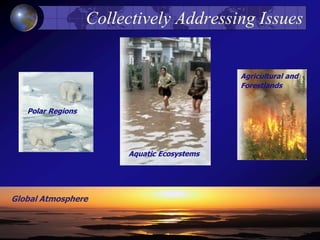
Collectively Addressing Issues
Global Atmosphere
Agricultural and
Forestlands
Aquatic Ecosystems
Polar Regions
Get Involved
State and local governments play an important role in meeting the national goal of
reducing greenhouse gas intensity by 18 percent by 2012. They are participating
in national voluntary programs and initiatives, analyzing the costs and benefits of
actions and developing and applying innovative programs and strategies that
achieve wide-ranging benefits to businesses, the environment and public health.
EPA supports states and communities in these activities by encouraging voluntary
approaches and providing technical assistance and tools.
State and Local Governments
Tell family and friends that energy efficiency is good for their homes and
good for the environment because it lowers greenhouse gas emissions and
air pollution. Tell 5 people and together we can help our homes help us all.
http://www.epa.gov
Citizens’ Involvement
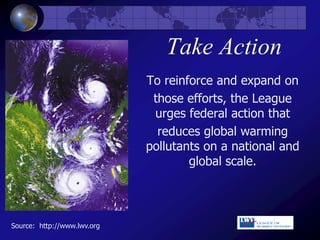
Take Action
To reinforce and expand on
those efforts, the League
urges federal action that
reduces global warming
pollutants on a national and
global scale.
Source: http://www.lwv.org
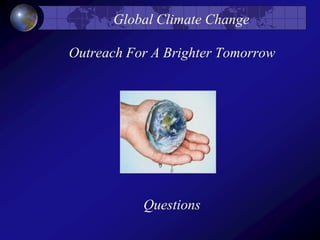
Outreach For A Brighter Tomorrow
Global Climate Change
Questions
References
http://www.epa.gov/greenpower/pubs/glossary.htm
http://www.epa.gov/climatechange/effects/polarregions.html
http://www.lwv.org/AM/Template.cfm?Section=Global_Climate_Cha
nge&Template=/TaggedPage/TaggedPageDisplay.cfm&TPLID=144&
ContentID=9858
http://news.aol.com/political-machine/2008/02/23/pentagon-climate-
change-report-alarming
http://www.whitehouse.gov/news/releases/2002/02/climatechange.html

Global Climate Change

  • 1.
    GLOBAL CLIMATE CHANGE MakingA Difference Created by: Professor Montrellle Caldwell 1Date: 2/18/2008
  • 2.
    World News Flash GlobalClimate Change On June 11, 2001, the President announced a new commitment to developing a science-based climate change policy, and a new commitment to funding research on "breakthrough technologies" that will help meet the long-run climate change challenge. To study areas of scientific uncertainty and identify priority areas where investments can make a difference, the President created the Climate Change Research Initiative (CCRI). Note: The CCRI promotes a vision focused on the effective use of scientific knowledge in policy and management decisions, and continued evaluation of management strategies and choices. Source: http://www.whitehouse.gov
  • 3.
    White House Initiatives GlobalClimate Change Reduce the Greenhouse Gas Intensity of the U.S. Economy by 18 Percent in the Next Ten Years. Substantially Improve the Emission Reduction Registry. Protect and Provide Transferable Credits for Emissions Reduction. Review Progress Toward Goal and Take Additional Action if Necessary Increase Funding for America's Commitment to Climate Change. Take Action on the Science and Technology Review Implement a Comprehensive Range of New and Expanded Domestic Policies Promote New and Expanded International Policies to Complement Our Domestic Program Source: http://www.whitehouse.gov
  • 4.
    Defining Global ClimateChange Global Climate Change: Climate change refers to any significant change in measures of climate (such as temperature, precipitation, or wind) lasting for an extended period (decades or longer). Source: http://www.epa.gov
  • 5.
    Global Climate Change Climatechange may result from: Natural factors, such as changes in the sun's intensity or slow changes in the Earth's orbit around the sun Natural processes within the climate system (e.g. ,changes in ocean circulation) Human activities that change the atmosphere's composition (e.g., through burning fossil fuels) and the land surface (e.g., deforestation, reforestation, urbanization, desertification)
  • 6.
    Making A Difference TheLeague believes that now is the time to act on global climate change. We can reduce global warming pollution by using existing technologies to make power plants and factories more efficient, make cars go farther on a gallon of gasoline, and shift to cleaner technologies. Cities, states and individuals are already adopting many of these solutions, which also reduce our dependence on oil, reduce air pollution, and protect pristine places from oil drilling and mining. State and local initiatives are proving that answers exist. Global Climate Change Source: http://www.lwv.org
  • 7.
    Collectively Addressing Issues GlobalAtmosphere Agricultural and Forestlands Aquatic Ecosystems Polar Regions
  • 8.
    Get Involved State andlocal governments play an important role in meeting the national goal of reducing greenhouse gas intensity by 18 percent by 2012. They are participating in national voluntary programs and initiatives, analyzing the costs and benefits of actions and developing and applying innovative programs and strategies that achieve wide-ranging benefits to businesses, the environment and public health. EPA supports states and communities in these activities by encouraging voluntary approaches and providing technical assistance and tools. State and Local Governments Tell family and friends that energy efficiency is good for their homes and good for the environment because it lowers greenhouse gas emissions and air pollution. Tell 5 people and together we can help our homes help us all. http://www.epa.gov Citizens’ Involvement
  • 9.
    Take Action To reinforceand expand on those efforts, the League urges federal action that reduces global warming pollutants on a national and global scale. Source: http://www.lwv.org
  • 10.
    Outreach For ABrighter Tomorrow Global Climate Change Questions
  • 11.