By John, Peter, Adrienne & Ryan
COMM 2330: Intro to Public Relations
Palo Alto College, San Antonio, Texas
 Build relationships worldwide
 Give public relations to nations that lack it
 More importance placed on PR as time passes
 Can be difficult due to human barriers
 Many countries use U.S. PR techniques.
 PR techniques predate the term “PR”.
 Best coverage – the Americas, EU, AU, East Asia
 Poor coverage – the Middle East, Africa,
Russia/Ukraine
 Surprisingly good - Antarctica
 US has been engaged in international business 1990s
 Today almost one-third of all U.S. corporate profits
 Fueling a new age of global PR
 400 million, 27 countries speak multiple languages
 Inter-Cultural Challenges
 High-Context Cultures
 Low Context Cultures
 Media Translation
 Global Segmentation
 Targeting
 What is a foreign corporation?
 How do foreign corporations benefit
globally?
 Challenges of foreign corporation?
 U.S. in other nations.
 Challenges abroad
 Sustainable development
 Benefits of globalization
 Political philosophies
 The best of all worlds
 U.S government disseminates information world
wide
 Open communication in American society presents
complexity
 Helps promote America’s idea of democracy
 United States Information Agency (USIA) 1953
President Dwight Eisenhower
 USIA developed after Committee on Public
Information (CPI)
 USIA fell because Congress and other critics
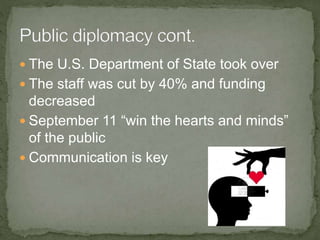
 The U.S. Department of State took over
 The staff was cut by 40% and funding
decreased
 September 11 “win the hearts and minds”
of the public
 Communication is key
 Millions of dollars are spent on tourism
 Countries that want to sweep U.S. audience aim
for:
 Advance political objectives
 Counsel on probable U.S. reaction
 English communication
 Counsel and help win support on specific
issues
 Help modify laws and regulations
 Foreign governments must register/file
reports with the U.S. Attorney General
 Non-U.S. governments gather detailed
information
 Provide facts and published statements
 Hundreds of NGOs depend on international support
 Coverage more than doubled over the past four-year
period
 Trust in NGOs is more than government or
corporations
 Viewed as a “wake up call”
 Large corporations have failed
 Large corporations are adopting an accommodation
stance
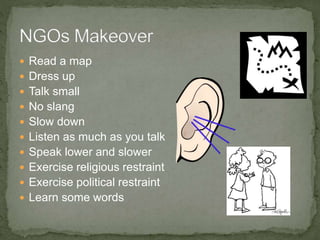
 Read a map
 Dress up
 Talk small
 No slang
 Slow down
 Listen as much as you talk
 Speak lower and slower
 Exercise religious restraint
 Exercise political restraint
 Learn some words
 Decide to work early to build skills
 Graduate study (master's/doctoral degrees)
recommended
 Study abroad!
 Have an interest in international cultures
 Large firms draw employees from worldwide
 Take the U.S. Foreign Service Officer’s exam
 What is Public Diplomacy?
 Which career opportunities are available in Global
PR?
 How is PR being practiced around the world?
 How is PR changing the new age?

Global Business and public relations

  • 1.
    By John, Peter,Adrienne & Ryan COMM 2330: Intro to Public Relations Palo Alto College, San Antonio, Texas
  • 2.
     Build relationshipsworldwide  Give public relations to nations that lack it  More importance placed on PR as time passes  Can be difficult due to human barriers  Many countries use U.S. PR techniques.  PR techniques predate the term “PR”.
  • 3.
     Best coverage– the Americas, EU, AU, East Asia  Poor coverage – the Middle East, Africa, Russia/Ukraine  Surprisingly good - Antarctica
  • 4.
     US hasbeen engaged in international business 1990s  Today almost one-third of all U.S. corporate profits  Fueling a new age of global PR  400 million, 27 countries speak multiple languages
  • 5.
     Inter-Cultural Challenges High-Context Cultures  Low Context Cultures  Media Translation  Global Segmentation  Targeting
  • 6.
     What isa foreign corporation?  How do foreign corporations benefit globally?  Challenges of foreign corporation?
  • 7.
     U.S. inother nations.  Challenges abroad  Sustainable development  Benefits of globalization  Political philosophies  The best of all worlds
  • 8.
     U.S governmentdisseminates information world wide  Open communication in American society presents complexity  Helps promote America’s idea of democracy  United States Information Agency (USIA) 1953 President Dwight Eisenhower  USIA developed after Committee on Public Information (CPI)  USIA fell because Congress and other critics
  • 9.
     The U.S.Department of State took over  The staff was cut by 40% and funding decreased  September 11 “win the hearts and minds” of the public  Communication is key
  • 10.
     Millions ofdollars are spent on tourism  Countries that want to sweep U.S. audience aim for:  Advance political objectives  Counsel on probable U.S. reaction  English communication  Counsel and help win support on specific issues  Help modify laws and regulations
  • 11.
     Foreign governmentsmust register/file reports with the U.S. Attorney General  Non-U.S. governments gather detailed information  Provide facts and published statements
  • 12.
     Hundreds ofNGOs depend on international support  Coverage more than doubled over the past four-year period  Trust in NGOs is more than government or corporations  Viewed as a “wake up call”  Large corporations have failed  Large corporations are adopting an accommodation stance
  • 13.
     Read amap  Dress up  Talk small  No slang  Slow down  Listen as much as you talk  Speak lower and slower  Exercise religious restraint  Exercise political restraint  Learn some words
  • 14.
     Decide towork early to build skills  Graduate study (master's/doctoral degrees) recommended  Study abroad!  Have an interest in international cultures  Large firms draw employees from worldwide  Take the U.S. Foreign Service Officer’s exam
  • 15.
     What isPublic Diplomacy?  Which career opportunities are available in Global PR?  How is PR being practiced around the world?  How is PR changing the new age?