-BY ANISH MONDAL
 Public relations (PR) is the practice of
managing the spread of information between
an individual or an organization (such as a
business, government agency, or a nonprofit
organization) and the public.
 Public relations may include an organization
or individual gaining exposure to their
audiences using topics of public interest and
news items that do not require direct
payment.
 Public relations professionals typically work
for PR and marketing firms, businesses
and companies, government, government
agencies, and public officials as PIOs,
and nongovernmental
organizations and nonprofit organizations.
 The public relations professional must know
how to effectively address those concerns
using the most powerful tool of the public
relations trade, which is publicity.
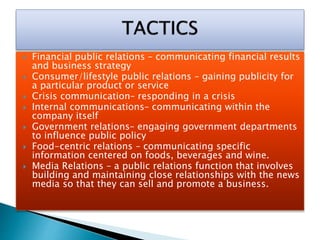
 Financial public relations – communicating financial results
and business strategy
 Consumer/lifestyle public relations – gaining publicity for
a particular product or service
 Crisis communication– responding in a crisis
 Internal communications– communicating within the
company itself
 Government relations– engaging government departments
to influence public policy
 Food-centric relations – communicating specific
information centered on foods, beverages and wine.
 Media Relations – a public relations function that involves
building and maintaining close relationships with the news
media so that they can sell and promote a business.
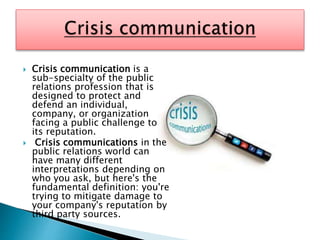
 Crisis communication is a
sub-specialty of the public
relations profession that is
designed to protect and
defend an individual,
company, or organization
facing a public challenge to
its reputation.
 Crisis communications in the
public relations world can
have many different
interpretations depending on
who you ask, but here's the
fundamental definition: you're
trying to mitigate damage to
your company's reputation by
third party sources.
IF YOU ARE A PR IN AN ORGANISATION LIKE-
 CINEMA HALL
 HOSPITAL
 INDUSTRY
 CORPORATE HOUSES
 GOVERNMENT OFFICES etc.
ANY DISASTER OCCUR.WHAT SHALL WE HAVE
TO FOLLOW-
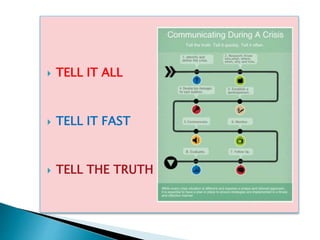
 TELL IT ALL
 TELL IT FAST
 TELL THE TRUTH
 Maintain connectivity
 Be readily accessible to the news media
 Show empathy for the people involved
 Streamline communication processes
 Maintain information security
 Ensure uninterrupted audit trails
 Support multi-channel communications
 Remove dependencies on paper-based
processes
 Two-fold: Preparation,
Response
 To prepare:
 detailed Crisis
Communication Plan
 More likely to respond
quickly
 Take immediate steps to
control message
Successfully regain
public’s trust
 Insurance policy for the
long-term health of your
organization
 CEO
 Head of Public Relations
 Vice Presidents, Managers of key departments
 Safety or Security Officer
 Company lawyers
SUPPOSE YOU ARE A
PR OF A RENOWNED
CINEMA
HALL.SUDDENLY
THERE WAS A FIRE IN
WHICH 56 PEOPLE
DIED.HOW WILL YOU
MAINTAIN THE
DAMAGE CONTROL
PLAN.
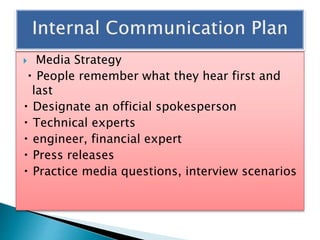
 Media Strategy
People remember what they hear first and
last
Designate an official spokesperson
Technical experts
engineer, financial expert
Press releases
Practice media questions, interview scenarios
 Ensure safety of all
involved
 Internal statements to
all employees
 Determine when to go
public
“Tell it all; tell it
fast”
 Send out press release
covering who, what,
when, where of the
crisis.
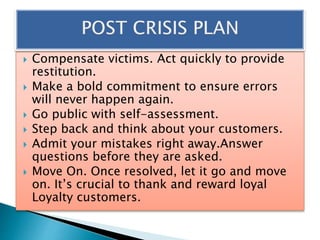
 Compensate victims. Act quickly to provide
restitution.
 Make a bold commitment to ensure errors
will never happen again.
 Go public with self-assessment.
 Step back and think about your customers.
 Admit your mistakes right away.Answer
questions before they are asked.
 Move On. Once resolved, let it go and move
on. It’s crucial to thank and reward loyal
Loyalty customers.
@
Thank You

Crisis communication

  • 1.
  • 2.
     Public relations(PR) is the practice of managing the spread of information between an individual or an organization (such as a business, government agency, or a nonprofit organization) and the public.  Public relations may include an organization or individual gaining exposure to their audiences using topics of public interest and news items that do not require direct payment.
  • 3.
     Public relationsprofessionals typically work for PR and marketing firms, businesses and companies, government, government agencies, and public officials as PIOs, and nongovernmental organizations and nonprofit organizations.  The public relations professional must know how to effectively address those concerns using the most powerful tool of the public relations trade, which is publicity.
  • 4.
     Financial publicrelations – communicating financial results and business strategy  Consumer/lifestyle public relations – gaining publicity for a particular product or service  Crisis communication– responding in a crisis  Internal communications– communicating within the company itself  Government relations– engaging government departments to influence public policy  Food-centric relations – communicating specific information centered on foods, beverages and wine.  Media Relations – a public relations function that involves building and maintaining close relationships with the news media so that they can sell and promote a business.
  • 5.
     Crisis communicationis a sub-specialty of the public relations profession that is designed to protect and defend an individual, company, or organization facing a public challenge to its reputation.  Crisis communications in the public relations world can have many different interpretations depending on who you ask, but here's the fundamental definition: you're trying to mitigate damage to your company's reputation by third party sources.
  • 7.
    IF YOU AREA PR IN AN ORGANISATION LIKE-  CINEMA HALL  HOSPITAL  INDUSTRY  CORPORATE HOUSES  GOVERNMENT OFFICES etc. ANY DISASTER OCCUR.WHAT SHALL WE HAVE TO FOLLOW-
  • 8.
     TELL ITALL  TELL IT FAST  TELL THE TRUTH
  • 9.
     Maintain connectivity Be readily accessible to the news media  Show empathy for the people involved  Streamline communication processes  Maintain information security  Ensure uninterrupted audit trails  Support multi-channel communications  Remove dependencies on paper-based processes
  • 10.
     Two-fold: Preparation, Response To prepare:  detailed Crisis Communication Plan  More likely to respond quickly  Take immediate steps to control message Successfully regain public’s trust  Insurance policy for the long-term health of your organization
  • 12.
     CEO  Headof Public Relations  Vice Presidents, Managers of key departments  Safety or Security Officer  Company lawyers
  • 13.
    SUPPOSE YOU AREA PR OF A RENOWNED CINEMA HALL.SUDDENLY THERE WAS A FIRE IN WHICH 56 PEOPLE DIED.HOW WILL YOU MAINTAIN THE DAMAGE CONTROL PLAN.
  • 14.
     Media Strategy Peopleremember what they hear first and last Designate an official spokesperson Technical experts engineer, financial expert Press releases Practice media questions, interview scenarios
  • 15.
     Ensure safetyof all involved  Internal statements to all employees  Determine when to go public “Tell it all; tell it fast”  Send out press release covering who, what, when, where of the crisis.
  • 16.
     Compensate victims.Act quickly to provide restitution.  Make a bold commitment to ensure errors will never happen again.  Go public with self-assessment.  Step back and think about your customers.  Admit your mistakes right away.Answer questions before they are asked.  Move On. Once resolved, let it go and move on. It’s crucial to thank and reward loyal Loyalty customers.
  • 17.