GLAUCOMA
Glaucoma is a group of eye conditions that damage the optic nerve, the
health of which is vital for good vision. This damage is often caused by an
abnormally high pressure in your eye.
Glaucoma is one of the leading causes of blindness for people over the age
of 60. It can occur at any age but is more common in older adults.
Many forms of glaucoma have no warning signs. The effect is so gradual
that you may not notice a change in vision until the condition is at an
advanced stage.
SYMPTOMS
The signs and symptoms of glaucoma
vary depending on the type and stage of
your condition. For example:
OPEN-ANGLE GLAUCOMA
Patchy blind spots in your side
(peripheral) or central vision, frequently
in both eyes
Tunnel vision in the advanced stages
ACUTE ANGLE-CLOSURE
GLAUCOMA
Severe headache
Eye pain
Nausea and vomiting
Blurred vision
Halos around lights
Eye redness
If left untreated, glaucoma will eventually cause blindness. Even with
treatment, about 15 percent of people with glaucoma become blind in at least
one eye within 20 years.
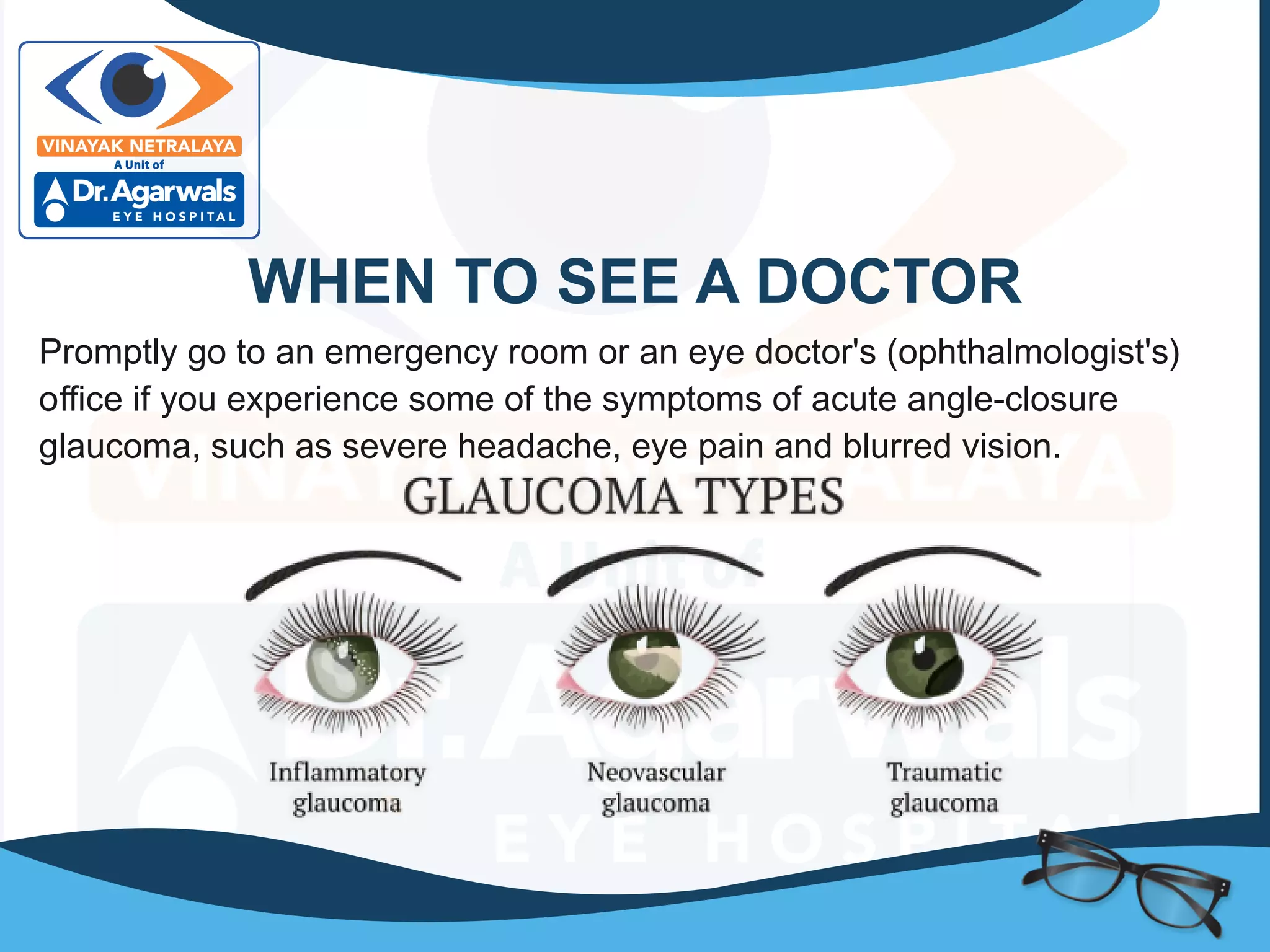
WHEN TO SEE A DOCTOR
Promptly go to an emergency room or an eye doctor's (ophthalmologist's)
office if you experience some of the symptoms of acute angle-closure
glaucoma, such as severe headache, eye pain and blurred vision.
CAUSES
Glaucoma is the result of damage to the optic nerve. As this nerve
gradually deteriorates, blind spots develop in your visual field. For reasons
that doctors don't fully understand, this nerve damage is usually related to
increased pressure in the eye.
Elevated eye pressure is due to a buildup of a fluid (aqueous humor) that
flows throughout the inside of your eye. This internal fluid normally drains
out through a tissue called the trabecular meshwork at the angle where the
iris and cornea meet. When fluid is overproduced or the drainage system
doesn't work properly, the fluid can't flow out at its normal rate and eye
pressure increases.
OPEN-ANGLE GLAUCOMA
Open-angle glaucoma is the most
common form of the disease. The
drainage angle formed by the cornea
and iris remains open, but the trabecular
meshwork is partially blocked. This
causes pressure in the eye to gradually
increase. This pressure damages the
optic nerve. It happens so slowly that
you may lose vision before you're even
aware of a problem.
ANGLE-CLOSURE GLAUCOMA
Angle-closure glaucoma, also called closed-angle
glaucoma, occurs when the iris bulges forward to
narrow or block the drainage angle formed by the
cornea and iris. As a result, fluid can't circulate
through the eye and pressure increases. Some
people have narrow drainage angles, putting them
at increased risk of angle-closure glaucoma.
Angle-closure glaucoma may occur suddenly
(acute angle-closure glaucoma) or gradually
(chronic angle-closure glaucoma). Acute angle-
closure glaucoma is a medical emergency.
NORMAL-TENSION GLAUCOMA
In normal-tension glaucoma, your optic nerve becomes damaged even though
your eye pressure is within the normal range. No one knows the exact reason
for this. You may have a sensitive optic nerve, or you may have less blood
being supplied to your optic nerve. This limited blood flow could be caused by
atherosclerosis — the buildup of fatty deposits (plaque) in the arteries — or
other conditions that impair circulation.
GLAUCOMA IN CHILDREN
It's possible for infants and children to have glaucoma. It may be present from
birth or develop in the first few years of life. The optic nerve damage may be
caused by drainage blockages or an underlying medical condition.
PIGMENTARY GLAUCOMA
In pigmentary glaucoma, pigment granules from your iris build up in the
drainage channels, slowing or blocking fluid exiting your eye. Activities such
as jogging sometimes stir up the pigment granules, depositing them on the
trabecular meshwork and causing intermittent pressure elevations.
PIGMENTARY GLAUCOMA
Because chronic forms of glaucoma can destroy vision before any signs or
symptoms are apparent, be aware of these risk factors:
Having high internal eye pressure (intraocular pressure)
Being black, Asian or Hispanic
Having a family history of glaucoma
Having certain medical conditions, such as
diabetes, heart disease, high blood pressure &
sickle cell anemia
Having corneas that are thin in the center
Being extremely nearsighted or farsighted
Having had an eye injury or certain types of eye surgery
Taking corticosteroid medications, especially eyedrops, for a long time
PREVENTION
These self-care steps can help you detect glaucoma
in its early stages
Get regular dilated eye examinations:-
Regular comprehensive eye exams can help
detect glaucoma in its early stages, before
significant damage occurs. If you're at risk of
glaucoma, you'll need more frequent screening.
Ask your doctor to recommend the right
screening schedule for you.
PREVENTION
Know your family's eye health history :- Glaucoma tends to
run in families. If you're at increased risk, you may need more
Exercise safely :- Regular, moderate exercise may
help prevent glaucoma by reducing eye pressure. Talk
with your doctor about an appropriate exercise
Take prescribed eyedrops regularly :-
Glaucoma eyedrops can significantly reduce
the risk that high eye pressure will progress to glaucoma.
To be effective, eyedrops prescribed by your doctor need to
be used regularly even if you have no symptoms.
DIAGNOSIS
Your doctor will review your medical history and conduct a comprehensive
eye examination. He or she may perform several tests, including:
Measuring intraocular pressure (tonometry)
Testing for optic nerve damage with a dilated eye examination and imaging
tests
Checking for areas of vision loss (visual field test)
Measuring corneal thickness (pachymetry)
Inspecting the drainage angle (gonioscopy)
OUR BRANCHES
JANJIRWALA BRANCH
203,Lakshya Badgara Creast Tower,
Janjirwala Square, Indore (M.P)
+91731-2536099, +91731-4077770
jangirwala@dragarwal.com
ASHTA CENTRE BRANCH
16, Maa Kamladevi Palace Bajrang
Colony , Kannod Road Ashta (m.p )
9993814320
astha@dragarwal.com
ANNAPURNA BRANCH
4, Bank Colony, Annapurna Road,
opposite Dussehra ground, Indore(M.P.)
+91731-4230699, +919098211302
annapurna@dragarwal.com

Glaucoma | Glaucoma Surgery, Glaucoma Eye Surgery Centre | Glaucoma Centre in Indore

  • 2.
    GLAUCOMA Glaucoma is agroup of eye conditions that damage the optic nerve, the health of which is vital for good vision. This damage is often caused by an abnormally high pressure in your eye. Glaucoma is one of the leading causes of blindness for people over the age of 60. It can occur at any age but is more common in older adults. Many forms of glaucoma have no warning signs. The effect is so gradual that you may not notice a change in vision until the condition is at an advanced stage.
  • 3.
    SYMPTOMS The signs andsymptoms of glaucoma vary depending on the type and stage of your condition. For example: OPEN-ANGLE GLAUCOMA Patchy blind spots in your side (peripheral) or central vision, frequently in both eyes Tunnel vision in the advanced stages
  • 4.
    ACUTE ANGLE-CLOSURE GLAUCOMA Severe headache Eyepain Nausea and vomiting Blurred vision Halos around lights Eye redness If left untreated, glaucoma will eventually cause blindness. Even with treatment, about 15 percent of people with glaucoma become blind in at least one eye within 20 years.
  • 5.
    WHEN TO SEEA DOCTOR Promptly go to an emergency room or an eye doctor's (ophthalmologist's) office if you experience some of the symptoms of acute angle-closure glaucoma, such as severe headache, eye pain and blurred vision.
  • 6.
    CAUSES Glaucoma is theresult of damage to the optic nerve. As this nerve gradually deteriorates, blind spots develop in your visual field. For reasons that doctors don't fully understand, this nerve damage is usually related to increased pressure in the eye. Elevated eye pressure is due to a buildup of a fluid (aqueous humor) that flows throughout the inside of your eye. This internal fluid normally drains out through a tissue called the trabecular meshwork at the angle where the iris and cornea meet. When fluid is overproduced or the drainage system doesn't work properly, the fluid can't flow out at its normal rate and eye pressure increases.
  • 7.
    OPEN-ANGLE GLAUCOMA Open-angle glaucomais the most common form of the disease. The drainage angle formed by the cornea and iris remains open, but the trabecular meshwork is partially blocked. This causes pressure in the eye to gradually increase. This pressure damages the optic nerve. It happens so slowly that you may lose vision before you're even aware of a problem.
  • 8.
    ANGLE-CLOSURE GLAUCOMA Angle-closure glaucoma,also called closed-angle glaucoma, occurs when the iris bulges forward to narrow or block the drainage angle formed by the cornea and iris. As a result, fluid can't circulate through the eye and pressure increases. Some people have narrow drainage angles, putting them at increased risk of angle-closure glaucoma. Angle-closure glaucoma may occur suddenly (acute angle-closure glaucoma) or gradually (chronic angle-closure glaucoma). Acute angle- closure glaucoma is a medical emergency.
  • 9.
    NORMAL-TENSION GLAUCOMA In normal-tensionglaucoma, your optic nerve becomes damaged even though your eye pressure is within the normal range. No one knows the exact reason for this. You may have a sensitive optic nerve, or you may have less blood being supplied to your optic nerve. This limited blood flow could be caused by atherosclerosis — the buildup of fatty deposits (plaque) in the arteries — or other conditions that impair circulation.
  • 10.
    GLAUCOMA IN CHILDREN It'spossible for infants and children to have glaucoma. It may be present from birth or develop in the first few years of life. The optic nerve damage may be caused by drainage blockages or an underlying medical condition.
  • 11.
    PIGMENTARY GLAUCOMA In pigmentaryglaucoma, pigment granules from your iris build up in the drainage channels, slowing or blocking fluid exiting your eye. Activities such as jogging sometimes stir up the pigment granules, depositing them on the trabecular meshwork and causing intermittent pressure elevations.
  • 12.
    PIGMENTARY GLAUCOMA Because chronicforms of glaucoma can destroy vision before any signs or symptoms are apparent, be aware of these risk factors: Having high internal eye pressure (intraocular pressure) Being black, Asian or Hispanic Having a family history of glaucoma Having certain medical conditions, such as diabetes, heart disease, high blood pressure & sickle cell anemia Having corneas that are thin in the center Being extremely nearsighted or farsighted Having had an eye injury or certain types of eye surgery Taking corticosteroid medications, especially eyedrops, for a long time
  • 13.
    PREVENTION These self-care stepscan help you detect glaucoma in its early stages Get regular dilated eye examinations:- Regular comprehensive eye exams can help detect glaucoma in its early stages, before significant damage occurs. If you're at risk of glaucoma, you'll need more frequent screening. Ask your doctor to recommend the right screening schedule for you.
  • 14.
    PREVENTION Know your family'seye health history :- Glaucoma tends to run in families. If you're at increased risk, you may need more Exercise safely :- Regular, moderate exercise may help prevent glaucoma by reducing eye pressure. Talk with your doctor about an appropriate exercise Take prescribed eyedrops regularly :- Glaucoma eyedrops can significantly reduce the risk that high eye pressure will progress to glaucoma. To be effective, eyedrops prescribed by your doctor need to be used regularly even if you have no symptoms.
  • 15.
    DIAGNOSIS Your doctor willreview your medical history and conduct a comprehensive eye examination. He or she may perform several tests, including: Measuring intraocular pressure (tonometry) Testing for optic nerve damage with a dilated eye examination and imaging tests Checking for areas of vision loss (visual field test) Measuring corneal thickness (pachymetry) Inspecting the drainage angle (gonioscopy)
  • 16.
    OUR BRANCHES JANJIRWALA BRANCH 203,LakshyaBadgara Creast Tower, Janjirwala Square, Indore (M.P) +91731-2536099, +91731-4077770 jangirwala@dragarwal.com ASHTA CENTRE BRANCH 16, Maa Kamladevi Palace Bajrang Colony , Kannod Road Ashta (m.p ) 9993814320 astha@dragarwal.com ANNAPURNA BRANCH 4, Bank Colony, Annapurna Road, opposite Dussehra ground, Indore(M.P.) +91731-4230699, +919098211302 annapurna@dragarwal.com