GLASGOW
COMA SCALE
Dr.Faisal K A
Tutor
Malabar Dental College and Research Centre
introduction
 Head injuries are one of the common causes of
death in road traffic accidents
 It can be open or closed injuries depending on
whether there is fracture skull with meningeal
injuries causing CSF leak or not . CSF can leak
through scalp wound/ear/nose based on site of
injury
 After initial steps for preservation of life are taken
satisfactorily and patient has been stabilized ,then
a full examination of patient is carried out to detect
the presence of associated important injuries
Triage
 Means ‘to sort out’ in French
 It was a system to attend patients with trauma
 Assessing 4 component
i. Physiologic assessment
ii. Anatomical injury
iii. Biomechanical injury
iv. Comorbid factors
Clinical approach of a patient with
head injury
 Detail history of injury-process of deterioration-rapid or gradual
 History of alcohol intake
 Neurological assessment: by
a. Level of consciousness- Glasgow coma scale
b. Pupillary reaction to light and size
c. Pulse
d. Temperature
e. Blood pressure
f. Respiratory rate
g. Reflexes
h. Limb movements- normal/mild weakness/severe weakness/spastic
flexion/extension/no response
Status and protection of airway
General assessment for other injuries
Glasgow coma scale
 This scale relates clinical observations for motor
response, verbal response, and eye examination
and its response
 Level of consciousness should be assessed:
 Fully conscious
 Drowsy patient with disorientation , but responds
irrationally to spoken questions
 Semiconscious patient
 Semi coma(unconscious but responds to painful
stimuli)
 coma
history
 Developed in 1974 by Teasdale and Jennet
 First attempt to quantify the severity of head injury
 Include 3 variables
1. Best motor response(reflects level of CNS
function)
2. Best verbal response(CNS ability to integrate
information)
3. Eye opening (function of brain stem activity)
Glasgow coma scale
 Eye opening
4-opens eyes spontaneously
3-opens eyes to voice
2-opens eyes to pain
1-no eye opening
C-unable to open eyes due to any swellings
Glasgow coma scale
 Motor response
6-obeys commands
5-localises to pain
4-withdraws to pain
3-abnormal flexor response
2-abnormal extensor response
1-no movement
Extensor Flexor
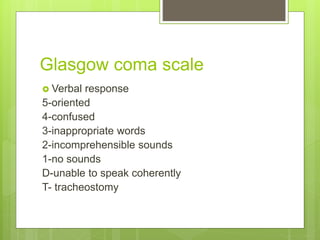
Glasgow coma scale
 Verbal response
5-oriented
4-confused
3-inappropriate words
2-incomprehensible sounds
1-no sounds
D-unable to speak coherently
T- tracheostomy
inference
 Total score -15
 Mild head injury:- 13-15
 Moderate head injury :-9-12
 Severe head injury :- less than 8(3-8)
In a prospective multicenter study
 GCS of 9 or less-higher mortality rates
 Used to predict outcomes
Weaknesses of GCS
Does not take in to account
 focal or lateralizing sign
 Diffuse metabolic processes
 intoxication
References
 SRB’ s manual of surgery
 Peterson’s principles of oral and maxillofacial
surgery
 Textbook of oral and maxillofacial surgery- S
M balaji
THANKYOU

Glassgow

  • 1.
    GLASGOW COMA SCALE Dr.Faisal KA Tutor Malabar Dental College and Research Centre
  • 2.
    introduction  Head injuriesare one of the common causes of death in road traffic accidents  It can be open or closed injuries depending on whether there is fracture skull with meningeal injuries causing CSF leak or not . CSF can leak through scalp wound/ear/nose based on site of injury  After initial steps for preservation of life are taken satisfactorily and patient has been stabilized ,then a full examination of patient is carried out to detect the presence of associated important injuries
  • 3.
    Triage  Means ‘tosort out’ in French  It was a system to attend patients with trauma  Assessing 4 component i. Physiologic assessment ii. Anatomical injury iii. Biomechanical injury iv. Comorbid factors
  • 4.
    Clinical approach ofa patient with head injury  Detail history of injury-process of deterioration-rapid or gradual  History of alcohol intake  Neurological assessment: by a. Level of consciousness- Glasgow coma scale b. Pupillary reaction to light and size c. Pulse d. Temperature e. Blood pressure f. Respiratory rate g. Reflexes h. Limb movements- normal/mild weakness/severe weakness/spastic flexion/extension/no response Status and protection of airway General assessment for other injuries
  • 5.
    Glasgow coma scale This scale relates clinical observations for motor response, verbal response, and eye examination and its response  Level of consciousness should be assessed:  Fully conscious  Drowsy patient with disorientation , but responds irrationally to spoken questions  Semiconscious patient  Semi coma(unconscious but responds to painful stimuli)  coma
  • 6.
    history  Developed in1974 by Teasdale and Jennet  First attempt to quantify the severity of head injury  Include 3 variables 1. Best motor response(reflects level of CNS function) 2. Best verbal response(CNS ability to integrate information) 3. Eye opening (function of brain stem activity)
  • 8.
    Glasgow coma scale Eye opening 4-opens eyes spontaneously 3-opens eyes to voice 2-opens eyes to pain 1-no eye opening C-unable to open eyes due to any swellings
  • 9.
    Glasgow coma scale Motor response 6-obeys commands 5-localises to pain 4-withdraws to pain 3-abnormal flexor response 2-abnormal extensor response 1-no movement
  • 10.
  • 11.
    Glasgow coma scale Verbal response 5-oriented 4-confused 3-inappropriate words 2-incomprehensible sounds 1-no sounds D-unable to speak coherently T- tracheostomy
  • 12.
    inference  Total score-15  Mild head injury:- 13-15  Moderate head injury :-9-12  Severe head injury :- less than 8(3-8) In a prospective multicenter study  GCS of 9 or less-higher mortality rates  Used to predict outcomes
  • 13.
    Weaknesses of GCS Doesnot take in to account  focal or lateralizing sign  Diffuse metabolic processes  intoxication
  • 14.
    References  SRB’ smanual of surgery  Peterson’s principles of oral and maxillofacial surgery  Textbook of oral and maxillofacial surgery- S M balaji
  • 15.