

Presentation subject to come here
Geographic Information Systems
Think Spatially
31st May 2012
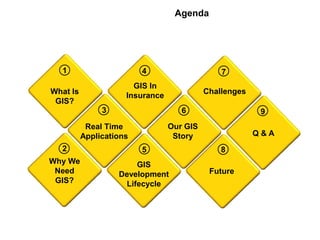
Agenda
2
What Is
GIS?
1
GIS
Development
Lifecycle
5
GIS In
Insurance
4
Why We
Need
GIS?
2
Real Time
Applications
3
Our GIS
Story
6
Q & A
9
Challenges
7
Future
8
What Is GIS ?
1
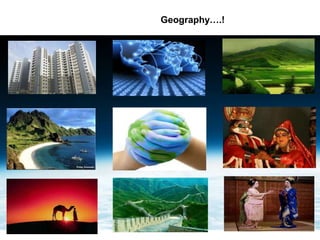
Geography….!
Geographic Information Systems
An organized collection of computer
hardware, software, geographic data,
and personnel designed to effectively
capture, store, manipulate, analyze,
and display all forms of
geographically referenced
information.
Confused….!
Geographic Information Systems
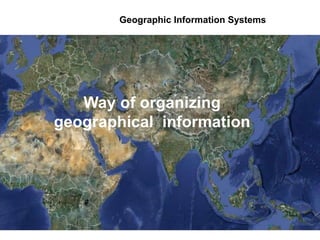
Way of organizing
geographical information
Why We Need
GIS ?
2
Why we need GIS ?
Visualization
Decision Making
Problem Solving
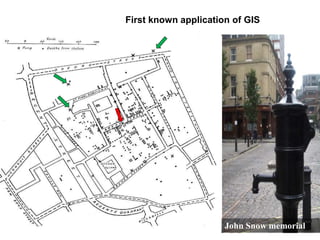
First known application of GIS
John Snow memorial
Real Time
Applications
3
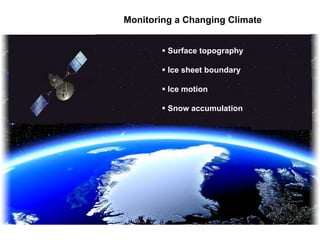
Monitoring a Changing Climate
 Surface topography
 Ice sheet boundary
 Ice motion
 Snow accumulation
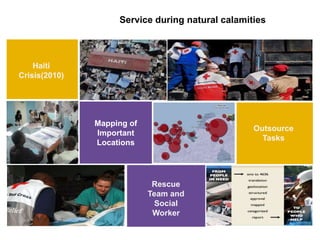
Service during natural calamities
Mapping of
Important
Locations
Rescue
Team and
Social
Worker
Outsource
Tasks
Haiti
Crisis(2010)
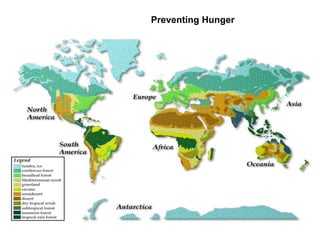
Preventing Hunger
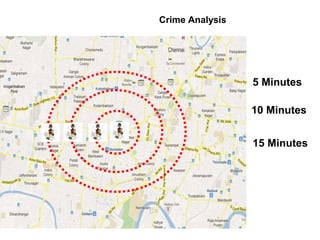
Crime Analysis
5 Minutes
10 Minutes
15 Minutes
Day to Day Scenario
How To Get
There A-B
Discover
Along The
Way
Explore
At Your
Destination
Where
To Go
GIS In
Insurance
4
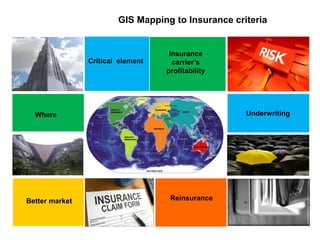
GIS Mapping to Insurance criteria
Critical element
Where
Better market Reinsurance
Insurance
carrier’s
profitability
Underwriting
GIS
Development Lifecycle
5
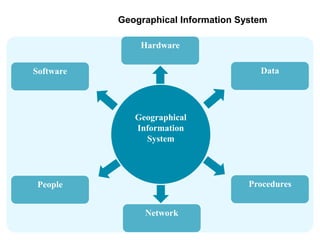
Geographical Information System
Data
People Procedures
Hardware
Software
Network
Geographical
Information
System
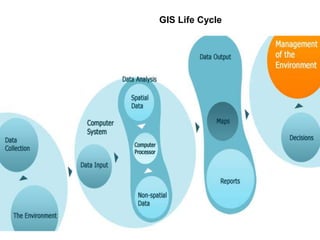
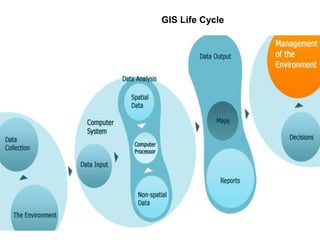
GIS Life Cycle
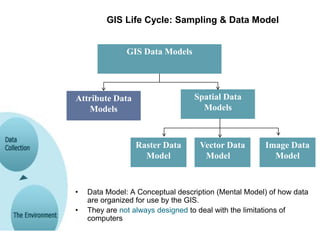
GIS Life Cycle: Sampling & Data Model
• Data Model: A Conceptual description (Mental Model) of how data
are organized for use by the GIS.
• They are not always designed to deal with the limitations of
computers
GIS Data Models
Attribute Data
Models
Spatial Data
Models
Raster Data
Model
Vector Data
Model
Image Data
Model
GIS Life Cycle: Data Transfer
• Data Structures: Methods of representing the data model
from w/in the computer
– Vector [Arc/Nodes] Data Structures
– Raster [Grid] Data Structures
GIS Life Cycle: Data Analysis
Spatial Data: Geographically referenced data, identified according to
Location.
Points Lines Polygons
Non-Spatial [Attribute Data ]: The attributes refer to the properties of spatial
entities.
Spatial Data
Community-
developed data
sets
Framework Data
sets
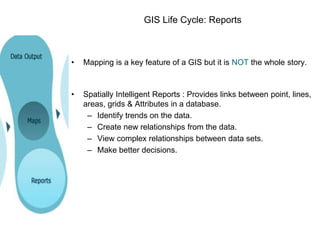
GIS Life Cycle: Reports
• Mapping is a key feature of a GIS but it is NOT the whole story.
• Spatially Intelligent Reports : Provides links between point, lines,
areas, grids & Attributes in a database.
– Identify trends on the data.
– Create new relationships from the data.
– View complex relationships between data sets.
– Make better decisions.
GIS Life Cycle
Our GIS Story
6
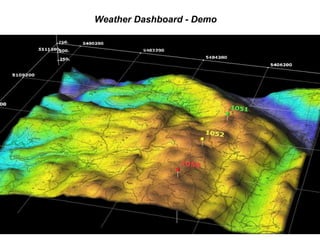
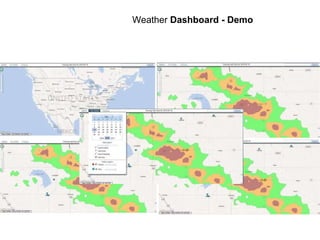
Weather Dashboard
 Objective of the tool?
– Develop a web interface that allows Travelers to visualize the
weather data by day, zoom into areas of significant “Impact” to
provide appropriate metrics related to the weather, policies, and
claims.
 Targeted Users
– Application will be utilized primarily by the “CAT Center” to
enhance event response activity.
Our GEO-SPATIAL CAPABILITIES
Weather Dashboard - Demo
Challenges
7
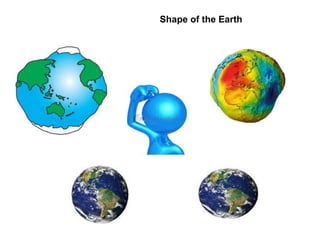
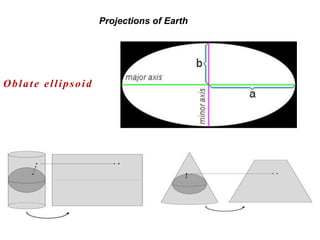
Shape of the Earth
Projections of Earth
Oblate ellipsoid
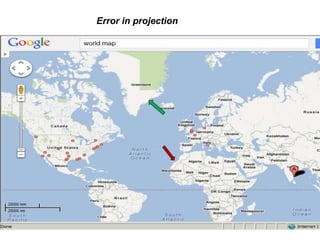
Error in projection
Data
1.Volume
Volume of Data
Data
Frequency of updating
Technology
1.Volume
2.Frequency of updating
Is It Safe?
Future
8
2-D description  4-D interaction
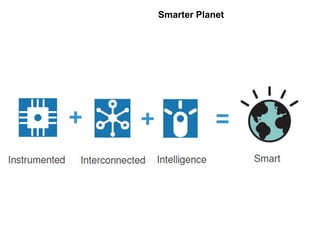
Smarter Planet
Future !!!!
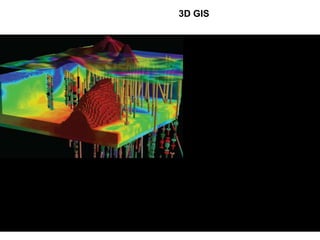
3D GIS
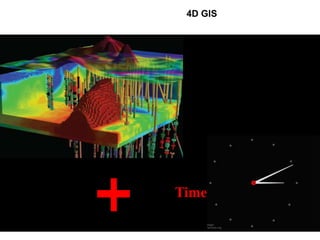
4D GIS
Time
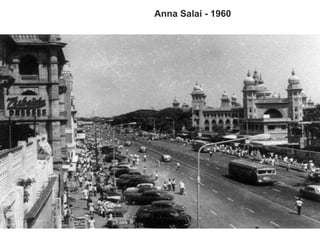
Anna Salai - 1960
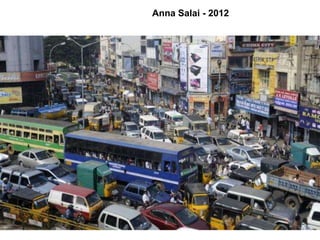
Anna Salai - 2012
Smarter Planet
Shoot
Thank You

Gis

Editor's Notes

  • #21 Generally, a GIS is custom-designed for an organization. Hence, a GIS developed for an application, jurisdiction, enterprise, or purpose may not be necessarily interoperable or compatible with a GIS that has been developed for some other application, jurisdiction, enterprise, or purpose. GIS is a collection of computer hardware, software, and geographic data for capturing, storing, updating, manipulating, analyzing, and displaying all forms of geographically referenced information. In the simplest terms, GIS is the merging of cartography, statistical analysis, and database technology. Organized collection of Hardware Software Network Data People Procedures
  • #22 Generally, a GIS is custom-designed for an organization. Hence, a GIS developed for an application, jurisdiction, enterprise, or purpose may not be necessarily interoperable or compatible with a GIS that has been developed for some other application, jurisdiction, enterprise, or purpose.
  • #23 Generally, a GIS is custom-designed for an organization. Hence, a GIS developed for an application, jurisdiction, enterprise, or purpose may not be necessarily interoperable or compatible with a GIS that has been developed for some other application, jurisdiction, enterprise, or purpose. Field Data Models : Selecting points from a continuous surface. Object Data Models: Selecting some discrete objects, discarding others. what is a Data Model? - The heart of any GIS is the data model. - A data model is a set of constructions for describing and representing selected aspects of the real world in a computer. - There is no single type of GIS Data model that is best for all circumstances.
  • #24 Generally, a GIS is custom-designed for an organization. Hence, a GIS developed for an application, jurisdiction, enterprise, or purpose may not be necessarily interoperable or compatible with a GIS that has been developed for some other application, jurisdiction, enterprise, or purpose. Vectors can represent point, line & area features very accurately Raster Model Advantages Simple data structure Efficient for remotely sensed or scanned data Simple spatial analysis procedures Disadvantages Requires greater storage space on computer Depending on pixel size, graphical output may be less pleasing Projection transformations are more difficult More difficult to represent topological relationships Vector Model Advantages Data can be represented in its original resolution without generalisation Requires less disk storage space Topological relationships are readily maintained Graphical output more closely resembles hand-drawn maps Disadvantages More complex data structure Inefficient for remotely sensed data Some spatial analysis procedures are complex and process intensive Overlaying multiple vector maps is often time consuming
  • #25  Geospatial Data: Community-developed data sets usually derived for a single purpose but made available for potential re-use. Data sets developed to a common content specification for high re-use potential. these are known as "FrameWork" Data
  • #26 Generally, a GIS is custom-designed for an organization. Hence, a GIS developed for an application, jurisdiction, enterprise, or purpose may not be necessarily interoperable or compatible with a GIS that has been developed for some other application, jurisdiction, enterprise, or purpose.
  • #27 Generally, a GIS is custom-designed for an organization. Hence, a GIS developed for an application, jurisdiction, enterprise, or purpose may not be necessarily interoperable or compatible with a GIS that has been developed for some other application, jurisdiction, enterprise, or purpose.
  • #31 Generally, a GIS is custom-designed for an organization. Hence, a GIS developed for an application, jurisdiction, enterprise, or purpose may not be necessarily interoperable or compatible with a GIS that has been developed for some other application, jurisdiction, enterprise, or purpose.