Open Source Geographic Information System (GIS)
Data for Financial Inclusion
Adityo Dwijananto | GIS Project Coordinator | adityo.dwijananto@hotosm.org
What is Geographic Information System?
Geographic Information System (GIS)
allows us to Manage, Analyze and Display
spatial information on the computer
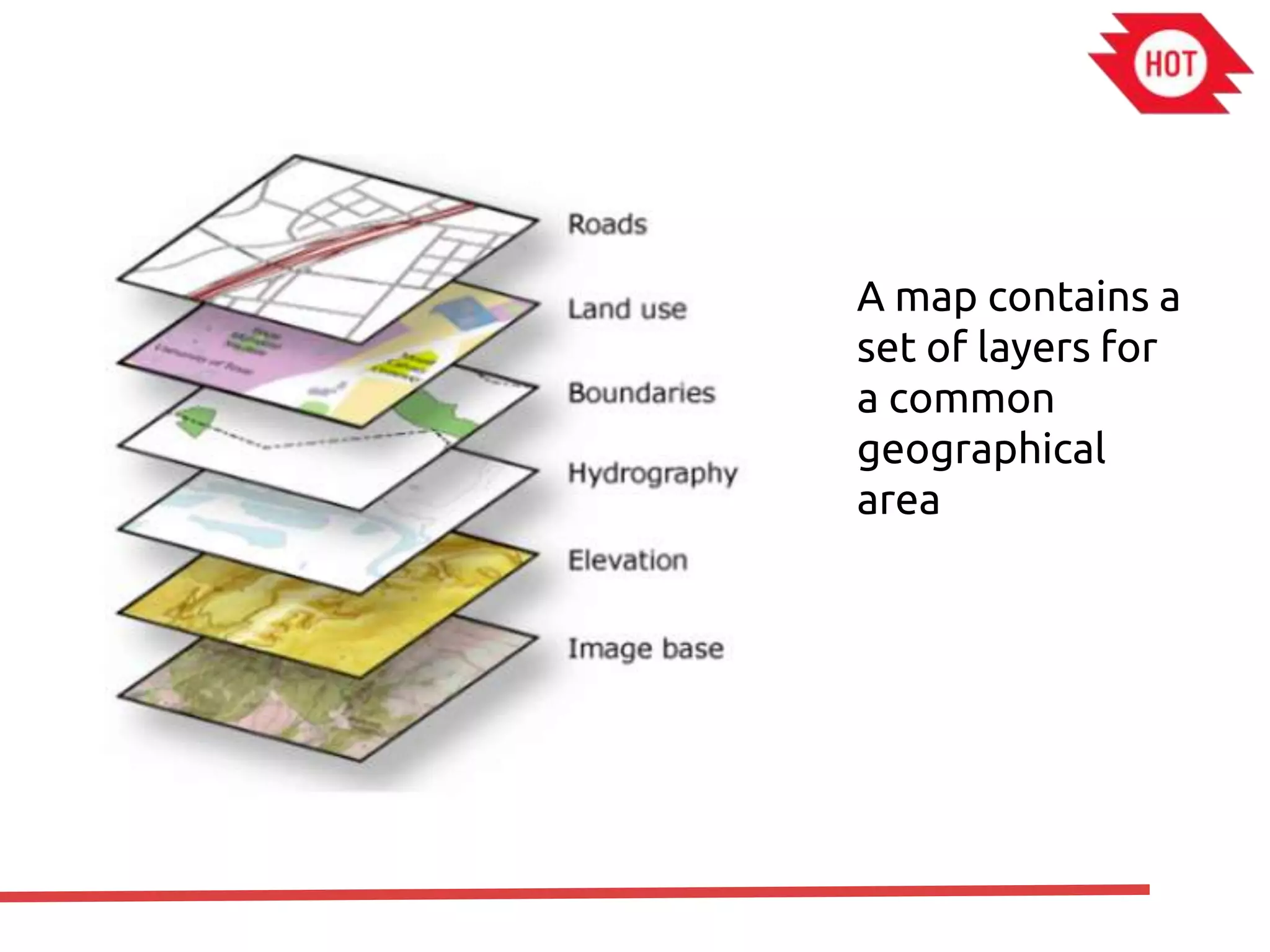
A map contains a
set of layers for
a common
geographical
area
OpenStreetMap
in a glimpse
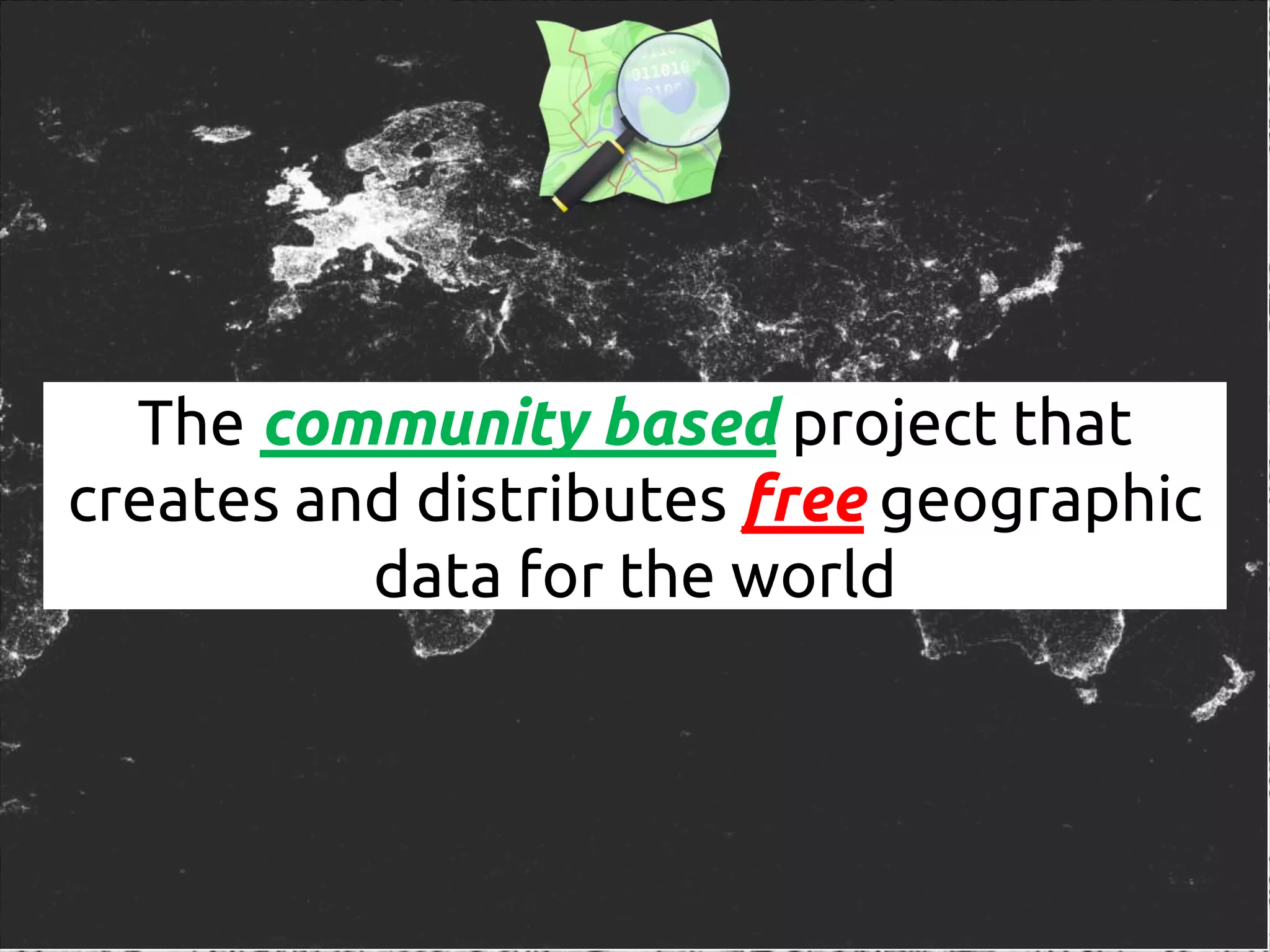
The community based project that
creates and distributes free geographic
data for the world
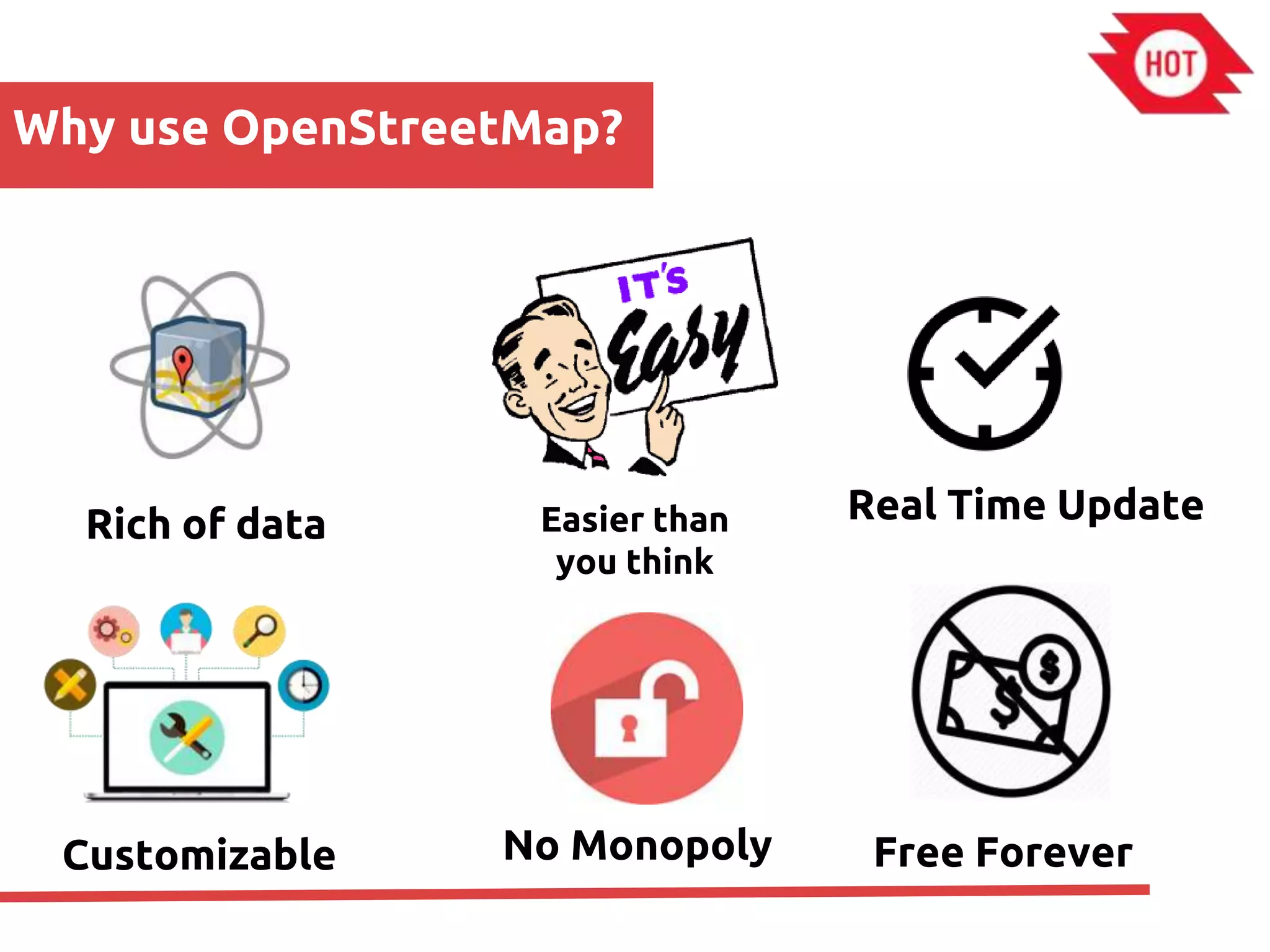
Why use OpenStreetMap?
Rich of data
No Monopoly Free Forever
Real Time UpdateEasier than
you think
Customizable
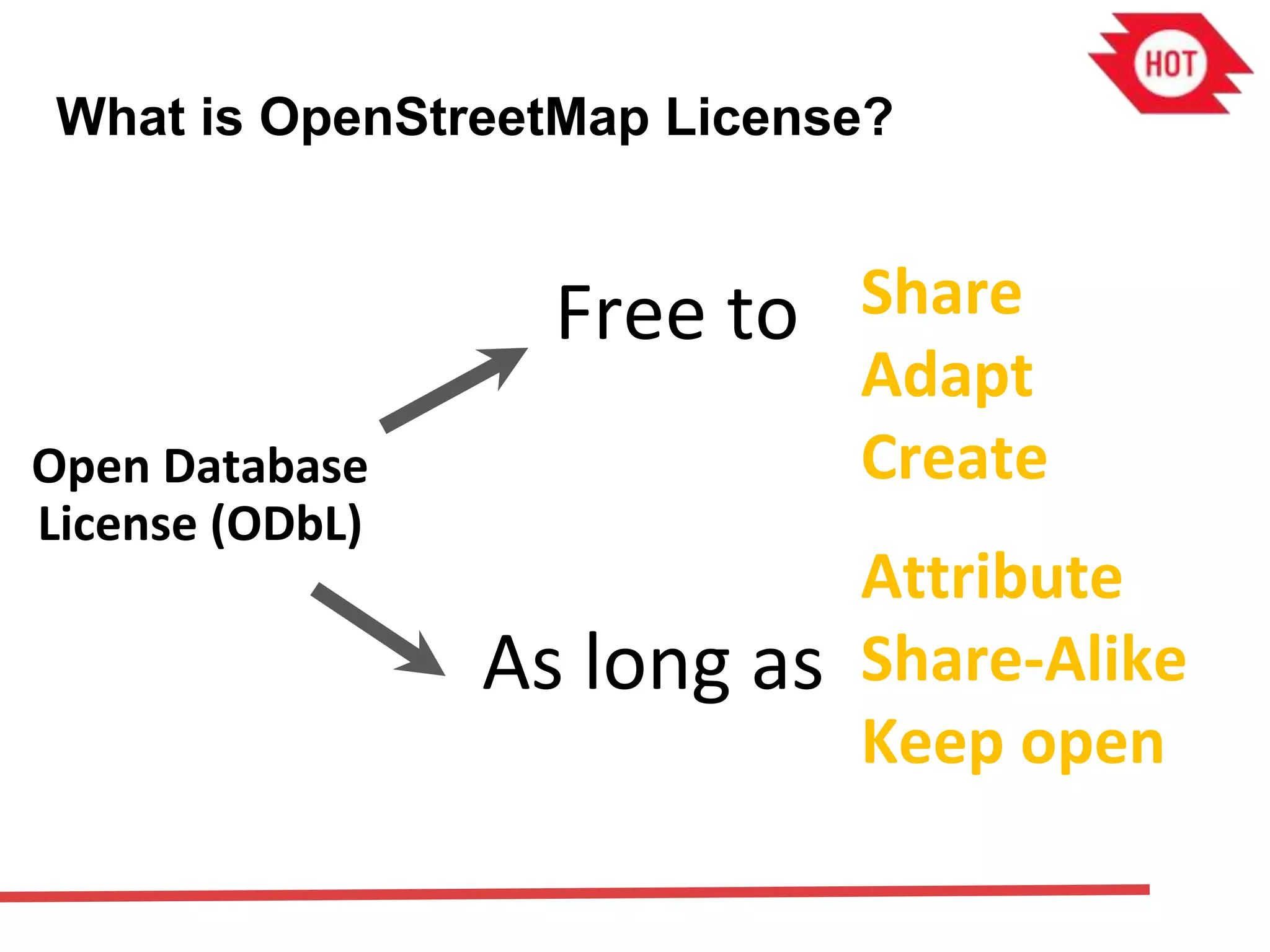
What is OpenStreetMap License?
Free to Share
Adapt
Create
As long as
Attribute
Share-Alike
Keep open
Open Database
License (ODbL)
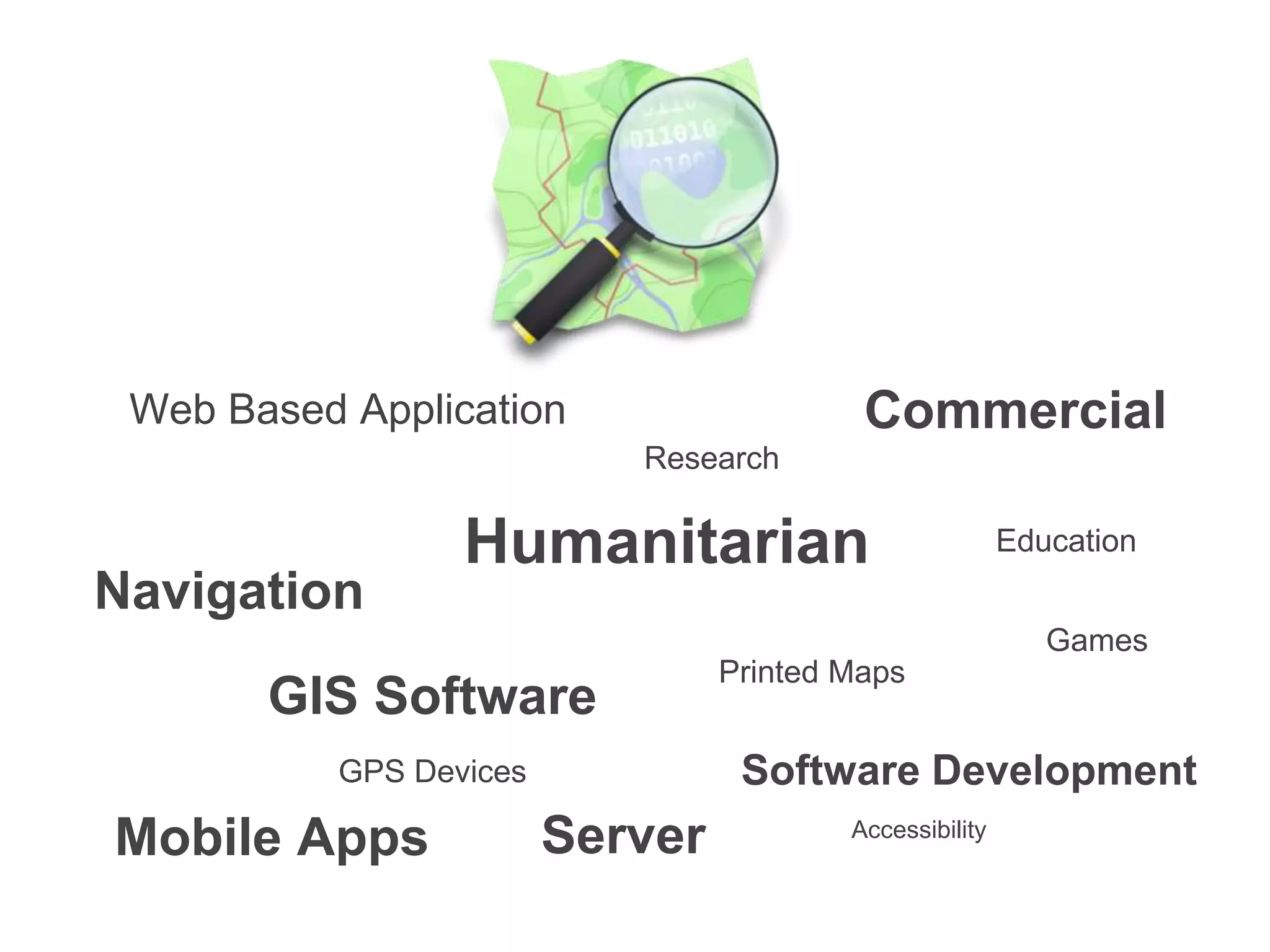
What can we do with
OpenStreetMap Data?
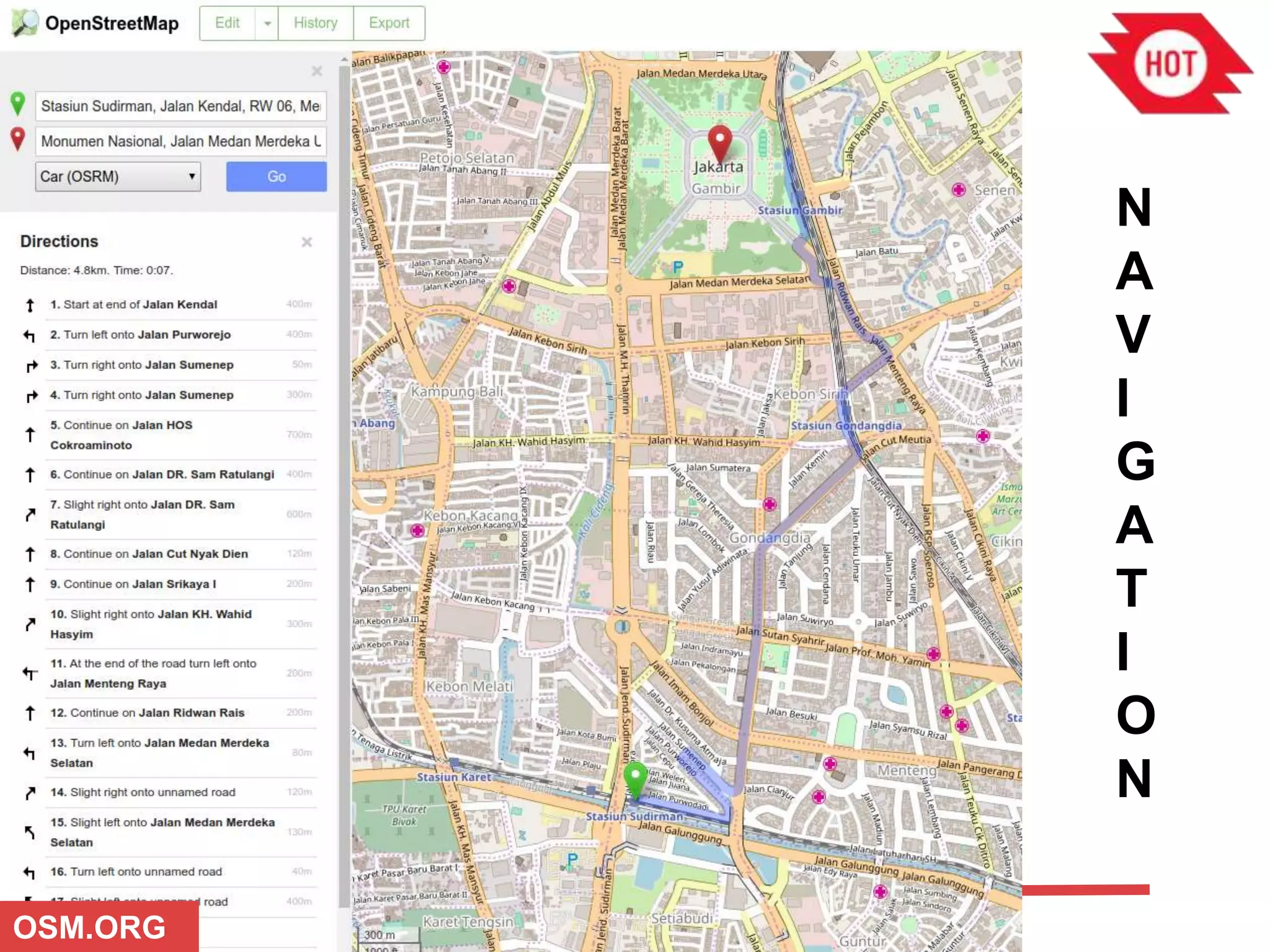
Navigation
Web Based Application
Humanitarian
Server
GIS Software
Research
Printed Maps
GPS Devices Software Development
Education
Commercial
Games
Accessibility
Mobile Apps
N
A
V
I
G
A
T
I
O
N
OSM.ORG
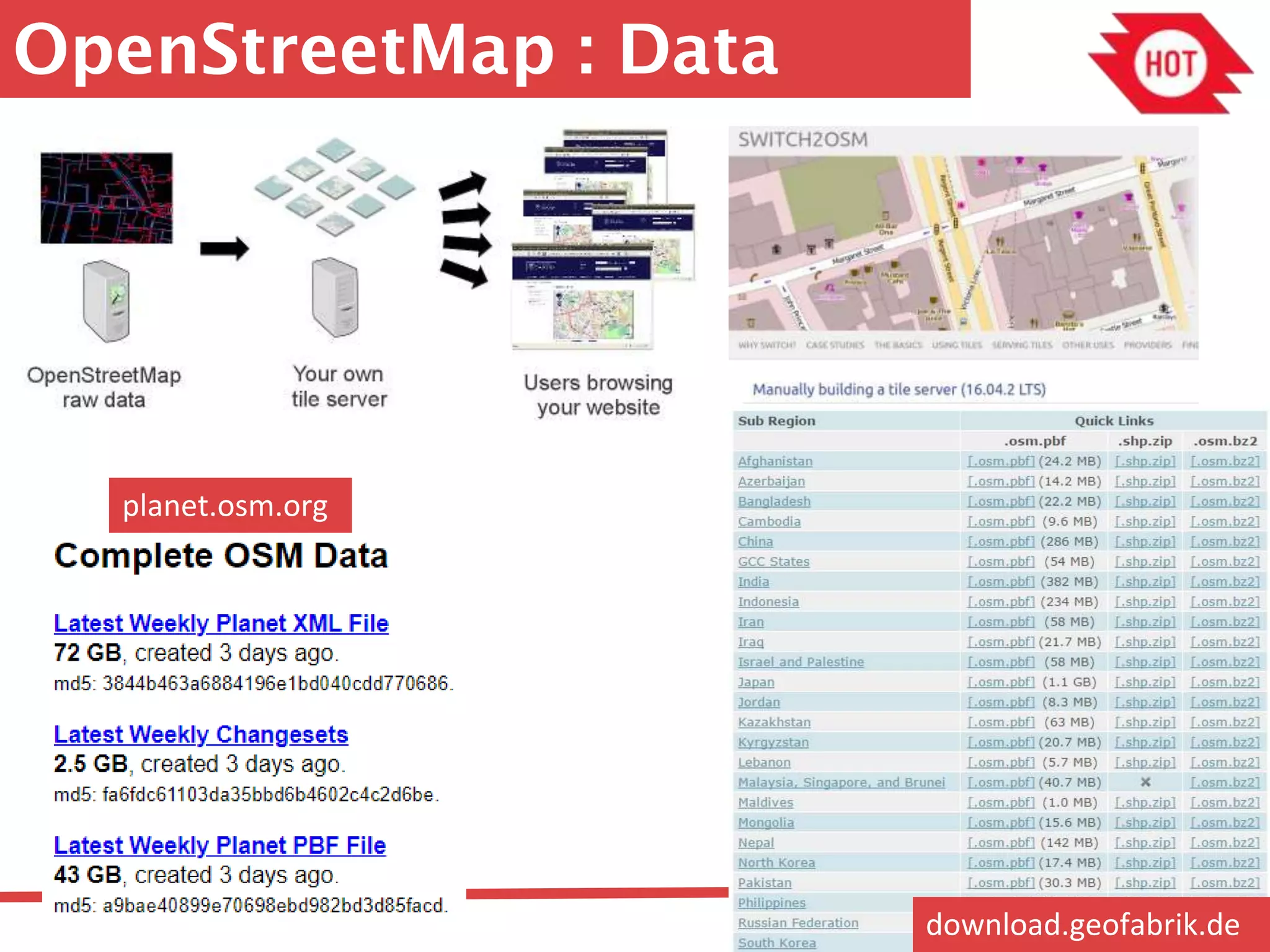
OpenStreetMap : Data
planet.osm.org
download.geofabrik.de
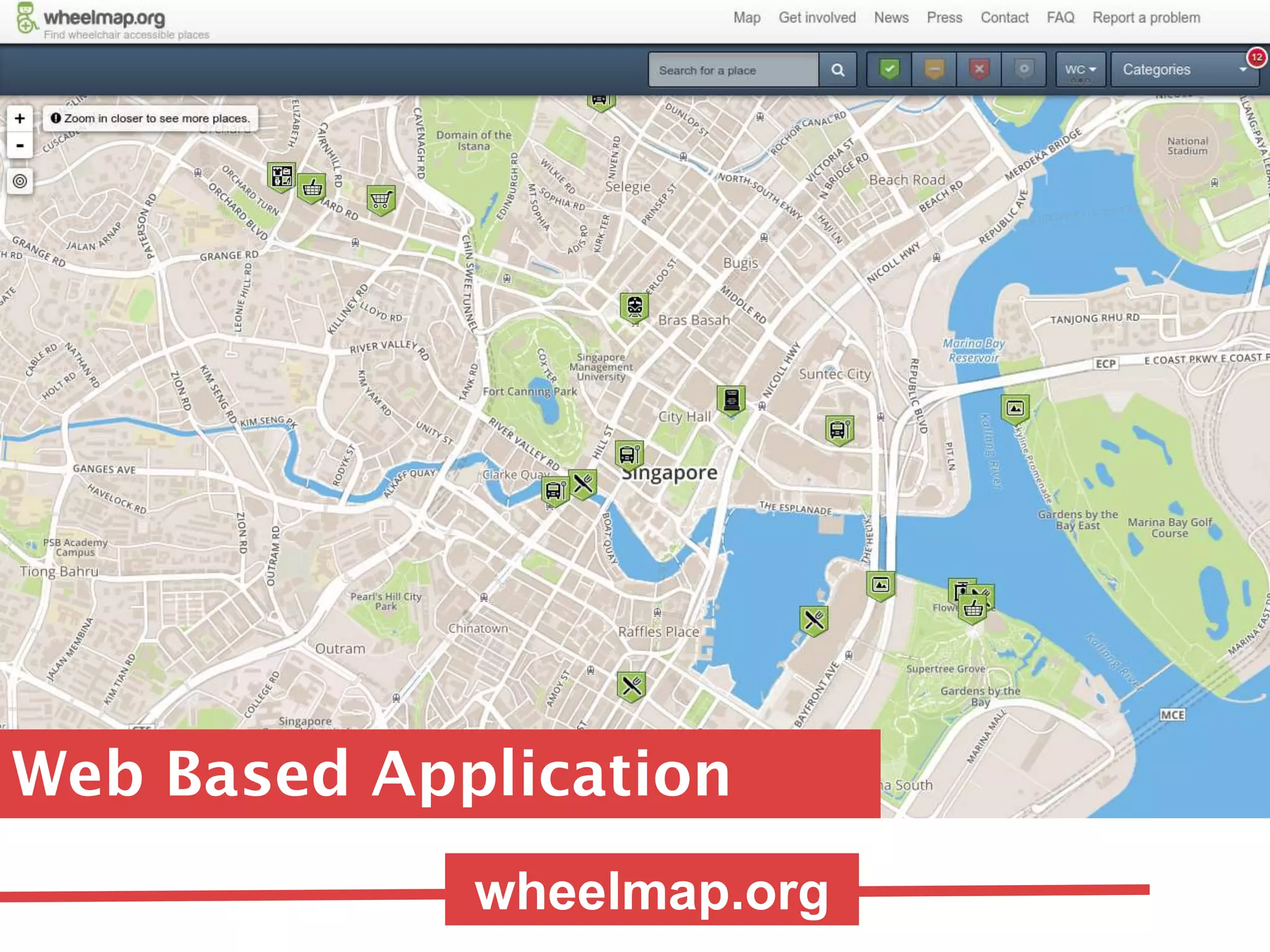
wheelmap.org
Web Based Application
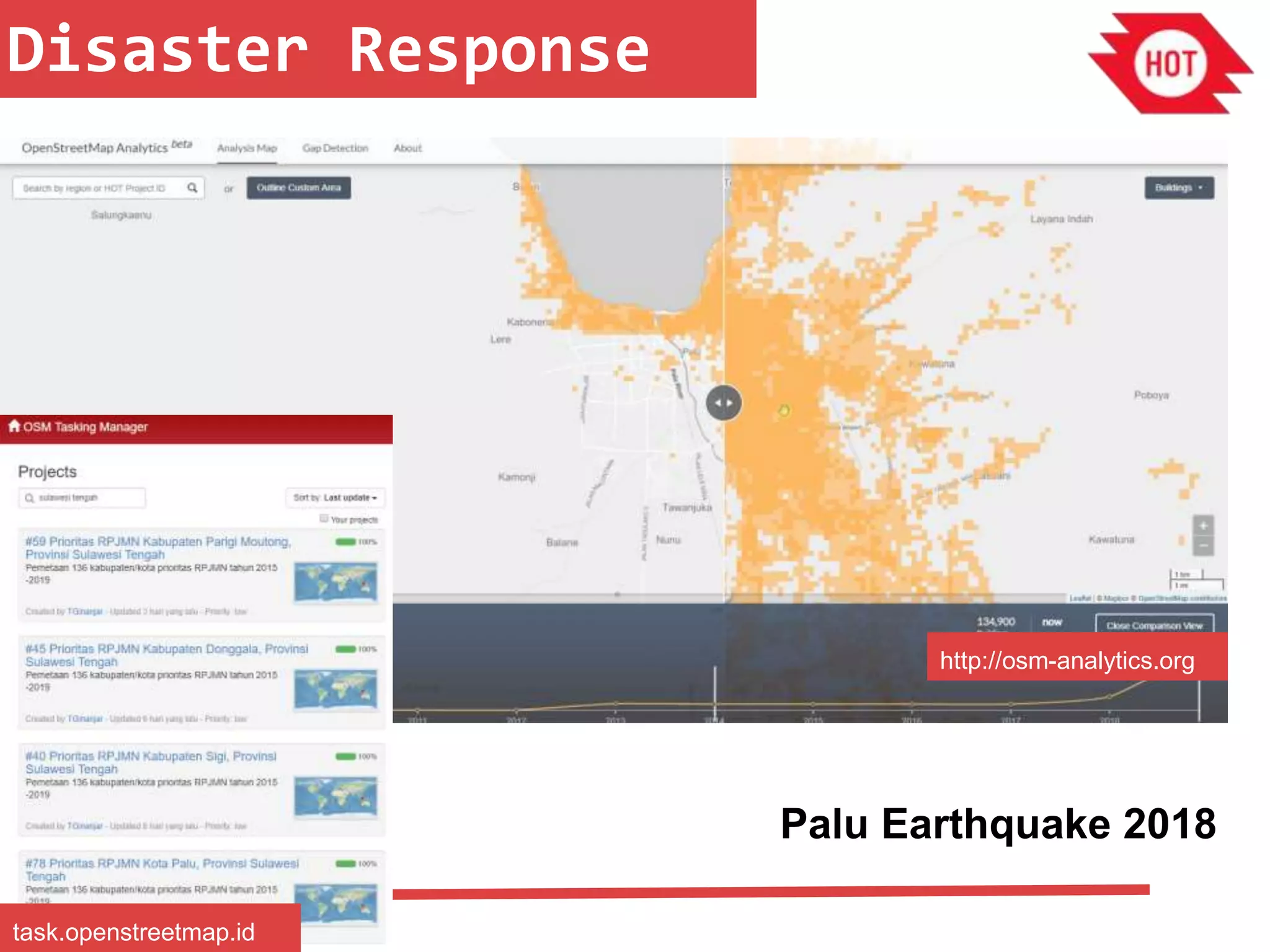
Palu Earthquake 2018
Disaster Response
task.openstreetmap.id
http://osm-analytics.org
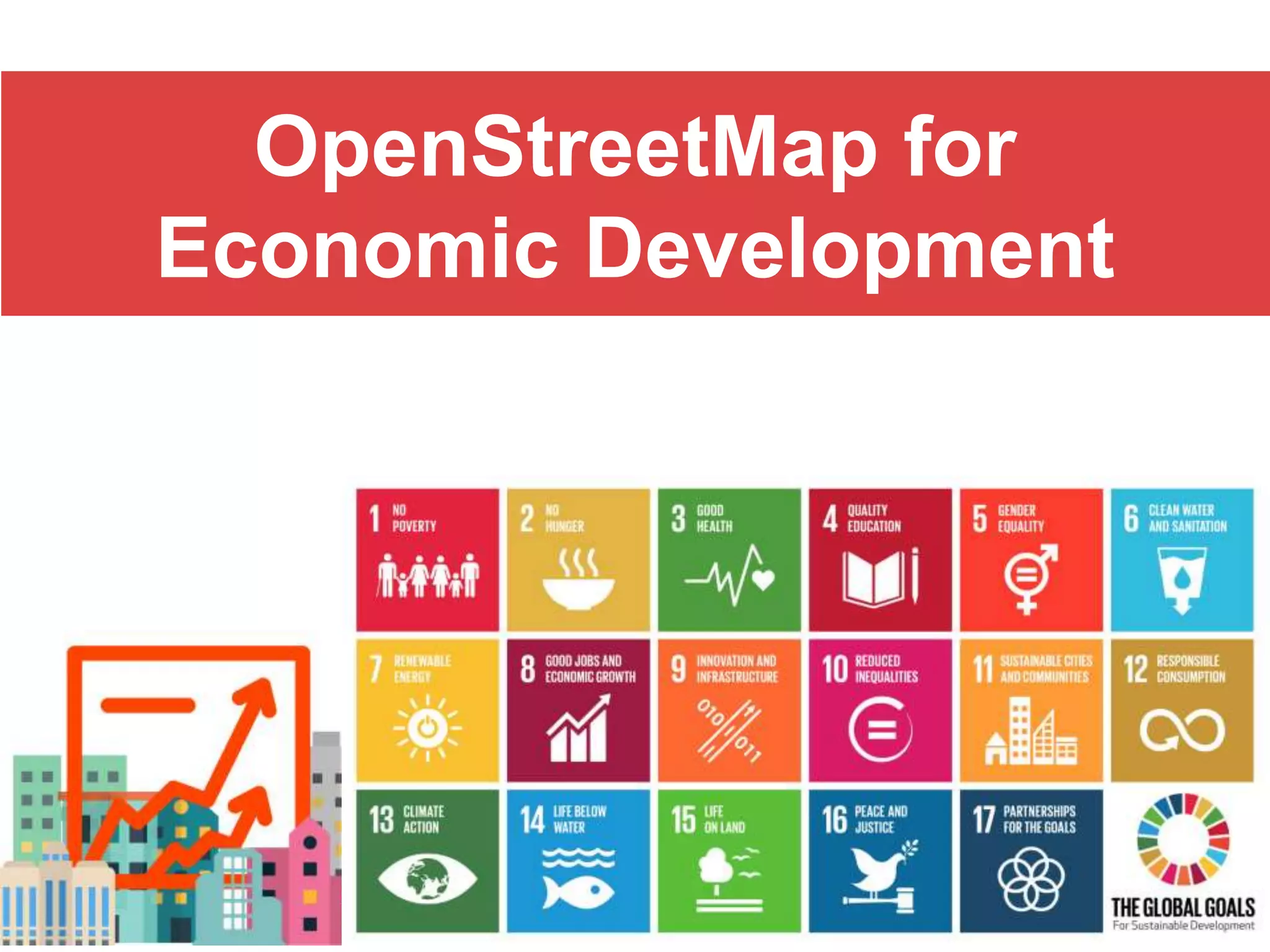
OpenStreetMap for
Economic Development
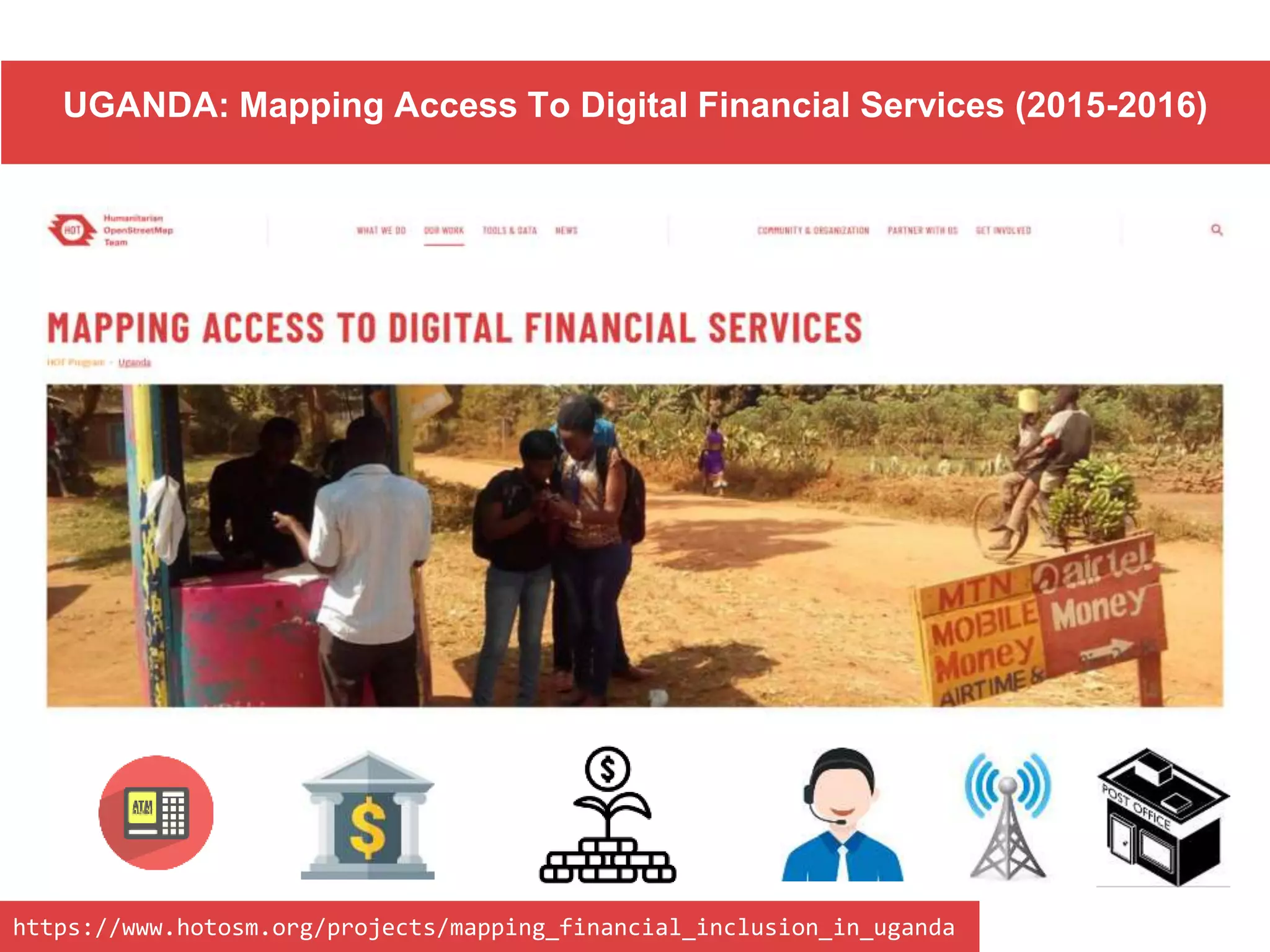
UGANDA: Mapping Access To Digital Financial Services (2015-2016)
https://www.hotosm.org/projects/mapping_financial_inclusion_in_uganda
http://fspmaps.com
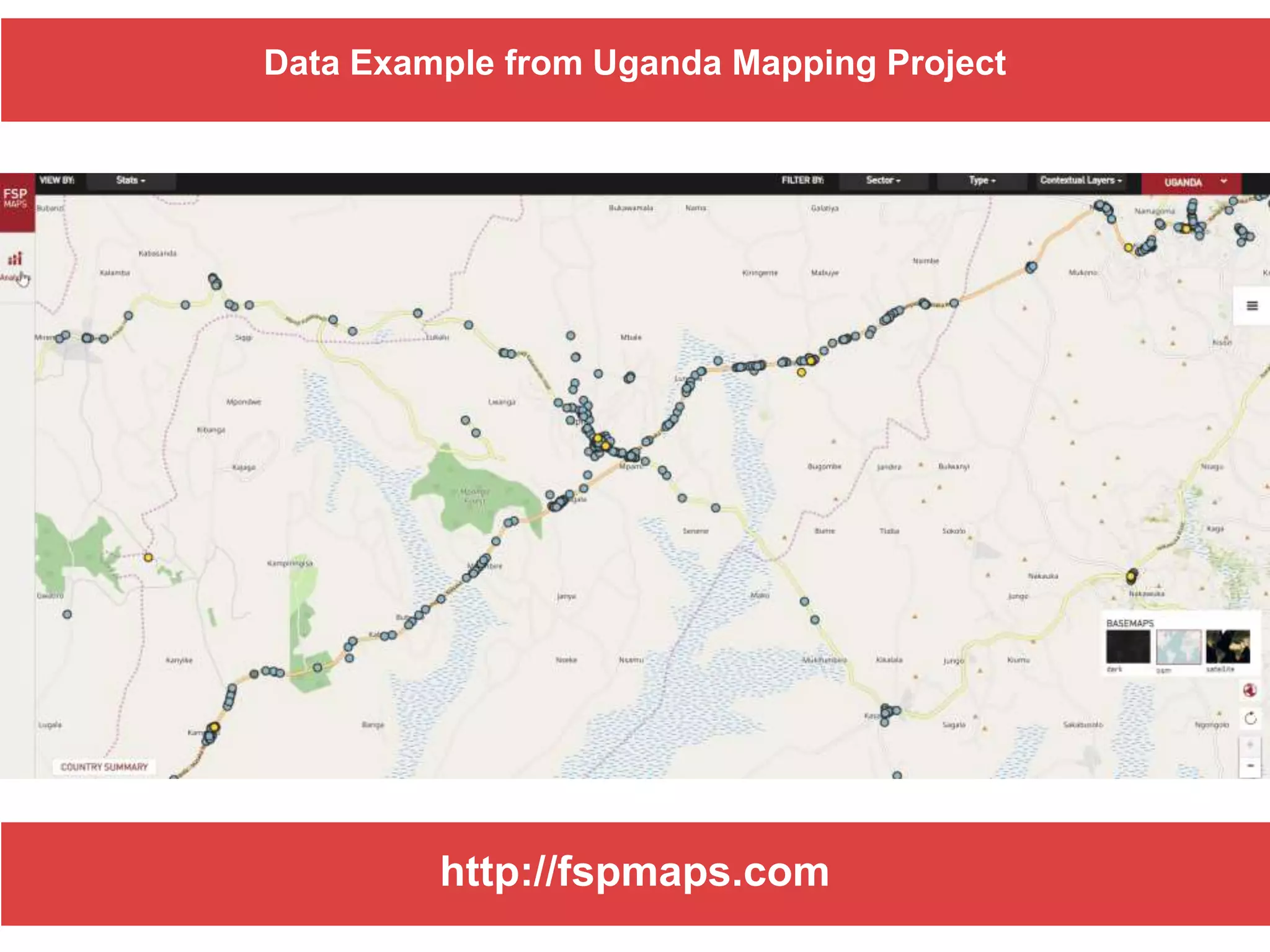
Data Example from Uganda Mapping Project
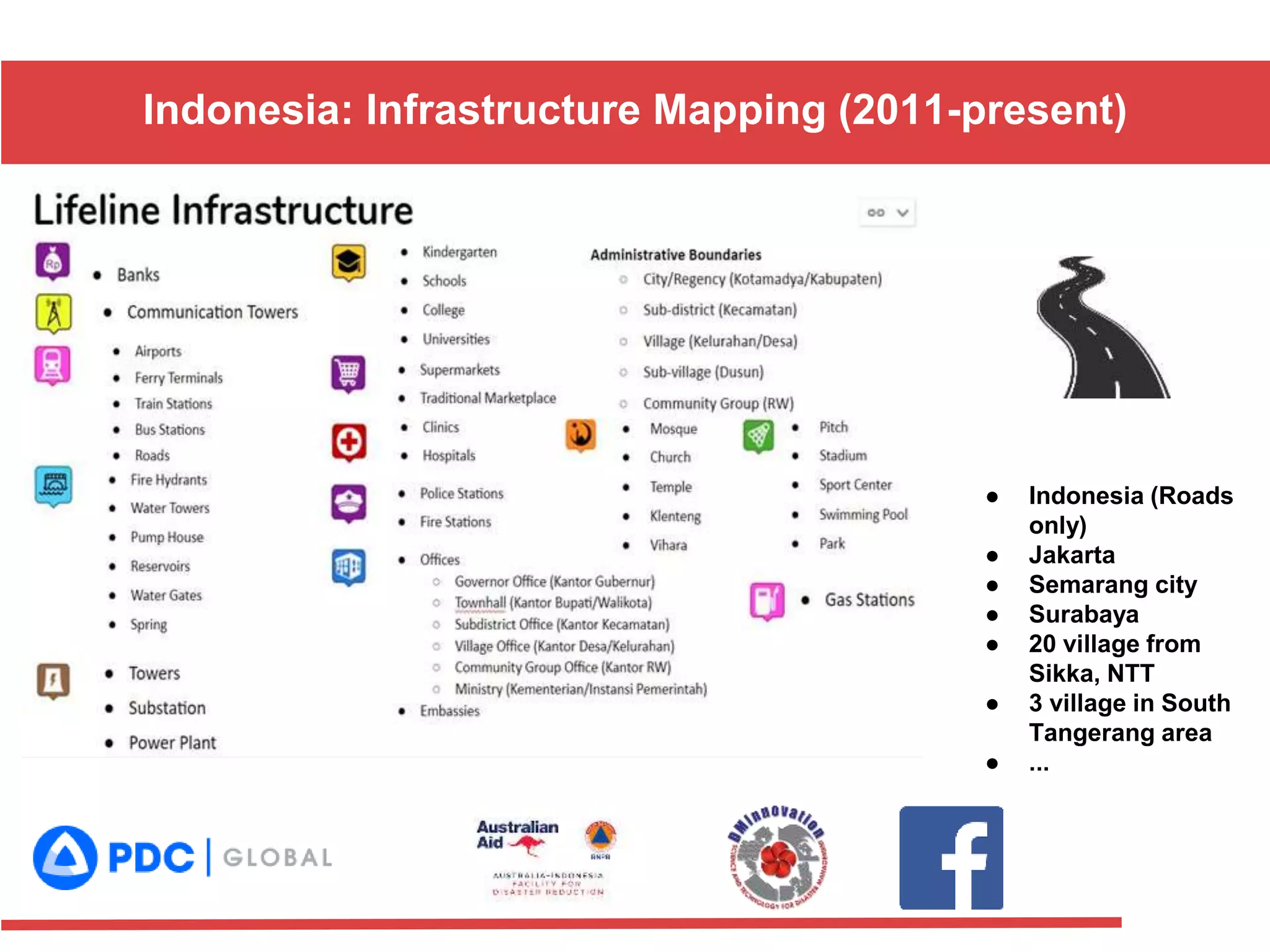
Indonesia: Infrastructure Mapping (2011-present)
● Indonesia (Roads
only)
● Jakarta
● Semarang city
● Surabaya
● 20 village from
Sikka, NTT
● 3 village in South
Tangerang area
● ...
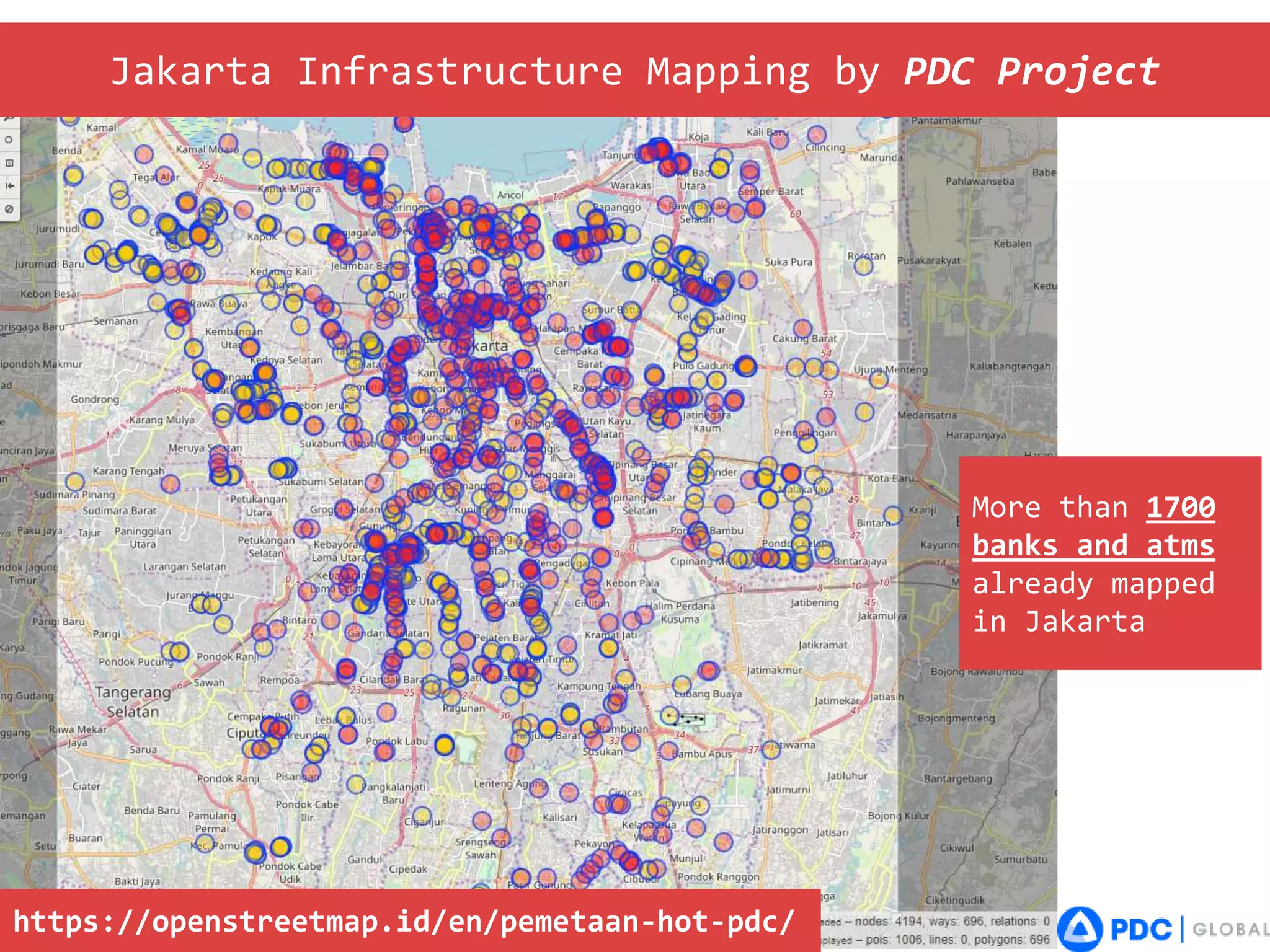
https://openstreetmap.id/en/pemetaan-hot-pdc/
More than 1700
banks and atms
already mapped
in Jakarta
Jakarta Infrastructure Mapping by PDC Project
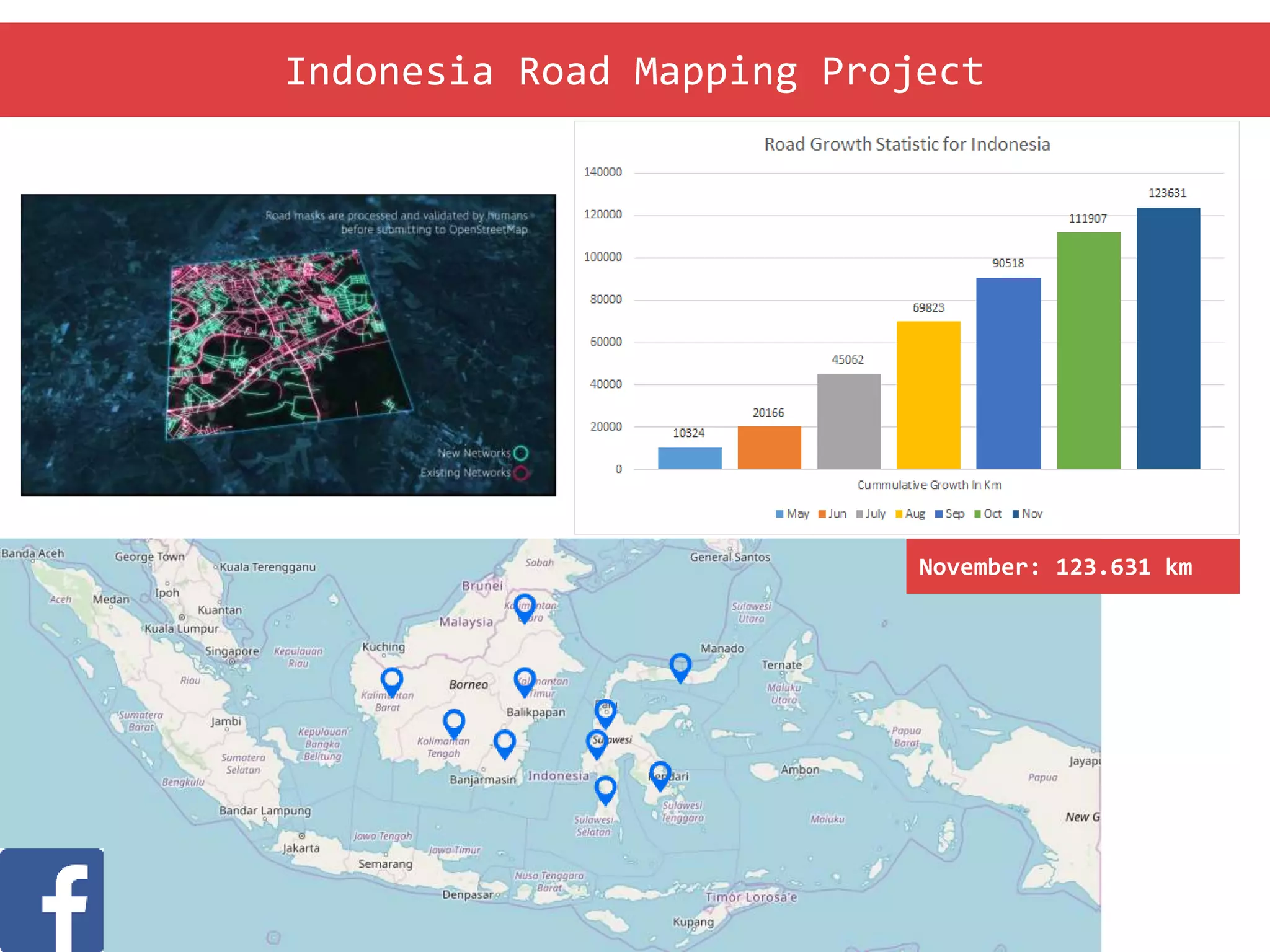
Indonesia Road Mapping Project
November: 123.631 km
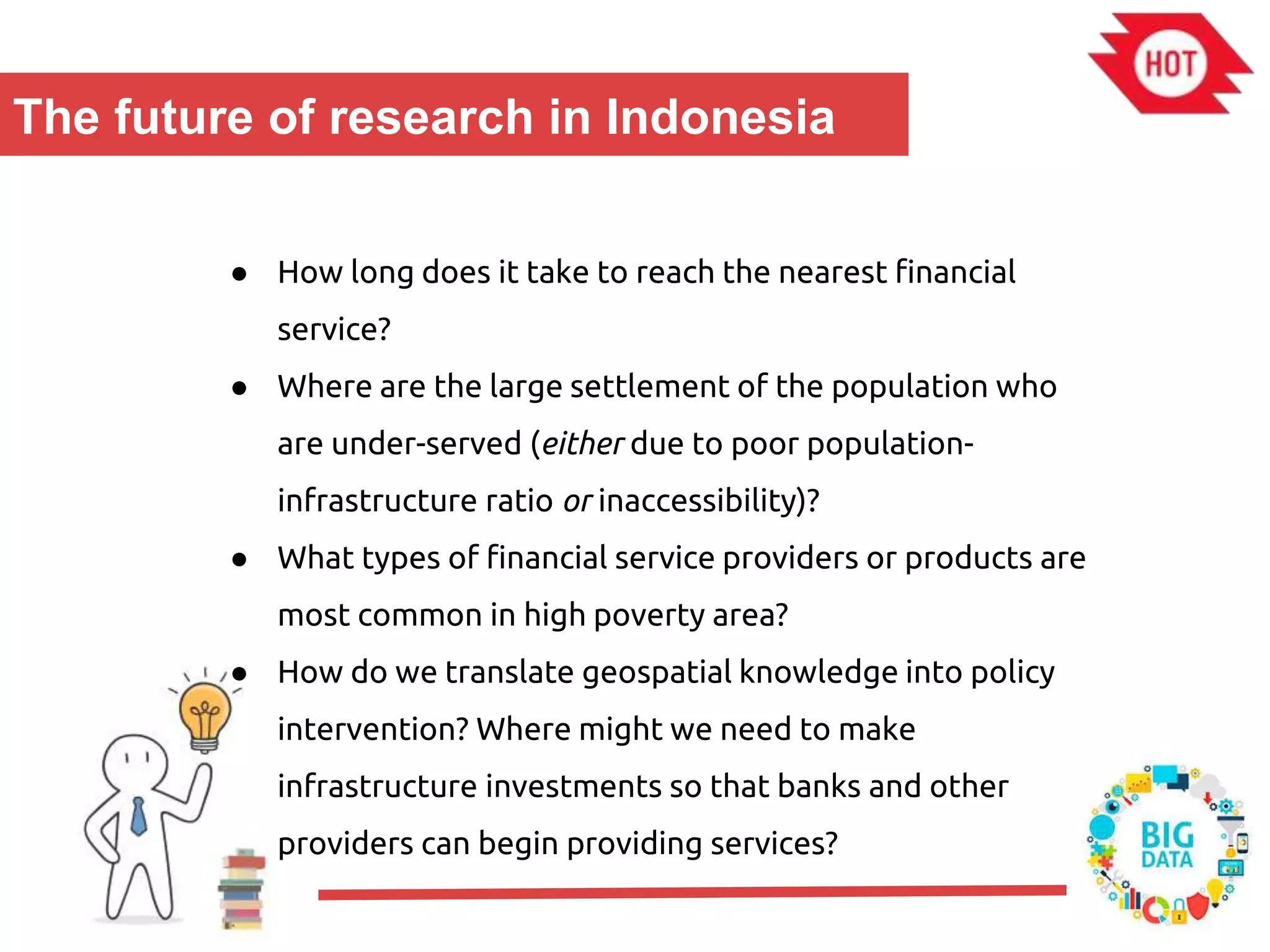
The future of research in Indonesia
● How long does it take to reach the nearest financial
service?
● Where are the large settlement of the population who
are under-served (either due to poor population-
infrastructure ratio or inaccessibility)?
● What types of financial service providers or products are
most common in high poverty area?
● How do we translate geospatial knowledge into policy
intervention? Where might we need to make
infrastructure investments so that banks and other
providers can begin providing services?
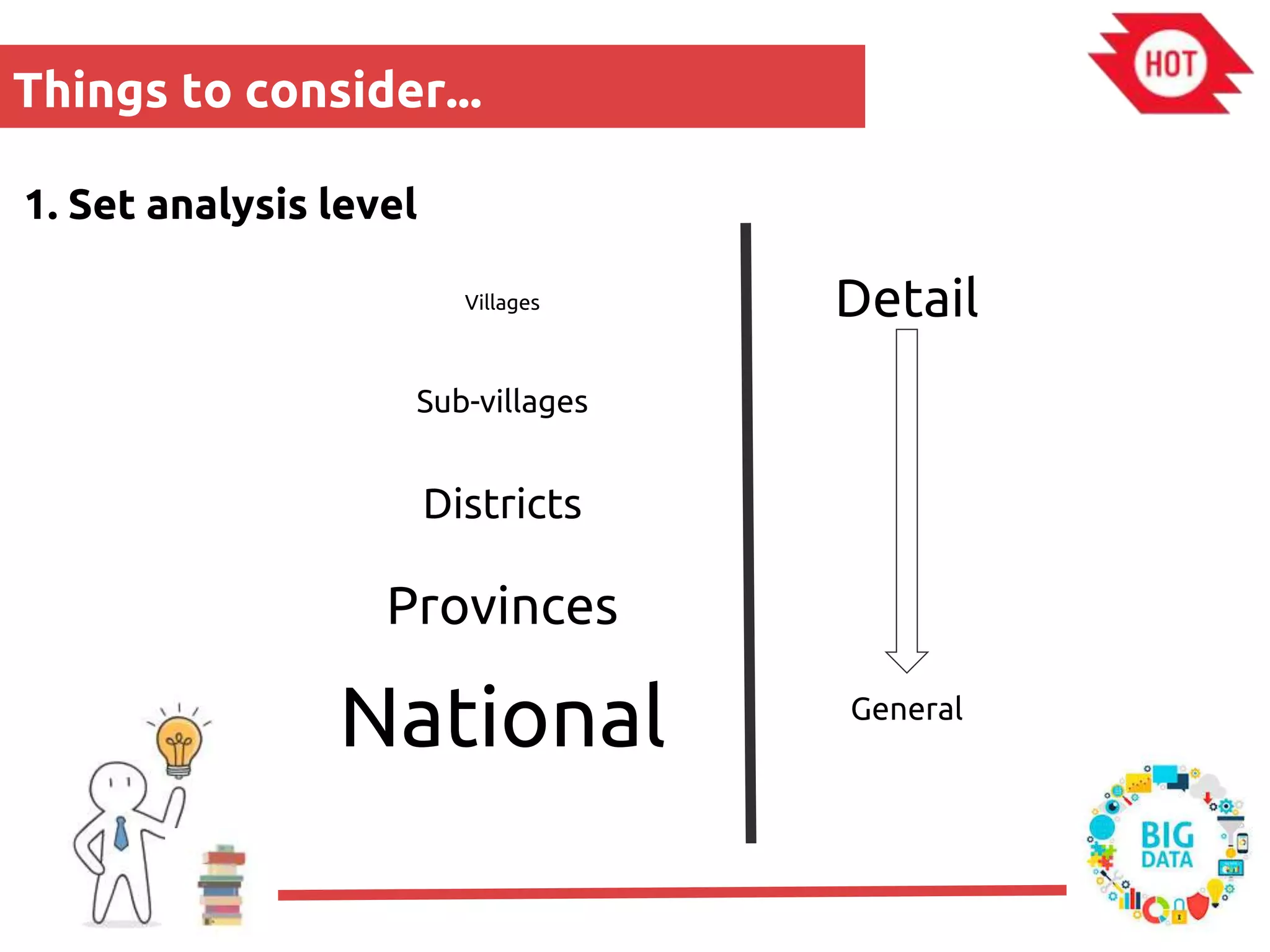
Things to consider...
1. Set analysis level
Villages
Sub-villages
Districts
Provinces
National
Detail
General
National
Pension
Commision
Bank
Insurance
Money
Agent
Post office
Minimarket
Population
Census
Poverty
Roads
Low income
worker
etc..
People
behaviour
Credit
Institution
Things to consider...
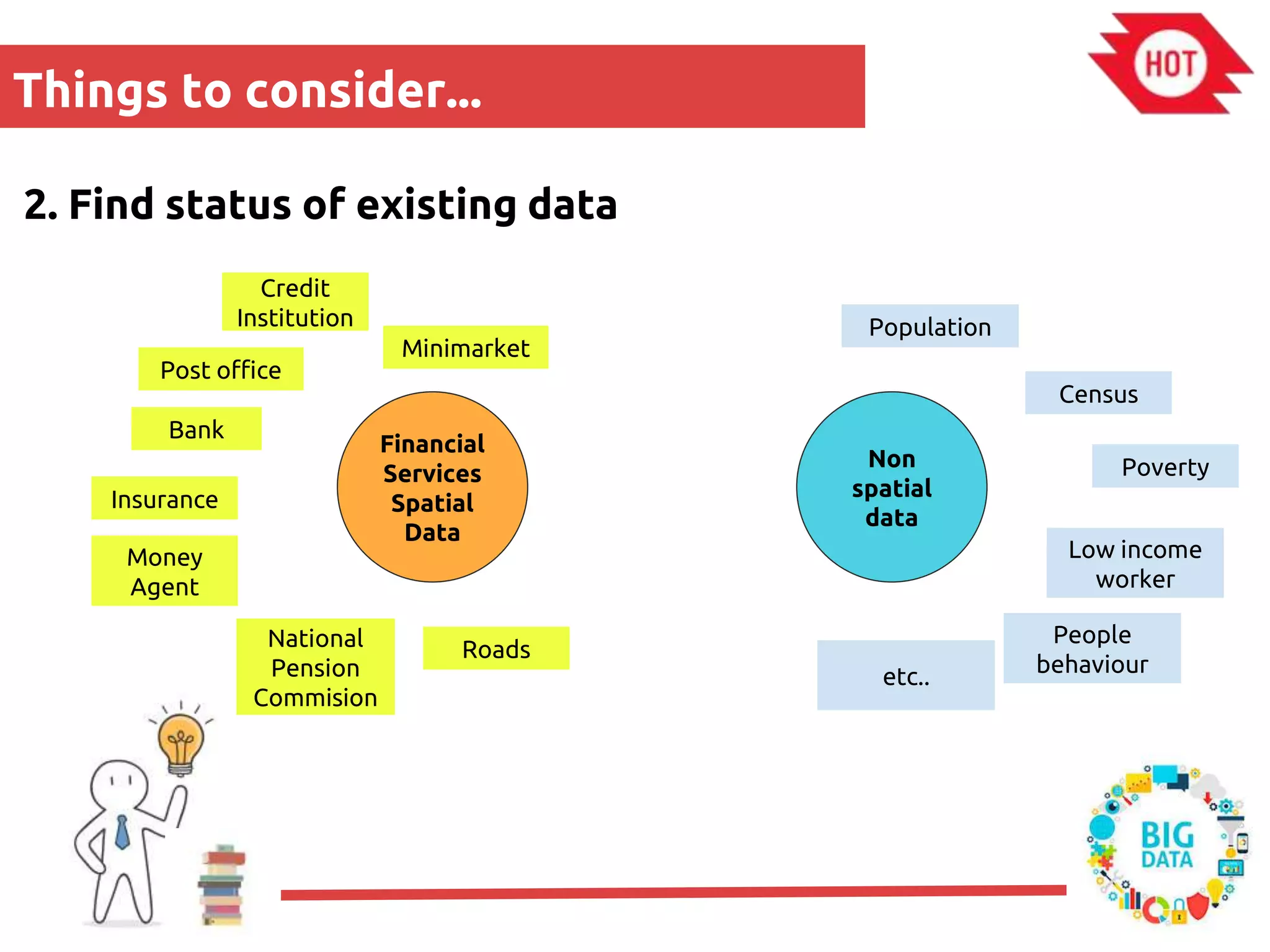
2. Find status of existing data
Financial
Services
Spatial
Data
Non
spatial
data
Last but not least..
If the data not available: how the
data be collected?
Thank you
adityo.dwijananto@hotosm.org | openstreetmap.id | +62812-8654-7434

Open source gis data for finacial inclusion

Editor's Notes

  • #7 OpenStreetMap is built by communities of mappers that contribute and maintain data about roads, buildings, cafés, railway stations, hotels and much more..
  • #11 Teknologi development and social support
  • #15 Tasks.openstreetmap.id http://osm-analytics.org
  • #17 One of HOT project that involved in economic development was conducted in Uganda, where we collected all location data that related to financial service such as atm, bank, micro finacing institution, mobile agent, and network provider who provide mobile money service. This data will help to develop overview about the condition of financial service in Uganda, and compare with the population distribution, we can see where the area that need government need to put more focus on.
  • #18 This is one of the example of the data from Uganda project being used. In this website all the data related to financial service showing and with aditional spatial layer, we can analyze more about the level of their financial inclusion in some area (given by 5km radius for example)
  • #19 For Indonesia, from 2011-now we haven’t had an opportunity to conduct research or project related to financial inclusion and I hope this will inspire all the people here. What we are currently doing is infrastructure mapping who mainly for disaster management, but all the data that we collected in infrastructure mapping, we can use it for financial inclusion research, for example for PDC mapping in jakarta, we collected all the bank in jakarta, we can use it to support our research in financial inclusion by comparing to other demographic data for example population data. Another project that we currently doing is mapping road across indonesia. This project can help us to understand their access to reach financial service place, whether it takes long time to get there or not.
  • #21 In 2017-now we collaborate with facebook to map all the roads in Indonesia with help from their machine learning system. Data from machine learning is validated by our team to ensure all the road data is correct. This road data can be the one biggest factor to determine the level of financial inclusion, by looking at the road network, we can figure out which place that took longer time than the other to reach certain financial service. But keep in mind that the distance or travel time will be different for urban and rural area.
  • #22 There is a gap in Indonesia in term of financial inclusion research. From technical side, there is a platform who can provide free and dynamic spatial data in Indonesia. The data itself already available in some area but when it comes to the area who have empty dataset, that’s our turn to start mapping. From research side, there still no research related to the financial inclusion at the moment. If you are wondering whether spatial data can be used for financial inclusion research? The answer is yes! Imagine you got the financial service data from OSM such as bank, post office, insurance office, or minimarket. Combine with demographic data such as population data, we can get the general overview about the quality of financial inclusion in those area. If you want to combine the data from cloud, make sure that the data itself already have place information, so you can combine and use it to make a analysis using GIS.
  • #23 There is a gap in Indonesia in term of financial inclusion research. From technical side, there is a platform who can provide free and dynamic spatial data in Indonesia. The data itself already available in some area but when it comes to the area who have empty dataset, that’s our turn to start mapping. From research side, there still no research related to the financial inclusion at the moment. If you wondering are the spatial data can be used for financial inclusion research? The answer is yes! Imagine you got the financial service data from OSM such as bank, post office, insurance office, or minimarket. Combine with demographic data such as population data, we can get the general overview about the quality of financial inclusion in those area. If you want to combine the data from cloud, make sure that the data itself already have place information, so you can combine and use it to make a analysis using GIS.
  • #24 There is a gap in Indonesia in term of financial inclusion research. From technical side, there is a platform who can provide free and dynamic spatial data in Indonesia. The data itself already available in some area but when it comes to the area who have empty dataset, that’s our turn to start mapping. From research side, there still no research related to the financial inclusion at the moment. If you wondering are the spatial data can be used for financial inclusion research? The answer is yes! Imagine you got the financial service data from OSM such as bank, post office, insurance office, or minimarket. Combine with demographic data such as population data, we can get the general overview about the quality of financial inclusion in those area. If you want to combine the data from cloud, make sure that the data itself already have place information, so you can combine and use it to make a analysis using GIS.
  • #25 Do you want to conduct field survey to collect spatial data? Or do you want to aggregate the data by districts or provincial level? The answer of course based on the point 1, If your analysis level is village level, you probably need to collect the data from the field or if your analysis level is provincial, you only need aggregate the data into several provinces